Latest News and Comment from Education

Monday, August 10, 2015

Perdido Street School: MaryEllen Elia Offers Counterattack To Hillsborough School Board Allegations Of Financial Mismanagement

Perdido Street School: MaryEllen Elia Offers Counterattack To Hillsborough School Board Allegations Of Financial Mismanagement:

MaryEllen Elia Offers Counterattack To Hillsborough School Board Allegations Of Financial Mismanagement


The Tampa Bay Times reported last week that former Hillsborough School Superintendent MaryEllen Elia, now the new NYSED Commissioner in New York State, was accused by both members of the Hillsborough school board and the man who replaced her as superintendent of leaving a financial mess in the school district.

Elia, who couldn't be reached for comment by the Tampa Bay Times for two straight days before the original story ran, wrote an op-ed piece on Saturday to pushback against the allegations.

As is always the case with Elia, her pushback is a mix of aggression and diverted responsibility:


Former Hillsborough County school Superintendent MaryEllen Elia said Friday she takes full responsibility for the district’s depleted reserve funds, but that doesn’t mean she was the only one who knew the money was dwindling.

In an op-ed column appearing in Saturday’s edition of The Tampa Tribune, Elia shot back against accusations that she kept school members in the dark while more than half of the district’s $360 million reserve fund was spent in just two years. She insisted that her replacement, Superintendent Jeff Eakins, and school board members were “fully aware” of the state of the reserves.

“The same Board members who routinely micromanaged and overstepped their roles, showed a peculiar lack of interest and lack of understanding of the larger financial issues,” wrote Elia, who landed a job as commissioner of education for the state of New York after being fired from the Hillsborough district in in January.

“My most vocal critics routinely failed to show up or cancelled meetings with me. Their lack of accountability is astounding.”

Here's what some of the board members said in the initial Tampa Bay Times article about how Elia hid the true picture of the district's finances:


Some board members said the budgets that were made public were difficult to understand and they did not get clear answers when they asked direct questions of Saunders and Elia.

"I tried to dig for information," said Harris, who ran for her board seat in 2014 and cast the tie-breaking vote to fire Elia. "But unless you are an expert, it's impossible to get a real budget and real figures."

Stuart, who often asked questions about spending, said she was stonewalled, and despite all her questions was as surprised as the others to learn about the spending issue.

"We had no idea. We honestly had no idea," she said. "We never got the full picture."

Here's more:


Stuart and Harris, who was elected to the board in September, both said they had trouble getting budget documents from Elia Perdido Street School: MaryEllen Elia Offers Counterattack To Hillsborough School Board Allegations Of Financial Mismanagement:

‘I refuse.’ — Teacher rejects Florida’s wacky new program to give bonuses to educators with high SAT/ACT scores - The Washington Post

‘I refuse.’ — Teacher rejects Florida’s wacky new program to give bonuses to educators with high SAT/ACT scores - The Washington Post:

‘I refuse.’ — Teacher rejects Florida’s wacky new program to give bonuses to educators with high SAT/ACT scores


Here’s an update on a kooky new plan that I wrote about in Florida to spend $44 million to award big bonuses to teachers who got high SAT or ACT scores before they went to college — even if they took the test decades ago. (Fine way to spend millions of public dollars, don’t you think?)
Jeffrey S. Solocheck wrote in this Tampa Bay Times story that the Florida’s Best and Brightest Teacher Scholarships didn’t actually make it through the  Republican-led Senate during the legislature’s spring session, but, somehow, was resurrected in a June special session and was included in the 2015-16 Florida education spending budget. To qualify for bonuses of up to $10,000 a teacher “must receive a ‘highly effective’ evaluation rating and have scored at or above the 80th percentile on the SAT or ACT they took in high school,” the story says, and, “for new teachers, just the test score would count.”
It’s just too bad for teachers who never took the SAT or ACT, such as  Faye Cook, a fifth-grade teacher at Wilson Elementary in Plant City, who gets top evaluations, but started her college career at a community college, which did not require either college entrance exam. Cook is a fine teacher who used to get a state-funded bonus for earning National Board certification — but she doesn’t anymore because the state decided that program wasn’t worth funding.
Many teachers have attacked the program for a number of reasons, including that single test scores aren’t representative of what an individual knows or can do, and that the state has better things to do with the money.
Now Solocheck has a follow-up story, saying that a lot of teachers in Florida — despite the criticism of the scholarship fund — have sought to find out how they can apply. But he  also wrote about veteran Pasco County teacher Celeste Richter, a highly rated AP government teacher who doesn’t want to be part of the program. She is quoted as saying:
“I refuse. A test I took in 1991 is not valid to say what a quality educator I am…. As a moral principle, I don’t believe this is an effective way to reward teachers for a good job”
Richter, who is starting her 19th year as a teacher, remembers that she did well on her SATS but won’t bother looking them up to apply.
Solocheck’s story says:
Lawmakers put $44 million into the program, modeling it for 4,400 teachers. But they also stipulated that the award would be prorated based upon the final number of teachers who qualify. In 2013-14, the last available data, more than 68,000 Florida teachers were evaluated as “highly effective.”
If 20 percent of them had SAT or ACT scores in the 80th percentile or higher, as required, the bonus would drop by two-thirds. That doesn’t count new teachers, who don’t have to show evaluation results.

A critical look at the annual high school rankings by U.S. News - The Washington Post

A critical look at the annual high school rankings by U.S. News - The Washington Post:

A critical look at the annual high school rankings by U.S. News


U.S. News & World Report is famous for its college rankings — but it does others too, including an annual ranking of high schools. Are the schools declared the best really the best? Kevin Welner, the director of the  National Education Policy Center at the University of Colorado Boulder, examines this issue in this post and the following post. Welner is an attorney and a professor education policy at the UC Boulder. He is also the co-founder of theSchools of Opportunity project, an effort to identify and highlight high schools that use research-based practices to ensure that all students have rich opportunities to succeed.
A version of this appeared on The Conversation, and I asked U.S. News to comment. The magazine took issue with Welner’s argument in a statement, which you can find at the end of this post.
By Kevin Welner
PART ONE
Rankings hold an odd sway over Americans. Assigning a numerical order somehow transforms a subjective opinion into an objective fact. It seems to matter little how the rankings are calculated or the care with which those calculations are undertaken.
I have recently been taking a closer look at the U.S. News and World Reportranking of “best high schools,” the nation’s most influential high school recognition program. In addition to surprising instances of carelessness, I discovered that the publication had deleted evidence concerning the earlier mistakes, and I found a troubling pattern whereby the rankings, which are supposed to recognize quality schooling, actually reward elite enrollment instead.
Given that this write-up is a bit lengthy, I will divide it into two separate parts. The first points out specific technical problems with the rankings. I briefly summarize the key problem that Carol Burris, Sean Feeney, and John Murphy identified and described here on The Answer Sheet, and I then provide additional evidence of how this problem plays out. I also describe how U.S. News apparently responded by removing evidence.
The second parts explores more fundamental problems with the rankings that would remain in place even if the technical problems were fixed. I will look at the results of the U.S. News ratings process, and I question whether it yields rankings that meaningfully identify “best” high schools.
 A Big Problem, Now Concealed
The U.S. News rating process this year altered its past approach for determining whether a school’s students attained proficiency. To illustrate, imagine students A, B, and C entering high school in Grade 9. In the past,U.S. News used what is known as a “cohort” approach to evaluate school quality (e.g., a cohort is the group of entering ninth graders at a school). The question it would ask is whether these three students passed their state-level proficiency exams.
This year, the publication instead took a snapshot of test results in a school in the measured year. So the test scores of A, B, and C may or may not appear, depending on whether they took a proficiency exam that year. Further, the test scores of students outside their cohort might appear, if those non-cohort students took a test that U.S. News decided to include. Moreover, in high-performing districts, one or more of these students might be accelerated and A critical look at the annual high school rankings by U.S. News - The Washington Post:

5 facts about America’s students | Pew Research Center

5 facts about America’s students | Pew Research Center:

5 facts about America’s students


 In a few weeks, America’s roughly 53.5 million K-12 students will head to the classroom. Trading in swimming pools and summer jobs for math problems and history homework, these students will hit the books at one of more than 129,200 schools across the country, including about 5,700 charter schools and 30,900 private schools.

Pew Research Center has found today’s American students as a whole to be more diverse and on track to be better educated – than their parents and grandparents. Here are five key findings about these students:
1As a whole, America’s K-12 students are more racially diverse than ever. The U.S. Department of Education projected that minorities would outnumber whites at public schools by fall 2014, due largely to fast growth in the number of Hispanic and Asian school-age children born in the U.S. Since 2000 there has also been a large increase in the number of states where at least one-in-five public school kindergartners are Latino.
These changes reflect a broader shift toward a majority-minority youth population. Young Americans are far more likely than older Americans to be racial or ethnic minorities. Data from the Census Bureau show that half of Americans younger than 5 were minorities in 2013, compared with just 17% of those ages 85 or older.
Public Schools in the United States Projected to be Majority-Minority in 2014
2Enrollment at Majority-Minority SchoolsYet, even while school-age children as a whole have become more diverse,most white students still attend largely white schools. Just 17.1% of whites attended a school where minorities made up at least half of all students in 2012. Meanwhile, more than three-quarters of Hispanics and blacks (and six-in-ten Asians) attended these majority-minority schools. But many of these minority students are going to school with classmates of their same race or ethnicity. For the 2011-12 school year, the average Latino student attended a school that was 56.8% Latino, and the average black student attended a school that was 48.8% black, according to a recent report from the Civil Rights Project at the University of California, Los Angeles. (The average white student attended a school that was 72.5% white.)
3Hispanic, Black High School Dropout Rate Reach Record LowsStudents today are more likely to stay in school. As of 2013, America’s high school dropout rate had reached a record low: Just 7% of 18- to 24-year-olds that year had dropped out of high school, down from 12% in 2000. The decline can be attributed to falling numbers of black and Hispanic dropouts. The dropout rate among black students fell by nearly half, from 15% in 2000 to 8% in 2013, while the rate for Hispanics tumbled to a record low of 14%, down from 32% in 2000. Yet while a growing share of Hispanic youths are finishing high school and attending college, Hispanics still lag behind whites in obtaining four-year college degrees.
4America’s students have improved in math and science over the past 20 years – but remain behind students in many other industrialized nations. The United States ranks 35th out of 64 countries in math and 27th in science, according to a cross-national test known as PISA. Although the U.S. spent more per pupil than many countries in 2012 ($115,000), its students performed the same in math as those in Slovakia, which spent $53,000 per student.
U.S. Stands in Middle of Pack on Science, Math Scores
Americans are critical of the quality of the nation’s K-12 science, technology, engineering and math (STEM) instruction: Only 29% believe U.S. STEM education is above average or the best in the world, and 29% say it is below average. At the same time, Americans believemath and science skills are less critical to success than communication and reading skills: 90% say communication is one of the most important skills for American children to get ahead, while 79% name math and only 58% name science.
5Millennials on Track to be the Most Educated Generation to DateWhile they may lag their peers in other nations, American students are outperforming one group: their grandparents. In fact, Millennials are on track to be the most educated generation in history compared with older generations when they were the same age. This is partly due to increases in higher education among minorities, as well as to educational gains for women. Millennial women are nearly four times as likely as women in the Silent generation to have at least a bachelor’s degree.

Even As States Continue to Leave, PARCC Sets Last Year's Cut Scores | Mercedes Schneider

Even As States Continue to Leave, PARCC Sets Last Year's Cut Scores | Mercedes Schneider:

Even As States Continue to Leave, PARCC Sets Last Year's Cut Scores


On August 07, 2015, NPR released an article concerning setting the cut scores for the PARCC tests that 5 million students took in the spring.
Originally entitled, "Who Is 'Good Enough' in a Common Core World?", the NPR article title was changed to "New Tests Push Schools to Define 'Good Enough."
Perhaps it was a bit too close to the true, original intention of Common Core to turn all of American public education into a "Common Core World" for NPR to actually allow as much in the title of one of its pieces.
In that piece, NPR writer Cory Turner makes this statement:
...Until last year, it was all but impossible to compare students across state lines. Not anymore.
This is not true. States have been required to participate in the National Assessment of Educational Progress (NAEP) as part of the No Child Left Behind Act of 2001 (NCLB).
What is interesting is that the Fordham Institute's grading of state standards (and finding in favor of Common Core even though it did not give Common Core a higher rating than all state standards) demonstrates no connection between their ratings of state standards and NAEP scores.
So now, we have PARCC, and according to NPR, we have a number of individuals meeting to "nail down cut scores for those 5 million tests."
If anyone tells you that PARCC or any other standardized test is by definition objective, don't buy it.
Instead, believe what Center for Public Education director Patte Barth says in that NPR piece:
"Establishing cut scores is part science. It's part art. But it's also part political."
I wonder which part dominates.
Tough call, eh?
So, it seems, this group in Denver is going to make sure that states cannot produce an "illusion of improvement." What is missing, however, is any established connection between PARCC, it's Denver-ballroom-basement-meeting-set cut scores, and previous tests used by the states.
My Louisiana teaching colleague, Herb Bassett, observed as much regarding the NPR link:
Explains how a committee is in process of determining which students passed and which failed the PARCC this year. The scores required for passing (the cut scores) have not yet been set even though the tests have been taken.
This radio piece sells the point that for the first time, proficiency tests will be comparable across some states. However, there is no way to compare them to the tests (LEAP and iLEAP) from years past. Thus, there is no way to determine if 
Even As States Continue to Leave, PARCC Sets Last Year's Cut Scores | Mercedes Schneider:

25 Leadership Quotes Even The "Dumbest" Leaders Can Learn From | Aleksandr Noudelman | LinkedIn

25 Leadership Quotes Even The "Dumbest" Leaders Can Learn From | Aleksandr Noudelman | LinkedIn:

25 Leadership Quotes Even The "Dumbest" Leaders Can Learn From


25 Leadership Quotes Even The "Dumbest" Leaders Can Learn From


Not everyone is meant for a leadership position. Unfortunately, with this uncertain economy we may be put in one, whether we like it or not.  And when that happens, we have to act and learn fast. And if and when we don't, we could find ourselves unemployed in a heartbeat. Here are 25 leadership quotes even the "dumbest" leader can learn from.
1. "The key to successful leadership today is influence, not authority." --Ken Blanchard
2. "No person can be a great leader unless he takes genuine joy in the successes of those under him." --W. H. Auden
3. "Good leaders make people feel that they're at the very heart of things, not at the periphery. Everyone feels that he or she makes a difference to the success of the organization. When that happens people feel centered and that gives their work meaning." --Warren Bennis
4. "No man will make a great leader who wants to do it all himself, or to get all the credit for doing it." -- Andrew Carnegie
5. "A leader takes people where they want to go. A great leader takes people where they don't necessarily want to go, but ought to be." --Rosalynn Carter
6. "Perhaps the most central characteristic of authentic leadership is the relinquishing of the impulse to dominate others." --David Cooper
7. "The first responsibility of a leader is to define reality." -- Max DePree
8. "Leadership is the art of getting someone else to do something you want done because he wants to do it." --Dwight D. Eisenhower
9. "A boss creates fear, a leader confidence. A boss fixes blame, a leader corrects mistakes. A boss knows all, a leader asks questions. A boss makes work drudgery, a leader makes it interesting. A boss is interested in himself or herself, a leader is interested in the group." --Russell H. Ewing
10. "Leadership is practiced not so much in words as in attitude and in actions. " -- Harold Geneen
11. "One of the true tests of leadership is the ability to recognize a problem before it becomes an emergency." --Arnold Glasow
12. "All of the great leaders have had one characteristic in common: it was the willingness to confront unequivocally the major anxiety of their people in their time. This, and not much else, is the essence of leadership. " -- John Kenneth Galbraith
13. "The very essence of leadership is that you have to have vision. You can't blow an uncertain trumpet." --Theodore Hesburgh
14. "The final test of a leader is that he leaves behind him in other men the conviction and the will to carry on... The genius of a good leader is to leave behind him a situation which common sense, without the grace of genius, can deal with successfully." --Walter Lippmann
15. "Leadership is getting someone to do what they don't want to do, to achieve what they want to achieve." --Tom Landry
16. "Leaders must be close enough to relate to others, but far enough ahead to motivate them." --John Maxwell
17. "The real leader has no need to lead-- he is content to point the way." -- Henry Miller
18. "The leader must know, most know that he knows, and must be able to make it abundantly clear to those about him that he knows." --Clarence B. Randall
19. "The person who know "how" will always have job. The person who knows "why" will always be his boss." --Diane Ravitch
20. "A true leader is hated by most, and respected by all. A follower is liked by all, and respected by none." --Scott Smigler
21."Outstanding leaders go out of their way to boost the self-esteem of their personnel. If people believe in themselves, it's amazing what they can accomplish." --Sam Walton 
22. "You know what makes leadership? It is the ability to get men to do what they don't want to do and like it." --Harry S. Truman
23. "Nothing so conclusively proves a man's ability to lead others as what he does from day to day to lead himself." --Thomas J. Watson
24.  "Efficiency is doing the thing right. Effectiveness is doing the right thing." --Peter Drucker
25. "If your actions inspire others to dream more, learn more, do more and become more, you are a leader." – John Quincy Adams
I put "dumbest" in quotations because no one is ever dumb. A leader may just be unnatural. But as they gain the experience, skills and confidence, I am sure they will flourish in the job. 
Take me as an example. I first wanted to work at Tim Hortons as a supervisor until retirement. Then I went into Administrative work and thought that's the ideal work for me. It wasn't until I went into teaching that I found my true passion and realized that I was under selling myself. 25 Leadership Quotes Even The "Dumbest" Leaders Can Learn From | Aleksandr Noudelman | LinkedIn:

That’s Rich. Across Country A Scramble Is On To Find Teachers: (NYT 8/10/15) | DCGEducator: Doing The Right Thing

That’s Rich. Across Country A Scramble Is On To Find Teachers: (NYT 8/10/15) | DCGEducator: Doing The Right Thing:

That’s Rich. Across Country A Scramble Is On To Find Teachers: (NYT 8/10/15)


images


This is no surprise. For years we have been predicting the demise of a great profession because of so–called “reform”. Ms. Rich writes a great deal in this article about this shortage but neglects to point out how changes in education over the past 15 years created this problem.
I’ve drawn on quotes from my book (Doing The Right Thing: A Teacher Speaks (published in December 2013) or posts that are at least a year old to show the point.
  • Barbara Tuchman, in her 1984 book, The March of Folly, from Troy to Vietnam, defines folly as the “pursuit of public policy contrary to self-interest, where people pursue the same failed policies and expect different results.” What better example of folly is there than current public education policy?
  • Reformers live by the standard of industrial America developed a full century ago by Frederick W. Taylor. Captains of industry (robber barons) supported scientific management, as it was called, in order to make their employees more productive. Today’s policy makers want to turn teachers into industrial employees, churning students out like Ford workers churned out Model T’s.
  • Our nation’s media, conservative and liberal alike spread misinformation. They vilify the teaching profession, regardless of how successful many teachers are with children of all ages. Our politicians implement laws and plans based on that misinformation. Foundations give huge sums of money based on that misinformation. Corporations profit from that misinformation.
  • Instead of “getting rid of bad teachers,” more good and excellent teachers are leaving. Teaching colleagues, who three years ago said they loved their job and would stay until someone carried them out, are now saying they That’s Rich. Across Country A Scramble Is On To Find Teachers: (NYT 8/10/15) | DCGEducator: Doing The Right Thing:

Sunday, August 9, 2015

Alright (My Identity in Passing) | The Jose Vilson

Alright (My Identity in Passing) | The Jose Vilson:

Alright (My Identity in Passing)


drdayparade
The last time I went to the Dominican Day Parade, my youthful naivete gave way for a conservatism I didn’t quite understand in myself. The schools of ostensibly hypermasculine Dominican men highlighting their hair and tightening their shirts threw me off. The crowds of voluptuous Dominican women wearing sexier varieties of the Dominican flag strapped across their tops and bottoms were distracting at first, but ultimately uninviting to a younger me who, from a hood lens, saw that sort of energy as plastic and unnecessary in his life. I also hated the obsession with the flags sans any context for the pride by which so many of us held this red, blue, and white rectangle so dear.
But that was me back then. Now, I’m less in my feelings about this.
One of the critical elements of our identities is the cultural signifiers we attach to what we deem to be that culture. In my case, it’s my family, and the three parts I don’t talk about enough: my mother’s side, my father’s side, and my stepfather’s side. My mother’s side had a different version of what it meant to be Dominican than my stepfather’s side, and my father’s side was what I knew about being Haitian. Anything I understood about those cultures were seen through generational lenses of the interactions I had with all of them.
That’s why, with all the opportunities I’ve had this summer to help others explore their identities and develop themselves as teachers, I too had all these synapses that didn’t connect in how I viewed the Alright (My Identity in Passing) | The Jose Vilson:

#SaidNoSchoolEver Teachers Say They Have Too Much Money for Supplies in This Sarcastic Hefty Campaign | Adweek


Teachers Say They Have Too Much Money for Supplies in This Sarcastic Hefty Campaign | Adweek:


"Teachers Say They Have Too Much Money for Supplies in This Sarcastic Hefty Campaign"


h bag company Hefty and Havas Worldwide Chicago tackle a big issue—one that's more powerful than smelly garbage or nondurable bags—for the brand's new #SaidNoSchoolEver campaign.
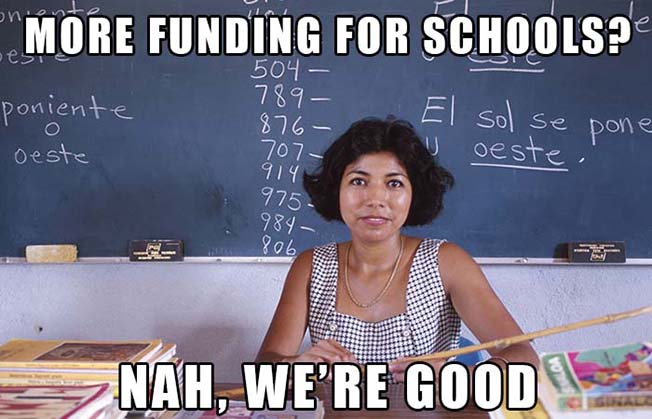
The new work, which includes two 30-second online spots and a handful of playful memes, aims to raise awareness of the serious lack of funding many public schools and teachers face—but does so in a tongue-in-cheek manner.
The writing in the 30-second spots is both sarcastic and sharp, with teachers delivering lines like "We do not need any more art supplies" and "This map—from 1913. Almost all of the states are there." 
"At no point was this supposed to be polarizing for the brand," Havas group creative director Ecole Weinstein told Adweek. "We wanted to touch the surface of the issue and still do it with a bit of a smile and make [the campaign] culturally relevant and sharable."
Havas also wanted to bring Hefty's involvement with the Box Tops for Education program to light. Hefty, the only trash-bag brand currently supporting the initiative, has donated over $3.5 million to Box Tops over the years. The subject matter also hit close to home for some members of Havas' creative team.
"Myself, as well as a couple members of the creative team, have deep ties to the education system," Weinstein said.
Weinstein, whose mother was an inner-city school teacher in Florida for 29 years, said she grew up knowing all about the challenges teachers and public schools face. She added that the dry, sarcastic humor would share well on social channels, especially among the teacher crowd searching for a little bit of humor. 


CREDITS Teachers Say They Have Too Much Money for Supplies in This Sarcastic Hefty Campaign | Adweek
Client: Hefty
Agency: Havas Worldwide, Chicago
Chief Creative Officer: Jason Peterson
Group Creative Director: Ecole Weinstein
Creative Director: Shelby Georgis
Copywriters: Matt Bush, Ellie Brzezenski
Co-Head of Production: David Evans
Executive Producer: Brigette Whisnant
Producer: Jordan Sider
Business Affairs Manager: Bonnie Hamilton
Group Account Director: Lisa Evia
Account Director: Kevin Passolt
Senior Project Manager: Matt Hartwig
Production Company: Caviar Content
Director: Jeff Bitsack
Executive Producer: Darren Foldes
Producer: Tova Dann
Director of Photography: Giorgio Scali
Editing Company: Studio 6 CHI
Senior Editors: Mike Abrams, Andrew Maggio
Senior Audio Engineers: Todd Bernstein, Studio 6 CHI; Mark Ruff, CRC
Executive Producer: Lauren Shawe
Post Producers: Jordan Sider, Kara Weinert
Colorist: Luke Morrison, The Mill
Assistant Editor: Kelsey Moher
Graphic Artist: Jesse Willis, Studio 6 CHI

New Orleans Recovery District Called a Dismal Failure by the City’s Leading African American Newspaper

New Orleans Recovery District Called a Dismal Failure by the City’s Leading African American Newspaper | Educate All Students: Larry Miller's Blog:

New Orleans Recovery District Called a Dismal Failure by the City’s Leading African American Newspaper 


On August 4th and 5th I attended an education conference in the great city of New Orleans, titled the New Orleans Education Conference. In contrast to the June conference, sponsored by Tulane University, it presented the truth about the New Orleans recovery school district. The amount of information, both from presented data and through parent and academic narratives, was overwhelming.


To start one should go to the website of The New Orleans Tribune, the uncompromising Black newspaper, published in New Orleans. Dr. Louis Charles Roundanez, founded The New Orleans Tribune, circa 1864. The modern Tribune is part of a publishing legacy that began 148 years ago, when Roudanez published the first Black daily newspaper in the United States. Then, as now, The Tribune was dedicated to social justice and civil rights for all Louisiana citizens. Volume 31, Number 5, is dedicated to the recovery school district and presents a major summary of 10 years of “Myth and Lies of The New Orleans Transformation.” (Go to: http://tinyurl.com/pvtgrop)


Following is their May/June editorial from that issue along with the Louisiana report card letter grades for the New Orleans schools:

THE NEW ORLEANS TRIBUNE EDITORIAL ON THE RECOVERY SCHOOL DISTRICT AFTER 10 YEARS

“FOR THE RECORD: YOU AIN’T DONE A THING | A TRIBUNE EDITORIAL”


It’s been a tough several months on the local public education front: Let’s count the ways:

First, Act 543, which captures local sales and property tax dollars for the use of the Recovery School District and charter school boards that do not answer to the voters and tax payers of New Orleans, passed easily late last year with the help of our local elected officials and leaders.


Then, advocates, community members, alumni and friends of John McDonogh High School were dealt a death blow when the historic school site was recently given to Bricolage Academy, a charter school that has close ties with a number of the key players and organizations in the reform movement and that has received significant financial backing from the Walton Foundation and New Schools for New Orleans.


With our offices across the street from John McDonogh, we have watched in disgust as workers have been sent in recent weeks to clean and clear the school. We assume that it is in New Orleans Recovery District Called a Dismal Failure by the City’s Leading African American Newspaper | Educate All Students: Larry Miller's Blog:


Jersey Jazzman: When You Punch Teachers Unions, You're Punching Teachers

Jersey Jazzman: When You Punch Teachers Unions, You're Punching Teachers:

When You Punch Teachers Unions, You're Punching Teachers


Fortunately, I was outside of the country when Chris Christie sank to his latest new low:

The New Jersey governor was on CNN on Sunday, where host Jake Tapper asked, “At the national level, who deserves a punch in the face?” (Why would Christie get that question? Because he has made it known he likes to deal with bullies by punching them in the face, an approach that would work well in the Oval Office, no?) According to this story by my Post colleague Lyndsey Layton, Christie did not hesitate with a response: “Oh the national teachers union, who has already endorsed Hillary Clinton 16, 17 months before the election.” 
If you're at all shocked or surprised by this, you haven't been paying attention to Chris Christie. The man insults teachers as easily as you and I breath. 

A few commenters have suggested that Tapper baited Christie with the question. Keep in mind, however, that Christie's original use of "punch in the face" was back in 2012, when he was referring, once again, to the state's largest teachers union, the NJEA.

It's clear at this point that Christie really doesn't give a damn about New Jersey anymore (assuming he ever did). Two of the most critical problems this state faces -- pension liabilities and school underfunding -- can only be solved through deliberations with the NJEA. It's fine for Christie to get tough and stake out his positions on the issues. But when
- See more at: http://jerseyjazzman.blogspot.com/2015/08/when-you-punch-teachers-unions-youre.html#sthash.ih6qdpGX.dpuf