Latest News and Comment from Education

Friday, August 7, 2015

Kasich's charter school flap | Columbus Ledger-Enquirer

John A. Tures: Kasich's charter school flap | Columbus Ledger-Enquirer:

Kasich's charter school flap


Ohio Governor John Kasich got some good news, as he made the cut for the Fox News debate. He's also been rising in the polls. But a charter school scandal in Ohio could derail the Kasich 2016 campaign.
During the 2014 election, three of Kasich's top donors were charter school operator David Brennan and his wife Ann, and Brennan's company CEO, all who donated thousands of dollars to the Ohio governor's reelection (as noted by the Columbus Dispatch), enabling him to swamp his Democratic rival in fundraising, and later, votes.
Kasich's opponent, Ed FitzGerald, claimed that the Republican had cut money from public schools to give to charter schools which were allegedly performing poorly. His ads even claimed that White Hat Management, another charter school operation, donated thousands of dollars to Kasich in 2010, and got to write the charter school law. But Kasich easily bested his opponent in a good year for Republicans across the country, and Ohio.
After his reelection, Kasich vowed to clean up charter schools, the targets of investigations for a series of corruption scandals and poor academic performance, even as he announced his support for such education institutions.
In addition, Kasich claimed he would regulate charter schools, independently run schools with taxpayer money, providing a site where viewers could compare the performance of charter schools and public schools.
Despite the concerns over the scandals and academic struggles, Kasich pushed to reward the charter schools with the prospect increased funding, to upgrade their facilities, with increases in the number of charter schools and their budgets, heading well above a billion dollars, in 2015.
A Washington Post report reveals that Kasich slashed public school funding by half a billion dollars, boosting state spending on charter schools, despite the quality concerns. In fact, Ohio now spends more per charter school pupil than it does for public school student, while costs have been passed on to local government just to keep their schools open.
Fears about the quality of charter schools in Ohio even began to unnerve even charter school advocates. Their concerns were evidently warranted.
According to the Columbus (Ohio) Dispatch, "David Hansen, the agency's director of school choice, resigned last month after admitting he left off poor grades for online and dropout-recovery schools on evaluations of their charter-school sponsors. His wife, Beth Hansen, is Gov. John Kasich's former chief of staff and current campaign manager for his 2016 presidential run."
Members of the State Board of Education have demanded an independent investigation ofJohn A. Tures: Kasich's charter school flap | Columbus Ledger-Enquirer:

North Carolina’s step-by-step war on public education - The Washington Post

North Carolina’s step-by-step war on public education - The Washington Post:

North Carolina’s step-by-step war on public education


Here is a piece by a veteran educator on the assault in North Carolina. It was written by James Hogan, a former teacher who is now a writer and a funderaiser at Davidson College aas well as a board member of Our Schools First, a local public education advocacy non-profit. He taught high school English for five years, including AP Language and Composition, Creative Writing, and American Lit. As a school teacher, he was also a member of NCAE (North Carolina’s version of an education advocacy group), and sometimes worked with our school system’s administration as an adviser. He is a North Carolina Teaching Fellows alumnus (a now-defunct state scholarship program that granted scholarships to college students in return for their service as teachers in-state) and 2003 graduate of Western Carolina University. A version of this appeared on his blog.

By James Hogan
I am no fan of hyperbole, but I mean it when I say this: North Carolina is waging war against public education.
The pathway that brought us here has been paved with underfunded budgets, tactical strikes against public school teachers, fundamental changes in charter school operations, the diversion of public funds to private or religious schools, and the erosion of our hallowed University of North Carolina system. Here’s what’s happened.

A Deficit of Electable Proportions

When North Carolina Republicans took control of the state government in 2012, they quickly set into motion a sweeping agenda to enact conservative social reforms and vastly change how the state spends its money. It was the first time in more than a century that Republicans enjoyed such political dominance in our state.
What brought them all to town? A good reason: in the 2011-12 budget year, North Carolina projected a multi-billion dollar deficit, enough to rank the state among the worst budget offenders in the country and bring a new slate of elected legislators to Raleigh. So Republicans, with a clear mandate to clean up the fiscal mess in November 2012, set to work righting the ship.
On what does a state like ours spend money? Public education, including higher education, consumes about a third of North Carolina’s budget. Health and Human Services, including the state’s Medicaid and unemployment programs, composes an even larger slice, about 37.5 percent.
Other state programs make up little bits and pieces: nearly 8 percent on transportation and highways, 5.5 percent on public safety, 9 percent on natural and economic resources.
In other words, if you want to make big cuts, public education is one of two really big targets.
After that landslide election in 2012, legislators began sharpening their knives.
A Fury of Budget Cuts
Among their first targets: reductions in unemployment benefits, cuts to public schools, including laying off thousands of teachers, and a massive, nearly half-billion dollar slash from the University of North Carolina system.
Two years later, in the last budget cycle, 2014-15, the legislature providedroughly $500 million less for education than schools needed.
Later in the 2013 session, though, the most radical changes in state financing fell into place. Republicans reconstructed the state’s tax code, relieving the burden on corporations and wealthy residents. They continued to take aim at other parts of the education budget, cutting More at Four program dollars and decreasing accessibility for poor families. The state lost thousands more North Carolina’s step-by-step war on public education - The Washington Post:

Why New Yorkers shouldn’t hold their breath for real education change - The Washington Post

Why New Yorkers shouldn’t hold their breath for real education change - The Washington Post:

Why New Yorkers shouldn’t hold their breath for real education change


Carol Burris is a veteran educator who was just named executive director of the nonprofit Network for Public Education’s foundation. She recently took early retirement after 15 years as principal of South Side High School in the Rockville Centre School District in New York. She was named New York’s 2013 High School Principal of the Year by the School Administrators Association of New York and the National Association of Secondary School Principals, and was tapped as the 2010 New York State Outstanding Educator by the School Administrators Association of New York State. Burris has also written several books, numerous articles and many posts on this blog about the seriously botched implementation of school reform in her state — including the Common Core standards and the implementation of high-stakes Core-aligned exams — and about the misuse and abuse of high-stakes standardized tests.
Here is a new post by Burris about a meeting she and other public education activists just had with MaryEllen Elia, New York’s new education commission, and school reform in the state.

By Carol Burris
MaryEllen Elia, the new education commissioner of New York, is on a listening tour. She is charged with repackaging the New York Regents Reform message and delivering it with more finesse than her predecessor, John King.
Earlier this week, fellow members of the New York State Allies for Public Education (NYSAPE) and I had the opportunity to meet with Ms. Elia. Education historian and activist Diane Ravitch arranged the meeting and was also a participant in our discussion.
Ms. Elia was friendly and generous with her time. Her interest in the issues we raised appeared to be both genuine and sincere. She politely listened to every speaker. We appreciated being a stop of the tour.
Even as Elia listens, she speaks. There are patterns and sound bites that appear in newspaper accounts of her visits. She carefully sidesteps questions. Stock lines are repeated—“I think of myself as a teacher,” “Opt outs are not good for teachers and parents,” and “I am totally in favor of accountability” are a few. During our NYSAPE meeting, she focused on the change of standardized tests for students in the state, from vendors Pearson to Questar, and how exams will move from paper and pencil to computer. But discontent runs far deeper than the technicalities of the test.
Although her appointment was intended to signal change, how much real Why New Yorkers shouldn’t hold their breath for real education change - The Washington Post:

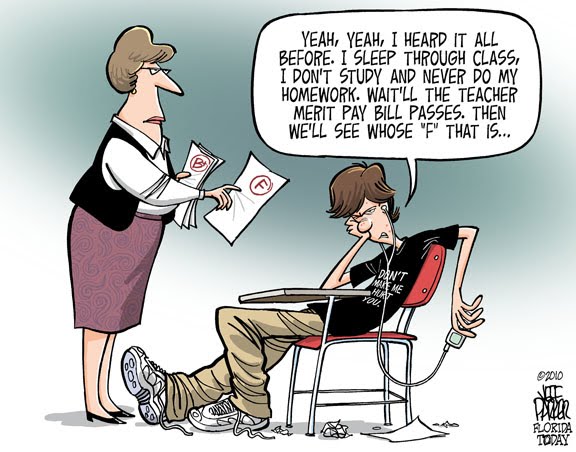
CURMUDGUCATION: Merit Pay Fallacies

CURMUDGUCATION: Merit Pay Fallacies:

Merit Pay Fallacies


Cynthia Tucker Haynes is a Pulitzer Prize-winning columnist who has hooked up with Campbell Brown's reformster-pushing website. She has done much distinguished work throughout her career, but last week she demonstrated that she doesn't understand teaching and especially not teacher merit pay.

The title of the piece pretty well gives us the whole picture: "Excellent Teachers, Like My Mom, Deserve Better Pay. No Matter What Their Unions Say." Yes, grammar police, the title is a punctuation abomination (suggesting, among other things, that her mother is not actually a teacher), but we're going to skip past that.

Haynes follows the standard template for this sort of piece, opening with an anecdote about a Really Awesome Teacher (who is, in this case, the writer's mom). In her opinion, her mom should have gotten bonus pay for being more awesome than other teachers, but the school district didn't offer it. And now Haynes lays out a mistaken and self-destroying argument.

Indeed, few public school districts do because the concept remains so controversial among teachers’ organizations. 

Not the whole truth. In fact, lots of school districts like the traditional teacher pay ladder because it makes budgeting for personnel costs so much easier. With a merit pay system, school districts have only two approaches available to budgeting (a process that begins over a year ahead of time in my neck of the woods).

#1) We don't know how much merit pay we'll be giving out next year yet, so we'll just leave the budget unfinished. The state should love that.

#2) We will budget a finite merit pay pool, which the teachers will then have to fight over in a zero sum teacher thunderdome. That should be great for school morale.

Haynes notes that merit-based pay systems require a means of linking teacher pay to student 
CURMUDGUCATION: Merit Pay Fallacies:


Special Issue of “Educational Researcher” Examines Value-Added Measures (Paper #1 of 9) | VAMboozled!

Special Issue of “Educational Researcher” Examines Value-Added Measures (Paper #1 of 9) | VAMboozled!:

Special Issue of “Educational Researcher” Examines Value-Added Measures (Paper #1 of 9)


VAMboozled!


A few months ago, the flagship journal of the American Educational Research Association (AERA) – the peer-reviewed journal titled Educational Researcher (ER) – published a “Special Issue” including nine articles examining value-added measures (VAMs) (i.e., one introduction (reviewed below), four feature articles, one essay, and three commentaries). I will review each of these pieces separately over the next few weeks or so, although if any of you want an advanced preview, do click here as AERA made each of these articles free and accessible.
In this “Special Issue” editors Douglas Harris – Associate Professor of Economics at Tulane University – and Carolyn Herrington – Professor of Educational Leadership and Policy at Florida State University – solicited “[a]rticles from leading scholars cover[ing] a range of topics, from challenges in the design and implementation of teacher evaluation systems, to the emerging use of teacher observation information by principals as an alternative to VAM data in making teacher staffing decisions.” They challenged authors “to participate in the important conversation about value-added by providing rigorous evidence, noting that successful policy implementation and design are the product of evaluation and adaption” (assuming “successful policy implementation and design” exist, but I digress).
More specifically, in the co-editors’ Introduction to the Special Issue, Harris and Herrington note that in this special issue they “pose dozens of unanswered questions [see below], not only about the net effects of these policies on measurable student outcomes, but about the numerous, often indirect ways in which [unintended] and less easily observed effects might arise.” This section is of, in my opinion, the most “added value.”
Here are some of their key assertions:
  • “[T]eachers and principals trust classroom observations more than value added.”
  • “Teachers—especially the better ones—want to know what exactly they are doing well and doing poorly. In this respect, value-added measures are unhelpful.”
  • “[D]istrust in value-added measures may be partly due to [or confounded with] frustration with high-stakes testing generally.”
  • “Support for value added also appears stronger among administrators than teachers…But principals are still somewhat skeptical.”
  • “[T]he [pre-VAM] data collection process may unintentionally reduce the validity and credibility of value-added measures.”
  • “[I]t seems likely that support for value added among educators will decrease as the stakes increase.”
  • “[V]alue-added measures suffer from much higher missing data rates than classroom observation[s].”
  • “[T]he timing of value-added measures—that they arrive only once a year and during the middle of the school year when it is hard to adjust teaching assignments—is a real concern among teachers and principals alike.”
  • “[W]e cannot lose sight of the ample evidence against the traditional model [i.e., based on snapshot measures examined once per year as was done for decades past, or pre-VAM].” This does not make VAMs “better,” but with this statement most researchers agree.
Inversely, here are some points or assertions that should cause pause:

Must Watch Pro-Public Education Movies – The Network For Public Education

Must Watch Pro-Public Education Movies – The Network For Public Education:

Must Watch Pro-Public Education Movies

Movie Posters
There are few organizing tools as powerful as film. In 2010, Waiting for Superman was a shot of adrenaline in the arm of the reform movement. Financed by billionaire Phillip Anschutz’s Walden Media, the film glorified charter schools and disparaged traditional public schools.
The film, The Inconvenient Truth Behind Waiting for Superman highlights the real life experiences of public school parents and educators to show how these so-called reforms are actually hurting education. The film talks about the kinds of real reform–inside schools and in society as a whole–that we urgently need to genuinely transform education in this country.
Anschutz and Walden Media released Won’t Back Down in 2012, likely hoping to replicate the success of their previous release. Public opinion had already turned however, and Won’t Back Down was both a critical and popular flop. To date it holds the record for the worst box office performance for any film released in over 2,500 theaters.
Since 2012 a slew of pro-public education, anti-reform films have been written, produced, and directed by public education allies determined to challenge the reformster narrative. Like The Inconvenient Truth Behind Waiting for Superman, all have been independently financed. Without the backing of billionaires with large production companies, it becomes incumbent upon us to learn, watch, and share the important messages contained in these films.
Below you will find a synopsis of each film, and links to reviews and more information on how you can not only watch the films, but schedule screenings in your community. We have also included a movie that is still in production. Please do what you can to help ensure this film is completed and released.
The films that follow represent a tremendous body of work in support of our movement. As NPE President Diane Ravitch says, “All they have is money. We, the defenders of democracy and public education, have numbers.” If each of us shares these powerful films with our networks, we can continue to successfully counter the reformster narratives that attempt to privatize and destroy public education.
 Standardized Image

Standardized

Watch online on Vimeo.
Read a review.
Synopsis:
For decades, standardized testing has been a part of public education. Within the last ten years, however, education reform has promoted even more testing. Test scores, mistakenly viewed as effective assessments of student ability and teacher/school effectiveness, are anything but. STANDARDIZED sheds light on the invalid nature of these tests, the terrible consequences of high-stakes testing, and the big money that’s involved.

Education-Inc-203x300

Education Inc.

Learn about screenings.
Read a review.
Synopsis:
Education, Inc. examines the free-market and for-profit interests that have been quietly and systematically privatizing America’s public education system under the banner of “school choice.”
Education, Inc. is told through the eyes of parent and filmmaker Brian Malone, as he travels cross-country in search of the answers and sources behind the privatizing of American public Must Watch Pro-Public Education Movies – The Network For Public Education:

Investigation of LAUSD upholds complaints that special education falling short | 89.3 KPCC

Investigation of LAUSD upholds complaints that special education falling short | 89.3 KPCC:

Investigation of LAUSD upholds complaints that special education falling short


97256 full


The Office of the Independent Monitor overseeing court-ordered improvements to Los Angeles Unified’s special education services found students still aren't getting the services they need, and it ordered the district to carry out a series of improvements.
In a report released Wednesday following an investigation into complaints filed on behalf of the children, the office said parents aren’t treated as equal partners in meetings that lay out services for the district's 85,000 special education students.
The independent monitor's office also said district representatives in Individualized Education Program (IEP) meetings — a key part of the  process for setting services — aren't given the authority to allocate school resources to help students as required by the federal law covering the education of children with disabilities.
“For example, a student might be needing speech services. So in some cases, the speech services personnel might be constrained by limited resources…so the provider in the meeting might feel constrained in recommending everything a child might need,” said David Rostetter, who heads the Office of Independent Monitor.
Rostetter's office called for numerous changes to the district's procedures, including more training for school officials, some of whom student advocates say lack the knowledge to properly carry out the requirements of the law.
Rostetter said in a letter accompanying the report that the school district and lawyers who represent special education students had reached a consensus on steps to fix the problems. 
An LAUSD spokeswoman said Superintendent Ramon Cortines will comment after he reads the independent monitor's findings. The students' lawyers could not be immediately reached for comment.
The report rolls out as LAUSD faces rising costs to provide services for special education students. Last year, the budget for its special education division stood at $1.4 billion, about 20 percent of the district's educational expenses.
Meanwhile, the concentration of special education students in the district is growing as the general pupil population declines and other trends take hold. Sharyn Howell, Investigation of LAUSD upholds complaints that special education falling short | 89.3 KPCC:

A Memo To States: This Is How You Create A Teacher Shortage

A Memo To States: This Is How You Create A Teacher Shortage:

A Memo To States: This Is How You Create A Teacher Shortage
A handy recipe for a teacher shortage like the one in Kansas.


It's back-to-school time in Kansas, and kids are starting to trickle back into school hallways. But when these students arrive at their classrooms, they may not find a teacher standing at the front. 
Kansas is suffering from a well-documented teacher shortage. Last year, more than 2,320 educators in the state retired, compared to 1,260 in the 2011-2012 school year, according to data from the Kansas State Department of Educaton. At the same time, 654 teachers decided to leave the state last year, compared to just 399 in 2011-2012. Over 270 open teaching and non-teaching school staff positions were listed on the Kansas Education Employment Board's website as of Thursday afternoon. 
Kansas has previously seen teacher shortages in areas like special education, as well as math and science. But this year, even typically popular jobs, such as teaching social studies classes or elementary school students, are proving hard to fill, KEEB coordinator Julie Wilson told The Huffington Post.
Those familiar with the situation say it is not surprising. A number of factors have recently converged to create a teacher shortage in the Sunflower State. Some of these factors are the result of actions taken by the state government and legislature. Over the past few years, Kansas has cut back on the job protections that give teachers due process rights, created a new school funding system that a district court panel ruled unconstitutional and cut taxes so severely that some districts lacked the revenue to stay open last school year
“I find it increasingly difficult to convince young people that education is a profession worth considering, and I have some veterans who think about leaving,” Tim Hallacy, superintendent of Silver Lake Schools, told HuffPost last month. “In the next three years I think we’ll have maybe the worst teacher shortage in the country -- I think most of that is self-inflicted.”
For other states looking to wind up in the same situation, here's a surefire recipe for a teacher shortage:
The How To Create A Teacher Shortage Recipe 
Ingredients:
2 pounds of bills and programs that attempt to de-professionalize teaching (specifically, aproposed bill that would make it easier to jail teachers for teaching materials deemed offensive and a new program that lifts teacher licensure requirements in certain districts)
3 tablespoons of a lack of due process rights for teachers
½ cup of finely diced repeated budget cuts amid a state revenue crisis
1 stalk of a new school funding system that is currently being challenged in state court
3 tablespoons of low teacher pay

Marco Rubio On Common Core: The Federal Government Will 'Force It Down Our Throats' - Forbes

Marco Rubio On Common Core: The Federal Government Will 'Force It Down Our Throats' - Forbes:

Marco Rubio On Common Core: The Federal Government Will 'Force It Down Our Throats'


The Republican presidential candidates from Florida tangled over the issue of Common Core State Standards for curriculum at the prime-time GOP debate in Cleveland on Thursday. Senator Marco Rubio challenged his one-time mentor, former Governor Jeb Bush, on one of the most divisive issues in education today.

Bush, an early support of Common Core, says it’s about “higher standards measured in an intellectually honest way” at the state level. “I don’t believe the federal government should be involved with the creation of standards directly or indirectly, or the creation of curriculum or content,” Bush said. “It’s clearly a state responsibility.”

Rubio, who argues against the standards for math and English, said the federal government will eventually “force it down our throats.”

“The Department to Education, like every federal agency, will never be satisfied,” Rubio said. “They will not stop with it being a suggestion. They will turn it into a mandate. In fact, what they will begin to say to local communities is: ‘You will not get federal money unless you do things the way we want you to do it.’”

Fox News moderator Bret Baier asked Bush a question from a viewer that touched on the topic of the Department of Education. Baier wanted to know if Bush agreed with Education Secretary Arne Duncan’s view that Common Core opposition is mostly limited to “a fringe group of critics.”

Bush, 62, touted his record in Florida, where he served as governor from 1999 to 2007. ”We had rising student achievement across the board because high standards, robust accountability, ending social promotion in the third grade, real school choice across the board, challenging teachers’ unions and beating them is the way to go.”

Rubio, 44, reminded the audience that he is also a supporter of curriculum reform. “It’s critically important in the 21st century,” he said. “We do need curriculum reform and it should happen in the state and local level.That’s where education policy belongs. Because if a parent isn’t happy with what their child is being taught in school, they can go to that local school board, their state legislature, or their governor and get it changed.”Marco Rubio On Common Core: The Federal Government Will 'Force It Down Our Throats' - Forbes:


Board votes to reopen downtown's Washington Elementary | Sacramento News - KCRA Home

Board votes to reopen downtown's Washington Elementary | Sacramento News - KCRA Home:

Board votes to reopen downtown's Washington Elementary
School closed due to budget cuts


SACRAMENTO, Calif. (KCRA) —The board of education in Sacramento has voted to reopen Washington Elementary School for the 2016-2017 academic year.

The school in downtown Sacramento was one of seven campuses to close due to budget cuts years ago.
It was one of the most expensive to operate and had some of the worst attendance levels in the Sacramento City Unified School District.
But demand has changed in the area.
The vote to reopen the school was unanimous
.Board votes to reopen downtown's Washington Elementary | Sacramento News - KCRA Home:

Educating for Democracy:What if all schools were charter | Joel Shatzky

Educating for Democracy:What if all schools were charter | Joel Shatzky:

Educating for Democracy:What if all schools were charter


 There's a comment attributed to Einstein: "The sign of insanity is when you do the same thing over and over again and expect different results." I wonder what this eminent thinker would have to say about someone who not only repeats the same flawed procedure but then expands on it. That is what Governor Bobby Jindal of Louisiana is doing by increasing the number of charter schools state-wide after turning over all the district schools in New Orleans to charter managers. Jindal obviously thinks it's a good thing as he declared last year in a speech in the Capitol:

"Louisiana Governor and likely presidential candidate Bobby Jindal (R) released his new "road map" for reforming K-12 education focusing on the importance of deregulating and privatizing public schools and holding up New Orleans' all-charter Recovery School District as a model for the nation. "I'm proud we've increased the number of charter schools, nearly doubling them," Jindal told an audience on Capitol Hill. "I get so frustrated when people tell us to wait for incremental gains. We have seen remarkable gains."
This is the "message" Jindal delivers in light of his opportunity to privatize all the schools in New Orleans as an example of what can happen when a school system is being "reformed" from the top down.
First of all " new data calls the supposed gains into question. Most of the class of 2014 graduating from the 100%-charter New Orleans Recovery School District scored so low on the national ACT test that they didn't meet the minimum requirements for Louisiana's colleges. According to numbers crunched by Louisiana public school teacher and doctor of statistics Mercedes Schneider, just over 6 percent of high school seniors in the Recovery School District scored high enough in English and Math to qualify for admission into a Louisiana four-year college or university straight out of high school. Five of the district's 16 high schools produced not a single student who met these requirements. The district's test scores were extremely low prior to Hurricane Katrina and the charter school conversion, but despite Jindal's claims of "remarkable gains," there has been no improvement in New Orleans' Recovery School District ACT scores since 2005. The class average is now 16.4, one of the lowest in Louisiana. There was a 0.6 decline statewide. "
Reality notwithstanding, let us explore Jindal's suggestion and try to anticipate the results of this "transformation" of education in the United States: 1.Since most charter schools "counsel out" ["Expel" in plain English] students who don't fit the profile for a successful education, that is, ones that are disruptive, poor learners and generally behave in ways that would have a negative effect on standardized test scores, if there were no more non-charters in which to dump them, where, besides the street, would they go during school hours?
"There are a huge number of young people in New Orleans between the ages of 16 and 24 who are neither in school or working. The recent Measure of America study, conducted by the Social Science Research Council, found that the greater New Orleans/Metarie region is home to more than 26,000 so-called "opportunity youth." The youngest would have been just six when the overhaul of the school system began.
"But even this number fails to convey the sheer number of young people here who have left the city's schools, and are in one of the fast-expanding alternative programs, or are in work-training programs to prepare them for jobs in the tourism and hospitality industry. Added together, the number of students who've dropped out of the New Orleans' schools begins to creep up uncomfortably close to the 43,000 students who are still in them."http://dianeravitch.net/category/new-orleans/
Among the Governor's other accomplishments were: 1
. An increase in segregation in the city schools through his voucher program so egregious that "In 2013, the Justice Department took Jindal's voucher program to court, arguing that it was making racial segregation worse in the state's 
Educating for Democracy:What if all schools were charter | Joel Shatzky:

Jon Stewart's Last 'Bulls**t' Rant On 'The Daily Show'


Jon Stewart's Last 'Bulls**t' Rant On 'The Daily Show'


"So I say to you tonight, friends. The best defense against bullsh*t is vigilance.
So if you smell something, say something."


Carol Burris Joins NPE as Executive Director | Diane Ravitch's blog

Carol Burris Joins NPE as Executive Sirector | Diane Ravitch's blog:

Carol Burris Joins NPE as Executive Director 


When award winning principal Carol Burris announced that she was retiring early to dedicate all of her energies to “fighting the assault on our public schools and our teachers,” many wondered how and where she would continue that fight.
There is no need to wonder any longer.
Today NPE President Diane Ravitch announced that Carol Burris will become the new Executive Director of the NPE Fund, NPE’s non-political 501C3.
“The Board of the Network for Public Education is thrilled that Carol Burris has agreed to serve as Executive Director of the NPE Fund. NPE Fund will conduct research, issue policy papers, and communicate to the public about the crucial issues facing public education today. With Carol’s extensive and exemplary experience as a principal, a teacher, and a writer, she is exactly the right person to lead the NPE Fund at this time.”
Burris had this to say about her new role with NPE:
“We are living in a time of unrelenting attacks on the women and men who have dedicated their life’s work to educating and caring for children. Our youngest students are buckling under the pressure of excessive testing, and our most vulnerable children are unfairly classified as failures. Parents are skeptical of and confused by the Common Core. Profiteers are seeking to capitalize on dissatisfaction and confusion.
“We must now stand together to stop the privatization of our democratically controlled local schools and protect all children’s rightful heritage to a free and equitably funded public education. I am proud to join Ravitch and the members of the NPE in leading that fight.”
And NPE Board Member Dr. Julian Vasquez Heilig added:
“Carol Burris brings the perspective of a life long educator and an important national voice to the position of ED for the NPE C3. I am thrilled to be working with her to connect communities and allies across the nation in the important work for our nation’s children.”
You can read more about this exciting development on our website.
Robin Hiller, who has been NPE’s Executive Director since the Carol Burris Joins NPE as Executive Sirector | Diane Ravitch's blog: