Latest News and Comment from Education

Thursday, August 6, 2015

Professional development for teachers: New study questions value of teacher training.

Professional development for teachers: New study questions value of teacher training.:

Is Professional Development for Teachers One Big Boondoggle?


A study raising a lot of eyebrows in the education world this week suggests that, despite the billions of dollars we are pouring into teacher development every year, we have very little to show for the expenditure. The report, released by the education-reform organization TNTP, puts a shockingly high price tag on professional development, which refers to the ongoing, on-the-job pedagogical training, both formal and informal, that teachers receive throughout their careers: The unnamed three large school districts and medium-size charter network it examined spent, on average, $18,000 per teacher for training that spanned 19 days, or roughly one-tenth of the school year. All that cash and time, for what TNTP found to be questionable outcomes at best. Among the roughly 10,000 teachers surveyed, teacher evaluations found that only 3 out of 10 teachers improved while 2 out of 10 got worse over two or three years.
While some teachers did improve (as measured, among other metrics, by students’ proficiency in math and reading and classroom observations), many others “plateau before they master core instructional skills.” And even in the best-case scenarios of teachers who “did grow substantially over time,” the study could identify “no clear patterns in these success stories and no evidence that they were the result of deliberate, systemic efforts.” There was no clear correlation between the type of training they received, or the number of hours they’d received it, and any discernible improvement. Basically, nobody knows what works, so districts just throw different teacher-development techniques (and lots of dollars) at the wall and hope something sticks. Instead of this haphazard approach, TNTP recommends that districts set clear, measurable goals, then constantly try to determine the best methods of achieving them. But how exactly do we do this? Anyone who dips even momentarily into the ferocious debate over “value-added” teacher evaluations understands that the evaluative process used to measure such goals is by its nature subjective and ever-shifting, its effectiveness and accuracy open to great debate.
And because the study emphatically found no concrete strategies that reliably improved teacher performance, TNTP’s recommendations struck this reader as more amorphous gobbledygook. “Give teachers a clear, deep understanding of their own performance and progress,” the report suggested, and “encourage improvement with meaningful rewards and consequences,” and “reconstruct the teacher’s job.” What exactly does any of that mean—and what is a better, in-plain-English path forward?
Ann Neary, who has taught English at DeWitt Clinton High School in the Bronx for 10 years, told me that the first thing that struck her about the study is the organizationProfessional development for teachers: New study questions value of teacher training.:

Guidance on supporting transgender students :: SI&A Cabinet Report

Guidance on supporting transgender students :: SI&A Cabinet Report :: The Essential Resource for Superintendents and the Cabinet:

Guidance on supporting transgender students


Guidance on supporting transgender students


(District of Columbia) Schools increasingly being called upon to better support their transgender students can now turn to new guidance that offers tips and best practices for working through common concerns or dealing with awkward situations should they occur.
Released Monday by a coalition of civil rights groups, “Schools in Transition: A Guide for Supporting Transgender Students in K-12 Schools” is first-of-its-kind national guidance that acknowledges the issues school officials face and provides legal and social justifications as to why they must act.
“Many are unfamiliar with the needs of transgender students, and attempts to meet those needs can be fraught with emotion for all involved,” wrote authors Asaf Orr of the National Center for Lesbian Rights and Joel Baum of Gender Spectrum, a San Francisco-based non-profit.
“(But) students have all kinds of needs — whether they are gifted and talented, speak a first language other than English or are transgender — and schools have a duty to provide for these needs,” they wrote.
The challenges faced by those who identify as transgender are openly discussed more now than ever. The issue generates headlines, whether about the “coming out” of prominent celebrities and students or a legal challenge over gender-specific facilities, and the topic is hitting closer to home in many schools.
According to a report released earlier this year by the Gay, Lesbian & Straight Education Network, however, only one in 10 school districts has a policy that explicitly protects lesbian, gay, bisexual and transgender students from bullying based on sexual orientation and gender identity or expression. Nearly three in 10 have no anti-bullying policy at all.
Handling instances of bullying is an important step for school officials. Accommodating the use of a bathroom or locker room which doesn’t match a student’s anatomy, however, is often an early hurdle schools face when met with an openly transgender student seeking help from teachers or administrators.
These educators are also faced with questions from concerned parents: “What if a student who identifies as male claims to be female just so he can enter the girls’ facilities?” or “What if other students have privacy concerns about using a restroom with a transgender student?”
Authors of “Schools in Transition” suggest addressing the legitimate concerns of parents and other students to first help clear up any misconceptions regarding transgender students.. Then, they said, schools should allow a student who is still concerned to change in a more private facility such as a nurse’s office or restroom.
“It is important to remind students that behaving in a way that makes others uncomfortable is unacceptable and a violation of the school’s commitment to ensuring the safety of all students,” authors wrote, “but it must also be clear that a transgender student’s mere presence does not constitute inappropriate behavior.”
The guidance gives detailed suggestions for handling accommodations during overnight field trips, participation in school sports, physical education classes and homecoming or other traditional school events, and aims to dispel misconceptions about transgender people that exist or arise during those scenarios.
According to the report’s authors, schools must address these situations in ways that are reasonably fair to all parties, and administrators must not discriminate against transgender students who are protected in some ways under federal laws, including Title IX and the Family Educational Rights and Privacy Act as well as some state anti-discrimination laws.
Although not legally required, authors also recommend that teachers and administrators use the name and pronoun preferred by the student. Doing so, they said, is a simple step in helping all students feel more accepted on campus.
“Consistently using a transgender student’s chosen name and pronouns signals that the speaker is respecting and affirming the transgender student’s gender identity,” authors wrote. “Although seemingly minor, these simple actions can have a profound effect on the student’s experience.”
The guidance also addresses how to keep personal records for transgender students, how to accommodate those transitioning publicly and privately, and more ways in which to create a more welcoming school environment overall.
Guidance on supporting transgender students :: SI&A Cabinet Report :: The Essential Resource for Superintendents and the Cabinet:


Facing Chris Christie Clones Who Bully Teachers

Facing Chris Christie Clones Who Bully Teachers:

Facing Chris Christie Clones Who Bully Teachers


bully watch sign illustration design over a notepad paper


It would be one thing if Gov. Chris Christie’s latest statement that the teachers’ union“deserved a punch in the face,” was some lone comment by one irate individual. But the sad fact is there are more Christies out there! The friction between Christie and the teachers’ union runs deep, but don’t forget the other noteworthy bullying teachers have had to endure.
Remember Rod Paige, President G. W. Bush’s first education secretary? He compared the teachers union to terrorists not long after 9-11! How can someone placed in a position to oversee, and nurture teachers in America hate teachers?
And then there was Dr. Reid Lyon a research psychologist who advised President George W. Bush about education and who was one of the architects of Reading First (look it up if you get a chance). At a 2002 forum sponsored by the Council for Excellence in Government, Reid said if he could pass any piece of legislation, it would be “to blow up colleges of education.”
Reid went to work with an online teacher education program called the American College of Education. Rod Paige is one of the trustees. Think about that.
There are many more of these teacher bullies on a national, state and even the local level.
Most of this bullying is directed at the teachers’ union. But the problems many see, with both the American Federation of Teachers (AFT) and the National Education Facing Chris Christie Clones Who Bully Teachers:

How White Students Reap Benefits from Teachers of Color - The Atlantic

How White Students Reap Benefits from Teachers of Color - The Atlantic:

Why Schools Need More Teachers of Color—for White Students

Nonwhite educators can offer new and valuable perspectives for children of all backgrounds.


Noah Caruso, 17, calls South Philadelphia home. Known for cheesesteaks, pizza, and bakeries, South Philly is a close-knit, largely Italian American neighborhood where much of the population has traditionally shared the same background, culture, and race. Though an influx of immigrants has made the area more diverse in recent decades, South Philly, like the rest of the city, remains highly segregated. Caruso’s predominantly white community was echoed at his middle school, Christopher Columbus Charter School, where he says all of his teachers were white like him, as were virtually all of his classmates. It was against this backdrop that Caruso enrolled in Science Leadership Academy (SLA)—a public magnet high school in the city—and landed in the freshman English class of Matthew Kay, his first black teacher.
Now a rising senior, Caruso looks back with appreciation on his ninth-grade year in Kay’s class. “He’s the most inspiring teacher I ever had by far,” Caruso said, recalling Kay’s emphasis and commentary on fraught topics such as present-day racism. “He definitely pushed us to really think about these social issues [that] weren’t talked about before in my life because everyone grew up in the same area,” he continued. “We were all white … and everyone had the same opinion.” Caruso recalled a class in which Kay had students watch a scene from American History X, a graphic 1998 film about neo-Nazis and white supremacy in America. The teacher, Caruso noted, didn’t hold back in expressing his perspective on the persistence of prejudice in the country. It was one of many discussions with Kay that Caruso said opened his eyes “to all of these things I never even thought about before ... It inspired me to want to do something about it.”
The importance of recruiting and retaining more teachers of color for students of color is well-reported and deeply researched. Most teachers—over 80 percent—are white, and surveys suggest that won’t change anytime soon. Among the ACT-tested graduates in 2014 who said they planned on pursuing an education major,72 percent were white, compared to 56 percent of all tested students. Yet nonwhite children are now believed to make up a majority of the country’s public-school populationStudies show that, academically, nonwhite teachers produce more favorable outcomes for students of similar backgrounds; emotionally and socially, these educators serve as role models who share students’ racial and ethnic identity. What hasn’t gotten much attention, however, are the potential gains for white students. 

The call for more teachers of color has grown more urgent in recent years because of America’s changing demographics. In an increasingly multiracial, multicultural society, some education experts question the impact on white How White Students Reap Benefits from Teachers of Color - The Atlantic:

Is Public Education In the US Broken Beyond Repair? Well, Is It? | The Jose Vilson

Is Public Education In the US Broken Beyond Repair? Well, Is It? | The Jose Vilson:

Is Public Education In the US Broken Beyond Repair? Well, Is It?


On Sunday, I had the pleasure of watching Seattle teacher, unionist / activist, and colleague Jesse Hagopian verbally spar with former US assistant Secretary of Education Peter Cunningham, with noted education professor and friend to this program Pedro Noguera interjecting as the “research voice” in the middle. For a snippet, check below (for a wrap-up, read here):
First, let’s give props to Al Jazeera for actually asking an actual teacher to debate on policy matters. The dynamic went as well as one could have hoped for. Cunningham touted the successes of education reform of the last decade (if you say so …) and Hagopian outed Cunningham’s Education Post as a 1%-er vehicle for education reform (mouth was agape the whole time). There were solid moments in there too, like when Jesse discussed the New York Performance Standards Consortium and the merits of students demonstrating knowledge via performance and not through a standardized test.
But I also came away thinking this discussion merited more than a focus on standardized testing. I’ve grown increasingly skeptical that the talking points out there are actually working because, the more Is Public Education In the US Broken Beyond Repair? Well, Is It? | The Jose Vilson:

“Education” Journalism’s Hollow Echo Chamber: New Orleans Edition | the becoming radical

“Education” Journalism’s Hollow Echo Chamber: New Orleans Edition | the becoming radical:

“Education” Journalism’s Hollow Echo Chamber: New Orleans Edition


What’s in a publication’s name? Apparently when the publication’s title includes “Education,” the lesson is “reader beware.”
First, the ever-misleading Education Next trumpets: Good News for New Orleans, concerning the Recovery School District created post-Katrina, which eradicated public schools in the city.
Essentially and uncritically parroting that piece, Education Week proclaims: New Orleans Test Scores Have ‘Shot Up’ 10 Years After Katrina, Report Says.
We have been here before since mainstream media—even the so-called “liberal media”—are prone to whitewashing the story of disaster capitalism in New Orleans education reform. And I have discussed recently the need to have a nuanced and complicated examination of both public and charter schools, inspired by Andre Perry’s impassioned and blunt confrontation of why black parents have embraced charter schools in New Orleans.
So it is in that spirit that I note, Salon (no “Education” in the title, by the way) has run a much better and more complex look at post-Katrina education reform in New Orleans: “Reform” makes broken New Orleans schools worse: Race, charters, testing and the real story of education after Katrina.
Much of Berkshire’s investigation parallels the concerns anticipated by the National Education Policy Center’s press release about claims and research coming out of the 10th anniversary of Katrina, which concludes:
Ten years after Hurricane Katrina and the subsequent reforms, there remain more questions than answers. Even if the reforms implemented under such a hyper-politicized arrangement show some clear gains in student achievement, as seems to be the case, it is important to attend to the serious equity concerns that remain in the system, and to examine other outcomes, beyond test scores. The preliminary evidence, from a combination of news reports and research studies, suggests that the New 
“Education” Journalism’s Hollow Echo Chamber: New Orleans Edition | the becoming radical:

8/6/2015 – Why Chris Christie Hates Teachers

8/6/2015 – Why Chris Christie Hates Teachers:

8/6/2015 – Why Chris Christie Hates Teachers

Why Chris Christie Hates Teachers

By Jeff Bryant

“What was the most surprising thing about New Jersey Governor and Republican presidential candidate Chris Christie’s recent remark that the “national teachers union” deserves a “punch in the face” … was how tepid the response has been from anyone but members of the teachers’ unions themselves … But the antipathy, or apathy, many politicians tend to have toward teachers derives from the reality that politicians tend to have unreal expectations about teachers and what they do.”
Read more …

NEWS AND VIEWS

Reform Makes Broken New Orleans Schools Worse

Salon

“There is … an aggressive effort already underway to sell the New Orleans [education] model … But … the real cost … 7,000 teachers whose firing was described as a wound that won’t heal; the shunting aside of special education students and English language learners, especially in the first years of the experiment; the loss of trust among New Orleanians who believe they’ve been shut out of any meaningful decision-making regarding their city’s schools … The question of who gets to be part of the conversation regarding the shape and future of schools in New Orleans is … touches on a fundamental – and still unresolved – debate about the very purpose that schools should serve.”
Read more …

More Than Half Of School Of Choice Students End Up Moving Schools Again, Study Shows

Michigan Live

“More and more families are opting to move their children out of the schools they would attend by residency to neighboring districts … But a new study for the first time reveals that fewer than half stay in that neighboring district. And the students who most often bounce between schools are the students most likely to be hurt academically by the instability … Low-income students … African-American students … students who are struggling academically are more likely to switch schools … But those same at-risk students are the ones who are most likely to give up on their schools of choice … That matters, because studies show that the more students bounce between schools, the less they learn.”
Read more …

ALEC Admits School Vouchers Are For Kids In Suburbia

The Center For Media And Democracy

“With vouchers gaining momentum nationwide, the American Legislative Exchange Council (ALEC) … has decided to drop the pretense that vouchers have anything to do with social and racial equity, and is now pushing vouchers for the middle class – a project which, if pursued enough in numbers, will progressively erode the public school system … Talking points at the end of the bills state … ‘children from low- and middle-income families should receive public support for their education regardless of whether they are attending a public or private school’ … ALEC is not the only organization coming clean on vouchers … Most students receiving vouchers last year were already attending private schools – meaning vouchers were being used a taxpayer subsidy for private education rather than as a way for students to escape underperforming public schools.”
Read more …

Years Of Cuts Threaten To Put College Out Of Reach For More Students

Center On Budget And Policy Priorities

“In almost all states, higher education support remains below what it was in 2008 … 47 states … are spending less per student in the 2014-15 school year than they did at the start of the recession … The average state is spending $1,805, or 20%, less per student … In 13 states, per-student funding fell over the last year … Average annual published tuition has risen by $2,068 nationally, or 29%, above the rate of inflation … Nearly every state has shifted costs to students.”
Read more …

World Bank Peddling Private, For-Profit Schools In Africa, Disguised As Aid

Mintpress News

“Private, for-profit schools in Africa funded by the World Bank and U.S. venture capitalists have been criticized by more than 100 organizations who’ve signed a petition opposing the controversial educational venture … The schools project is called Bridge International Academies and 100,000 pupils have enrolled in 412 schools across the two nations … The statement reflects a growing global movement questioning Western policies pushing private education in developing countries. It was written and signed by 30 organizations in Uganda and Kenya and supported by 116 organizations around the world, including Global Justice Now and ActionAid. They claim BIA uses highly standardized teaching methods, untrained low-paid teachers, and aggressive marketing strategies targeted at poor households.”
Read more …


8/6/2015 – Why Chris Christie Hates Teachers:

W. E. B. Du Bois: A Black Schoolmaster in the Post-Antebellum South South - The Atlantic

W. E. B. Du Bois: A Black Schoolmaster in the Post-Antebellum South South - The Atlantic:

A Negro Schoolmaster in the South

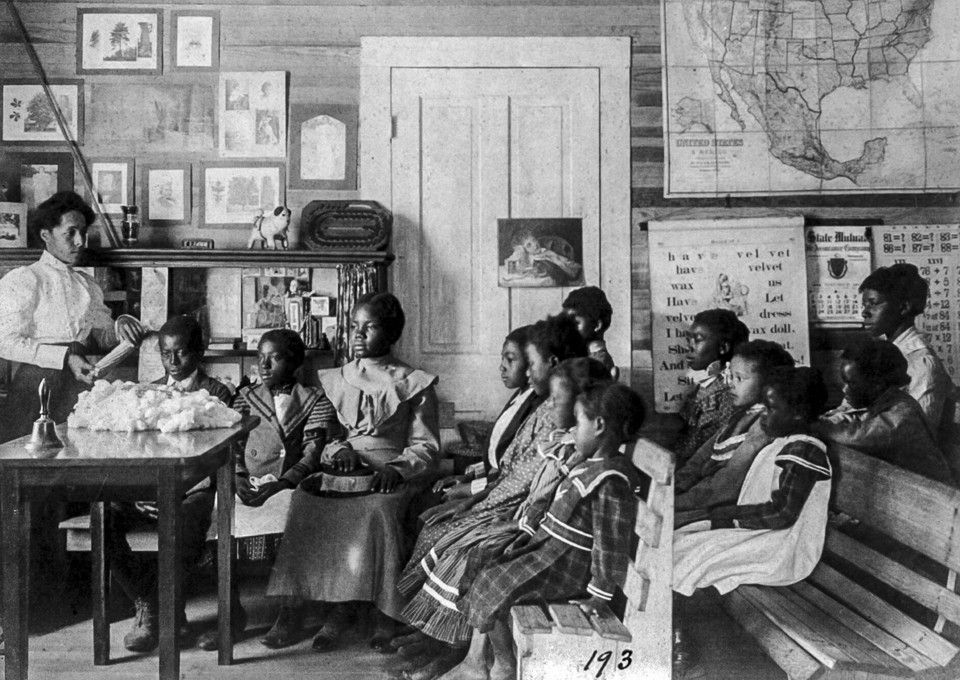
W. E. B. Du Bois’ 1899 account as a young, black schoolmaster in the South


Once upon a time I taught school in the hills of Tennessee, where the broad dark vale of the Mississippi begins to roll and crumple to greet the Alleghanies. I was a Fisk student then, and all Fisk men think that Tennessee —beyond the Veil—is theirs alone, and in vacation time they sally forth in lusty bands to meet the country school commissioners. Young and Happy, I too went, and I shall not soon forget that summer, ten years ago.
First, there was a teachers' Institute at the county-seat; and there distinguished guests of the superintendent taught the teachers fractions and spelling and other mysteries,—white teachers in the morning, Negroes at night. A picnic now and then, and a supper, and the rough world was softened by laughter and song. I remember how—but I wander.
There came a day when all the teachers left the Institute, and began the hunt for schools. I learn from hearsay (for my mother was mortally afraid of fire-arms) that the hunting of ducks and bears and men is wonderfully interesting, but I am sure that the man who has never hunted a country school has something to learn of the pleasures of the chase. I see now the white, hot roads lazily rise and fall and wind before me under the burning July sun; I feel the deep weariness of heart and limb, as ten, eight, six miles stretch relentlessly ahead; I feel my heart sink heavily as I hear again and again, "Got a teacher? Yes." So I walked on and on,— horses were too expensive,—until I had wandered beyond railways, beyond stage lines, to a land of "varmints" and rattlesnakes, where the coming of a stranger was an event, and men lived and died in the shadow of one blue hill.
Sprinkled over hill and dale lay cabins and farmhouses, shut out from the world by the forests and the rolling hills toward the east. There I found at last a little school. Josie told me of it; she was a thin, homely girl of twenty, with a dark brown face and thick, hard hair. I had crossed the stream at Watertown, and rested under the great willows; then I had gone to the little cabin in the lot where Josie was resting on her way to town. The gaunt farmer made me welcome, and Josie, hearing my errand, told me anxiously that they wanted a school over the hill; that but once since the war had a teacher been there; that she herself longed to learn,—and thus she ran on, talking fast and loud, with much earnestness and energy.
Next morning I crossed the tall round hill, lingered to look at the blue and yellow mountains stretching toward the Carolinas; then I plunged into the wood, and came out at Josie's home. It was a dull frame cottage with four rooms, perched just below the brow of the hill, amid peach trees. The father was a quiet, simple soul, calmly ignorant, with no touch of vulgarity. The mother was different,— strong, bustling, and energetic, with a quick, restless tongue, and an ambition to live "like folks." There was a crowd of children. Two boys had gone away. There remained two growing girls; a shy midget of eight; John, tall, awkward, and eighteen; Jim, younger, quicker, and better looking; and two babies of indefinite age. Then there was Josie herself. She seemed to be the centre of the family: always busy at service or at home, or berry-picking; a little nervous and inclined to scold, like her mother, yet faithful, too, like her father. She had about her a W. E. B. Du Bois: A Black Schoolmaster in the Post-Antebellum South South - The Atlantic:

CURMUDGUCATION: TNTP: Why Does Professional Development Suck?

CURMUDGUCATION: TNTP: Why Does Professional Development Suck?:

TNTP: Why Does Professional Development Suck?


TNTP has released a new report-ish papery thing addressing the state of teacher professional development in the US. Their conclusion? It sucks.

To their credit, they're apparently unhappy with those results. I'm not sure they need to be quite so discouraged; as with most TNTP researchy products, this one has some problems. Still, if you think I'm going to stick up for the awesomeness of professional development, I do hope you have another think coming. But let's go ahead and take a quick look at The Mirage: Confronting the Hard Truth about Our Quest for Teacher Development.

Do we know how to help teachers get better? 

I confess that I find this particular reporty thing oddly fascinating, because at its root it is a slow-motion collision between a fundamental reformster flaw and reality. So what we're looking at is TNTP trying to jump their unicorns over an existential chasm while trying not to look directly into the abyss.

The intro is almost plaintive-- we were so sure that if we could just figure out what teachers should be doing and then train them to do it, students would start racking up the big test scores (I'm paraphrasing, but only a little). I want to feel bad for these guys, because right out of the box they are designing a whole study based on fundamental misunderstandings of how teaching works, what teachers do, and what student success looks like. Really, we've driven right past the unicorn farm to a special lab where scientists are trying to make kumquats produce better pork chops by developing techniques for making the number nine smell more like lilacs.

I'm not entirely sure how to address the issues here, but let's start by looking at what they think they've learned.

Districts are spending big bucks

Well, they can't screw this up-- it's just running the numbers, right? TNTP found that districts are spending astronomical funds on teacher development, including the district that spends more on PD than on transportation. Okay, then.

Despite the buck spendage, most teachers do not appear to improve from year to year

How would you even measure something like that? TNTP went with just looking at the districts' own ratings of teachers, and discovered that "the difference in performance between an average first-
CURMUDGUCATION: TNTP: Why Does Professional Development Suck?:


Putnam: Social Capital and Children

If Robert Putnam had never done a thing in his life except write Bowling Alone, he would have done more than enough to justify his taking up space on Earth. The work looks at the collapse and rebuilding of the American community, pairing sharp insight with exhaustive and clever collected data. It is required reading. But Putnam has just released another work entitled Our Kids, and in its own way it is just as important as his earlier work.

The book sets out to answer a particular question:

Do youth today coming from different social and economic backgrounds in fact have roughly equal life chances, and has that changed in recent decades?

Well, spoiler alert: the answers are “no” and “yes,” respectively. It’s the details and the explanations that make Putnam’s book worth reading. You should read the whole thing, because I am not going to cover everything. But let me give you some tidbits while I hit the broad strokes.

TIDBIT #1

Income inequality has risen within each major racial/ethnic group between 1967 and 2011. In other words, rich blacks have pulled away from poor blacks. The Great Recession stymied the growing gap briefly, but recovery has brought more of the same.

TIDBIT #2

When considering the debate about social mobility, it’s useful to remember that “conventional indicators” are generally three or four decades out of date.

TIDBIT #3

For those who believe that the fabled welfare mother is behind the growth in single-mom 

Putnam: Social Capital and Children


Building a Prison-to-College Pipeline - Yahoo News

Building a Prison-to-College Pipeline - Yahoo News:

Building a Prison-to-College Pipeline


If there’s an argument against giving Pell grants to prisoners that particularly galls Education Secretary Arne Duncan, it’s the suggestion by some Republicans that the Obama administration is taking money intended for hard-working students and giving it to criminals.
“Having an inmate receive Pell grants doesn’t take a nickel from anybody else,” Duncan told me in a phone interview on Wednesday. “This never pits one group over another, and it’s not robbing Peter to pay Paul. It’s just trying to have a few more people have access to what could be a life-chance-forming opportunity.”
Last week, alongside Attorney General Loretta Lynch, Duncan appeared at a prison in Maryland to announce the launch of a pilot program that would make a limited number of inmates eligible for federal college aid while they’re still in jail. Congress banned Pell grants for prisoners in 1994, but the administration is relying on a provision of the Higher Education Act to resume the practice on a trial basis. The idea—backed by a 2013 Rand Corporation study that found prisoner education is a cost-effective way to reduce recidivism—is one that has bipartisan support.
Recommended: The Makeup Tax

Related Story


Yet the Obama administration is clearly taking a risk by launching the pilot program now, without waiting for full congressional approval that could come through the passage of criminal-justice reform, which has gained momentum on Capitol Hill in recent months. Already, someRepublicans are accusing the administration of going around the law—an argument that Duncan similarly dismissed. “I think waiting on Congress is almost never a good bet,” the secretary said with a chuckle. He knows from experience. Duncan is one of two Cabinet officers (along with Agriculture Secretary Tom Vilsack) who have served for the entire Obama presidency, and he has been waiting six and a half years for Congress to overhaul the George W. Bush-era No Child Left Behind Act. (In the face of congressional inaction, the administration has exempted most states from many of its key requirements.)
“Quite candidly, Congress often doesn’t do much until we do something, and then they react to that,” Duncan said. “So it kind of spurs them to take action. But anyone who says this stops them from doing something or stifles debate—it’s just patently false.”
The administration is now waiting for proposals from universities who want to participate in the Pell grant initiative. Duncan said that while there are no plans to restrict eligibility based on the type of crime an inmate committed, it would be focused on prisoners scheduled for release “in the next couple of years.” About 700,000 inmates are released from prison in the U.S. each year, which Duncan likened to a “tidal wave.” “They’re either going to be released and go back to the streets and go back to a life of crime, and go back to being a menace to society, or they’re going to be released with some real skills and possibly even a college degree, or credit towards a college diploma,” he said. “And as a parent, as a taxpayer, I know which one I would prefer.”
“They’re either going to be released and go back to the streets and go back to a life of crime … or they’re going to be released with some real skills and possibly even a college degree.”

In the interview, Duncan also addressed a more fundamental goal of education: keeping kids out of prison in the first place. The administration last year stepped up its efforts to close what is often described as the “school-to-prison pipeline,” and Duncan said the government had spent about $5 billion on grants to turn around failing schools. He tied that effort to the push in many states and districts to reduce out-of-school suspensions and expulsions, which disproportionately affect people of color. “We’ve seen many states and districts start to change their policies, moving away from zero-tolerance, moving toward restorative justice and peer juries, and working with kids rather than putting them out into the street,” he said. “That’s a big, big step in the right direction.”
Here's a transcript of my interview with Duncan, edited for clarity and length.

Russell Berman: Just getting Congress to reauthorize Pell grants for non-criminals has been a struggle under Republican control. What do you say to families of students who have worked hard, still are saddled with student-loan debt and may wonder why inmates should get government assistance for education?
Arne Duncan: To be clear, this is never haves-versus-have-nots or whatever. Having an inmate receive Pell grants doesn’t take a nickel from anybody else, and this is really about trying to help individuals get back on their feet. And ultimately why Republicans should—and some will—love this is it’s a huge way to reduce recidivism and save money over time. This never pits one group over another, and it’s not robbing Peter to pay Paul. It’s just trying to have a few more people have access to what could be a life-chance-forming opportunity.
Look, when this program was in place 20 years ago, it was something like 0.1 percent of all Pell money, so the budget conversation here is not a real debate or a real issue.
Berman: So it’s not coming from some pool of money that is limited?
Duncan: Exactly. The opposite of that.
Berman: How many prisoners are likely to receive Pell grants as part of this program?
Duncan: We really don’t have any idea yet. To be clear, what we’re going to be doing is putting out a [request for proposal] for universities who want to partner with prisons. We don’t know how many are going to step up. We’re only going to pick ones where we think there’s a good chance of success, where there’s a high quality. And of those we pick, we don’t know their capacity to serve a certain number, so there’s no sense now. We do hope that many universities across the nation will step up and apply. And we think, again, this has a chance to have a very significant impact. And [for] Congress, which we hope chooses at some point to take this to scale, hopefully that evidence base that we build will help to inform that conversation.
So we’re hopeful, and we’ll have a strong evaluative piece to this, and we’ll sort of learn over time what works and what doesn’t.
Berman: As of now, what limits is the administration going to put on this? Would violent offenders be eligible?
Duncan: The short answer is that we’re first going to look to work with folks who are going to be released back into society relatively soon, in the next couple of years. So I think we distinguish less on the type of crime and more on the, ‘Are you coming back into society?’ And I kept Building a Prison-to-College Pipeline - Yahoo News:

Is There a Teacher Shortage? That Depends How You Frame It - Teaching Now - Education Week Teacher

Is There a Teacher Shortage? That Depends How You Frame It - Teaching Now - Education Week Teacher:

Is There a Teacher Shortage? That Depends How You Frame It


Across the country, states and districts have ramped up efforts this summer to recruit new teachers, as they work to avoid vacancies at the start of the new school year.
Data around the size of the teaching profession is only current up through 2011, according to the National Center for Education Statistics, but estimates suggest that by 2018, there will be more teachers than ever before.
In a new story for Education Week, I wrote about teacher shortages in spots across the nationand how districts and states are responding in some cases. The gist is that, while there are many instances of teacher shortages nationwide, the number of teachers per student has remained relatively constant.
Current estimates show that there are about 100,000 fewer public school teachers than there were in 2008, at the onset of the Great Recession. Since there are 14,000 public school districts, per the U.S. Census Bureau, that number works out to just about seven teachers per district. (Not that districts across the board lost seven teachers each, obviously. New York City, for instance,shed about 8,100 general education teachers between 2007 and 2012, although it gained about 2,500 special education teachers.) Teacher-prep enrollment numbers are also down over the past several years.
At the same time, though, a soon-to-be-record-high teaching population and teacher shortages are not mutually exclusive. So let's break down what the term "teacher shortage" actually refers to.

Subject-Area Shortages

The U.S. Department of Education has information running back over two decades on teacher shortage areas in each state by subject. That list does not reflect whether states are actually hiring such teachers, so much as denote that they would like to.
From that federal data, four trends are most visible:
  • Special education teachers do the Lord's work: Almost every state has long needed and continues to need special education teachers of all stripes. For a position that is coveted, though, the Bureau of Labor Statistics reports that the average salary for special education teachers is almost indistinguishable from non-special education teachers'. I don't think that's how supply and demand is meant to work.
  • Science and math teachers are widely needed: While many states have long sought to have more math and science teachers, there's an uptick in the middle of the last decade. Part of that is likely the increased accountability for math proficiency under the No Child Left Behind Act, and some might have been inspired by the boom in STEM careers. (The shortage list doesn't always differentiate by scientific fields.) Government officials, from President Obama on down, have been pushing for more STEM teachers.
  • What subjects have too many teachers? If there are so many members of the teaching profession, but shortage areas remain, then it's reasonable to believe some subjects have too many teachers. The likely culprits: English and early childhood. Relatively few states listed English or humanities as shortage areas in 2014-15. And a January 2013 Education Week analysis found that many states oversupply elementary teachers.
  • Don't get certified in New York: New York reported no shortages in core subject areas last year, though like many states, it does need bilingual educators. The Empire Statemay be the most competitive job market, with somewhere under 30 percent of new teachers being able to find jobs.
(Teacher opinion blogger Peter Greene has done yeoman's work highlighting news stories about teacher shortages from every state and the District of Columbia, while adding some color commentary, if you're interested.)

Demographic Shortages

The teaching profession is very white. It is, specifically, 82 percent white. High school teachers are a little less likely to be white, at 70 percent. There are a lot of reasons why the teaching profession may be so white. Some may be due to discrimination in teacher licensing tests. Some may also be due to the systemic discrimination within the U.S. education system, including quality of instruction and disciplineIn the words of Christina Berchini, writing in Education Week Teacher in April:
"Why would historically marginalized populations elect to eventually become teachers for the very system that (likely) underserved them in some way?"
This is the kind of discussion that generally invokes protest from a segment of white teachers, who would point out that they are just as qualified and capable of teaching students of color. SomeIs There a Teacher Shortage? That Depends How You Frame It - Teaching Now - Education Week Teacher: