Latest News and Comment from Education

Wednesday, August 5, 2015

A Few Lessons That AP U.S. History Can Teach the Common Core :: Frederick M. Hess

A Few Lessons That AP U.S. History Can Teach the Common Core :: Frederick M. Hess:

A Few Lessons That AP U.S. History Can Teach the Common Core


This morning, the College Board released its newly revised version of the AP U.S. History framework. As readers may recall, last year marked the first time that the College Board put out an extensive framework for AP U.S. History. The resulting framework had real problems. The College Board initially went into a defensive crouch and dismissed critics as uninformed know-nothings. However, the College Board then shifted gears. It talked to critics, acknowledged the problems, and went back to the drawing board. The result was the revised framework released this morning. As one who was quite critical of the initial version, I'll just say that the result has fully answered my concerns.
If you're interested in the particulars, check out this analysis that Max Eden and I published this morning over at National Review. Meanwhile, as I've been noodling on this outcome, it struck me that there are some intriguing parallels to the Common Core kerfuffle. The most obvious is that the president of the College Board who so deftly managed the AP U.S. History imbroglio is David Coleman . . . the same guy who was point on the Common Core state standards (the management of which has not been nearly as deft). At a glance, you might think the history situation would've been tougher to handle. After all, history is more politically fraught than reading and math. AP U.S. History is the work of one none-too-beloved private vendor, whereas the Common Core enjoyed the sponsorship of the National Governors Association and the Council of Chief State School Officers. Yet the College Board seems to have learned from, benefited from, and largely defused the blowback . . . while the Common Core's path looks quite different.
I think that there are at least four insights worth noting here.
First, someone was actually in charge of AP U.S. History. The College Board had the clear authority to make revisions and could be called to account for doing so. One of the challenges with the Common Core enterprise has been that it has never been quite clear who would make any adjustments or is manning the complaint desk. This posed a design challenge that advocates still haven't really sorted out.
Second, the context of the AP U.S. History rollout meant that the blowback could be addressed. The new framework was rolled out gradually and for just one school subject. This helped make it possible for the College Board to hit the pause button and address concerns. Meanwhile, the Common Core blowback didn't really start in earnest until 2012, when people first started to encounter or hear about the standards that their states had signed onto two or three years earlier. That early, widespread, Race to the Top-fueled adoption of the Common Core meant that the machinery was up and running, making any kind of course correction much tougher to contemplate. And the grand scope and ambition of the Common Core—reshaping instruction and instructional materials for grades K-12 and across the nation in one fell swoop—made that kind of response tougher still.
Third, after some initial missteps, the College Board didn't disdain its skeptics. Instead, it purposefully reached out to them. For instance, I was much harsher with regard to the AP U.S. History framework than I have ever been with regard to the Common Core (about which I've always been fairly ambivalent), and yet the College Board took time to understand my concerns. My own experience is that the panoply of Common Core advocates (outside of CCSSO chief Chris Minnich) have shown remarkably little interest in reaching out to hear or discuss concerns. Instead, figures as prominent as the U.S. Secretary of Education have dismissed Common Core skeptics as an uninformed, conspiratorial "fringe." Of course, this has fueled skeptics' frustrations and concerns.
Fourth, when confronted with blowback, the College Board acknowledged that its process may have been unintentionally insular and initiated a process for incorporating feedback and addressing concerns. The College Board could have protested that it had already done all of this (which it had)—but it instead took its lumps, recognized its process had been a lot less inclusive than intended, and did something about it. The Common Core coalition responded very differently. Common Core advocates insisted that the design process had already been exhaustive, that all legitimate questions had been heard and answered back in '08 and '09, and that there was no point in discussing further revisions. This, I think, is one place where the insistence that the Common Core was "evidence-based" really tripped up its advocates. If standards or frameworks are informed by judgment, then scrutiny and revision seem sensible. But if advocates believe that their handiwork is "evidence-based," it's easy to dismiss skeptics as malicious or merely uninformed.

It seems clear that some of the very elements credited for the Common Core's initial success (e.g., that nobody "owned" it or that Race to the Top fueled rapid adoption) have hampered the ability of advocates to respond constructively to critics. It's equally clear that the tenor and temperament of advocates have played their part as well. There are lessons here, I think, for those inclined to learn from them.A Few Lessons That AP U.S. History Can Teach the Common Core :: Frederick M. Hess:

Teachers’ Union Engages Community to Confront Cult of Efficiency Pushed by Politicians | janresseger

Teachers’ Union Engages Community to Confront Cult of Efficiency Pushed by Politicians | janresseger:

Teachers’ Union Engages Community to Confront Cult of Efficiency Pushed by Politicians


This blog will take a short, early August break.  Look for a new post on Tuesday, August 11.
In her recent article in The AtlanticUsing the Restroom: A Privilege—If  You’re A Teacher, Alia Wong seems obsessed with one problem for teachers—particularly for elementary school teachers: There is little time in a school day for a teacher to have a few moments of solitude or get a cup of coffee or  use the restroom.  These problems were more serious back in the days before teachers’ unions grew their membership and their protections for teachers’ needs and rights.
I know something about this because my mother was an elementary school teacher. When we moved to Havre, Montana in 1960 in the middle of January, my mother immediately took a job to fill a mid-year opening.  It was the rule back then in Havre that teachers took the children outside twice every day for recess unless the temperature dipped lower than 15 degrees below zero. My mother’s first purchases in that town were a much warmer coat and boots with thicker pile lining. Teachers’ unions have brought teachers some relief—lunchroom aides and recess supervisors in many places—so that teachers have a few relatively short breaks during the school day.  Personally I think that is a good thing.
I am always puzzled by what has become a dominant belief—that teachers have it easy. In a recent commentary, Jeff Bryant describes what we hear all the time: “that teachers have ‘cushy’ jobs with short workdays and summers off.  This attitude has become so run-of-the-mill that we actually have a political candidate running for president in the Republican Party—New Jersey Governor Chris Christie—who openly chastises teachers for being ‘part time workers’ who get ‘full time pay.'”  I remember how hard my mother worked to keep her full time job in perspective as she fulfilled her other responsibilities in our family, and I also remember my friend Chelli’s mother—a truly dedicated elementary school teacher, whose crawl-space garage attic was so packed with lesson plans and projects from years of teaching that it took my friend months to empty it out after her mother died.  The materials in that garage attic reflected a history of generations of our community’s children.
Jeff Bryant documents the impact of the persistent trashing of teachers by the media and politicians, along with the impact of sanctions-based school reform and funding problems, on the pipeline of school teachers willing to do this hard work of managing and nurturing groups of children year after year: “Many states are currently experiencing steep drops in Teachers’ Union Engages Community to Confront Cult of Efficiency Pushed by Politicians | janresseger:

Louisiana’s 2015 District ACT Composite Scores | deutsch29

Louisiana’s 2015 District ACT Composite Scores | deutsch29:

Louisiana’s 2015 District ACT Composite Scores

Louisiana


On July 16, 2015– the same day that the Senate passed its version of the ESEA reauthorization, the Every Child Achieves Act of 2015– Louisiana superintendent John White decided to release his version of the 2015 ACT composites for Louisiana school districts, as noted in a nola.com article by Jessica Williams.
He had only just released his version of the 2014 ACT scores five months earlier, in February 2015 with a wee bit of blindsided prompting that over the course of nine days took him where he really did not expect to go.
Therefore, White’s actually releasing 2015 ACT scores in 2015 is a good choice. That noted, bear in mind that these are only the Louisiana Department of Education (LDOE) district composites. School scores have yet to come.

Schneider is a southern Louisiana native, career teacher, trained researcher, and author of the ed reform whistle blower, A Chronicle of Echoes: Who’s Who In the Implosion of American Public Education.

She also has a second book, Common Core Dilemma: Who Owns Our Schools?, newly published on June 12, 2015.

both books

41 Ohio school districts create Greater Cincinnati School Advocacy Network | Local News - WLWT Home

41 Ohio school districts create Greater Cincinnati School Advocacy Network | Local News - WLWT Home:

41 Ohio school districts create Greater Cincinnati School Advocacy Network

Network designed to keep control of schools local, not in hands of government, organizers say


CINCINNATI —Local school districts are telling Columbus to back off.

On Monday, 41 districts from Hamilton, Butler, Warren, and Clermont counties joined together to announce the formation of the new Greater Cincinnati School Advocacy Network.
"It's time for the state to stop trying to fix a problem that doesn't exist," Mason Superintendent, Dr. Gail Kist-Kline said.
The group's mission is to stop the erosion of local control of its schools.
"We need more local control of our public schools," Deer Park Superintendent Jeff Langdon said. "We appreciated the efforts of our teachers, but their work is becoming nearly impossible."
District leaders said unfunded mandates and constant testing are burdens to teachers, taxpayers and children.
Many local parents said they agree, including Liberty Township resident Kate Halpin, whose daughter is going into the third grade.
"It has been really stressful for her because she gets really tired from all the testing. She doesn't want to do her homework then," Halpin said.
Amy Baccei's son, Sam, is entering the fifth grade at Lakota.
"He even said to me, 'They're pushing all of this content on us that doesn't have anything to do with what I'm supposed to be learning,'” Baccei said. “It's just extra, and it's stressing the teachers out, and we're all stressed out. Having children sit through three hours of testing a day over a course of several weeks is not what public school is about."
Instead of helping academic performance, Greater Cincinnati leaders say, mandates are reducing opportunities for innovation.
"Our local school boards should be making decisions. They're the property taxpayers. They're representing their community, and they should have the lion’s share of the decision making about what their school should look like and what the requirements and mandates should be in their local community," Jon Graft, superintendent of the Butler County Educational Service Center, said.
Another concern is compliance, which is costing the districts millions of dollars.
"When I think about how I have to hire half-a-dozen technicians to send millions of pieces of data to Columbus and to Washington, D.C., when I could be hiring teachers instead, that's where the real value is," said Mary Ronan, superintendent of Cincinnati Public Schools.
Districts say it all trickles down and hurts students who like to learn.
WLWT reached out to the Ohio Department of Education to get a response but we have not yet heard back.41 Ohio school districts create Greater Cincinnati School Advocacy Network | Local News - WLWT Home:

Imagine that you wanted to slowly kill public education | Dangerously Irrelevant

Imagine that you wanted to slowly kill public education | Dangerously Irrelevant:

Imagine that you wanted to slowly kill public education


Pine box label


Imagine that you are a policymaker who is generally anti-government, anti-union, and pro-privatization. Public schools conflict with all of those, don’t they?
So you’ve got a challenge. Citizens and communities generally like and strongly support their schools. Somehow you have to create a narrative over time that erodes citizens’ support for public schools and counters their incredible historical legacies of college and career preparation, citizenship development, cultural socialization, economic opportunity creation, and facilitation of intergenerational income mobility. 
Here are some things that you and your like-minded colleagues might try to do:
  • underfund schools so that they can’t keep up with operational costs, will struggle to meet educational mandates, and will have to reduce personnel (bonus: fewer union members!)
  • maintain claims about ‘fiscal accountability’ and future revenue concerns, even when they require ignoring strong revenue generation and projections
  • reduce existing revenue streams in order to bolster claims of fiscal hardship (bonus: less government!)
  • employ bait-and-switch funding mechanisms that supplant rather than supplement and/or disappear at the last minute
  • ignore legal requirements to timely establish school funding levels that would allow districts to adequately plan and budget
  • implement new, supplemental ‘bread and circuses’ initiatives (say, STEM or financial literacy) that distract the general public from the year-to-year erosion of base school funding
  • give as little policy attention as possible to the known educational needs of students who live in poverty or don’t speak English as their primary language (and thus struggle academically), even as those student and family populations increase markedly within the state
  • deflect the blame for your underfunding of schools by alleging schools’ inefficiency and superintendents’ mismanagement
  • frequently change state standards and assessments and/or make them more difficult so that educators and students struggle to keep up and have less chance of hitting the moving targets
  • use selective data (say, NAEP scores) to manufacture educational crises that feed your rhetoric of public school failure
  • try to create school grading and ranking schemes that shame struggling schools, demoralize the educators within them, and alarm parents
  • try to implement teacher evaluation schemes that are guaranteed to be unfair, demoralize educators, and confuse the public
  • pitch tax credits and private/religious school vouchers or ’scholarships’ (‘money that will follow students in their backpacks’) to the general public as natural recourses to the failures of public schools
  • write legislation that expands public school alternatives such as charters or homeschooling, particularly ones that can siphon funds away from public schools
  • create double-standard school and educator ‘accountability’ provisions that apply to public schools but not non-public alternatives
  • accept policy proposals, money, and political influence from seemingly anyone other than actual educators
  • affiliate with anti-public-school organizations (say, ALEC) that will feed you ‘model’ legislation proposals, connect you with successful players and tactics from other states, and provide ongoing encouragement to stay the course
  • hold yearly education summits at which educators can only listen passively to carefully-vetted speakers who feed your desired agendas
  • publicly dismiss, disparage, intimidate, or try to silence educators, parents, researchers, and others who speak out against your policies
and so on, year-after-year, all under the guises of ’transparency’ and ‘accountability’ and ‘global competitiveness.’ Heck, you might even co-opt the journalists that used to ask tough questions about your educational policymaking (by, say, hiring them).
Here in Iowa? Checkmarks on all fronts, I believe (and we’re not as bad as many other states). There’s an evolving playbook out there, folks, and we’re seeing it being implemented in every state.
More of this to come in the years ahead… Do you care? If so, what will you do about it?

Eduwonk » The Every Child Achieves Act Is Loose-Loose

Eduwonk » Blog Archive » The Every Child Achieves Act Is Loose-Loose:

The Every Child Achieves Act Is Loose-Loose

Spend enough time in education policy, and you’re bound to hear someone articulate the concept that federal education policy should be “tight-loose.” That is, federal policy should be “tight” on the expectations for what students should know and be able to do, but “loose” on how students and schools meet those expectations. The Thomas B. Fordham Institute’s Mike Petrilli has been one of the most active champions of this concept, articulating in a 2011 “Briefing Book” (with Checker Finn, Fordham’s President at the time) exactly how this tight-loose construction should work. (The slogan became so ubiquitous that Fordham released a joke video in 2013 where “tight loose” played a prominent role.)

But times have changed, and although you may hear the same phrase, it no longer means what it used to. Petrilli now supports a Senate bill, the Every Child Achieves Act (ECAA), that is loose on goals AND loose on means.

I’m not just aiming potshots at Petrilli for the sake of it. I consider Mike a friend, but I find it troubling that he and others seem willing to walk away from his good policy ideas simply because the political winds today are less friendly to federal involvement in education policy.

For my purposes here, Petrilli presents the opportunity to show that what used to pass for a sensible, “reform realist” conservative policy is now considered anathema. So as a useful historical exercise, here’s a list of key policy issues with how Fordham circa 2011 proposed tackling it, compared with how today’s ECAA does it. On nearly every aspect, the ECAA is looser than what Fordham and Petrilli supported just a few years ago:

IssueComparison
StandardsFordham: “As a condition of receiving federal Title I funds, require states to adopt the Common Core standards in reading and math, OR to demonstrate that their existing standards are just as rigorous as the Common Core. Standards developed apart from the Common Core initiative would be peer reviewed at the federal level by a panel of state officials and content-matter experts…” 

ECAA: States must “provide an assurance that the State has adopted challenging academic content standards and aligned academic achievement standards,” but states are not required to submit their standards to anyone.


Verdict: Looser
Achievement GoalsFordham: “As a condition of receipt of Title I funds, require states to set achievement standards such that students will be college- and career-ready by the time they graduate from high school. Require states to back-map achievement standards down to at least third grade, so that passing the state assessment in each grade indicates that a student is on track to graduate from twelfth grade ready for college or a career. States…would have their standards peer reviewed at the federal level by a panel of state officials and content-matter experts.” 

ECAA: States must establish goals, “that take into account the progress necessary for all students and each of the categories of students to graduate from high school prepared for postsecondary education or the workforce without the need for postsecondary remediation,” but there is no federal oversight and the Secretary is explicitly prohibited from establishing any “criterion that specifies, defines, or prescribes…the specific goals that States establish.”


Verdict: Looser
Student GrowthFordham: “In the spirit of “tight-loose” and transparency, we think it’s reasonable for the federal government to require, as condition of Title I funding, that states be able to measure student growth.” 

ECAA: Student growth is left to state discretion, and the Secretary is explicitly prohibited from requiring states to measure student growth.


Verdict: Looser
Other SubjectsFordham: “Require states to develop grade-level science standards; for history (or history/civics/geography), require standards in at least three grade bands. Require annual testing in science and at least one test in history in each of the elementary, middle, and high school levels.”“States must report separately their schools’ reading, math, science, and history scores.”


ECAA: States must develop standards in science. They must test students in science at least once per grade band and release the results on state report cards. States may also administer assessments in other subjects at their discretion.


Verdict: Looser
School Accountability MeasuresFordham: “State rating systems cannot be pass/fail, but should indicate a range of effectiveness.”“All schools should be judged, at least in part, by how many of their students are on a trajectory to reach college and career readiness by the end of the twelfth grade.”

“Individual student growth must feed into a school’s rating system, though states should have the flexibility to determine the specifics of this requirement. States must have data systems that make this possible.”


ECAA: States must establish “a system of annually identifying and meaningfully differentiating among all public schools in the State” that include student proficiency and graduation rates, in significant part, plus at least one other “valid and reliable indicator of school quality,” but states are free to weight factors as they choose and omit student growth. At their discretion, states could give schools binary pass/fail ratings.


Verdict: Looser
Subgroup PerformanceFordham: “State rating systems must incorporate subgroup performance into school ratings. Schools may not receive the highest rating if any of their subgroups is performing poorly.” 

ECAA: State accountability systems must include all students and subgroups of students, but the bill does not include any protections if individual subgroups are low-performing.


Verdict: Looser
In sum, although some conservatives may want to claim the ECAA is tight on goals and loose on means, it’s actually loose on both.  If the bill goes forward as is, I think conservatives like Mike Petrilli will regret everything they gave up to get a bill, any bill, through this Congress. That’s a shame, because there is a small-c conservative vision for federal education policy that has real merit. It would start with setting national priorities for transparency on measures that matter (like student growth and college-readiness) and add in a strong federal role in research and innovation. One potential path forward would be to hold states accountable for student outcomes while leaving the details (content standards, assessments, curricula, interventions, and more) to the discretion of each state. The ECAA has none of those things. It’s just loose-loose.

–Chad Aldeman
Eduwonk » Blog Archive » The Every Child Achieves Act Is Loose-Loose:


New Mexico teacher evaluations see change | Albuquerque Journal News

New Mexico teacher evaluations see change | Albuquerque Journal News:

New Mexico teacher evaluations see change


SANTA FE – New Mexico’s Public Education Department will no longer require school districts to use test scores and other data to evaluate roughly 1,000 teachers who teach subjects that don’t use standardized testing – removing one of the most controversial components of the evaluation system.
Also, that data will no longer be used in evaluating first-year teachers even if they are in tested subjects.
Hanna Skandera
SKANDERA: System is more fair for new teachers
Public Education Secretary Hanna Skandera said Monday the changes to the evaluation system will make it more fair for new teachers, since the evaluations will be based more heavily on classroom observation and teacher attendance, and will no longer be tied to student performance measures from a previous year.
For veteran teachers in subjects and grade levels without standardized tests – music teachers would be one example – school districts will have the option of using primarily classroom observation and attendance to evaluate them.
School districts would be allowed to choose whether to keep using the backup measures, such as improvement of some student test scores, or scrap them altogether. But if they do continue to use those measures, they can make up no more than 25 percent of a teacher’s evaluation, rather than the 50 percent now.
The changes were made in response to feedback received by the agency in recent months, Skandera said. Skandera said they were presented to statewide superintendents last week and got a largely positive reaction.
“We feel like we’ve been very responsive,” she told the Journal . “We want to make sure we have the fairest, most objective system for evaluating teachers.”
The controversial teacher evaluations – released for the first time in 2014 and for a second round in May – have been blasted by some for rating teachers based in part on students they have never taught.
Ellen Bernstein, president of the Albuquerque Teachers Federation, a teachers union that has filed a lawsuit over the evaluation system, said the changes might address that problem, but will make the rating system more uneven overall.
“I think what this represents is a small concession,” Bernstein said in a Monday interview. “But I think the system is so deeply flawed … that it doesn’t help the vast majority of teachers.”
Retroactive for new teachers
Under New Mexico’s teacher evaluation system, test scores typically carry the most weight, accounting for 50 percent of a teacher’s rating. The other 50 percent primarily consists of observation by principals, teacher attendance and students surveys.
For teachers who do not have student test data, either because they are new to the job or teach subjects or grades that don’t have student tests, school districts were told last year to come up with an alternate assessment instead that accounted for 50 percent. For instance, Albuquerque Public Schools chose to use the academic growth of the 25 percent of lowest-performing students in a school as the backup measure for teachers.
Under the changes announced Monday, that backup measure will no longer be used in evaluating new teachers.
But APS could choose to use it for those teaching non-tested courses. However, it could only use it at the lower 25 percent level or less, or abandon it entirely in favor of more heavily weighted observation and attendance criteria.
For the 1,876 new teachers in the 2014-15 school year – out of roughly 23,000 total teachers statewide – the revised evaluation formula is being used to recalculate evaluations from last year’s school year. The change will also be applied moving forward.
Most of the 1,876 teachers will not see a change in their rating from last year due to the new criteria. Only 197 of the 1,876 new teachers will have a change in their designation – with 166 of those New Mexico teacher evaluations see change | Albuquerque Journal News:

The new, new framework for AP US history | 89.3 KPCC

The new, new framework for AP US history | 89.3 KPCC:

The new, new framework for AP US history


The College Board has just released the latest curriculum framework for its Advanced Placement U.S. history course, and it appears to have satisfied many of the old framework's critics.
The re-write comes after anger over its 2014 framework sent the College Board, which administers the AP exam, back to the drawing board.
It agreed to revise in an attempt to quell what had become a national controversy over how to teach issues like imperialism, slavery, racism, and American identity.

A little history...

America doesn't have a national history curriculum, but the AP U.S. history course comes close. Last year, nearly half a million high school students sat for the AP exam, with top scorers earning many millions of dollars worth of college credit.
The controversial 2014 framework — meant to help teachers prepare students for a new AP exam — was the first update since 2006, and it signaled a big shift away from important names and events toward interpretation and comprehension: debating ideas instead of regurgitating facts.
But critics argued that the new framework presented a view of the country's history that was too negative and too political.
A retired AP U.S. history teacher named Larry Krieger, who now runs a test prep and tutoring company, was among the first to raise the alarm about the curriculum guide. He connected to a network of education activists who had already mobilized against issues like the Common Core and standardized testing.
Eventually, the Republican National Committee passed a resolution that called theframework "radically revisionist." And policymakers in several states — including Oklahoma, Georgia, Colorado, and Texas — introduced proposals hoping to force a revision.
Specific objections ranged from the framework stating that the nation's founders believed in "white superiority" and that white southerners had "pride in the The new, new framework for AP US history | 89.3 KPCC:

Is public education in the U.S. broken beyond repair? Third Rail | Al Jazeera America

Third Rail | Al Jazeera America:

Is public education in the U.S. broken beyond repair?


Third Rail | Al Jazeera America:

First day of school: Why August is the new September - CNN.com

First day of school: Why August is the new September - CNN.com:

Back to school: Why August is the new September


(CNN)First came the summer camp promotion from the YMCA of Metro Atlanta, crashing like a brick into my inbox June 17.
"Six more weeks of summer," the subject line taunted. "Make 'em fun!"
Didn't the fine people at the YMCA know that the summer solstice had not yet arrived? And still, here they were, telling me and my 4-year-old that we had only six more weeks of summer?!
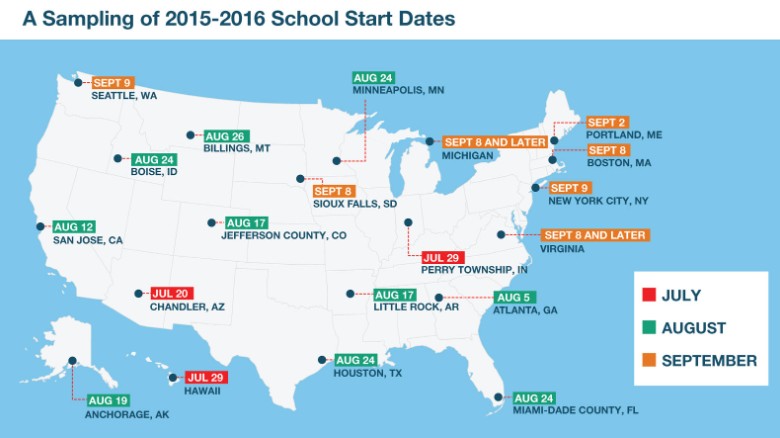
But, going by the school calendar, they were right. My son starts pre-kindergarten today at our neighborhood school. That's right -- August 5. It's the same for children in cities and towns across the country, including in Phoenix, Oklahoma City, Indianapolis and Monterey, California. Lots of schools join them the following week and all throughout August.
We're not smashing any records here. In Hawaii and parts of Indiana and Arizona, kids have been in class since late July.
Having grown up in New England, where I was still writing letters home from summer camp in late August, I was perplexed and awash in nostalgia-fueled angst. What happened to school starting after Labor Day?
    It turns out a lot of parents have the same question, and there are answers.
    But first, a short history of school calendars: Kids didn't always have summers off. In fact, summer vacation as we know it is a pretty recent phenomenon. When the public education system started in the 1800s, calendars varied depending on the needs of the community. In cities, schools were open practically year-round, up to 240 days a year. Rural schools, on the other hand, were open for only about five months over two sessions, in the winter and summer. Fall and spring, school was out so children could help harvest the crops and help with planting, said John Rury, a historian of American education at the University of Kansas.
    By the late 1800s, a concern for the professionalization of teachers, periodic financial shortfalls and "the ill effect of too much schooling on students' and teachers' health" were among the factors that moved school leaders to eliminate the summer term, said Kenneth Gold, interim dean of education at The College of Staten Island/CUNY and the author of "School's In: The History of Summer Education in American Public Schools."
    In the early 20th century, the rural and urban districts came into alignment so pretty much everyone had a 180-day school year that started after Labor Day and ended in June.

    OK, so when did August become the new September?

    There are more than 12,000 school districts in the country, and all sorts of laws and reasons govern when they can start and who decides. All the education experts I spoke with seemed to agree that through the 1980s, Labor Day still ruled. But by the mid-1990s, especially in the South, districts began to hop aboard the August train. The last time schools started after Labor Day in my current home of Atlanta, it was 1996.
    This year, districts in states from Florida to Kansas to California will start in August and end around Memorial Day.
    There are still plenty of schools that start after Labor Day. The later date is popular in the Northeast, for one, and in Michigan and Virginia, there are state laws backed by the local tourism industry that prohibit schools from starting before Labor Day unless they have a waiver.
    But, even in those two states, some schools are starting in August. This year in Virginia, students in Prince William County will start school before Labor Day for the first time.

    Why start before Labor Day? Do schools hate summer?

    I spoke with several education professors and the head of scheduling for Atlanta Public Schools, and they offered several reasons:
    • An earlier start date gives teachers more instructional time before statewide assessment tests in the spring. Several experts agreed that this is one of the biggest factors pushing calendars back.
    • Beginning in August allows students to complete the first semester before the December holiday break, rather than taking tests and turning in big projects after two weeks off. Teachers don't have to spend time reviewing material in January when they should be starting new lessons. Those were some of the reasons given by the Los Angeles Unified School District when it moved up its start date in 2012.
    • Starting early allows for a fall break in September or October and a winter break around February, in addition to breaks around Thanksgiving, Christmas and Easter. Teachers are happier and kids behave better when they have more breaks throughout the year, said Rebecca Kaye, the Atlanta Public Schools policy and governance adviser, who makes the yearly calendar. "Learning is hard work, and teaching is hard work, and people need breaks," Kaye said. "We have gotten feedback from our employees that they need that time."
    • When you start after Labor Day and end school in June, that last month is simply not taken as seriously. "That end of the year is perceived as being time that is sometimes not used to the maximum value," Kaye said. And in fact, when Atlanta schools ended in June, a lot of kids simply didn't show up after Memorial Day. "Even though we were having school after Memorial Day, people had it in their minds that school ended. It may seem ridiculous, but that's what happened."
    • Many graduating students and staff members take summer courses at colleges and universities. Ending school around Memorial Day creates fewer conflicts for them.
    I guess those reasons trump my nostalgia. But isn't it too hot for school in August? Is that the best use of money?

    Wouldn't schools save money by starting later?

    That's what some critics argue. They say that earlier dates put extra pressure on schools' air-conditioning systems and that it would be less expensive to have summer vacation during the hottest part of the year.
    Atlanta Public Schools analyzed the costs and determined that there would be minimal, if any, savings by shifting the school year. There are people working in the schools pretty much year-round. "Schools are bustling with activities: summer school programs, summer camps and maintenance activities. And you can't just shut down the air conditioning; the technology requires a certain amount of climate-control to protect the equipment," Kaye said.

    Fine. Maybe it's not so bad ...

    I'll get used to this calendar, Kaye says. She points out that parents like me tend not to be quite as nostalgic for school in late June. Getting out at Memorial Day is nice, and I suppose June is a lovely time to vacation. Unfortunately, it probably means my kids won't be able to attend one of the summer camps in New England that ends a week after our schools have started. She sympathizes with my plight. But she has more pressing concerns.
    If it was up to her, she says, she would extend the school year even longer, like the urban schools in the 1800s.
    "I would love to have that 220-day calendar, because our kids -- the majority of the students in the system -- if they're not in school, they're not learning."
    When does your child start school? Is it too early, too late or just right? Weigh in with CNN Parents on Facebook.

    No ‘public purpose’ in school vouchers | News & Observer

    No ‘public purpose’ in school vouchers | News & Observer:

    No ‘public purpose’ in school vouchers 


    The N.C. Supreme Court’s vote to overturn the ruling that the education voucher program is unconstitutional means taxpayer funds will now flow freely to schools that are not required to have trained or certified teachers, any identified or minimum curriculum, any accreditation or criminal background checks for employees and that can discriminate on the basis of religion.
    And as the state continues to struggle to meets its obligation to provide all students with a “sound basic education,” millions of dollars of public money will now go to support schools that are not subject to the fundamental education mandates of our state constitution.
    The 4-3 decision was grounded in the determination that despite sending state funds to private entities, the voucher program is somehow consistent with the public purpose doctrine of the state constitution, which requires that with the expenditure of state funds, “the ultimate gain must be the public’s, not that of an individual or private entity.” A constitutionally permissible public purpose must involve “a reasonable connection with the [the state’s] convenience and necessity; and . . . benefits the public generally, as opposed to special interests or persons.”
    The majority first declares that giving public money to “lower-income families so that their children have additional educational opportunities is well within the scope of permissible governmental action and is intimately related to the needs of our state’s citizenry.” Setting aside the obvious disconnect between this purported goal and the numerous other recent legislative acts that have made it more difficult for poor children to gain access to quality educational resources, this is an interesting descriptor: “lower-income.” Currently, voucher-eligible families must earn at or below 133 percent of the income qualification for the free or reduced-price lunch program. But every other voucher program across the country that was initially touted as giving educational opportunity to poor children was quickly expanded to include middle class families.

    Immediately in the wake of the court’s ruling, legislative leaders talked about raising the eligibility requirements here. But does this language in the majority opinion mean that if the eligibility criteria are expanded, the program would violate public purpose doctrine? And as to benefiting the public generally, while the majority repeatedly touts that promoting educational opportunity is good for our state, it ignores the fact that similar programs elsewhere have led to divestment from the public schools where the vast majority of children (especially poor children) are educated.

    As the dissents point out, the overwhelming evidence shows that voucher programs increase racial and socio-economic isolation of students and “exacerbate, rather than alleviate, educational, class, and racial divides.” Nothing in our state’s voucher plan prevents the same result. Moreover, our state’s flawed plan lacks the substantive educational standards that other jurisdictions impose on schools receiving vouchers.
    The same week our state Supreme Court issued the voucher ruling, in another Wake County courtroom Judge Howard Manning explained that the failure to provide a certified teacher in every classroom is a per se violation of the constitutional mandate established by that same Supreme Court in its Leandro decision in 2004. In fact, none of the metrics established toNo ‘public purpose’ in school vouchers | News & Observer:


    Read more here: http://www.newsobserver.com/opinion/op-ed/article29978790.html#storylink=cpy

    Tuesday, August 4, 2015

    The 74 Campbell Brown - Bill Gates Connection


    The 74 Campbell Brown - Bill Gates Connection

    WIN - WIN 


    Settlement approved on Bill Gates’ horse poop code case
    WELLINGTON — Billionaire philanthropist and Microsoft founder Bill Gates has 30 days to pay $30,600 in Wellington to clear up code violations involving a misplaced manure bin.
    The infractions against Gates’ Mallet Hill estate were resolved during a hearing Thursday. The case was part of the consent agenda approved without comment by village special magistrate Rafael Suarez-Rivas.


    Settlement approved on Bill Gates’ horse poop code case photo
    Dimitrios Kambouris/Getty Images

    There was no discussion about the settlement Gates’ representatives reached with the village. The $30,600 settlement is a markdown of 80 percent from the total fines that had accumulated,which happens frequently with code compliance cases in Wellington.
    Special magistrates in Wellington are appointed attorneys who serve as judges in deciding code enforcement cases. They almost always accept the recommendations or settlements presented to them by Wellington’s code compliance office, and that’s what happened Thursday with Gates’ case.
    A private trust affiliated with Bill and Melinda Gates bought a 4.5-acre, $8.7 million home in the village’s Mallet Hill community in April 2013. Their daughter, Jennifer, is a competitive show jumper who has shown at Wellington’s Winter Equestrian Festival.
    In January 2014, a village inspector found an existing horse waste bin was built too close to a nearby canal and the one the Gates family built to replace it elsewhere on the property wasn’t permitted, and the Gates family was cited for two code violations.
    The family said in the fall that they didn’t know about the violations until then because an incorrect contact address had been listed with the property appraiser. A spokeswoman at the time chalked up the case to a paperwork mistake and said the family was working to fix the infractions.
    Fines of $250 a day on each of the two violations accumulated to about $148,000 until they ceased last month when the problems were ultimately corrected.Settlement approved on Bill Gates' horse poop case in Wellington | www.palmbeachpost.com:

    Related: Big Education Ape: Campbell Brown Announces a Nationwide Recall of BROWN SOUP Due to Mislabeling http://bit.ly/1STpGXQ