Latest News and Comment from Education

Tuesday, August 4, 2015

Schools Matter: With Friends Like These...redux

Schools Matter: With Friends Like These...redux:

With Friends Like These...redux


By Ken Derstine @ Defend Public Education!
August 4, 2015

Leaders of the U. S. Congress are beginning meetings of a Conference Committee to reconcile differences in the Senate and House versions of the Elementary and Secondary Education Act. They are hoping to revise the 1965 ESEA that was reauthorized as No Child Left Behind in 2001. If they can reconcile the drastically differing Senate and House versions, after a five-week summer vacation, the plan is to send it to President Obama for his signature or veto by the fall. Who sits on the committee is a controversy in itself.

On July 28, 2015, the Network for Public Education issued an analysis of the two versions being debated in the ESEA Conference: ESEA Conference: Accountabilty vs. Title I Portability. While it contains some good description of the contrasts in the two versions, it does not explain what is behind the conflicts in Congress over federal education policy. This article will go into what is behind these disagreements and what they portend for the future of education, and the struggle for an equitable education for all, in the United States.

The House vs. Senate version of the ESEA rewrite

The House version of the bill, known as the Student Success Act, mainly focuses on reducing the role of the federal government in education making education policy an issue of states rights. Being reintroduced in the Conference Committee, after being rejected in its original bill, is the allowance of the use of Title I funding to be used by parents from low-income families for vouchers to private and parochial schools.

The Senate version of the bill, known as the Every Child Achieves Act, is a bipartisan piece of legislation that focuses on accountability. Neoliberal Democrats hope to restore a form of the amendment of Senator Chris Murphy (D-CT) that would require states to establish state designed goals based on standardized testing. It would require states to intervene in the lowest scoring 5 percent of schools and those that graduate less than 67 percent of their students. It was voted down in the Senate by 43-54. Only two Democrats rejected this corporate education reform measure that is being used to close public schools and reauthorized them as charters in low-income communities. It was voted down because a majority of Republicans saw it as a violation of their ultimate goal of reducing the federal role in education.

Teacher educator Deborah Duncan Owens says this of the Senate version, that besides continuing standardized testing,

“Second, nearly 10% of the bill is devoted to the expansion of charter schools.  The entire bill is 601 pages. The first 11 + pages consist of a table of contents.  That leaves 590 pages of text. Fifty-five of those pages — nearly 10% — outline a plan to expand charter schools.  I think the record is clear that charter schools are problematic.  Remember — the charter school movement emerged from the voucher and choice movement. Milton Friedman’s own Schools Matter: With Friends Like These...redux:

Dorn and Duncan Jeopardize the Careers of 181 Teachers Over a Clerical Error - Living in Dialogue

Dorn and Duncan Jeopardize the Careers of 181 Teachers Over a Clerical Error - Living in Dialogue:

Dorn and Duncan Jeopardize the Careers of 181 Teachers Over a Clerical Error 


By David Spring.
On Saturday, August 1, 2015, KIRO News in Seattle Washington reported that the careers of nearly 200 highly qualified and highly experienced teachers in the Kent School District were being placed at risk due to a clerical error. Here is a link to their report.
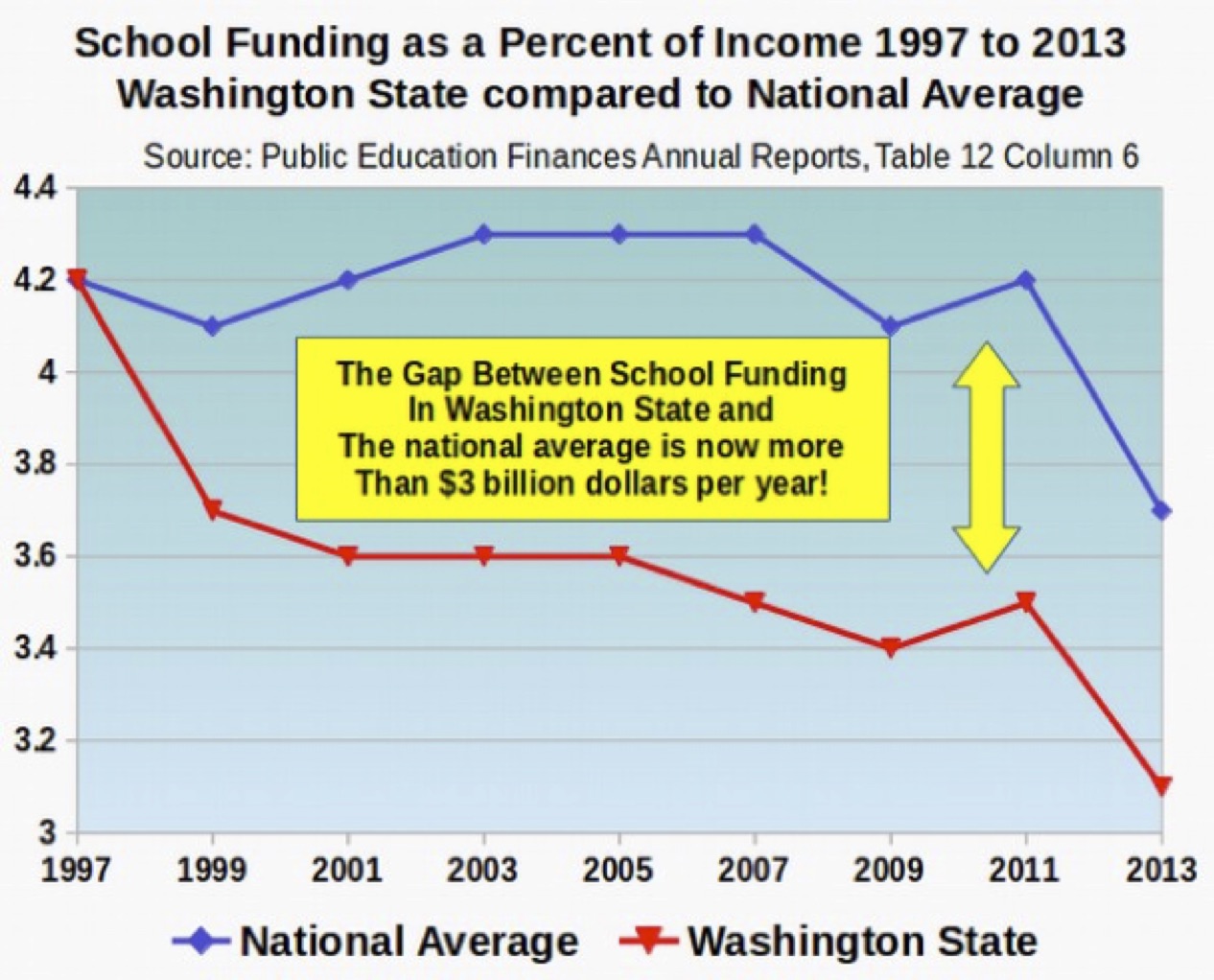
Keep in mind that teachers (and students and parents) in Washington state are already forced to deal with among the lowest school funding and highest class sizes in the nation. School funding is so low in Washington state that in September 2014, the Washington State Supreme Court held the State legislature in “Contempt” for failing to follow our State Constitution which calls funding schools the “Paramount Duty” of the State legislature.
Also because of this extremely low level of school funding, teacher Cost of Living Adjustments have been canceled by the legislature nearly every year since the 1990s. This is despite the fact that voters approved an Initiative requiring the legislature to at least give the teachers a cost of living adjustment and recently passed another Initiative to lower class sizes in our schools. So the legislature is ignoring the state constitution and the will of the voters and the direct order of our Supreme Court. And because of all of this, teachers today are making about 30% less in buying power than they made in the 1990s while they are responsible for teaching in much larger classes. So our teachers in Washington state are already being hammered.
wafunding
Now, we learn that 181 of our dedicated but already hammered Washington state teachers are having their careers put at risk due to a clerical error. Tell me this is not true. So I looked into it. Sadly, it is true. In fact, I hope you will keep reading as this story sounds like it is straight out of Alice in Wonderland. We will let you figure out who is playing the part of the Mad Hatter.
To be fair, I contacted both the President of the Kent Education Association and the Superintendent of Public Instruction to get their views on what the problem was. How could the careers of hundreds of teachers be put at risk due to a clerical error? And what is being done to help them?
First here is the email I received from Christie Padilla, the President of the Kent Education Association (note that she is also a teacher in the Kent School District):
You are correct that the Kent School District did not file the correct information with 
Dorn and Duncan Jeopardize the Careers of 181 Teachers Over a Clerical Error - Living in Dialogue:

Landmark UN Resolution Urges States to Monitor and Regulate Private Education Providers | Right to Education Project

Landmark UN Resolution Urges States to Monitor and Regulate Private Education Providers | Right to Education Project:

Landmark UN Resolution Urges States to Monitor and Regulate Private Education Providers


UN Human Rights Council


(Geneva, 2 July 2015) Eight international civil society organisations today welcomed a landmark resolution of the United Nations Human Rights Council (HRC) urging States to regulate and monitor private education providers and recognising the potential “wide-ranging impact of the commercialization of education on the enjoyment of the right to education”.
The HRC is the leading global inter-governmental political body dealing with human rights. In the resolution adopted by consensus of its 47 members, the HRC has, for the first time, responded to the growing phenomenon of privatisation and commercialisation of education.
This phenomenon, and in particular the emergence of large-scale for-profit “low-cost” private school chains targeting poor families in developing countries, has received heightened attention from civil society organisations and UN expert bodies alike in recent months.
Camilla Croso, of the Global Campaign for Education, reacted: “the rapid, unregulated growth of private providers of education is already creating - and enabling - violations of the right to education, threatening to erase the last 50 years of progress in access to education. This resolution shows that States have realised that they must act now to regulate such providers - before it is too late.”
Sylvain Aubry, of the Global Initiative for Economic, Social and Cultural Rights  elaborated: “Our research has consistently shown that privatisation in education leads to socio-economic segregation and discrimination against the poorest children in schools, in violation of States’ obligations, as was recently recognised in the case of Chile. The resolution adopted today, crucially highlights the obligation to provide educational opportunities for all without discrimination.
The resolution demands that States “put in place a regulatory framework” that establishes minimum norms and standards for and “monitor private education providers”. Delphine Dorsi, of the Right to Education Project, commented: “This is a very welcome reminder of States’ obligations under international law to regulate private education providers, at a time when a growing number of education providers, in particular multinational education companiesare taking advantage of weak regulation in some countries to make profit to the detriment of parents and children’s rights”.
The HRC resolution also calls on States to ensure that “education is consistent with human rights standards and principles”. Angelo Gavrielatos, of Education International, explained: "The evidence is quite clear. The growing commercialisation and privatisation of education is undermining the right to quality education. Governments cannot be allowed to abrogate their obligation to provide quality public education for every child. As recognised in human rights treaties, education is a fundamental pillar for a dignified life and must be protected as such.”
Crucially, the resolution confirms that “education is a public good”. According to Tanvir Muntasim, of ActionAid International, “this is the third time within a year, following the May 2014 UNESCO Muscat Agreement and the May 2015 Incheon Declaration, where States have described education as a public good. It is a striking response to the actors that have been trying to reduce education to a private commodity, rather than a universal right.” 
The HRC insists in the resolution on the “significant importance of public investment in education, to the maximum of available resources”. For Katie Malouf Bous, of Oxfam International, “Too many governments have neglected their duty to adequately finance education, leading to weakened public schools and increased privatization as the inevitable result. Serious and substantial investments to provide good quality public education must be the antidote to privatization.
Finally, the resolution asks States to “support research and awareness-raising activities to better understand the wide-ranging impact of the commercialization of education on the enjoyment of the right to education”.  Ian Macpherson, of the Privatisation in Education Research Initiative, stated: “We have been working with partners over the past few years to research the social justice implications of the growth of private actors in education, and we stand ready to collaborate with States to implement this resolution and increase and strengthen research and dialogue on this crucial issue.”
It is now time for all stakeholders to firmly take action to implement this resolution” concluded Tony Baker, of Results Educational Fund. “This particularly concerns States but also international institutions and donors, like the World Bank, that have been investing in for-profit, fee-charging private schools in recent years. These investments need to align with global and national efforts to achieve free, universal education for all to harness education’s power to break the cycle of poverty. Development actors, in addition to governments, must act in accordance with international human rights law.”  
END
Notes
The organisation that welcomed the Resolution are:
Documents
•        The resolution of the Human Rights Council can be found on: http://bit.ly/1IQEGAj
•        A summary of recent concluding observations from UN human rights bodies on privatisation in education: http://bit.ly/1QPZmlz
•        The last report of the report of the UN Special rapporteur on the right to education on the commercialisation of education: http://bit.ly/1CsI569
- See more at: http://www.right-to-education.org/news/landmark-un-resolution-urges-states-monitor-and-regulate-private-education-providers#sthash.fOlITiZe.dpuf

Important Survey from SCUSD Board of Education

Important Survey from SCUSD Board of Education:


Important Survey for SCUSD Families

Dear SCUSD Families:

The Board of Education is seeking feedback from our community about the service our schools and central office provide to students and families. Please take a moment to participate in this brief survey (click here) – this is your opportunity to let your voice be heard. Survey results will be shared with the Board and our administrative team and will help us identify our strengths and areas that need improvement. Thank you!

SCUSD Board of Education

Marie Corfield: .@GovChristie He-Man Woman Haters Club Part 2

Marie Corfield: .@GovChristie He-Man Woman Haters Club Part 2:

.@GovChristie He-Man Woman Haters Club Part 2

While attending the NEA Representative Assembly (RA) in Orlando last month, I posted Part 1 of this series after the Essex County Education Association staged a very successful protest rally outside Gov. Christie's campaign kick-off event at his alma mater, Livingston HS. The social media memes followed, and this one caught my eye:


Yes, he really said that to a woman at a public event. Go to Part 1 to see the video. To this day, I still don't know why that comment didn't torpedo his career (and people complain about the 'liberal media'). It's vulgar and disgusting—especially coming from a sitting governor with White House aspirations. But apparently enough people in NJ liked that kind of crass talk enough to elect him twice. Go figure.

Right now Christie's feeling the heat. Not to be trumped by Trump as the King of Mean, and desperate to make the cut for this week's debate, Christie needed some additional press, so he took to the airwaves and lashed out at his favorite target: women—
Marie Corfield: .@GovChristie He-Man Woman Haters Club Part 2:


Teachers are spending thousands of dollars of their own money to stock classrooms with basic supplies

Teachers are spending thousands of dollars of their own money to stock classrooms with basic supplies:

Teachers are spending thousands of dollars of their own money to stock classrooms with basic supplies


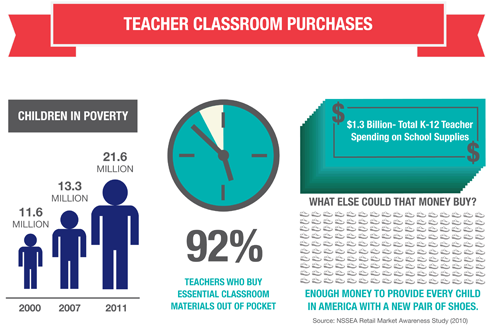
School may be out for summer, but I guarantee you there’s one thing teachers are already worried about as they plan for the coming school year: how they’ll offset the inevitable out-of-pocket costs that come with running a classroom.
It’s not just a few books or art supplies we’re talking about here; the truth is much more discouraging. During my last year of teaching, I spent over $5,000 of my own money on my classroom during the year, and I know I wasn’t alone. On an annual salary of $42,000, that was hardly pocket change.
The Reason Teachers Have to Pay
In the United States, it has become increasingly clear, we just don’t value education.The average starting teaching salary in the US in 2012-2013 was $36,141, notably low considering that even intern teachers require a bachelor’s degree, plus credentialing for those who remain in the profession. In one of the country’s most expensive cities, San Francisco, a beginning teacher made just $47,902 during the 2014-2015 school year, far from enough to live on as a sole source of income when a1 bedroom apartment in SF averages $3,213/mo (that adds up $38,556 per year — more than 80% of the pre-tax income).
Every part of education in the United States has its own set of financial woes, but teachers bear the brunt of the burden. Many public schools, even districts located in wealthy areas, do not give their teachers any money for supplies; those that do may only provide $200 – $250 per classroom (and those funds are often distributed only to new teachers). In some areas, the PTA (parent-teacher association) steps in with a modest but helpful stipend to each teacher at the beginning of the school year. But even the more generous PTA grants of $500 or higher don’t provide for much past the initial setting up of a classroom. And relying on private donations only works in middle- and upper-class areas, thereby increasing disparity. I taught in a poor neighborhood in Oakland, and we never had a functioning PTA in the eight years I was employed there.
A Tour of Expenditures
I was shocked my first year of teaching, when I found myself spending several hundred dollars just to set up the classroom for the first day of school. The school provided desks, chairs, tables, textbooks, and not a lot beyond that. There were a few “free reading” books, but they looked like they were decades older than the children and hadn’t been treated well.
New and naïve, I asked the office where I’d get supplies. The office clerk let me into the supply room and counted out my supplies for the first part of the year: one box of crayons per child, two pencils per child, 10 rulers, lined paper, composition books, and some markers. She gave me some chalk and when I pointed out that I had whiteboards and needed dry erase markers, just shrugged and said, “Do you want the chalk or not?” I looked around and requested a stapler and staples, tape dispenser and tape, construction paper, and some more markers. That was all there was.
I asked where I got scissors, and the office clerk laughed and suggested I visit the nearest office supply store. Also not in the school supply room: permanent markers, paints in any color except shades of brown, paintbrushes, tissues, hand sanitizer, soap, glue, glue sticks, erasers, folders, pencil sharpeners, binders, or spiral notebooks.
Those were just the basics. A good teacher who wants to make her students feel welcome on the first day of school needs a lot more. Most of us buy welcome posters to hang on our door, writing our name and grade level, sometimes with all the Teachers are spending thousands of dollars of their own money to stock classrooms with basic supplies:

Big Easy, Hot Mess | EduShyster

Big Easy, Hot Mess | EduShyster:

Big Easy, Hot Mess

Why New Orleanians are turning against the city’s education reform experiment…


Here is all you need to know about the New Orleans schools before Hurricane Katrina hit, ten years ago this summer: they were awful. The schools were awful, the school board was awful, the central office was awful—all of them were awful. At a recent conference held to tout the progress made by the schools here since Katrina, Scott Cowen, an early proponent of the all-charter-school model that exists here now, described New Orleans’ pre-storm schools as mired in *unprecedented dysfunction.* In other words, they were awful.
The problem with a story like this isn’t just that it leaves out anything that doesn’t fit but that it can be hard to contain once it gets going. Before long, this *awfulizing narrative,* as it was described to me more than once during the ten days I recently spent in New Orleans, spread past the school yards and central offices, sweeping up in its wake parents, children, indeed the whole hot mess that is New Orleans. The awful story was at the root of the decision to fire 7,000 teachers after the storm, the majority of whom were Black New Orleanians and the backbone of the city’s middle class. It is the reason why so few locals can be found among the ranks of education reform groups here. And it is a rarely acknowledged justification for the long school day favored by charters here—ten, even 12 hours when you factor in the cross-city bus trips that a choice landscape necessitates.
New Orleans classroom*When you start from the point of view that the communities these kids come from are broken, then the goal becomes to keep kids away from them as much as possible,* says Deirdre Johnson Burel, the executive director of the Orleans Public Education Network or OPEN, which seeks to engage community members around school-related policy issues. *It’s a way of containing and insulating kids from their own families.*
An advocate of school reform in New Orleans long before the cause was cool, not to mention lucrative, Burel doesn’t fit the pre/post Katrina schools narrative at all. A native New Orleanian, Burel is a proud graduate of McMain High School, then a magnet school, now part of the Orleans Parish School Board, still one of the city’s best. She was an early proponent of charter schools here, including the city’s first, NOLA Charter Middle School. *I worked in the district and saw the disfunction. I saw what a difference it made for children and families when schools had autonomy and a community could create something for its own children.*
But when Burel looks at the version of education reform that has taken root in New Big Easy, Hot Mess | EduShyster:

Online Education News: Boring Glut — Or Golden Age? | The Grade | The Washington Monthly

Online Education News: Boring Glut — Or Golden Age? | The Grade | The Washington Monthly:

Online Education News: Boring Glut — Or Golden Age?

By Alexander Russo


Adsfadsfadsf


Mark Walsh’s new package of stories about the growth of online education outlets is worth a read for any education journalist or coverage-watcher.
While there’s nothing particularly new or different from what you may already know about the current education media landscape, the EdWeek package includes a lot of useful information in one place and some interesting observations (including one from me, for what it’s worth).
It includes a main story (Crowded Field of Online News Sites Focuses on Education Issues), a sidebear about Chalkbeat (Chalkbeat Wields Web to Boost Local Ed.-News Coverage), and a 2nd sidebar about so-called “advocacy” journalism (Some Online Sites May Blur News, Advocacy Line).  There’s also a nifty graphic featuring all the different sites that are discussed (see full version below).
The gist of the main piece — no surprise — is that there is an awful lot of education news out there these days, primarily available online, that has offset to some degree the decline of legacy and print coverage:
“The past two years or so have seen a boom in online news outlets covering education. New local and national sites are focusing exclusively on the subject; general-interest sites have education beat reporters or otherwise include K-12 issues in their mix.”
Over all, it’s been “been pretty good for education reporting,” says LynNell Hancock, a professor at the Columbia University Graduate School of Journalism, who’s quoted in the piece. “There are far more places now that are doing serious, long-form education reporting… And there are more places for reporters to do this kind of work than ever before.”
USC professor Morgan Polikoff tends to agree, according to his quotes in Walsh’s piece:  “I think there is more quality journalism about education than when I started doing this a decade ago.”
But it’s a pretty crowded field, in terms of quality and trustworthiness, including “innumerable blogs” by teachers, education leaders, and think tanks. And for some — including those studying the field, “There is kind of an information overload.”
In response, some educators like Joshua Starr and Michael Lubelfeld rely on aggregators to help sift the torrent.
The issue of credibility is pretty obvious. Advocacy-oriented sites like The Seventy Four must not only inform those who agree with the views of the outlet but also generate a certain amount of credibility to outsiders. “We’ll all be reading with interest to see if the coverage here will rise above,” says Hancock about The Seventy Four. 
Too much of an effort at fair-mindedness creates its own problems, however. “I feel like writing without a perspective is pointless,” according to The Daily Caller’s Eric Owens. “I feel a lot of [education journalism] is really boring and not fun to read.”Online Education News: Boring Glut — Or Golden Age? | The Grade | The Washington Monthly:

What’s Wrong with Education in Louisiana and Some Ideas On How to Fix it | Crazy Crawfish's Blog

What’s Wrong with Education in Louisiana and Some Ideas On How to Fix it | Crazy Crawfish's Blog:

What’s Wrong with Education in Louisiana and Some Ideas On How to Fix it


 FLIP THE 
LOUISIANA BOARD OF ELEMENTARY AND SECONDARY EDUCATION 
( BESE)


Louisiana Voters,
A few months ago I had a meeting with Lane Grigsby about my candidacy for BESE.
For those of you who don’t know, Grigsby is one of the chief funders of the education reform movement in Louisiana. Investigative journalist Lee Zurik did a multi-segment story on corruption in Louisiana politics called Louisiana Purchased, and he discovered that Grigsby, owner of Cajun Industries and one of the chief supporters of LABI (the pro-privatization business lobby) was one of the most prolific funders of political candidates in Louisiana and was able to bypass many of the individual spending limits by having family members, PACs he formed, and as many as 17 companies he owned or controlled donate the maximum allowable amount to candidates he was supporting.
I wasn’t seeking funding. I was seeking some understanding of why he was getting involved in education and why he held the stands and beliefs he did. (Grigsby apparently didn’t know who I was which is why he agreed to meet with me. I knew I was diametrically opposed to him on almost every issue.)
While we disagreed on almost everything in our meeting, Lane brought up a very important point that I was overlooking.
“Besides kicking out John White, what are you actually going to do to improve education in Louisiana?”
My focus had been on fighting the BESE board, LDOE, and returning ownership of the public education system to the people of Louisiana.  I hadn’t really considered what I would do if I was placed in a position where I could actually work to improve things!
For the past two months I have been doing much less talking and writing and much more listening and analyzing.  This is probably not going to win me more votes, but getting elected is not really the most important thing, is it?  Improving our education system and the outcomes of our children and thus the future of our people and our state is a much more important long-term goal.
Win or lose the upcoming election, I believe I’ve already accomplished my short-term mission of showing how ordinary people can get involved with their government to try and make things better.
But let’s get back to the whole improving education part.
Despite all the “reforms” Louisiana has undertaken over the past decade our outcomes really haven’t improved all the much, now have they?
10 years ago Louisiana was in a 5 way tie for 44th place (out of 52 States + DC + territories) on the NAEP exam for 4th grade Mathematics. (NAEP is a long term national test used for comparing states to each other and to themselves longitudinally.
NAEP2004
For a snapshot of what this lack of growth looks like over time, refer to the chart below. Notice how the gap between Louisiana and the rest of the country has only widened under the current administration and their misguided policies.
NAEP2004graph
In 2013, Louisiana was just 2 tenths of one point (out of 500), ahead of Mississippi. We’ve actually lost a lot of ground compared to other states, despite the continuous claims of success issued by Lousiana’s state Education Board, Governor Jindal – now finishing up the 8th year of his term consecutive terms and running for President, and the Louisiana What’s Wrong with Education in Louisiana and Some Ideas On How to Fix it | Crazy Crawfish's Blog:

National teacher union: Christie ‘a bully and has anger management problems’

National teacher union: Christie ‘a bully and has anger management problems’:

National teacher union: Christie ‘a bully and has anger management problems’


MANCHESTER, N.H. -- A national teachers union leader lashed out at Gov.  Chris Christie Monday, calling the presidential hopeful a "bully" with "anger management problems."
American Federation of Teachers President Randi Weingarten reacted to Christie after the Republican governor said over the weekend the group deserves a punch in the face. The union leader criticized Christie for promoting a culture of violence.
"Chris Christie has issues--from reneging on his promise to fix pensions to his state's fiscal standing facing near junk bond status. But the biggest issue is he's a bully and has anger management problems," Weingarten said in a statement.

RELATED:  NJEA calls on Christie to resign for 'bully' comment (VIDEO)


"That he would threaten to punch teachers in the face -- mostly women seeking to help children meet their potential and achieve their dreams -- promotes a culture of violence and underscores why he lacks the temperament and emotional skills to be president, or serve in any leadership capacity," she said. "It's a sad day in the life of our nation to see a candidate threaten violence to gain political favor."
The statement from the national group came a day after New Jersey's largest teachers union, the New Jersey Education Association, called on Christie to "resign as governor immediately" over his comments.
Christie sparked outrage from the groups in response to his interview with CNN's Jake Tapper on "State of the Union."
"They're not for education for our children," Christie told Tapper. "They're for greater membership, greater benefits, greater pay for their members. And they are the single most destructive force in public education in America. I have been saying that since 2009. I have got the scars to show it. But I'm never going to stop saying it, because they never change their stripes."
Christie suggested the national teachers' unions deserved to be punched in the face when he responded to a specific Tapper question that used the "punch in the face" phrase.
"During your first term as governor, you were fond of saying that you can treat bullies in one of two ways -- quote -- 'You can either sidle up to them or you can punch them in the face.' You said, 'I like to punch them in the face.' At the national level, who deserves a punch in the face?" Tapper asked.
Christie responded: "Oh, the national teachers' union."
The governor is scheduled to be in Manchester Monday afternoon for a meet-and-greet session before taking part in a GOP forum hosted by the Union Leader.

EVAAS, Value-Added, and Teacher Branding | VAMboozled!

EVAAS, Value-Added, and Teacher Branding | VAMboozled!:

EVAAS, Value-Added, and Teacher Branding


VAMboozled!


I do not think I ever shared this video out, and now following up on another post, about the potential impact these videos should really have, I thought now is an appropriate time to share. “We can be the change,” and social media can help.
My former doctoral student and I put together this video, after conducting a study with teachers in the Houston Independent School District and more specifically four teachers whose contracts were not renewed due in large part to their EVAAS scores in the summer of 2011. This video (which is really a cartoon, although it certainly lacks humor) is about them, but also about what is happening in general in their schools, post the adoption and implementation (at approximately $500,000/year) of the SAS EVAAS value-added system.
To read the full study from which this video was created, click here. Below is the abstract.
The SAS Educational Value-Added Assessment System (SAS® EVAAS®) is the most widely used value-added system in the country. It is also self-proclaimed as “the most robust and reliable” system available, with its greatest benefit to help educators improve their teaching practices. This study critically examined the effects of SAS® EVAAS® as experienced by teachers, in one of the largest, high-needs urban school districts in the nation – the Houston Independent School District (HISD). Using a multiple methods approach, this study critically analyzed retrospective quantitative and qualitative data to better comprehend and understand the evidence collected from four teachers whose contracts were not renewed in the summer of 2011, in part given their low SAS® EVAAS®scores. This study also suggests some intended and unintended effects that seem to be occurring as a result of SAS® EVAAS® implementation in HISD. In addition to issues with reliability, bias, teacher attribution, and validity, high-stakes use of SAS® EVAAS® in this district seems to be exacerbating unintended effects.EVAAS, Value-Added, and Teacher Branding | VAMboozled!:

Paraeducator Applauded for Her Local's Fight Against Outsourcing - NEA Today

Paraeducator Applauded for Her Local's Fight Against Outsourcing - NEA Today:

Paraeducator Applauded for Her Local’s Fight Against Outsourcing


Marla Lipkin at Netroots Nation.


Thousands of social justice advocates, grassroots organizers, bloggers, and other activists gathered for three days recently in Phoenix, Ariz., for Netroots Nation, an annual conference widely considered to be the nation’s largest gathering of progressives.


In addition to discussing immigration policy, income inequality, same-sex marriage, gun violence, and racial relations, attendees learned from paraeducator Marla Lipkin about her local’s anti-privatization campaign that saved 300 education support professional (ESP) jobs.


As a panelist, Lipkin, president of the Pennsbury Educational Support Professionals Association (PESPA) in Pennsylvania, explained how her local of 650 members was able to get organized, mobilize community members, identify business allies, work with the media, and emerge victorious without losing a single job position.


“Having the opportunity to attend Netroots and speak to other activists assures me that we are not alone in this [anti-privatization] fight,” Lipkin told attendees. “But we must keep telling our stories to raise awareness.”


Privatization, also known as “outsourcing” and “contracting out,” means transferring the work of public school and other public sector employees to the private sector. For parents and the community, privatization is a threat to the health and safety of students. For ESPs, privatization is another word for “fired!”


“I see more and more locals across the country facing the threat of privatization,” Lipkin told the gathering. “Our former school board was led by someone who wanted to destroy our union. He ran on the platform of not raising taxes. In order to do that, savings had to be found.”


Firing school support staff was identified as a means to cut costs. Once the school district started to consider outsourcing ESP jobs, PESPA’s paraeducators, bus drivers, clerical staff, custodial workers, information technology staff, and maintenance workers immediately organized a ground game.


“We knew we needed our community’s support to combat this threat,” Lipkin said.


PESPA members turned to Facebook, Twitter, and other social media to get the word out. They also created a website with photos of members in action, job classification descriptions, information on why privatization doesn’t work, and school board member contact information. There was also a direct link to PESPA’s petition, which asked community members to object to privatization. A Web page was also created to thank business owners for displaying posters in shop windows and restaurants.


“We also encouraged our union members to support those businesses,” said Paraeducator Applauded for Her Local's Fight Against Outsourcing - NEA Today:

Detroit school board alleges Gov. Snyder and EMs discriminate against black children | MLive.com

Detroit school board alleges Gov. Snyder and EMs discriminate against black children | MLive.com:

Detroit school board alleges Gov. Snyder and EMs discriminate against black children


DETROIT, MI — Creating a separate and unequal minority school system. Destroying neighborhood life in Detroit. Potentially allowing former Detroit City Council President Charles Pugh access to students after he was known to have a relationship with a high school student.
These are just a few of the serious charges leveled by members of the Detroit Board of Education toward Gov. Rick Snyder and emergency managers that have been in charge of Detroit Public Schools in a Title VI complaint released Monday.
The 162-page document is a meandering list of accusations from both school officials and anonymous individuals that paint Snyder and the emergency managers as racists looking to destroy public education in Detroit.
One of the most serious allegations in the expansive document is one section alleging former Emergency Manager Roy Roberts allowed Charles Pugh to mentor young men in the school system, despite the complaints of Board Member Lamar Lemmons.
Lemmons said it was well-known Pugh was dating a young man he met through a school program, and that was a cause for concern when it came to his participation in a mentorship program in Detroit schools.
"Pugh openly had young lovers about town who were the same age range as Frederick Douglas students. His sexuality was not the issue. What is at issue is the fiduciary responsibility to maintain a mentor-mentee relationship with students of all ages," Lemmons wrote in the complaint.
"Since Pugh's dating preference seemed to involved (sic) males in the same young adult range, it did not seem the best idea to put Pugh over young adult male students. Roberts went ahead giving special allowances to community influencers on the coalition list. This allowed Pugh his pick of hundreds of students."
Outside of that allegation, there are plenty of other grenades tossed at Snyder and the emergency managers who have been in charge of the district, including current Emergency Manager Darnell Earley.
Among the accusations is that teachers, parents and elected officials who speak out are yelled at intimidated; the Education Achievement Authority inflates grades of students to get them to graduate; the closing of schools has caused neighborhoods to fall into violence and school buildings in the district are unsafe.
Dave Murray, a spokesman for Snyder, said the rhetoric used by the board was "divisive."
"It's unfortunate that the Board of Education is using divisive rhetoric at a time when so many people are coming together to improve the quality of education in Detroit," he said.
"Gov. Snyder has been working with community leaders and our partners in the Legislature on proposals to give all students in Detroit the best possible education. Detroit needs strong public schools so students are prepared for college and careers, Detroit school board alleges Gov. Snyder and EMs discriminate against black children | MLive.com:

Union Access To New Teachers Treated Differently In Denver, Aurora | CPR

Union Access To New Teachers Treated Differently In Denver, Aurora | CPR:

Union Access To New Teachers Treated Differently In Denver, Aurora


Members of the Denver teachers union Monday said they are being shut out of the district’s new teacher orientation this week, hurting the association’s membership drive. Meanwhile, several miles east at the Aurora Public Schools new teacher orientation, that district’s superintendent encouraged new teachers to join the union.  

Aurora’s collaborative atmosphere, in which union officials sat in bright red shirts among tables of teachers fielding questions at Aurora's Professional Learning and Conference Center Monday morning, contrasted sharply with the scene at the Denver Performing Arts Complex the same morning.
Aurora Superintendent Rico Munn encouraged new teachers to join the union, saying it was a “valuable” tool for him to learn about the concerns of teachers and to work collaboratively on shared goals. 
Denver Public Schools is hosting more than 800 new teachers for an orientation before classes start in the largest school district in Colorado.  At the arts complex plaza and on sidewalks, security officers stopped black-T-shirted Denver Classroom Teachers Association members from handing out literature to new teachers.
Union officials said they weren’t allowed to host a table at the event, though the Denver Zoo, Delta Dental, and the Museum of Nature and Science all had tables. Veteran teachers said they tried to sit at the table of their parent organization, the National Education Association, but security intervened and said they couldn’t distribute information.
“I was expecting to have much more open and free access to new educators,” said teacher Aaron Lowenkron. “In the past, we were usually welcomed with open arms and this year it’s a lot of silence, a lot of mystery. From the outside looking in like they want to keep us out.”
He tried to distribute new member literature on the promenade but was told if he did that he would be ticketed by police.
A security official said when a “client” – the Denver Public Schools – rents the event space groups can’t simply hand out literature.  Though the Denver Performing Arts Complex facilities are owned by the city and county of Denver, “that does not mean they are public forums under the first Amendment of the Constitution of the United States,” according to a  DPAC “Free Speech Information Sheet” that was distributed to union members.
In previous years, the DCTA has hosted a breakfast for the hundreds of recently hired teachers at which they could provide information about the union. But this year, DCTA
- See more at: http://www.cpr.org/news/story/union-access-new-teachers-treated-differently-denver-aurora#sthash.pC2QNDjT.dpuf