Latest News and Comment from Education

Sunday, August 2, 2015

WHO IS LEADING THE LAUSD WITCH HUNT AGAINST TEACHERS- THE ANSWER WILL SHOCK YOU - Perdaily.com

WHO IS LEADING THE LAUSD WITCH HUNT AGAINST TEACHERS- THE ANSWER WILL SHOCK YOU - Perdaily.com:

WHO IS LEADING THE LAUSD WITCH HUNT AGAINST TEACHERS- THE ANSWER WILL SHOCK YOU


Barnes.jpg


(Mensaje se repite en Español)
How is it that the LAUSD's go-to outside law firm Sedgwick L.L.P. that was embroiled in the Miramonte Scandal and sanctioned for covering up evidence is running teacher investigations, teacher jail, and the current witch hunt into nationally acclaimed teacher Rafe Esquith?

As City Watch has previously reported, LAUSD's latest demand for 15 years of financial reports for the Hobart Shakespeareans non-profit as well as Rafe Esquith's own personal finances was answered by Esquith's friends with a rather novel and unprecedented 4 minute video featuring Hal Holbrook and Ian McKellen and students whose lives have been positively impacted.

Documents exclusively obtained by City Watch show how the video came about. It was in response to letters from the Sedgwick law firm supposedly representing LAUSD, but refusing to share their authority for making such an intrusive and invasive request without having given any legal justification for such a demand.

Here is the timeline of Sedgwick's involvement:

-July 8th Craig S. Barnes, Managing Partner of the Sedgwick law firm contacts the Geragos law firm and says, "This investigation is now about alleged financial issues relating to the Hobart Shakespeareans." What those issues are or whether they are justified in investigating Esquith is never addressed. And although they seek to do this in lieu of a subpoena, one must wonder why they didn't bring a formal legal action against Esquith, if they really had anything to justify such an intrusive investigation.

- July 14, 2015- Geragos law firm responds, "It is not clear (1) who at LAUSD appointed your firm counsel, (2) when your firm was retained, (3) whether disclosures were made to stakeholders regarding your significant billable rate for the witch-hunt against Mr. Esquith you apparently wish to bill away at, and (4) what authority you have. No response from either Sedgwick or LAUSD.

- July 20, 2015- Managing Partner Barnes from Sedgwick says, "investigation is designed to determine Mr. Esquith's compliance with government ethics laws in his actions with Hobart Shakespeareans." Again, as for any basis for thinking that Esquith has violated any "government ethics laws" or why a non-governmental entity like LAUSD or the Sedgwick law firm is investigating Esquith is a noticeable omission. And again there is no statement as to why Esquith's actions are being investigated in the first place.

- July 28th- Geragos law firm responds on behalf of Esquith, "Who hired you and who is paying you billable hour"- no response. Geragos now informs Sedgwick that, "Your July 20, 2015 letter to the Shakespeareans and your statements concerning Mr. Esquith constitute defamation of character per se. Still no response

- Esquith supporters respond with YouTube video in defense of Esquith and the Hobart Shakespeareans.

Since Sedgwick continues to refuse to respond to any WHO IS LEADING THE LAUSD WITCH HUNT AGAINST TEACHERS- THE ANSWER WILL SHOCK YOU - Perdaily.com:

Oregon Save Our Schools: Washington Tribal Leaders Strongly Question Standardized Education and Testing

Oregon Save Our Schools: Washington Tribal Leaders Strongly Question Standardized Education and Testing:

Washington Tribal Leaders Strongly Question Standardized Education and Testing


Robey Clark, a member of Oregon Save Our Schools, shared with us a letter that was sent to Washington State Superintendent of Public Instruction Randy Dorn by the governing tribes of the Washington State Tribal Compact Schools on June 5th, 2015. Mr. Dorn has yet to respond to the tribes.

As Kathleen Hagans Jeskey, of her Teacher Talks Truth blog, (she is also an Oregon BAT and member of Oregon Save Our Schools as well) states in her post regarding the tribal letter, "The sentiment in this letter can be broadly applied not only to Native students but to all students.  Our public schools are diverse. Students deserve to have their cultures recognized and respected. They deserve lessons that engage and speak to them, and they deserve to be evaluated in an authentic way. We must bring the humanity back to our schools. "

Thank you Robey Clark for sharing this with the public. 

Their official letter is presented below:

WASHINGTON TRIBAL COMPACT SCHOOL POSITION STATEMENT:

We, the governing tribes of the Washington State Tribal compact schools, hope to break the chronic cycle of failure among schools serving American Indian reservations. We intend to capitalize upon the opportunity presented by this new Tribal Compact School law by promoting the adoption of teaching practices which we believe to be more congruent with tribal cultures. In support of this effort, we intend to foster some important reforms in educational accountability methods that will encourage and reward a change in practice.

In recent decades, state and federal educational policy has focused on raising test scores for poor and minority students up to the general population average by the third grade (or soon after) in an effort to minimize the dropout rate. This policy has been a particular disaster for most public schools serving Indian reservations. The result has been a system that labels Indian children early; subjects them to continued remedial instruction; and fails to keep them engaged after the 4th grade. The over-emphasis on early grade test scores has evolved into a self-fulfilling (and self-perpetuating) prophecy of failure for Indian students. We believe it is this labeling effect, coupled with limited instructional methods that cause many if not most dropouts.

The Iroquois Sachem Canasatego once said to the English colonists of his time, “...you who are so wise must know that different Nations have different Conceptions of things and you will, therefore, not take it amiss if our Ideas of this kind of Oregon Save Our Schools: Washington Tribal Leaders Strongly Question Standardized Education and Testing:

Bangert: Education reform’s next trick? Teacher shortage

Bangert: Education reform’s next trick? Teacher shortage:

Bangert: Education reform’s next trick? Teacher shortage


What sort of gymnastics will state lawmakers try to pull off at this point to remedy a looming teacher shortage after years of running off potential, young candidates by convincing Hoosiers that public schools were essentially broken?
And will they actually be willing to shoulder some of the blame?
We’re about to find out.
Last week, the chairmen of the Indiana House and Indiana Senate education committees asked House Speaker Brian Bosma for a summer study into the creeping ambivalence to the teaching profession. It’s a situation that has depleted the ranks of undergrads studying education in state universities and put some districts on their heels when it comes to recruiting for open positions.
In their letter to Bosma, Rep. Robert Behning and Sen. Dennis Kruse laid out numbers that have pricked up ears in recent months. New data from the state show that “licenses issued to first-time teachers (have) declined from 16,578 in 2010 to 6,174 in 2014.”
“We think,” Behning and Kruse wrote, “it would be wise for the Indiana General Assembly to proactively address this issue.”
No kidding.
Where to start?
The biting commentary came right away from teachers, who have been bristling under state-pushed reforms — the killing of collective bargaining, the rise of private school vouchers, pay raises tied in part to student performance on standardized tests and more — put into high gear in 2010.
“It’s not that hard to figure out,” said Randy Studt, a German teacher at West Lafayette High School. “We could get this problem sorted out in, I don’t know, an afternoon. … The fact that they’re just now realizing this is a problem? Come on. Look in a mirror, you guys. Listen to what you’ve been telling Indiana — and what you’ve been telling teachers, in particular.”
Maybe a decent place to start would be with a recording from the May 14 Purdue University trustees meeting. That day, College of Education Dean Maryann Santos de Barona laid out the situation on the West Lafayette campus, where undergraduate enrollment in her school is down 33 percent since 2010.
Santos de Barona talked about starting pay that forced some teachers, early in their careers, to pick up second jobs to make ends meet. She talked about the message sent when schools were growingly reluctant to give a classroom over to a student teacher because the stakes were so high. And she talked about how each twitch by the Statehouse raised new doubts of trust and worth in classrooms.
She was clear: This was a national issue, playing out not just at Purdue or other campuses in Indiana.
Still …
“Our profession is at a critical juncture,” Santos de Barona told Purdue trustees. “The pervasive negativity about the teaching profession, and the misconception that Bangert: Education reform’s next trick? Teacher shortage:

Badass Teachers Association: Governor Christie, We Will Not Turn the Other Cheek!

Badass Teachers Association: Governor Christie, We Will Not Turn the Other Cheek!:

Governor Christie, We Will Not Turn the Other Cheek!


As a national organization dedicated to purposeful action to support educational professionals and America’s children, we would be remiss in our mission if we were to take lightly presidential candidate Chris Christie’s recent statement on CNN that the national teachers union deserves a “punch in the face” for being the most “destructive force” in America. Our duty must extend beyond a call to action to expose a presidential candidate’s bullying attack on teachers unions. Now is the time to show how these statements are symptomatic representations of what is a national agenda.


The 21st century in the United States is a time of profound social inequality, with great economic prosperity for the few and a steady erosion of the safety net for the rest of us.  It is incumbent on educators to expose the systemic tearing away of the fibers of unionism itself through this and countless other attacks. These attacks have come not only from presidential candidate Christie, but from politicians and public figures that stand to directly and personally benefit from seeing an end to unions in this country. Christie's statement is a call to arms for all unions to unite against  the common enemies who have union busting agendas as we face future battles, including the impending Supreme Court decision in the Friedrichs vs. California Teachers Association. Unions were once an essential tool in the establishment of the middle class in the US, fighting for equity within our society. As we face a further threat to economic equity, we need to call upon the ideals of unionism and strengthen protections for society as a whole, including additional support for our marginalized populations.

Exposing the national anti-union agenda must not be our only goal in the wake of presidential candidate Chris Christie’s repugnant statements. Such a blatantly violent, misogynistic term must not
Badass Teachers Association: Governor Christie, We Will Not Turn the Other Cheek!:

Frequently Asked Questions About Community Schools

FAQs:


Coalition for Community Schools


Frequently Asked Questions About Community Schools


#1: What is a Community School?
 

#2: Why do we need community schools?


#3: Are community schools public schools?

#4: What are the key conditions for learning?

#5: What are the areas in which community schools offer programs and services?

#6: What is the curriculum like in a community school?

#7: What are the guiding principles driving the development of community schools?

#8: What are the benefits/advantages of a community school?


#9: Do community schools work?

#10: Where can I find some examples of a community school?

#11: What are key factors that make a community school strategy successful?

#12: How much do community schools cost and how are they funded?

#13: How many community schools are currently in operation?


#14: Where can I find evaluations of a community school?

#15: Are there principal preparation and teacher education programs with a community schools focus?

#16: How can I create a community school?

#17: Where can I go for technical assistance?

#18: What is the difference between a community school, full service community school, extended service schools etc.?

What parts of U.S. history should AP students learn? - CBS News

What parts of U.S. history should AP students learn? - CBS News:

What parts of U.S. history should AP students learn?


Every year, about half a million high schoolers take an Advanced Placement American history class as a way to earn college credits.
But there's been a national debate over what parts of American history should be emphasized.
On Thursday, The College Board -- under pressure from conservatives -- changed the guidelines for teaching the course.
Students might not notice the changes, but AP U.S. history teachers will. Take lessons on westward expansion.
"In the original version, the focus was almost exclusively on the negative impact of western settlement on Native American populations," said historian Jeremy Stern, who helped The College Board craft the revisions. "Including that is obviously essential, but you also want to talk about the point of view of the settlers themselves."
Like beauty, history may be in the eye of the beholder. And what Seton Hall history professor Williamjames Hull Hoffer sees is downright ugly.
"When you change the story to one of pioneering spirit and economic opportunity, it's not just a change in emphasis, it's a lie," Hoffer said. "The new standards have gone completely wrong."
The College Board changed guidance for teachers about what the final exam will cover. New recommended course topics now include "the American ideals of liberty, citizenship and self-governance" and "the productive role of free enterprise."
"Those are Republican National Committee, presidential, Donald Trump talking points," Hoffer said.
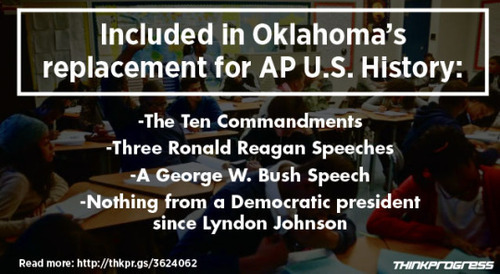
Critics had slammed last year's AP course guidance as unpatriotic. Lawmakers in many states went on a rampage, pushing for changes.
In Colorado last September, conservative school board members said the AP American history "materials should not encourage or condone civil disorder." ThatWhat parts of U.S. history should AP students learn? - CBS News:

Bill de Blasio's broken class size promise | am New York

Bill de Blasio's broken class size promise | am New York:

Bill de Blasio's broken class size promise 


Class size vital to learning


Mayor Bill de Blasio and the Department of Education have rejected a chance to commit to smaller class sizes in public schools. The move reflects a broken promise from de Blasio, who campaigned on reducing the number of children per classroom.
A task force, composed of city officials, advocates and other stakeholders, recommended reforms to the so-called "Blue Book," a document that details how every city school utilizes its space, and the available space each school building has, based on the number of rooms and kids.
City officials accepted many of that task force's recommendations. But last week, they rejected the most significant proposal: to align the Blue Book with lower class sizes.
The proposal would have used a lower number of kids per class to determine how many classrooms were needed for each school's total student population. With smaller class sizes, more rooms would be needed for the same number of children.
Eight years ago, a state law dubbed the Contracts for Excellence required New York City to reduce class sizes in exchange for additional funding. Kindergarten classes weren't to reach above 20 children; fifth grade, no more than 23.
But 25 kids in kindergarten and 30 in second grade remain typical. City officials said the state hasn't done its part to provide funding increases in recent years, which could reduce class sizes.
Having fewer children in a class is key to improving schools. As a candidate, de Blasio said he'd support lower Blue Book class size levels. As mayor, he showed last week how little that meant.
A Department of Education spokesman said reducing class size is a "critical goal." We haven't seen the proof.
Accepting the Blue Book recommendation wouldn't have forced class size reductions. But it would've signaled that the issue matters. Instead, even in a move mostly about perception, city officials failed to do the right thing.Bill de Blasio's broken class size promise | am New York:

Jon Tester: Ensuring every Montana child has chance to achieve

Jon Tester: Ensuring every Montana child has chance to achieve:

Jon Tester: Ensuring every Montana child has chance to achieve


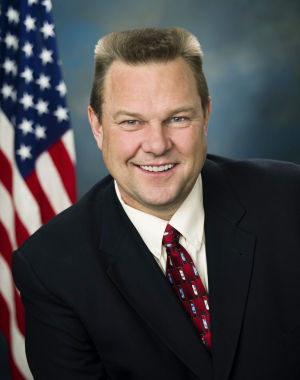
Jon Tester
The bill also moves us away from using testing as the primary measure of a student’s performance -- another No Child Left Behind policy that failed.


My mother had an unshakable faith in the power of public education. With her encouragement, the first job I took after college was teaching at my childhood elementary school.
I have been actively involved in public education my entire life -- as a student, teacher, school board member, parent, grandparent and now a U.S. senator.
So when the Senate had the chance to undo some of the damage caused by the No Child Left Behind Act, I was proud to stand with a bipartisan group of 81 senators and overhaul this broken system. That’s why I voted for the Every Child Achieves Act last week.
This bill reforms education policy for the first time in 13 years -- affecting millions of American families.
While I don’t agree with everything in the bill, it’s a big step forward.
Most importantly, the bill returns decision making to the local level, giving school boards, teachers and parents control over students’ education.
The bill also moves us away from using testing as the primary measure of a student’s performance -- another No Child Left Behind policy that failed.
No Child Left Behind assumed that classrooms in Livingston are the same as classrooms in Los Angeles, and that success in school meant passing a standardized test. We know that’s not the case.
The Senate’s bill acknowledges that Washington doesn’t have all the answers when it comes to public education.
It also builds on the Schools of Promise initiative that has worked in Montana to put some of our poorest-performing schools on the right path.
Under the leadership of Superintendent Denise Juneau, Montana has an innovative approach to improve the state’s lowest-rated schools, attract and retain better teachers, and encourage community members to be more involved in their children’s education. That state-based model is strengthened by the Every Child Achieves Act.
While this bill is certainly an improvement over No Child Left Behind, the Senate missed an opportunity to responsibly reduce the number of federally required tests. Under No Child Left Behind we’re testing our kids too much. The level of testing currently required is choking out creativity and innovation in the classroom.
A fourth-grade teacher in Billings recently told me that her students spend over four weeks a year taking standardized tests. That’s time that teachers and students could spend teaching and learning.
That’s why I offered an amendment that would’ve required schools to test once per subject in elementary school, middle school and high school. If states or school districts want to test Jon Tester: Ensuring every Montana child has chance to achieve:

LAUSD's top rookie teachers to be honored at Dodger game - MyNewsLA.com

LAUSD's top rookie teachers to be honored at Dodger game - MyNewsLA.com:

LAUSD’s top rookie teachers to be honored at Dodger game


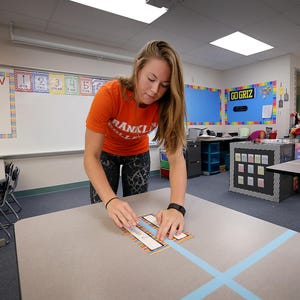
Photo courtesy of the Los Angeles Dodgers
The Los Angeles Unified School District‘s top first- year teachers from the 2014-15 school year will be honored at Sunday’s Los Angeles Dodgers-Los Angeles Angels of Anaheim interleague game at Dodger Stadium.
The district employed more than 900 first-year teachers in the 2014-15 school year, with 87 nominated by school site administrators and new teacher support for the inaugural Rookies of the Year award.
A committee selected the 23 winners based on characteristics, including effectiveness in preparing and delivering instruction; providing a positive classroom climate with strong routines and procedures; adopting a dynamic and engaging teaching style, and showing high levels of professionalism.
“These talented teachers are the building blocks of great schools,” said Superintendent Ramon C. Cortines. “They inspire young people. They encourage students to achieve, and embrace lifelong learning.”
Here is the list of honorees:
  • Emily Aguon, second grade, West Athens Elementary School;
  • Rosalinda Aleman, fifth grade, Franklin Avenue Elementary School;
  • Jasmine Allen-Matora, special education, 24th Street Elementary School;
  • Edgar Avalos, special education, Middleton Street Elementary School;
  • Rachel Axelrad, first grade, Hillcrest Elementary School;
  • Sara Benyaminy, kindergarten, West Hollywood Elementary School;
  • Jessica Blake, third grade, Trinity Street Elementary School;
  • Rigoberto Cruz, sciences, Franklin High School;
  • Alexander Dinh, biology, Downtown Business Magnet School;
  • Cindy Flores, kindergarten, Van Nuys Elementary School;
  • Jessica Garcia, kindergarten, Wisdom Elementary School;
  • Teasha Gilliam, fifth grade, Dr. Owen Knox Elementary School;
  • Lorenzo Hidalgo, special education, Bridge St. Elementary School;
  • Maria Huerta, fourth grade, Saticoy Elementary School;
  • Melissa Ally Kim, first grade, Weigand Elementary School;
  • Aja Koester, English, Nava College Preparatory School;
  • Heidy Lopez, first grade, Queen Anne Elementary School;
  • Kelsey Meek, biology, Washington Preparatory High School;
  • Jose Pillado, special education, Leichman High School;
  • Julia Rosenmeyer, kindergarten, 96th Street Elementary School;
  • Enrique Rodriguez, special education, Sheridan Elementary School;
  • Robert Sears, special education, Cochran Middle School;
  • Patrick Sherwood, math, Humanities & Arts Academy at Narbonne High School

Lacey Slekar – our Newest Student Hero | Poetic Justice

Lacey Slekar – our Newest Student Hero | Poetic Justice:

Lacey Slekar – our Newest Student Hero 


On May 22, 2015, 12 year old Lacey Slekar stood in front of the Board of Education in her school district and tried to convince the adults in the room that standardized testing is bad for children. Her speech was eloquent, well-organized, and very persuasive. She is a hero for writing and delivering a speech that truly presented the student point of view.
Her father, Tim Slekar who writes the Busted Pencils:Fully Leaded Education Talk blog and pod-cast, was not aware his daughter was even researching this topic. As Tim writes in his own blog post,
“Lacey wrote a research paper about standardized testing. We had no idea she was doing this until she asked Tim for some advise. She felt very strongly about sharing her findings with the school board. Her teachers encouraged her to read it, so she did. Wow, very proud of our BustED Pencils Student Correspondent.”
Here is the video of this student hero fighting to eliminate standardized testing from her school:


And here is the text of her persuasive speech:
Hello, my name is Lacey Slekar and I am a student at Badger Ridge middle school. I am here to share with you my concerns about standardized testing. I believe Standardized testing should be banned from all schools.
First of all, Standardized testing causes harmful stress on students. The stress and pressure put on students is not healthy. It can cause kids to cry, vomit, and get angry with themselves, or all at the same time. Students should not have to take the whole year preparing and stressing over one test that doesn’t even Lacey Slekar – our Newest Student Hero | Poetic Justice:

Teachers’ Quality of Worklife Survey & Unfair Terminations | Education Town Hall Forum

Teachers’ Quality of Worklife Survey & Unfair Terminations | Education Town Hall Forum: Archives, Announcements, & Extended Discussion on Weekly Broadcasts...:

Teachers’ Quality of Worklife Survey & Unfair Terminations


On the July 30th show of Education Town Hall, we had guests Lori, Denisha Jones, and Gus Morales on the show. The guests discussed the recent Atlantic article published about the Quality of Worklife Survey, released in part with the BadAss Teachers Association. Also, Gus Morales recalls his personal struggle with the teacher evaluations in his district.

Quality of Worklife

First on the show, Denisha Jones and Lori talk about the disappointing Atlantic article. Lori was quick to state that the article “missed the mark.” The article focused almost exclusively on only one of the many workplace qualities. The article gives the reader the idea that teachers are complaining about not being able to use the bathrooms regularly at work, when that is not at all what the survey was about.
“We felt it was actually rather demeaning,” said Lori. Although the bathroom issue is a serious one, not being able to relieve oneself can lead to health problems, the facts associated were not the most striking from the results of the survey.
The more striking statistics are ones including mental health. Forty-five percent of the 30,000 teachers who completed surveys reported having mental health problems due to the stress involved with teaching, while 86% of teachers said they were treated for stress related illnesses. The survey covers a lot of workplace stressors, not just bathroom breaks and Lori believes that the article missed the main point, “One of the goals of our survey is to change the working conditions for teachers, because a teacher’s work environment is a student’s learning environment.” Another important fact found in the survey was that there was a lot of discrimination and even bullying taking place in teachers’ workplace environments. Teachers are being discriminated by race, gender, sexual orientation, and even age.
When asked why the public is not more aware of problems like this, Denisha Jones responded, “They don’t want the public to know these things…if people knew what it’s really like in some of their schools, they would be in the streets-they would be upset.”
The Atlantic article, according to Lori, was “disparaging.” The author of this article shows irresponsible journalism by not Teachers’ Quality of Worklife Survey & Unfair Terminations | Education Town Hall Forum: Archives, Announcements, & Extended Discussion on Weekly Broadcasts...:

Seattle Schools Community Forum: City's Preschool Program

Seattle Schools Community Forum: City's Preschool Program:

City's Preschool Program


Big Education Ape: Greedy Corporate Education Reformer's Newest Media Blitz: Pre-K and Charter Schools http://bit.ly/1I6hiBg


The Times had big news this morning that preschoolers can learn math but nobody in preschool teaching ever knew this before.

Naturally, I'm being facetious as most parents do know this (even if they don't know the best way to teach their own children).  As well, I would think most bonafide preschools do know this (and I certainly know Montessori and Waldorf do).

This article seems a bit of a cheerleading piece for the City's preschool but then, the City extended the deadline for parents to enroll so maybe they need the help.

Their centerpiece of the story is the preschool at South Shore which isn't the best example.  The claim is that 95% of kids who are in kindergarten at SS come in with basic skills for elementary school math.  They DON'T explain that it has been set up so that the pre-k kids get a bump to be in kindergarten at South Shoe so yes, if they had SS's preschool program, it would follow that their kindergarten class would have that readiness as well to go into first grade.  The point being that the over-whelming majority of kids were in the same program whereas that isn't true (and can't be true) for the rest of the kindergartens.

Yay
I give the Times credit for actually admitting that South Shore gets $1M a year extra.

Nay
But the Times doesn't name the foundation - League of Education Voters - nor do they say how long this has been going on (more than a decade).  Makes you 
Seattle Schools Community Forum: City's Preschool Program:

Why teachers can’t hotfoot it out of Kansas fast enough - The Washington Post

Why teachers can’t hotfoot it out of Kansas fast enough - The Washington Post:

Why teachers can’t hotfoot it out of Kansas fast enough


Teachers can’t hotfoot it out of Kansas fast enough, creating a substantial shortage expected only to get much worse. Why?
Well, there’s the low pay. According to the National Center for Education Statistics, the average teaching salary in 2012-2013 (the latest year for which data were available, in constant 2012-2013 dollars), was $47,464, lower than the pay in all but seven states (Arkansas, Florida, Mississippi, North Dakota, Oklahoma, South Dakota and West Virginia), though not by much in most of them.
Last year, job protections were cut by state lawmakers, who have also sought to reduce collective-bargaining rights for public employees.
Then there’s the severe underfunding for public education by the administration of Republican Gov. Sam Brownback, so much of a problem that some school districts closed early this past school year because they didn’t have the cash to keep operating. This story by Huffington Post, quoted Tim Hallacy, superintendent of Silver Lake Schools, as saying:
“I find it increasingly difficult to convince young people that education is a profession worth considering, and I have some veterans who think about leaving. In the next three years I think we’ll have maybe the worst teacher shortage in the country — I think most of that is self-inflicted.”
This June, a three-member district court panel ruled that parts of a new state school financing law violated the Kansas Constitution by allowing inequitable distribution of more than $4 billion in annual education funding. It ordered the state to give $54 million back to the public schools, though that part of the ruling was stayed indefinitely by the Kansas Supreme Court which quickly took up the issue. Now, the state’s entire funding formula for public education is up in the air.
And there’s more. According to the Topeka Capital-Journal,  the Kansas Board of Education decided in July to allow six school systems — including two of the largest in the state — to hire unlicensed teachers to ease the shortage. (Let the irony sink in for a minute.)  Specifically, the newspaper reported:
The measure will waive the state’s licensure regulations for a group of districts called the Coalition of Innovative Districts, a program that the Legislature established in 2013 based on model legislation from the American Legislative Exchange Council.
(Yes, ALEC, an organization that writes “model legislation” on a variety of topics that conservative legislators use in states  to make new laws that promote privatization, strikes again.  Under this legislation, districts can ignore most laws and regulations — including union contracts — that other public schools in a state must follow.)
Some Kansas educators and others tried to dissuade the board from taking this action, including James Neff, a chemistry teacher from Manhattan United School District 383, which the Capital-Journal quoted as saying that there is more to teaching than just knowing subject material. He was quoted as saying, “A subject matter specialist is just a subject matter specialist, but a Why teachers can’t hotfoot it out of Kansas fast enough - The Washington Post:

What's in Store with Common Core | Alan Singer

What's in Store with Common Core | Alan Singer:

What's in Store with Common Core


If you can put aside the high-stakes testing, which admittedly is not easy to do, and if you put aside the break-up of learning into micro-pieces, which I really cannot forgive, and if you can somehow forget the push for corporate take over and profit from education in the United States, there are some are some decent curriculum ideas imbedded in the national Common Core English Language standards. Unfortunately, even the better ideas, reading carefully, looking for underlying meaning in a passage, editing writing, and supporting arguments with evidence, are often laid-out and taught in ways that just do not make academic sense.
A good example is the New York City high school ELA guidelines created by Houghton Mifflin Harcourt and being circulated to schools by the New York City Department of Education High School ELA Scope & Sequence. The package starts off with pretty standard Common Core edu-speak - students will be "literate" and "informed," curriculum will be "rigorous" and "engaging."
"The New York City Department of Education strives to prepare all students to live rich, literate lives and to be active, informed citizens. In order to do so, students need access to rigorous, comprehensive and engaging English Language Arts curricula. Students should have the opportunity to read a variety of texts, make informed judgments that are grounded in evidence and communicate their thinking through oral, written, and artistic expressions."
I did a careful analysis of the 11th grade ELA curriculum because it is the same year most New York City high school students study United States history and must pass a state "Regents" exam in order to graduate. The New York State United States History Framework is organized chronologically with a series of unifying themes. The most themes important in 11th grade are Time, Continuity, and Change; Geography, What's in Store with Common Core | Alan Singer:

Campbell Brown Announces a Nationwide Recall of BROWN SOUP Due to Mislabeling


Campbell Brown Announces a Nationwide Recall of BROWN SOUP Due to Mislabeling


Campbell Brown's Soylent Greed is Also Under Investigation For Mislabeling

  
Campbell Brown IS Corporate Education Reform's Salesperson of the Month


Still Stuck In Food Services Director Jail, David Binkle Retires - Change The LAUSD

Still Stuck In Food Services Director Jail, David Binkle Retires - Change The LAUSD:

Still Stuck In Food Services Director Jail, David Binkle Retires


“I felt bad collecting my salary while being forced to sit home without doing the work.”
-David Binkle
Last December, David Binkle’s paid suspension was announced with typical LAUSD double speak. At the same time the press office was stating that he had “been temporarily reassigned pending the conclusion of an internal investigation into a CONFIDENTIAL personnel matter,” (emphasis mine) a leaked copy of the Inspector General’s draft audit stated that they “found that the program is currently at a minimum being mismanaged and at worst being consistently abused.” While the district initially stated that the investigation was likely to “wrap up in late spring or early summer,” last month they stated “they could not estimate when the investigation might be concluded.” In the meantime, Binkle was being paid his $152,000 salary not to work, a situation that was unfair to both Binkle and the taxpayers.
Like the many teachers who have been forced to quit after getting stuck in the purgatory of Teacher Jail, Binkle has filed his paperwork to retire. While this provides him with a way to move forward from the experience, he also pays the price of having an unresolved cloud over his name. Unfortunately for the stakeholders of the district, Binkle’s retirement may also give the district an opportunity to leave the investigation unfinished and the resulting unanswered questions will create a situation where the status quo will be allowed to continue.
If the Inspector General is correct in the assessment that there was mismanagement of the division, it is unclear why the buck stops with Binkle. It is not unreasonable to expect that senior district officials should know what is Still Stuck In Food Services Director Jail, David Binkle Retires - Change The LAUSD: