Latest News and Comment from Education

Monday, May 18, 2015

Brown at 60: Great Progress, a Long Retreat and an Uncertain Future — The Civil Rights Project at UCLA

Brown at 60: Great Progress, a Long Retreat and an Uncertain Future — The Civil Rights Project at UCLA:

Brown at 60: Great Progress, a Long Retreat and an Uncertain Future


Marking the 60th anniversary of the landmark U.S. Supreme Court decision Brown v Board of Education, the UCLA’s Civil Rights Project/Proyecto Derechos Civiles assessed the nation's progress in addressing school segregation, and found that--contrary to many claims--the South has not gone back to the level of segregation before Brown. It has, however, lost all of the additional progress made after l967, but is still the least segregated region for black students. New statistics show a vast transformation of the nation’s school population since the civil rights era. The authors reveal that Latinos are significantly more segregated than blacks in suburban America.


Executive Summary

Six decades of “separate but equal” as the law of the land have now been followed by six decades of “separate is inherently unequal” as our basic law. The Brown decision set large changes and political conflicts in motion and those struggles continue today.

New national statistics show a vast transformation of the nation’s school population since the civil rights era. Particularly dramatic have been an almost 30% drop in white students and close to quintupling of Latino students. The nation’s two largest regions now have a majority of what were called “minorities” and whites are only the second largest group in the West. The South, always the home of most black students, now has more Latinos than blacks and is a profoundly tri-racial region.

Desegregation progress was very substantial for blacks, and occurred in the South from the mid- 1960s to the late l980s. Contrary to many claims, the South has not gone back to the level of segregation before Brown. It has lost all of the additional progress made after l967 but is still the least segregated region for black students.

The growth of segregation has been most dramatic for Latino students, particularly in the West, where there was substantial integration in the l960s, and segregation has soared. A clear pattern is developing of black and Latino students sharing the same schools; it deserves serious attention from educators and policymakers.

Segregation is typically segregation by both race and poverty. Black and Latino students tend to be in schools with a substantial majority of poor children, but white and Asian students are typically in middle-class schools.

Segregation is by far the most serious in the central cities of the largest metropolitan areas, but it is also severe in central cities of all sizes and suburbs of the largest metro areas, which are now half nonwhite. Latinos are significantly more segregated than blacks in suburban America.

The Supreme Court has fundamentally changed desegregation law, and many major court orders have been dropped. Our statistical analysis shows that segregation increased substantially after the plans were terminated in many large districts.

A half century of research shows that many forms of unequal opportunity are linked to segregation. Further, research also finds that desegregated education has substantial benefits for educational and later life outcomes for students from all backgrounds (see research summary and sources in Appendix A).

We conclude with recommendations about how we might pursue making the promise of Brown a reality in the 21st century. Desegregation is not a panacea and it is not feasible in some situations.

Where it is possible-- and it still is possible in many areas-- desegregation properly implemented can make a very real contribution to equalizing educational opportunities and preparing young Americans for the extremely diverse society in which they will live and work and govern together.


Related Documents

Connecticut Makes Rare Progress On School Segregation As America Moves Backwards

Connecticut Makes Rare Progress On School Segregation As America Moves Backwards:

Connecticut Makes Rare Progress On School Segregation As America Moves Backwards


When Connecticut high school senior Akbar Maliki looks back on his high school experience, he can think of only one negative: his school has made him so open to and accepting of diversity, he says, that he worries about his ability to make friends with people from too-similar backgrounds.
"I'm always going to be looking for the next diverse group. It's hard for me to be surrounded by the same types of people," Maliki, who moved to the United States from Indonesia as a child, told The Huffington Post.
Unlike so many around the country, Maliki's school is deliberately diverse. Its student body is slightly over half black, about a quarter white, 16 percent Hispanic. Nearly half of its students are eligible for free or reduced price lunch. When Maliki looks around his lunchroom, he sees "every race," he said. "It's not like, just the white kids sitting at one table or black kids at one table."
Maliki is set to graduate from Metropolitan Learning Center in Bloomfield this spring. Metropolitan is one of Connecticut's 84 magnet schools designed to bring together students from different socioeconomic backgrounds. These magnet schools make Connecticut a rare exception in a region that increasingly accepts racially isolated schools as inevitable.
"It is the only state in the Northeast that is going in a positive direction and it has created voluntary processes that have clearly reduced severe segregation in a time devoid of national leadership," an April report from UCLA's Civil Rights Project found. "This is a solid accomplishment that the state should be proud of and other states should look at as an example."
Sunday marks the 61st anniversary of the landmark Supreme Court decision, Brown v. Board of Education, the case that declared intentionally segregated schools unconstitutional and set off a wave of efforts to increase school diversity. For years following the case, court-ordered interventions boosted school integration. However, since a string of court decisions allowed states to relax these efforts, the number of students in intensely segregated schools has risen since the late '80s and '90s.
Connecticut stands as a unique deviation from this trend. In 1996, a decision in the state's Supreme Court in a case called Sheff v. O'Neill ruled that "racial and ethnic segregation has a pervasive and invidious impact on schools," and ordered the governor and state legislature to find a solution. In 2003 the legislature created a system to fund regional magnet schools and a voluntary interdistrict transfer system.
The transfer system allows a small number of urban students to attend suburban schools and vice versa -- something atypical in traditional public schools, where students usually live close to the school they attend. The magnet schools draw from students in both urban and suburban districts through a lottery.
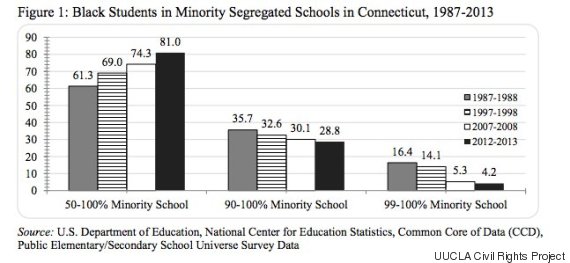
About 40,000 Connecticut students currently attend a regional magnet school, according to the UCLA report. In 1987, about 16.4 percent of black students in the state attended schools that were nearly 100 percent minority. Now, about 4.2 percent of black students do.
ucla
Maliki attends one of 19 magnets schools managed by Connecticut's Capitol Region Education Council. Overall, CREC schools serve a population that is32 percent white, 28 percent black and 27 percent Hispanic. Some 48 percent of CREC students are eligible for free and reduced price lunch.Connecticut Makes Rare Progress On School Segregation As America Moves Backwards:

Spending in race for three LAUSD board seats reaches nearly $4.6 million - LA Times

Spending in race for three LAUSD board seats reaches nearly $4.6 million - LA Times:

Spending in race for three LAUSD board seats reaches nearly $4.6 million


Total spending in the battle for three spots on the Los Angeles Board of Education has increased sharply since the March primary, reaching nearly $4.6 million, as interest groups vie to influence the nation's second-largest school system.

The top spender is a group supporting charter schools, which has poured in more than $2 million. Next are committees controlled by the teachers union and its allies, which have spent more than $1 million. These groups are backing opposing candidates in two races, but have settled on the same candidate in a third.

These organizations aren't the only special interests involved. A relatively new political action committee, allied with the charter group, has joined the big money ranks. And a union representing non-teaching employees also could have an effect.

The results of Tuesday's election could shift the ideological balance of the seven-member board, affecting the choice of who would take the helm as the next superintendent of schools. Current schools chief Ramon C. Cortines, 82, agreed to serve another year as a search gets underway for a successor; he returned from retirement last October after John Deasy resigned under pressure.

The board also faces key budget decisions and must develop a new teacher evaluation system with the union.

The election also could affect district policy related to charters, which are independently managed and free from some restrictions that govern traditional public schools. Charters are not obligated to hire union employees.

L.A. has more students enrolled in charter schools than any district in the nation.

The future of charters are at the heart of the most heavily contested race. One-term incumbent Bennett Kayser typically resists creating new charters or renewing existing ones. His opponent is Ref Rodriguez, co-founder of one of the largest local charter-school organizations.

Kayser represents District 5, which encompasses neighborhoods north and east of downtown and the cities of southeast L.A. County.

California Charter Schools Assn. Advocates has put $1.8 million into unseating Kayser. More than half a million dollars has gone into negative advertising against him.

"We're expecting a low turnout, possibly as low as 8%," said Gary Borden, executive director of the charter group. "But the folks who went to the polls for Ref in the primary care deeply about his campaign and we're optimistic that they'll make sure to vote for him again in the runoff."Spending in race for three LAUSD board seats reaches nearly $4.6 million - LA Times:


To fight for education, vote for Helen Gym

To fight for education, vote for Helen Gym:

To fight for education, vote for Helen Gym


TOMORROW we will head to the polls to vote in an election in which, for the first time in recent memory, education is seen as the most important issue in the city. Because of the growing importance of public education, over the course of the election season almost every candidate has laid out a vision for the future of our schools.

What must not be overlooked, however, is why education is in the stump speech of every candidate running for office right now. The truth is that education is at the top of voters' concerns and on the tip of politicians' lips due to the tireless work of advocates in this city who have fought to change the narrative about our city's schools and demand a public-education system that works for all of our children. Leading that charge for the last 20 years is City Council at-large candidate Helen Gym.

Helen has been at the forefront of the battle for fair funding for our schools for years. When the patronage-dense Philadelphia Parking Authority was cooking its books to show zero profits every year - profits that were mandated to go into our schools - Helen Gym organized parents and didn't back down. Today, the PPA pays millions of dollars into our schools every year.

When the School Reform Commission threatened to close Steel Elementary, the last public school in the Nicetown neighborhood, and convert it to a more expensive charter school, it was parents, and advocates like Helen Gym, who organized to stop them.

These are only a couple of examples of the work Helen has done for our communities over the years, and she'd be the first to tell you that she hasn't accomplished anything on her own, but with the support and teamwork of parents and activists from every neighborhood throughout our city. Helen was one of many Philadelphians who helped co-found the advocacy organization Parents United for Public Education, as well as the Public School Notebook, an independent newspaper that has reported on the conditions of our public schools for the last 20 years.

Tomorrow is a big day for the future of education in our city.

Read more at http://www.philly.com/philly/opinion/20150518_To_fight_for_education__vote_for_Helen_Gym.html#vHzXqJC0G17UxrCz.99


The Challengers: Helen Gym’s Aim — To Make Council Holds Schools Accountable


A series of Citified Q&As with the top Democratic challengers in the at-large City Council race.


Helen Gym | Photo by Alex Hogan

All week, Citified is featuring Q&As with leading at-large City Council Democratic challengers on topics of their choosing. The prompt was simple: if elected, what’s a problem you would you prioritize, and how would you address it? To keep the conversation substantive and on-point, we asked the candidates to focus on a relatively narrow question (i.e., not “schools,” or “crime.”)

Longtime schools activist Helen Gym is running an at-large campaign powered by an enthusiastic grassroots network of supporters, the backing of teacher unions and her own indomitable personality. Her presence on Council would surely shakeup a a legislative body that is, plainly, sick and tired of talking about the city’s struggling schools and the questions of how to fund them.

Gym would make schools her central focus if she is elected to Council. In particular, Gym wants to dramatically change Council's approach to schools oversight, and that's the subject she chose to discuss with Citified.

Citified: You want to talk about oversight. Not just City Council’s oversight of the School District, but of the mayor, and the mayor’s role vis-à-vis the School District. Is that right?

Gym: I want us to be really thoughtful about the city's engagement with the district. One of the things I’ve done — when we helped start the Notebook, we were very focused on the school budget and looking at data and research over time. And we're looking at budgets not just in terms of how numbers line up on a spreadsheet, but their impact on classrooms and teaching and learning and our ability to achieve the things we say we want to accomplish.

Because of that, I think I'm better prepared than anybody else currently sitting on City Council to really take a look and understand the district’s budget and hold the district accountable for what it’s saying.

Citified: So what does that look like? How do you actually do that?

Gym: Well, one is the district has a statement that every eight-year-old will be on reading level. I would want to know what our reading specialists look like. I’d want to do know how many kindergarteners had access to a functional school library. I'd want to know what class size looked like in K-2, and how that had changed over time. I’d definitely want to know about special needs students and how they’re being supported, and what our language access looks like for K-2. I don't see anybody in City Council looking at that in a very serious way.

Citified: So what’s the mechanism for that? City Council members will complain privately that the district doesn’t respect Council — that they ask for information and it’s not forthcoming. What’s the mechanism you would use to get the district to take Council seriously and respect its oversight role?

Gym: If council is serious about accountability it should hold hearings and conduct reports. It has subpoena power. It has the ability to compel testimony. It certainly has the right to access any and all data — they just have to know what data to ask for. That’s where I see the problem.

Council schedules all of one day of testimony in budget hearings for the district, and it’s the third largest budget in the state of Pennsylvania. I don’t think you're going to get good data in one day of hearings. And often it's not even one full day. It's just a couple of hours of prepared testimony. There’s very little data provided other than the district’s budget. There's very little research done ahead of time, and there's hardly any follow up that happens afterward.
Read more at http://www.phillymag.com/citified/2015/05/15/challengers-interview-helen-gym/#kDM933SpiI0MH73E.99

Weingarten stumps for Helen Gym

Weingarten stumps for Helen Gym:

Weingarten stumps for Helen Gym


Helen Gym. ( ED HILLE / Staff Photographer )


Helen Gym's City Council campaign got early momentum from an endorsement from the Philadelphia Federation of Teachers. On Friday, it was bolstered by the effusive support of Randi Weingarten, the president of the national teachers' union.

"If we had more people like Helen in public office, we'd be solving more problems across the United States of America," Weingarten said, standing outside the Philadelphia School District headquarters. "I'm impressed by her passion, by her smarts, by her ability to problem solve."

Weingarten and District Attorney Seth Williams spoke at a late-morning rally for Gym, the longtime public-education activist. Mayoral candidate Jim Kenney stood behind Gym at the event, but did not speak.

Williams said that he was "going to vote for the right person. I'm here to endorse education."
Kendra Brooks, a Nicetown resident and district parent, fought alongside Gym to hold back the conversion of Steel Elementary to a charter school.
"We support Helen Gym because Helen Gym supports us," Brooks said. "We're going to support her all the way to City Hall."
But the rally was mostly about Weingarten's nod. The American Federation of Teachers president flew in from Los Angeles after traveling internationally, and was scheduled to appear at a Kenney event later in the day - the union has thrown its support and spending power behind Kenney, too.
Gym said she felt good going into the election.
"I think the ground rules of this election were defined by the education community," Gym said. "It's a transformative message."

Read more at http://www.philly.com/philly/blogs/school_files/Weingarten-stumps-for-Helen-Gym.html#9ocul0cehZfT4LBp.99

CALIFORNIA STATE PTA SUPPORTS LOCAL INITIATIVE SEEKING TO INCLUDE LGBTQ PERSPECTIVE IN HEALTH EDUCATION:

4LAKids - some of the news that doesn't fit: CALIFORNIA STATE PTA SUPPORTS LOCAL INITIATIVE SEEKING TO INCLUDE LGBTQ PERSPECTIVE IN HEALTH EDUCATION: Burbank PTA resolution on sex-ed inclusion wins approval at state PTA convention.:

CALIFORNIA STATE PTA SUPPORTS LOCAL INITIATIVE SEEKING TO INCLUDE LGBTQ PERSPECTIVE IN HEALTH EDUCATION 

Burbank PTA resolution on sex-ed inclusion wins approval at state PTA convention.


Burroughs students
John Burroughs High School graduates Jessica Little and Brian Kaplun and current student Susie Miller, right, worked on a PTA resolution with Burbank parents that advocates for clearly stated health standards and equality for lesbian, gay, bisexual, transgender and questioning students. The resolution was passed during the California PTA Convention earlier this month.  (Courtesy of Steve Frintner / May 15, 2015)


May 15, 2015 | 5:04 p.m [LA Times May 18] .  ::  The Burbank school district’s Parent Teacher Assn. is one step closer to influencing change across California with a resolution seeking to incorporate clear health standards into the state’s curriculum to address lesbian, gay, bisexual, transgender and questioning students, in addition to promoting an inclusive school environment for the young LGBTQ community.

The resolution won formal approval at the California State PTA convention in Sacramento earlier this month, and its passage still brings Steve Frintner to tears.

As Burbank PTA council president, Frintner’s voice broke with emotion as he shared the news with the Burbank school board last week, and he choked up again this week while discussing it during a phone interview.

“It’s been two weeks, and I can hardly talk about it without getting emotional about it,” he said.

The resolution was months in the making and not without outspoken opponents.

Its passage will allow lawmakers or state education officials to refer to the document should they introduce legislation or curriculum that would lead to sexual health education and learning materials acknowledging lesbian, gay, bisexual, transgender students and those who are exploring their sexual identity.

Burbank parents formed a committee to write the resolution at the start of the school year, based on the work of former John Burroughs High School student Brian Kaplun.

Now a freshman at Stanford, Kaplan, 19, wrote a bill while he belonged to Burroughs’ Junior State of America Club. In it, he advocated for health standards that deal with issues surrounding gender expression and identity, in addition to supporting a safe learning environment for LGBTQ students.

“From a personal experience, I’ve never been bullied as a result of being gay…There’s never been violence against me or anyone I know… but we still have a ways to go,” he said during the phone interview.

California education code prohibits discrimination based on students’ sexual orientation, and states that sexual health instruction and learning materials “shall be appropriate for use with pupils of all races, genders, sexual orientations, ethnic and cultural backgrounds, and pupils with disabilities.”

However, in Kaplun’s experience, many LGBTQ students have been marginalized during conversations about sexual health in the classroom, which are largely given in the context of heterosexual relationships, he said.

After writing the bill for the club, “I thought to myself, I want to make this a real thing. It’s a really important issue,” Kaplun said.

He then approached state Sen. Carol Liu, who suggested working with the Burbank school board. Roberta Reynolds, school board member and a longtime member of the PTA, advised Kaplun to take it to the PTA to draft a resolution.

“I thought this was a great idea,” Frintner said, and when he brought the idea to fellow parents, they responded with overwhelming support, some of them with transgender, gay or lesbian children, others without, but all in agreement that the issue needed to be addressed.

“It wasn’t a hard sell,” Frintner said. “Everyone was on board.”

For the next several months, the Burbank Council PTA resolution committee backed up the resolution with recent research citing cases of LGBTQ students dropping out of school or becoming depressed because they didn’t feel they belonged, or in the most devastating events, they physically hurt themselves.

“That’s why we really feel like it’s so important and such a big issue for us,” Frintner said.

The draft ultimately won support from First District PTA — encompassing all PTA groups from Burbank to Pomona, including the Glendale Council PTA, which paved the way for it to be introduced at the state level.

On May 2, the day it came down to a vote in Sacramento, opponents who spoke out against it said gender identity and sexual health education were topics that would be better left to discuss within the family home. Others approached the contingent of Burbank parents and students with gratitude and encouragement.

“People I didn’t know shared their own moving stories,” Kaplun said.

Fellow students Susie Miller, a Burbank High senior, and Jessica Little, now a freshman softball player at Glendale Community College, also spoke in favor of the resolution passing.

“This resolution means a lot to me because I have people that are close to me — best friends that went through high school and middle school not really being accepted for who they were,” Little said. “I do have friends and family who were affected either by bullying or weren’t fully understood by their peers.”

She added that students could also learn that it’s OK to have two moms or two dads in a more accepting environment.

As the vote came down from more than 600 delegates, the resolution secured about 60% approval, and Frintner sunk into his chair with overwhelming relief.

“I had to just stop for about five minutes,” he said. “I had to put things down and try and breathe, and it took me several minutes to compose myself before I could start paying attention again to the next order of business.”

Kaplun is hopeful that the resolution could spur legislative action.

“My personal goal is to work to actually effect real change,” he said.

The resolution will also go before voters at the National PTA convention in Orlando next year.

“As generations are going on, they’re becoming more accepting,” Little said. “I think it’s a very good time to start to become more aware of these issues. It’s to help everybody. Everybody has a voice, and everybody needs to be understood.”

_______________

NYC Educator: The Professor Tells Us How Things Are

NYC Educator: The Professor Tells Us How Things Are:

The Professor Tells Us How Things Are


I was a little upset by this piece, written by a college professor. I know he's a professor because he announces it. He's not a teacher, he says, and I agree. However, I'm a little surprised he so absolutely accepts every one-dimensional stereotype spouted by Bill Gates, Arne Duncan, and everyone else spewing reforminess. 
Up to now your instruction has been in the hands of teachers, and a teacher's job is to make sure that you learn. Teachers are evaluated on the basis of learning outcomes, generally as measured by standardized tests. If you don't learn, then your teacher is blamed.
That's a pretty shallow view of what teachers do. A teacher's job certainly includes helping kids learn, but it also entails helping them on a broader basis. And even though we are evaluated via junk science, any of us who read Diane Ravitch know what nonsense that is. Furthermore, that is not the only factor on which we are judged. Given his sink or swim philosophy, it's surprising the professor hasn't done his homework. He continues:
However, things are very different for a university professor. It is no part of my job to make you learn. At university, learning is your job -- and yours alone. My job is to lead you to the fountain of knowledge. Whether you drink deeply or only gargle is entirely up to you.
It must be liberating to have no responsibility whatsoever. It's absurd to judge teachers on test scores. The American Statistical Association estimates teachers affect test scores by a factor of 1-14%, and suggests that judging teachers by scores could have negative consequences. On the other hand, it's also fairly reprehensible to not give a damn how your students do.
I am not held responsible for your failures. On the contrary, I get paid the same whether you get an "F" or an "A."
Well, enjoy that paycheck, professor. You may be surprised to learn that I also get paid the same regardless of my students' grades. But I kind of want them to pass. I develop bonds with kids I see every day, and I do not delight in their failure. I understand that you are not expected to intervene with parents, as I am, but that doesn't mean you ought to be indifferent to student progress either.
Your teachers were not allowed to teach, but were required to focus on preparing you for those all-important standardized tests.  
That's nonsense. The overwhelming majority of high school teachers do not prepare for standardized tests. And it's a blatant insult to say we are "not allowed to teach." Aren't you the one who declares yourself a professor rather than a teacher? If teachers aren't teaching, who is?
Lecture has come under attack recently. "Flipped learning" is the current buzz term among higher-education reformers. We old-fashioned chalk-and-talk professors are told that we need to stop being the "sage on the stage," but should become the "guide on the side," helping students develop their problem-solving skills. Lecture, we are told, is an ineffective strategy for reaching today's young people, whose attention span is measured in nanoseconds. 
I'm certain you're adept at lecture, as you indulge in it throughout your article. I've had professors who lectured. Some were very good at it. I recall one professor who lectured us constantly. I paid rapt attention, as he was very clever. He did not make outrageous assertions like those in your article. But I got a C on his first test, which had nothing whatsoever to do with his lecture and was based entirely on the textbook. I got A NYC Educator: The Professor Tells Us How Things Are:

Is There a Doctor in the Education House? - Lily Eskelsen García

Is There a Doctor in the Education House? - Rick Hess Straight Up - Education Week:

Is There a Doctor in the Education House?


 Note: Rick is taking a hiatus while he's off talking about his new book, The Cage-Busting Teacher. Meanwhile, this week's guest posts will be written by Lily Eskelsen García (@Lily_NEA), president of the National Education Association.

I want to thank my friend, Rick Hess, for asking me to guest blog for him this week. He's a brave man. While we disagree on many things, we agree that we should never be afraid of an opposing point of view. It's how we learn if we're right or if our opponent has a point we should think about. I appreciate that in Rick. And I appreciate that he'll let me bust a few cages in his blog.
First, however, I need to vent.
We've suffered under the factory model of school reform for the past dozen years under No Child Left Untested. The pillars are simple enough. Privatize (vouchers, franchise charters); De-professionalize (fast-track teacher prep, short-term, disposable labor designed to churn in and out with paychecks low and no pension to worry about); Standardize (scripted texts, homogenized lessons, pacing guides to require each teacher to be on the same page on the same day); and above all else: Hit your number. Motivate staff, students, and systems with carrots and sticks, with the goal wrapped around a quota of kids hitting a cut score. Standardized tests are the measure of basic progress. Standardized tests decide if a child is succeeding. Standardized tests decide if a teacher is effective. Standardized tests decide if a school should be closed down. It is a classic industrial model.
There is no science that says this works with children. There is no evidence that elite private or high-performing public schools are elite or high-performing because they use this model. There's no evidence that parents are demanding it. None of those countries described as our "global competition" that out-perform us on international tests use this model. The corporate school model is not driven by science. It is strictly out of the pages of the New England Journal of We Make This Stuff Up.
But numbers are impressive, and too many people think numbers must mean what someone says they mean. Schools compete against each other by test score rankings that declare which ones are making more "adequate yearly progress" than the others. Teachers compete with each other by test score rankings that declare who is more "effective." Students are expected to perform to specifications each spring so we know which will advance and which will repeat third grade. Teacher are incentivized with prizes or threatened with punishments depending on their students' test scores, just as factory workers are incentivized with bonuses or threatened with losing their jobs depending on who is more efficient at moving the product down the line.
Test & punish models are simple. Everyone knows that heads will roll for failing to improve numbers. Simple. Elegant. What could go wrong? Except for everything.
Of course, if you've got your 401(k) invested in the testing industry, everything's going quite well. I am not given to conspiracy theories that all this testing was the brainchild of the Testing Industrial Complex. I believe they are simply opportunists who are taking advantage of the simple-minded policies of misguided politicians and market ideologues. They have a product to sell, and fear is a fabulous motivator. Across the country, school boards and administrators who feared that their systems would be labeled as failing bought just about any sales pitch for bundled test-prep materials to improve test scores; teacher training designed to improve test scores; textbooks to improve test scores; and pre-tests, practice tests, post-tests, tests for the sake of tests... The billions wasted are, well, billions wasted. In terms of the bloated Educational Industrial Complex, we can only say caveat emptor. Buyer beware.
Franchise charters have pitches based on promises of getting the test scores up. Fast track teacher preparation was justified because any adult with content knowledge would suffice—no need for clinical preparation under expert supervision or studies in child development, pedagogy, classroom management, or response to intervention. Scripted textbooks and pacing guides only required a teacher with good reading skills, a good attitude, and a computer to keep score.
Studies show that privatization did not produce the vast improvements that the magical invisible hand of the market place promised either at home or abroad. In fact, as part of its analysis of the 2012 PISA results, the OECD looked at the impact of competition and found that "within school systems, there is no performance difference between schools that compete with other schools for students and those that do not, after taking into account students' socio-economic status." Fast-track teachers were not the answer. And the test scores obsession has been disastrous. Test scores have become the definition of student achievement instead of simply one single indicator of a student's progress.
Imagine that a hospital decides that the goal is a healthy patient. One measure of patient's health is a temperature of 98.6. So we take the patient's temperature. Ten times a day. And we chart it. We report it. We rank hospitals according to patient temperature. We pay doctors according to their patient temperatures. 
You get the point. If all you know is the temperature, you're missing a great deal about whether or not the patient is healthy.
That's how I see standardized tests. Even good tests were designed to measure one small aspect of student achievement. Under our national testing obsession, educators are encouraged to focus on what moves the standardized testing needle to the exclusion of other important aspects of a child's education. Educators have struggled to serve two masters. One is hitting the cut score. The other is educating the whole child. We have learned the hard way that it cannot be done. 
The factory school model has seriously corrupted critical, creative teaching and deep learning, and I resent it to my bones, so the rant had to come first. Breathe. Namaste.
We know what doesn't work. But we know what research says does work. All success indicators go up with good teaching practice, essential resources, and deep connections between home and school. A good doctor practicing good medicine will see the fever go down as the patient's health improves. Maybe it's time to change from the Factory Model of school reform to the Good Doctor Model.

The big business of charter schools - The Answer Sheet - The Washington Post

The big business of charter schools - The Answer Sheet - The Washington Post:

The big business of charter schools

If you are wondering why you should add charter schools to your investment portfolios, here’s David Brain, head of a major investment concern called Entertainment Properties Trust, to tell you.
This isn’t a joke.
You may think charter schools are just one option for parents looking for an alternative to traditional public schools for their children, but they are big business in some quarters.
What is Entertainment Properties Trust? According to its website, it is “a specialty real estate investment trust (REIT) that invests in properties in select categories which require unique industry knowledge, and offer stable and attractive returns.”
And the website also says this: “Our investment portfolio of nearly $3 billion includes megaplex movie theatres and adjacent retail, public charter schools, and other destination recreational and specialty investments. This portfolio includes over 160 locations spread across 34 states with over 200 tenants.”

This is why some people see the growth of charter schools run by for-profit management companies as part of a movement to privatize the country’s public education system, which has been the country’s most important civic institution.

Above is a video — with the headline “Invest in Charter Schools?” — that shows an interview that Brain did with anchors at CNBC. Here is part of the dialogue:
Anchor: Charter schools have become very popular as parents seek more choice in educating their children. But are charter schools a wise addition to your investment portfolio? Well let’s ask David Brain, president and CEO of Entertainment Properties Trust. ....Why would I want to add charter schools into my portfolio?
DB: Well I think it’s a very stable business, very recession-resistant. It’s a very high-demand product. There’s 400,000 kids on waiting lists for charter schools ... the industry’s growing about 12-14% a year. So it’s a high-growth, very stable, recession-resistant business. It’s a public payer, the state is the payer on this, uh, category, and uh, if you do business with states with solid treasuries. then it’s a very solid business.
Anchor: Well let me ask you about potential risks, here, to your charter school portfolio, because I understand that three of your nine “Imagine” schools are scheduled to actually lose their charters for the next school year. Does this pose a risk to investors?
DB: Well, occasionally — we have Imagine arrangements on a master lease, so there’s no loss of rents to the company, although occasionally there are losses of charters in certain areas and they’re used to peculiar, ug, particular circumstances. In this case it’s a combination of relationship with the supervisory authorities and educational quality. Sometimes educational quality is very difficult to change in one, two, or three years. It’s a long-term proposition, so uh, there are some of these that occur, but we’ve structured our affairs so this is not going to impact our rent-roll and in fact we see this as uh maybe even a good experience as the industry thins out some of the less-performing schools and we move on to the best-performing schools.
Anchor: David, there has been somewhat of a public backlash to charter schools in some areas given their use of public money, as you noted. Any risk to the growth of charter schools generally?
DB: I don’t — there’s not a lost of risk, there’s probably risk to everything but the fact is, this has bipartisan support. It’s part of the Republican platform and Arne Duncan, secretary of education in the Obama administration, has been very high on it throughout their work in public education. So we have both political parties very solidly behind it, you have high demand, high growth, you have good performance across the board. Most of the studies have charter schools at even or better than district public education. So, I think it has some risk because it’s new and it’s emerging and it is a high-growth category. But at the same time I think ... much more’s going forward so it’s still a safe area for investment.
Anchor: You’ve invested in retail centers, ski parks, you’ve got charter schools, you’ve got movie theaters.... If you could buy one thing right The big business of charter schools - The Answer Sheet - The Washington Post:

Our Turn - Change The LAUSD

Our Turn - Change The LAUSD:

Our Turn


Like athletes, politicians are expected to declare victory in advance of their contest. The standard stump speech is expected to include the words “when I win this election, I will…” because the first job of the candidate is to get voters to contemplate them sitting in office. Using the words “if I win election” does not inspire that same confidence.
Tamar Galatzan takes things further and publicly ignores the fact that the election will even occur. As voters prepare to make their decision she has refused them every opportunity to compare her against other candidates byblowing off candidate forums. Instead of addressing the voters directly through the city’s free program to provide a video statement to the voters, she relies on the charter schools to spend over $900,000 trying to buy the seat for her. A student journalist and LAUSD graduate could not even get an interview with her. When addressing the concerns of parents, she promises them that she “will continue with my plan to ask the board and the superintendent to review the Breakfast in the Classroom program at the conclusion of the school year,” ignoring the fact that this will occur after the voters have spoken.


Perhaps Galatzan’s greatest swipe at the electorate’s intelligence is when she asserts that the “district is going in the right direction.” Not since the Wizard told Dorothy not to look behind the curtain has their been such a pitiful attempt to spin reality. This school year has included a constant barrage of scandals, including ethics complaints filed against the incumbent herself.  A state judge had to tell the district to fix the $100 million MiSiS program, the FBI and SEC are both investigating the $1.3 billion iPad program and our children are drinking from water fountains that are leaching leadCalahan ElementaryNobel Middle School and Sherman Oaks Center for Enriched Studies are just some of the schools in District 3 that have reported a severe breakdown in the ability of parents to engage in their children’s education. All is not alright in Oz.
Fortunately for the electorate, Tuesday’s election will not be a case of choosing between the lesser of two evils. Her opponent, Scott Mark Schmerelson, is a retired principal who also was a teacher and counselor during his 35 year career as a professional educator. There are a great many teachers volunteering for his campaign who used to work under him, which is a great testimony to both his temperament and professionalism.
We have the power to bring the change to the LAUSD that we all know is needed. All it requires is taking a few minutes out of your day on Tuesday. If turnout is as expected, you will not even have to wait in much of a line. Alternatively, you can sit at home and reward the arrogance of a public servant who treats her re-election as an entitlement. The ball is in your court.Our Turn - Change The LAUSD:


A Personal Word on the BAT-AFT Teacher Stress Survey | deutsch29

A Personal Word on the BAT-AFT Teacher Stress Survey | deutsch29:

A Personal Word on the BAT-AFT Teacher Stress Survey


On May 12, 2015, the Badass Association of Teachers (BATs) and the American Federation of Teachers (AFT) produced the first of what will likely be many reports on information collected as part of an online survey on teacher stress.
The report linked above is posted on the AFT website and introduces the survey as follows:
After concerns of stress on the job were reported to the Badass Teachers Association, a survey on well-being, working conditions and stressors for educators was designed by a group of teachers who are members of the American Federation of Teachers or BATs, and it was reviewed and refined by a workplace stress expert and a professional pollster. Circulated via email and social media, the survey was posted online on April 21 and closed on May 1. The first of its kind, the 80-question survey was filled out by more than 30,000 educators.
The survey can be viewed here.
I plan to write about the survey results; however, I am waiting until the BATs are ready to release the actual response rates for each of the categorical questions on the survey. (Some questions are open-ended and thus are not tabulated by category. These open-ended responses must be analyzed using qualitative research techniques.)
For now, in this post, I would like to offer a teacher stressor response more like an individual case study:
My own.
What I write is my experience, and I offer it here in hopes that my experience might prove useful to those who read it. Though they are candid, my words are not intended to negatively reflect on the BATs’ noble effort to support teachers by publicizing the stress we currently face as a matter of course under test-score-driven, teacher-scapegoating, corporate “reform.”
What follows is simply my perspective on the matter of both the BATs survey and my own “teacher stress” experience.
I saw the invitation to take the survey on the BATs Facebook page, and I also received an email from AFT about the survey. I chose not to complete the survey. My immediate thought upon seeing the invitation was that one needs no survey to know that teachers are under tremendous stress to prove their worth in student test score outcomes.
tightrope closeup
However, I realize now that the survey was a chance for teachers to not only have a voice, 80 questions of brief catharsis, but also for BATs to preserve a record of A Personal Word on the BAT-AFT Teacher Stress Survey | deutsch29:


Sunday, May 17, 2015

Cuomo Promotes Tax Credits for Families of Students at Private Schools - NYTimes.com

Cuomo Promotes Tax Credits for Families of Students at Private Schools - NYTimes.com:

Cuomo Promotes Tax Credits for Families of Students at Private Schools


In a campaign-style tour meant to put pressure on lawmakers, Gov.Andrew M. Cuomo visited churches and a yeshiva on Sunday to promote a bill to give tax credits to families of students at private schools, including religious ones.
Mr. Cuomo’s visits showed that he intended to make the bill one of his top priorities in the final weeks in the legislative session, which concludes in mid-June. His plan would also give tax credits to individuals and businesses that donate to nonprofits that award scholarships to students at those schools.
But he will have to overcome opposition from some fellow Democrats, who blocked a similar proposal in this year’s state budget. In particular, his proposal faces a roadblock in the State Assembly, which is controlled by Democrats, many of whom are closely allied with the state’s teachers’ unions.
On Sunday, Mr. Cuomo argued for his proposal by pointing to the presence of “failing public schools,” and saying he wanted to give parents another option.
“There are some areas, frankly, where the public schools are not places where you would want to send your children,” he said at the Shrine Church of St. Jude in Canarsie, Brooklyn. He added that “sending your child to one of these failing public schools is in many ways condemning your child to get a second-class education.”
“We want you to have the ability to choose where to send your child,” Mr. Cuomo told churchgoers, asking them to contact their legislators.
Mr. Cuomo said his father, former Gov. Mario M. Cuomo, chose to send him to parochial school, believing that “I needed the nuns to keep me on the straight and narrow.”
On the other hand, Mr. Cuomo said he sent his three daughters to public school, citing the quality of the public schools in Westchester County. (He did not mention that after attending public school, two of his daughters went on to graduate from Deerfield Academy, a boarding school in Massachusetts.)
“There’s no right or wrong,” he said. “But it should be your choice.”
Mr. Cuomo announced his proposal last week, and appeared with Cardinal Timothy M. Dolan to promote it. In total, it would provide for $150 million in annual tax credits.
Under the proposal, families with annual incomes up to $60,000 would qualify for a credit of up to $500 per student who attends private school.
Donors to nonprofit groups that award scholarships to private school students would get a tax credit for up to 75 percent of their donations. Tax credits would also be available for donations to public schools and for public-school teachers who buy classroom supplies.
Teachers’ unions reiterated their opposition to the proposal. Michael Mulgrew, president of the United Federation of Teachers, the city’s teachers’ union, said the governor was pushing the legislation at the behest of wealthy campaign donors eager for tax credits.
“I’ve now come to the conclusion that the governor will do or say anything for his hedge fund buddies,” he said.
Similarly, Carl Korn, a spokesman for New York State United Teachers, the statewide teachers’ union, said the proposal would “siphon off taxpayer money for tax giveaways to the rich.”
“We respect parents’ decisions to send their children to private or religious schools, but they shouldn’t ask taxpayers to subsidize those personal choices,” Mr. Korn said. “What’s next, tax credits for parents who want to golf at country clubs instead of municipal courses?”
Mr. Cuomo included an earlier version of his tax credit proposal, which did not include the credit for families, in his budget proposal this year. He proposed the credit in tandem with another contentious education proposal, the Dream Act, which would provide state tuition assistance to undocumented college students.
The Dream Act has been opposed by the Republican-controlled State Senate, and in the end, neither proposal made it into the final budget.
On Sunday, Mr. Cuomo pushed for the education tax credit without also making a case for the Dream Act. Asked about the omission, he said the Dream Act was still one of his priorities.
But the legislative prospects of both proposals are questionable. The Senate, which passed a version of the tax credit this year, has shown no sign of budging on the Dream Act. And the Assembly has other priorities for the final weeks, including strengthening rent regulations and extending mayoral control of New York City schools.
“There has not been sufficient support in the Assembly for the tax credit,” said Michael Whyland, a spokesman for the Assembly speaker, Carl E. Heastie, a Bronx Democrat. Mr. Whyland added that the Assembly would not allow the extension of mayoral control to be made contingent on the passage of any other legislation, such as the tax credit.
Assembly Democrats are likely to consider passing part of the governor’s proposal that would be limited to giving tax credits to families of students at private schools, as well as teachers for supplies, according to a person with knowledge of the matter, who insisted on anonymity because of the confidential nature of legislative discussions.
Supporters sounded optimistic on Sunday.
“We’ve been dreaming about this education tax credit our entire lives, and today the governor is making it a reality,” Councilman David G. Greenfield, a Democrat from Brooklyn, said at a rally held at Yeshivat Shaare Torah in Midwood, Brooklyn.
At the Shrine Church of St. Jude, Msgr. John Delendick had a similar outlook. “I think this will be the last year we’ll have to fight on this,” he said. “We’ll have to find something else to fight on next year.” As Mr. Cuomo headed to his next event, Monsignor Delendick joked that there was only one fault with his visit: “The governor left before the collection.”Cuomo Promotes Tax Credits for Families of Students at Private Schools - NYTimes.com: