Latest News and Comment from Education

Sunday, May 17, 2015

Stare Them In The Eyes | The Jose Vilson

Stare Them In The Eyes | The Jose Vilson:

Stare Them In The Eyes


Stare Them In The Eyes


When John Norton, editor and writing guru, was having long conversations with me on Skype about the direction of my book, he often told me that the book would elevate my voice in ways I couldn’t imagine. The morning after my book dropped on May 6th, 2014, I was on a train to meet Secretary of Education Arne Duncan. My strategy in conversing with politicians with whom I vehemently disagree goes as follows: ask unexpected questions and challenge precisely. Before the day was over, he saw the composition of the attendees and said, “We need more of you,” referring of course to the lack of male teachers of color in our teaching corps. My reply, “I’m about it if you’re about it.”
As usual, I didn’t hold my breath on that promise, either. We’re still in the throes of overtesting, overprivatization, overpunishing, overempoverishing, and I’m over it.
Fast forward to a couple of weeks ago, where I was chastised by so-called white anti-testing allies for asserting that predominantly white education conferences ought to have racial issues at the center of the education reform discussions, not just to counter the diversity of the “other side,” but because our students are becoming more diverse in our public schools, and alleducators should have a stake, especially with our recent BlackLivesMatter social movements. These commenters resorted to calling me jealous, sensitive, as if my essay was fueled by avarice and race-baiting, similar to what trolls do when I bring up Trayvon Martin, Mike Brown, Aiyana Jones, but they don’t see the patterns in their own behaviors to see their flaws. Even the mere mention of race makes many of my endorsers jump into their feelings. That’s OK. Everyone has places for growth.
We can’t criticize civil rights groups for their stance when the “anti-testing” crowd doesn’t want to deal with the re-segregation of our schools as a mechanism for disparate school resources, but that’s another post.
After a tough week in school where some of us had to inform dozens of students that they haven’t done the work to graduate to high school, it was an uncanny and refreshing feeling to go to the US Department of Education the next week for a celebration of male educators of color by the White House Initiative on Educational Excellence for African Americans (full disclosure: I’m Black, not African American, but that’s for another time). The room had perhaps 100 Black, Latino, Asian, and Native American educators and education leaders from as close as Baltimore and DC and as far as Hawaii. I was invited for the express purpose of speaking about my experience as a male educator of color, but my purpose for showing up was to join with the dozens of other educators of colors who had a common experience there.
I challenged the US Department of Education through my questions. A sample:
  • Do male educators get hired for their expertise or to serve as overseers?
  • Is the lack of male educators of color in the National Teacher of the Year conversation a symptom of the lack of aforementioned people in the profession period or is it because we’re less likely to be seen as experts of pedagogy and more on “how to teach those kids?”
  • Is hiring people like me a shortcut towards getting the teaching profession to be more culturally competent?
Unlike other education conferences where even snaps of approval for these types of questions get folks staring and leaving the room, this audience of educators from across the country met Stare Them In The Eyes | The Jose Vilson:

Have We Wasted Over a Decade? | Daniel Katz, Ph.D.

Have We Wasted Over a Decade? | Daniel Katz, Ph.D.:

Have We Wasted Over a Decade?

Embedded image permalink
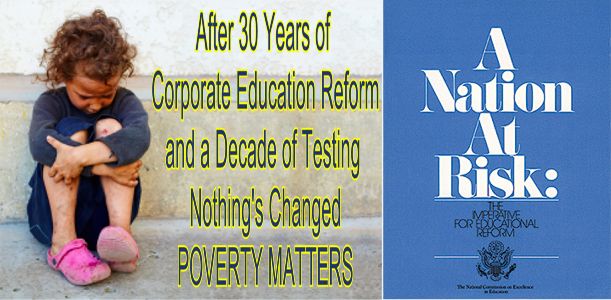
A dominant narrative of the past decade and a half of education reform has been to highlight alleged persistent failures of our education system.  While this tale began long ago with the Reagan Administration report A Nation at Riskit has been put into overdrive in the era of test based accountability that began with the No Child Left Behind Act.  That series of amendments to the Elementary and Secondary Education Act mandated annual standardized testing of all students in grades 3-8 and once in high school, set a target for 100% proficiency for all students in English and mathematics, and imposed consequences for schools and districts that either failed to reach proficiency targets or failed to test all students.  Under the Obama administration, the federal Department of Education has freed states from the most stringent requirements to meet those targets, but in return, states had to commit themselves to specific reforms such as the adoption of common standards, the use of standardized test data in the evaluation of teachers, and the expansion of charter schools.  All of these reforms are predicated on the constantly repeated belief that our citizens at all levels are falling behind international competitors, that our future workforce lacks the skills they will need in the 21st century, and that we have paid insufficient attention to the uneven distribution of equal opportunity in our nation.
But what if we’ve gotten the entire thing wrong the whole time?
Or, perhaps to be more accurate, what if the entire picture of American public education is simply far, far more complicated that the simplistic, even opportunistic, narrative of failure we’ve been hearing since 1983?  Two reports, noted in January of this year by Kay McSpadden of the Charlotte Observerput the presumption of failure into question.   The first report was released by the National Center for Educational Statistics at the USDOE and was about the results of the Progress in International Reading Literacy Study (PIRLS).  According to the PIRL Study, the United States does very well compared to other nations and international cities, ranking below 4 other territories (Hong Kong, Russian Federation, Finland, Singapore) and not being significantly different than 7 others (Northern Ireland-GBR, Denmark, Croatia, Chinese Taipei-CHN, Ireland, England-GBR).  While PIRLS does not include all of the nations we typically see cited as outperforming the United States, the study evaluates Have We Wasted Over a Decade? | Daniel Katz, Ph.D.:

CEA Convention passes Opt-Out Resolution, re-elects incumbents - Wait What?

CEA Convention passes Opt-Out Resolution, re-elects incumbents - Wait What?:

CEA Convention passes Opt-Out Resolution, re-elects incumbents


Congratulations to Sheila Cohen and Jeff Leake on their re-election and a big thank you to Martin Walsh and Scott Minnick for running for and helping to push the CEA forward on the critical opt out issue.
As reported by the CEA Blog,
“Teacher leaders from across the state took decisive action today to strengthen the organization’s position on the right of parents to opt their children out of high-stakes standardized tests and re-elect CEA President Sheila Cohen and Vice President Jeff Leake overwhelmingly.
The motion on opting out was unanimously adopted by teachers who were delegates to the CEA Representative Assembly (CEA RA), the highest policymaking body of the Association.
[…]
CEA has long supported the right of parents to make critical decisions about their children’s education. Today’s vote goes a step further by putting the full weight the CEA RA behind that position and providing great detail about teachers’ objectives in ensuring less testing and more learning in Connecticut public schools.
[…]
Essential components of the motion include:
  • Call on state policymakers and local school districts to formulate and pass legislation and policies that allow school employees to discuss standardized tests with parents and inform them of their ability to exclude children from state and/or district standardized tests.
  • Call on state lawmakers and school districts to formulate and pass legislation and policies that allow school employees to provide parents with their opinions on whether students would benefit from exclusion from a state/and or district standardized test and that no adverse action or discipline would be taken against employees who engage in such discussion.
  • Provide that a school and its employees would not be negatively impacted due to a student not taking a state and/or district-level standardized test, such as by ensuring that students who are opted out of standardized tests by a parent or guardian are excluded from performance calculations for state and local accountability measures and from employee evaluations.
  • Reexamine public school accountability systems throughout the state, and develop a system based on multiple forms of assessment that do not require extensive standardized testing, that more accurately reflects the broad range of student learning, and is used to support students and improve schools.
Also at the Convention,
The 2015 Connecticut Teacher of the Year, Cara Quinn, said that poverty is a problem that cannot be ignored. “Collectively we have the power to advocate for real and tangible things that will make a difference for our poorest students and families. First, we can insist that CEA Convention passes Opt-Out Resolution, re-elects incumbents - Wait What?:

A failed idea will fail Milwaukee's kids

A failed idea will fail Milwaukee's kids:

A failed idea will fail Milwaukee's kids


During my 30 years of teaching fifth grade, I've always encouraged my students to look critically at problems and to learn from mistakes.
Sen. Alberta Darling's and Rep. Dale Kooyenga's plan to take over public schools in Milwaukee does neither.
The few details in their plan provide no framework for actually improving academic achievement. Equally important, the plan ignores the Milwaukee community's experience with similar efforts to dismantle our public schools and undermine our democratic institutions.
There are several glaring problems with the Darling-Kooyenga plan.
■Not learning from mistakes. Attempting to improve public schools by turning them over to private charter or voucher operators has been tried before — and failed. For 25 years, vouchers have been a conservative's dream: no unions, no school board, no state-mandated curriculum or regulations. What has been the result? Voucher schools on the whole perform worse academically than the Milwaukee Public Schools.
Voucher schools have drained over a billion dollars of taxpayers' money away from public schools and into private schools with little public accountability. The defunding of public schools has meant larger class sizes, less individual attention to students and greatly reduced access to art, music, libraries and physical education within Milwaukee's public schools. Let's fully fund our public schools and fix them, not abandon them.
■Undermines democracy. Governance is not the problem with our schools — Milwaukee arguably has more governance options than any urban system in the country. The rhetoric around governance in the Darling-Kooyenga scheme is a smokescreen to get rid of democratically elected and accountable school boards and schools.
There are two ways to undermine democracy. First, by attacking voter rights through limiting early voting options and requiring photo IDs. Another way is to remove entire institutions from democratic control. Yes, democracy can be messy, but the alternative is worse. If we decide to abandon every democratic institution that is not up to our hopes and dreams, why not get rid of the U.S. Congress? Or the Wisconsin Legislature?
■Part of a coordinated attack. The Darling-Kooyenga plan can't be viewed in isolation. It's in the context of Walker's budget that continues deep cuts in public education across the state, and increases statewide privatization of public schools. In addition, Walker's budget eliminates Chapter 220 — the only educational program in Milwaukee designed to reduce racial segregation in public schools and improve equal opportunity for students of color.
■Exacerbates inequality. Data show that privately run charter and voucher schools serve significantly fewer students with special needs, English language learners and more difficult to educate students. Students are counseled out and pushed back into public schools. The Kooyenga-Darling plan will only increase this problem.
■Refusal to learn from other urban areas. Other urban districts have tried similar takeovers, with disastrous results. A takeover plan in Detroit is costing the state $72 million, with the mayor raising strong objections. In Memphis, several national charter operators have repeatedly proposed new schools, only to abruptly cancel their plans. And in New Orleans, thousands of students — including those with special needs — are being underserved. Let's learn from, not replicate, the problems that have come up in these other cities.
■Continues Milwaukee's plantation mentality. The plan's colonial implications — what MICAH President Rev. Willy Brisco calls the "plantation" mentality that dominates social policy in Milwaukee — are disturbing. Milwaukee is the most segregated metropolitan region in the nation. Sixty years ago, the U.S. Supreme Court, in its Brown decision that was fundamental to overthrowing Jim Crow segregation, noted that "separate is inherently unequal." It should give people pause when two white suburban legislators propose having a white county executive appoint a "commissioner" to be able to pluck schools away from the democratically elected school board of an overwhelmingly nonwhite district.
If we want to truly provide equal education opportunities, why not try something truly radical? Why not build a countywide school system — democratically elected and controlled and open to all children, regardless of the ZIP code where they were born? Not only would this open up well-funded schools with excellent opportunities and learning conditions to the children of Milwaukee, it would attack the dual problems of segregation and inequality that plague our region.
■Sending the wrong message to our children. What message do we send to the next generation when we condone a plan to remove control of public institutions from a democratically elected board? When we undermine a superintendent with a doctorate from Harvard University and instead place public schools in the hands of a "commissioner" to be appointed by a county executive who doesn't even have a college degree and was not elected to run schools? When we allow a plan that specifically says the children of Milwaukee do not need licensed teachers?
These are just some of the many problems in the Darling-Kooyenga plan.
This proposal should be rejected by anyone who believes in democracy and the importance of educating all children.
The Milwaukee Public Schools is the only institution in the city with the capacity, commitment and legal obligation to serve all our students.
Our schools are the foundation of our democracy and of our future. Let's unite to support and improve our public schools, not abandon them.
Bob Peterson is president of the Milwaukee Teachers' Education Association. He has taught 5th grade in MPS for 30 years.A failed idea will fail Milwaukee's kids:

Schools Matter: Ref Rodriguez's school scandals unreported by LA School Report?

Schools Matter: Ref Rodriguez's school scandals unreported by LA School Report?:

Ref Rodriguez's school scandals unreported by LA School Report?

“Of course, the network of power and privilege that eases access to the Ivy League isn’t severed at matriculation—it supports the scions of the superrich throughout. Further emails from the Sony hack show the Lynton nepotism machine gearing up for his elder daughter, Eloise, an undergraduate at Harvard who found herself unable to get into a very popular class with Dr. Jerome Groopman, a New Yorker writer and professor of biology.” — Sam Biddle

Jamie Alter-Lynton's Deasy (LA) School Report
Jamie Alter-Lynton's blog byline should read "what Deasy wants you to think is really going on in LAUSD"
Professor Diane Ravitch discussed a recent Daily News piece in her Los Angeles School Board Race: Attack Ads and Lies Aplenty. The Thomas Hines article in question rightly points out that all of Rodriguez's and his California Charter Schools Association's attacks on the Honorable Bennett Kayser have been patently false, but the issues brought up about Rodriguez—like the PUC Lakeview Charter Academy Audit—are true. Of course, not every Los Angeles media outlet has covered the myriad scandals surrounding the billionaire's candidate. I addressed this issue in the following commentary.

I keep wondering when Jamie Alter-Lynton, sibling of the dubious Jonathan Alter, will have her “news” blog — LA School Report — cover either the Lakeview Audit, or the Jacqueline Duvivier Castillo (Better 4 You Meals) self-dealing scandal, or both? Alter-Lynton’s site claims that it practices “journalism in the public interest”, yet somehow misses two of the biggest Los Angeles education scandals of the year, both centering around their candidate: charter industry profiteer Ref Rodriguez.

This quote says it all: “audits… indicated charter officials [i.e. Ref Rodriguez] knew of the alleged conflict of interest” http://4lakidsnews.blogspot.com/2015/05/lausd-charter-group-gave-food-contract.html
The well heeled Rodriguez was PUC Corporation’s CEO, and then their Board Treasurer during both the Lakeview financial malfeasance and Duvivier Castillo incidents. He claims to have known absolutely nothing about either 
Schools Matter: Ref Rodriguez's school scandals unreported by LA School Report?:

Peg with Pen: A response to Derek Briggs and the Denver Post re: Opt Out Propaganda

Peg with Pen: A response to Derek Briggs and the Denver Post re: Opt Out Propaganda:

A response to Derek Briggs and the Denver Post re: Opt Out Propaganda


Truth, Justice, and the American Way


 My comment in response to the Denver Post piece titled: PARCC adviser: opt-out 'propaganda' mischaracterizes comments

I heard about Dr. Briggs comments via Facebook and I believe that the email he references was forwarded to me as well. But honestly, I didn't read it because I have been too busy answering what I consider to be my priority emails - the emails from parents who are asking for helping refusing the tests which are destroying authentic learning and any chance for a whole and equitable public education for all children.
As a teacher in the public schools today, as well as one of the founders of United Opt Out National, I am privy to what these tests truly do to our public schools, our children, and the teaching profession. I checked out the curriculum vitae of Derek Briggs and it appears he has never taught in a public school. He has also received some hefty grants from Pearson and DPS where corporate reform is loved. I also checked out the video he linked to in the post above. At around 38 minutes you can hear him talk about opt out (in which he states Title 1 schools can lose funding. This is not true. See here: http://unitedoptout.com/optout-refusethetest-without-fear-of-federal-penalty-to-your-school/ ). And I recommend also listening as he shares info on the DLMs (alternative assessment for PARCC) at around 33 minutes. He shares an example of a "testlet." The DLM is composed of multiple small tests that are an incredible waste of time and in no way inform a special education teacher's instruction. DLMs should be refused by all parents as should PARCC.

Having spent the entire year watching children test in lieu of actual learning, I am continually stunned that the Denver Post, Derek Briggs, or anyone for that matter, actually believes that these posts about the values of PARCC will somehow halt the opt out movement and/or cause the public to suddenly embrace PARCC and any other test that is being used erase learning from our classrooms and drive corporate profit sky high on the backs of children and teachers.
I sat in a meeting on Friday in which teachers were asked to list their greatest successes this year. The clear success we all agreed on at my table was our ability to survive. We have survived by far the absolute most horrific year of testing I have ever seen in my 18 years of teaching. I can count approximately 3 weeks of the year in which my work with students was NOT interrupted by a test.
The first half of our school year was filled with district testing, READ Act testing and MAPS. The PARCC and CMAS (social studies and science) tests consumed the second half of the year. In addition, because I teach in a high poverty school in which approximately 40 languages are represented, we also get to administer ACCESS to many of our students. In addition to that, because we are a high poverty school and many of our children lack literacy rich environments within their homes, we have many children who were placed on READ plans (thanks to the READ Act which will be used to retain children in third grade -regardless of the fact that research on retention clearly shows that not only does retention NOT work, it causes students to drop out of school and fuel the school to prison pipeline). The children on READ Act plans get an additional layer of testing via PALS mandated at a minimum of twice a year. Furthermore, children on IEPs must also have READ plans which means that the kids who must do alternative PARCC testing and/or receive accommodations for PARCC testing also get to be tested via PALS too. Never mind the fact that there is also district testing which must be completed for all students, such as DRA2. Never mind the fact that we also must administer TS Gold (data mining extravaganza) in our kindergarten classrooms. I'm sure I'm forgetting a test but just wanted to make it clear that whatever happened with Derek's comments at the SBE meeting is the least of our worries re: any potential opt out propaganda.
Our current worries right now as teachers are simply keeping our head above water while being told to keep our mouths shut about what's really happening in the public schools. Our current worries right now include figuring out a way to provide wrap around services for our schools while testing proponents continue to push forward tests that once again tell us zip code. Yet, these testing proponents do nothing to actually address these issues of poverty discovered via zip code, because it's more profitable to ignore the true problems within our public schools by continually feeding children tests. In Derek's video he does say something about opt out that is actually worth discussing here. He asks that if we are
opting out, what are we opting into? I'm happy to answer that question.
We opt into a public school system that is equitably funded, democratically based, anti-racist, and desegregated for all children - a public school system that prepares students to exercise compassionate and critical decision-making with civic virtue. We demand social policies that protect children from poverty and lift communities up so that teachers can focus on teaching and students can focus on learning. We demand an end to a test and punish system that is used to rank, sort and order our schools and label them as failing when in reality they are under-resourced.
I recommend that the Denver Post and the legislators and Derek Briggs turn their attention to figuring out how to help schools such as mine fill 180 food bags every Friday for our children who have no food at home. I recommend examining why there is always money for chrome books and testing, yet we have no funding for a librarian or small class size? I recommend allowing teachers, the actual professionals who teach in the public schools. to be given the autonomy to determine which assessments support their instruction and allow us to actually do the assessing, evaluating, planning and finally - teach. We are so busy giving all these high stakes corporate Peg with Pen: A response to Derek Briggs and the Denver Post re: Opt Out Propaganda:

Kate with a Keyboard: Public Education is a Right!

Kate with a Keyboard: Public Education is a Right!:
Public Education is a Right!

The following article is a post written by guest blogger Richard Lipsitz, president of the Western New York Area Labor Federation (WNY-ALF):


Public Education is a Right!

The education of ordinary people as a priority of this society has always played a part in economic development.  Historically public education moves an economy from one mode of production to another. The development of mass industrial production in the mid to late 19th century spurred the establishment of education as a civic responsibility, a public right and an individual legal obligation. The education of the population at large became universal.

 The transformation of the economy from one that was based on a rural/agricultural model to an urban industrial based one demanded new skills, new levels of literacy, and a new style of instruction. Literacy became the norm. In fact, an argument can be made that the level of literacy in the United States was higher by the early part of the 20th century than it is today. The exception to this rule was the Jim Crow, segregated education in the deep south, where African Americans were consciously left with a segregated and inferior system.

What has happened and what can be done to protect universal education and a high level of literacy? Further, what can be done to restore integrity and a sane discussion of the needs, modes and methods of educational policy? The primary point to be made is this: Education of the population must be considered an inviolable right for ordinary people. This is and has been a basic element of our social compact for well over 150 years, so there should really be no debate on this point. Unfortunately there is, and it comes from no less a figure than the leader of the “majority” faction of the Buffalo Board of Education. This individual is the key spokesperson in favor of dismantling public education in our region. In September of 2014, less than one year ago he said at an Erie County Community Enrichment meeting of the Erie County Legislature the following:

“The solution is going to lie in the disassembly of the Buffalo Public School system. And we‘re going to do that until people smarten up. We’re going to open charter schools, we’re going to hopefully help the privates and the Catholics to become better and be able to take more kids. We’re supporting the closing of a number of Buffalo Public Schools and turning them into charters, that’s the game we’re playing.”

It is clear this individual supports charter schools as the solution to the various vexed and difficult problems facing the Buffalo district. It is also important to note that the Buffalo district has similar problems to most urban core school districts, and these problems far exceed the simplistic solution given by the leader of the majority faction of the Buffalo Board. Make no mistake:  charter schools are not clearly defined public education and studies like the following one: “The Tip of the Iceberg: Charter Schools Vulnerabilities to Waste Fraud and Abuse”, by the Alliance to Reclaim Our Schools, report that charter schools are very prone to fraud and waste, that they lack transparency and ultimately fail in the majority of situations.

There is only one clear answer, and it is a hard one. Rebuild the system of public education as part of the rebirth of the Buffalo and Western New York economy. This is not a 
Kate with a Keyboard: Public Education is a Right!:

LAUSD: Fact-checking California Charter Schools Assocation Attack Ads Against Schmerelson

LAUSD: Fact-checking California Charter Schools Assocation Attack Ads Against Schmerelson:

Fact-Checking Attack Mailers on Schmerelson Sent By the California Charter School Association


Below in the Scribd window is yet another attack mailer sent to residents of Los Angeles by the California Charter Schools Association (CCSA), a lobbyist group that pushes for unfunded expansion of unregulated charter schools in the state. In the race for LAUSD District 3, the runoff is between incumbent Tamar Galatzan and the challenger Scott Schmerelson.
Tamar Galatzan and the discredited John Deasy
CCSA’s candidate is Galatzan, who was closely allied with failed superintendent John Deasy, currently being investigated for bid-rigging by the FBI and by the SEC for misuse of facilities bond funds. Galatzan favors charter schools and supported John Deasy’s iPad plan well past time it became clear that his signature initiative was poorly planned and implemented, had the air of being corrupt, and relied on improper sources of funding.
NOT TRUE: The misguided basis of CCSA’s allegations that Schmerelson is “executive director of an organization that lobbies in Sacramento for more funding and higher salaries for school bureaucrats” seems to be this memo dated August 2, 2014, where Schmerelson was elected executive director of region 16 of the Association of California School Administrators (ACSA). There are 19 regions in all representing school principals from all across California. He is NOT the President of ACSA, nor is he the Executive Director of ACSA as the mailer implies. Insofar as ACSA lobbies Sacramento, it does so to speak with one voice so lawmakers can know where education professionals stand on issues relating to the funding of public schools and school policy — from the perspective of people whose job it is to run public schools.
NOT TRUE: Scott Schmerelson is no more a “Sacramento lobbyist” than a parent who belongs to the California State PTA is a lobbyist — these are citizen-lobbyists who advocate for public schools due to their interests as stakeholders. The professional organization ACSA may retain paid lobbyists but that is not Scott Schmerelson. Ironically, the California Charter Schools Association is an organization much like ACSA, and the CCSA retains two lobbying firms in Sacramento to push for unfunded charter school expansion (spending $200,000 in 2013-2104 to influence legislators) and has made large dollar donations to Tamar Galatzan in the past and present school board races, so you could say they have a vested interest in influencing an LAUSD school board member who has the power to approve or deny new charter applications and renewals.
NOT TRUE: Salaries of school “bureaucrats” are ultimately determined by the locally-elected school board members who hire principals and decide salary and benefits packages, not Sacramento lawmakers.
Why the distortions aimed at Scott Schmerelson, a career educator and person who seems to have moderate views when it comes to school administration? Perhaps CCSA feels that their own candidate is tainted by association with Deasy, or perhaps they find Schmerelson’s decades serving students, parents, and career educators threatening. If anything, CCSA’s attack mailers make their candidate Galatzan look weak.
In any case, it’s surprising that these inaccuracies are allowed to stand by candidate Galatzan when previously she’s been called on to denounce CCSA attack mailers sent out on behalf of a slate of CCSA LAUSD school board candidates that also included her. With support from “friends” like mudslinging lobbyist group California Charter Schools Association, who needs enemies to drag you down into the mud?

Big Data and Little Kids: In Whose Best Interest? | ECE PolicyWorks

Big Data and Little Kids: In Whose Best Interest? | ECE PolicyWorks:

Big Data and Little Kids: In Whose Best Interest? 

Americans love data. We cannot get enough of it. Collectors on speed, we measure every indicator in sight. Children are the youngest, most fragile casualties of our obsessive compulsive disorder. How many words do they have in their emergent lexicons? Do they know their letters? Can they count up to 20? Are they ready for school? Are they reading The Sorcerer’s Stone ahead of the third-grade benchmarks? They’re on treadmills, each milestone anxiously awaited, and dutifully recorded.
Exams Only Put Youngest Learners under the Microscope
Nothing is off limits in our pursuit of cognitive development and predictors of academic achievement. And we start early. Several years ago, Susan Goldin-Meadow and Meredith Rowe, two researchers from the University of Chicago, published a study in Science that revealed a gap among infants’ gesturing across socioeconomic lines—a potential harbinger of stunted language acquisition. In 2014, amid vociferous debate about the Common Core standards, Susan Sirigatti, a former school principal, extrapolated from their findings in a posting to a blog called “A Smarter Beginning.” The headline read “Gesturing PredictsChildren’s Future School Success”—a symptom of our ever-growing anxiety.
Recently, Megan McClelland, an associate professor of health and child development at Oregon State University tracked the outcomes of 400 preschoolers who had played a tweaked version of the classic children’s game, “Head, Shoulders, Knees, and Toes.” In the original game, the directives match the body part; in McClelland’s experiment, she required the children to do the opposite, touching toes, for example, when she asks them to touch their heads.
Never mind that some of her undergraduates had trouble executing the task; she got her rich lode of data. Children who were able to finesse the exercise were more likely to pay attention in class or keep nose to the grindstone in specific activities—signs of a well-functioning prefrontal cortex, the locus of school readiness and academic success.
Kindergarten assessments are among the latest manifestation of our obsessive-compulsive tendencies. Their origins can be traced to a meeting of George H.W. Bush and the nation’s governors in 1995 at whichschool readiness floated to the top of the agenda, enshrined in the Goals 2000: Educate America Act of 1994. The first Bush, grandfather of No Child Left Behind, had officially welcomed early childhood to the beleaguered precincts of K-12 education reform.
I welcomed this development. I must have been crazy. The landscape of early learning was a mess: a patchwork of public and private programs plagued by uneven quality, an ill-educated, generally impoverished workforce, and anemic investment. How the field was going to get these young students with their variable backgrounds prepared for kindergarten was anyone’s guess. And then there’s that little problem of definition. What does school readiness mean? How do you know if a child is prepared—and for what?
A classic survey of parents and teachers, conducted on the cusp of the Goals 2000 legislation highlights the divergence of opinion. The surveyors divided their work into two clusters of behavioral and school-related items. Included in the first category were the ability to verbally communicate needs, wants, and thoughts; take turns and share; display enthusiasm and curiosity in approaching new activities; and sit still and pay attention. The second listed proficiency with pencils and paint brushes, counting ability (up to 20 or more), and knowledge of the letters of the alphabet.
Both groups converged on the need for well-honed communication skills and positive approaches to learning. But stark disagreement emerged on the question of the academic items: the percentage of parents who rated them very important or essential ranged from six to eight times greater than those of teachers.
Assessing readiness “a somewhat narrow and artificial construct of questionable merit,” as one early childhood expert put it, is daunting.  Kids develop on wildly different timelines, their progress difficult to capture in a snapshot. But that doesn’t stop us. Today, a growing number of states are adopting universal assessment of kindergarten students, grappling with the challenges of reliability and validity in the instruments they use.
As Jennifer Stedron and Alexander Berger noted in a technical report for the National Conference of State Legislatures, “ideally, evaluation of the complicated set of skills and behaviors that comprise ‘school readiness’ would use multiple assessment methods.” Nuance, needless to say, does not come cheap, and children suffer the consequences.
“Our protective urges are stymied,” Peter Mangione, co-director of WestEd’s Center for Child and Family Studies in Sausalito, California, told me. “Our tenderness is critical for their sense of well-being.” A child psychologist, he served as a technical advisor to Ohio when the state was crafting its standards for children from birth to age 5. He worries that we expect infants to act like third-graders: “We’re asking the child to do what they’re not ready to do, and we’re not supporting what they’re ready and meant to do.”
Last December, in the wake of a survey of kindergarten teachers, the Maryland State Education Association called for immediate suspension of the state’s readiness assessment. The teachers had delivered an hour-long test to five-year-olds whom they barely knew on skills that they had not yet taught. Nearly 30 percent of the students were unable to understand and use the technology required by the exam. Many teachers lamented the loss of critical time for bonding with their eager, young learners. And 63 percent of them reported that they had received no meaningful data to inform instruction from administration of the exam.
As the southern writer Walker Percy observed, authentic knowledge remains elusive. “The scientist, in practicing the scientific method, cannot utter a single word about an individual thing or creature insofar as it is an individual,” he wrote in “Diagnosing the Modern Malaise,” one of a collection of essays in Sign-Posts in a Strange Land. “This limitation holds true whether the individual is a molecule of NaCl or an amoeba or a human being.”
I am not arguing that we should bury our heads in the sand. Assessment is necessary, a critical tool for marking human progress, and for surfacing the deep inequalities that mark young children’s development and learning in the U.S. But America’s youngest students have had the grave misfortune to enter the academic arena in a period of measurement gone terribly awry. We need to come to a consensus on the kind of data that’s worth collecting, and we need to stop putting our smallest learners under the microscope, squashing their own insatiable quest for data and knowledge about the world.
An abridged version of this article appeared in the Albany Times Union on April 22, 2015.Big Data and Little Kids: In Whose Best Interest? | ECE PolicyWorks:


Attack ads plentiful as more than $5.5 million spent on LAUSD board races

Attack ads plentiful as more than $5.5 million spent on LAUSD board races:

Attack ads plentiful as more than $5.5 million spent on LAUSD board races


Three seats on the Los Angeles Unified School Board will cost more than $5.5 million by the time ballots are cast Tuesday.
Nearly $1 million of that money will have been spent on attack ads that attempt to misinform voters with revisionist histories and less than honest portrayals.
Board member Tamar Galatzan, who is running for re-election to the District 3 seat representing the western San Fernando Valley, said it’s a “different time” than her first campaign eight years ago.
In the 2007 elections, outside money was controlled by campaigns, she said. Now, Galatzan said, outside groups act without the oversight of candidates they support.
“The thing that’s difficult for me, as a candidate, is not having control over what’s said about me or my opponents,” Galatzan said.
Teachers union-supported groups have spent $82,630 opposing Galatzan’s bid for re-election. A recent flier gives the two-term incumbent an “F” for failing to support students and protect tax dollars — apparently blaming her for a recession that cut revenues prompting layoffs.
Charter school groups that support Galatzan, meanwhile, have spent $141,211 attacking her opponent, Scott Schmerelson.
According to the mailers, the retired LAUSD principal and teacher is actually a lobbyist, responsible for trying to convince legislators they should “increase the already bloated salaries and benefits for administrators, taking money out of the classroom.”
Schmerelson is not a lobbyist. He’s also backed by the teachers union. A political newcomer, Schmerelson said he’s shocked by all the money and lies used in a nonpartisan race for the school board.
“I just can’t believe people would say things that are absolutely not true,” Schmerelson said.
But the most vigorous attack ads were made in efforts to influence voters in areas of Eagle Rock, Echo Park and other neighborhoods inside District 5.
Charter school advocacy groups have spent $554,604 in an effort to oust board member Bennett Kayser and install Ref Rodriguez.
The onslaught started before the primary, when a mailer made the unfounded claim that Kayser tried to stop Latinos from attending “schools in white neighborhoods.” While the stir caused by the mailer prompted Rodriguez to disavow the group “Parent Teacher Alliance in Support of Rodriguez, Galatzan, Vladovic, and McKenna for School Board 2015,” the negative campaigning continues.
Recent attacks portray Kayser as being responsible for the district’s plan to buy $1.3 billion in iPads. Kayser never voted for the contract that sent money to Apple and Pearson — a deal now under federal investigation — because he owned a small amount of stock in Apple. He was also an outspoken critic of the program’s failings.
Meanwhile, groups funded by the teachers union have spent $167,582 attacking Rodriguez. Recent mailers have largely focused on an audit of a charter campus Rodriguez co-founded, Lakeview Charter Academy.
The audit concluded Lakeview Charter Academy, which is one of 16 schools operated by Rodriguez’s Partnership to Uplift Communities, operated in the red and had poor fiscal oversight. According to the attack ads, Rodriguez tried to hide the audit from the public.
The claim is apparently based on the request of a board member that the audit be discussed in closed session prior to its public release. LAUSD General Counsel Dave Holmquist has said such requests are not unusual.
In the South Bay, negative campaigning in the race for District 7 has been limited to $37,549 spent against challenger Lydia Gutierrez. In that district, both charter advocates and unions support Board President Richard Vladovic’s re-election bid.
According to a flier funded by Service Employees International Union Local 99, Gutierrez is a “Tea Party Extremist” who opposes teaching evolution in schools and promotes other beliefs that are commonly part of a conservative agenda.
Gutierrez called the claims made in the flier false and demanded an apology from Local 99.
“Every SEIU Local 99 member should be outraged that their union would attack an individual who is a union member on her personal beliefs and distort the truth,” Gutierrez said in a written statement.Attack ads plentiful as more than $5.5 million spent on LAUSD board races:

School is Out - Let Your Education Begin! - Living in Dialogue

School is Out - Let Your Education Begin! - Living in Dialogue:

School is Out - Let Your Education Begin! 


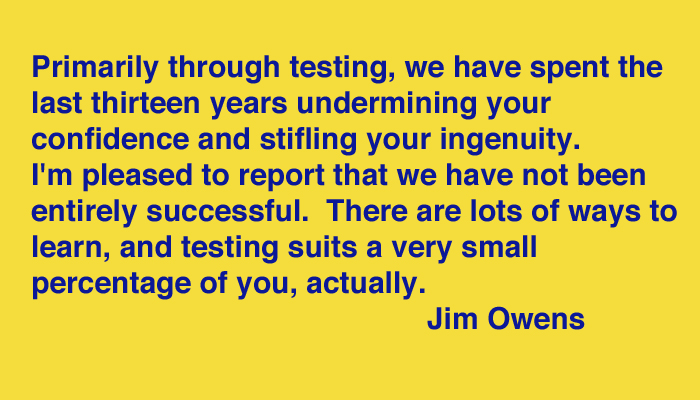
Teacher Jim Owens was chosen by the 435 graduating seniors at Gainesville High School to address them and their families, and delivered this speech to an audience of 5,000 on June 5, 2011. I originally shared this talk back then, and I think it is still relevant now. 
Testing. Testing 1,2. Just like school, no? Always testing. Can you hear me in the cheap seats? Look at you! You’re radiant. You look brighter than ever today. You look like you’ve learned something. It must be the cap. What do you think, should we make it and the gown the SCHOOL UNIFORM for next year? Think of the photo ops. That would show the rest of the world what education looks like in America.
owens.jpg
I am deeply, deeply honored to be speaking to you today, to have been invited BY YOU, the students, on this very special occasion. There is no honor that this humble profession of mine offers that I would ever, or could ever, value more …not even … Merit Pay!
My name is Owens. Not Mister Owens. Not Jim. Just PLAIN Owens. That’s what the kids call me and have for years. I must confess, it felt a little brisk at first, like an enthusiastic slap on the back. Until I realized it was a gesture of cordiality, whereupon I embraced it with affection. Should you too, in the future, feel inclined to call me Owens, by all means, do so.
I teach thinking skills. I do not teach to the test. I’m the guy who teaches your children to think outside-of-the-box. I do not teach your children how to think. Would that not be indocrination? Would that not be brainwashing? I provoke thought, at least I try to. I rather suspect that’s why your children invited me to speak today: to provoke you. I shall do my utmost not … to disappoint them.
Thinking skills. What’s that? Well, that depends on whom you ask. If you ask the people who WRITE the tests, thinking skills might look something like this: If Chinese workers can produce and ship a television for $50, what would it cost to import a million televisions from China. A. $50,000 B. $500,000 C. $5,000,000 D. $50,000,000 or E. Insufficient factors to compute. For instance: how many American jobs will be lost? How will those lost jobs affect the middle class? How will rising unemployment affect the sale of televisions? The ONLY thing I can guarantee you, for sure, is that option E will NOT be on the test.
A more interesting question, I think, might be: If we’ve been testing for the past decade or two and our children, in world competition, are supposedly falling further and further behind, could it be that testing School is Out - Let Your Education Begin! - Living in Dialogue: