Latest News and Comment from Education

Friday, May 15, 2015

How Testing Is Driving More Teachers From Classroom | Oklahoma Observer

How Testing Is Driving More Teachers From Classroom | Oklahoma Observer:

HOW TESTING IS DRIVING MORE TEACHERS FROM CLASSROOM
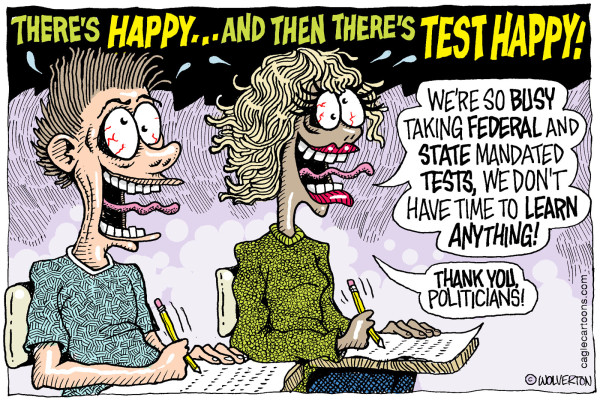


Thompson,JohnBY JOHN THOMPSON
KOSU’s Emily Wendler reports that Robyn Venable taught for 31 years. She is one of the wave of Oklahoma teachers who are reluctantly leaving the profession. Ms. Venable loved teaching, but she is retiring because “[t]he testing is just ridiculous, the paper work is growing by leaps and bounds. The stuff that you’re expected to do just gets added on and added on and added on … ”
Wendler cites State Superintendent Joy Hofmeister, who says that the state began the school year with a shortage of 1,000 teachers, and despite those efforts, it still ended with 1,000 openings. Hofmeister describes the resulting harm of using substitutes, and she also says that 800 classes were canceled because teachers weren’t available.
NPR reports that “school administrators have scrambled throughout the year to fill the gaps by utilizing emergency certifications. … The State Board of Education issued 500 of them this year. Five times more than normal.”
Moreover, Oklahoma City Public Schools has hired hundreds of Teach for America teachers, which is one reason that 36% of the district’s teachers are inexperienced, with less than three years under their belts. OKCPS has also been “recruiting around the nation, in Puerto Rico and Spain because they are having trouble finding teachers here.”
Wendler then cites Sand Springs Superintendent Lloyd Snow, who links the problem to the No Child Left Behind Act of 2001. NCLB “dumped too much testing on students and has irked many teachers for years,” he says. The problems grew worse with the Achieving Classroom Excellence [ACE] law, which “spread on even more layers testing and a teacher evaluation system [TLE] that leaves educators feeling unappreciated.”
Snow concludes, “Now we sit 10-15 years later and where do we find ourselves? Very little progress. A lot of discouraged teachers. A teacher shortage of which I have never seen in my career.”
Wendler’s NPR report follows the release of the “Listening Tour” report by the reform group Stand for Children. As Nora Habib explained in the Tulsa World, Stand learned that “testing was the issue of greatest concern for teachers.”
The report‘s section on testing began with representative teachers’ statements, such as, “So much time has been consumed with testing, over testing, to the point kids have lost all motivation for the test that really matters.” It closed with the protest, “The whole focus is on testing and not learning … there’s no passion for learning.”
Stand’s findings follow an analysis by the Oklahoma Policy Institute of the testing portion of the new teacher evaluation law, which the state adopted in order to compete for Department of Education Secretary Arne Duncan’s Race to the Top.
OKPolicy’s Gene Perry concluded that the test-driven portion of the TLE could be Oklahoma’s next big education crisis:
As Oklahoma already struggles with a dire teacher shortage, we can’t afford to reduce teachers’ morale even more by evaluating their work using an arbitrary and unreliable formula. Test scores may be one piece of evidence used to evaluate educators, but over-reliance on the formula could drive even some of our best teachers away from the profession.
Oklahoma teachers echo the veteran teachers interviewed by the Teachers College Record on why they left the classroom. It reported:
The teachers in this study, who taught prior to and following the enactment of No Child Left Behind, argued that teaching had changed for the worse. The far-reaching accountability measures, which in high-poverty schools often take the form of scripted curricula, lock-step scope and sequence of units, and mandated test preparation that narrows the curriculum, squeezed out all protected institutional space.
Our state’s teachers are repulsed by the same dynamics reported by 30,000 teachers polled by the American Federation of Teachers. The survey discovered that “89% said they were strongly enthusiastic about teaching when they began their careers but just 15% felt the same way today. Most said that drop in enthusiasm has happened in the past two or three years.”
This is consistent with my experience. NCLB was awful, but it imposed high-stakes testing on only about one-fifth of teachers. The worst harm was inflicted as Duncan’s RTTT and NCLB waivers extended bubble-in accountability to every educator.
On the other hand, we should heed the wisdom of veteran Superintendent Lloyd Snow. He told the NPR How Testing Is Driving More Teachers From Classroom | Oklahoma Observer:

BustED Pencils Trending News: predictable; big lie; college readiness declining | BustED Pencils

BustED Pencils Trending News: predictable; big lie; college readiness declining | BustED Pencils:

Trending News: predictable; big lie; college readiness declining 


newsboy_bustedpencils-logo_full color


BustEDstretchChristopher comes to BustED Pencils first with this breaking education news.  When are CNN and MSNBC going to cover this story?  BustED Pencils to become the mainstream media!
“Predictable Results” with Dr. Christopher Tienken
BustEDstretchEducation for “citizenship” – That’s not measurable.  Obliged to care more about profit than children.
Education “reforms” big lie: The real reason the right has declared war on our public schools
BustEDstretchLoss of attention on the culture and climate in schools.  Negative impact created by mandated tests.
College readiness declines when school’s focus is improving test scores, study finds

Want BustED Pencils Trending News to go right to your in-box?
Enter your email on the right under “SUBSCRIBE” on our main page bustedpencils.com

CURMUDGUCATION: Honesty: The Hot New Gap (With Anti-CCSS Bonus)

CURMUDGUCATION: Honesty: The Hot New Gap (With Anti-CCSS Bonus):

Honesty: The Hot New Gap (With Anti-CCSS Bonus)


A new report from Achieve.org doesn't provide a lot of information, but it has opened up a great talking point Gap-- ladies and gentlemen, may we introduce the Honesty Gap!

The report, "Proficient vs. Prepared: Disparities between State Tests and the 2013 National Assessment of Educational Progress (NAEP)" -- well, actually, that title pretty well covers it. Achieve compared Big Standardized Test results to NAEP results.

Achieve, you may recall, was one of the groups instrumental in creating Common Core and foisting it on American schools. So we can't be surprised when their stance is somewhat less than objective.

Today’s economy demands that all young people develop high-level literacy, quantitative reasoning, problem solving, communication, and collaboration skills, all grounded in a rigorous and content-rich K-12 curriculum. Acquiring these skills ensures that high school graduates are academically prepared to pursue the future of their choosing. 

Two sentences. The first one sounds lovely, if rather limited, and is an opinion that I'm sure many folks share (at least in part). The second is another iteration of the unproven belief that such a list of qualities will lead to academic preparation. But then, in the next sentence, in bold typeface-- we make a huge, huge leap.

Many state tests, however, continue to mislead the public about whether students are proficient. Parents, students, and teachers deserve transparency and accuracy in public reporting.

This statement assumes and implies that "proficient" is a measure of students development of the list above. It is not. It is a score from one badly designed, non-validated Big Standardized Test thatdoes not have a hope of measuring any of those high function skills (not to mention "collaboration," which is of course expressly forbidden).

I do like the call for transparency. Does this mean that Achieve is going to call for an end to the Giant Cone of Secrecy around the test, and that states should no longer be required to serve as enforcement arms for protecting the proprietary rights of test manufacturers over the educational interests of students? No, I didn't think so.

BS Tests are measuring tools that have never been checked. It's like somebody holds up a length of string and says, "Yeah, that is what I imagine a yard should be, more or less" without ever grabbing a yardstick. Now, Achieve is shocked-- shocked!!-- to discover that the various states' pieces of string aren't exactly a yard long.

But their framing of it is, well, exquisite. States that have BS Test scores that come (somehow) in line with their NAEP scores are called the Top Truth-Tellers. The big gap states are not called Top Dirty Rotten Liars, but hey, if the shoe fits. This raises a few questions, such as how one compares the state-level BS Tests with the NAEP (maybe, it seems, just by counting the number who pass or fail).

More importantly, it raises this question: if the NAEP is the gold standard for measuring all that cool stuff about student achievement, why don't we just use it and scrap all the state-level BS Tests?

Reformsters are skipping right past that to The Honesty Gap. It's a more formal version of the old assertion that schools and teachers are just lying to their students and ed reform has to include telling parents and students that they and their schools and their teachers all suck.

Not surprisingly, the Honesty Gap has shown up in pieces by Mike Petrilli at Fordham and at the Reformster Website To Which I Will Not Link. And those pieces are not a surprise because the Honesty Gap has recently launched its very own website!! Woo hoo!! That website was launched by The Collaborative for Student Success, an advocacy group with most excellently reformy partners,
including the Fordham Foundation, the US Chamber, and even-- oh, look! Also Achievethecore.org. All of which explains why Honesty Gap uses much of the same rhetoric to highlight the data from 
CURMUDGUCATION: Honesty: The Hot New Gap (With Anti-CCSS Bonus):

With A Brooklyn Accent: The Coming High School Graduation Crisis in New York State

With A Brooklyn Accent: The Coming High School Graduation Crisis in New York State:

The Coming High School Graduation Crisis in New York State


Among the many things that the NY State Regents and New York State Department of Education have done terribly wrong is require all students in the state, other than a small number of students with IEP's, to pass five Regents examinations to graduate from high school. This is a huge departure from when I went to school when students had a choice of graduating with a Regents diploma, a commercial diploma, or a general diploma. That was a time when New York City and New York State had first rate vocation and technical programs, and many young people chose to go that route, and head straight for the job market, rather than go the academic route and head off to college.  Somehow, between now and then, the geniuses in Albany decided that everyone has to get a Regents diploma and in the process, they ended up undermining technical and vocational education in many parts of the state.

There have been some gains as a result of that approach. More students have gone on to college and junior college, and fewer students have been
neglected entirely and put in make work classes with teachers that don't push them. Unfortunately, while all this has taken place, many technical and vocational programs in the state have been undermined, requiring students who want a trade to spend their own money on trade schools after they leave high school, with or without a degree

But the worst damage is yet to come. In the last few years, as Regents exams are increasingly aligned with the Common Core standards, the exams have been made much more difficult, and many students are in an utter panic about being able to graduate from high school. Worse yet, the alternative to an official high school diploma, the GED, which has now been taken over by Pearson, has also been made much more difficult.  Within the next few years, we face the prospect of hundreds of thousands of students in the state being able to get any kind of high school certification, with ELL students, special needs students and students in high poverty districts being especially victimized.

There are some special interests in the state who welcome this crisis. They see it as an opportunity to take over whole districts, replace public schools with charter schools, or hire consulting firms to undertake "school turnaround" strategies in schools with low graduation rates. You can be sure that teachers will be blamed for that crisis, and put under fierce pressure to squeeze test results out of terrified students

But the impact will not only be felt on the high school level. As panic about low graduation rates filters through the system, educators from Pre-K up will feel the pressure to make students test ready and make testing and test prep and integral part of the school experience when exploration and play and the arts should be integral parts of the curriculum

In short, the education system in the entire state will be held hostage to the gradution crisis

If you think test pressure are bad now, wait till you see what they are like in three or four years when the Regents are entirely Common Core aligned

It is time for parents and teachers and students to organize NOW to demand that there be alternative paths to graduation other than the Regents Diploma and the GED. Otherwise schools in NY State will be in full scale panic mode from Pre-K to 12 gradeWith A Brooklyn Accent: The Coming High School Graduation Crisis in New York State:

Pro-privatization money behind bills to boost N.C. charter schools

Pro-privatization money behind bills to boost N.C. charter schools:

Pro-privatization money behind bills to boost N.C. charter schools


Charter schools have experienced rapid growth in North Carolina in recent years after state lawmakers lifted a cap limiting their numbers. Now the General Assembly is considering legislation that could boost the finances of the schools, which are public but independently run — increasingly by private, for-profit companies — and don't have to adhere to all the regulations that apply to traditional public schools. Charters have a mixed record on academic achievement and have been shown to lead to increased segregation.
Several of the proposed bills that would aid charter schools failed to survive the crossover deadline, when legislation must be passed by one chamber to remain in play. But one did survive — and it's possible that any of the others could be brought back to life by legislative maneuvers.
The measure that survived crossover, Senate Bill 456, would require additional monies from a special fund established in 2010 to be shared with charter schools. It passed the Senate on April 29 and moved on to the House. In reviewing a similar bill, the N.C. Association of School Administrators noted that money from the fund has "already been shared in previous years with [charter schools] when the funds were originally appropriated" and raised concerns that the proposed law would result in charters "double dipping."
The sponsors of Senate Bill 456 — Republicans Jerry Tillman of Archdale and Ronald Rabin, who represents Harnett and Lee counties and parts of Johnson County — did not receive support from groups advocating school privatization in recent election cycles. But the sponsors of the other pro-charter bills did.
The money trail begins at the Walton Family Foundation, the grantmaking organization of the billionaire Wal-Mart founders known for funding charter and private school efforts, and the American Federation for Children (AFC), a 501(c)(4) nonprofit that also advocates for school privatization. Members of the Walton family have given millions of dollars to the AFC, its affiliates and All Children Matter, AFC's predecessor. In turn, these groups fund a trio of pro-school privatization organizations in North Carolina that lobby, give money directly to candidates for state office and make independent political expenditures that indirectly benefit candidates to promote their agenda: expanding charter schools, increasing charter school funding and offering private school vouchers.
Among the lawmakers who have received support from this network are Republicans Rep. Paul Stam of Wake County, speaker pro tempore of the state House and vice chair of the House Appropriations Committee on Education, and Rep. Larry Yarborough of Roxboro.
Stam and Yarborough introduced House Bill 761, titled "Charter School Capital Funds," on April 14. It would allow counties to provide funding to charters for purchase, construction or modification of buildings and other structures such as playgrounds, libraries, auditoriums and gymnasiums, as well as for purchase of furnishings and equipment. To date, public funds have not gone towards charter school campuses in North Carolina. Charter school groups including the North Carolina Public Charter School Association have been seeking this allowance for some time. Critics have raised concerns the bill could lead to another that mandates counties to pay for school facilities. The measure was referred to the House Local Government Committee, where it stalled.  
Less than two weeks earlier, Stam and Yarborough introduced House Bill 557; similar to Senate Bill 456, it would allocate additional money to charter schools from a special fund. The bill stalled in the House Appropriations Committee.
One of the North Carolina pro-privatization groups, a 501(c)(4) "social welfare" nonprofit called Partners for Educational Freedom in North Carolina, manages a political action committee that gave Stam $3,250 in the 2011-12 election cycle and another $500 in the 2013-14 cycle. A longtime advocate of school privatization, Stam helped remove the state's cap on charter schools in 2011. He also incorporated "Opportunity Scholarships" — taxpayer-funded vouchers given to students from lower-income families to help pay for private school tuition — into the 2013 state budget. This year Stam is a primary sponsor of House Bill 133 to increase private school voucher allowances for children with disabilities.
Yarborough's campaign benefited from over $24,000 worth of supportive mailers and phone calls from North Carolina Citizens for Freedom in Education IE PAC, an independent political committee that shares its address and some staff with Partners for Educational Freedom and its sister group, a 501(c)(3) nonprofit called Parents for Educational Freedom in North Carolina. Yarborough, a first-term state legislator, is a co-sponsor of House Bill 133, which currently sits in the House Appropriations Committee.
Other primary sponsors of the measure are Republican Rep. Bert Jones of Reidsville, who received $1,500 in campaign contributions from Partners for Educational Freedom in 2012 and $350 in 2014; Republican Rep. Jonathan Jordan of Jefferson, who benefited from over $18,000 in independent expenditures in 2014 from North Carolina Citizens for Freedom in Education IE PAC; and Democrat Cecil Brockman of High Point, whose campaign received $750 from Partners for Educational Freedom in 2014.
Another measure introduced this year, House Bill 535, would allot $2 million in state funds to Parents for Educational Freedom to expand charter schools through its Public Charter School Accelerator; that bill has been referred to the House Committee on Rules, Calendar and Operations. The bill's primary sponsors — Rep. Brockman and Republican Reps. Rob Bryan of Mecklenburg County and Brian Brown of Pitt County — have either received direct campaign contributions from Partners for Educational Freedom or benefited from independent spending by North Carolina Citizens for Freedom in Education IE PAC.
The chart below details the money trail to state House members who have sponsored bills during this legislative session that benefit charters and school privatization.Pro-privatization money behind bills to boost N.C. charter schools:

Standardized Test Scores and Family Income | Tucson Weekly

Standardized Test Scores and Family Income | The Range: The Tucson Weekly's Daily Dispatch | Tucson Weekly:

Standardized Test Scores and Family Income 


click to enlargetucson-school-score-map_allclouds.jpg

    This bears repeating whenever the subject of high stakes testing comes up. There’s a very strong correlation between standardized test scores and family income. Test scores are higher in areas with high family income and lower in areas with low family income. It’s true in Tucson. It’s true in Phoenix. It’s true across the United States. It’s true in developed countries around the world (and probably even more true in undeveloped countries).

    Based on information from international testing, we know that test score inequality is higher in the U.S. than other developed countries, but so is income inequality.

    I created a few maps of the Tucson area awhile back with schools' state grades and median household income to demonstrate how neatly the test score/family income correlation works out.

    The map at the top of the post shows the state grades of all the schools in the Tucson area. Since state grades are mostly a reflection of the schools’ AIMS scores, a high grade generally means high test scores. I generated the map from the Department of Education website, then added colored clouds to emphasize the grade clusters. As you can see, Marana, Oro Valley, the Foothills and Vail have mostly A schools with a smattering of B schools thrown in. The B schools cluster just below the Foothills, the C’s are scattered from the center to the east of the city and the D schools are mainly in the south and southwest areas.

    Anyone who’s lived around here for awhile doesn’t really need the second map to understand how closely the school scores align with the incomes of families living in those areas, but in the map below, the distribution of median family incomes lays any questions to rest.


    click to enlargePIMA-NOT-CHARTER-AND-MEDIAN-INCOME-w_clouds.jpg
       
      Blue areas have the highest incomes, and the pinkish areas have the lowest incomes—the lighter the shade, the lower the income. The triangles are schools and their state grades. The colored clouds for the school grades match up incredibly closely with the income levels. (Note: Since the person who made this map for me left out the charter schools, the clouds on the two maps are close but not a perfect match.)

      I've gone through the same process with a map of the Phoenix area and arrived at similar results, and all the literature indicates you'll find the same correlation elsewhere.

      What does this mean? It means we pretty much know how schools' test scores are going to turn out, with minor variations and occasional exceptions. Generally, schools with high income students will get high test scores. and schools with low income students will get low test scores. In other words, most of what we “learn” from our arduous, costly regimen of high stakes testing, we already know. The scores have less to do with successful schools and failing schools than with the socioeconomic status of the kids who walk through the door. As for the exceptions, they tell us less than we might hope. The tests are such blunt instruments and gaming the tests to increase student scores, legally and illegally, is so prevalent, minor variations from what we expect tell us little about a school’s student achievement. As for those situations where the results are very different from what we might expect—usually schools with low income students who get high test scores—all too often, the unbelievable results turn out to be just that: unbelievable. We should have learned that lesson from schools in Atlanta, Georgia, Washington, DC, and most likely Arizona as well, and we have plenty of indications it’s true elsewhere. We’ve been fooled too many times. We shouldn’t let amazingly high test scores make fools of us again.

      Of course, some schools really do get great results, and not because they cherry-picked their students or because they gamed the test. Some schools genuinely do an exceptional job with their students. Unfortunately, we haven’t figured out how to catch that lightning, put it in a bottle and transport it to other schools. It’s not like building a thousand identical McDonalds and turning out identical burgers and fries at each location. Education doesn’t work that way. Sure, we can keep testing every student every year, year after year, and tell schools with low income students, “Your scores are too low. Be exceptional! Be exceptional!” We can also tell writers whose style and substance aren’t up to snuff, “Your writing isn't good enough. Be Shakespeare! Be Shakespeare!” Unfortunately, that doesn’t mean those schools will end up being exceptional or those writers will end up being Shakespeare.

      You want to test kids so we can get a snapshot of their achievement level and a rough idea of how well their schools are teaching them? Fine. Administer standardized tests to 3rd grade, 6th grade and 10th grade students. It’ll cost less, take up far less teaching time, create far less stress for students and staff and yield the same or better results as what we’re getting from this insane regimen of yearly high stakes tests.Standardized Test Scores and Family Income | The Range: The Tucson Weekly's Daily Dispatch | Tucson Weekly:

      Marie Corfield: Is the NJ pension crisis Christie's Waterloo?

      Marie Corfield: Is the NJ pension crisis Christie's Waterloo?:

      Is the NJ pension crisis Christie's Waterloo?


      It's the 15th of the month, and once again, along with thousands of other public employees across the state, I made my legally-required pension payment. How about you, Gov. Christie? No? I didn't think so.

      If you live in NJ, you'd have to be living under a rock to not know about the pension battle raging in Trenton. And if you're reading this, you also know that this debacle is decades old with Democratic and Republican governors being equal opportunity offenders as one after another raided the once-flush fund to plug budget holes and prop up their pet projects. (Bonus points for alliteration!)
      So, what can public employees do to fix this mess? Nothing. We didn't cause it and we can't cure it. The only thing we can and should do is demand nothing less than full funding of the pension system as required by the law Gov. Christie touts as his signature, bipartisan 'reform'. Because while he was busy cutting deals with certain Democrats to 'fix' this fiasco (translation: public employees work more, pay more and get less in return while the super wealthy and corporations get tax breaks) he was also doing this—with the blessings of the NJ Democratic Party Machine and GOP legislators who have been too afraid to stand up to him:


      The state can afford to fix this crisis; it all comes down to priorities. If Christie can afford to give tax breaks to the super wealthy and corporations—which, by the way, has done little to spur the state's economy—he can afford to make his legally-obligated pension payments. If he doesn't, this will happen in 12 years:


      It's really that simple, folks. 

      But that would mean helping public employees, and if there's one thing Gov. Christie hates, it's public employees. So he keeps beating the same dead horse, continuing to excoriate us, oddly fighting his signature legislation in court, while his poll numbers point to a populace that has grown weary of the blustering, the bullying and the flat-out lies. He's acting less like a confident presidential candidate and more like one who has to play Marie Corfield: Is the NJ pension crisis Christie's Waterloo?:

      Pearson profits while students pay | American Federation of Teachers

      Pearson profits while students pay | American Federation of Teachers:

      Pearson profits while students pay


       By Virginia Myers

      PEARSON IS everywhere.
      Those textbooks you order every year—the ones with the astronomical price tags your students complain about? Pearson published them. The Miller Analogies Test (MAT) that landed your graduate assistant her position in the department? Pearson wrote it. The online program your university just launched? Pearson. Even the Penguin paperback you brought to the beach this year is from a publisher partially owned by Pearson.
      Pearson also owns the Financial Times, Prentice Hall, Adobe Press and part of Nook. It follows students from recruiting software through online courses, lectures, PowerPoints, discussion questions, study programs and grading rubrics.
      Most important for colleges and universities, Pearson has monopolized the online learning industry. Riding its reputation as a decades-old source of educational materials, from grade-school geography to graduate-study texts, it has become the go-to company when an institution wants to expand online learning programs but may not have the resources to do it with in-house staff. In fact, some institutions are so anxious to jump into bed with a familiar name, they forgo the usual bidding process.
      That was the case at the University of Florida, according to an exposé Politico published in February: Administrators awarded Pearson a $186 million, decade-long, no-bid contract—claiming it was an extension of a much smaller contract for an entirely different service—and now Pearson is building an online college there. Two colleges in Texas acted similarly, hiring Pearson to create online coursework for $9 million. And Northern Arizona University signed on for more than 100 online Pearson-designed courses, for about $8.7 million.
      All of this doesn’t begin to touch the preK-12 market, where Pearson is best known for assessments such as the Partnership for Assessment of Readiness for College and Careers (known as PARCC), but it also provides test prep, tutoring, teacher evaluation and curriculum.
      Pearson is so ubiquitous, it “has become almost like a shadow national Department of Education unto itself,” says Michael Apple, an education professor at the University of Wisconsin, Madison and a member of United Faculty and Academic Staff. Pearson “has also become even more powerful in teacher education,” he says, citing Pearson’s role operating edTPA (formerly the Teacher Performance Assessment), a popular assessment tool sometimes required of new graduates looking for a teaching job. According to Apple, edTPA gives short shrift to critical social and cultural knowledge, “thereby making it even more unlikely that … important foundational courses in education (history, philosophy, sociology) will be seen as necessary at institutions of higher education.”
      “Many of us are more than a little worried that education will be transformed into simply preparation for an unequal economy rather than a place for learning about civic responsibility and critical citizenship,” he warns. “Yet these are among the most important aims of any education.”
      Pearson’s aim, however, is profit. The British-based company reported 4.9 billion pounds in sales in 2013, or approximately $6.86 billion, 60 percent of which is earned in the United States. The company receives up to 60 percent of student tuition dollars collected for its online courses. And get this: If it doesn’t meet enrollment goals—and frequently, it does not—Pearson still gets paid. In other words, if it promises 100 students, it gets paid tuition for 100 students, even if only 50 show up. That leaves the university holding the bag.
      Much of this goes on behind a screen of corporate privacy, since Pearson is not, despite its multiple contracts at public institutions, a public entity itself. The screen does not extend to test takers, however: Pearson has been found monitoring the social media accounts of students taking the PARCC test, and has declined to join other education-technology firms that have signed the Student Privacy Pledge designed to limit the collection, maintenance and use of student personal information.
      A backlash has begun to take hold. According to Politico, California State University scrapped a 2012 contract for $25 million after online recruiting flopped. Howard University canceled Pearson plans for online program development, for undisclosed reasons. And in Texas, a $90 million contract for standardized testing was “too vague” to renew.
      Unionized faculty at Rutgers were able to stop further involvement with Pearson this spring, with their resolution to reject any new online degree programs managed by the company. The move was not designed to limit online teaching, but rather to preserve the faculty’s essential role in directing it themselves.
      Pearson may not be a bad corporation. It makes lots of money—that’s what corporations do. But Pearson is not set up to value academics over profit. That is what faculty do. We must ensure that we continue to shape the heart of higher learning, not just filling classrooms but reaching students with inspiring pathways to knowledge and innovation driven by scholarship, not profit.
       Pearson profits while students pay | American Federation of Teachers:
      AFT On Campus, Summer 2015 - See more at: http://www.aft.org/periodical/aft-campus/summer-2015/pearson-profits-while-students-pay#sthash.lHIhPqn9.dpuf

      Why my students’ AP scores matter. And why they don’t. | NBPTS

      Why my students’ AP scores matter. And why they don’t. | NBPTS:

      Why my students’ AP scores matter. And why they don’t.

      Ray Salazar |  


       Editor's Note: Ray Salazar, NBCT,  teaches high school English in Chicago Public Schools and  is an award-winning blogger. The views expressed in this blog are his own

      I fight the obsession with testing and over-testing in our classrooms.  Yet, given the choice, I choose to teach AP English Language every chance I get.  After months of intense writing and thinking, over sixty of my students take their AP test this morning.  This is the sixth time I’ve taught this class.  And each year, I value this course—and the experience of teaching it—more and more.
       
      Focused on examining non-fiction and images as text, this class allows high-school students to enter complex conversations that matter to them—or that eventually matter to them. The only request I make of anyone who signs up for this AP class with me is that he or she be ready to write a lot and think a lot.  Every year since I started teaching this class in 2008, my classes are packed.  And when students change their minds after two weeks and want a schedule change, I don’t approve it.  “Too bad,” I tell ‘em.  “We’re stuck writing with each other for the whole year.”
       
      In a working-class neighborhood on Chicago’s Southwest side, we study how writers use memory, observation, and evidence.  We examine classic approaches to make an audience feel calm, kindness, indignation, or fear.  I challenge students to challenge themselves as they create complex texts that that build their competence and confidence as writers.  They complain sometimes. But when we pause to reflect on how they’re growing as writers and thinkers, students reveal their pride.
       
      This is why, the longer I teach AP English Language, the less I define my success or my students’ success by their scores.  Don’t get me wrong—I’m overjoyed when I see some 3s or a 4 when scores come out in July.  And I’m disappointed when a student I thought might get a 3 ends up with a 2—or a 1. But even with a low score on the AP exam, a year’s worth of study ensures that they see themselves in a new way.  With a teacher’s support and deep content knowledge, non-traditional AP students reaffirm or redefine their educational identity. Most of my students will be the first in their family to go to college: even if they don’t score a 3, they challenge a stereotype.
       
      In one conversation with a student who told me how this class helped him succeed in a college 2,000 miles away, he told me, “Before your class, I knew what I did right.  But I never knew what I did wrong.”  This is the confidence-building approach I’ve gained by teaching AP English Language: when a student’s writing does not work, we focus on whatever does work, but then the student must decide what to do next.
       
      A student from St. Olaf in Minnesota stopped by in December.  When I asked him how college was, he said, “Everything in my writing life is fine.”
       
      Another former student, now studying nursing, told me her professors complimented her writing each time she turned in a paper.
       
      One student tweeted me from Northern Illinois: “Guess who’s the only one in class who can explain ethos, pathos, and logos?”
       
      Even the student who went to Northwestern and struggled incredibly in math classes felt prepared for all the writing she had to do.
       
      These stories affirm my belief that more students deserve access to AP courses. In November, Chicago Public Schools boasted that “the number of CPS high school students enrolled in has grown by 25 percent, with 30 percent more students passing their AP exams and earning college credit. The number of students reaching the passing score of 3 or above on AP exams, earning eligibility for college credit, has nearly doubled since 2011 for both African American and Latino students.”
       
      This week, the Illinois General Assembly continues work to pass HB 3428, which would guarantee all public universities in our state grant college credit to any student who earns a score of 3 or better on an Advanced Placement exam. As Advanced Placement teachers, our responsibility is to ensure that we fulfill the commitment the College Board promises through its courses: to build college readiness and increase college success. And though the score is not the only thing that matters, or even the most important thing, we must maintain the goal that our students will earn that 3 or 4 or 5.
       
      Many AP teachers will face skepticism from a colleague, doubts about the extra work or the odds of students passing the exams. I focus on my energy on engaging my students in a classroom experience that builds writing skills and simultaneously fosters conversations about poverty, race, opportunity.  These conversations—not the skeptical ones—will matter in our students’ futures.
       
      Before today’s test, I cheered on my students and told them to persevere.  They know how to write for this test and for college.  In a few days, I’ll admit to them that on my AP English Literature Exam in 1990 when I was seventeen years old, I got a 2.  I felt disappointed in myself when I opened that envelope.  “But you know what,” I’ll add, “even if I had gotten a 3 or higher, it would not have changed my life.  I still turned out OK.”
      Ray Salazar has been an English teacher in the Chicago Public Schools since 1995. He is a National Board Certified Teacher. His blog, The White Rhino, tied for second place in EWA's Community Members Best  Blog category in 2012. National Public Radio and Chicago Public Radio aired his essays and the Chicago Tribune and CNN's Schools of Thought Blog published his editorials. Salazar earned a bachelor's degree in English/Secondary Education and master's degree in writing, with distinction, from DePaul University. 
      Visit his blog The White Rhino at www.chicagonow.com/white-rhino
      Follow him on Twitter @WhiteRhinoRay
      Contact: WhiteRhinoBlog@gmail.com
      Why my students’ AP scores matter. And why they don’t. | NBPTS:


      What’s wrong with New Jersey? | Bob Braun's Ledger

      What’s wrong with New Jersey? | Bob Braun's Ledger:

      What’s wrong with New Jersey?


      The mayor of the state’s largest city joined hundreds of others–teachers, students, parents– in a march that closed down its largest thoroughfare. And the mayor promised the demonstrations would continue and be even more creative. In any other state in the nation, the event would have made, not just statewide news, but national news.  But not here in New Jersey. Here in New Jersey, Mayor Ras Baraka’s bold action and aggressive words were ignored by the media, including the state’s largest newspaper. Only a few digital journalists and photographers did cover it–along with a public television station looking to balance a ridiculously one-sided interview the day before with the target of Newark’s anger, state superintendent Cami Anderson.
      What’s wrong with New Jersey? Why is it ignoring a situation that could easily boil out of control–while its media cover every burp uttered by Chris Christie who doesn’t deserve becoming president of anything besides an inmates’ foodie club in a federal prison somewhere?
      It’s not  unnoticed. Baraka raised the question in his speech on Broad Street at rush hour. After reciting why the people of the city are angry with  Cami Anderson, he turned on what he called the “press” and, of course, everyone there knew he was talking about The Star-Ledger:
      “That’s why we’re upset. We’re not upset with her personality. And I wish the media would figure that out. I wish they’d figure that out. Because you can open up the paper and, if I have an argument with a council person, it’s on the front page. But this is a lady with a $70 million deficit–who has closed a bunch of schools–and has schools that haven’t worked–and there’s not one thing, not one thing in the press.
      “Just constantly defending and defending and defending her, until you want to figure out who is protecting her? Why is she being protected and who is making (Newark) What’s wrong with New Jersey? | Bob Braun's Ledger:
      Mayor Baraka joins the march