Latest News and Comment from Education

Sunday, May 10, 2015

Boycotters Might Be Winning the Battle Over Standardized Testing | TakePart

Boycotters Might Be Winning the Battle Over Standardized Testing | TakePart:

Boycotters Might Be Winning the Battle Over Standardized Testing

Thanks to pressure from parents and activists, a growing number of school districts and state boards of education are putting the brakes on new high-stakes exams.


In Chicago, home to the nation’s third-largest school system, the city superintendent has decided not to administer a test tied to the federal Common Core curriculum. The move eases the pressure on tens of thousands of students—and validates parents and educators who boycotted the test last year—but risks billions of dollars in government funds.  
Half a continent away, in California, state education officials are ready to follow Chicago’s lead and ask the federal government for an exemption from using scores on tests mandated by No Child Left Behind to measure progress in reading and math. Meanwhile, in Colorado, state education authorities recently voted 5–2 to walk away fromCommon Core and leave their share of Education Department money on the table—all because their kids are staggering under the testing burden.


In districts across the nation, from Florida to Alaska, the grassroots push for a rollback in high-stakes testing has gained momentum, and a broad coalition of parents, teachers, and advocates are poised to take advantage, even if it means an end to federal grants in tight fiscal times. But it also puts pressure on local and national education policy makers, including President Obama and Secretary of Education Arne Duncan, who see frequent testing as a key component in the education-overhaul tool kit.

“What you’re seeing is a response to a grassroots movement of parents, teachers, and students pushing back against testing overkill,” said Robert Schaeffer, public education director of FairTest, one of the organizations leading the test-reform movement. He said suburban schools where parents doubt the usefulness of standardized testing is worth the stress have linked arms with poorer ones that don’t have the resources to ensure students score well and will lose money if they don’t.
According to Schaeffer, school districts and state education boards are beginning to recognize that forcing students to take standardized tests—and using the results to determine federal funding, millions of dollars in education reform incentives, and teacher salaries—does more harm than good. The tests have barely moved the needle in the drive to improve public education.
“The [Common Core] tests were supposed to be a whole new generation, designed to get beyond the fill-in-the-bubble, multiple-choice tests,” he said. “But they’re the same tests, only longer and harder.”
Starting with No Child Left Behind and continuing with the Common Core curriculum, student testing has spiked in the last decade. Along with state assessments, some districts test their students as often as once a year on math and reading proficiency; before the change, testing usually happened just once in elementary, middle, and high school.
Proponents say testing is a valuable tool that helps parents measure school and teacher performance with an independent, unbiased, standard yardstick. But there’s a lot of pressure: Some tests can determine a student’s future education and career.


“This movement has been growing, and if Congress reauthorizes the [Elementary and Secondary Education Act, known as No Child Left Behind], it may well trigger a larger test boycott movement across the country,” Pedro Noguera, an education professor at New York University, wrote in an email. “Many communities are growing weary of the amount of time devoted to testing—which comes at the expense of time focused on instruction—and they are increasingly willing to take on the federal government.”

Noguera and Schaeffer agree that Chicago Public Schools is Exhibit A, and perhaps the turning point the movement has been waiting for. After all, both President Obama and Secretary Duncan are standardized-testing advocates who have close ties to Chicago and to its mayor, Rahm Emanuel, Obama’s former chief of staff.

When parents and some teachers boycotted the Common Core–affiliated Partnership Assessment for Readiness for College and Careers (known as the PARCC) test last year, “public opinion polls say the public backed them,” Schaeffer said. Other grassroots organizations and teachers’ unions threw their weight behind the boycott, leading Chicago Public Schools chief Barbara Byrd-Bennett to recently make the strategic decision to have only about 10 percent of the district’s 664 public schools take the test as a representative sample.

Disparities in school funding played a role in Bennett’s decision; the test is computerized, which isn’t a problem for schools in wealthier areas, but in some of Chicago’s poorest schools, it’s a disqualifier. That’s the situation in plenty of other cities across the nation too. “In many places, computer labs do not exist,” Schaeffer said.

Ultimately, he said, the movement has probably reached critical mass, and as many as 25 states are discussing opting out of the system—including New York, where Schaeffer predicted “widespread opt-outs and boycotts by parents” beginning in March, the start of so-called testing season.

“Politicians are scrambling and backpedaling,” he said. “This is a rapidly escalating moment, especially as testing season approaches.”


“This movement has been growing, and if Congress reauthorizes the [Elementary and Secondary Education Act, known as No Child Left Behind], it may well trigger a larger test boycott movement across the country,” Pedro Noguera, an education professor at New York University, wrote in an email. “Many communities are growing weary of the amount of time devoted to testing—which comes at the expense of time focused on instruction—and they are increasingly willing to take on the federal government.”
Noguera and Schaeffer agree that Chicago Public Schools is Exhibit A, and perhaps the turning point the movement has been waiting for. After all, both President Obama and Secretary Duncan are standardized-testing advocates who have close ties to Chicago and to its mayor, Rahm Emanuel, Obama’s former chief of staff.
When parents and some teachers boycotted the Common Core–affiliated Partnership Assessment for Readiness for College and Careers (known as the PARCC) test last year, “public opinion polls say the public backed them,” Schaeffer said. Other grassroots organizations and teachers’ unions threw their weight behind the boycott, leading Chicago Public Schools chief Barbara Byrd-Bennett to recently make the strategic decision to have only about 10 percent of the district’s 664 public schools take the test as a representative sample.
Disparities in school funding played a role in Bennett’s decision; the test is computerized, which isn’t a problem for schools in wealthier areas, but in some of Chicago’s poorest schools, it’s a disqualifier. That’s the situation in plenty of other cities across the nation too. “In many places, computer labs do not exist,” Schaeffer said.  


Ultimately, he said, the movement has probably reached critical mass, and as many as 25 states are discussing opting out of the system—including New York, where Schaeffer predicted “widespread opt-outs and boycotts by parents” beginning in March, the start of so-called testing season.   
“Politicians are scrambling and backpedaling,” he said. “This is a rapidly escalating moment, especially as testing season approaches.”Boycotters Might Be Winning the Battle Over Standardized Testing | TakePart:

“I’ve Got Ants in My Pants and I Need to Dance” - Students Need Physical Education

Students Need Physical Education:

“I’ve Got Ants in My Pants and I Need to Dance”


Students Need Physical Activity to Excel

Nothing gets me angrier or more upset than hearing that students in the Bronx, and other high needs communities, have almost no access to physical activity during their school day, both because they lack gym access and school teams, and because schools are now now using recess and gym for test prep because they fear being closed or subject to outside “intervention” if their test scores should go down
Not only does this hugely magnify health issues among students, ranging from obesity to circulatory problems, it has an even more negative impact on student behavior and academic performance. Asking young people to go through entire days sitting in their chairs, devoid of any regular physical outlet, is to ask them to do something entirely unnatural for any human being, much less a child. It will make students restless, make them angry, and inhibit their ability to concentrate on the material authorities want them to master. And though an emphasis on improving test scores is often promoted as a vehicle to promote educational equity, having test prep dominate the school day to the exclusion of physical activity, or artistic expression, is a prescription for long term academic disaster.

It pains me to think that there are brilliant young people all over this country whose intellectual or artistic potential is being squandered because their schools give them no exercise opportunities whatsoever!

This is something I know from first hand experience as well as the available academic research. I could never have had the patience to sit for hours doing historical research, something I started doing in high school and began to adopt as a regular routine in college, had not I gone through an extremely demanding regimen of physical activity. In high school, that consisted of daily gym class as well as being on a school team; in college it consisted of playing two hours of basketball several evenings a week after having tennis team practice every afternoon. It was that expenditure of energy that allowed me to spend three or four hours in a library at a time; the activity which ultimately became the basis of my career as a scholar and teacher. There is no way I could have done that without huge opportunities for physical release.
It pains me to think that there are brilliant young people all over this country whose intellectual or artistic potential is being squandered because their schools give them no exercise opportunities whatsoever! To put the matter bluntly, I would never have become an historian if I had to go through school with little or no exercise the way many Bronx youngsters do today. I might have even ended up in jail, because I would have been so angry and restless that I would have done something destructive.
mark-naisonWe are doing a terrible thing to our children by denying them exercise.
This has to change and change now, even if it means a moratorium on testing. Come to think of it, that may be exactly what we need.
mak-naison-175James Brown spoke for millions of children, including me, when he said ” I have ants in my pants and I need to dance.” That is a fundamental human need which current education policy makers are suppressing in their panic to raise test scores.

About Mark Naison

Mark Naison is a Professor of African-American Studies and History at Fordham University and Director of Fordham’s Urban Studies Program. He is the author of three books and over 100 articles on African-American History, urban history, and the history of sports.Students Need Physical Education:

Quality of So-Called “Education” Journalism Actually Low | the becoming radical

Quality of So-Called “Education” Journalism Actually Low | the becoming radical:

QUALITY OF SO-CALLED “EDUCATION” JOURNALISM ACTUALLY LOW


 In both my May Experience course on education documentaries and my foundations in education course, we view and discuss the 2008 HBO documentary Hard Times at Douglass High:

Shot in classic cinema verité style, the film captures the complex realities of life at Douglass, and provides a context for the national debate over the controversial No Child Left Behind Act, focusing on the brutal inequalities of American minority education, considered an American tragedy by many.
Although many scenes are powerful, one in particular remains disturbingly relevant in 2015: The camera captures with a voice-over students taking the standardized test that is being field-tested for students (no stakes), but will be high-stakes for the school and teachers; many of the students are shown with their heads down, essentially making no effort on the test.
Hard Times ends by noting that the administration has been replaced and Douglass High (Baltimore, MD) joins one of many narratives that too often we read about in the on-going era of high-stakes accountability: failed schools, schools “taken over” by the state, closed schools.
A few years ago, I was working on an Op-Ed for The State (Columbia, SC), but I was challenged about my outline of the accountability movement in South Carolina by the editor. Just for context, I began teaching in SC in 1984, when the first implementation of accountability began, linked to higher teacher pay, greater educational funding, and the start of the standards/high-stakes testing movement.
The editor insisted that accountability was a child of the late 1990s, but I was able to send her links to the first SC laws in the late 1970s and explained my own life as a teacher at a school where we were actively teaching to the exit exam in the early and mid-1980s (including double-tracking students in math and ELA courses as tenth graders to help them pass the tests to graduate).
What do these two topics above have to do with each other?
For thirty years, journalism addressing education and more specifically education reform has been inadequate to the point of being a huge part of the education reform problem.
Take for yet another example this piece from The Hechinger Report (and a repost in Education Week): Stakes for “high-stakes” tests are actually pretty low.
The maps, data, and serious tone are likely to have masked the flippant headline as well as terse “gotcha” lede: “It turns out that the stakes for this spring’s Common Core-aligned tests are not quite as high as they might seem.”
Seems all that opt-out nonsense and teacher caterwauling has been for naught, right?
Just as I suspected. As the article clarifies early, “both sides” are truly out-of-bounds:
“I think the stakes are either overstated or understated depending on which side of the argument you’re on,” said Chris Minnich, executive director of the Council of Chief State School Officers. “Both sides need to take a step back and just take a look at this map.”
As one point of concern, however, let’s consider another piece in the same publication: More than 5,000 Mississippi third-graders could be held back this year for low reading scores:
Results of the new third-grade reading test announced Thursday that aimed to make it tougher for students to advance if they don’t read at grade level could mean 15 percent of the test-takers will repeat third grade.
Some 38,000 public school students took the Third-Grade Reading Summative Assessment, widely known as the “third-grade gate,” created under state law to address lagging reading skills and 
Quality of So-Called “Education” Journalism Actually Low | the becoming radical:

Serving Moms of Students with Special Needs in Public Schools

Serving Moms of Students with Special Needs in Public Schools:


flower and grass isolated on white background showing summer concept with copyspace

Serving Moms of Students with Special Needs in Public Schools

This Mother’s Day I thought I’d direct my attention to moms who have students with special needs, and ask, “How could public schools do a better job of helping them out?” Of course this relates to dads too, but usually moms are more on the front line and it is their day!
Education Secretary Arne Duncan wants to cut special education in public schools, like politicians have wanted to end these services for years. What if, instead, he said, “Hey moms, especially you tired moms who struggle every day to help your child learn, who fight for assistance and are scared of what the future holds for your student, how can your public schools help you?”
I have gathered information from previous comments, the research, and moms. This is the list I compiled. Here are some problems and possible solutions.
Loneliness
Support Groups. Suzanne Perry has several lovely blogs and she wrote “6 Secrets Special Needs Moms Know but Won’t Tell You.” Loneliness heads the list. So wouldn’t it be nice when Mom registers her child with special needs in school, that she be immediately linked to a support group? Schools should maintain and be ready to share the best up-to-date information concerning community assistance and disability foundations and associations.
PTA. Along with this, the PTA also has ideas for support, including pairing parents of students with special needs. Social media and networking online is nice, but there is nothing like meeting over coffee or lunch, or allowing parents to pitch-hit for each other so they can have a night out.
Speakers. The PTA and the school, or school district, should bring in speakers to address the needs of students with disabilities. This brings awareness to other parents and students. It also brings parents and students together.
School Climate
School Office. A school should be welcoming to parents with students who have disabilities and it starts in the front office.
Showcase Student Work. Many students with disabilities thrive in the arts. Any way a school can showcase a student’s work when they struggle with a disability should be a top objective in the school.
School Ambience. Do the hallways seem safe and clean? Are they reasonably monitored and do students look content? What are the restrooms like? Is there a playground and does it look safe and well-maintained? Are there programs or incentives to have peer acceptance programs? These variables are important to all parents, but especially those with students who have special needs.
Needs Assessment. Parents might appreciate a needs assessment. I’m not talking about nosy data collection, but sincere questions to find out what parents would like from the school. Principals, teachers and guidance counselors should use this Serving Moms of Students with Special Needs in Public Schools:

NC Bill Could Send Teachers to Jail For Wearing a Red Shirt | Women AdvaNCe

NC Bill Could Send Teachers to Jail For Wearing a Red Shirt | Women AdvaNCe:

NC Bill Could Send Teachers to Jail For Wearing a Red Shirt


This article referred to a previous version of this bill, which would have made political activity a misdemeanor. The current bill still includes the misdemeanor language, but applies it to a different situation. Ann McColl, an education law attorney and writer for EdNC, says that including the threat of arrest on an education bill is a strange and confusing tactic. 
Your child sits in their high school 10th grade Civics and Economics class. The teacher, dressed in a red shirt, is teaching North Carolina state learning competency goal #4: “the learner will explore active roles as a citizen at the local, state, and national levels of government.”
The door opens, and two police officers enter. They place the teacher under arrest.
The crime? Violation of a law, SB 480, currently under consideration by the North Carolina General Assembly. The teacher was wearing a red shirt in honor of “Wear Red 4 Ed.”
Lawmakers are considering this law, which would effectively serve as a “gag rule” during work hours for teachers, superintendents, and principals, and would forbid them from “engaging in political activity… while on duty.” Violation “shall be a Class 1 Misdemeanor.”
In theory, the law makes sense. You want the employees of the local school boards to be doing the work that they are paid to do; you do not want them doing other jobs while they are supposed to be teaching. But this law isn’t making it a crime for someone to teach and simultaneously promote their lawn care business (which we also don’t want). The law makes it a crime when that “other activity” is political.
Which means there is more to it than punishing teachers for not doing their jobs.
“What makes it difficult,” says Ann McColl, an education law attorney and writer for EdNC, is “the notion that promoting public education has become a political statement.”
McColl speaks to the “chilling effect” that this bill could have on teachers. When classroom speech is being policed to the point where a civics teacher might go to jail for talking about writing their elected officials, the climate of fear that would ensue would ensure faculty silence on all fronts. Because who knows what constitutes criminalized speech? What types of speech cross the line? The bill is unclear.
For example, there is a line in the law about the instruction of “civic literacy,” but then stipulates that it is a crime to “encourage student advocacy for or against issues of local, state, or federal policy.” Does that mean if a student asks you how to write to one of their lawmakers because they are against a certain bill, are you not allowed to show them how to find the address? Maybe? But you don’t want to get in trouble, so you better not. That’s what “chilling effect” means.
Policies such as these may, in fact, violate First Amendment rights. We saw this in Pickering v. Board of Education in 1968. In this case, Justice Thurgood Marshall said that the “threat of dismissal is nonetheless a potent means of inhibiting speech.” Not only will North Carolina teachers have the threat of dismissal, they also would be subject to criminal proceedings.
The bill, at its core, seems designed to prevent public school teachers from advocating for public education itself.
And hearing from teachers about what makes the public school system work is extremely valuable information. “We, as a society, benefit when we hear from teachers,” McColl states.
We should be looking to our educators to inform us about the best practices in public education, to act as advocates for our students and districts, and to provide our children NC Bill Could Send Teachers to Jail For Wearing a Red Shirt | Women AdvaNCe:

Charter Scam Week 2015 | The Progressive

Charter Scam Week 2015 | The Progressive:

Charter Scam Week 2015


Protestor sign reads, "Is this a school or a corporation"?


It’s Charter Scam Week again—time for the annual corporate Charter School Week P.R. campaign. Time to point out how that charter advocacy has revealed itself in the following ways:
  • Charter advocacy cannot be about improving student achievement since charter schools consistently have a range of outcomes similar to public schools.
  • Charter advocacy cannot be concerned about resegregation of schools by race and class since charter schools are significantly segregated.
  • Charter advocacy is a thinly veiled attempt to introduce school choice as “parental choice” despite the U.S. public mostly being against channelling public funds into privately run schools.
  • Charter advocacy is tolerating at best and perpetuating at worst schools for “other people’s children”—a system that subjects minority and high-poverty children to limited learning experiences, extensive test-prep, and authoritarian/abusive disciplinary policies.
  • Charter advocacy chooses to ignore that charters eject some the most challenging students, ELL and special needs students.
  • Charter advocacy also ignores that nothing about “charterness” distinguishes charter from public schools.
  • Charter advocacy has committed to the (dishonest) “miracle” approach to demonizing public schools, and abandoned the original ideal of charter schools as pockets of experimentation (means and not ends) for the improvement of the public school system.
The problem for charter advocacy is that the evidence is overwhelmingly counter to nearly every claim in favor of charter schools.

Charter Scam Week 2015: A Reader

P. L. Thomas, EdD. is associate professor of education at Furman University. Prior to working in teacher education he taught high school English in South Carolina. He is currently a column editor for English Journal (National Council of Teachers of English) and author of Ignoring Poverty in the U.S. (IAP). He blogs at The Becoming Radical.
- See more at: http://www.progressive.org/news/2015/05/188123/charter-scam-week-2015#sthash.E7wyKW4p.dpuf


Schools Matter: Rhee and former Union Chief in Memphis to Sell Charters

Schools Matter: Rhee and former Union Chief in Memphis to Sell Charters:


Rhee and former Union Chief in Memphis to Sell Charters

As I noted in 2011, "after DC voters last year repudiated Fenty and Rhee, one of the first actions by DC teachers was to replace the scheming, ineffectual, and bought union president, George Parker, who had sold out and signed on to the contract crafted by Weingarten and the Broad Team."
Parker, in fact, became the first Senior Fellow Whore of Students First.

Rhee (teeth bared at right) and Parker were in Memphis last week trying to browbeat parents into supporting the disintegrating Achievement School District, which is the state office in charge of handing out charter contracts to replace community schools in Memphis.

From a post at Memphis Schools Matter:
The Commercial Appeal had a story today about another Walton funded group in town to drum up support for Haslam's corporate giveaway, the Achievement School District.  A clip:
 Stand Up for Great Schools, the pro-school choice network that challenges African-American “grass tip” leaders to take charge of their children’s education, held its first “policy summit” in Memphis Thursday. . . .
My reaction posted at the CA:

Grass tips? Really? I would describe these corporate reform has-beens as turf clippings, as in astro. Although 
Schools Matter: Rhee and former Union Chief in Memphis to Sell Charters:


Wildly varying teacher salaries part of state budget debate | The Seattle Times

Wildly varying teacher salaries part of state budget debate | The Seattle Times:

Wildly varying teacher salaries part of state budget debate


 When it comes to adequately funding Washington’s public schools, the state Supreme Court says teacher pay is key.

In the landmark McCleary case that’s at the center of budget negotiations in Olympia this year, the justices ruled that the state doesn’t give school districts nearly enough to cover the true cost of a basic public education, which is what the state constitution requires.
State funding falls short, they wrote, for everything from textbooks to school buses to salaries for principals, librarians, custodians — and teachers, the largest group of school employees.
Just how much more money lawmakers need to put toward teacher compensation, and where those dollars come from, are among the Legislature’s most hotly contested issues as lawmakers wrestle with how to find enough money to fulfill the court’s orders.
The proposals for compensation alone, early estimates show, range from $1.3 billion to $2.2 billion a year once they are fully phased in.“Of the whole McCleary debate, the biggest issue is compensation,” said Chris Vance, who once chaired the state Republican Party and now works part-time for the state’s education department.
That doesn’t mean that teacher pay is necessarily about to skyrocket. Most of the proposals to increase the state’s share of teacher pay also require the contribution from local taxpayers to go down.
That’s because the court’s main message is that the state pays too little — not that pay overall is too low.
“It’s not an adequacy (issue), it’s more of a ‘who pays?’ problem,” said Sen. Bruce Dammeier, R-Puyallup, the author of one proposal to lower the amount of local school levies and raise the state’s property tax by roughly the same amount — an idea sometimes referred to as a levy swap.
But total pay is part of the debate, too, as well as bringing more coherence to a salary system that now varies wildly from district to district, with teachers in some parts of the state making tens of thousands of dollars more than colleagues who sometimes don’t live all that far away.
Some also have proposed paying teachers in high-cost communities more than those in low-cost areas, ending the practice of providing the same base salary whether a teacher lives in Bellevue or Brewster.
The justices offered little concrete guidance on any of these issues. While they wrote in the McCleary ruling that “substantial evidence” showed the state has consistently underfunded salaries for teachers and administrators — and their benefits, too — they didn’t provide any specific amount, instead encouraging lawmakers to carry out promises in a bill passed in 2009 that called for, among other things, a study of how wages should change.
But the justices were clear that school districts today rely too heavily on local property-tax levies to pay teachers and other school employees.

Ruling not the first

Teacher pay, a complicated mix of state and local dollars, has always been a contentious issue.
The state adopted its current way of paying teachers in the 1970s, after the first time the Supreme Court ruled that state lawmakers were failing to adequately fund public schools.
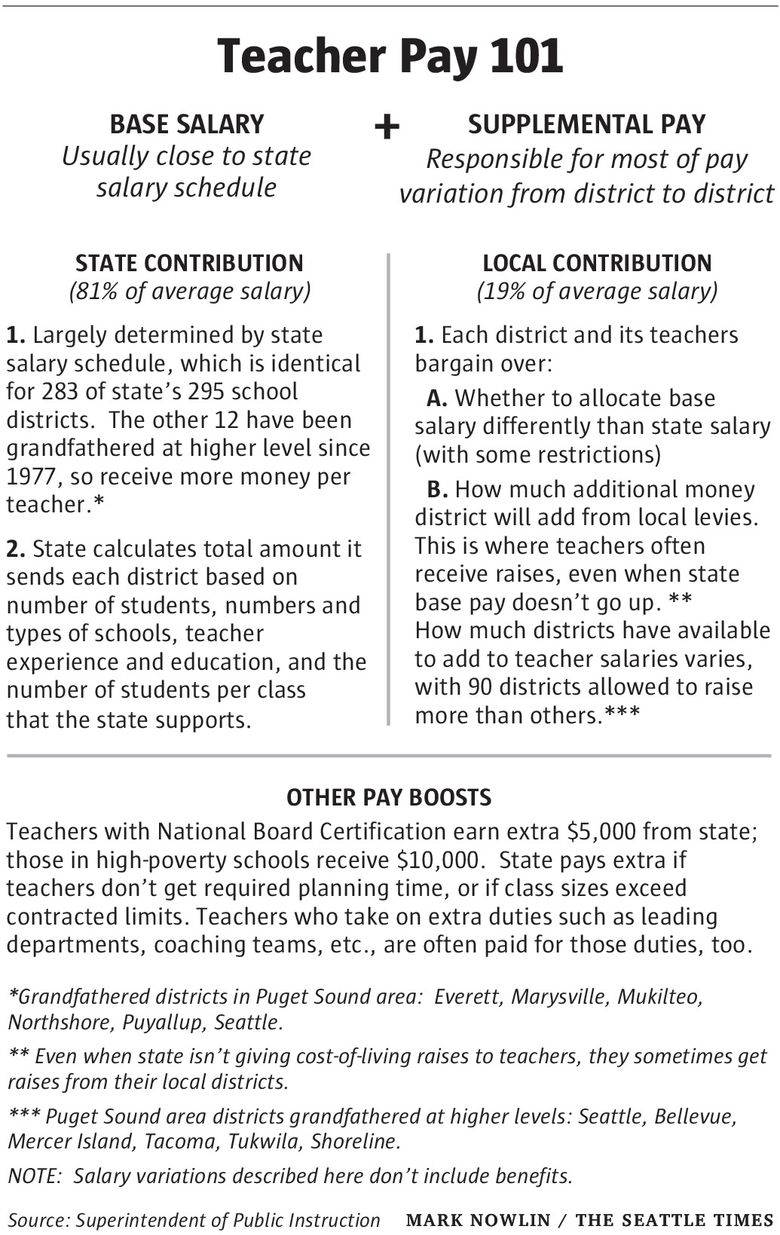
That base salary is supposed to cover about 1,000 instructional hours over 180 school days each year, plus some planning time. The schedule also includes built-in salary increases for the first 10 to 15 years of teachers’ careers, based on their level of education and years of experience.
Local districts could still supplement what the state provided, but not as much as they do now. The local contributions started to pick up in the late 1980s, when lawmakers started to relax how much local districts could add to what teachers earn.
The local pay is supposed to be for extra tasks, such as planning time before or after the school year. It came to be known as TRI pay, for extra time, responsibility and incentive.
In the McCleary decision, the court noted that the local contribution has increased a lot over the years, citing those who say districts use TRI pay as a de facto cost-of-living adjustment, especially when the state wasn’t providing one. While the Washington Education Association — which represents the state’s K-12 teachers — still insists that TRI money is for extra time and responsibility, some say those local contributions have essentially become a part of a teacher’s salary.
Over the years, a patchwork of policies and practices has led to big variations in pay from district to district.
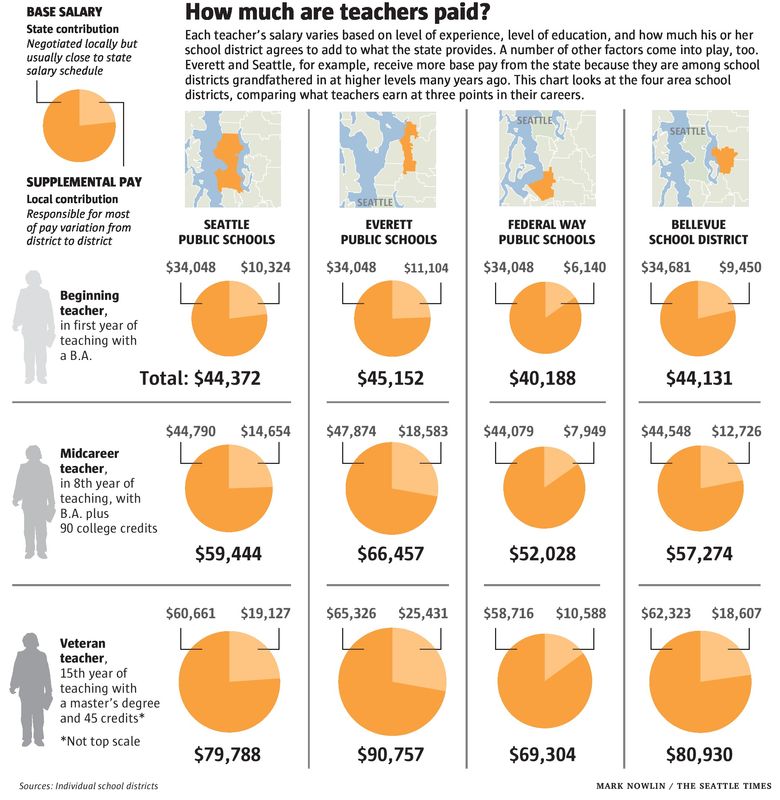
Twelve districts, for example, get more salary dollars from the state because they were grandfathered in at a higher base pay back when the state salary schedule was first adopted.
Everett is among them, one reason why teacher salaries are higher there. An Everett teacher with eight years of experience, for example, can now make $66,457, while the same teacher in Yakima would make $49,163.
On average, the state covers about 81 percent of teachers’ salaries, and local districts make up the rest, roughly $13,000 per teacher.
The local share for school administrators is even greater, with districts Wildly varying teacher salaries part of state budget debate | The Seattle Times:

Joseph Rogan: How should teachers prepare themselves? - Times Leader - timesleader.com

Joseph Rogan: How should teachers prepare themselves? - Times Leader - timesleader.com:

Joseph Rogan: How should teachers prepare themselves?


Teachers have become somewhat of a punching bag for politicians who unfairly paint us as selfish and ineffective – or even worse. It started with President Ronald Reagan who claimed government is bad. Teachers work for governments, so teachers are guilty by association.
Despite these and other attacks, researchers and sound data have confirmed what teachers always knew: Things teachers cannot control have impact, but among school factors, teachers matter most. Environmentalist Helen Caldicott was correct when she said teachers “are the most responsible and important members of society.”
How should teachers be prepared? In 2002, the U.S. Secretary of Education wanted to dismantle programs that he said imposed “burdensome requirements” on those who want to be teachers. Michigan’s current governor wants to allow anyone with a bachelor’s degree who can pass a content test to become a teacher. Teach for America claimed it can do it with a five-week summer course. Phoenix University does it online.
On the other hand, our state recently added new requirements and the U.S. Department of Education added even more. There is so much to learn that Lehigh University moved to a five-year program.
Several Stanford University professors answered the question in the report, “Does Teacher Preparation Matter?” They found that certified teachers were most effective. Teachers without professional preparation and with no certification actually had negative impacts, as did alternatively prepared teachers and people working with emergency or temporary certificates.
Experience matters, too. Experienced teachers see less student absenteeism, are more motivating and have fewer discipline problems. In a recent Education Week article, Stephen Sawchuk summarized new research that suggests teachers continue to improve for the first decade of their careers, and get even better when provided with high-quality professional development.
It is naive to debate how a teacher should be prepared because there is no prototypical teacher. Pennsylvania has four dozen certifications, and teachers get different assignments which require different skill sets. High school teachers have to know content, but one might be assigned to a class populated with students who have trouble learning it. Another might be assigned to an advanced placement class.
To earn accreditation, traditional teacher education programs must ensure that graduates mastere content, and teaching and management processes. They also have to be ready to handle diversity and adversity. They have to teach students in under-performing sections, and meet the needs of students from poverty and those for whom English is a second language. Then there are students with physical and learning disabilities – not just those included in regular classrooms. They must be ready to handle violent emotions and keep children with severe medical needs safe. Teachers make about 3,000 consequential decisions every day.
The job market for teachers has been rough. Pennsylvania actually cut about 20,000 positions, thus limiting opportunities. Now that at least some governors are reversing trends, things are starting to improve. Growing enrollments, smaller classes, special education and impending retirements mean that we need more teachers. The U.S. Department of Education found that some shortages have already occurred in Pennsylvania. Philadelphia plans to hire at least 400 for next year.
Several states already have shortages, in part because so few are in the pipeline and because about a third of the teaching force is close to retirement. The Center for the Future of Teaching and Learning estimates that California needs 100,000 teachers. The Huffington Post reported that by 2020 we will have a serious national shortage. We need 167,000 new teachers just to fill new early childhood programs.
To be admitted into a program, applicants must have a 3.0 grade point average or better in high school, high SAT scores and pass a battery of tests. Once enrolled, they must meet a set of state-required courses, hundreds of hours of field experiences and maintain at least a 3.0 GPA. To be certified, they must pass state-mandated tests. It may have been true in the past that people who could not do anything else could teach; now, only the best and brightest need apply.
Along with social workers, teachers are the lowest paid professionals. If salaries grew in proportion to education spending, the average salary would be $120,000. According to a McKinsey Study, salaries actually declined. Plus, politicians want to eliminate tenure, reduce pensions and otherwise cut benefits.
Under these circumstances, who wants the job? At least at Misericordia University, we have lots of clear-eyed and very bright students who want to spend the rest of their lives making a difference. They know teaching is difficult and poorly compensated, but they also know that it is the best job in the world.
Joseph Rogan, Ed.D., is a professor of teacher education at Misericordia University in Dallas.Joseph Rogan: How should teachers prepare themselves? - Times Leader - timesleader.com: