Latest News and Comment from Education

Friday, May 8, 2015

Gates Foundation: Time to Declare an End to EdReform 2.0 - Living in Dialogue

Gates Foundation: Time to Declare an End to EdReform 2.0 - Living in Dialogue:

Gates Foundation: Time to Declare an End to EdReform 2.0


 By Anthony Cody.

This coming week I will be back in Seattle, a few months shy of the third anniversary of my first visit to the Gates Foundation. I will give a talk at the University of Washington, introduced by Jesse Hagopian and several Teachers of Conscience from the area, who have refused to give high stakes tests to their studentsACSEattleMay15.
The world of education has shifted since that visit. Then I was in conversation. The Gates Foundation said they wanted to hear how their work was being received. In the online dialogue that followed,however, we were unable to resolve the biggest differences between us. Since then, the Gates Foundation has continued on its path, largely undeterred by mounting evidence of major errors.
It would be great if representatives from the Gates Foundation would join us at UW on May 15. There is a new CEO there, Sue Desmond-Hellmann, and she has voiced a willingness to learn, and spoken of the need for humility in the Foundation’s work. I sent her my book, The Educator and the Oligarch, a Teacher Challenges the Gates Foundation, last month, and it would be remarkable indeed to see this influential institution show a capacity to learn and change direction.
Bill Gates entered the field of education about fifteen years ago with some interesting ideas. Starting around the year 2000, his foundation invested about $650 million in promoting small schools. On the positive side, this was a concept with some basis in how students learn best. There was an understanding that human relationships were improved when schools and class sizes were smaller. Schools like High Tech High were able to experiment with project based learning and other innovative approaches. On the negative side, the foundation was determined to “scale up” this approach, and so there was a tendency to give money to anyone willing to go through the motions.
The small schools that Deborah Meier had created in the decades preceding this were carefully developed, with staff that was devoted to working closely together, solving problems in a democratic way. When the Gates small schools money came to Oakland, where I was working at the time, we saw large schools broken up into smaller ones left and right, with little time or expertise to develop coherent and sustainable practices. While some succeeded, many were not much better than the larger schools they replaced, and they came with a high price tag for increased administrative costs. Oakland is still burdened with too many schools long after the Gates funding disappeared, and a number of the small schools have been re-combined in recent years.
In 2009, there was huge shift in focus for the Gates Foundation. They drew some unfortunate lessons from their small schools work:
Many of the small schools that we invested in did not improve students’ achievement in any significant way. These tended to be the schools that did not take radical steps to change the culture, such as allowing the principal to pick the team of teachers or change the curriculum. We had less success trying to change an existing school than helping to create a new school. Even so, many schools had higher attendance and graduation rates than their peers. While we were pleased with these improvements, we are trying to raise college-ready graduation rates, and in most cases, we fell short.
But a few of the schools that we funded achieved something amazing. They replaced schools with low expectations and low results with ones that have high expectations and 
Gates Foundation: Time to Declare an End to EdReform 2.0 - Living in Dialogue: 

Remember the String - Badass Teachers Association

Badass Teachers Association:
Remember the String 
By Anthony Griffin, a Long Island Teacher and Co-founder of Lace to the Top

Originally published on the Lace to the Top Blog: https://lacetothetop.wordpress.com/2015/05/08/remember-the-string/

... Bakery String, Cotton Twine, Craft String, Craft Twine, Halloween


The only tangible thing I give students in my English 12 class is a piece of bakery string. I don't give them tests. I don't give them jobs. I give them a piece of string they tie around their fingers. Today affirmed for me why it is the only thing many of my students have and will care about.

When he walked into the resource center in his Marine uniform, my memory of of his high school self, blood-shot eyes, huge curly hair, and sleepy laugh, made me half uncertain I knew who had walked in. I rose to shake his hand, but it turned into a hug. It was him; a confident, calm diamond that was hidden in a cloud just a few years earlier.

As we spoke, I was proud of his transformation, yet I knew the change I saw was the result of Basic, not the classroom activities he respectfully endured in my class.

I asked if he remembered anything from high school. "No, sir. It's all down the drain," he replied without the giggle he once had in high school, yet was still the direct, honest person he was in class. "But I kept your string."

A hot fuzzy ball filled my throat.

On his first day in my class, he participated in the string exercise which I use to learn students' names, create a class culture, and demonstrate the lessons I focus on for the year: collaboration, problem solving, reflection, planning, communication, lateral thinking to name a few. For the string exercise, students stand in a circle state their names, share something they love with the group, tie the piece of the string around a finger, then pass the string to someone else in the circle. By the end, every student is attached to every other student by the piece of string and the middle of the circle usually looks like a spider web.

The lesson ends with the instruction, "Return the string to me." He took the initiative to wrap the string around a pencil so it wouldn't get tangled.

For the following 40 weeks, he was often late, seldom quiet, and usually high, but managed to pass.

On the last day of class, after dozens of projects, assignments, but not one test, his class went outside for the last lesson. "Here is the string from the first day of class," I said. "Each person must have a piece tied to a finger. Cover as much ground as possible. Go."

It took time for his class to untangle the string, but eventually, they made a large oval. "Is this the most ground you can cover?" I asked. I spoke about their year, shared how proud I was of all they had done, and took out a pair of scissors. I explained the metaphor as I cut the string connecting them. The message was simple. It's relationships 
Badass Teachers Association:

Feds Spent $3.3 Billion Fueling Charter Schools but No One Knows What It's Really Bought | PR Watch

Feds Spent $3.3 Billion Fueling Charter Schools but No One Knows What It's Really Bought | PR Watch:

Feds Spent $3.3 Billion Fueling Charter Schools but No One Knows What It's Really Bought -


(Madison, WI)–The federal government has spent more than $3.3 billion over the past two decades creating and fueling the charter school industry, according to a new financial analysis and reporters' guide by the Center for Media and Democracy (CMD). (The new guide can be downloaded below.)
Despite the huge sums spent so far, the federal government maintains no comprehensive list of the charter schools that have received and spent these funds or even a full list of the private or quasi-public entities that have been approved by states to "authorize" charters that receive federal funds. And despite drawing repeated criticism from the Office of the Inspector General for suspected waste and inadequate financial controls within the federal Charter Schools Program—designed to create, expand, and replicate charter schools—the U.S. Department of Education (ED) is poised to increase its funding by 48% in FY 2016.
CMD’s review of internal audits reveals that ED did not act quickly or effectively on numerous reports that state education officials had no idea where the federal funds ended up. The documents also show that ED knowingly awarded grants to states with no statutory oversight over charter authorizers and schools as the grant applications are evaluated based on how much "flexibility" from state laws charter schools have.
As a result of lax oversight on the federal level, combined with many state laws that hide charter finances from the public eye, taxpayers are left in the dark about how much federal money each charter school has received and what has been wasted or spent to enrich charter school administrators and for-profit corporations who get lucrative outsourcing contracts from charters, behind closed doors.
"The Department of Education is pushing for an unprecedented expansion of charter schools while paying lip service to accountability, but independent audit materials show that the Department's lofty rhetoric is simply not backed up by its actions," noted Jonas Persson, a writer for the Center for Media and Democracy, a national watchdog group that publishes PRWatch.org, ALECexposed.org, and SourceWatch.org, adding, "the lack of tough financial controls and the lack of public access to information about how charters are spending federal tax dollars has almost inevitably led to enormous fraud and waste."
CMD's guide, "New Documents Show How Taxpayer Money Is Wasted by Charter Schools—Stringent Controls Urgently Needed as Charter Funding Faces Huge Increase," analyzes materials obtained from open records requests about independent audits of how states interact with charter school authorizers and charter schools.
These documents, along with the earlier Inspector General report, reveal systemic barriers to common sense financial controls. Revealing quotes from those audit materials, highlighted in CMD's report, show that too often states have had untrained staff doing unsystematic reviews of authorizers and charter schools while lacking statutory authority and adequate funding to fully assess how federal money is being spent by charters.
In many instances, states have no idea how charter schools actually spent federal monies and they have no systematic way of obtaining that information or making sure it is accurate.
Meanwhile, charter school advocates within state agencies and private entities have sought to prevent strong financial controls and reporting systems backed up by government oversight.
"It is astonishing that the federal government has spent more than $3 billion dollars directly on charter schools and is poised to commit another $350 million on their expansion this year, even though charters have failed to perform better than traditional public schools overall and have performed far worse when it comes to fraud and waste," noted Lisa Graves, CMD's Executive Director.
She added: "This result is not surprising since many charter school advocates have pushed to create a system that allows charters to get federal funds without federal controls on how that money is spent--but it should not be acceptable for so much of taxpayers' money to be spent this way, with no requirement that the public be told how much money each and every charter school receives, how much each spends on high-paid charter executives, how much money makes it to the classroom, and how much is outsourced to for-profit firms."
In CMD's view, "There is no doubt that American school children and American taxpayers are getting short-changed by the charter school system that is siphoning money away from traditional public schools."
Download a copy of CMD's full report below. You can also read excerpts of responses to open records requests via CMD's SourceWatch, such as the corrective action plan imposed by the ED Office of the Inspector General after a scathing 2012 audit.
- See more at: http://www.prwatch.org/news/2015/04/12799/new-documents-show-how-federal-taxpayer-money-wasted-charter-schools#sthash.7s4RgutO.6FunRi4N.dpuf


H/T Jonathan Pelto Wait What? Website


Also don’t forget the following


Along with these others


Not to Mention the Dark Money Used to Elect Politicians that Set Up State Laws that Don't Hold Charter Schools Accountable 


Not to Mention That the:

National Association of Charter School Authorizers (NACSA) Group: 1 in 5 charter schools not doing well enough to stay open
A group that oversees more than half of the nation's 5,600 charter schools said as many as one in five U.S. charter schools should be shut down because of poor academic performance. 

http://seattletimes.com/html/nationworld/2019784379_charterschools29.htm

Discrimination against students of color rampant in Louisiana school district | Southern Poverty Law Center

Discrimination against students of color rampant in Louisiana school district | Southern Poverty Law Center:

Discrimination against students of color rampant in Louisiana school district


Three years after a Southern Poverty Law Center complaintsparked a U.S. Department of Education (DOE) investigation into the disproportionate number of African-American students arrested for minor rule violations in Louisiana’s Jefferson Parish Public School System, the problem has worsened, the SPLC told federal authorities this week.
The SPLC is now asking the Department of Justice to intervene.
The proportion of African-American children arrested for school-based misbehavior is now higher than when the initial complaint was filed, according to a supplemental SPLC complaint.
One black eighth-grader spent six days in juvenile detention after being arrested for throwing Skittles candy at another student.
“The Jefferson Parish Public School System has continued its destructive practice of arresting and jailing children for minor, and often trivial, violations of school rules and decorum,” said Eden Heilman, managing attorney for the SPLC’s Louisiana office. “It’s nothing less than a racially biased system of criminalizing African-American children. It must stop now.”
The SPLC’s complaint urges federal officials to take action, noting that the district’s arrest and law enforcement practices violate Titles VI and IV of the Civil Rights Act of 1964. It states that there has been “little to no movement” since the DOE launched its investigation three years ago.
The school district maintains contracts with local law enforcement agencies, including the Jefferson Parish Sheriff’s Office, that give officers stationed at district middle and high schools the authority to stop, frisk, detain, question, search and arrest schoolchildren on and off school grounds. 
“If law enforcement officers are on school grounds at all, they should be there in a very limited capacity – to protect children in the unlikely event of some kind of violent attack,” Heilman said. “But, as in many other places across the country, school authorities have inappropriately handed off their responsibility to administer routine school discipline to the police.” 
Jefferson Parish stands out in Louisiana as the school district with, far and away, the most school-based arrests and law enforcement referrals. The overwhelming majority of these arrests are for nonviolent, minor student misbehavior. African-American students are disproportionately targeted.
The supplemental complaint describes how 80 percent of the district’s school-based arrests during the 2013-14 school year were African-American students – even though they are only 41.5 percent of the student population. When the SPLC filed its initial complaint in 2012, African-American students comprised 76 percent of school-based arrests despite being 46 percent of the student population.
“The Jefferson Parish Public School System is needlessly derailing young lives with these arrests,” said Sara H. Godchaux, an SPLC staff attorney. “Far too many school children have been pushed out of class and into the justice system.”
 
The latest complaint describes how one eighth-grader was arrested at school after allegedly throwing Skittles candy at another student on a bus. The boy was charged with simple battery and handcuffed in front of his class by an officer. When he cried out as the officer twisted his arm, the officer said he was going to also charge him with resisting arrest. The boy was held at Rivarde Juvenile Detention Center for six days.
The complaint also describes how a 10-year-old African-American student diagnosed with autism ended up handcuffed and face down on the ground with a police officer’s knee in her back. Police were called after the girl had an outburst in class and began running around the classroom, jumping on desks, and knocking down chairs. She climbed out a classroom window and up a tree. The police dragged her away from the tree by her ankles and handcuffed her. Several officers were on the scene.
When the girl’s grandmother arrived, she found a police officer pressing her granddaughter’s face so close to the ground that she was having difficulty breathing. Officers eventually released the girl. Since the incident, the girl has said the police are not her friends and has asked, “Why do they hate me?”
Another Jefferson Parish student, a seventh-grader, became upset during a conference with school officials and her mother this year. After arguing with her mother, she was handcuffed and charged with “interference with an educational facility,” according to the latest complaint. She was held overnight at Rivarde Juvenile Detention Center and suspended from school. 
The supplemental complaint was filed with both the U.S. Department of Education’s Office for Civil Rights in Washington as well as its local office in Dallas. It also was filed with the Educational Opportunities Section of the U.S. Department of Justice Civil Rights Division.
The original complaint was filed in January 2012 on behalf of four students and their families, and all other similarly situated students, with the U.S. Department of Education’s Office for Civil Rights in Dallas. The office informed the SPLC in March 2012 that an investigation had been launched.Discrimination against students of color rampant in Louisiana school district | Southern Poverty Law Center:

Los Angeles teachers face political fight to defend public education

Los Angeles teachers face political fight to defend public education - World Socialist Web Site:

Los Angeles teachers face political fight to defend public education


More than 35,000 teachers are currently voting on the agreement reached between the United Teachers of Los Angeles (UTLA) and the Los Angeles Unified School District (LAUSD), the second-largest public school system in the United States with 670,000 students.
The deal is a stab in the back to the district’s teachers and other school employees, which opens the door for an escalation of the attacks on the jobs, wages and conditions of educators in Los Angeles and around the country. The sellout further integrates the UTLA into the billionaire-led education “reform” movement and the anti-teacher attacks being spearheaded by the Obama administration and the Democrats and Republicans at every level of government.
The agreement is a veritable compendium of anti-teacher provisions that should be decisively rejected. These include:
  • The implementation of teacher evaluation schemes designed to accelerate the mass firings of well-qualified teachers. Far from ending punitive test-based “accountability” schemes, the contract establishes a new evaluation program in which the UTLA will have joint authority with the district to implement new teacher evaluation measures.
  • An agreement to end the so-called “teacher jail” system. Instead, teachers accused of alleged misconduct will have their cases reviewed in 90 days or less to accelerate the victimization and dismissal of teachers.
  • An insulting 10.6 percent pay increase, which the union agreed to after dropping its initial 17 percent proposal. The raise will not make up for unpaid furlough days and other sacrifices forced on teachers since the 2008 financial crash, nor the additional out-of-pocket health care expenses absorbed by UTLA members.
  • Guidelines related to class size restrictions that will do nothing to actually reduce class sizes or hire more teachers. Only $13 million—out of a budget of $7.2 billion—will be allocated to reduce class sizes. The union itself acknowledges class size reductions “may not be achieved due to circumstances such as state funding limitations.”
The World Socialist Web Site calls on teachers and school employees to reject this sellout deal with the contempt it deserves and form rank-and-file committees to prepare a citywide strike. At the same time teachers must reach out to the broadest sections of the working class—parents, students, city workers, dockworkers, immigrant workers and others—to support the fight to defend public education.
Above all teachers must understand that this is a political fight. Every section of the political establishment—from President Obama to Governor Brown to Mayor Eric Garcetti, the Democrats and the Republicans—are determined to destroy public education and further open up the $1.3 trillion “education market” to for-profit companies and hedge funds.
Teachers and the achievements won through decades of struggle have become such a target that university enrollment in teacher and education programs is experiencing record declines. In the state of California, teacher enrollment programs fell 53 percent between 2008 and 2012 while overall student enrollment in the university system actually increased.
While the financial elite claims that there is no money for smaller class sizes or decent pay for teachers, trillions are squandered on Wall Street bailouts, corporate tax cuts and the funding of current wars and the new ones being planned. As poverty increases and social programs are cut, 95 percent of all income gains have gone to the top one percent since the economic “recovery” began.
According to a 2014 study, the city of Los Angeles is the ninth most unequal major city in the country, with the top 5 percent of income earners earning as much as 12.3 times the lowest 20 percent of income earners. This actually understates the real level of inequality since it does not factor in capital gains and investment income.
Meanwhile more than 50 percent of Los Angeles children between one month and 17 years live in poverty. More than 1.3 million county residents are classified as food insecure.
To claim that teachers can overcome these wretched conditions without a vast infusion of resources to eradicate poverty and chronically underfunded schools is a lie. Instead the politicians from both parties scapegoat teachers for these problems in order to accelerate the destruction of public education.
In the eyes of the corporate and financial elite, an educated working class is dangerous. That is why the expansion of poverty wage jobs, cuts in essential services, an epidemic of police killings and threat of wider wars have gone hand in hand with the shutdown of schools and the layoff of hundreds of thousands of teachers since 2008.
The UTLA, like its counterparts across the country, seeks to conceal these political issues and prevent a mobilization of teachers and other workers against the Democratic Party, with which the unions are allied. At the same time the union promotes the absurd claim that the lack of funding is solely due to local district mismanagement.
In reality, successive state administrations, including Democratic Governor Jerry Brown’s, have cut billions from public education to provide more tax cuts to the corporations and the wealthy. To the extent that education funding has been restored under the “balanced” state budget of 2014, it has largely been funneled into the Local Control Funding Formula (LCFF), which pumps billions of dollars into private charter schools.
The UTLA has not raised any complaints about the LCFF and is also largely silent on the question of the governor’s soon-to-be-released May Budgetary Revise, which could reduce traditional public school funding even further.
The UTLA and its parent organization, the American Federation of Teachers, do not defend the interests of teachers, parents or students. On the contrary, the UTLA and AFT collaborate with the enemies of public education, including Bill Gates, President Obama and Arne Duncan, and are only looking to get their own share from the transformation of education into a profit-making business.
The UTLA already runs its own charter-style operations, so-called “Pilot Schools,” which give the union authority to hire and fire teachers while Los Angeles teachers face political fight to defend public education - World Socialist Web Site:

Stephen Colbert: SC Teachers' $800,000 man

Stephen Colbert: SC Teachers' $800,000 man:

Stephen Colbert: SC Teachers' $800,000 man


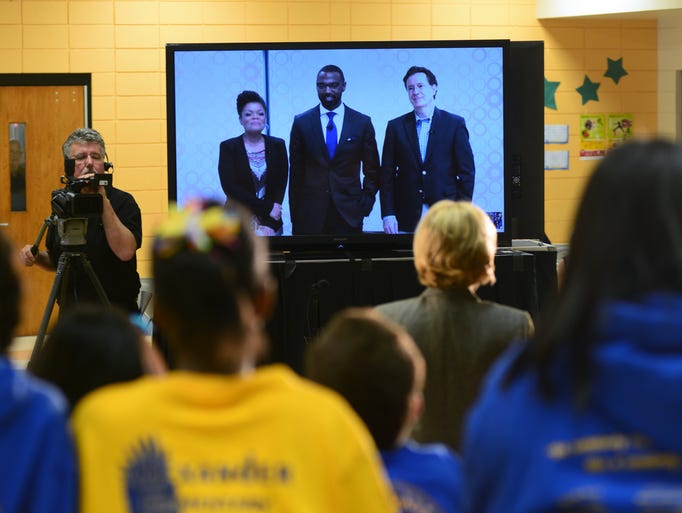
 Comedian Stephen Colbert announced Thursday that he would fund every existing grant request South Carolina public school teachers have made on the education crowdfunding websiteDonorsChoose.org.
Colbert made the announcement on a live video feed Thursday at a surprise event at Alexander Elementary School in Greenville.
Colbert partnered with The Morgridge Family Foundation 's Share Fair Nation andScanSource, which is headquartered in Greenville, to fund nearly 1,000 projects for more than 800 teachers at over 375 schools, totaling $800,000.
Colbert, a South Carolina native and product of South Carolina's public schools, announced the funding at a conference in New York hosted by DonorsChoose.org, a crowdfunding non-profit where teachers create projects requesting materials and experiences their students need to learn, and donors support the projects that inspire them.
"Using the proceeds of the sale of my old set on The Colbert Report which we auctioned off, and with the generous matching funds from The Morgridge Family Foundation and ScanSource, DonorsChoose is going to flash-fund all 1,000 projects in South Carolina," Colbert said. "Enjoy your learning, South Carolina."
Damon Qualls, a teacher at Alexander Elementary School in Greenville, joined Colbert for the surprise announcement in New York. Qualls has had 126 projects funded onDonorsChoose.org, including five projects from today's announcement.
The event was attended by local and state school officials, including state schools Superintendent Molly Spearman.
"There are going to be some happy, happy teachers across the state," Spearman said. "This is Teacher Appreciation Week, so what a great way to say 'thank you teachers for what you're doing every day.'"
Grants will fund everything from new books to classroom supplies, school-branded clothing or professional development for teachers.
"I think it's generally extra things, but to be honest with you, in some situations it could be basic-type things that the students need where the district just hasn't been able to fund it," Spearman said.
"There's a great need out there and thankfully Stephen Colbert is from South Carolina," she said.
Alexander Elementary has been central to the promotion of DonorsChoose.orgprojects in South Carolina. The small, Title 1 school on Greenville's Westside surpassed $100,000 in grants funded earlier this year and now has received more than $125,000 for supplies and experiences through DonorsChoose, said Principal Sonya Campbell.

teacher Damon Qualls receiving the news from Stephen Colbert in NYC
Hitting the $100,000 mark kicked off planning for Thursday's announcement, Campbell said.
Campbell asked each teacher at Alexander to write at least one grant request this year. Now every teacher has had a project funded, she said.
DonorsChoose and ScanSource surprised teachers and hand-delivered some gifts Thursday.
Beth Bailey, Alexander's school librarian, picked through a cardboard box filled with new books for a girls reading group she had hoped to start.
"These girls, they've been asking for this one for weeks," she said, holding up a paperback. "To have this in our library is huge and it's just promoting reading in so many ways. We're so grateful."
ScanSource helped bring then-fledgling DonorsChoose to South Carolina in 2005 and offered tech support, helped them set up their office and offered advice on how to structure the nonprofit as it grew, said Christy Thompson, vice president for worldwide Stephen Colbert: SC Teachers' $800,000 man:

Jersey Jazzman: Lifestyles Of The Rich and Reformy

Jersey Jazzman: Lifestyles Of The Rich and Reformy:

Lifestyles Of The Rich and Reformy


Back in 2013, I told the story of Joe Bruno, a former accounting and health care executive who is now heads a non-profit that is one of the biggest sources of capital for charter school construction.


This picture was taken at the 2013 National Charter School Conference; apparently, charter school advocates thought that the misogynist rapper Pitbull was a fine choice for a keynote speaker that year.


To Pitbull's right is Fernando "Ferny" Zulueta; the two are partners in the SLAM Charter School in Miami. According to a series of reports by the Miami Herald, Zulueta runs the "richest charter school management firm" in Florida, Academica, a for-profit company with annual revenues of $158 million at the time of the reports. Zulueta also controls, along with his brother, Ignacio, more than $115 million of South Florida real estate that is exempt from property taxes as "public" schools.

Bruno's firm, Building Hope, is a major source of capital for Zulueta and other charter school profiteers. Bruno works essentially as a mortgage broker: he gathers up both governmental and private, non-profit funds -- both of which are subsidized by taxpayers -- and disburses those funds to firms like Zulueta's to be used for charter school construction.


Considering taxpayers both provide the capital (either directly through the government or indirectly through the tax code) and pay for students to attend these charter schools, this is a sweet deal for all involved. As I said back in 2013:
Also: while we can debate the relative merits of charter schools, one thing is quite certain: any notion that the charter industry is "all about the kids" needs to be dismissed, because there are adults who are clearly making a lot of money off of charter expansion. And it's not just people like the Zuluetas: Bruno himself, according to Building Hope's 2011 tax return, earned $388,709 in compensation and another $56,865 in benefits for a year's work. In contrast, the average Florida teacher salary is $45,723.
Tax forms for 2013 from Guidestar show Bruno made $386,576 in salary $57,668 in benefits that year. To be fair, Bruno likely made much more when he was a partner at - See more at: http://jerseyjazzman.blogspot.com/2015/05/lifestyles-of-rich-and-reformy.html