Latest News and Comment from Education

Friday, May 8, 2015

A love letter to tireless teachers everywhere, who deserve a little appreciation

What teachers really want for Teacher Appreciation Week:

A love letter to tireless teachers everywhere, who deserve a little appreciation

What teachers really want for Teacher Appreciation Week


Our teachers are under siege. They're underfunded, over-scrutinized and exhausted. And we're all paying the price.
We're losing our best teachers. Nearly half. Four out of every 10 freshly minted teachers will leave the profession in the first five years of their career. Why? Because as the Association of Teachers and Lecturers General Secretary Mary Bousted says, teaching is a profession that has become "incompatible with normal life."
I happen to know one of these teachers. Just a few years into her career, Lauren (not her real name) is without question what you would call a rock star teacher. She has won all kinds of awards, and the thriving kids in her class are proof they're well deserved. But she's leaving teaching at the end of the school year to pursue a career in travel. Countless kids are losing a fantastic, spirited, smart teacher, and that sucks. When I asked her what she would like more than anything else for Teacher Appreciation Week, her response reflected her disillusion.
"Competent administrators, a supportive district and a living wage would be nice, I guess..."
That doesn't really sound like such a tall order, does it?
And so with Lauren and so many of her colleagues in mind, here are a few things that teacher in your life would sincerely appreciate during this Teacher Appreciation Week.

1. Professional respect
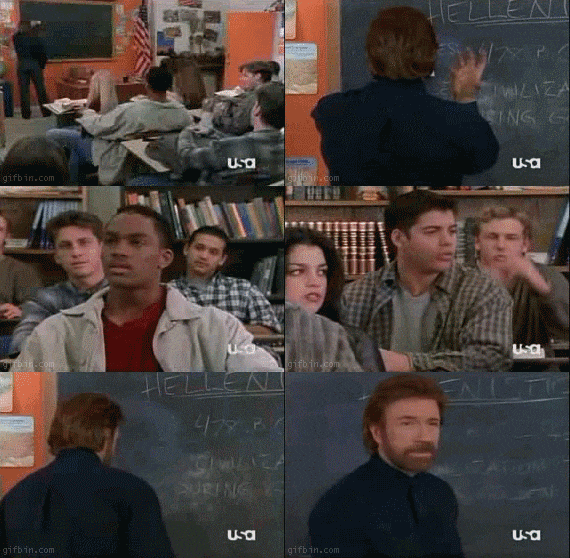
Chuck Norris teacher respect
Image: Giphy
Teachers are professionals with a specialized knowledge not just of the subject they teach, but they are actually certified experts in the way kids learn. Listen to them, and take their opinions seriously. They really do know what they're talking about.

2. The benefit of the doubt

teacher benefit of the doubt
Image: Giphy
Chalk it up to Tiger Mom or helicopter parents or the ultra-competitive nature of parenting in the new millennium, but parents by and large just don't have the teacher's back anymore. Let's try to remember that teachers are there because they want to help, and work on giving them a little more support when our smart-mouth kid needs to learn some self-control during math class.

3. Your support

Support teachers
Image: Giphy
After a long day, it's hard to come home and immediately launch into "enforcer" mode, especially when it comes to schoolwork. But teachers need to know you're making school a priority at home too. Your investment at home can make a huge difference in your kid's education. So support their discipline and boundaries. Make sure homework is getting done. And if you have the time, volunteering in the classroom is a great way to connect with your kid's school experience and lend a hand too.

4. School supplies

School supplies
Image: Giphy
Gutted school budgets across the country have forced the burden of adequate school supplies to fall directly — and shamefully — on the shoulders of the underpaid teachers themselves. One teacher just last month had already spent $800 over the school year on school supplies when her pencil sharpener broke. So she turned to crowdfunding for the $323 she needed for a replacement pencil sharpener for her classroom. If you'd like to give the teacher in your life a gift for any holiday, consider a gift card to your local office supply or big box store so they can stock up on what they need.

5. Kids with full bellies

Hungry Kids
Image: Giphy
Three out of four public schoolteachers say they have kids who come to school hungry on a regular basis. First, make sure your own students are going to school on a full stomach, and support programs that expand low-cost breakfasts and lunches for every single student every day. Teachers are spending an average of $35 per month to stock classrooms with food for hungry kids, so next time you're at the grocery store, pick up something for your favorite teacher. Or better yet, get a grocery store gift card so the teacher can get exactly what their students need.

6. Wine

Wine teachers
Image: Giphy
Because being a teacher is a hard job, and a nice bottle of wine makes almost anything better. Cheers!

7. Your vote

Vote teachers
Image: Giphy
You don't have to look very hard to see the damage the past decade of extremely underfunded schools has done to our country. The next time a budget override or increase comes on the ballot in your neighborhood, vote for it. Pay a little extra in taxes, and call it a smart investment in your community's future. Our education system is the foundation for tomorrow's America, and we need policies in place to strengthen our education system, not cut off all its funding and then scream about its lack of quality.

8. Communication

Thank you
Image: Giphy
Teachers value — and need — a steady stream of communication about what's going on with your kid. They want to know, and it helps them do a better job of meeting your kid's needs. You, however, aren't the important person in the relationship; the teacher and student are. Also, you don't need to "sell" you kid's abilities to the teacher. They'll figure that out on their own (remember, they are certified for this). Attend parent-teacher conferences, come prepared with questions, and actually be open to the feedback, which is easier said than done, admittedly.

9. Your teamwork

Teachers team
Image: Giphy
Another one of my favorite teachers, Susan (not her real name), when asked what she would want most for Teacher Appreciation Week, had this incredible response. "The gift I would most treasure is to have parents realize that we are all on the same side," she says. "We love their children and want them to have all the choices in life that a strong education can provide. We are a team."
Amen. Let's give our teachers a little more of that.

10. A nap

Nap
Image: Giphy
Not sure how to pull this one off, but I bet you know a teacher who could really use a nap. Maybe a fold-down classroom cot for lunchtime? If you figure this one out, call me.

11. A "thank you"

Thank you teachers
Image: Giphy
They give encouragement and teach kids to read. They love our kids like they are their own and are asked to care even though they're surrounded by apathy and criticism. During this Teacher Appreciation Week, sure, candy is a sweet gesture, and everyone loves a Starbucks card, but a simple "thank you for everything you do every day" would probably go a long way. If it becomes a habit, great. Our teachers could use a little love; they don't get too much of it these days. And you know you'll miss them over summer vacation.

More about teachers

It’s National Charter Schools Week. Are charters really worth celebrating? - The Washington Post

It’s National Charter Schools Week. Are charters really worth celebrating? - The Washington Post:

It’s National Charter Schools Week. Are charters really worth celebrating?


Celebrating National Charter Schools Week: Dark Money Part 4  #CharterSchoolsWeek

Celebrating National Charter Schools Week: Re-Segregating America’s Schools Part 3 #CharterSchoolsWeek


This week is National Charters School Week, a time intended to “raise awareness” about — and hold a “national celebration” for — charter schools,according to the National Alliance for Public Charter Schools. In the following post, Paul Thomas, an associate professor of education at Furman University in South Carolina, asks exactly what it is about charter schools that are worth celebrating. This post, which I am publishing with his permission, appearedon AlterNet.


By Paul Thomas
In his proclamation for National Charter Schools Week, President  Obama asks us to accept a truth as yet unproven. He writes: “Today, our nation’s very best charter schools are gateways to higher education and endless possibilities, lifting up students of all backgrounds and empowering them to achieve a brighter future.”
Obama is not the only one building the hype. Political praise for charter schools emanates from both sides of the aisle; nearly every conservative call for education reform extols charter schools, with said accolades usually accompanying calls for the holy grail of free-market thinking in the educational realm: more parental “choice.”
But no amount of proclaiming and rallying can upend the evidence, which is not good for the charter school camp. Considering that under Obama, the basic framework of education reform has hewn closely to the deeply flawedtemplate created by George W. Bush’s No Child Left Behind Act (and, arguably, raised the stakes even higher), perhaps we should use this week less for celebration and more to seriously consider the evidence. What, exactly, are we meant to celebrate about charter schools? What have they achieved?
Charter Advocacy Fails Against Evidence
For education reformers committed to market forces as a way to force public schools to improve, the initial focus was on vouchers that allowed parents to use public money to pay for private schools. During the Bush administration, however, researchers found that when controlling for student characteristics, private and public schools were mostly alike—both demonstrating a range of quality, the greatest factors being student characteristics.
Since the public has often resisted private-school vouchers, charter schoolshave become the next great hope that school choice will motivate public schools to reform. Yet in an analysis of charters conducted for the Shanker Institute, researcher Matthew Di Carlo has concluded that “there is nothing about ‘charterness’ that leads to strong results.” In other words, there is nothing about a school being identified as a charter school that excludes other types of schools (regular public, private) from adopting the same policies or practices; there is also nothing about a school operating as a charter school that specifically leads to success. (Take that as your first indication that charter advocacy is more about ideology than evidence-based reform.)
But if there’s nothing about the structure of charters that separates them from the pack, are we celebrating charter schools because of superior student achievement?
In my home state of South Carolina, the picture on student achievement in charters is much like it is in the rest of the U.S. Over a two-year analysis, I have compared S.C. charter schools with public schools with similar populations of students. Approximately 95 percent of those charter schools reflect student achievement about the same or worse than comparable public schools.
In other words, charter, public and private schools have about the same range of student outcomes. As Di Carlo stressed in his report, what we know to be true is that the type of school structure matters far less than what schools do and who the students are.
So if it’s not about school structure and it’s not about student achievement, are we celebrating charter schools for reversing the trend of re-segregation in U.S. public schools?
Sixty years after Brown v. Board, public schools across the country have become increasingly segregated by race and class. Few who seek education reform would argue against seeking policies that would counter that trend. Charter schools have demonstrably not met that need because they are significantly segregated—and charter schools also cause serious concern about selectivity, pushing out and under-serving marginalized student populations (highest-poverty, English language learners, special needs students).
Since many charter schools serve black, Latino and impoverished students, are we celebrating charter schools for offering those students the types of educations wealthy, white students experience?
If political and public support for charter schools was built on all children having the sort of school experience Obama’s daughters enjoy, I imagine virtually no one would be challenging charter schools. Minority and high-poverty students in charter schools, however, experience nothing like that. They are instead treated like “other people’s children” and subjected to reduced curricula, extensive test-prep and harsh “no excuses” discipline policies. And when a high-profile media examination of “no excuses” exposes horrors like students wetting their pants during testing, charter advocates remain committed to their standard (though misleading) “miracle” playbook, suggesting that the ends justify the means.
Finally, are we celebrating charter schools for those “miracles” that can serve as models for reforming all public schools?
There are two problems with miracle schools. The first is a point of logic: elite outliers are not models for any norm. If miracle schools existed, they would be no more useful as a yardstick for all schools than Michael Jordan is the template for evaluating all NBA players—since the typical NBA player (already an elite athlete) is rendered a failure against Jordan.
But the greater problem is that miracle schools have overwhelmingly been discredited. They are not miracles at all, we discover, once the data are It’s National Charter Schools Week. Are charters really worth celebrating? - The Washington Post:

Los Angeles School District Builds Apartments for Teachers | L.A. Weekly

Los Angeles School District Builds Apartments for Teachers | L.A. Weekly:

L.A. RENTS ARE SO HIGH THE SCHOOL DISTRICT IS BUILDING APARTMENTS FOR TEACHERS

L.A. Rents Are So High the School District Is Building Apartments for Teachers


Teachers in Los Angeles aren't exactly poor. But consider the cost of living here: A report last year said it takes you nearly $100,000 a year in household income just to make a median rental home in L.A. affordable.
Furthermore, a UCLA study concluded that the gap between local incomes and rents have made Los Angeles the least affordable rental market in America.
The Los Angeles Unified School District is one of the few bureaucracies in town that is doing anything significant about the problem.
Its 66-unit, four-story Selma Community Workforce Housing Project is under construction at North Cherokee and Selma avenues in Hollywood and is scheduled to open in fall of 2016, the district says. It's ...
 ... intended for L.A. Unified employees who fall into a designated economic category. The complex is part of the District’s ambitious effort to attract and retain staff who want to live near work but can’t afford to pay for housing costs. 
The LAUSD notes that annual median rents in California have increased 21 percent since 2000, while average renters have experienced a real-world loss in income of eight percent:
Increasingly, the high rents place more people into poverty. A new report from the California Housing Partnership said statewide the lowest-income households spend two out of three dollars of income on housing. That leaves little money for food, utilities and other expenses.
This traps many people. In fact, the study found 1.5 million low-income households across the Southland cannot find housing they can afford. The problem has worsened as rents rise and incomes stall.
L.A. Rents Are So High the School District Is Building Apartments for Teachers
Selma under construction via LAUSD
Teachers are not immune. Interestingly, the district last month agreed to a contract that will give its educators a 10 percent salary boost over two years, the kind of raise not seen among average L.A. workers.
The LAUSD has planned three such apartment complexes for its teachers. The Sage Park Apartments next to Gardena Senior High School opened last month and features 90 units.
The 29-unit Norwood Learning Village near USC is expected to open late next year.
The district notes that its projects are among "few affordable housing projects under construction in the Southland."
That's a problem. We're looking at you, City Hall.
Send feedback and tips to the author. Follow Dennis Romero on Twitter at @dennisjromero. Follow L.A. Weekly News on Twitter at @laweeklynews.

Thursday, May 7, 2015

Gonzalez: Feds failed to keep tabs on $3B in school aid to launch new charter schools - NY Daily News

Gonzalez: Feds failed to keep tabs on $3B in school aid - NY Daily News:

Gonzalez: Feds failed to keep tabs on $3B in school aid 


 The federal government shelled out $3.3 billion over the past 20 years to launch new charter schools nationwide, yet failed to monitor how that money was used, a new report has found.

Federal spending to launch charter schools zoomed from a mere $4.5 million in 1995 to more than $253 million today, according to the Center for Media and Democracy, a liberal watchdog group — with President Obama now asking Congress for a whopping increase to $375 million for next year.
And that’s on top of billions of dollars state governments spend for charter school operations.
Yet the new report concludes there is “no systematic public accounting for how the federal budget allocated to charters is actually being spent,” and “major gaps in the law allowing waste and fraud.”
The U.S. Department of Education doesn’t even bother to keep a public record of which charter schools get money from more than a half-dozen federal programs, said Lisa Graves, director of the Center for Media and Democracy. Her organization had to review thousands of pages of documents obtained through Freedom of Information Law requests before it could coming up with an initial tally of federal charter school spending.
This happens even as cases of fraud, waste or mismanagement by charter school operators pop up all over the country.
The Department of Education’s own inspector general has warned about the lack of accountability.
This lack of oversight is a recipe for disaster for too many American school children and for taxpayers.
In a 2012 audit, the inspector general found federal officials “did not effectively oversee and monitor (state governments) and did not have an adequate process to ensure (they) effectively oversaw and monitored their subgrantees.”
The audit found, for example, that Florida “could not provide a reliable universe of charter schools . . . that received onsite monitoring, desk audits or closed during the grant cycle.”
In California, auditors reviewed 12 charter schools that closed after receiving federal startup funds — some even before opening their doors to any students. The state “had no followup documentation” for any of the schools, nor “any indication of what happened to any assets purchased” with federal funds, the audit concluded.
Even when monitoring of charter schools showed major deficiencies, federal and state officials were slow to seek improvements, the audit found.
“This lack of oversight is a recipe for disaster for too many American school children and for taxpayers, when large chunks of the money ends up either missing in action or in corporate charter school coffers,” this latest report warns.

Education doesn’t need Common Core reform, teachers need the time and resources to build great schools - The Hechinger Report

Education doesn’t need Common Core reform, teachers need the time and resources to build great schools - The Hechinger Report:

Education doesn’t need Common Core reform, teachers need the time and resources to build great schools

Now that every state has modified the Common Core and cherry picked their tests, are the standards “common?"


Dear Jayne,
In my last letter, I asked a question that I think lies at the heart of the Common Core debate. I was disappointed that you did not respond to it. Here it is again, with context:
Jayne, there was nothing to prevent you from challenging all children before the Common Core arrived. I am certain you had strategies to level the playing field for economically disadvantaged students prior to 2010. Why do you believe you need the Common Core?
You told me in a previous letter that Florida parents and teachers reviewed the Common Core and made minor revisions. But this wasn’t the first time standards were reformed in Florida. In 2006-07 your state adopted the Sunshine State Standards, then changed to the Florida (Common) Core Standards in 2010, and then tweaked and renamed them the Florida Standards in 2014. My question remains, why did you need to go from one set of standards to another?
According to a report by the Thomas B. Fordham Institute, the Sunshine State Standards were at about the same level of rigor and quality as the Common Core. In English Language Arts, Fordham gave the Sunshine State standards a B while the Common Core grade was B+. In math, the Sunshine State were rated A and Common Core received A-. Do you agree with Fordham’s findings that the level of difficulty was about equal? If so, do you support Common Core because you believe that all states should have the same standards?


Here is why I ask the question. Those who support the Common Core standards often claim they are needed because state standards were weak and, if states would adopt the same standards, the achievement of all students would rise. The problem is there is no evidence that standards per se make a difference in student performance, and there is some impressive scholarship that says they do not make any difference.
Tom Loveless of the Brookings Institutehas shown that similar reforms over the past three decades have not improved student achievement, even when the standards were “rigorous” and schools did their best to implement them. He points out that when we look at National Assessment of Educational Progress scores, that the range of scores within individual states is “four to five times greater than differences” in state averages, even though states had vastly different standards. Back in 2010, writing for the National Education Policy Center, William Mathis made similar arguments based on both national and international data.
As principal, I’ve seen transfer students from Florida adjust easily and I’ve seen those who fell apart. The same goes for students who transferred from other New York schools. The quality of the prior school, the effort of the student, and all of the social and economic factors that impact learning, made the difference in how the student adjusted. Any reform, by state or national standards setting and testing, is a waste of precious financial resources and time. We should be working hard to improve the lives of our students and the quality of our schools. Public schools have not failed America, Jayne. America has failed its public schools.


Nevertheless, if the standards are developmentally or academically inappropriate and the tests are aligned with them, damage can be done. You asked in your last letter where is the evidence that parental unhappiness with New York testing and test prep has anything to do with the Common Core. It is a great question.
New York had high-stakes testing just like every other state since NCLB. It was only when the Common Core tests began that the opt-out movement started. Florida is in year one. We are in year three. The Common Core standards were implemented, and the tests followed. During the first year, it was apparent that the Common Education doesn’t need Common Core reform, teachers need the time and resources to build great schools - The Hechinger Report:

Oklahoma's Poor Need Much More than Charters Can Give

Oklahoma's Poor Need Much More than Charters Can Give:

OKLAHOMA’S POOR NEED MUCH MORE THAN CHARTERS CAN GIVE

charter school oklahoma city
What was once Harding High School in Okla. City Public Schools is now Harding Charter Preparatory High School, authorized by the district.| Photo by Brett Dickerson


There has been a surge of anti-public-education talk in the past several weeks. Why?
Legislation to allow the governments of Tulsa and Oklahoma City to establish their own charter schools has come back to life as an amendment to another bill in the Oklahoma Legislature.
And the bill’s promoters want to make their case that the two biggest urban districts in the state are horrible, dystopic places that deserve abandonment instead of support and renewal.
OKC and Tulsa governments could start charters on their own – So much for worry about “government schools”
HB 1696 contains modified language that was once in SB 68 which could not get enough support in the House. It was “laid over” by its author, Senator David Holt (R-Oklahoma City), so that the language could be put into another bill later.
Now that the associations for school boards and school administrators have negotiated to allow for charter schools to be everywhere in Oklahoma under illusory control by their local districts, this bill would modify what was just signed by the governor.
If HB 1696 passes, the city governments of Tulsa and Oklahoma City could establish their own charter schools independent of their respective school districts.  The only recourse of those districts would be to call for an expensive public “yes/no” special election on each charter establishment being proposed.
How many times do we think that will happen until the public becomes weary of the special elections? You know the answer. And that’s the plan.
An opinion piece promoting the bill in today’s edition of The Oklahoman argued that “the charter model has been highly successful in Oklahoma City” as they failed to mention that all of the charters they cite in OKC have been authorized by OKCPS.
Isn’t it astonishing that those who get into such a froth about “government schools” are excited to establish…government schools? The only difference is that these government schools will not be controlled directly by democratically elected boards, only appointed boards of the mayors.
The tail that wags the dog: realtors
This idea is being pushed mostly by Oklahoma City senators and representatives who are doing the bidding of the realtors and the Oklahoma's Poor Need Much More than Charters Can Give:

CPS CEO Barbara Byrd-Bennett Troubles Make You Wonder What They "Teach" at The Broad Academy

CPS CEO Barbara Byrd-Bennett May Have Met Her Match in Chicago - Working In These Times:

CPS CEO Barbara Byrd-Bennett Troubles Make You Wonder What They "Teach" at The Broad Academy


Latest CPS Scandal Highlights Chicago’s Need for Democratically Elected, Representative School Board http://bit.ly/1H56qFF

As her inner circle draws federal heat, CPS CEO Barbara Byrd-Bennett steps down | Chicago http://bit.ly/1H56Ews

Former CPS CEO Brizard: SUPES owner 'instrumental' in bringing Byrd-Bennett to district | Chicago http://bit.ly/1H56HIT

Byrd-Bennett out, Ruiz in as fallout from federal probe continues | Catalyst Chicago http://bit.ly/1H56JjW


 This afternoon at 4pm, a coalition of Chicago teachers, parents, students and community members will meet at Daley Plaza to voice their displeasure with the announcement last week by Chicago Public Schools (CPS) CEO Barbara Byrd-Bennett that 61 Chicago Public Schools will be closed before the opening of the 2013-2014 school year.

Byrd-Bennett is the latest in a long line of well-compensated mayoral proxies pushing forward the slow and steady destruction of Chicago schools, a process that has been going on for decades. In 1995, the Illinois general assembly passed an omnibus of reactionary school reforms, called the “Amendatory Act,” that restructured the governance of CPS. Under the new system, the Mayor of Chicago was given the power to appoint the entire Board of Education without any community oversight, the union’s ability to bargain over classroom issues was tossed out, and the superintendent was replaced with a “Chief Executive Officer,” mimicking the corporate structure of the business interests that pushed for these reforms.
Since the passage of the Amendatory Act, Chicago has seen six CEOs come and go, each leaving the system a little less stable than they found it. The first CEO under the Amendatory Act was Paul Vallas, who set schools on a path to becoming standardized testing factories. Vallas was followed by Arne Duncan, who was likeable enough to play basketball with some very important people (namely, Barack Obama, who later appointed him Secretary of Education). After Duncan, a succession of new CEOs shuffled through, closing public schools and opening charters at a pace on par with much of the rest of the country.
For most of the past two decades, the primary prerequisites for a CEO were an ability to address the media and a talent for glad-handing power brokers (and, in some cases, a willingness to fall on the sword after new policies failed). CEO were, essentially, spokespeople for the district who hobnobbed with the city’s elite. They were also involved in contract negotiations with the various unions in the schools, none of which had been acrimonious since the 1987 teachers strike.
However, the impatient Mayor Rahm Emanuel is operating in a very different political landscape than his predecessor, Mayor Richard Daley. Daley presided over 22 years of labor peace due to decades of “business unionism” in the Chicago Teachers Union (CTU)—a model where backroom deals and close relationships with management replace work actions. Daley’s ambitious plan to close public schools and replace them with charters was a long con, the equivalent of slowly turning up the heat until the frog is cooked. But this strategy inadvertently gave communities time to understand what was going on, and to organize a response. Many activists who came out of that movement took leadership roles in the CTU after ousting the business union leadership in 2010. (Full disclosure: I am a founding member of its current leadership caucus and the CTU's new media coordinator). Last year, after Emanuel did everything within his power to avert the first teachers strike in 25 years and failed miserably, it became clear that a new type of boss would be necessary to speed up the process of busting the teachers union and turning over schools to the highest bidders. A new union and community coalition and growing public awareness around the failings of education reform meant that Mayor Emanuel had to find someone with experience executing unpopular mandates.
Fortunately for Emanuel, the answer was right in front of him: One month after the strike, CPS announced that CEO Jean-Claude Brizard was leaving the district by “mutual agreement” and that then-Chief Education Officer Barbara Byrd-Bennett would be taking his place.  Byrd-Bennett can be thought of as something of a "cleaner," like Harvey Keitel's problem-solving character Winston Wolf in Pulp Fiction: She comes in, takes care of business and leaves quickly. In the school system of the neoliberal era, the job of the cleaner is to close as many schools as possible and replace them with charter schools before the public catches on to the plan. After the announcement, the “chaos on Clark Street” (where CPS headquarters are located) intensified, and the media painted Byrd-Bennett as a phoenix rising above the ashes to save the public schools.
 When Byrd-Bennett was appointed as Chief Education Officer of CPS in the spring of 2012, quickly and with little fanfare, her savior reputation preceded her. In Cleveland, where she was hired as schools CEO in 1998, Byrd-Bennett was called the “$300,000 wonder,” a reference to her salary. The narrative in Cleveland was that she expensive, but worth every penny. While media wrote glowing reports about her, Byrd-Bennett cut hundreds of teacher jobs and closed over 20 schools before leaving the district in 2006.
Flash forward to 2009, when Detroit Public Schools Emergency Manager Robert Bobb hired Byrd-Bennett as his “chief academic and accountability officer.” Over the next two years, Bobb and Byrd-Bennett closed 59 schools and cut 30 percent of the workforce. In the tradition of Chicago Mayor Richard Daley’s “Renaissance 2010” plan and Philadelphia’s “Imagine 2014,” in March 2011, DPS announced its “Renaissance Plan 2012,” which included adding 41 charters, making 29 percent of district run by private interests.
Byrd-Bennett  has proven herself so skilled at the art of “cleaning” districts that she has part time job with the Broad Academytraining school superintendents in the ways of corporate education reform. The Broad Academy is a billionaire-funded venture that closely resembles Teach for America, but it trains aspiring school district superintendents instead of teachers.  “Broadies” often come from business or law backgrounds and have a keen interest in neoliberal education reform. After training, Broadies are placed in high-profile positions in urban school districts throughout the country. The Academy’s graduates include Jean-Claude Brizard , Detroit’s Robert Bobb, and CPS newcomer Chief of Innovation and Incubation Officer Jack Elsey, who worked with Bobb and Byrd-Bennett in Detroit.
The Broad Academy is an initiative of the Broad Foundation, which literally wrote the book on closing public schools, School Closure Guide: Closing Schools as a Means for Addressing Budgetary Challenges. One of the more telling sections provides tips for effective public relations, offering detailed instructions on how to make the public feel like they are part of the process without actually listening to them. For example, the guide offers instructions for messaging to the media, offering a table of “ineffective statements” and offering “possible alternatives” for each. Instead of saying that “the district is operating in the red and this cannot continue,” the book suggests a more effective alternative: “The fact that the district is operating in the red prevents us from providing the best possible educational opportunities to the children in this community in a sustained way.” Lines like these were delivered by CPS bureaucrats at school closing hearings that took place earlier this year in various Chicago neighborhoods, which were attended by thousands of concerned community members.
But if Emanuel brought Byrd-Bennett in to work the same kind of charter magic in Chicago that she did in Detroit, he may be dismayed to encounter one important difference: Chicago is now in a good position to fight back. The school closings hearings were packed with engaged, motivated citizens, and the teachers union is more organized than it's been in three decades. During its popular and successful strike, the union’s approval rating climbed while the mayor’s fell—public opinion polls showed that taxpayers blamed Emanuel for the ugliness that took place during negotiations. The CTU’s current leadership has built relationships with community leaders and organizations, forming a coalition to fight the slash-and-burn privatization pushed by the Board of Education and its corporate sponsors, and has even hosted civil disobedience trainings open to the public. This afternoon’s protest will serve as further evidence that Emanuel is indeed up against a new opponent, one strong enough that not even the best “cleaner” may be able to defeat it.CPS CEO Barbara Byrd-Bennett May Have Met Her Match in Chicago - Working In These Times:

9 Investigates high rate of charter school failures | www.wftv.com

9 Investigates high rate of charter school failures | www.wftv.com:

9 Investigates high rate of charter school failures


ORANGE COUNTY, Fla. — 
There are 60 charter schools in central Florida, one-fifth are failing.

Compared to the area’s traditional public schools, charter schools have about the same percentage of A-rated schools, however, charter schools have 10 times the number of F-rated schools.

“Taxpayer money was spent to buy computers, supplies, furniture all for those children, all of that is gone,” Orange County School Board member Linda Kobert said, referring to Acclaim Academy, an Orange Countycharter school that suddenly closed Wednesday. “While we don’t get the money back or the equipment back, we are taking the children back.”

In Florida, school districts are responsible for issuing charters for charter schools, however, that is where the oversight ends. Schools can revoke a charter but only under the direst of circumstances such as continued failing grades or severe financial issues.

“The school district does not have jurisdiction over charter schools, that is the law of the state,” Kobert said.

More Information: Florida statutes on charter schools

In 2012 it took back-to-back F grades from the state for Orange County Public Schools to finally shut down Rio Grande Charter School.

While letter grades from the state are a far from perfect metric for measuring school performance, they are the only system in place to gauge schools and the only way to close a charter school.

The State of Florida gives all charter schools a three-year grace period where they do not receive a letter grade, although they are still evaluated. After the three-year grace period, underperforming charter schools can stay open for another 18 months while the school district goes through the process of closing them down; all while the school continues to receive state and federal tax dollars.

In 2011, almost half of all failing grades handed out by the state went to charter schools. In 2012, 34 percent of all failing grades went to charters, yet they only make up 15 percent of the state's schools.

During that same time, five charter schools received termination letters, all while receiving an average of $930,000 from the state.
9 Investigates high rate of charter school failures | www.wftv.com: