Latest News and Comment from Education

Wednesday, April 8, 2015

Hispanic, Black Parents More Likely to Approve Common Core State Standards: Poll : Latin Life & Culture : Latin Post

Hispanic, Black Parents More Likely to Approve Common Core State Standards: Poll : Latin Life & Culture : Latin Post:

Hispanic, Black Parents More Likely to Approve Common Core State Standards: Poll


students


 Black and Hispanic parents are more likely to approve of the Common Core, according to a recent poll.

Common Core State Standards, a set of high-quality academic standards in mathematics and English language arts/literacy, have met opposition in cities across the nation, including Portland, Oregon, New York City and St. Tammany Parish, Louisiana. While those cities are wildly diverse, the protestors these cities boast are fairly homogeneous, meaning that they're overwhelmingly white.
The Pearson-sponsored NBC News State of Parenting Poll found that 50 percent of parents approved of Common Core and 38 percent are opposed to grade level expectations in math and English. Seventy-three percent of Hispanic parents and 56 percent of black parents indicated that they favor the Common Core, according to the poll. At the same time, 49 percent of those in opposition are white parents.
Common Core's agenda is to implement college--and career-ready standards and tests into schools. For many non-white parents, any form of standardized education is better than the substandard education that's historically been given to underserved communities. However, many whites see the standards as a political overreach by the Obama administration, which has trifled with federal education funding.
SHARE THIS STORY
  
 
According to the poll, a parent's designation as a Democrat or a Republican certainly played a role. Conservatives were more likely to be opposed to the Common Core, and conservatives tend to be disproportionally white. Sixty-one percent of Democrats and 57 percent of independents indicated that they supported the Common Core. Compared that to just 26 percent of Republicans.
Leticia de la Vara, senior strategist for civic engagement at the National Council of La Raza, said that education is important for all Latinos, whether it's the "recent immigrant or a sixth-generation American," according to The Hechinger Report. She believes that standards are "leveling the playing field so that our kids are not relegated to lesser instruction because of the zip code that they are born into."
According to the poll, Hispanics tend to be more optimistic about the standards. And this is confirmed by the fact that 65 percent of Hispanics parents said they believe that the standards will help their children to do better (compared to 59 percent of blacks and 40 percent of whites). In addition, the poll indicated that Hispanics were more likely to want to be more involved when it comes to their child's education. And both white and non-white parents believe that Common Core can be too focused on reading and math, and less focused on music and art.
The Hechinger Report indicated that blacks and Latinos desire a higher education more than whites, and receiving a standard education is appealing to black and Latino parents who want the best things for the school-age children. Non-white parents believe that the standards encourage quality, institution-level education for their children. At the same time, white parents offer lower levels of support for standards because they have more at stake. Their children will receive the same levels of education as non-white children, who've seldom been granted luxuries such as non-fiction writing classes and art during school hours.
Overall, the poll showed that more parents were in support of the standards. According to the results, Common Core offers a promise of education fairness, even though schooling isn't inherently fair, particularly when it comes to the education of children of color. The Hechinger Report cautioned Hispanic, Black Parents More Likely to Approve Common Core State Standards: Poll : Latin Life & Culture : Latin Post:

What Will Be the Legacy of Today's School 'Reforms'? | Vicki Cobb

What Will Be the Legacy of Today's School 'Reforms'? | Vicki Cobb:

What Will Be the Legacy of Today's School 'Reforms'?


The other day I was doing a program for a group of 4th-6th graders at a local public library. I introduced myself to them by telling them how I had LOVED school so much when I was a kid that I basically recreate it for myself everyday as I write my books. The kids' reaction to my confession was a unanimous, vociferous, vocal expression of how much they disliked school. I was startled. After all, I've told this to children many times before at school visits. Was this because the venue was not in school and they felt freer to express themselves? Or has something changed to make school more onerous? These were privileged kids from an affluent public school district. Could it be because they had just finished a month of standardized testing? What's going on here?
This is just the latest piece of evidence that something is rotten in American education. It seems that many people in a position of power believe that education is too important to allow professional educators do their jobs because they have failed to produce a consistently excellent product of people who are college and career ready after twelve years of schooling. They believe the way to excellence is to first write a law decreeing "No Child Left Behind" or "All Children College and Career Ready" to set a policy, without consulting anyone who actually teaches children. And then to test, test, test, to see if these impossible standards have been met. Meanwhile, they are creating a population of quietly submissive students and teachers who narrow the curriculum to what they hope will be on the test while administrators are cutting art, music, physical education programs and librarians to pour more of their limited financial resources into test prep and test grading. I could go on and on but the person who has done that the best is Diane Ravitch. She has brilliantly connected the dots between history and the misguided public policies that have brought us to this abysmal state in this recent piece in the New York Review of Books "The Lost Purpose of School Reform."
Since I have autonomy and freedom as a free-lance writer, I can spend time followingDiane Ravitch. She keeps coming and coming, tirelessly pointing out the failures of education policy in myriad ways, aggregating other voices, who also speak powerfully. There are also many popular uprisings, particularly from parents, who see the toll their kids are paying for high-stakes testing. Yet, the NY state legislature just passed Cuomo's new budget plan with such a punitive and draconian assessment plan for teachers that it will effectively decimate the profession. What will it take to for politicians to get the message that all of this is just plain wrong? Diane just reported that Merryl Tisch, Chancellor of NYS Board of Regents has suggested that high performing districts, like the one where I was speaking, be exempt from Cuomo's fear-mongering teacher assessment program, thus creating a two-tiered system where the rich (educationally speaking) get richer. Where is it written in our hallowed Constitution that Liberty and Justice is NOT for all? The politicians who voted with "heavy hearts" for Cuomo's plan are all too timid to stick it to the lobbyists in whose pockets they reside. 

Let me take this opportunity to remind us that human beings, from the moment they appear on this earth, are born to learn. A baby is as smart as s/he will ever be. What Will Be the Legacy of Today's School 'Reforms'? | Vicki Cobb:

Senate Plan to Revise No Child Left Behind Law Would Not Measure Teachers by Test Scores - NYTimes.com

Senate Plan to Revise No Child Left Behind Law Would Not Measure Teachers by Test Scores - NYTimes.com:

Senate Plan to Revise No Child Left Behind Law Would Not Measure Teachers by Test Scores


 A bipartisan Senate bill revising the No Child Left Behind law, and eliminating many of its most punitive elements, was announced on Tuesday.

The bill retains the requirement for yearly tests in math and reading for every student in third through eighth grade, and once in high school, and requires that the scores, broken down by race and income, be made public.
But it ends the framework under which almost all public schools were found to be failing, and could defuse what has become an all-out campaign by teachers, joined by many parents, to prevent having their job performances measured by students’ test scores.
The proposed legislation was negotiated by Senators Lamar Alexander, Republican of Tennessee, and Patty Murray, Democrat of Washington. Earlier this year, a House bill was abruptly pulled, mid-debate, when it became clear that it would not muster enough Republican support to pass.
The Senate proposal requires that states adopt “challenging” academic standards in reading, math and science that would enable students to fulfill state vocational guidelines or to enter public universities in the state without having to take remedial classes. But the bill specifically deprives the secretary of education of the power to approve these standards.
Opposition to standardized testing has boiled over in recent years as the Obama administration used financial incentives and relief from the most onerous provisions of the No Child Left Behind law to require that states tether teachers’ job performance ratings to student test scores. The new Senate bill makes clear that states are not required to formally evaluate teachers or to use test scores if they do.
Also, under the proposal, the federal government would no longer prescribe how the states must handle schools with continuously poor scores.
“This is a big deal,” said Randi Weingarten, the president of the American Federation of Teachers. “It goes back to the original intent of the law, to level the playing field for at-risk kids.”
She added, “The decreased emphasis on testing and the stakes that go along with it will help create some oxygen, so the attention is on instruction and the joy of learning.”
Lily Eskelsen Garcia, president of the National Education Association, the country’s largest teachers union, however, expressed disappointment that the new bill retained annual testing requirements.
“Are you going to give that third grader some relief from test and punish?” she said. “Under this proposal, they still have to take just as many tests.”
The No Child Left Behind law, passed in 2001, was the signature education achievement of the George W. Bush administration and created an elaborate set of cascading punishments for schools that failed to make “adequate yearly progress” on test scores. It expired in 2007, but Congress has repeatedly failed to reauthorize the legislation, formally known as the Elementary and Secondary Education Act.
At its heart, the battle over the reauthorization reflects disagreement about how large a role the federal government should play in public schools. Democrats often argue that the most vulnerable children need the protection of the federal government. Republicans make the case that education is traditionally a state function and that the federal government has overstepped its bounds in recent years.
At a time when new, widely adopted academic standards known as the Common Core have led to bruising political battles, the Senate proposal prohibits the Education Department from pushing states to adopt any specific curriculum guidelines.
Robert Schaeffer, the public education director at FairTest, a watchdog group concerned with standardized testing, said he hoped that when the bill came up for debate, the amendment process would lead to “grade span” testing, in which children would be assessed in reading, math and science once in elementary school, once in middle school and once in high school, reducing the number of required tests to nine from 17.
Throughout the long negotiations over reauthorizing the law, civil rights Senate Plan to Revise No Child Left Behind Law Would Not Measure Teachers by Test Scores - NYTimes.com:

America is criminalizing Black teachers: Atlanta’s cheating scandal and the racist underbelly of education reform - Salon.com

America is criminalizing Black teachers: Atlanta’s cheating scandal and the racist underbelly of education reform - Salon.com:

America is criminalizing Black teachers: Atlanta’s cheating scandal and the racist underbelly of education reform

Our educational system stacks the deck against Black children -- now we're throwing their teachers in jail


America is criminalizing Black teachers: Atlanta's cheating scandal and the racist underbelly of education reform
Former Atlanta Public Schools school research team director Tamara Cotman, center, is led to a holding cell after a jury found her guilty in the Atlanta Public Schools test-cheating trial, Wednesday, April 1, 2015, in Atlanta. (Credit: AP/Kent D. Johnson)


 Last week, an Atlanta jury convicted 11 teachers and school administrators of racketeering in a system-wide cheating scandal. Yes, you read that correctly. Teachers and administrators inflating student scores on standardized tests is now considered “organized crime” in this country, and is punishable by more 20 years in prison, in these cases.

I am an educator. I am a Black woman who may someday mother a Black child. I have taught other Black mothers’ children. Much of my educational success in elementary school is directly attributable to high performance on standardized tests that caused my white teachers to notice me and intervene on my behalf to get me “tracked” into higher-achieving classrooms. I believe all children deserve access to a good, high-quality,public education.
Therefore, I don’t have to condone cheating in any form (and I don’t) to assert that what has happened in Atlanta to these teachers is a travesty. The pictures that emerged last week of handcuffed Black schoolteachers being led out of Southern courtrooms in one of the country’s largest urban Black school systems were absolutely heartbreaking.
Scapegoating Black teachers for failing in a system that is designed for Black children, in particular, not to succeed is the real corruption here. Since the early 1990s, we have watched the deprofessionalization of teaching, achieved through the proliferation of “teacher fellow” programs and the massive conservative-led effort to defund public education in major urban areas throughout the country. There is no longer a consensus that a good public education — a hallmark of American democracy — should be considered a public good.
Black children have for generations been the primary victims of this continuing social mendacity about the national value of education. More than 51 percent of children who attend public schools live in poverty. In Georgia, the percentage of Black children living in poverty hovers right around 39 percent. For Latino children, the number is consistently over 40 percent. Nationally, the number for Black children is 39 percent, according to most recent data, and 33 percent for Latino youth.


Eighty percent of children in Atlanta Public Schools are Black. Eleven percent are white and 3 percent are Latino. However, only 50 percent of children in Atlanta’s Gifted and Talented programs are Black, whereas 40 percent are white. More disturbingly, 98 percent of all students expelled from Atlanta public schools during the 2009-2010 academic school year were Black.
These numbers taken together paint an abysmal picture of students who are disproportionately poor, over-disciplined, and systematically “tracked” out of high-performing classrooms. And yet we expect teachers to work magic in conditions that are set up for failure.
Lest you think this is merely an Atlanta problem, over at the Crunk Feminist Collective, Susana Morris tells a similar story of attending a predominantly Black high school in Florida with advanced classes that were overwhelmingly white.
Her story mirrors my own. In Louisiana in the 1980s and 1990s, students took two standardized tests. One (the LEAP test) measured basic proficiency and the other (the California Achievement Test) measured more advanced proficiencies. In the third grade, I scored 100 percent on the LEAP test, the only student in my overwhelmingly white class to do so. The teacher Mrs. Callender called me up to the front of the room and bragged about me to all the other students. That same year, on the CAT Test, I scored in the 89 percent percentile.
Meanwhile, I noticed one day during class that several of my white classmates, among them my best friend Amanda, were all mysteriously led out of class and then returned later, with no explanation. When I asked Amanda where she’d been, she said school officials had made her take a test, but she wasn’t clear what for. She never mentioned it again.
The next year, fourth grade, I walked into a classroom and met Beatrice Gaulden, one of only three Black academic teachers I would ever have. With her neon green and yellow Hammer-pants, her penchant for drinking eight tall glasses of water a day, and her strict instructions each morning  – we were not to approach her desk, but rather to wait until she moved to a stool in the front of the room for open discussion time — she was a wonder. Mrs. Gaulden is a character in most of my childhood stories of transformation because she was so pivotal to my own sense of self-worth as an outspoken, bossy, loquacious, bespectacled, ponytailed Black girl in a predominantly white classroom.
Because of Mrs. Gaulden’s instruction, my test scores leaped from the 89th percentile to America is criminalizing Black teachers: Atlanta’s cheating scandal and the racist underbelly of education reform - Salon.com:

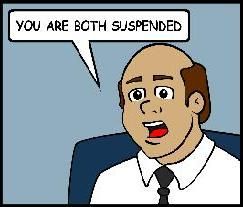
Why Are Kids Suspended? | Margaret Crotty

Why Are Kids Suspended? | Margaret Crotty:

Why Are Kids Suspended?


Mayor de Blasio's recent announcement that the New York City Department of Education would seek to reduce the number of student suspensions has sparked a conversation about the effectiveness -- and fairness -- of suspensions as a disciplinary tool. The Department of Education reported that in the 2013-2014 school year there were 53,504 suspensions in NYC. We debated this as a society for decades, and it is time to talk about what triggers the behaviors that result in thousands of suspensions, and how schools could better address them.
Under the Mayor's new proposal, there will be an increase in principal accountability of suspensions and in the use of restorative justice and peer mediation programs -- community approaches to handle offenses. The goal is to create a safer school climate that ensures the social-emotional and behavioral success as well as the educational success of all students. Like many working in the public school community, I applaud this direction. When a suspension deprives a student of the support system a school could provide, it massively increases that student's likelihood of dropping out of school, being at risk for court involvement, or future unemployment. Suspensions may not be directly responsible for these larger issues, but they are, according to The Civil Rights Project, one of the greatest indicators of whether a child will drop out. A 2011 report from the National Education Policy Center found that 95 percent of suspensions are for disruptive behavior. So the question is why are some children more likely to engage in this type of behavior and are suspensions -- often a predictor of future entanglements with the law -- really the answer?
Childhood trauma is a primary contributor to disruptive behavior in the classroom. Traumatic events for children include abuse (emotional, physical, sexual); neglect (emotional, physical); and growing up in households with domestic violence, and drug or alcohol abuse. Child Trends, a nonprofit research center, reports that poor children are more than twice as likely as their more affluent peers to experience multiple Adverse Childhood Experiences (ACEs), and the probability of severe childhood trauma decreases as family income increases. They found that 14 percent of children living at the poverty level or below had three or more adverse experiences, compared with only six percent among children living at more than twice the poverty level.
The stress of living in poverty and the deep-rooted trauma from ACEs often manifests in the classroom as "problem" behaviors. Students living in poverty face enormous external challenges--including community and housing instability, food insecurity, neglect and neighborhood violence. How can an eight-year-old understand healthy interpersonal interactions when he is hungry, scared or worried about his parents? Too often, behavioral issues are symptoms of stress--stress that stems from chronic trauma.
At Partnership with Children (PWC), we work with schools to identify the child's specific needs and provide the appropriate mental health interventions and a supportive environment. Oftentimes when we start working with schools, we find teachers who are overwhelmed and schools feel they have no choice but to remove the child from the classroom and the school. These punitive approaches end up unfairly targeting the very children who need support services most.
PWC social workers are in schools in some of New York City's highest-need Why Are Kids Suspended? | Margaret Crotty:

Tuesday, April 7, 2015

Rahm Emanuel: Symbol of a Sick America - NationofChange

Rahm Emanuel: Symbol of a Sick America - NationofChange:

Rahm Emanuel: Symbol of a Sick America 


 America’s is a sickness of the mind, the unwavering belief by people in power that free-market capitalism will somehow work for everyone.

As with a virus that refuses to die, the effects are insidious, because the very rich have convinced themselves that they made it on their own, and that others have only themselves to blame if they are poor.
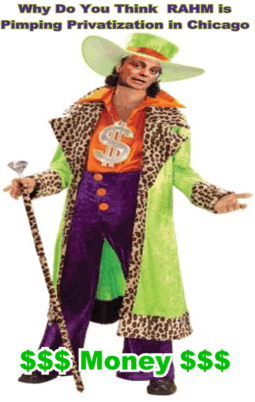
Rahm Emanuel is Mayor 1%. He speaks a politician’s words to entice many Chicagoans to vote for him, but his actions are on behalf of his friends and colleagues in the business world.
Snubbing the Needs of Average People
The author of Mayor 1%Kari Lydersen, tells the story of Helen Morley, a resident of the southwest side of Chicago and a regular patient at one of the mental health clinics closed by Mayor Emanuel. At Chicago’s 175th birthday party in 2012, Morley pleaded, “Mayor Emanuel, please don’t close our clinics! We’re going to die…There’s nowhere else to go.” Emanuel ignored her. According to Lydersen, Morley and others believed that the mayor “didn’t understand the role these specific clinics played in their lives and the difficulty they would have traveling to other locations.”
The same can be said for Chicago’s shuttered public schools, once the vital centers of their communities. The state of Illinois cut education spendingby a greater percentage than any other state in fiscal 2012, and for 2013 it was third-worst in percentage cuts per student. Privatizers rushed in and blamed the public system. As a result, 50 neighborhood schools were closed in Chicago, opening the way for charter schools, which take taxpayer money but have little accountability to the public and an obligation only to their investors. In the end, 2,000 public school employees were fired by Emanuel, including over 1,000 teachers.
Parent Ronald Brooks, whose daughter’s school Lafayette was shut down,spoke in the aftermath of the mayor’s action: “Lafayette was more than a school. It was an institution….the heart and soul of our community.”
Lafayette, which was reportedly underutilized, was replaced by a selectivepublicly-funded contract arts school with approximately the sameenrollment as before the closing.
Cozying Up to Cronies
According to the Chicago Tribune, “The mayor regularly courts his benefactors behind closed doors..” Nearly 60 percent of his 103 donors received “contracts, zoning changes, business permits, pension work, board appointments, regulatory help or some other tangible benefit.”
Democracy Now cites a report by the International Business Times which found that Emanuel uses no-bid, no-contract voucher payments to quietly pass along money to his contributors. It was also reported by the Chicago Tribune that the lawyers for Chicago’s infamous parking meter deal contributed over $100,000 to Emanuel’s campaign chest. City attorneys touted the ‘benefits’ of the deal.
In another egregious episode, Mayor Emanuel appointed Deborah Quazzo, a managing partner at GSV Advisors, to the Chicago Board of Education. The Chicago Sun-Times reported that Quazzo’s business affiliates subsequently tripled their business with the public schools. Tellingly, GSV founder Michael Moe related his goal for the future: “An education revolution in which public schools outsource to private vendors such critical tasks as teaching math, educating disabled students, even writing report cards.”
Making Deals that Send Our Tax Dollars to Wall Street
Rahm Emanuel has made Chicago look good for tourists, sprucing up the downtown (Loop) business district, adding retail stores and office space. But the funding comes at the expense of average citizens. The mayor’s plan for a South Loop hotel and basketball arena is using Tax Increment Financing (TIF) funds (our tax money, meant for blighted neighborhoods), and stands to enrich a hedge fund that contributed to Rahm’s campaign fund and then invested in the hotel as the deal was being finalized.
According to Crain’s Chicago Business, Emanuel has borrowed high-interest money that won’t come due until he’s out of office. For example, instead of paying $120.8 million in bonds owed now, he refinanced, thus adding another $228.8 million in interest over 30 years. Like Mayor Daley before him, Rahm hides the costs until someone else is around to take the blame.
Even the vital area of pre-K education is set up to benefit big business, with progressive-sounding social impact bonds likely to double the profits of Goldman Sachs and other investors in the next few years. Said Chicago reporter Rick Perlstein: “[The mayor] struck a deal with a bunch of investment banks to use the preschoolers of Chicago as collateral..” The deal was arranged with little debate, and with little understanding of the long-term risk.
And what about Chicago’s (and Illinois’) massive deficit? In recent years the state’s largest corporations have been paying only about a third of their required state taxesThreats to leave the city seem empty in one of the nation’s busiest trading centers. Yet Mayor Emanuel opposes even a tiny tax on the quadrillion dollar business of the Chicago Mercantile Exchange, whose profit margin in recent years has been higher than any of the top 100 companies in the nation.
His Legacy
The mayor claimed credit for a minimum wage increase, even though he didn’t act until the State of Illinois began putting the plan in place. He took credit for a longer school day for the kids, but he didn’t provide the necessary funding. He took credit for coal-burning power plant closings that resulted largely from neighborhood activism.
Like its mayor, Chicago has two faces. The rest of the nation sees the glitz and glamour of Chicago’s magnificent downtown, but the city’s south and west sides, according to urban analyst Daniel Hertz, are more dangerous than in the 1990s. This is part of the sickness: a persistent inequality, more-so of wealth than of income, that plagues America and manifests itself in the questionable dealings of a man like Rahm Emanuel. He may best be remembered as the privatizer of Chicago and, as Perlstein suggested, “a strikingly corrupt mayor.”Rahm Emanuel: Symbol of a Sick America - NationofChange:


Ohio Politics Now: Amid test concerns, state to allow some schools to create their own | The Columbus Dispatch

Ohio Politics Now: Amid test concerns, state to allow some schools to create their own | The Columbus Dispatch:

Ohio Politics Now: Amid test concerns, state to allow some schools to create their own


The tests linked to Common Core standards have been under fire from educators and parents who are concerned with glitches and the amount of time it takes to prepare for and take the tests.


 A look at what’s happening in Ohio politics and policy today:

The state is starting a pilot program to allow 15 schools and districts to develop their own standardized testingamid complaints that the current system isn’t working, Dispatch reporter Catherine Candisky writes. “The Innovative Learning Pilot is the latest effort by state officials to alter, scale back or dump tests that cost about $50 million to develop and administer, and first given to students last month.”
The tests linked to Common Core standards have been under fire from educators and parents who are concerned with glitches and the amount of time it takes to prepare for and take the tests.
The state already has a 28-person committee looking at the tests while state schools Superintendent Richard Ross has recommended a decrease in the number of hours testing.Ohio Politics Now: Amid test concerns, state to allow some schools to create their own | The Columbus Dispatch:

Some Details on the Senate-proposed ESEA Reauthorization | deutsch29

Some Details on the Senate-proposed ESEA Reauthorization | deutsch29:

Some Details on the Senate-proposed ESEA Reauthorization


 On April 7, 2015, the Senate education committee announced the following as part of a press release:

WASHINGTON, D.C., April 7 – Senate education committee Chairman Lamar Alexander (R-Tenn.) and Ranking Member Patty Murray (D-Wash.) today announced a bipartisan agreement on fixing “No Child Left Behind.” They scheduled committee action on their agreement and any amendments to begin at 10 a.m. Tuesday, April 14.
The result of the Lamar-Murray collaboration on the Elementary and Secondary Education Act (ESEA) reauthorization (the latest version of which is renamed No Child Left Behind) is this 600-page document entitled, The Every Child Achieves Act of 2015.
I read the first 136 pages of the act, which I refer to below as the Alexander-Murray reauthorization.
I am aware that when the document goes before the Senate education committee, it could well be amended. But for now, in this post, I offer my observations on key points in those first 136 pages as they appear in the draft version of Alexander’s and Murray’s draft as linked above.
The first construction I noticed was that the Alexander-Murray reauthorization document does not include the controversial name, No Child Left Behind” (NCLB) (pg. 4). Yes, the table of contents to be revised is the NCLB table of contents. (To view the complete NCLB document, click here.) However, the original name of the legislation, the Elementary and Secondary Education Act of 1965, is the name that Alexander and Murray use.
I will still use NCLB for the sake of clarity.
Section 1001 of NCLB (“statement of purpose”) is lengthy and included details such as, “holding schools, local educational agencies, and States accountable for improving the academic achievement of all students, and identifying and turning around low-performing schools that have failed to provide a high-quality education to their students…” and “providing greater decision making authority and flexibility to schools and teachers in exchange for greater responsibility for student performance.”
The Alexander-Murray reauthorization “statement of purpose” is not nearly so detailed:
The purpose of this title is to ensure that all children have a fair, equitable, and significant opportunity to receive a high-quality education that prepares them for postsecondary education or the workforce, without the need for postsecondary remediation, and to close educational achievement gaps.
The Alexander-Murray reauthorization deletes NCLB Section 1003– the one about “school improvement” and which includes language such as, “the State educational agency shall allocate not less than 95 percent of that amount directly to local educational agencies for schools identified for school improvement, corrective action, and restructuring.”
The Alexander-Murray reauthorization also removes NCLB Sections 1111 through Some Details on the Senate-proposed ESEA Reauthorization | deutsch29:


Big Education Ape: The Every Child Achieves Act of 2015 (Summary of the Bill) Fixing “No Child Left Behind”  http://bit.ly/1GlmiDp

Big Education Ape: Bipartisan Agreement on Fixing “No Child Left Behind” Sch Committee Action for 10 a.m. Tuesday, ... http://bit.ly/1Glj4jn

For more details on the bill:
Click here for the legislation.

Big Education Ape: National Day of Action April 8 Overhaul ESEA/NCLB: Less Testing More Learning FairTest http://bit.ly/1P8A9PZ

Big Education Ape: Join April 8 national call-in day to #CutFedTests | Parents Across America http://bit.ly/1GV0xtf

Big Education Ape: NEA - Educators to spring into Wave of Action on eve of 50th anniversary of ESEA http://bit.ly/1ah1ore

Big Education Ape: Get Out The Pitchforks - The Every Child Achieves Act of 2015 #ESEA http://bit.ly/1y1ZLZs

AFT President Weingarten on Today's Chicago Election | American Federation of Teachers

AFT President Weingarten on Today's Chicago Election | American Federation of Teachers:

AFT President Weingarten on Today's Chicago Election


WASHINGTON—American Federation of Teachers President Randi Weingarten on the results of today's election in Chicago.
"Runoffs carry a special message for re-elected leaders: Voters are willing to give them a second chance. Tonight Mayor Emanuel was given that chance by an electorate that is willing to believe his humbled promise that 'he can do better,' but does not want him to forget that education policies have to change.

"Jesus 'Chuy' Garcia ran a principled and spirited campaign on behalf of the children, the families and the citizens of Chicago's forgotten neighborhoods. He became the standard-bearer for hard-working Chicagoans who want good jobs and safe neighborhoods with thriving, not closed, public schools.
"The mayor now has a chance to reverse some of the damage felt by neighborhoods in Chicago. As we congratulate him tonight, we urge him to start by reinvesting in the communities he unnecessarily gutted by closing schools he could have chosen to fix and make the hub of neighborhoods.
"He can start tomorrow by pledging to meet with KOCO, the Kenwood Oakland Community Organization, the Chicago Teachers Union and others—working with them to identify and foster the services the neighborhood needs for kids and families. And speaking of CTU and UIC United Faculty, we urge him to start working with, rather than fighting with the educators of this great city.

"Across the nation, cities are increasingly returning to their role as this country's economic engines: In Chicago and elsewhere, we must collaborate to compete, for our cities, our schools, our economy and our children to thrive.
"We are still watching the aldermanic races, but between the plebiscite on an elected school board and a number of new seats held by pro-public education policymakers, Chicago will be governed by a different, and more pro-public education legislature."
# # # #
The AFT represents 1.6 million pre-K through 12th-grade teachers; paraprofessionals and other school-related personnel; higher education faculty and professional staff; federal, state and local government employees; nurses and healthcare workers; and early childhood educators.
- See more at: http://www.aft.org/press-release/aft-president-weingarten-todays-chicago-election#sthash.1AfhRuxj.dpuf