Latest News and Comment from Education

Thursday, April 2, 2015

Resistance To Standardized Testing Not Going Away

Resistance To Standardized Testing Not Going Away:

Resistance To Standardized Testing Not Going Away


Parents Can Opt Out - United Opt Out National

Click Here to go to United Opt Out National: 


Click Here to go to the WebsiteUnited Opt Out Team
Home
Click Here to go to the Website FairTest


Does populist outrage matter anymore? Anyone following the growing resistance to unpopular standardized testing in the nation’s public schools may soon see.
Thousands of teachers, parents, students, and public school advocates poured into the streets of New York City to call attention to the plight of public schools and to protest new proposals considered by the state legislature.
As a report from progressive news outlet Common Dreams recounts, the protestors’ demands ranged across an array of threats to public education – including lack of resources for schools and the rapid expansion of charter schools – but chief among the complaints was the increased emphasis on high-stakes testing.
The protests echo demands that rang through the halls of the state capital in Albany two days earlier when, according to a report from a local Fox News outlet, teachers “stormed” the building to express their opposition to a new state budget that puts “more emphasis on testing.” Teachers oppose the testing not only because of the effects over-testing has on student learning but also because the tests will be used in teacher evaluations, placing 50 percent of their performance assessment on student scores.
For these reasons and others, teachers across the state are increasingly advocating for parents to resist the influence of standardized tests by opting their children out of the exams. The head of the state’s teacher union endorsed a boycott of the tests. And for the first time, Randi Weingarten, the leader of the American Federation of Teachers, the nation’s second largest teacher union, spoke out in support of parents who opt their children out of tests, according to a blog post by education historian Diane Ravitch.
Many parents are taking the advice. As education journalist Valerie Strauss reports from her blog at The Washington Post, “New York state has been at the forefront of the opt-out movement, with some 60,000 parents last year deciding not to allow their children to take these tests. Activists say they expect more this year.”
Strauss turned the rest of her post over to New York educators Carol Burris and Bianca Tanis who write, “New York is on the leading edge of a growing national Opt Out movement – a movement that galvanizes the energy of parents, teachers and administrators who are pushing back against the Common Core tests and standardized test-based reforms.”
Burris and Tanis point to a recent survey showing, “by more than a 2 to 1 margin, New Yorkers trust the teachers union more than the governor, and less than 30 percent want test scores to determine teacher pay and tenure.” They point to “a coalition of pro-public school, anti-testing advocates” sponsoring forums across the state to encourage parent to oppose testing.” The forums, they contend, “have drawn hundreds of parents and teachers.”
The opt out movement is becoming so strong, Burris and Tanis maintain, many district school superintendents are taking steps to discourage opt outs for fear of being noncompliant with directives from state board of education.
So after all this outpouring of populist demand, how did state lawmakers respond?
A quick recap in The New York Times notes that negotiations between Governor Andrew Cuomo and state senators produced a bill that enforces “tying teacher evaluations more closely to students’ state test scores.” The resulting legislation will ensure, according to an Albany news outlet, public education governance that “continues to rely heavily on standardized test results.”
Testing mandates sailed through the state Assembly as well, where according to state news outlet Capital, lawmakers passed a bill which “creates a new educator evaluation system” based on a 50 percent wieght from the scores.
New York-based teacher Daniel Katz writes, “The governor’s education agenda only enjoys a 28 percent approval rating. 65 percent do not want tenure tied to test scores. Yet, despite overwhelming disapproval, the Assembly was unable to hold fast with the voting public.”
What’s worse, the legislation that passed ensures test scores will not only become 50 percent of a teacher’s evaluation but Resistance To Standardized Testing Not Going Away:

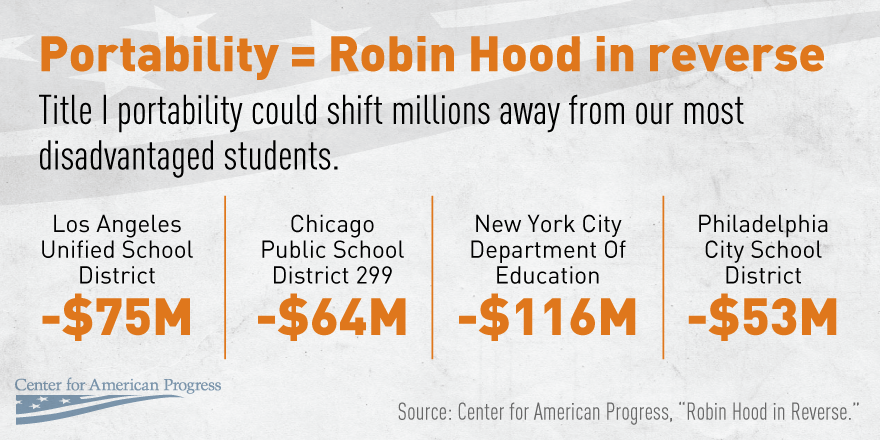
What is Title I Portability? - Freedom Outpost

What is Title I Portability? - Freedom Outpost:

What is Title I Portability?


 Education Daily February. 25, 2015, quotes Secretary Duncan.

"Duncan: 'Hard to fathom' compromise with GOP on Title I portability."
What a crock!
Let's shine a little light on this. This was the same portability when the Senate Democrats were in power. Their version of the Reauthorization of ESEA in 2013 was called SB 1094. The only compromise was to get Democrats on board with choice for all private and religious schools. Title I portability (all children are at-risk) and "direct student services" (meaningful choice funded by IDEA for all at-risk children) is embedded in the 2015 HR 5 and Alexander's ESEA with convoluted definitions and mandates for all public, charter, private, Christian, and Catholic schools. See HR 5 Bastardizes Title I and IDEA.
[Background: In the older Reauthorization of ESEA legislation, SB 1094 and HR 5 from 2013, there was language in the bills and amendments that were submitted for Title I portability by both Democrats and Republicans. Democrats were having a hard time agreeing to choice for private and religious schools. Senator Reid never brought this bill to the floor for a vote when it was released out of committee. Why? The Republican version passed the House with flying colors...passed without a whimper. So, why did Reid hold up the vote in 2013 to Reauthorize ESEA? They didn't have the votes. It looks worse now that parents know the content of the 2015 Reauthorization of ESEA bills.]
Title I funds "following the child" is not a new phenonoma. In fact, former Governor Mitt Romney and Republican candidate for President, had the exact same agenda for Title I and IDEA in 2012. Read closely.
Romney Calls for Using Title I, IDEA Funds for School Choice
"Republicans in Washington have long been attracted to proposals to use federal funds for school vouchers, and in that context, Romney's proposal is not unusual, Michael J. Petrilli, a vice president at the Thomas B. Fordham Foundation. He described the Republican candidate's school choice proposal as "an interesting idea," though he said it could be difficult to implement, for a variety of reasons.
Federal per-student Title I and special-education funds, on their own, are probably not sufficient to cover many private school costs, though they could help if combined with state voucher money, Petrilli said. The broader challenge is that federal funding formulas currently do not distribute Title I and other funds in ways that make it easy to give it out individually among qualified students.
On the other hand, if the federal funding stream could be overhauled so that each qualified student was given a "backpack" of funding to carry to any school.... Petrilli said." (Emphasis added)
This is the agenda. Overhaul federal funding formulas and distribute these federal-per-student Title I funds and IDEA funds that would follow all children in a "backpack" of funding that would go to any public, charter, private, or religious school.
Who is a "qualified" student for choice?
How will private and religious schools pay for these services?
...since these funds "are probably not sufficient to cover many private school costs." (Petrilli)
The devil is in the definitions. The definitions of at-risk and disabilities that go with Title I and IDEA have changed. You no longer have to be poor or handicapped. "Direct student services" are the psychological interventions and remediations for Common Core. Are private and religious schools taking into account that a choice child is at-risk of failing for not meeting Common Core psychological mental health standards (standards in the affective domain defined as attitudes, values, beliefs, and dispositions)? Do they realize that all schools will be mandated to deliver mental health interventions and remediation through IDEA? Are they willing and able to hire the social workers, psychologists, and psychiatrists that are mandated for these services? Is this choice?
In order for Obama and Duncan to get total control of all education in the United States, they need choice called TITLE I PORTABILITY (where the money 'follows the at-risk child') and "DIRECT STUDENT SERVICES" (psychological interventions and remediation funded by IDEA that will "follow the at risk child.") This was his equity in education plan, For Each and Every Child(Also see Compendium)
Yes, Title I portability is for every child. This is the equitable education and equitable funding that Obama promised. Every child will be taught the same Common Core psychological standards, every child be funded exactly the same, and every child will be remediated with psychological interventions exactly the same, with integrity and "fidelity." (Teachers are retrained to deliver and teach exactly as the scientifically evidence-based techniques were designed. (Response to Interventions, RTI) here
and here.
What is not being discussed is, what will be measured and how will these non-

Read more at http://freedomoutpost.com/2015/03/what-is-title-i-portability/#6sfzliHCOWSeOYKx.99

Before Book Deal, Andrew Cuomo Backed Bills That Helped News Corporation

Before Book Deal, Andrew Cuomo Backed Bills That Helped News Corporation:

Before Book Deal, Andrew Cuomo Backed Bills That Helped News Corporation


New York Gov. Andrew Cuomo likes to portray himself as a crusader against corruption in Albany, the state's capital, taking a hardline position against allowing state lawmakers to collect outside income that may be connected to pending legislation. He has championed a bill that would require lawmakers to disclose more of their outside income lest they write bills that benefit special interests in pursuit of private cash.
"We must prove once again that state government can be trusted, and that means passing tough new ethics laws and creating a system that deters, detects and punishes individuals who seek to abuse and corrupt," he said last week in a statement announcing ethics reform legislation. "We must bring sunlight to ethical shadows. New Yorkers deserve nothing less."
But the Democratic governor's strong words don’t quite square with his own personal appetite for cash earned outside the confines of his state work. Cuomo has so far raked in more than $188,000 from HarperCollins, a News Corporation subsidiary. That is part of a book deal that could ultimately net him more than $700,000. With Albany’s transactional politics now the subject of a federal probe, the context of that April 2013 book deal is particularly significant: An International Business Times review of New York state documents reveals that News Corporation gave Cuomo a book contract after Cuomo’s administration backed a series of state initiatives that benefited the media giant.
One of the initiatives was a bill that created a special sales tax break for online-only publications that charge for subscriptions. News Corporation, which was one of the two companies that lobbied for the bill, was at the time investing tens of millions of dollars in such a publication. Another initiative was a special tax exemption that Cuomo’s administration created for electronic books, which are sold by, among others, HarperCollins. State records list News Corporation as lobbying Cuomo’s tax department in the months before the exemption was announced. And, while News Corporation lobbied the governor’s office in 2012, Cuomo championed an expansion of controversial film and television tax credits that have benefited News Corporation’s films, and that News Corporation had lobbied for in the past.
News Corporation did not respond to IBTimes’ request for comment. Cuomo’s office -- his calls for transparency notwithstanding -- declined IBTimes’ request to release the text of the contract for the book, which has reportedly sold just 3,000 copies. The governor’s office also declined to comment about the legislation he signed and the administrative tax change his officials enacted. The governor has previously rejected the notion that his book deal had anything to do with state business, saying book income is “an exception” because “I'm not allowed to represent anyone or any business matter." He has also scoffed at the idea of applying outside income restrictions on statewide elected officials like himself, challenging anyone to identify how those paying his book contract benefited from his policies.
“What activity are they doing that you would like to see curtailed? I don't think there is any activity,” hesaid at a press conference last month. “What possible scenario are you talking about? Or is it just theoretical?"
Critics are troubled by the legislative goodies for News Corporation and the company’s subsequent payout to Cuomo.
“We've seen a disturbing series of cash-for-policy transactions by the Cuomo administration that benefit the governor's billionaire political supporters to the detriment of the public, and this seems to be part of Before Book Deal, Andrew Cuomo Backed Bills That Helped News Corporation:

Blue Jersey:: Camden's Public School Parents Deserve Vote and Voice in School Closures

Blue Jersey:: Camden's Public School Parents Deserve Vote and Voice in School Closures:

Camden's Public School Parents Deserve Vote and Voice in School Closures


Camden heating up. Promoted by Rosi. Cross-posted from the Local Knowledge Blog.How many signatures would it take to stop a school closure? 
How many parents coming to meetings would it take to stop a school closure? 
How many parental votes would it take to stop a school closure?


There are no answers to these questions because the Camden School District has steadfastly refused to be accountable in any concrete manner to the parents it claims to serve. But based off of this video from a meeting held at a school being taken over, we do know two things: 1) We know that in Camden, as in Newark, Philadelphia and New Orleans before it, local institutions, teachers and schools are deeply valued by their communities and 2) we have concrete evidence that Camden's state-appointed Superintendent Paymon Rouhanifard is incapable of reaching out and being accountable to parents in the schools he is closing. Here's the video:


Stephen Danley :: Camden's Public School Parents Deserve Vote and Voice in School Closures
Over and over, these parents express how deeply they value McGraw. One parent asks why they can't keep the teachers. Another talks about the wonderful music and arts programs. A third explains that when she was in the Camden public school system, she had a teacher she loved and that that teacher is now the principal at McGraw. A fourth teacher asks why the principal has to leave at all. A fifth parent laments, "why come here and discombobulate our home?"Right now, there is a raging debate in Camden about what a great school is, but that quote, at 16:47 is a powerful reminder that sometimes schools are more than test-score factories. Camden parents see these schools as home. What a testimony to the value of having long-lasting institutions with deep roots in the neighborhood, and to the value parents find in that very thing.

It makes a sharp contrast with the newcomers standing in front of the community. Early on in the meeting, a parent asks, "you don't even know nobody's [sic] name in here, do you?" (2:29)

This speaks to a larger problem in Camden. The Camden School District central office has been gutted of local educators. What is obvious from this meeting, and from the events of the last year and a half, is that replacing a local educators with young, inexperienced staff from other locations makes it virtually impossible to Blue Jersey:: Camden's Public School Parents Deserve Vote and Voice in School Closures:

Teacher Education under attack since 2011: Our Response! | BustED Pencils

Teacher Education under attack since 2011: Our Response! | BustED Pencils:

Teacher Education under attack since 2011: Our Response!


In 2011 I posted the blog below and ticked off some of my teacher education colleagues.  I received messages and notes and voice mails that proclaimed that speaking out in ways that are not “civil” does nothing but hurt our movement.
Well check it out and judge for yourself.


HELP! Where are all the credible teacher educators? Where all of my colleagues? Do you really think that hiding behind your “research” agenda shields you from the reality of this new push to destroy the American public school system along with quality teaching and learning? WAKE UP! PAY ATTENTION! The corporate reform movement is coming for you and me now.
The NEA, NCATE, and as far as I can tell, our institutions of higher education that employ us now support “accountability” as defined by the Obama/Duncan Department of Education. As reported by Stephen Sawchuck, “Momentum appears to be gathering behind a U.S. Department of Education plan to hold teacher education programs accountable for the achievement of students taught by their graduates.” If you need to, go back and read that statement again and again until it sinks into your thick skulls.
We are now going to be responsible for the test scores of children that end up being taught by our graduates. In other words, if my son fails and his teacher was your student, it’s now your fault! And if you don’t make the changes needed to help your students “teach” my son how to do well on his standardized tests you, your department, your school, and/or your college will be slapped and eventually shut down. When that happens please tell me about how important your “research” was.
I’m sorry was I too harsh? Did I offend you (my colleagues)? Did I dare pick on your research? Yes I did. Now get over it and start speaking, writing and screaming about how “No Child Left Behind” for teacher education is at best a bone-headed idea and at worst an absolute assault on our academic freedom and an unethical attempt to make us do what we know is absolutely wrong.
Remember NCLB? Yeah, some of you complained and some of you even managed to turn it into a productive line of research. And what was it that you complained about and what did all that research reveal? You complained that testing would not do anything to the achievement gap, that the curriculum will narrow, that the “least among us” would be hit hardest, and that linking student test scores to teachers and schools was problematic. Then after years of conducting research you found out that all of your complaints were substantiated. The achievement gap still exists, public school children now receive little to no instruction in the arts or the humanities, the children of poverty are bearing the brunt of this misguided ideological attack on public schools and value-added measures of teachers are extremely unreliable and the public reporting of these statistics causes harm to all involved with public education.
It is our turn to join with the children, parents, teachers and public schools. All across the country there is an “Opt Out” movement occurring. Parents are refusing to allow their children to take standardized tests (hereherehere), teachers are refusing to administerthe tests, administrators are speaking out against the negative consequences associated with the tests, and some schools have actually stopped administering the tests.
What should we do? How should we respond? Who’s willing to be the first teacher educator to say:
“No. I opt out too. I will not abandon everything I know about children, teaching learning and schools. I refuse to take part in a rigged political system designed to dismantle public education and thwart democracy.”
Isn’t it our turn to tune in and “opt out”?

It’s now 2015 and what has happened?  How has all that silent civility worked out for teacherTeacher Education under attack since 2011: Our Response! | BustED Pencils: 


Can't Blame the Teachers for Getting Us Into This Mess | Marc Joseph

Can't Blame the Teachers for Getting Us Into This Mess | Marc Joseph:

Can't Blame the Teachers for Getting Us Into This Mess


In today's America, why would anyone ever want to become a teacher? The budgets for our classrooms dwindle each year, and teachers continue to take money out of their own pockets to provide their students with supplies. The schools are getting older, and fewer new schools are being built annually. Based on the school shootings over the last few years, teachers must now worry every day about the security of students and themselves. All of this seems to eclipse why teachers wanted to teach in the first place.
In spite of the pressure on teachers, according to the National Center for Educational Statistics, public schools employed 3.1 million teachers this year. There were 284,000 new teachers joining public schools (compared with 222,000 a decade ago). Thankfully, the spirit to teach has not been lost on our newest college graduates. Why teachers choose to teach can be a very personal decision, but common themes include giving back, being a caring adult in a child's life, proving one person can make the difference and inspiring students.
This year, 49.8 million students attended public elementary and secondary schools. There are 13,600 public school districts, with 98,300 schools between them. We will spend $619 billion on our schools, which works out to $12,281 per student. And this school year, 3 million students will graduate from public schools.
It does pay to stay in school. Today's working adults aged 25 to 34 with a bachelor's degree earn $46,900, while those with an associate degree earn $35,700. High school graduates earn $30,000, and the median is $22,900 for those without a high school diploma.
The fact that the United States is ranked the 14th best educational country in the world, according to Pearson, is a real wake-up call for all of us. South Korea is ranked first, followed by Japan, Singapore, Hong Kong, Finland, the United Kingdom and Canada. Pearson found that the top-ranked countries offer teachers higher status in society and have a culture emphasizing education. Society's attitude about education and its underlying moral purpose seems to be stronger in the top-rated countries. And to think that just three decades ago, the U.S. was ranked first in the world.
It continues to amaze me that people want to become teachers. New teachers make around $36,000 and can earn $58,000 after 20 years, so striking it rich does not seem to be a reason to pursue this career. There are so many stories about teachers helping others that remind us that there is spirit within these individuals that the rest of us don't posses.
ABC News had a story about Lindsey Painter, a first-grade teacher in New Braunfels, Texas, who is donating her kidney to one of her students. The Arizona Republicreported about a Phoenix fifth-grade teacher, Reid DeSpiegelaere, who helped the school's families when their rent was increased. Many of the families were immigrants from war-torn countries who could hardly pay their current rent and were very connected to the school, teachers and staff. DeSpiegelaere organized the effort to find the families other places to live in the district. "In modern education, especially in this area, we need consistency," DeSpiegelaere said.
Schools are the heartbeat of our community. And it isn't only teachers who mold our kids, as People magazine reports. Charles Clark is a janitor in Euless, Texas, and for 26 years has been mentoring poor and fatherless kids. Trinity High School's 2,400 students name Clark as the most influential person at their school, and he has hundreds of thank-you letters from students.
With what is going on in Congress, it is very unlikely that our schools will be receiving additional funding in the near future. Add to this the fact that teachers this year took an average of $513 out of their own pockets for classroom supplies, food for hungry kids in their classrooms, instructional materials and books for their students, and we have a no-win situation for students and teachers. It is up to concerned citizens and parents to make a difference and give teachers well-deserved help.
The National Teachers Assistance Organization gathers donations for professional assistance for teachers. At Donors Choose, public school teachers post classroom project requests, and you can donate to the project that most inspires you. At Start Donating, they match donors with teachers in need of supplies. And at DollarDays, on our Facebook page, we are giving away $5,000 worth of products to help teachers across this great country. Please nominate your favorite teacher for this giveaway!
It takes an entire village to bring quality education to the next generation. We have Can't Blame the Teachers for Getting Us Into This Mess | Marc Joseph:


Cuomo: Education reforms are transformative, pro-teacher - Yahoo Finance

Cuomo: Education reforms are transformative, pro-teacher - Yahoo Finance:

Cuomo: Education reforms are transformative, pro-teacher

Despite fight with unions, Gov. Cuomo calls education reforms transformative, pro-teacher


ALBANY, N.Y. (AP) -- Gov. Andrew Cuomo on Wednesday touted the contentious educational reforms he fought to include in the state budget as transformative and said that when combined with a big school funding increase, they make this budget the "most pro-teacher" ever.
The Democratic governor's comments to The Associated Press came after a bruising fight with teachers unions over the changes, which include revisions to teacher evaluations, new rules for the dismissal of ineffective teachers and changes to the process by which the state can take over chronically struggling schools.
Lawmakers included the reforms along with $1.4 billion in additional school funding in the budget approved early Wednesday.
"The largest investment in history. The most pro-teacher budget in history," Cuomo said. "My mother was a schoolteacher. I have tremendous respect for teachers. There is no state budget that has honored teachers more than this."
Teachers unions scoff at the assertion. While they like the spending increase, they say Cuomo's emphasis on evaluations tied to student testing unfairly blames teachers for the economic and social challenges many students face.
"He basically said, 'I'm declaring war on teachers and public education,'" said Michael Mulgrew, president of the United Federation of Teachers. "This was the first battle. The governor thought he was going to get all of this stuff, and he did not get it."
Cuomo initially suggested his own revisions to evaluations; now it will be up to state education officials to oversee the changes. His proposal on the state takeover of struggling schools was modified. A call to authorize more charter schools was removed from the budget to be considered separately later this year.
Cuomo points to provisions in the budget intended to recruit, retain and reward good teachers. One is a new scholarship program for students at public colleges and universities who commit to teaching in the state for five years. Others include a new statewide admissions standard for teacher preparation programs and a continuing education requirement for teachers.
There also is $20 million in the budget for teacher merit pay, which Cuomo said will reward excellent teachers with up to $20,000 in bonus pay.
The evaluation proposals dominated debate over the $142 billion budget. Even some supporters acknowledged reservations about Cuomo's plan.
"I won't go as far as to say we love it, but it's a reasonable compromise," said Democratic Assemblywoman Catherine Nolan of Queens, chairwoman of the Assembly's Education Committee.
The governor said he views his reforms in the context of his future legacy and as a struggle against who he calls "the most political forces that run Albany ... the forces of the education industry ... the supporters of the political establishment."
"Government often tries episodic solutions or partial solutions because the political process doesn't allow for a wholesale solution," he said in a phone interview. "Sometimes incremental doesn't work. Sometimes you can't fix a part of the chain. You have to replace the entire chain."
Unions held protests against the plan throughout the state and mounted an aggressive advertising campaign to criticize the governor.
The fight will continue, with debates over charter schools and mayoral control of New York City schools expected to loom large in the final two months of the legislative session.
State education officials will now oversee the details of the new evaluations, which will be used in the Cuomo: Education reforms are transformative, pro-teacher - Yahoo Finance:

Ohio Governor John Kasich & Others Are Either Lying or Misinformed About Who Wrote Common Core | PJ Lifestyle

Ohio Governor John Kasich & Others Are Either Lying or Misinformed About Who Wrote Common Core | PJ Lifestyle:

Actually, No, Governors & Classroom Teachers Did NOT Write the Common Core Standards

Ohio Governor John Kasich and other defenders are either lying or misinformed.


Ohio Governor Kasich appeared on Fox News Sunday with Chris Wallace in January and made a claim about the origins of the Common Core State Standards. “These were governors who helped create Common Core,” insisted Kasich, who is pondering a presidential run. “That up-close involvement means they know Common Core wasn’t Obama-driven.” He went on to say that the standards were “written” by state education superintendents and local principals, a claim he has made repeatedly as he has stubbornly defended the standards in the face of growing public resistance. For emphasis, he added that the standards were “created by local school boards.”
Try to imagine for a moment the hilarity that would ensue during a giant conclave of governors (from both parties), state school superintendents, local principals, and local school boards tasked with writing national education standards.
But that’s not all.
The Common Core State Standards website claims that the National Governors Association was involved in writing the standards, as was the Council of Chief State School Officers, teachers, parents, school administrators, standards experts from across the country and the alphabet soup of education special interest groups — the National Education Association (NEA), American Federation of Teachers (AFT), National Council of Teachers of Mathematics (NCTM), and the National Council of Teachers of English (NCTE) along with “other organizations.”
If that sounds like way too many cooks in the kitchen, you’re right. A group that large with a myriad of diverse and competing interests could not possibly be expected to sit down in a room together (if a large enough room could be found) and agree upon a list of all the things every student in the nation should know before they graduate from high school. Sure, those special interest groups could give input and make suggestions, but when it came time to sit down and actually write the standards, that responsibility fell to a pair of workgroups and a handful of individuals who received their marching orders from three groups: the National Governors Association (NGA), the Council of Chief State School Officers (CCSSO), and Achieve, Inc.
It started with the Memorandums of Agreement (MOAs) that 46 states signed in 2009 when they agreed to take Race to the Top funding in exchange for implementing the not-yet-written Common Core standards. The “owners” of the copyrighted Common Core States Standards (CCSS) are named in the title of the MOA: The Council of Chief State School Officers and the National Governors Association Center for Best Practices Common Core Standards Memorandum of Agreement. 
Neither group has any authority to make decisions that are legally binding on the states, nevertheless the states agreed when they signed the MOAs that the writing of standards could be assigned to a pair of “work groups” — one for the math standards and one for English Language Arts. 
It’s important to note a few things about the NGA. Though governors do vote to express some measure of solidarity with shared priorities during the group’s two annual meetings, details about how the governors vote (or whether individual governors even show up to vote) are not released to the public, despite the fact that the group is heavily subsidized by taxpayers. Five Republican governors — from Florida, Maine, North Dakota, South Carolina, and Texas — have publicly withdrawn their membership from the group in recent years, saying membership in the group was a waste of time and taxpayer money. So when Common Core supporters try to say that the effort to create the standards was “led by the nation’s governors” and they cite the NGA’s involvement as proof, it must be understood that the NGA’s support is not necessarily representative of the nation’s governors and it certainly does not represent the will of state legislatures, which did not have a say in signing the MOAs.
Achieve, Inc., a nonprofit dedicated to promoting higher educational standards, joined with the NGA and the CCSSO in 2009 to begin working on the CCSS standards, but again, the actual work of writing them fell to the two work groups. (A year later, Achieve, Inc. signed on as a “Project Management Partner” for the Partnership for Assessment of Readiness for College and Careers (PARCC) tests.)
Mercedes Schneider described the 24 individuals who participated in the work groups (all of whom had to sign confidentiality agreements about what went on at the meetings). She said that instead of teachers with classroom experience, the groups were stacked with individuals with “ACT” and “College Board” credentials.
In the math work group:
In sum, only 3 of the 15 individuals on the 2009 CCSS math work group held positions as classroom teachers of mathematics … Only one CCSS math work group member was not affiliated with an education company or nonprofit.
And in the English Language Arts work group:
In sum, 5 of the 15 individuals on the CCSS ELA work group have classroom experience teaching English. None was a classroom teacher in 2009. None taught elementary grades, special education, or ESL, and none hold certifications in these areas. Five of the 15 CCSS ELA work group members also served on the CCSS math work group. Two are from Achieve; two, from ACT, and one, from College Board.
Within the work groups there were a handful of lead writers who did the bulk of the work: David Coleman (who is now president of the College Board, which administers the SAT) and Susan Pimentel in English, and Jason Zimba, Phil Daro, and William McCallum in math.
There were also two feedback groups, which, like the work groups, were stacked heavily with professors and included only one math teacher. These groups were tasked with providing research and advice to the writers. Finally, there was a validation committee which was supposed to sign off on the standards after ensuring they were “research and evidence-based.” Five of the 29 members of the validation committee refused to sign off on the CCSS, though the final report failed to mention that fact.
Last week Kasich defended the statements he has made about the the genesis of the Common Core standards, telling reporters at Nashua Community College, “I said, ‘If I don’t know what I’m talking about, please correct me,’ and I was met with profound silence.” He said that concerns about the standards are a “runaway internet campaign.” If Kasich were so inclined, he could, with just a few simple Google maneuvers, discover plenty of evidence (on that Ohio Governor John Kasich & Others Are Either Lying or Misinformed About Who Wrote Common Core | PJ Lifestyle:


Andrew Young Shares His Thoughts and Civil Rights Experiences

Andrew Young Shares His Thoughts and Civil Rights Experiences:

Andrew Young Shares His Thoughts and Civil Rights Experiences


Andrew Young, Jr., former ambassador, civil rights activist, and mayor of Atlanta, spoke to the members of Sacramento's IndiviZible on March 25 in Oak Park. Young was a close associate of Dr. Martin Luther King, Jr. (OBSERVER photo by Robert Maryland)
Andrew Young, Jr., former ambassador, civil rights activist, and mayor of Atlanta, spoke to the members of Sacramento’s IndiviZible on March 25 in Oak Park. Young was a close associate of Dr. Martin Luther King, Jr.
(OBSERVER photo by Robert Maryland)


 OAK PARK — Civil rights icon Andrew Jackson Young Jr. has experienced and accomplished many, many things in his lifetime. While he was a close confidant of Dr. Martin Luther King, Jr., Young practically learned the social mentally of America — and he’s not afraid to talk about the good and the bad side of it.

Before Young went on stage early this week in front of members of Sacramento’s IndiviZible group at the Guild Theatre in Oak Park, he engaged in a discussion about the disturbing issues that have emerged in Ferguson, Mo., the Department of Justice report about the city’s police practices, and the killings of unarmed Black men.
Young lamented that these occurrences are disturbing, but in the same regard, the African American community needs to realize that “White supremacy is a sickness,” and having ill-will toward it can create more problems, he said. Black people need to control their behavior, too, he hastened to add.
“In the first place, you need to know that you’re still Black,” Young said in an exclusive interview with The OBSERVER. “This is nothing new. You can go about acting like you’re free and talking like you’re big and bad. But it won’t get you anywhere,” he said.
In the 1960s, when Young was entrenched in the civil rights movement, the practice was non-violence no matter what the situations or conditions were, Young said. Black men who find themselves in any of these positions today must learn how to prevent a fatal outcome.
“You don’t overcome sickness by being sick yourself,” Young said during the interview at Underground Books. “You have to let them know that you are not like them, you are so confident that you are sure of who you are, and let them know you’re God’s child. They are the ones with the problem. Don’t let that get you upset,” he stated.
Young also shared that he dealt with the police all over Mississippi, Alabama, Georgia, and Florida during the civil rights movement “and never got shot.” Unlike others during the movement, Young did not endure continuous, physical confrontations.
“I only got beat up once,” Young said. “But all I am saying is that if you’re unarmed and have a big-bad mouth you’re liable to get shot. You might as well face that. I knew at four years old that if I was going to survive in New Orleans, Louisiana, I had to be a gentleman, be polite, show myself self-respect, and I had to show my enemies self-respect,” he suggested.
The killing of unarmed Black men concerns Young, though he shared his thoughts about the underlying matters that also plagued Black and White communities.
Young said the real problems have nothing to do with race.
“The thing that worries me more than that (the death of unarmed Black men) is that 93 percent of the Black men killed are killed by other Black men,” Young said. “That’s self hatred. Also, I think, about 86 percent of the White men killed are killed by other White men. So we don’t have a race problem. We have a violence problem. Sometimes we make a mistake when we put everything in racial terms,” he continued.
Born on March 12, 1932, in New Orleans, Louisiana, Young became active in the civil rights Movement, working with Dr. Martin Luther King Jr. in the Southern Christian Leadership Conference (SCLC). Young was with Dr. King when he was slain on April 4, 1968 in Memphis, Tenn.
In 1972, he was elected to the House of Representatives. Young was the first African American to represent Georgia in Congress since Reconstruction. In his time as a Congressman, he supported programs for the poor, educational initiatives and human rights.
Young left his seat in Congress to take the position to be the U.S. ambassador to the United Nations in the Jimmy Carter administration.
In 1979, Young had to resign his ambassadorship and was elected as Atlanta’s mayor in 1981.
Young was successful in a campaign for Atlanta to host the Olympic Games in 1996.
Before Sacramento Mayor Kevin Johnson introduced Young at the IndiviZible meeting, he reminded 400-plus members of what one of Young’s roles were while traveling with Dr. King during an intense period of the civil rights movement.
“If you look at all photos back then when Dr. King was marching, you’ll see Andrew Young in the Andrew Young Shares His Thoughts and Civil Rights Experiences: