Latest News and Comment from Education

Friday, March 6, 2015

Principal to parents: ‘We don’t need to get used to this. We need to stop it.’ - The Washington Post

Principal to parents: ‘We don’t need to get used to this. We need to stop it.’ - The Washington Post:


Principal to parents: ‘We don’t need to get used to this. We need to stop it.’


Parents Can Opt Out - United Opt Out National

Click Here to go to United Opt Out National: 


Click Here to go to the WebsiteUnited Opt Out Team


 Troy LaRaviere is the principal of Chicago’s Blaine Elementary School and a leader of the Administrators Alliance for Proven Policy and Legislation in Education. He has been outspoken about school reform policies that he thinks are harmful to children or a waste of Chicago Public Schools money. Here’s an example, from  this interview with him:

CPS just spent $20 million that should be going to the children of Chicago and put it towards principal training to be provided by an organization called SUPES Academy. Now I don’t know a principal who hasn’t said that it’s horrible. It’s poor quality and it’s a waste of our time. I believe in training when it’s effective but this is ineffective.
Here’s another example of how outspoken LaRaviere is, from this post published b y LaRaviere in 2014, about Chicago Mayor Rahm Emanuel:
The administration’s interaction with principals is often insulting. During the debate over the longer school day, some principals questioned its merits. CPS officials were then dispatched to tell the principals their opinions didn’t matter.
Here’s something new from LaRaviere: a letter he wrote to parents of students at his school about the Common Core test known as PARCC,  created by the Partnership for Assessment of Readiness for College and Careers, one of two new Common Core tests created by two multi-state consortia with some $360 million in federal funds. Illinois is a PARCC state, and the new tests are being given this spring.
In mid-January, Chicago Public Schools district chief Barbara Byrd-Bennett said that the system would not give all students the PARCC, as expected, but instead would give it in a fraction of the more than 600 schools in CPS. She said that she had big questions about the value of the test, as well as about whether the district had the technological capability to give the computer-administered test to all students. But this week, shortly before the PARCC was to be given in Illinois, she said that pressure from state officials had persuaded her to reverse position and give the test to all students. The Chicago Tribune quoted her as saying:
“There are huge, huge financial sanctions that have been very clearly delineated to us. It would be irresponsible for me to even put us in that position of danger, of losing the funds, given our financial conditions now. … I continue to personally and professionally believe that to administer PARCC this year is absolutely not in the best interests of our students. However, given the threat from [the Illinois State Board of Education], there is absolutely no choice that I can present to this board and to our community.”
This is from LaRaviere, as posted to his blog (and which I am publishing with his permission):

On March 2nd, members of my school’s PTA sent letters home to parents encouraging them to opt their children out of the PARCC Test. Their effort was covered in an article by Lauren FitzPatrick in the Chicago Sun-Times. Many parents asked my position on the matter. As a result, I released the following letter to our parent community.
============================
I am writing to make it clear that the Blaine administration fully supports the PTA’s effort to maximize Blaine students’ instructional time. As a result we will respect and honor all parent requests to opt-out their students from the PARCC. Students whose parents opt them out will receive a full day of instruction. Teachers are developing plans that will provide enriched learning experiences for non-testing students during the testing window. I want to clearly state that whether you opt-out or not, Blaine’s administration and teachers will 
Principal to parents: ‘We don’t need to get used to this. We need to stop it.’ - The Washington Post:

The argument for a basic income - CNN.com

The argument for a basic income - CNN.com:


The argument for a basic income


John D. Sutter is a columnist for CNN Opinion and creator of CNN's Change the List project. Follow him on TwitterFacebook orInstagram. Email him at ctl@cnn.com. The opinions expressed in this commentary are solely those of the author.
(CNN)Earlier this year, I visited a town where residents are cut a check just for being alive. It's not some Scandinavian utopia. It's not part of some holdout communist state. It's Cherokee, North Carolina, a town of 8,000 hidden away in the particularly misty stretch of the Great Smoky Mountains.
I went to Cherokee to explore the idea of a "universal basic income," which is a fancy way of saying something that's really quite simple: Give everyone cash, just for existing. The goal, according to proponents of such a policy, is to alleviate, if not eliminate, the scourge of poverty. And, more importantly, to reduce the social ills -- poor health, poor educational attainment, poor job prospects and higher odds of ending up in jail -- associated with kids who grow up poor.
The difference between the poor and the non-poor, according to basic income supporters (and basic logic), is just money. Give poor people more of it, and they'll be better off.

'Moral shame'

These topics are of particular interest to me because readers of this website voted for me to cover child poverty as part of my Change the List project. In the interactive story "The poor kids of Silicon Valley," I explored the incredible scope of childhood poverty in this rich country. I was surprised to learn that census data show one in five American kids is poor. The United States, according to UNICEF, actually has the second-highest rate of child poverty in the developed world. Only Romania fares worse on that measure.
Not even Silicon Valley -- home to Facebook, Google and Apple, which is building a new campus that looks like a damn spaceship -- is immune. A third of kids there -- in this epicenter of wealth and prosperity -- are at risk for hunger, meaning their families can't pay all of their bills and may have to cut back on food to make it through the month, according to Caitlin Kerk, spokeswoman for the Second Harvest Food Bank.
    "This is the moral shame of our community," San Jose's mayor, Sam Liccardo, told me.
    This level of poverty among society's most vulnerable people, as the Children's Defense Fund and others have argued, is both immoral and expensive. Children obviously cannot choose their parents' salaries. We can't blame poverty on them, and yet they are statistically the group most likely to be poor in modern America. They also bear its costs most directly. The outcomes of their lives, even the chemistry of their brains, literally can be shaped by it. The rest of us pick up the tab, too. Child poverty costs the United States $500 billion per year, according to University of Chicago research. That includes lost earnings as well as health care and the cost of crime.

    'Where do we go from here'

    For a problem so massive -- and so costly -- a wholesale fix like the basic income seems appropriate. Before my trip to the North Carolina mountains, I read up on the basic income and its history. The more I learned, the more encouraged I became.
    For starters: This tidy, egalitarian concept isn't new, and its support isn't limited to the radical political left. Dig through the Rev. Martin Luther King Jr.'s little discussed book, "Where Do We Go From Here: Chaos or Community," published in 1967, the year before his assassination, and you'll find an endorsement: "I am now convinced that the simplest approach will prove to be the most effective. The solution to poverty is to abolish it directly by a now widely discussed measure: the guaranteed income." Milton Friedman, the Nobel-prize winning economist who was an adviser to conservatives Ronald Reagan and Margaret Thatcher, also supported a variation of the idea.
    The basic income continues to have a diverse set of supporters -- left, right and libertarian. They like the concept for different reasons, said Matt Bruenig, a writer and policy analyst for Demos. Those on the left tend to like it because it's egalitarian. It helps give everyone an equal (or more equal) shot at success in our capitalist society. Some libertarians and right-wingers support the concept, meanwhile, because they see it as a way to whittle away at government bureaucracy. Some would have the basic income replace many existing social safety net programs. There's also a conservative philosophy underlying all of this: Give people money and they, not the government, know best how to spend it. They know what they need. The feds do not.

    '8 million coins'

    Other countries are taking the idea more seriously. In fall 2016, Switzerland is scheduled to vote on instituting a national, basic income program. Enno Schmidt, an artist and activist behind the push, told me demonstrators dumped a pile of 5-centime Swiss francs on a public square to make the point that everyone in the nation deserves a cut of the country's staggering wealth.
    "There are 8 million people" here, he said. "There were 8 million coins."
    That's 16 tons of money, he said.
    In the United States, such discussions have been less visible.
    But they are playing out in that little North Carolina town.

    'I'm so thankful'

    And in that little town, it starts with a casino.
    The Harrah's-operated casino is owned by the Eastern Band of the Cherokee Nation, which also owns the land beneath the mountain town. In 1996, according to Larry Blythe, vice chief of the tribe, the local tribal council voted to do something rather unorthodox: It decided to split half of the casino's profits evenly among its members, which now number 15,000. The goal: Let the community share in the wealth that would be generated from gambling.
    The payouts were modest at first -- about $500 per person per year, Blythe said.
    Now the annual sums are more like $10,000 per person.
    Talk your way around town and you'll meet people like Kaitlin Blaylock, a debt-free 23-year-old who used the money to pay for her education. "I honestly don't think I would have been able to go to grad school without it," she told me. Or James Sanders II, a 34-year-old bald guy with a beard. He told me he spends the money on his two young boys and on a welding and auto repair business, which he uses to supplement his job as a security guard. "I don't have to worry if I'm going to be able to put food on the table or clothes on their backs," he told me. James' sister, Lori Sanders, 46, operates a beauty salon, Lori's Beauty Box, out of a trailer on the family's land. She's saving the "per cap" payments, as locals call the biannual distributions, to send her son on a school trip to Europe. "I'm so thankful for the opportunity it affords me -- to do what I love," she said, referring to her salon, the interior of which is decorated with images of Wonder Woman.
    These folks aren't just anecdotes. I talked with Jane Costello, a Duke University researcher who has been studying the effects of these payments on 1,420 Cherokee-area children over the course of 20 years. The subjects started out as children and now are in their 30s. The results of Costello's longitudinal studies, which compare the lives of children who got the "per cap" payments with those of locals who did not, are staggering. The poorest kids who received the payments were one grade year ahead in school, compared with those who didn't, when researchers checked in with them at age 21. Kids who were lifted out of poverty by the payments saw behavioral problems decrease 40%. For the poorest families, the payments reduced by 22% the odds that children would commit minor crimes by their late teenage years.

    How much would it cost?

    Bruenig, a basic income proponent who has written about this topic for The Atlantic and other publications, told me implementing a basic income easily could halve the poverty rate in the United States. He developed an online "basic income calculator" to evaluate the costs and benefits. Using his math, based on 2012 figures, we could pay every man, woman and child in the United States $1,610 per year, reducing the overall poverty rate from 15% to 10.8%, for about $500 billion. That's what child poverty, alone, costs the United States each year.
    Bruenig suggests paying more -- $3,000 per year -- to cut the overall poverty rate in half. I'm less concerned with who would be paid how much than the financial ballpark: Considering how much poverty costs, this out-there solution can be seen as affordable. It could be paid for with a progressive tax system and distributed much in the way Social Security is today, Bruenig suggests. The payments might go to everyone, but because the rich would be paying more in taxes they would not be getting as much benefit from the program as low-income people who need the help. Less expensive, still, would be targeting families with children, specifically. In a way, the concept also builds upon -- and makes more meaningful -- tax credits that this country already gives to low-income people and families with children.
    The United States won the war on poverty among older Americans, Bruenig told me, by investing in Social Security. Consider this Social Security for the young -- or for all of us.

    'Just give them the money'

    The way Cherokee collects and distributes money to residents is particular to the town, and could not be replicated nationwide. But that doesn't seem to bother Costello. She's interested in what happens when poor families get money for free. And, based on what she's seen in Cherokee, she's convinced these families use the money to buffer their kids from the worst of poverty.
    She told me the work has made her more convinced of an argument certain political thinkers have been making for 100 years: "Stop trying to micromanage the poor and dividing up the 'deserving poor' from the 'undeserving poor.' Just give them the money."
    There's something simple, charming and fair about this approach.
    What's most important, from my perspective, is that we do something -- and something big -- to combat the scourge of child poverty. There are viable solutions, and the universal basic income should be a front-running candidate. Other ideas to be considered -- and which could reduce child poverty by 60% -- are deftly presented in a recent Children's Defense Report titled "Ending Child Poverty Now." I dissect some of the report's ideas in my Change the List story.
    The broader point is this: It doesn't have to be this way.
    We live in one of the richest countries on Earth.
    We can't afford to let our children grow up poor.

    Growing up poor has long been associated with reduced educational attainment and lower lifetime earnings. Some evidence also suggests a higher risk of depression, substance abuse and other diseases in adulthood. Even for those who manage to overcome humble beginnings, early-life poverty may leave a lasting mark, accelerating aging and increasing the risk of degenerative disease in adulthood.
    Today, more than one in five American children live in poverty. How, if at all, to intervene is almost invariably a politically fraught question. Scientists interested in the link between poverty and mental health, however, often face a more fundamental problem: a relative dearth of experiments that test and compare potential interventions.
    So when, in 1996, the Eastern Band of Cherokee Indians in North Carolina’s Great Smoky Mountains opened a casino, Jane Costello, an epidemiologist at Duke University Medical School, saw an opportunity. The tribe elected to distribute a proportion of the profits equally among its 8,000 members. Professor Costello wondered whether the extra money would change psychiatric http://opinionator.blogs.nytimes.com/2014/01/18/what-happens-when-the-poor-receive-a-stipend/

    Thursday, March 5, 2015

    It’s a Badass Film Festival! Closeup on Corporate School Reform! | gadflyonthewallblog

    It’s a Badass Film Festival! Closeup on Corporate School Reform! | gadflyonthewallblog:


    It’s a Badass Film Festival! Closeup on Corporate School Reform!

    11025643_1787964744761514_7757764095588311307_n
    I blog.
    I write.
    I look at the devastation, the hopes and promise of our public school system, and I report it to the world.
    It seems a futile pursuit some days. Does anyone actually read this stuff? Or am I just talking to myself?
    The hit counter tells me that, yes, indeed, there are people out there clicking on my humble little gadflyonthewallblog. Comments appear under my Facebook posts. My tweets get retweeted. Followers and friends multiply.
    But I wonder sometimes about all the sets of eyes that see a block of text under my name and just keep on scrolling.
    Would the minds connected to those eyes have understood? Would they have been spurred to action? Might they have been just the people we need to turn the tide and take back our education system?
    And I answer: maybe.
    So today’s entry is an attempt to get those roving, impatient orbs to stop, look and see.
    Because today I bring not just words but pictures. Movies, in fact.
    But first some background.
    This whole enterprise began by accident. My school district received a $360,000 donation from Apple and Bill Campbell so every student could have an iPad for use in class.
    The program will be rolled out next year, but teachers have already been given devices and some minimal training.
    We were encouraged to play around with the devices to find applications for our students next year. One such app we were told to explore was iMovie.
    I made a brief preview trailer for S.E. Hinton’s “The Outsiders” – one of the novels my students read. I thought it might make a good lesson on theme for next year’s kids.
    However, in doing the assignment, I wondered what it might look like if I made a similar short movie about corporate education reform. After all, I spend a lot of my off hours writing about it. Why not try another medium?
    Let me be clear. I did NOT use school equipment. I have my own personal iPad at home. It’s not nearly as nice as the ones the students will be using. In fact, I had to pay for a few upgrades to get it up to similar specs.
    But once I did, it was a simple matter to make the “OPT OUT OF STANDARDIZED TESTING” movie you see here:It’s a Badass Film Festival! Closeup on Corporate School Reform! | gadflyonthewallblog:

    Reform fatigue: How constant change demoralizes teachers.

    Reform fatigue: How constant change demoralizes teachers.:


    A Painful Decade of School Reform


     Reforms come and go so quickly at Intermediate School 61 in Queens. First there was the push for smaller schools that began in 2003. Then a mind-boggling data system was introduced in 2007. The implementation of Common Core began in 2012, a process on track to continue through at least 2022. A new teacher evaluation system debuted in 2013.

    The experience over the last decade at this very large middle school—which enrolls nearly 2,400 students, employs close to 200 teachers, and takes up nearly an entire city block—offers a case study in how fatigue with top-down reforms can become the biggest impediment to meaningful educational change. With each reform, teachers and administrators have lost a little more trust in the city, state, and federal officials setting the agenda—not to mention a lot of their time.
    The decade of ceaseless change started with one of then-Mayor Michael Bloomberg’s signature initiatives: the push for smaller schools. Bloomberg (as well as the deep-pocketed Gates Foundation) was a big proponent of small schools, aggressively shutting down or breaking apart a total of 157 large, comprehensive schools. This shift, which occurred simultaneously in several districts across the United States, dramatically altered the New York City school system and helped give the charter movement a more significant foothold.
    “The whole focus of the prior administration was to make everything small,” said principal Joseph Lisa, who has run I.S. 61 since 2007 and was assistant principal before that.
    When Bloomberg came to power, I.S. 61, located in the largely poor and immigrant Queens neighborhood of Corona, was indeed a school in need of a turnaround: Test scores were low, and discipline problems were rampant. (One longtime assistant principal, William Voges, described the school he arrived at as “a hellhole of destruction.”) So the school adopted a twist on Bloomberg’s small-schools model, breaking the school down into five distinct academies. The move offered an opportunity to improve the school’s culture and, hopefully, pre-empt any potential reorganization by the city. Each academy was named after a prestigious school—Harvard, Yale, Cornell, Princeton, and Stanford—and staffed by its own assistant principal, dean, and faculty. The idea was that teachers would likely never be able to know more than 2,000 students, but they stood a chance at getting to know a couple hundred.
    But the small-schools movement quickly became a prime example of the kind of fleeting change that comes and goes before even a class of kindergarteners makes it to middle school. Though small schools ultimately fell out of favor in cities across the country, the staff at I.S. 61 stayed committed to their reorganization. But they began to question the staying power of any change introduced from on high.
    Some of these changes are much-needed and well-intended. But, almost always, they alter a teacher’s job, requiring additional work outside the classroom to fulfill new requirements or learn to teach in a different way. That consumes a lot of staff time—time that can come to be seen as wasted if the reform fades away. “Nothing hasReform fatigue: How constant change demoralizes teachers.:

    NSBA Challenges a "Dear Colleague Letter" from Justice and ED | National School Boards Association

    NSBA Challenges a "Dear Colleague Letter" from Justice and ED | National School Boards Association:


    NSBA Challenges a "Dear Colleague Letter" from Justice and ED


    DCL on Comunication Needs of IDEA-Eligible Students
    March 5, 2015
    Alexandria, Va. (March 5, 2015) – The National School Boards Association, the leading advocate for public education, today challenged a recent “Dear Colleague Letter” (DCL) on how to appropriately meet the communication needs of IDEA-eligible students with hearing, vision, or speech disabilities. The DCL to which the NSBA objects was jointly issued by three federal agencies and offices — the U.S. Department of Justice, the U.S. Department of Education’s Office of Special Education and Rehabilitative Services, and the U.S. Department of Education’s Office for Civil Rights — on Nov. 12, 2014.
    At issue is the Departments’ reliance on a single court decision reached by the Ninth Circuit, K.M. v. Tustin Unified Sch. Dist., to impose a national standard. While Tustin requires both an IDEA analysis and a Title II effective communication analysis to meet the communication needs of students with hearing, vision, or speech disabilities, among federal courts that have weighed this issue, the Ninth Circuit decision is widely considered to be an outlier. In its comments, NSBA presents case law that argues against the expansive view of the law that the DCL puts forward, warning that it risks:
    • Encouraging litigation by erroneously declaring a legal standard in only one of the 11 federal circuits to be the law across the country;
    • Dismantling the collaborative IEP process by replacing the educational determinations of a team of school experts and parents with parental preference, regardless of a student’s educational needs;
    • Disrupting activities, services, and programs for students by failing to assess whether aids and services are proven and effective, risk being interruptive to others, or are otherwise educationally ineffectual; and
    • Burdening schools, administratively and financially, by failing to establish clear, appropriate, and judicially recognized legal standards.
    “It is time to put a stake in the ground to challenge misguided policy issued absent an open, transparent process,” said Thomas J. Gentzel, Executive Director, National School Boards Association. “The Departments’ continued issuance of guidance absent public comment is not serving the best interests of students, parents, or schools, and it imposes greater expense and liability across school districts.”
    “Well-meaning but ill-informed expressions of policy, especially without the benefit of formal public comment from affected stakeholders, confuse rather than aid the legal landscape and make the work of schools and parents in ensuring students receive appropriate education needlessly difficult,” said Francisco M. Negrón, Jr., Associate Executive Director and General Counsel, National School Boards Association. “We stand ready to work in partnership with the Departments to inform the policy determinations they make. Considering the perspective of school boards and their counsel before guidance such as the latest DCL issues will best serve the Departments’ and NSBA’s joint interest in meeting the educational needs of students. ”
    ###
    Available for interview:
    • Thomas J. Gentzel, Executive Director, National School Boards Association
    • Francisco M. Negrón, Jr., Associate Executive Director and General Counsel, National School Boards Association
    • Michael C. Zola, Associate Executive Director, Federal Advocacy and Public Policy, National School Boards Association
    Please arrange media interviews through Linda Embrey, NSBA Public Advocacy and Communications, lembrey@nsba.org(link sends e-mail).
    The National School Boards Association (NSBA) is the leading advocate for public education and supports equity and excellence in public education through school board leadership. NSBA represents state school boards associations and their more than 90,000 local school board members throughout the U.S. Learn more at: www.nsba.org.
    - See more at: https://www.nsba.org/newsroom/press-releases/nsba-challenges-dear-colleague-letter-justice-and-ed#sthash.wTSvHoII.dpuf

    NAISON RANTS: My Memories of the Selma Protests – Written for BK Nation | The War Report on Public Education

    NAISON RANTS: My Memories of the Selma Protests – Written for BK Nation | The War Report on Public Education:


    1


    NAISON RANTS: My Memories of the Selma Protests – Written for BK Nation

    Here is a piece written by Notorious PhD – Dr. Mark Naison:
    It was the spring of 1965. I was a junior at Columbia,  preparing for the tennis season, where I had the opportunity to play number 1 singles. But as exciting as that prospect was, because i was an activist as much as an athlete, I was deeply concerned about two high profile political issues- the bombing of North Vietnam and the failure of President Johnson to move aggressively to secure voting rights for African Americans in Southern States. I found myself wondering- would the emerging conflict in Vietnam distract the President from undertaking the most important remaining civil rights initiative still left- making sure that every American, including Blacks living in the Deep South states, could go to the polls and vote their conscience without risking their lives?
    Apparently, Dr. Martin Luther King had the same concerns, because he launched a high profile, high risk effort to force President Johnson to act on voting rights. His target city was Selma Alabama, where he knew that the local sheriff, Jim Clark would use the same brutal tactics against non violent protesters that Bull Connor did in Birmingham, and so doing create a set of embarrassing images, broadcast around the world, that would force the president to act.  But to do this, King had to persuade a large number of people to take the same kind of risk of beatings, and jailings and shootings and bombings that demonstrators in Birmingham faced, at a time when more and more Black people were getting fed up with non violence and were ready to fight back. This time, fearing that he might not get enough protesters from Selma alone, he encouraged protesters from all over the country to descend on Selma, including white labor activists, and Black and white clergy.
    King’s strategy turned Selma into a tinderbox, an embittered outpost of the Old South which saw itself invaded by an occupying army. The resentment was directed at white supporters from outside the city as much as local Black demonstrators and the rage spilled over not only into fierce attacks on protesters, marked by clubs and tear gas, but the murder of two white activists who came to support the protests, Rev James Reeb and Viola Liuzzo.
    King’s strategy ultimately worked, as he entered into high wire negotiations with both the President and local officials which produced a peaceful march to from Selma to Montgomery. But the violence and brutality against the protests was the thing that ultimately turned the tide, forcing the President into a dramatic step he had never anticipated- putting a Voting Rights Act before Congress that would send federal registrars into the South wherever there was evidence of discrimination at the polls. What forced him to take this step, ironically,  mayNAISON RANTS: My Memories of the Selma Protests – Written for BK Nation | The War Report on Public Education: 

    The Triumvirate of Upheaval in Our Classrooms - Living in Dialogue

    The Triumvirate of Upheaval in Our Classrooms - Living in Dialogue:


    The Triumvirate of Upheaval in Our Classrooms 


     By Michelle Strater Gunderson.

    I recently had an epiphany while listening to Melissa Katz, a wonderful student activist from New Jersey, talk about corporate education reform on the radio. When speaking about the swift and drastic changes in education based on implementation of Common Core and aligned tests she used the word upheaval.
    Upheaval. Think about it. Is this what you are experiencing in your school setting?
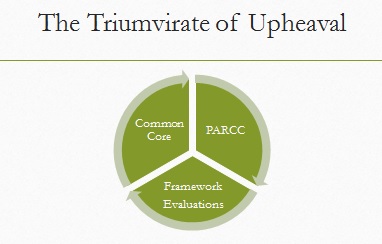
    The roll out of Common Core standards, aligned tests such as PARCC and Smarter Balance, and new punitive evaluations has produced what I call the Triumvirate of Upheaval. The combination of all three has disrupted almost every school in our country.
    The changes have been full speed ahead, and this should concern us all. This is my 28th year of teaching, and in my experience change in education happens slowly. It should. The ways in which we approach student learning should never be adjusted on a whim and teachers should hold on to what they know works with children. Yet, with the onset of Common Core standards we are being asked to practically throw everything we know aside and form completely new curricula. Concurrently, the textbook publishers saw an opportunity for profit and a boatload of poorly developed and un-piloted materials were rushed into the education marketplace.
    My school is a case in point. It is a high-performing arts magnet school in Chicago. By anyone’s measure – school climate, test scores, educational level of faculty, parent/teacher relationships, and student satisfaction – we are an exceptional school community. Yet, this year my first grade team was asked to completely toss aside our teacher created curriculum and teach with “fidelity” the newly purchased Common Core aligned Math curriculum.
    Now, to be honest, all of the lessons in the new Common Core Math curriculum are not universally horrid, but what I was teaching in Math before was amazingly good. There was no reason to completely overhaul my entire Math programming. And this is happening in classroom upon classroom around the country. Teachers are being asked to scrap what they know about teaching and children and start from scratch with really bad The Triumvirate of Upheaval in Our Classrooms - Living in Dialogue:

    When children are informed about why their parents are opting them out of high stake tests | Poetic Justice

    When children are informed about why their parents are opting them out of high stake tests | Poetic Justice:


    When children are informed about why their parents are opting them out of high stake tests

    Here is a repost with permission from Lourdes Perez Ramirez a new friend and the founder and CEO of HispanEduca – a wonderful non-profit organization “empowering Hispanics/Latinos with access to education policy and reform so they (we) can impact and shape it!”
    He followed every single instruction he had been given to refuse his computer-based tests scheduled for today.
    He clicked SUBMIT without having answered a single test item. He raised his hand, very politely, and his teacher knew the student had finished before his classmates because he and his mom had decided to refuse.
    His wonderful, Hispanic mom, who has two jobs every single day of the week, could not pick him up and keep him away from school for more than an hour, and then come back for the rest of the school day. Missing a few hours of her job would be the difference between paying the rent or being evicted.
    After HispanEduca and the mom handed the principal a test-refusal letter, the school agreed, and the mom authorized for the child to spend the rest of the testing period at the school’s office.
    There he was, doing some homework, when an office employee of this Orange County middle school approached the boy and threatened him saying that “he had to take the test because it was mandatory and if he didn’t he would be affected!”
    But this 8th grade boy had been instructed, kept informed for more than a year, of what was going to happen today;  what to say and do and the importance of When children are informed about why their parents are opting them out of high stake tests | Poetic Justice:

    PODER para los padres hispanos

    Sep 16, 2012No Commentsby 
      Bienvenidos a Padres con PODER! ¿Por qué este blog se llama iPadres con PODER!? Desde 2008 al 2012 publiqué un boletín para los padres hispanohablantes en el que compartía información acerca de asuntos relacionados con la educación, pero en particular, sobre cómo los padres hispanos podían ayudar a sus hijos a tener éxito en […]
    - See more at: http://hispaneduca.org/#sthash.gLn1jSf4.dpuf
    HispanEduca Website