Latest News and Comment from Education

Friday, February 27, 2015

Dems May Want to Watch What Duncan Is Wishing for - Rick Hess Straight Up - Education Week

Dems May Want to Watch What Duncan Is Wishing for - Rick Hess Straight Up - Education Week:


Dems May Want to Watch What Duncan Is Wishing for

Gosh. With the White House issuing preemptive veto threats and Secretary of Education Duncan attacking House Republicans, it's almost like the Obama administration isn't all that eager to reauthorize ESEA. It's almost as if they like the status quo and are content to let Duncan keep enjoying his NCLB waivers. If I didn't know better (and if the administration hadn't so often explained its desire to reauthorize the law and its frustration with "congressional inaction"), I'd think that Duncan would rather continue to impose his agenda than compromise with Congress.
Whatever Duncan's preferences, though, other Democrats just might want to contemplate the possibility that Hillary won't win in 2016—and that a Republican might occupy the White House. Should that happen, it might be worth revisiting a possible future that I forecast back in 2011:
---
The Obama administration steadfastly refuses to acknowledge the problems with ED's "backdoor blueprint" waiver strategy or the ugly precedent that it's trying to set. But those with even a glimmer of imagination can see where this is going...
Embedded image permalink

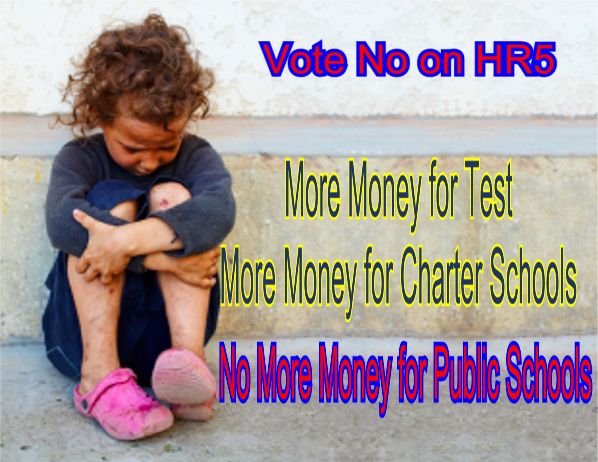
 #NOonHR5
#STOPHR5 #NOonHR5 US Representatives on Twitter Find your Member Hit them with a Vote No on HR5 Tweet http://bit.ly/17s6O1b

Big Education Ape: This so-called “Student Success” Act should be named the “Student Regress” Act #NOonHR5 http://bit.ly/1GyeuLy

Transcript from Fox News Channel
January 13, 2013
Chris Wallace: First off, congratulations Congresswoman Bachmann on being named U.S. Secretary of Education by President-elect Perry.
SecEd Nominee Bachmann: Thanks very much. It's a big job, and I'm looking forward to tackling it.
Chris Wallace: Last November, the Democrats narrowly retained control of the Senate and the Republicans enjoy only a modest majority in the House. Are you worried you'll be unable to make the legislative changes that you and the President think necessary?
SecEd Nominee Bachmann: Once upon a time, that might've been a concern. Happily, the Obama administration provided a path for driving educational change even when you don't have the votes. That's why we've promised that, come inauguration day, we'll be ditching the Obama administration's requirements for waivers from No Child Left Behind and substituting our own. They'll be drawn from the President's plan that we've been calling the Freedom Blueprint.
Chris Wallace: What do you have in mind?
SecEd Nominee Bachmann: We'll be employing the Obama administration's notion that we can provide states waivers from federal law so long as they promise to do stuff that we like. We'll impose a few conditions for states seeking to maintain their NCLB waivers or obtain new ones. They'll have to adopt certain elements of our Freedom Blueprint if they want their Dems May Want to Watch What Duncan Is Wishing for - Rick Hess Straight Up - Education Week:

Vote Against the Student Success Act - Campaign For Children #NOonHR5

Vote Against the Student Success Act - Campaign For Children:


Vote Against the Student Success Act

Embedded image permalink

 #NOonHR5
#STOPHR5 #NOonHR5 US Representatives on Twitter Find your Member Hit them with a Vote No on HR5 Tweet http://bit.ly/17s6O1b
 Education

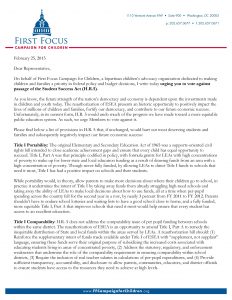
FFCC ESEA Comments House Floor Markup 2-25-2015 (2)_Page_1On February 25, 2015, FFCC sent this letter regarding the the House of Representatives markup of the Student Success Act (H.R. 5). This legislation, sponsored by Representative Kline, would reauthorize the Elementary and Secondary Education Act (ESEA). First Focus Campaign for Children sent this letter regarding the markup, highlighting the opportunity that reauthorization of ESEA presents to positively impact the lives of millions of children and families and contribute to our future economic success. It also highlights FFCC’s serious concerns with H.R. 5.

DOWNLOAD ATTACHMENTS

Report Slams Virtual Charter Schools That Graduate Just 36% Of Students - BuzzFeed News

Report Slams Virtual Charter Schools That Graduate Just 36% Of Students - BuzzFeed News:


Report Slams Virtual Charter Schools That Graduate Just 36% Of Students

California Virtual Academies, a chain of 11 online charter schools with 14,000 students, is the subject of a critical new report from In The Public Interest, an advocacy group.

One of country’s largest chains of for-profit online charter schools has seen almost a decade of declining academic results, mounting structural problems, and potential self-dealing by its operator, according to a report released today by In The Public Interest. California Virtual Academies, which has 14,000 students at 11 schools strung out across the state, is run by the giant K12 Inc., a publicly traded company that has attracted strong criticism in the past for its management of virtual charters. 

Even in the face of controversy, K12 has been in the business of rapidly expandingvirtual education across the country; in the past month alone, it won drawn-out legal battles to open new online schools in Maine and North Carolina, and it now enrolls 123,000 students nationwide. But In The Public Interest’s report could deal a blow to that growth.
Virtual charter schools like California Virtual Academies, or CAVA, are public schools that exist entirely online: Taxpayer dollars pay for students in kindergarten through 12th grade to take classes from home, communicating with their teachers via computer.
CAVA, the report says, has been plagued by years of slumping academic results: its graduation rate over the past four years has been 36%, meaning it had more dropouts than graduates, and its academic performance has declined steadily since 2005. Though K12 Inc. has consistently blamed poor academic results at virtual schools on the student population it serves, the report shows that even compared to demographically similar schools, CAVA falls short.
Katrina Abston, the head of California Virtual Academies who is an employee of K12 Inc., called In the Public Interest’s report “inaccurate and deeply flawed,” alleging it was based on misinformation supplied by the teachers’ union that is helping CAVA teachers with an effort to unionize, which K12 has opposed.
“Our schools provide families a public school option for children who need alternatives to traditional public school,” Abston said. “Efforts by powerful special interests opposed to charter schools and parent choice will not deter us from that commitment.”
A representative for K12 Inc. said that the school’s graduation rates should be put into context, saying that virtual charters enroll many students who are not on track to graduate when they enroll in the school. The company has previously said that students who stay in K12 schools for all four years graduate at much higher rates.
Though the schools themselves must technically be nonprofits, K12 and the company’s main competitor, Pearson’s Connections Academy, have transformed them into a booming business by taking over virtual schools’ management, administration, curriculum, and even budget. K12, which is publicly traded, takes in just under half of the tens of millions in taxpayer money that flows into CAVA’s 14 schools, according to the report; the rest goes to teacher and staff salaries.
The report takes aim at the “troublesome” relationship between K12, its school boards, and the districts that approve the schools. Control of schools is effectively Report Slams Virtual Charter Schools That Graduate Just 36% Of Students - BuzzFeed News:

My Newest NY Times Post For ELLs Is On “Teaching and Learning About Animals” | Larry Ferlazzo’s Websites of the Day…

My Newest NY Times Post For ELLs Is On “Teaching and Learning About Animals” | Larry Ferlazzo’s Websites of the Day…:


My Newest NY Times Post For ELLs Is On “Teaching and Learning About Animals”


animals
Ideas for E.L.L.s | Teaching and Learning About Animals is my latest New York Times Learning Network post, and it’s filled with ideas and multimedia resources for teachers of English Language Learners.
I’m adding it to:

CURMUDGUCATION: Teaching: Too Hard for Teachers

CURMUDGUCATION: Teaching: Too Hard for Teachers:


Teaching: Too Hard for Teachers


What exactly is a teacher's job? I have generally felt that I know the answer, but in these reformy times I have moments when I wonder.

I had one such moment today, reading this piece from The Hechinger Report entitled "Common Core's Unintended Consequence." The subheading of this piece by Jonathan Sapers tells us what that dreadful, unintended, potentially tragic consequence might be-- "More teachers write their own curricula." Clearly an unexpected tragic side effect of Common Core is that some teachers have forgotten what their proper place is.

OMG! How did such a terrible thing happen!!

According to many teachers, experts and advocates of the Common Core, traditional curriculum sources haven’t been meeting the demands of the new set of math and English standards that have been rolled out in more than 40 states in the past few years. More and more teachers are scrapping off-the-shelf lessons and searching for replacements on the Internet or writing new curriculum materials themselves.

Yes, it's true. Because of a failure of the education materials publishing industry, teachers out there are being forced to find their own teaching materials. Some are even-- choke-- designing teaching materials all by themselves! Oh, the humanity!!

The Center on Education Policy (CEP), a nonpartisan research group, reports that in roughly two-thirds of districts in Common Core states, teachers have developed or are developing their own curricular materials in math (66 percent) and English Language Arts (65 percent). In more than 80 percent of districts, the CEP found that at least one source for curriculum materials was local — from teachers, the district itself or other districts in the state.

Local materials!?! Good heavens! How can teachers hope to create teaching materials?! Don't they understand that they are only teachers?? Do they imagine that just because they went to college and got a degree and completed student teaching and have spent some amount of time in a classroom with students-- I mean, do they think all that qualifies them to create instructional materials?!

Whose fault is this?

Authorities (by which, of course, I mean people other than teachers, who are clearly not authorities
 CURMUDGUCATION: Teaching: Too Hard for Teachers:

Angry Andy’s Failing Schools & the Finger of Blame | School Finance 101

Angry Andy’s Failing Schools & the Finger of Blame | School Finance 101:


Angry Andy’s Failing Schools & the Finger of Blame


 NY Governor Andrew Cuomo’s office has released a report in which it identifies what it refers to in bold type on the cover as “Failing Schools.”

Presumably, these are the very schools on which Angy Andy would like to impose death penalties – or so he has opined in the past.
The report identifies 17 districts in particular that are home to failing schools. The point of the report is to assert that the incompetent bureaucrats, high paid administrators and lazy teachers in these schools simply aren’t getting the job done and must be punished/relieved of their duties. Angry Andy has repeatedly vociferously asserted that he and his less rabid predecessors have poured obscene sums of funding into these districts for decades. Thus – it’s their fault – certainly not his, for why they stink!
Slide3Slide4
I have addressed over and over again on this blog the plight of high need, specifically small city school districts under Governor Cuomo.
  1. On how New York State crafted a low-ball estimate of what districts needed to achieve adequate outcomes and then still completely failed to fund it.
  2. On how New York State maintains one of the least equitable state school finance systems in the nation.
  3. On how New York State’s systemic, persistent underfunding of high need districts has led to significant increases of numbers of children attending school with excessively large class sizes.
  4. On how New York State officials crafted a completely bogus, racially and economically disparate school classification scheme in order to justify intervening in the very schools they have most deprived over time.
I have also written reports on New York State’s underfunding of the school finance formula – a formula adopted to comply with prior court order in CFE v. State.
  1. Statewide Policy Brief with NYC Supplement: BBaker.NYPolicyBrief_NYC
  2. 50 Biggest Funding Gaps Supplement: 50 Biggest Aid Gaps 2013-14_15_FINAL
Among my reports is one in which I identified the 50 districts with the biggest state aid shortfalls with respect to what the state itself says these districts require for providing a sound basic (constitutional standard) education.  Districts across NY state have funding gaps for a variety of reasons, but I have sAngry Andy’s Failing Schools & the Finger of Blame | School Finance 101:

What is the standardized test opt-out movement? Take the quiz | PennLive.com

What is the standardized test opt-out movement? Take the quiz | PennLive.com:


What is the standardized test opt-out movement? Take the quiz

Parents Can Opt Out - United Opt Out National

Click Here to go to United Opt Out National: 


Click Here to go to the WebsiteUnited Opt Out Team


 PennLive's Candy Woodall reported this week that in 2010, nearly 230 Pennsylvania students opted out of state assessments in reading, math and science.

That's a small percentage of the 1.8 million students enrolled in public schools that year.
The numbers have grown dramatically since.
As more parents learn that they can "opt out" of having their children take the state assessments, that number continues to climb and the national opt-out movement is gathering steam.
The stories have garnered much attention on PennLive this week. Take our quiz to see how much you know about the opt-out movement.
App users: to take the quiz, click here.

OPT OUT MOVEMENT

Parents kept out of lawsuit challenging Louisiana’s charter schools « Watchdog.org

Parents kept out of lawsuit challenging Louisiana’s charter schools « Watchdog.org:

Parents kept out of lawsuit challenging Louisiana’s charter schools

Photo courtesy of the LAE's official Facebook page.

A Louisiana teachers union can join a lawsuit challenging state funding for Louisiana charter schools, but parents of children attending these schools may not participate.
This is according to a ruling this month from the 19th Judicial District Court for the Parish of East Baton Rouge.
The Louisiana Association of Educators, a teachers union, joined the Iberville Parish School District late last year in the district’s lawsuit challenging the constitutionality of state-based funding for charter schools.
The Louisiana Board of Elementary and Secondary Education, which provides the funding for charter schools, is the primary defendant in the case.
The trial is scheduled to start Monday.
Members of the LAE and the school district say charter schools, one of which is located in Iberville Parish, take away their rightful share of state-based money meant for the district.
Both parties are asking the court to declare that state funding of charter schools goes against the language of the state constitution.
Parents of two sets of children attending charter schools, along with representatives of Public School Options, a Washington, D.C.-based parent advocacy group, criticized the court keeping them out of the suit in a recent press release.
Contact information for one parent, Jennette Franklin, was seemingly unavailable.
The other parent, Christin Kaiser, did not respond to a request for comment on her personal Facebook page.
A representative for Public School Options chose not to speak on the record, but provided Louisiana Watchdog with a copy of their motion to intervene, which appears Parents kept out of lawsuit challenging Louisiana’s charter schools « Watchdog.org:

Virtual charter school network making profit at the expense of California schoolchildren, study finds - ContraCostaTimes.com

Virtual charter school network making profit at the expense of California schoolchildren, study finds - ContraCostaTimes.com:


Virtual charter school network making profit at the expense of California schoolchildren, study finds


California schoolchildren studying at home through a growing network of for-profit online charter schools often lack functional computers and other materials they need to learn -- even as millions in state tax dollars flow to the schools' operator, according to a report released Thursday.
California Virtual Academy's high schools graduated just 36 percent of their students from 2011 to 2013 and had more dropouts than graduates, the report found.

"This is not what virtual education in California should look like," concludes the report by In the Public Interest, a Washington, D.C.-based research group that focuses on contracting and privatization.

The troubling findings about the network's academic performance, resources and finances suggest that the company managing the 11 California schools -- Virginia-based K12 and its California subsidiary, K12 California -- is rewarding shareholders and executives at the expense of the 14,500 children enrolled in them from kindergarten through grade 12.

"There's an increased feeling that corners are being cut so that profits can be maximized," said Cara Bryant, who has taught for nine years at a Davis school operated by K12.

One of the largest virtual charter-school companies in the nation, K12 manages -- and sells technology and other services to -- online schools in dozens of states. One of the 11 California Virtual Academies is based in San Mateo County, which is permitted to enroll students from the adjacent counties of Santa Cruz, Santa Clara, San Francisco and Alameda.

In the Public Interest did not contact K12 or K12 California before releasing the report, which the head of school at California Virtual Academies, Katrina Abston, called "inaccurate and deeply flawed."

In a statement, Abston accused the organization of having a bias against publicly funded, privately run charter schools and getting much its information from the California Teachers Association. (The report's 16-page appendix lists numerous sources for its data, including the California Department of Education, news stories and interviews.)

"Our schools provide families a public school option for children who need alternatives to traditional public school," Abston said. "Efforts by powerful special interests opposed to charter schools and parent choice will not deter us from that commitment."
The report highlights a complicated relationship between the taxpayer-funded schools and their for-profit operators that allows for self-dealing and conflicts of interest.
Through its California subsidiary, the company not only manages the schools and control their bank accounts but also serves as its main vendor; contracts reviewed by researchers forbid the schools from seeking competitive bids from other companies, the report found.
In exchange for management, technology and administrative services, K12 received $47 million from the California schools -- nearly half of K12's total revenue -- during the 2012-13 school year, the report found.
How much of those dollars were spent on services for California schools and how much paid for profits, advertising and executive pay remains a mystery, said Shahrzad Habibi, the lead author.
K12's top executive in 2011-12 received nearly $4 million in pay and bonuses, while teachers in the California network averaged wages of about $36,000 -- at least $20,000 less than the public school teachers in the area, a disparity that fueled teacher turnover, the report found.
Teachers interviewed in the report said that in the push to expand, the company aggressively recruited and enrolled students who weren't likely to succeed in an online-only setting. The report also suggested the network encouraged teachers to fudge student-attendance records, instructing teachers to mark students as present even if they had logged on to the system for a single minute Virtual charter school network making profit at the expense of California schoolchildren, study finds - ContraCostaTimes.com:

Charter school group is political force in L.A. Unified board election - LA Times

Charter school group is political force in L.A. Unified board election - LA Times:


Charter school group is political force in L.A. Unified board election


Los Angeles mayors once played the role of kingmaker in school board elections.

Both Richard Riordan and Antonio Villaraigosa took on the teachers union, leading campaigns to raise money for favored candidates. When those candidates won, the mayors influenced district spending, the hiring of superintendents and the direction of reforms — often over union opposition.

In Tuesday's election, this role has shifted to a statewide charter school group, which is raising money, sending mailers and rallying parents in an effort to become a permanent political force. The push comes at a crucial time for charter schools, which have been growing at a rapid clip in Los Angeles Unified despite concerns from some — including union officials — that they are sapping vital resources from traditional public schools.

California Charter Schools Assn. Advocates, a political action committee, has put its muscle into a race it considers crucial. The charter group seeks to unseat one-term incumbent Bennett Kayser and elect charter school founder Ref Rodriguez to represent an area that encompasses Silver Lake and Eagle Rock as well as southeast L.A. County.

The teachers union, United Teachers Los Angeles, is pouring money into the race on behalf of Kayser.

Another candidate for District 5 is parent leader and education consultant Andrew Thomas, who frequently reaches for middle ground between his two opponents.

Through Wednesday's campaign filings, the charter group had spent $699,688 to support Rodriguez. UTLA had spent $384,109 for Kayser. Those totals far surpass donations directly to the candidates as well as the spending totals for the other contested board races.

Since September, the donors to the charter PAC include Netflix Chief Executive Reed Hastings ($1.5 million), former New York Mayor Michael R. Bloomberg ($450,000), Jim Walton of the Wal-Mart founding family ($250,000) and local philanthropist Eli Broad ($155,000). All are longtime charter school backers with a broad interest in education.

"At least for this election, and in board District 5, where it's going to be the most competitive race, this looks like a proxy war between the California Charter Schools Assn. and United Teachers Los Angeles," said Dan Chang, who heads a different political action committee that supports the same candidates as the charter PAC.

Four seats are on the ballot for the seven-member school board. George McKenna, who recently took office in a special election, is unopposed. Two other incumbents, Tamar Galatzan and Richard Vladovic, are seeking to retain their seats in contested but lower-cost races. The union is silent in these races; the charter group endorses the incumbents.

The next Board of Education will choose a superintendent for the nation's second-largest district and face difficult decisions over how best to restore programs and staffing as funding recovers from the recent recession. L.A. Unified also is mired in contract talks with the teachers union.

Another challenge is how to deal with the growing number of charter schools, a main point of distinction between the candidates.

Charters are independently operated and exempt from some rules that govern traditional campuses. Most are nonunion.


According to the charter group, Kayser cast votes supportive of charter schools only 11% of the time. Kayser's vote was usually symbolic because the board majority regularly approved valid petitions for new charters, as required by state law.

But Kayser's reflexive opposition made him enemy No. 1 for charter advocates.

More than 100,000 students, or 15% of L.A. Unified's enrollment, attend charters, the most of any school system in the nation. State funding, at least $8,000 per student, goes to the charter school where a student enrolls, leaving fewer resources in L.A. Unified to pay for infrastructure, programs for the disabled, retiree Charter school group is political force in L.A. Unified board election - LA Times:

Charters (Buicks) are Good Because They are Charters (Cars): DUH! | Cloaking Inequity

Charters (Buicks) are Good Because They are Charters (Cars): DUH! | Cloaking Inequity:


Charters (Buicks) are Good Because They are Charters (Cars): DUH!

Screen Shot 2015-02-27 at 5.24.00 AM
Does this sentence make sense? Just because I call it an car (charter school), it has high reliability and quality in build. Are all cars (charter schools) awesome because I call them automobiles (charters)!? Or is car (charter schools) awesome because it hangs out with other cars in the same sentences (charter schools)?
I am paying attention to which automobiles are actually desirable this month because I need to replace my Chevrolet Volt. Consumer Reports came out this week with their list of 10 Top Picks of 2015.  For the first time in many years, American automakers had three entries on the Consumer Reports top ten list. This news makes me happy as the grandson of two American autoworkers, I of course want to buy an American automobile. A big surprise on the list was the Buick Regal. There is no question that some cars (charter schools) perform better than others. Is that really under debate? Because a Buick made the list does that mean that all Buicks (charter schools) outperform all Hondas (traditional schools)? Because a Buick (KIPP school) made the list and beat the BMW for the first time in many years, does that mean that all Buicks (KIPP schools) are good or bad? I had my eye on the list. Now I am definitely not besmirching the reputation of Buicks. My parents have had two Buicks over the last decade and a half and have collectively put nearly a million miles on those two cars. So let’s take this logic a little farther. Whats fantastic about ALL Buicks (charter schools) is that they have done a few things. First, they have solved the effects of poverty. Second, we no longer have to worry about school finance because, well, charters— of course it never mattered anyways according to a particular group of politicians (although there is this Top Ten List: Why “choice” demonstrates that money matters). Buicks (charters) have also solved the issue of school discipline. You get my point, I could keep going. Screen Shot 2015-02-27 at 5.33.54 AM
, a columnist at the Boston Globe, sought to weigh in to this debate recently in his column entitled Foreshadowing the charter school debate(Thanks to Karen from Houston for the heads up on piece).
His argument went like this: 1) The BAEO folks in the panel were better debaters. 2) The unions didn’t directly address the success of charters. 3) They hadn’t read that the two studies ahead of time that I thought were interesting. 4) The unions are obstructionist.
1) So what about BAEO. See this The Teat: BAEO, Choice, $, and Strings Attached?
2) My research and writing on charters and achievement at Cloaking Inequity spans a few years. Check it out here.
3) See below
Lehigh first mentions a “Harvard study.” The study is not actually a “Harvard” study, its a study paid for by the Boston Charters (Buicks) are Good Because They are Charters (Cars): DUH! | Cloaking Inequity:

Mike Klonsky's SmallTalk Blog: Rahm asked by Ponce: 'Do you need to tweak your style?' Or 'Why are you such a dick'?

Mike Klonsky's SmallTalk Blog: Rahm asked by Ponce: 'Do you need to tweak your style?' Or 'Why are you such a dick'?:


Rahm asked by Ponce: 'Do you need to tweak your style?' Or 'Why are you such a dick'?

"You know, Phil. I'm human just like you."
Telling interview with Mayor 1% on Chicago Tonight.


Rahm is not used to being confronted face-to-face interview style where he can't sneer, give a glib answer, and walk away. Phil Ponce basically asks him why he is such an asshole (Ponce doesn't use those words of course) and Rahm struggles for words. He tries to force a smile -- they've prompted him to smile more, to be a softer, gentler Rahm -- but his mouth just doesn't seem to stretch that far. He's just not a self-aware guy and all the coaching by Axelrod's people can't change that.


After denying the Guardian report that Chicago PD has an off-the-books, secret interrogation spot at Homan Square ("We follow all the rules... Everything's done by the book."), Rahm is asked about the PARCC test fiasco.


He's lost. Non-responsive. I can't really blame him on that one. He's an education know-nothing and his own schools chief Byrd-Bennett has ordered that full PARCC testing be put off for a year, blasted the testing process and called the PARCC test “unproven.” All Rahm can do is mutter something about how the test needs improvement. He admits, "We haven't even gotten the results back from last-year's tests." But you can tell he's going to cave to Arne Duncan and Rauner's guy Meeks on this one and give the test anyway ("There is a serious financial and that's what we have to weigh"). What?


Then comes Ponce's asshole question. Why do so many Chicagoans hate you? Actually, he asks, "Do you need to tweak your style?" Rahm hesitates, trying to Mike Klonsky's SmallTalk Blog: Rahm asked by Ponce: 'Do you need to tweak your style?' Or 'Why are you such a dick'?:

To Tom Balanoff and the SEIU: Join me in song. | Fred Klonsky

To Tom Balanoff and the SEIU: Join me in song. | Fred Klonsky:


To Tom Balanoff and the SEIU: Join me in song.


SEIU-CST-022715


 SEIU President Tom Balanoff.

My grandfather was a rabbi. My dad was one his four sons. My uncle Ben became a Cantor, but all all my uncles and my dad had beautiful voices. And they all sang in my grandfather’s temple, including my dad until he split at seventeen to join the International Brigades in Spain.
But that is another story.
My dad had this wonderful deep voice and he loved singing Paul Robeson songs. We would find him doing some household chore while singing, “Sometimes I feel like a motherless child…”, which would cause my brother and me to crack up. But really, he had a great voice.
I did not inherent the gene.
However, this morning I would ask you to join me in an old Methodist hymn.