Thursday, February 19, 2015

Principal: ‘There comes a time when rules must broken…. That time is now.’ - The Washington Post

Principal: ‘There comes a time when rules must broken…. That time is now.’ - The Washington Post:


Principal: ‘There comes a time when rules must broken…. That time is now.’

Last year the parents of about 60,000 New York state students decided to opt their children out of high-stakes standardized testing, putting the state at the forefront of an “opt-out” movement that is growing nationally. That movement will be put to its own test as new Common Core testing are scheduled to begin shortly in states around the country. In this post, award-winning Principal Carol Burris of South Side High School in New York explains why she is now calling for parents to choose to keep their children from taking high-stakes standardized tests even though it breaks the rules.
Burris, who has written frequently for this blog,  was named New York’s 2013 High School Principal of the Year by the School Administrators Association of New York and the National Association of Secondary School Principals, and in 2010, was tapped as the 2010 New York State Outstanding Educator by the School Administrators Association of New York State. Burris has been exposing the botched school reform program in New York for years on this blog, and it is worth reading. Some of her earlier posts are listed at the bottom.

By Carol Burris
It has become increasingly clear that Congress does not have the will to move away from annual high-stakes testing. The bizarre notion that subjecting 9-year-olds to hours of high-stakes tests is a “civil right,” is embedded in the thinking of both parties. Conservatives no longer believe in the local, democratic control of our schools. Progressives refuse to address the effects of poverty, segregation and the destruction of the middle class on student learning. The unimaginative strategy to improve achievement is to make standardized tests longer and harder.
And then there are the Common Core State Standards. Legislators talk a good game to appease parents, but for all their bluff and bluster, they are quite content to use code names, like the West Virginia Next Generation Content Standards,  to trick their constituents into believing their state standards are unique, even though most are word for word from the Common Core.
The only remedy left to parents is to refuse to have their children take the tests. Testing is the rock on which the policies that are destroying our local public schools are built. If our politicians do not have the courage to reverse high-stakes testing, then those who care must step in. As professor of Language and Composition, Ira Shor, bluntly stated:
 Because our kids cannot defend themselves, we have to defend them. We parents must step in to stop it. We should put our 
Principal: ‘There comes a time when rules must broken…. That time is now.’ - The Washington Post:


Philadelphia SRC Approves 5 New Charter Schools, 4 Arrested During Heated Meeting « CBS Philly

Philadelphia SRC Approves 5 New Charter Schools, 4 Arrested During Heated Meeting « CBS Philly:


Philadelphia SRC Approves 5 New Charter Schools, 4 Arrested During Heated Meeting


By Mike DeNardo, Jan Carabeo
PHILADELPHIA (CBS) — At a raucous meeting that lasted more than five hours, the School Reform Commission Wednesday night voted to deny 34 of 39 applications for new charter schools.
The meeting was frequently disrupted by protesters opposed to new charters, four of which were arrested.
The SRC granted conditional three-year charters to five schools. The schools receiving charters include Independence Charter School West, KIPP Dubois, MaST Community Charter-Roosevelt campus, Mastery Charter Gillespie campus and Tech Freire Charter.
SRC chair Bill Green says there was no effort to appease GOP leaders in the legislature, who pushed the district to approve more charters:
“There was no strategy there. We reviewed each applications on its own terms for merit, and called the balls and strikes that we thought were appropriate.”
Some spoke in support:
“Four years my son has attended GLA,” says parent Hanna Nunez. “He has received an extraordinary education.
While many others were clearly against, like Commissioner Marjorie Neff who voted against every charter application.
“There were deficiencies in all of them,” she said. “Some more deficient than others.”
The anti-charter group came out on top with the SRC approving just the five schools.
The district has an $80-million deficit, but Green says the five new charters won’t have a deep Philadelphia SRC Approves 5 New Charter Schools, 4 Arrested During Heated Meeting « CBS Philly: 

Cuomo's education agenda picks up where Bloomberg left off | Capital New York

Cuomo's education agenda picks up where Bloomberg left off | Capital New York:


Cuomo’s education agenda picks up where Bloomberg left off


It can be easy to forget, as Governor Andrew Cuomo promotes his aggressive education reform agenda, that he only recently became the most prominent champion of the cause in New York.
Before Cuomo took office, and continuing right up to the election of Mayor Bill de Blasio, that champion was Michael Bloomberg.
Cuomo doesn't go out of his way to credit the former mayor—or anyone, really—for influencing his thinking on education. But it's clear that the program he has been advocating, and which he has promised to prioritize in the coming session in Albany, draws heavily on the agenda of Bloomberg and, in particular, former New York City schools chancellor Joel Klein.
Merit pay for teachers who help raise their students’ test scores, stricter teacher evaluations with more weight on exams, support for charter schools and little patience for struggling schools are national reform initiatives ushered into New York City during the decade Klein served as chancellor.
Now, Cuomo is elevating those proposals to the state level, and assuming the mantle of education reform for New York as the teacher-friendly de Blasio administration directs policy out of City Hall.
Cuomo's role as a key player on local education policy took shape rather dramatically last year during the fight over the future of New York's charter schools, when the governor saw an opportunity to establish his dominance in education policy (and over his erstwhile colleague de Blasio). While Cuomo had been a consistent supporter of teacher evaluations and charters, his role as a fully formed education reformer sprung to life during that 2014 legislative session.
The collection of policies he embraced bore a particularly close resemblance to that of Bloomberg and Klein.
“What was percolating then is now boiling,” said David Cantor, Klein’s longtime former press secretary. “Cuomo has picked up the pieces of reform that have been out there and sort of thrust them together.”
Some of those ideas were embraced nationally by the Obama administration and U.S. Department of Education secretary Arne Duncan, in other cities, most prominently by former Washington D.C. schools chancellor Michelle Rhee. But the Bloomberg-Klein Cuomo's education agenda picks up where Bloomberg left off | Capital New York:

Yong Zhao Explains America's "Faustian Bargain" | John Thompson

Yong Zhao Explains America's "Faustian Bargain" | John Thompson:


Yong Zhao Explains America's "Faustian Bargain"


In one sense, I can understand why some Americans have flirted with the "Faustian Bargain" that is high-stakes testing. As Yong Zhao explains in Who's Afraid of the Big Bad Dragon, the authoritarianism of a single test-driven ladder to economic success has an enduring power. But, I don't understand reformers who whistle past the graveyard, gambling that they can grab the benefits of a single, controlled path to improving education outputs without losing our creativity, individuality, diversity, and innovative talents.
Reformers apparently believe that our democracy is too weak to compete with Chinese authoritarianism in the global marketplace. But, they pretend that we are too invulnerable to succumb to the inherent dangers of data-driven institutions of social control.
It's been a long time but let's remember Sputnik. Many fearful adults insisted that my generation was too soft and could not compete with the Soviets. Even in elementary school, we were often urged to put down our childish books, knuckle down, and become nascent engineers. That dread, it later became clear, was a legacy of adults who had survived the Great Depression and World War II.
But, we children were also bolstered by the dynamism, courage, and democracy that overcame those ordeals. Plenty of other adults nurtured us, urged us to "be ourselves," and challenged us to "learn how to learn." Despite memories of extreme poverty and the war against totalitarianism - or because of those memories - my generation often prospered in schools that fostered "creative insubordination."
Reading Zhao's account of the "rising tide of authoritarianism" created by high-stakes testing, I once again pondered the seemingly inexplicable. Why is it not obvious to reformers that "the damage done by authoritarianism is far greater than the instructional time taken away by testing, the narrowed educational experiences for students, and the demoralization of teachers." Why are they even tempted to emulate "a survival strategy the Chinese people developed to cope with thousands of years of authoritarian rule?"
Sadly, I believe that the worst of school "reform" is rooted in more than the fear that America can't prosper in the 21st century global marketplace. Reform also grew out of a sincere, but second-rate effort to help poor children of color. My generation saw education as a civil rights campaign designed to give all children the same rights and opportunity that was bestowed on the most fortunate Americans. Starting with the bifurcation of the United States accelerated by Reaganism and Supply Side Economics, too many Americans lost faith that equity could be achieved by Yong Zhao Explains America's "Faustian Bargain" | John Thompson:

Why I am a Teacher Activist « Movement of Rank and File Educators

Why I am a Teacher Activist « Movement of Rank and File Educators:


Why I am a Teacher Activist

February 19, 2015 — Leave a comment


#WhyImTeacherActivist
By Mindy Rosier
I have been a teacher for almost 18 years and the last 8 ½ with the DOE. I am now a newly delegate, however, I do feel it is important to share my story with you all to show you that you don’t need to have an official position to help organize your school. You can make a difference in any capacity. You need to educate yourself on this road of activism and justice. The truth is very ugly out there and we need to make an impact. We need to be fierce and unrelenting. We all have a voice and we need to use it loud and clear. Today we are fighting for our schools, our kids, and our livelihoods and I will be damned to let anyone take that away from us!
For way too long I was a complacent special ed teacher in Harlem who did what everyone else did. I complained with co-workers which really got nothing done other than cause more complaining.
My little District 75 school has been co-located with Success Academy for years. In fact, they began in my building. Over the years we have lost so much space to them, and what we gave up was never enough. In Oct 2013, Moskowitz came up with a plan that got pushed through via Bloomberg and his cronies that would have essentially kicked out my school. Enough was enough! During this time, I met Community Education Council 3’s VP Noah Gotbaum, Sen. Perkins, and a few others who spoke up for my school and something began stirring inside of me. Mayor de Blasio came into office and overturned that decision and saved my school. Of course Moskowitz got upset. In late November, I met Maria B. from the Alliance for Quality Education (AQE) and she basically gave me a crash course in organizing. She saw something in me that I didn’t even think was possible. I was very quiet, and mostly kept to myself, but I was very angry and she tapped into that. A press conference was planned on the corner of my school. She told me who I needed to call including community leaders, elected officials, and parents. I contacted the media and I discovered how useful Twitter can be for getting the word out. Our press conference was amazing. Many great people showed up to speak and even though I did not know of MORE at the time, I found out later that some of them was there as well. I will never forget how Noah Gotbaum said to me that day, “you need to speak up.” I have never shut up after that. ( Here is the link to the complete story I wrote for Crooks and Liars about what happened to my school and our battle with Eva Moskowitz.) At the end of March, Maria organized another press conference but this time on the steps of Tweed. So once again, I helped contact community leaders, elected officials, parents, my fellow educators, and the media. New York Communities for a Change was involved in the planning of this too. Maria encouraged me to speak at this press conference from a teacher’s perspective. This was on school day morning and I got permission to take a personal day for this. As nervous as I was, I gave my speech. Noah felt my schools’ story was very important and wanted me to share it again at the Save Our Schools Rally a couple of days later.. After several elected officials, I gave my speech to hundreds of people at the NY Public Library and proudly marched to Governor Cuomo’s office.
By this time, I had grown more confident. I took to social media with no abandon and I met MORE. In the following months, I helped fellow MOREista Patrick, who is in the gen ed school in my building, write up a proposal for our two schools by providing him all the information needed for my school so that we could become a combined Community Learning School. We got accepted!! My admins have been very hands off on this new adventure and they just recently said that they are trusting me with this and are basically giving me free reign. Also throughout  this Why I am a Teacher Activist « Movement of Rank and File Educators:

Accountability doesn't need to be a dirty word in education - Newsday

Accountability doesn't need to be a dirty word in education - Newsday:


Accountability doesn't need to be a dirty word in education

Updated February 18, 2015 11:08 AM

By LILY ESKELSEN GARCรA AND OTHA THORNTON, Special to the Washington Post


Public education for every child was an American idea, but it has always been a local and state responsibility. Even when Congress passed the Elementary and Secondary Education Act 50 years ago, the intended federal role was limited but clear: ensuring equal opportunity.


The act provided federal resources for states to level the playing field between schools in wealthy and poor districts. However, its 2002 reauthorization, which became known as No Child Left Behind, took the law off track by mandating that all students hit arbitrary scores on standardized tests instead of ensuring equal opportunities.


No Child Left Behind has failed. Now we have a chance to fix the law by refocusing on the proper federal role: equal opportunity. To do that, we must change the way we think about accountability.


Under No Child Left Behind, accountability has hinged entirely on standardized test scores, a single number that has been used to determine whether students graduate or teachers keep their jobs. The problem is, a single test score is like a blinking "check engine" light on the dashboard. It can tell us something's wrong but not how to fix it.


What we need instead is a whole dashboard of indicators that monitor better measures of success for the whole child - a critical, creative mind, a healthy body and an ethical character. And we need indicators of each student's opportunities to learn - what programs, services and resources are available?


Success should be measured throughout the system - preschool to high school - but a standardized test tells us so little. We want to know which students are succeeding in Advanced Placement and honors programs, where they earn college credit in high school. You can measure that. We want to know which students have certified, experienced teachers and access to the support professionals they need, such as tutors, librarians, school nurses and counselors. We want to know which students have access to arts and athletic programs. Which middle school students are succeeding in science, technology, engineering and math tracks that will get them into advanced high school courses, which will get them into a university. You can measure all that, too.


And we want the data broken down by demographic groups, so Accountability doesn't need to be a dirty word in education - Newsday:


Who Needs Gifted Education When We’ve Got Common Core and Rigor?

Who Needs Gifted Education When We’ve Got Common Core and Rigor?:


woman_box

Who Needs Gifted Education When We’ve Got Common Core and Rigor?

Common Core interjects the idea of rigor into standards for all. So where do gifted students fit in this plan? If every student is meant to accomplish these high standards, are there higher standards for students whose IQ is off the charts, or who have been identified as twice exceptional (students with a disability but who are also gifted)?
According to the National Association of Gifted Children, there are three to five million gifted students in the U.S. What is being done for them and how will Common Core impact the gifted student population?
Common Core enthusiasts will say that through differentiation and universal learning (online), gifted students will get even more rigorous activities beyond the already demanding standards. The trouble is they are still pretty much the same standards.
Common Core devotees, who stand to profit greatly, will tell you that Common Core will fix the gifted issue in our schools. What will it mean for students hanging out on the far right of the bell curve? Well here are some problems to consider when it comes to Common Core and gifted students. And, of course, many of these problems face all students.
  • First, most gifted students attend regular classes. Teachers might not focus on gifted students. They will concentrate instead on the students with problems who will drag scores down if they aren’t given a lot of drilling.
  • Gifted students with inquisitive questions or quirky behavior might be considered a liability to the teacher with a large class and many demanding students. Or they might be considered nice students to have around. I have heard of gifted students who are sent to the library to tutor other students. While a little of this might be fine, gifted students should be working on their own school material.
  • Many gifted students develop a deep interest in a particular subject. But students are being denied a well-rounded curriculum.  With no exposure to a variety of subjects, and that special subject, gifted students miss out on important learning.
  • Along with the above, we all know that the arts are gone in many poor schools. But how many elementary and middle school students are currently missing Who Needs Gifted Education When We’ve Got Common Core and Rigor?:

Wednesday, February 18, 2015

Inside Take: New Charters Should Be Unacceptable to All - Citified

Inside Take: New Charters Should Be Unacceptable to All - Citified:


Inside Take: New Charters Should Be Unacceptable to All

Donna Cooper: “No child should be harmed so another child can be helped.”

(This is an opinion column from a Citified insider.)
Conditions in the School District of Philadelphia have hit a new low after four record breaking years of state disinvestment in education and years of meager improvements in school performance. That situation is poised to change for the better if the new governor and legislature heed the voter sentiment expressed in the historic ousting of a sitting governor largely because of his sweeping education funding cuts. Unfortunately, while the new players in Harrisburg are still unpacking their boxes, the School Reform Commission must decide whether to approve new charter schools and what cuts to impose on traditional schools to pay for charter expansion.
While there are thousands of families who have good reason to love their local schools and teachers, the share of satisfied families is shrinking, as each year goes by. But there is also no question that most schools need urgent attention. Families who have lived in Philadelphia for generations are rightfully frustrated and impatient with the slow pace of improvement. The same goes for the recent influx of young families, who have neither the income nor the inclination to send their children to private school.
Meanwhile, the growing chorus behind expansion of charters makes the pathway to progress sound simple: authorize additional charter schools and families will stay and our students will do better. Thirty-nine charter operators have lined up for approval from the District to expand charter enrollment to 51 percent of the district’s students and potentially balloon annual charter payments to a billion dollars. Unfortunately the facts don’t support the charter silver bullet theory. Our recently released report on the challenges of authorizing new charters found:
  • Many of the applicants for new charters are proposed by charter school operators that already run charter schools that are not preforming as well as the traditional public schools in the city.
  • Nearly 60 percent of the applicants educate a student population from families that are more affluent than those attending traditional public schools, which could mean that as they expand they will be unprepared for the rigors of classrooms of mostly very poor students. In fact, some of the strongest performing charters might have better results than the traditional public schools only because they have a more ready student body than the students who attend the average District school, where the official poverty rate is 84 percent.
  • Finally, there is the reality of money. For every student that enrolls in a charter school the District must pay the charter operator around $10,000. While the district avoids some costs when a student transfers to a charter, most of the overhead of operating the district schools remains the same. As a result, according to the Boston Consulting Group every new charter student ends up costing the district about $7,000 per child. Given the District’s dire fiscal straights, unless the state or the city were to ante up more money, the District will have to pay the cost of new charters by making deeper cuts to already starving traditional public schools.
If the commission is seriously entertaining the possibility of new charters, it would mean that it has essentially decided that it can find new funds for school improvement. If that’s the case, it raises the possibility that additional funds could be invested in struggling traditional public schools that lack books, teachers and counselors instead of new charter school seats. Are there really two policy options backed by new resources on the table for improving student

Read more at http://www.phillymag.com/citified/2015/02/12/philadelphia-charter-schools-unacceptable/#azG2qEBZoQmHxyUM.99

Newark students seize Cami Anderson’s office | Bob Braun's Ledger #OccupyNPS #OurNewark

Newark students seize Cami Anderson’s office | Bob Braun's Ledger:

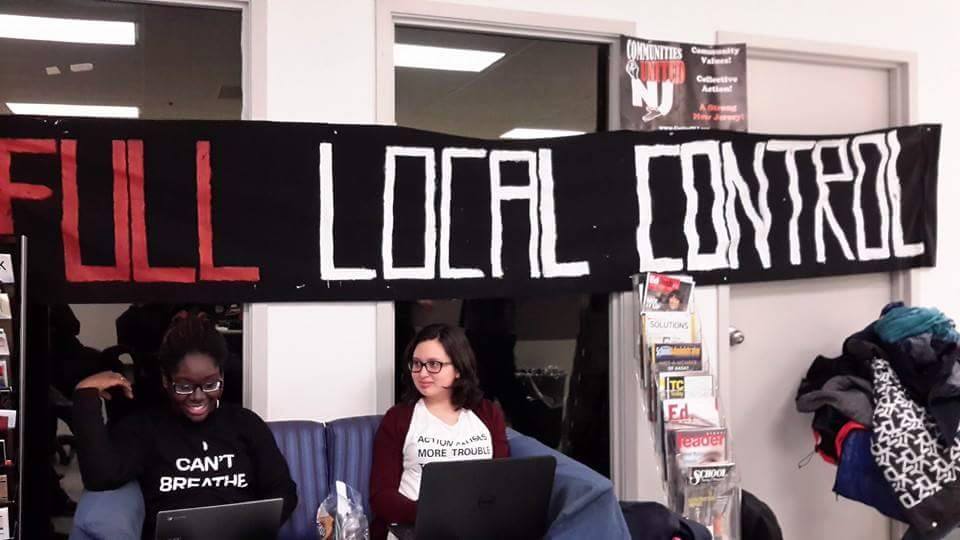
Newark students seize Cami Anderson’s office


Charlotte Hitchcock, NPS counsel, tried to shoo students from Anderson's office. The students set up their broadcast center.
Charlotte Hitchcock, NPS counsel, tried to shoo students from Anderson’s office. The students set up their broadcast center.

A small group of Newark high school students Tuesday night seized the office of state-appointed superintendent Cami Anderson in a protest timed to coincide with her imminent re-appointment to another year, her fifth,  as head of the state’s largest school district. The action, which is continuing through the night, stands in stark contrast to the failure of Anderson’s older–and, theoretically, more powerful–critics to do anything to dislodge her from her post.
The operation was executed with an efficiency that has eluded Anderson’s control of the district. The dozen students and a few adult advisers pulled off the occupation of the suite of offices on the eighth floor while a public school board meeting droned on two floors above on the tenth floor. The students had attended the meeting and some spoke, hinting broadly they were about to do something, and then left in a group–but they weren’t going home to do their homework.


Newark students sprint down long eighth-floor hallway to get to Anderson's offices ahead of security officers
Newark students sprint down long eighth-floor hallway to get to Anderson’s offices ahead of security officers

The dozen or so students crammed into an elevator and pushed the 8th floor button, then sprinted to Anderson’s office, expecting all the while to be met with resistance from security officers. Instead, the office site was wide open and empty except for a puzzled janitor who, while mopping the floors, cautioned the students not to slip Newark students seize Cami Anderson’s office | Bob Braun's Ledger:

UPDATE: A Perfect Storm Part 2: The Illusion of Choice | New Orleans Education Equity Round Table

A Perfect Storm Part 2: The Illusion of Choice |:


 A Perfect Storm Part 2: The Illusion of Choice

Hiding facts
It is no secret that Tennessee's Achievement School District (ASD) is modeled after the Recovery School District (RSD) of Louisiana.  The original intent of both the ASD and RSD was to take failing schools and, without the rules & regulations of public schools, turn those failing schools into successful schools of "choice."  Competition between schools, it was believed, would breed excellence and innovation for every child.

Well, it has been 10 years since Hurricane Katrina devastated New Orleans and the RSD took over public schools.  There are no public schools left in New Orleans today.  Sadly, what is left in place is not quality, equitable education for every child but a patchwork of uncertainty, churning, and failure.  It has been 2 years since the ASD took over schools in Memphis, and even the ASD's professional PR team can't hide that the ASD's TCAP scores are lower now than they were as public schools 2 years ago.  Even harder to ignore, entire communities in Memphis and Nashville are irate over their public schools being taken from them and given to out-of-state charter operators.

Only a fool would call this "recovery," "achievement," or "success."

The Louisiana Department of Education may be able to manipulate cut scores on their own state's tests, but they can't do so for the National ACT test.  Since they couldn't manipulate the truth, Louisiana simply didn't release the state-wide ACT results to the public as they normally have.  They kept the ACT scores a secret.  A big ugly secret... until a high school teacher in New Orleans found out the truth.

Mercedes Schneider is a high-school teacher by day and a ruthless researcher & writer by night.  She holds a phD in statistics and isn't afraid to dive into data that the average person would have no clue about.  She's published books and knows her stuff.  She'd requested the ACT information from her state, which normally should be a simple process to request information, but to no avail.  Then, she got a break from an anonymous source who works for a college in Louisiana.  

Schneider found out why it was no wonder that Louisiana hid the ACT test results!  After 10 years of "reform," the results were undeniably awful.  Scores were dropping.  Students in New Orleans weren't anywhere near ready for college and career.  Schneider writes, "The RSD Class of 2014 was in third grade when Katrina hit. The state has been in charge of their education since then, and this is what they have to show for their test-score-driven, charter-friendly, Teach-for-America-friendly, so-called 'education.' Nothing remotely touching 'college ready.' A sham."

The Recovery School District hasn't recovered any child's education, (oh, but it did make some charter school investors some nice, cushy salaries).  Read Mercedes Schneider's articles and see all the data for yourself.  If you think plummeting ACT scores are a "success," then we have some ocean-front property right here in TN to sell you!

Why is this information about Louisiana important to Tennessee?  Well, 400 miles north of New Orleans in Memphis, TN, the ASD is following in the RSD's footsteps and using the RSD's game-plan.  300 more miles away to the east, the more profitable public schools of Nashville are the next targeted prize for the ASD.  This is important for legislators and the public to understand.  Tennessee if following a failing plan.  

Also important to know: Louisiana has vouchers.  They are a dismal failure there.  Read Mercedes Schneider's article about how their state can't get private schools to accept them.  Their state is literally bribing schools and parents to use the unwanted voucher system.  What a mess.  What a waste.

Tennessee is following a failing plan.  We should learn from their mistakes.

Educate yourself on what is happening.  Watch these short videos on "The Perfect Storm" and see for yourself what reality is like in New Orleans now after 10 years of recovery, reform, vouchers, and charters:

 
If you only have time to watch 1 video, watch this one to see how the RSD has negatively impacted students and communities in New Orleans:

NOTE:  TN House Bill 508 filed by Representative Mitchell last week is a great start to eliminate the wastefulness, churn, and failure of the TN ASD.  It would abolish the ASD after 2015-16 and return local control to communities.  Thank you, Representative Bo Mitchell and Senator Thelma Harper!
A Perfect Storm: The Takeover of New Orleans Public Schools is a series of short videos, that reveals the real story behind the creation of the nation’s first all charter school district.
For the past nine years, state education officials and corporate school reformers have touted the dramatic turnaround of New Orleans public schools. National media outlets have published numerous articles and TV news stories of the miracle in New Orleans citing unprecedented academic achievement where parents finally had School Choice.
The first Perfect Storm video focuses on the illegal takeover and the academic failure of the Recovery School District. Part 2 explores the reality of an all charter district where parents no longer have neighborhood schools.
The film features interviews with community members and  leaders in the New Orleans education who were faced with the daunting task of reopening schools immediately following Hurricane Katrina.
We are looking to fund more short videos, followed by an hour-long documentary which will chronologically tell the story from 2005 – 2015. Donate button coming soon!A Perfect Storm Part 2: The Illusion of Choice |:

Teachers Can Be the First to Identify Teen Depression

Teachers Can Be the First to Identify Teen Depression:


TEACHERS CAN BE THE FIRST TO IDENTIFY TEEN DEPRESSION

robin-williams - 2


The sad death of comedian Robin Williams has reminded me of the many times in my professional life where it was up to me to help parents and students find help in dealing with teen depression that often was masked with self-medication by chemical abuse.

Of the 16 years that I was in the public school classroom, 6 were spent in alternative ed. During those years, as well as in a traditional classroom, I had to learn a lot about identifying drug addiction. Often, drug addiction was a sign of deeper issues of depression.

Here is a good definition of depression from the Mayo Clinic web site:

Depression is a mood disorder that causes a persistent feeling of sadness and loss of interest. Also called major depression, major depressive disorder or clinical depression, it affects how you feel, think and behave and can lead to a variety of emotional and physical problems. You may have trouble doing normal day-to-day activities, and depression may make you feel as if life isn’t worth living.

Self-medication is the most common form of “treatment” for students when overly busy parents or overworked single parents miss the signs of depression and students start trying to cope in any way that they can find available to them.

When that happens it is often up to a teacher to identify growing problems and raise a careful, professional alarm to our principal and counselors.

Oklahoma veteran reporter Gerry Bonds did a whole episode of her great news program The Living Room where she interviews several people who have struggled with their own children having depression struggles and an advocate for increased mental health care in Oklahoma. It is an excellent starting resource for any teacher who wants to grow professionally in their understanding.

Teacher — not counselor

Teaching itself takes all of our creative and even physical energy. And we wouldn’t be good teachers if we didn’t deeply care for and about our students. But, we are fooling ourselves to believe that we can also be our students’ counselors.

During my years as a high school public school teacher I did not hesitate to call in targeted professional help. I had learned to do that in my 17 years as a United Methodist pastor before going into teaching. It was the best and most effective thing that I learned post-seminary.

The pastor or teacher is focused on engineering huge processes in their respective institutions that demand all of their time and energy. It is too much to engage in the extra full-time task of counseling someone who is depressed. To effectively do that, there must be focus, discipline, training, and most importantly, peer review.

In both cases, I was a generalist who had frequent contact with people who allowed me to see both positive and negative developments as they began. Professional counselors, psychologists, Teachers Can Be the First to Identify Teen Depression:

BREAKING! Newark Student Union Call to Action! | Poetic Justice

BREAKING! Newark Student Union Call to Action! | Poetic Justice:


BREAKING! Newark Student Union Call to Action!

I am so proud of these brave students fighting for their schools. We are all Newark. Please support these young voices by following their live-stream coverage and supporting their gofundme appeal.
#2015YearoftheStudent #studentvoices #DoNoHarm
Join Tanaisa Brown and the Newark Student Union as they Occupy the Office of Cami Anderson. These students are brave and really know how to take on the elusive Cami.
CALL TO ACTION: ALL NEWARK STUDENTS, TEACHERS, PARENTS, AND FELLOW COMMUNITY MEMBERS THAT STAND IN SOLIDARITY WITH US AGAINST THE PRIVATIZATION OF OUR SCHOOL SYSTEM… COME OUT TOMORROW MORNING TO 2 CEDAR STREET. WE ASK THAT THE COMMUNITY COMES OUT AND WELCOMES CAMI ANDERSON WITH OPEN ARMS!
THERE WILL BE A PRESS CONFERENCE AS WELL (TIME NOT SPECIFIED YET). LETS SHOW THE REST OF THE WORLD THAT NEWARK IS UNITED AND STANDING STRONGER THAN EVER!
STUDENTS: GET YOUR FRIENDS!
PARENTS: STAND WITH YOUR CHILDREN!
TEACHERS: THIS IS YOUR FIGHT TOO! 
Watch Live Stream Here:
Read and watch news coverage here:
View original 22 more words