Latest News and Comment from Education

Tuesday, February 3, 2015

Civil rights groups, education scholars join fight challenging North Carolina’s school voucher law | The Progressive Pulse

Civil rights groups, education scholars join fight challenging North Carolina’s school voucher law | The Progressive Pulse:

Civil rights groups, education scholars join fight challenging North Carolina’s school voucher law


Civil rights groups as well as a long list of academic scholars have joined the fight to end the state’s new school voucher law, which allows families to use taxpayer dollars to send their children to private schools over which the state exercises almost no oversight.
The opponents of school vouchers, who filed amicus briefs with the N.C. Supreme Court late last week and on Monday in support of the taxpayers and school boards that are suing to end the program, present arguments that range from school vouchers don’t help poor black children as they are intended to contesting the validity of using public dollars for private, religious education.
“The voucher plan will harm the great majority of children of color who will remain in the traditional public schools,” according to the NC NAACP’s amicus brief, filed Monday.
Further, the NAACP brief adds that “[the voucher plan] will undermine North Carolina’s public education system, not just by drawing resources away from the public schools, but also by turning those schools into “discard zones” where only the poorest children remain, and by subsidizing hypersegregated private schools that are at liberty to discriminate against at risk students.”
Duke University public policy professor Helen Ladd heads up a long list of education scholars as well as the Duke Children’s Law Clinic in their friend-of-the-court brief, filed Monday, asserting that a dedicated body of scholarly research indicates that school voucher programs do not produce positive educational outcomes for students.
“While it is possible to cherry-pick a few studies that show occasional modest benefits to students using vouchers – typically those done by advocacy groups rather than independent scholars – the overwhelming thrust of the evidence is that voucher programs do not foster academic gains for children,” asserted the scholars in their brief.
The ACLU along with Americans United for the Separation of Church and State argue in their amicus brief that the state’s voucher program violates the state constitution because no public purpose is served by funding with taxpayer dollars religious education at private schools that discriminate on the basis of religion.
The National Education Association, the nation’s largest teacher’s union, also filed an amicus brief late Monday opposing North Carolina’s voucher program.
- See more at: http://pulse.ncpolicywatch.org/2015/02/02/civil-rights-groups-education-scholars-join-fight-challenging-north-carolinas-school-voucher-law/#sthash.blYK4C1a.dpuf

Private School Vouchers? Thanks, But No Thanks

By Aleksandr Sverdlik, Program on Freedom of Religion and Belief at 3:10pm
Claiming that they merely want to improve students' educational options, "school choice" proponents observed "National School Choice Week" over the past seven days. "School choice" may sound innocuous, but more often than not, a cry for "school choice" is a cry for private school vouchers – a reckless scheme that results in neither quality education nor real choice.
That's why the ACLU joined with allies Friday to file a friend-of-the-court briefopposing a North Carolina voucher program. As we explain in the brief, vouchersundermine the separation of church and state. They do this by shifting millions of taxpayer dollars from public schools – which are open to all, regardless of faith – to private schools, the vast majority of which are religious. In turn, taxpayer funds directly support religious instruction – and not just in theology class, but in biology class, history class, and even math class.
In North Carolina, for example, private religious schools are not required to comply with the same academic standards applied to public schools, and many use Christian textbooks published by Bob Jones University Press and Accelerated Christian Education. These publishers have produced textbooks teaching, among other inaccurate lessons, that "[d]inosaurs and humans were definitely on the earth at the same time and may even have lived side by side within the past few thousand years." What's more, private religious schools can and do discriminate, for example by excluding students on the basis of religion, sexual orientation, or disability.
The principles of religious liberty undoubtedly mean that parents may choose to send https://www.aclu.org/blog/religion-belief/private-school-vouchers-thanks-no-thanks

What Would It Mean to 'Fix' No Child Left Behind? - Room for Debate - NYTimes.com

What Would It Mean to 'Fix' No Child Left Behind? - Room for Debate - NYTimes.com:


What Would It Mean to ‘Fix’ No Child Left Behind?


INTRODUCTION

RFD No Child Left Behind

Evan McGlinn for The New York Times
The Elementary and Secondary Education Act is up for reauthorization, and Congress is busyreviewing the federal education law, which since 2001 is often referred as No Child Left Behind. At issue are fundamental issues like whether the federal government can direct states on how to hold schools accountable.
What would it mean to “fix” the legislation?
READ THE DISCUSSION »


DEBATERS


Monday, February 2, 2015

How “Yeee Haw” Howard Dean is Way off Base Concerning Teach for America

How “Yeee Haw” Howard Dean is Way off Base Concerning Teach for America:


Howard-Dean-Joe-Raedle-Getty-Images-72350864

How “Yeee Haw” Howard Dean is Way off Base Concerning Teach for America


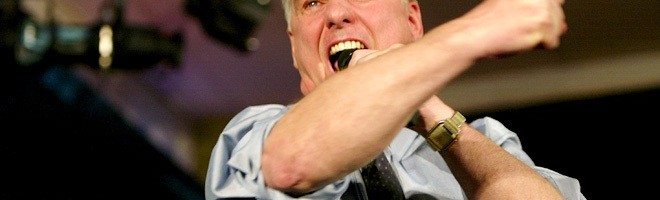
How many times were we subjected to Howard Dean’s Yee Haw speech on the news? And how much will the media debate Dean’s words about Teach for America (TFA)? I am guessing, probably not at all, but his words are out there now, with his Saloninterview, and he is mistaken when it comes to TFA.
Many years ago I heard Howard Dean as Governor of Vermont speak about public schools in a good way. It was on NPR, I believe, as I was driving to work as a teacher. I remembered those words and I liked him when he later ran for president. He seemed a refreshing candidate, and it was painful to watch his decline in that race.
But I couldn’t disagree with Dean more now on his stance for Teach for America. And while you may not pay much attention to Dean, he is, of course, a voice for Democrats, and I think quite revealing of what they are about when it comes to school reform.
Like Dean, I know others too, who have adult children, who have joined TFA. I will never say that young people who enter TFA are not good and decent, filled with the desire to help children, but Teach for America, as an organization, is out to destroy professional teaching, and Dean either doesn’t know that, or he too close to it because of his son’s involvement.  Perhaps he is a privatizer like many Republicans and Democrats. Wherever he gets his ideas, mixing up the neoliberal message here is mistaken.
Dean, like many in both parties, blurs the line between real teacher education and Teach for America, and that is dangerous. It confuses people, leading them to think TFA is the answer to the problems involving teaching and poverty. But TFA, in reality,is much of the problem with what is happening to teacher education today.
He does not seem to understand that it is probably no coincidence that TFA was started in the early 90s. So were many other so-called school reforms, put into place to privatize public schools. Budget cuts meant the deterioration of school programs that parents loved. Poor schools were hit hardest. Parents, who could, ran with their children to the nearest private school.
If leaders really cared about schools and children, they would have enhanced the real teacher education programs, making a teaching degree more valuable…examining teacher education programs that already worked well in this country. Instead, How “Yeee Haw” Howard Dean is Way off Base Concerning Teach for America:

Broad Foundation Puts Hold on Its Prize for Urban Education - District Dossier - Education Week

Broad Foundation Puts Hold on Its Prize for Urban Education - District Dossier - Education Week:


Broad Foundation Puts Hold on Its Prize for Urban Education


Disappointing academic results are prompting the Eli and Edythe Broad Foundation to "pause" its $1 million annual award that recognizes improvements in student achievement in the nation's urban school districts. 

When it was founded 13 years ago, the Broad Prize for Urban Education was meant to galvanize urban school districts that serve low-income students to significantly improve student performance and close the achievement gap. But today, the foundation announced that the prize has been "paused" because of "sluggish" academic results from the country's largest urban school systems and to allow it time to reflect on how it can improve the prize-awarding process given the ways that urban education has evolved in the last 13 years. 

The foundation cited changes in New Orleans since Hurricane Katrina, Tennessee's Achievement School District, and other "portfolio" districts that offer a mix of traditional public schools and charter models as some of the changes that the foundation will review and to update the award. (Some of those efforts are funded by the foundation.) 

"The decision to pause the prize was further precipitated by sluggish academic results from the largest urban school districts in the country," according to the press release making the announcement. "Previously, 75 of the largest public school districts in the country were automatically eligible for The Broad Prize each year. A review board of education experts reviewed performance data and selected the finalists. Since 2002, there have always been four or five finalists." 

But last year, only two districts made it past the review board to a jury for consideration. 

"The rise of a new definition of public school systems, coupled with more rigorous standards and higher expectations for our public schools, convinced us that now is the right time to take a break and evaluate how to improve The Broad Prize so it fulfills its original mission: to catalyze dramatic improvement in America's public schools," said Bruce Reed, president of The Broad Foundation. "We want to make sure any award recognizes the best achievement in K-12 public education today while incentivizing school systems to raise student achievement to the highest level." 

The foundation will still award its $250,000 annual prize for charter schools, which Reed said he hoped would inspire educators across the country "to work with heightened urgency and creativity to make sure that every student achieves at high levels." 

The prize for urban districts had four goals: reward districts that boosted achievement levels for disadvantaged students; restore public confidence in public schools; create incentives for districts to improve; and showcase best practices for urban school districts. 

The announcement was not entirely a surprise for those paying attention. In selecting two winners in 2014—Gwinnett County, Ga., and Orange County, Fla., with Gwinnett being a repeat winner—jurors said they were underwhelmed by the lack of progress. 

Mr. Broad himself hinted that there was some soul searching under way when he took the stage in Manhattan last year to recognize the winners. 

He acknowledged the hard work in the 15 years they spent trying to move the achievement needle in urban systems. 

And Reed indicated at the time the foundation was "disappointed" that more districts weren't showing the progress both Gwinnett and Orange counties have displayed and that as a country "we desperately need to do better, in more places, much faster." 

Frederick Hess, the director of Education Policy Studies at the American Enterprise Institute who has served as a Broad Prize review board member, said: 

"I think it's a fascinating decision," Hess said. "The prize was intended to recognize and encourage urban improvement efforts, and after more than a decade of energetic activity, The Broad Foundation has concluded that progress has not been substantial enough or fast enough. I think this occasions appropriate reflection among all of us." 

Hess went on: "One can also say looking at the TUDA [Trial Urban District Assessment] data there has been real improvement in urban education over the past 10 or 15 years," he added. "It's just that the results aren't anywhere close to where we all might wish...and the question this poses is whether we are inevitably going to grow frustrated with the pace of improvement in urban school systems." 

Prizes are given to those with the best performance, and it was difficult to argue that the urban school systems were delivering the best, Hess said. 

"It's hard to look at urban school systems and say that any one of them that [they] are truly producing the kinds of results for their children that we would want to brag about," he said. "There is no urban system where 95 percent of children are graduating, and they are Broad Foundation Puts Hold on Its Prize for Urban Education - District Dossier - Education Week:


And now, online preschool classes. Really. - The Washington Post

And now, online preschool classes. Really. - The Washington Post:


And now, online preschool classes. Really.


It was only a matter of time. Online school classes for toddlers and preschoolers are here.
VINCI Education is offering what it calls a “groundbreaking virtual school” for youngsters, which was featured by by Dr. Gadget®, the nationally recognized TV and radio personality, on CBS’s “The Talk” late last month.
VINCI Education, according to its Web site,”is a pioneer in providing Blended Learning Curriculum, Assessment Tools and Data Analytics for the Early Childhood Education.” It operates preschools and day-care centers in Los Angeles, Ottawa and Beijing, which use technology and blended learning strategies to, the Web site says, “strengthen the main developmental areas of a child’s mind.” The company won the CODiE 2014 award (given by the software industry) for Best Game-Based Curriculum.
So what is the virtual school for toddlers and preschoolers? Here’s what the VINCI Web site says:
Let’s face it. You are not sure about how well your child will be doing in school. Now you can gain that confidence by preparing early. VINCI Virtual Preschool is a subscription based service. Use your own device or order one from VINCI Store to receive lesson plans, books and activity guides….
The Web site says that each teacher has at least an early childhood education degree. This is what it says about what is available for children 18 months to 3 years old, with the title: “Practical Life and Sensory Experience:”
Every week, you receive weekly lesson plan including activities, books and games as well as a lesson guide. You use a game to introduce a concept, such as “Same or Different”, read the included books on a daily basis to reinforce, and use designed activities such as playing sand and water to help your child to master the concept. The lesson plans integrate Montessori and Reggio Emilia approaches such as you interact with your child in a more purposeful way.
It says that VINCI tablets are not required, but if they are purchased, “you save time (and hassle) for installation, because it is already conveniently programmed.”
It also offers material for 4-year-olds, who the Web site says will turn into 5-year-old kindergartners expected to learn material aligned to the Common Core State Standards (which, incidentally call for kids to read in kindergarten). So 4 years old is almost too late to start getting prepared for And now, online preschool classes. Really. - The Washington Post:

Teachers who #defendchildren: AFT & NEA Call to Action - UNITED OPT OUT: The Movement to End Corporate Education Reform

Teachers who #defendchildren: AFT & NEA Call to Action - UNITED OPT OUT: The Movement to End Corporate Education Reform:


Teachers who #defendchildren: AFT & NEA Call to Action

The harm being inflicted on children for the sake of corporate profit is a national crisis. It is a crisis that is ignored in the national media but understood by educators, parents and students as a problem that calls for revolution.
NEA President Lily Eskelsen Garcia states, “The revolution I want is ‘proceed until apprehended.’” Translation: Teachers, administrators and everybody else involved should ignore bad school reform policy and do “the right thing” for kids. Whether they [reformers] have sinister motives or misguided honest motives, we should say, ‘We are not going to listen to you anymore. We are going to do what’s right.”
The national unions have stated their intent to  support  teachers who refuse to administer high stakes tests.
United Opt Out joins hands with  teachers across the country who stand up and refuse to administer high stakes tests that harm children cognitively, emotionally and physically.  Peer reviewed research on high stakes testing clearly shows that such testing causes illness, decreased motivation, and heightened levels of anxiety .  In addition, the current corporate regime of Common Core aligned high stakes tests are not developmentally appropriate, adding an entirely new level of stress that is creating a generation of young children who view themselves as failures.  Early childhood health and education professionals wrote a joint statement in 2010 demanding that the K-3 Common Core standards be withdrawn.  They  state, “The proposed standards conflict with compelling new research in cognitive science, neuroscience, child development, and early childhood education about how young children learn, what they need to learn, and how best to teach them in kindergarten and the early grades.”
We  join hands and stand strong with the teachers who recognize the effects of poverty on brain development.  Fifty-one percentof public school children are currently living in poverty. Research reveals that the stresses of poverty cause changes in brain development that negatively impact student learning. High stakes and high stress testing should not be inflicted on children living in poverty. Such toxic testing further increases the damage done to the pre-frontal cortex, the part of the brain which deals with problem solving.
We join hands with these teachers who recognize the harm these tests inflict on our children of color, children with exceptional needs, and children who suffer from emotional stresses such as anxiety, OCD and suicidal thoughts.
We join hands with these teachers who recognize that these high stakes tests harm even our good test takers, who receive praise for a score that narrowly defines who they are to a number.
While joining hands, we ask President Eskelsen Garcia and President Weingarten to provide support in the form of legal support, press and social media support – local and national if needed – to union members  who are finding their voices and refusing to obey unjust laws which harm our children. It is essential that the unions  come forward to stand by these members and support them in fighting back against those who demand that we submit to laws that harm children cognitively, emotionally and physically.
If a teacher is being harassed and/or is in jeopardy of losing his or her job due to test administration refusal, it’s essential that we reach out to national and let them know.  President Eskelsen Garcia can be reached at  @Lily_NEA or leskelsen@nea.org  and President Weingarten can be reached at @rweingarten or randiweingarten@gmail.com .
We at United Opt Out ask that all citizens stand up for action that lifts up and protects the teachers who honor and defend America’s children.  We ask that our unions make good on their promise to provide support for these teachers who stand up – these teachers who have a moral obligation to disobey unjust laws. If your local has not yet created a resolution to support teachers who refuse to administer high stakes tests, create a resolution now.  Seek out advice and support from locals, such asAurora Education Association in Colorado, who has already created a resolution.
We send out this reminder today as each week  there are more teachers standing up to #defendchildren as they refuse  to administer these high stakes corporate tests.
Join us by forwarding this call to action to President Eskelsen Garcia and President Weingarten and by sharing it on Twitter using hashtag #defendchildren.
The current list of teachers around the country who have refused to administer high stakes tests includes:Teachers who #defendchildren: AFT & NEA Call to Action - UNITED OPT OUT: The Movement to End Corporate Education Reform:

Let's Rank Everybody | Alan Singer

Let's Rank Everybody | Alan Singer:

Let's Rank Everybody


Because of the miracle of data collection and computer algorithms (don't ask me what an algorithm is but your computer knows) we can now track everyone's performance and take appropriate action to get rid of incompetence. Politicians like Andrew Cuomo and Arne Duncan are very excited about doing this for teachers and Schools of Education. Below is my recommendations for ranking other professions and people as well.
Of course the data collected and processing might not make any sense. I recently met with an eighth grade social studies teacher in a New York City suburb who explained that in his district, social studies teachers receive 20% of their professional rating based on student performance on 6th, 7th, and 8th grade high-stakes standardized reading and writing tests. Of course he does not teach reading and writing and does not even know the sixth and seventh graders yet, but their tests scores count for his evaluation. He was a bit concerned because New York State Governor Andrew Cuomohas declared the teacher rating system too easy and wants these test scores counted for 40% of teacher performance.
After we finished laughing about how the physical education teachers in his school are being evaluated the same way as he is, we talked about how Barack Obama and Arne Duncan propose to use student scores on high-stakes standardized tests to evaluate the effectiveness of teacher education programs. Since this teacher was my student in a social studies teacher education program fifteen years ago and he is being evaluated based on the performance of students who he has not yet met, I will be evaluated on the performance of students who were not even born and many whose parents were not even in the country when he was in my class. While this may be hard to follow, it must be fair if the algorithm says so.
At the 2014 American Educational Research AssociationLinda Darling-Hammond, who as a lead member of a group called SCALE was influential in developing and promoting a lot of the new assessments, declared, "New York is a prototype of how not to implement teacher performance assessment." I only wish she recognized these problems before lending her name and professional credibility to the test makers.
Meanwhile, back in New York State, Governor Andrew Cuomo wants the State Education Department to deregister and suspend the operation of teacher education programs if for three consecutive years fewer than fifty percent of its students pass every required certification examination. But just to make it even less fair, the exams are created by Pearson rather than State Education, Pearson administers and evaluates performance on the exams, and because Pearson is a private company that "owns" the tests through its Evaluation Systems and Pearson Assessment sub-divisions, the tests and grading policies are not subject to outside review or oversight.
In addition, Cuomo proposes to bar candidates from teacher education programs who have below a 3.0 or B average in college. This would eliminate from teaching students who took longer to adapt to college, could not decide on a major, switched majors, or who chose a more difficult subject area such as math or chemistry.
There is concern that this requirement would impact negatively on Black and Latino teacher education candidates who attended poorly performing inner-city schools that left them initially unprepared for college. It necessitated significant remediation before they could adequately perform in college classes. As a result, although they performed well at the end of college, their overall grand average would fall below the Cuomo cut-off.
Instead of open discussion of these proposals and whether it makes sense to evaluate students, teachers, schools, school districts, and Schools of Education based on student performance on high-stakes standardized reading, writing, and math tests, Let's Rank Everybody | Alan Singer:

Analysis: New York charter schools flush with cash | NYSUT.org

Analysis: New York charter schools flush with cash | NYSUT.org:


Analysis: New York charter schools flush with cash


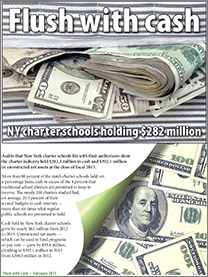
 ALBANY, N.Y. February 2, 2015 - New York's charter schools are flush with cash, holding $282.3 million in taxpayers' money in the bank and $392.1 million in unrestricted net assets that can be used to pay for rent and academic programs, according to a new analysis by New York State United Teachers. One Long Island charter school alone had banked $21 million in cash savings at the close of fiscal 2013.

charter school cashThe analysis also shows 82 percent of the state's charters held, on a percentage basis, cash in excess of the 4 percent that traditional school districts are permitted to keep in reserve. The nearly 200 charters studied had, on average, 25.3 percent of their annual budgets in cash reserves - more than six times what regular public school districts are permitted to keep. Five charter schools had enough cash in the bank at the close of fiscal 2013 to fund more than a year of operations without any new revenue.
NYSUT President Karen E. Magee said the charter industry's push for additional per-pupil and facilities money is undermined by their own financial accounting, which shows the current funding formula is more than adequate to meet charters' needs.
"It's the definition of 'chutzpah' for the charter industry to be crying poverty and demanding ever more state funding when their own balance sheets show that most individual charter schools are rolling in cash and have tidy savings in the bank," Magee said. "Instead of siphoning money from traditional public schools, maybe charters should first use the cash stashed in their mattresses."
Magee added that Gov. Andrew Cuomo's budget proposal to give charters more state funding at a time when scores of districts are facing fiscal stress suggests he is trying to reward his billionaire hedge fund backers - many of whom sit on charter school boards - rather than address the real funding needs of traditional public schools that serve 97 percent of public school students. "It certainly appears the governor is more interested in rewarding his billionaire friends who bankroll the charter lobby than providing the adequate and equitable state funding that all kids need," she said.
NYSUT Executive Vice President Andrew Pallotta said the union's analysis of charter balance sheets demonstrates why the charter industry must be held to stricter standards of accountability and transparency. "Charters are public schools. Yet, because local taxpayers have no say in how charter boards are appointed and there is no local budget vote and accompanying scrutiny, many charters are getting away with stockpiling money," Pallotta said. "Taxpayers have every right to know their tax dollars are being used wisely. At a time when our school districts are starved for funding - and inequality is at record levels - it's outrageous that individual charters are, in many cases, sitting on piles of cash while students in traditional public schools are doing without. Charters with extra money should be using those assets to invest in programs for their students and to treat their teachers fairly."
NYSUT analyzed renewal reports, tax returns and audits that charter schools were required to file with their authorizers for 2011-12 and 2012-13. The reports became available in Fall 2014 and are the latest available for public scrutiny. Although no data is available for several dozen charters - many of them new - the NYSUT findings show the charter industry has no need for additional funding.
The amount of cash held by charters is growing rapidly, as are the charters' unrestricted net assets, which can be used for a variety of purposes. The $282.3 million in cash held by the state's charter industry grew by about $61 million from 2012, when charter schools reported having $221 million in cash on hand. Unrestricted net assets held by charter schools grew by about $93 million, from $298.5 million in 2012 to $392.1 million in 2013, according to the review of charter audits.
Ironically, the charters that tend to hold the least amount of cash are generally those connected with large networks. Charter networks, such as Success Academy, bill their individual schools per-pupil "management fees," sometimes more than $2,000 per student. Still, the Success network Analysis: New York charter schools flush with cash | NYSUT.org:

Teacher Regulations Worthy of George Orwell | Patricia McGuire

Teacher Regulations Worthy of George Orwell | Patricia McGuire:


Teacher Regulations Worthy of George Orwell


Who will remain to teach the nation's schoolchildren when the U.S. Department of Education (USDE) succeeds in its plan to force every single pupil, teacher, school, college and university to conform to its Orwellian plan for constant surveillance and measurement of teachers via standardized tests and surveys?
The proposed regulations on Teacher Education released in December by USDE are the latest example of federal over-reach into the nation's classrooms at all levels of education. Through 75 dense and difficult pages of reading in the Federal Register, a picture emerges of a federal bureaucracy obsessed with controlling and measuring virtually every aspect of a teacher's work. Despite my own legal training, parsing the Fedspeak of the proposed regs was a turgid slog through too much jargon. Rules that are this long and so obtuse cannot be good. I found myself wondering how many teachers are actually able to read and understand what is about to happen to them. Even more, I found myself asking the unthinkable: who would even want to enter a profession that has so little freedom and so much governmental oversight?
Great teachers need the oxygen of freedom to create, to imagine, to inspire and lead their pupils on the journey of discovery that is the essence of acquiring knowledge and skills. Sure, that journey requires some structure and sequencing across ages and grade levels, and we need local, state and national agreement around the framework of what knowledge is important to learn at each age, what skills a student should be able to manifest after certain years of learning, and what diplomas, certificates and degrees represent by way of baseline learning mastery at each level. People entering the teaching profession need to know and accept the legitimate structures of curricula and programs, accreditation and assessment practices appropriate for their schools and locales. But the proposed regulations suck the oxygen out of the classroom, depleting freedom in favor of federal mandates. This is quite the opposite of what education in a democracy should be all about.
We all agree on the need for rigorous standards for learning, for teachers and students, and for schools, colleges and universities. Without a single federal bureaucrat sitting on our shoulders, we educators are the first to want our students to be wildly successful. We also know far more than Big Brother about what blocks student success. The problem is not the idea of standards that have teeth. The problem is the methodology of the federal government, and its arrogation of power to itself to address issues of teaching and learning in ways that are threatening, wasteful, inappropriate and, ultimately, ineffective -- but not before also being very harmful.
What do the proposed new regulations do? Boiling down 75 pages of dense Fedspeak into a few plain English terms, the proposed regulations would dictate to states the criteria for approval of teacher education programs, and through the states would dictate to teacher education programs the criteria for student admission, assessment and graduation from those programs. The states would have to assess all teacher education programs based on four elements every year: student learning outcomes as measured by standardized test results for the pupils taught by the teachers of the schools of education; employment data for graduates of schools of education including placement and retention in first jobs; opinion surveys of graduates and employers; and accreditation. The state assessments of each teacher education program would then translate into a rating that the school must display on its website and other materials. Teacher education programs that fail to get satisfactory ratings Teacher Regulations Worthy of George Orwell | Patricia McGuire: