My wife and I had a great discussion after my last postabout the Gates Foundation’s instance that U.S. poverty could be overcome by better schools and teachers instead of a broad-based approach (like the Foundation uses overseas). She led off by saying, “Isn’t Gates a good guy? He’s giving away his money trying to help people.” My response was that putting money into bad ideas doesn’t necessarily help people. With all the publicity about philanthropy lately this has been a topic of discussion (see the New York Times Op-Ed piece “Good Charity, Bad Charity“). To be fair, I really couldn’t tell my wife if all the K-12 education projects the Gates Foundation funds are good or bad ideas.
To their credit, the Gates Foundation maintains a list of all the projects they have funded on their website. I cut and pasted information about the 128 “College Ready” (K-12 education) projects they funded in 2014 into a spreadsheet (ironically a MicroSoft product). Note: K-12 education projects are not limited to public schools, as will be discussed in Part 2.
Yesterday, The LA Times reported that, “Major California school districts are failing to comply with a state law that requires them to evaluate teachers in part by how much their students have learned.” This claim is completely incorrect. In fact, California is one of the few states where most districts do NOT tie test scores to Teacher Evaluation.
California Ed Code states:
44660. It is the intent of the Legislature that governing boards establish a uniform system of evaluation and assessment of the performance of all certificated personnel within each school district of the state, including schools conducted or maintained by county superintendents of education. The system shall involve the development and adoption by each school district of objective evaluation and assessment guidelines which may, at the discretion of the governing board, be uniform throughout the district or, for compelling reasons, be individually developed for territories or schools within the district, provided that all certificated personnel of the district shall be subject to a system of evaluation and assessment adopted pursuant to this article. (emphasis my own) This article does not apply to certificated personnel who are employed on an hourly basis in adult education classes.
This simply states that each school district can come up with their own, objective evaluation system for teachers. Perhaps later in the Ed Code it mentions test scores? Nope.
44661.5. …a school district may, by mutual agreement between the exclusive representative of the certificated employees of the school district and the governing board of the school district, include any objective standards from the National Board for Professional Teaching Standards or any objective standards from the California Standards for the Teaching Profession if the standards to be included are consistent with this article….
So, districts can use standards from the National Board for Professional Teaching Standards or from the California Standards for Teaching Profession. No mention of test scores…hmmmm…
Here, Ed Code states:
44662. (a) The governing board of each school district shall establish standards of expected pupil achievement at each grade level in each area of study. (b) The governing board of each school district shall evaluate and assess certificated employee performance as it reasonably relates to: (1) The progress of pupils toward the standards established pursuant to subdivision (a) and, if applicable, the state adopted academic content standards as measured by state adopted criterion referenced assessments. (2) The instructional techniques and strategies used by the employee. (3) The employee’s adherence to curricular objectives. (4) The establishment and maintenance of a suitable learning environment, within the scope of the employee’s responsibilities.
So, there are expectations of achievement for students at each grade level, and the progress of students toward the expectations can be used in evaluation. Where does it say TEST SCORE? It doesn’t. In fact, I would argue that it is AGAINST California Ed Code to tie Badass Teachers Association: LA Times Report on Teacher Evaluations Incorrect:
No Child Left Behind May End, But The Industry It Spawned Is Here To Stay
George W. Bush’s signature education reform turned standardized testing into a multi-billion dollar industry. But with change approaching, those making money from the system say the good times will continue.
At the center of what is gearing up to be the biggest political battle over American education in decades, leaders across the political spectrum are calling loudly for the end of the test as we know it. Standardized testing was shaped by George W. Bush’s No Child Left Behind Act into a central pillar of the American education system — a federal mandate on which the fate of low-performing schools rested.
But the 13-year-old No Child Left Behind is in the process of being dismantled, and lawmakers’ first priority is to to change the standardized testing regime. They plan to remove many of the high stakes attached to tests, slash the number of exams students must take each year, and even, under some proposals, eliminate No Child Left Behind’s central mandate, that students must be tested every year.
But the testing industry — a multibillion-dollar market built, in large part, on the shoulders of No Child Left Behind — isn’t worried.
Thirteen years after the law was enacted, widespread testing is so ingrained in the American education system the companies who profit from it see little threat from plans to remake elementary assessment. No matter what the federal government decides, experts say, states are likely to keep annual testing around in some form or another, likely with high stakes attached to them.
For the companies that rule the testing world — Pearson, which has a 40% market share in the industry, McGraw-Hill, and a handful of large nonprofits — No Child Left Behind is already an afterthought. They are riding the high of the huge revenue boost created by implementation of the Common Core standards, and expect demand to increase in 2015 as states and school districts look to develop new and innovative types of assessments and tools to analyze their students’ results.
Some experts said they even saw potential for the testing industry to see a boost from a new version of No Child Left Behind.
“I don’t see things changing for us much in terms of the size of our business,” said John Oswald, the vice president of Educational Testing Service, a large nonprofit test maker. With No Child Left Behind’s mandates over, Oswald said, “People are just going to be moving towards other kinds of testing.”
In 2002, when it was signed into law by George W. Bush, No Child Left Behind was unarguably a boon for testing companies. The law required new, different tests, and lots of them: enough for students to take a test every year from grades three through eight, and once in high school. The federal government pumped tens of millions of dollars into each state’s budget — from 2002 to 2008, annual state spending on tests rose from $423 million to $1.1 billion, according to the Pew Center on the States.
The money was used to develop a battery of data-rich tests that would be used to measure how many students in each grade were “proficient” in reading and math. Unlike in the years before No Child Left Behind, those tests suddenly carried consequences: Schools were graded based on whether they brought enough students up to proficiency each year, and could face increasingly dire consequences if they did not, including possibly being shut down.
A new version of No Child Left Behind would almost certainly remove the federal sanctions that made NCLB’s tests high-stakes for schools, which some see as a potential threat to large education and testing companies like Pearson and McGraw-Hill.
School Choice Is A Problem, Not a Solution For Education
published by Kate_Lenox on Fri, 01/23/2015 - 12:31pm
Ugh. The Bee editorial page has trotted out its conservative bull dog Ben Boychuk again. Just days after Martin Luther King Day, Boychuk is writing about his own dream--school choice.(1)
It seems that next week is National School Choice Week and the kickoff event is being held in southern California. This will serve as a show case for what we're missing says Boychek, because California only offers five kinds of school choice: neighborhood public school; charter schools; magnet schools; home schooling and private schools. That is not enough! What California really needs is vouchers or the tax credit equivalent, so that students may take their school dollars where ever they want.
Never mind that school choice exists only for those parents with the means to get their child to the school of their choice (provided of course, that the school chooses them). Forget that California rejected vouchers multiple times in statewide initiatives. Ignore that we have almost no accountability for the tax dollars that already go to charter schools. Pretend that vouchers haven't been the well rounded success that Boychuk claims they are.(2) Vouchers are the Holy Grail for school choice advocates, and that's what he's asking for, no, dreaming about in School Choice Is A Problem, Not a Solution For Education | The Sacramento Coalition to Save Public Education:
Bush has maintained a national profile on the issue with which, as governor, he had sought to make his biggest mark: education reform.CREDITILLUSTRATION BY DAN ADEL
In December, Jeb Bush posted an update on his Facebook page which began by reporting that, over Thanksgiving, he and his family had “shared good food and watched a whole lot of football.” He added, “We also talked about the future of our nation. As a result of these conversations and thoughtful consideration of the kind of strong leadership I think America needs, I have decided to actively explore the possibility of running for President of the United States.”
The wording of the announcement was oddly diffident. It was widely known that Bush had been “actively exploring” the possibility of a campaign at least since the spring, when he started showing up at the gym in the grand Biltmore Hotel in Coral Gables, where he keeps his office, with a personal trainer and new workout gear. But there had been as yet no signs of a commitment. “It’s the telegraph people have been waiting for,” Jim Nicholson, a former Republican National Committee chairman and Cabinet secretary under President George W. Bush, said.
The announcement inevitably renewed questions about the desirability of political dynasties and about whether Jeb was being propelled to run, in part, by fraternal rivalry. “There’s always been a friendly competition among the siblings in the family, and that’s just human nature, I suppose,” George P. Bush, Jeb’s older son, told me. As Jeb, who was the governor of Florida for two terms, has followed his brother’s career, he has also stood apart from it. “There is kind of George W.’s world, and then there’s Jeb’s world, and frankly there’s not a lot of intersection,” Mark McKinnon, who was a senior adviser to George W.’s Presidential campaigns, said. Jeb is more introverted and more ideological than both his father, George H. W. Bush, whose politics are driven more by personal associations than by doctrine, and his brother, whose conservatism is more instinctual than considered. It was Jeb who signed the nation’s first “Stand Your Ground” self-defense law, and fought to keep Terri Schiavo on life support.
Now, though, as a result of the rightward shift in the Republican Party, Bush is being viewed as a moderate in the emerging Presidential field. He has strong support among the Party’s establishment and donor class, but his popularity among the current conservative rank and file is difficult to gauge. Since he left office, Bush has maintained a national profile through his work on the issue with which, as governor, he had sought to make his biggest mark: education reform. But, after leading the way in pushing a conservative vision for America’s schools, Bush is now caught in the midst of an unexpected upheaval on the issue within his own party.
His level of enthusiasm for running has also been difficult to assess. He has often cited worries about the effect that a campaign would have on his family, especially on his wife, Columba, who dislikes the role of political spouse. George P. Bush told me that it would be hard for his father to relinquish the life in business that he has led since leaving office, in 2007. “People forget that before he went into public service he was in real estate and has always had a business mind,” his son said.
The family that, over three generations, has served in the White House (twice), the Senate, the House of Representatives, and the governors’ mansions of two states is also a family of businessmen. Prescott Bush was a partner at the investment bank Brown Brothers Harriman, but, even as he thrived on Wall Street, with a house in Greenwich, Connecticut, and three live-in maids, he declined to run for a vacant House seat in 1946, because he didn’t think he could afford it. He was finally elected to the Senate in 1952, at the age of fifty-seven. His son George H. W. Bush didn’t enter politics until he had become a millionaire in the Texas oil industry; he was elected to Congress in 1966, when he was forty-two. Doug Wead, who served as an adviser to both Presidents Bush, told me, “I don’t think it’s about money for money’s sake. It’s a way of defining who I am and where I sit in the history of the family: ‘Can I do it? Can I be a real man?’ Just imagine the pressure. The first step in life in the Bush family is: Can I make a million?”
After college, Jeb worked for the Texas Commerce Bank in Venezuela before returning to join his siblings—George; their younger brothers, Neil and Marvin; and their sister, Dorothy—on their father’s 1980 Presidential The Education of Jeb Bush - The New Yorker:
GWEN IFILL: As Congress begins to tackle a new federal education law that would succeed No Child Left Behind, one of the major dividing lines is already clear. What is the proper role and use of testing?
It’s a question that has long touched a raw nerve among parents and educators.
A new book explores that controversy and testing’s possible future.
Hari Sreenivasan has our conversation from our New York studios.
HARI SREENIVASAN: On the one hand, parents know their children’s talents can’t be quantified by multiple choice tests. At the same time, they often want their children to do well on high-stakes exams.
A new book explores those issues and a growing backlash against testing in many circles. It’s called “The Test: Why Our Schools are Obsessed with Standardized Testing, But You Don’t Have to Be.”
The author and NPR’s lead education blogger, Anya Kamenetz, joins us now.
So, it’s been, what, a dozen years since No Child Left Behind, several years since the Race to the Top. Now we’re starting to roll out Common Core. And as soon as I say these phrases, there are parents that are just already bracing themselves. But our kids are not at the competencies that were the goal. And your book really says, in part, testing is contributing to the problem.
ANYA KAMENETZ, Author, The Test: Why Our Schools are Obsessed with Standardized Testing, But You Don’t Have to Be: Yes, you know, it really is a case of big unintended consequences because tests were imposed to have some kind of system of equity and objective measures of how students were doing.
But because of the high stakes attached to them, districts and schools are increasingly spending more and more time prepping for the tests and also giving benchmark and interim exams up to a high of about 113 by the time students graduate.
HARI SREENIVASAN: Well, 113 tests just seems mind-boggling.
But we have done several stories about testing on the program. What is it in your research that you have found that most surprised you? Is it about the — sort of the industry that’s grown up around it? Is the variance in different states?
ANYA KAMENETZ: I think it’s — you know, considering the stakes, again, that we attach to these tests and the amount of stock that people seem to put in them, when we talk about data-driven decision-making and outcomes, as though this were some measure.
But, in fact, the psychometricians will tell you that the tests are being used in ways that they were never designed for, and that proficiency, which is dictated in the law, No Child Left Behind, doesn’t really have a single scientific definition.
And so there’s a real gap there, I think, between the level of science that we’re working with and then the decisions we’re making based on those measurements.
HARI SREENIVASAN: It seems the intention was noble, to try to figure out a way to measure the problem. You know, one of — the advocates for testings will say, if you can’t measure it, you can’t manage it. Right?
So how do you know which schools are failing if you don’t know how the students are doing inside those classrooms?
ANYA KAMENETZ: Right.
HARI SREENIVASAN: So, what happened from that noble goal to where we are now?
ANYA KAMENETZ: Well, the problem is exactly that.
There is so much that we don’t measure within schools, starting with subjects that aren’t math and reading. Right? These tests are math- and reading-based only. They don’t even test writing very much. So, there’s all this — besides all the other school Is ‘The Test’ failing American schools?:
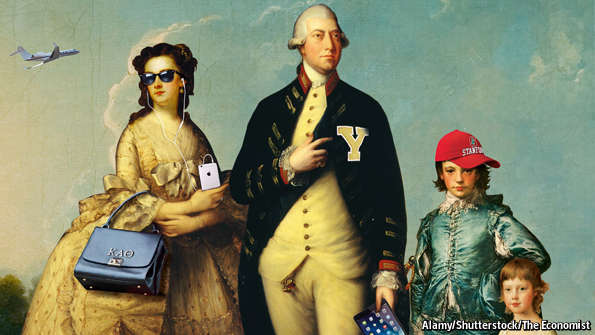
As the importance of intellectual capital grows, privilege has become increasingly heritable
WHEN the candidates for the Republican presidential nomination line up on stage for their first debate in August, there may be three contenders whose fathers also ran for president. Whoever wins may face the wife of a former president next year. It is odd that a country founded on the principle of hostility to inherited status should be so tolerant of dynasties. Because America never had kings or lords, it sometimes seems less inclined to worry about signs that its elite is calcifying.
Thomas Jefferson drew a distinction between a natural aristocracy of the virtuous and talented, which was a blessing to a nation, and an artificial aristocracy founded on wealth and birth, which would slowly strangle it. Jefferson himself was a hybrid of these two types—a brilliant lawyer who inherited 11,000 acres and 135 slaves from his father-in-law—but the distinction proved durable. When the robber barons accumulated fortunes that made European princes envious, the combination of their own philanthropy, their children’s extravagance and federal trust-busting meant that Americans never discovered what it would be like to live in a country where the elite could reliably reproduce themselves.
Now they are beginning to find out, (see article), because today’s rich increasingly pass on to their children an asset that cannot be frittered away in a few nights at a casino. It is far more useful than wealth, and invulnerable to inheritance tax. It is brains.
Matches made in New Haven
Intellectual capital drives the knowledge economy, so those who have lots of it get a fat slice of the pie. And it is increasingly heritable. Far more than in previous generations, clever, successful men marry clever, successful women. Such “assortative mating” increases inequality by 25%, by one estimate, since two-degree households typically enjoy two large incomes. Power couples conceive bright children and bring them up in stable homes—only 9% of college-educated mothers who give birth each year are unmarried, compared with 61% of high-school dropouts. They stimulate them relentlessly: children of professionals hear 32m more words by the age of four than those of parents on welfare. They move to pricey neighbourhoods with good schools, spend a packet on flute lessons and pull strings to get junior into a top-notch college.
The universities that mould the American elite seek out talented recruits from all backgrounds, and clever poor children who make it to the Ivy League may have their fees waived entirely. But middle-class students have to rack up huge debts to attend college, especially if they want a post-graduate degree, which many desirable jobs now require. The link between parental income and a child’s academic success has grown stronger, as clever people become richer and splash out on their daughter’s Mandarin tutor, and education matters more than it used to, because the demand for brainpower has soared. A young college graduate earns 63% more than a high-school graduate if both work full-time—and the high-school graduate is much less likely to work at all. For those at the top of the pile, moving straight from the best universities into the best jobs, the potential rewards are greater than they have ever been.
None of this is peculiar to America, but the trend is most visible there. This is partly because the gap between rich and poor is bigger than anywhere else in the rich world—a problem Barack Obama alluded to repeatedly in his state-of-the-union address on January 20th (seearticle). It is also because its education system favours the well-off more than anywhere else in the rich world. Thanks to hyperlocal funding, America is one of only three advanced countries where the government spends more on schools in rich areas than in poor ones. Its university fees have risen 17 times as fast as median incomes since 1980, partly to pay for pointless bureaucracy and flashy buildings. And many universities offer “legacy” preferences, favouring the children of alumni in admissions.
Nurseries, not tumbrils
The solution is not to discourage rich people from investing in their children, but to do a lot more to help clever kids who failed to pick posh parents. The moment to start is in earlyEducation and class: America’s new aristocracy | The Economist:
Condoleezza Rice taking over Jeb Bush's education foundation
BY THOMAS BEAUMONTASSOCIATED PRESS
01/23/2015 12:42 AM
01/23/2015 12:42 AM
DES MOINES, IOWA
Former Florida Gov. Jeb Bush on Thursday tapped former Secretary of State Condoleezza Rice to serve as chairman of his education foundation, turning over the organization to the former diplomat and academic who remains popular inside the Republican Party.
Rice, a professor at Stanford University and partner in a consulting firm, has for the past two years served as a board member of the Foundation for Excellence in Education.
Bush launched the group after serving two terms as Florida governor. It served as the primary vehicle through which he maintained a public profile and pushed to export the education policies he pioneered in Florida to other states.
"I cannot overstate Dr. Rice's international and national accomplishments and the vast intellect and bold vision she brings to our ambitious work in reform," Bush said in a letter to foundation staff obtained by The Associated Press.
Bush formally left the foundation late last year, resigning as part of his preparations for a possible run for president in 2016. He also left the boards of several for-profit companies, including Tenet Healthcare Corp. and timber company Rayonier Inc.
In his letter, Bush said F. Philip Handy, who served as chairman of the Florida State Board of Education under Bush and as chairman of his two campaigns for governor, would become the foundation's president.
While hardly an endorsement of a presidential campaign that has yet to formally launch, Rice's move to take over the leadership of Bush's foundation was sure to be noticed by the GOP activists already engaged in the 2016 race.