Latest News and Comment from Education

Thursday, January 15, 2015

Wisconsin Legislators talk too much. | BustED Pencils

Wisconsin Legislators talk too much. | BustED Pencils:


Wisconsin Legislators talk too much.

Share
Im_not_listening
Today was the “public” hearing on Wisconsin republicans’ school accountability bill.  I wish somebody would have told me that by “public” they meant that the “public” gets to watch legislators talk to each other and that at some point during the day any zombie left in the room would get a chance to say something.
Like most of the “public” that showed up, I was there early and was supposedly registered to speak at 10:30 am.  However, after 2 and 1/2 hours of listening to a hearing where the “public” was supposed to get a voice, it was obvious that anybody that had any responsibility outside of sitting in a room listening to legislators talk at each other, that “public” comment would occur when the real important people were done.
I sat for as long as I could but my professional responsibilities required that I leave the “public” hearing before the “public”—me and all the others—got a chance to speak.
I complained on my way out the door and was informed by a shadowy figure some guy that this was obviously my first “public” hearing.  “Real people don’t really get a chance to speak at public hearings.”  Obviously that wasn’t literally true but unless you had nothing to do—other than sit for hours and lose feelings in your lower extremities—you were not going to be heard.
I have a suggestion for the legislature.  When you call a public hearing please be specific about when the public will actually get a chance to speak.  Most of us are accountable to our careers and families.
Phew! That feels better.  Now I can get the point of this post.
Here’s what I was prepared to say at 10:30 am.
Thank you for this opportunity.  My name is Tim Slekar and I am here with a large group of educators.  Between us we have over 200 years of experience as educators.  But more importantly, we have all actually taught children in public schools.
All of us examined this bill and found nothing educationally beneficial for the children of Wisconsin.  Therefore we can only come to to 2 conclusions.  1) You (the authors and sponsors of this bill) just didn’t know enough about education.  Or, 2) You knew exactly what you were doing.
Sadly—based on the evidence available—we can only conclude that the authors and sponsors of this bill new exactly what they were doing and had no intention to improve 
Wisconsin Legislators talk too much. | BustED Pencils:

Plutocratic philanthropy shaped education — People Power

People Power — Plutocratic philanthropy shaped education:


Plutocratic philanthropy shaped education


“In our dreams, people yield themselves with perfect docility to our molding hands. The present education conventions of intellectual and character education fade from their minds and unhampered by tradition we work our own good will upon a grateful and responsive folk. We shall not try to make these people or any of their children into men of learning or philosophers, or men of science. We have not to raise up from them authors, educators, poets or men of letters, great artists, painters, musicians, nor lawyers, doctors, statesmen, politicians, creatures of whom we have ample supply. The task is simple. We will organize children and teach them in a perfect way the things their fathers and mothers are doing in an imperfect way.”

~ First mission statement of the J.D. Rockefeller-endowed General Education Board in 1906
In 1905 J.D. Rockefeller kick-started the creation of the General Education Board (GEB). Rockefeller alone, with 1905 dollars, initially gifted $1 million dollars, then increased it to $10 million in 1907, later a further sum of $32 million and through subsequent decades granted some $7.5 billion. With significant money buys significant influence and loyalty.

In 1913, the Sixty-Second Congress created a commission to investigate the role of these newly created NGO foundations. The commission after a year of testimony concluded:

“The domination of men in whose hands the final control of a large part of American industry rests is not limited to their employees, but is being rapidly extended to control the education and social services of the nation. The giant foundation exercises enormous power through direct use of its funds, free of any statutory entanglements so they can be directed precisely to the levers of a situation; this power, however, is substantially increased by building collateral alliances which insulate it from criticism and scrutiny.”
image
“We view with alarm the activity of the Carnegie and Rockefeller Foundations—agencies not in any way responsible to the people—in their efforts to control the policies of our State educational institutions, to fashion after their conception and to standardize our courses of study, and to surround the institutions with conditions which menace true academic freedom and defeat the primary purpose of democracy as heretofore preserved inviolate in our common schools, normal schools, and universities.”  National Education Association meeting, 1913]http://www.wakingtimes.com/2014/01/28/untold-history-modern-u-s-education-founding-fathers/

"We want one class of persons to have a liberal education, and we want another class of persons, a very much larger class, of necessity, in every society, to forgo the privileges of a liberal education and fit themselves to perform specific difficult manual tasks.
—Woodrow Wilson, then president of Princeton University.

Rockefeller plaque

In 1962, the center management placed a plaque at the plaza with a list of principles in whichJohn D. Rockefeller, Jr. believed, and first expressed in 1941. It reads:[29]
I believe in the supreme worth of the individual and in his right to life, liberty, and the pursuit of happiness.
I believe that every right implies a responsibility; every opportunity, an obligation; every possession, a duty.
I believe that the law was made for man and not man for the law; that government is the servant of the people and not their master.
I believe in the Dignity of labor, whether with head or hand; that the world owes no man a living but that it owes every man an opportunity to make a living.
I believe that thrift is essential to well ordered living and that economy is a prime requisite of a sound financial structure, whether in government, business or personal affairs.
I believe that truth and justice are fundamental to an enduring social order.
I believe in the sacredness of a promise, that a man’s word should be as good as his People Power — Plutocratic philanthropy shaped education:

Wednesday, January 14, 2015

NSBA Statement on ESEA Reauthorization | National School Boards Association

NSBA Statement on ESEA Reauthorization | National School Boards Association:


Home


Statement of the National School Boards Association
Alexandria, Va., (Jan. 14, 2015) - As Sen. Lamar Alexander (R-TN), Chairman of the Senate Health, Education, Labor and Pensions Committee, Sen. Patty Murray (D-WA), and other lawmakers discuss their priorities for reauthorizing the Elementary and Secondary Education Act (ESEA) , the National School Boards Association announces its top priorities to advance student achievement and ensure all students have equitable access to a high quality education. Also in a speech on Monday (Jan. 12), U.S. Secretary of Education Arne Duncan outlined Administration priorities for reauthorizing No Child Left Behind (NCLB), the latest iteration of ESEA.
"We all agree, the current version of ESEA must be revamped, taking care not to repeat the inadequacies of the existing law," said Thomas J. Gentzel, Executive Director, National School Boards Association. "A modern ESEA must ensure that local school boards in local communities across the nation gain the flexibility essential to deliver a high-quality public education. NSBA calls for flexibility and strong local governance, among other priorities aimed at supporting student outcomes, to appear in any version of ESEA sent to the president for his signature."
With Alexander’s nearly 400-page draft bill, “Every Child Ready for College or Career Act of 2015,” under scrutiny, and in advance of congressional hearings next week, NSBA calls for a comprehensive, strategic reauthorization of ESEA that provides school districts with the flexibility and funding essential to support local community public schools and our nation’s public schoolchildren. 
NSBA urges Congress to pass legislation that will:
  1. Safeguard the authority and flexibility of states and local school districts, without placing undue burden on districts or adversely impacting effective local governance.
  2. Ensure the modernized version of ESEA is fully supported by federal investments in Title I, a cornerstone of ESEA intended to improve academic achievement of disadvantaged students, which has been woefully underfunded for decades.  And, also ensure Title V restores local flexibility to provide innovative programs and services and is fully supported by federal investments to advance local innovative programs effective in closing achievement gaps.
  3. Ensure ESEA going forward includes requirements for Maintenance of Effort (a provision of the current law that requires states and districts to maintain spending at a certain level in order to access federal funds) to help sustain and improve education services for millions of students.
  4. Eliminate the sanctions of NCLB that impose unintended consequences on schools that are trying to improve and advance reform.
  5. Protect the federal investments in public education and ensure public dollars are not redirected to private schools that are not fully accountable to the same laws and civil rights that govern public schools.
NSBA leaders are available for comment or interview:
Thomas J. Gentzel, Executive Director, National Schools Boards Association
Michael C. Zola, Associate Executive Director, Federal Advocacy & Public Policy, National School Boards Association
Interviews may be arranged through Linda Embrey, lembrey@nsba.org(link sends e-mail), or 703-838-6737
Communications Office, National School Boards Association
# # #
The National School Boards Association (NSBA) is the leading advocate for public education and supports equity and excellence in public education through school board leadership. NSBA represents state school boards associations and their more than 90,000 local school board members throughout the U.S.
- See more at: http://www.nsba.org/newsroom/press-releases/nsba-statement-esea-reauthorization#sthash.vFmkychF.dpuf

Sincerely, A Teacher By: NY BAT Eric Olson Badass Teachers Association

Badass Teachers Association:


Sincerely, A Teacher
By:  NY BAT Eric Olson

Hello, Everyone,
I'm writing this email to inform and update folks about what is happening to public education in New York State and across the country as a whole. Let there be no mistake about it, there are a few very wealthy people who are trying to destroy public education for their own gain and teachers must educate and inform themselves, stay on top of what is happening, and begin to act before it is too late.
The attack on public education has been going on now for over a decade (some would say it goes back to the 1983 "A Nation at Risk" Report), gained steam with the 2009 Race to the Top initiative, and has now gone to an entirely new level in the past few weeks.
Since the New Year alone, Andrew Cuomo has threatened teacher pensions (he tweeted, "Albany has been too concerned with protecting the pension rights of teachers and not enough with the future of students"). He has attacked teacher tenure by stating, “I understand the union’s issue; they don’t want anyone fired, but we have teachers that have been found guilty of sexually abusing students who we can’t get out of the classroom. We have a process where literally it takes years and years to get a bad teacher out of the classroom.“ Obviously, this is a lie - there are no convicted sex offenders teaching in classrooms. He has initiated a new call to change the new APPR system that we have all worked so hard to put in place and carry out. Many believe his comment about pensions is an empty threat - who knows with this guy - but the APPR threats are very real, I'm sorry to say.
Cuomo believes the current APPR system is too lenient. He points to the low percentage of teachers that received an ineffective rating last year. He sees a problem with the fact that most teachers are effective or highly effective while just over 30% of New York's students are not meeting the new Common Core Standards as measured by 3-8 tests in ELA and Math tests. He doesn't mention, of course, that the cut scores are actually set AFTER the tests have been scored and calculated. In other words, the state decides, after the fact, what percentage of students will be deemed as performing at grade level making these tests and their results invalid. He also doesn't mention that testing, in general, is a poor measure of a teacher's effectiveness.
More alarming is what Regent Chancellor Merryl Tisch is proposing in response to a letter sent by Jim Malatras, Cuomo's state director of operations, that expressed Cuomo's disappointment with the APPR system. Tisch's response suggested that, instead of the current 20/20/60 breakdown, the state tests should count for 40% of the evaluation, thus eliminating the local 20%. Even worse, she is proposing that if a teacher is rated ineffective in the 40% test score component, the 60% based on observations and "other measures" doesn't matter. The 40% state test score trumps all and the Badass Teachers Association:

Should elementary schools have recess? Some Florida parents fight for break - Parents - TODAY.com

Should elementary schools have recess? Some Florida parents fight for break - Parents - TODAY.com:


Should elementary schools have recess? Some Florida parents fight for break

Some Florida parents are fighting for their child’s right to recess.
Twenty-three elementary schools in Orange County, Florida, have been cutting back on recess, and even canceling it altogether to maximize class time. In a recent Orange County School Board meeting, parents asked that recess time be enforced in all local schools for all students.


Visit NBCNews.com for breaking news, world news, and news about the economy


Angela Browning, a parent in the area, told TODAY that schools are fluctuating between holding zero to 30 minutes of recess per day.
“Five-year-olds not getting recess is nothing short of abuse,” said Browning, who added that her twins, who are in the second grade, have ADHD and benefit from taking a break to use up some of their energy. "We will not accept a 'recess for some, but not all' approach."

Should elementary schools have recess?

17978 votes
"They have become machines that produce data as opposed to children,'' Amy Narvaez, a mother of two, told Kerry Sanders on TODAY Wednesday. 
At the center of the issue in Florida are Common Core exams, mandatory standardized tests in math, language arts and literacy, where the students' performance often dictates teachers' pay and sometimes their jobs. Many teachers are using that extra 20 minutes that would have been spent on the playground at recess in order to teach the test. 
"Because so much of the money is tied to the schools' scores and their grades, everybody's pressured,'' Diana Moore, president of the Orange Count Classroom Teachers Association, told TODAY. 
"We will come to a place in Florida and probably nationally where we have to admit that we really don't have enough minutes in the day to get everything done that we'd like to see accomplished for our children,'' Orange County Public Schools Superintendent Barbara Jenkins told TODAY. 
The decision of whether recess takes place, and for how long, has thus far been up to each school’s principal.
“Florida law requires that districts provide 900 instructional hours during the school year,” Florida’s Department of Education press secretary Cheryl Etters said in a statement. “Whether recess is part of the school day is a decision made by the school board.”
Eliminating recess also can take away an opportunity for children to learn social skills, according to many experts. 
"At the end of the day, who cares if you have straight A's and you get a scholarship to Harvard if you're socially inept?" Heather Mellet, a mother of two children in the district, told TODAY. 
NBC's Krista Brunson, Amy Eley and Scott Stump contributed to this report.Should elementary schools have recess? Some Florida parents fight for break - Parents - TODAY.com:

The Trouble with Common Core Standards | Seattle Education

The Trouble with Common Core Standards | Seattle Education:


The Trouble with Common Core Standards

Common Core Standards

“…charter chains would prefer national standards… This would allow them to use prepackaged curricula across their charter outlets no matter the location…for dummied down standardized curriculum keeps costs down and the dispensation is formulaic and repetitive. This is the Walmart model of education.”
Danny Weil, 2009
To follow what’s going on in the realm of Common Core Standards, I suggest taking a look at Truth in American Education. For folks in Washington State, check outStop Common Core in Washington State.
Rethinking Schools published an article titled The Trouble with the Common Core which is a good overview of the subject. To follow is an excerpt:
common core2
It isn’t easy to find common ground on the Common Core. Already hailed as the “next big thing” in education reform, the Common Core State Standards are being rushed into classrooms in nearly every district in the country. Although these “world-class” standards raise substantive questions about curriculum choices and instructional practices, such educational concerns are likely to prove less significant than the role the Common Core is playing in the larger landscape of our polarized education reform politics.
We know there have been many positive claims made for the Common Core:
  • That it represents a tighter set of smarter standards focused on developing critical learning skills instead of mastering fragmented bits of knowledge.
  • That it requires more progressive, student-centered teaching with strong elements of collaborative and reflective learning.
  • That it equalizes the playing field by raising expectations for all children, especially those suffering the worst effects of the “drill and kill” test prep norms of the recent past.
We also know that many creative, heroic teachers are seeking ways to use this latest reform wave to serve their students well. Especially in the current interim between the rollout of the standards and the arrival of the tests, some teachers have embraced the Common Core as an alternative to the scripted commercial formulas of recent experience, and are trying to use the space opened up by the Common Core transition to do positive things in their classrooms.
We’d like to believe these claims and efforts can trump the more political uses of the Common Core project. But we can’t.
For starters, the misnamed “Common Core State Standards” are not state standards. They’re national standards, created by Gates-funded consultants for the National Governors Association (NGA). They were designed, in part, to circumvent federal restrictions on the adoption of a national curriculum, hence the insertion of the word “state” in the brand name. States were coerced into adopting the Common Core by requirements attached to the federal Race to the Top grants and, later, the No Child Left Behind waivers. (This is one reason many conservative groups opposed to any federal role in education policy oppose the Common Core.)
Written mostly by academics and assessment experts—many with ties to testing The Trouble with Common Core Standards | Seattle Education:

Recess Is Under Attack And These Parents Are Exercised | ThinkProgress

Recess Is Under Attack And These Parents Are Exercised | ThinkProgress:


Recess Is Under Attack And These Parents Are Exercised

 POSTED ON  
In Florida, a fight brewing between parents and administrators hinges on whether elementary school kids have enough time on the playground.
About 23 elementary schools in Orange Country, Florida have recently cut back on recess, saying there’s not enough time in the school day as teachers are trying to juggle other academic priorities. Unhappy parents, meanwhile, have collected more than 1,200 signatures on a petition asking the district to reverse course. They presented the signatures at a school board meeting this week.
“Our kids were coming home tired, tired of sitting in desks all day, tired of instruction all day,” Angela Browning, one of the parents who attended Tuesday’s meeting, said. “They weren’t getting a regular day in school to run and play and be kids.”
School district officials aren’t opposed to recess in theory. They say they’re just struggling to fit everything in as teachers are working toward standardized tests. Particularly as schools switch over to new requirements under Common Core, officials say they’re concerned about having enough time to prepare students in the classroom.
“We will come to a place in Florida and probably nationally where we have to admit that we really don’t have enough minutes in the day to get everything done that we’d like to see accomplished for our children,” Barbara Jenkins, the Orange County Public Schools Superintendent, told TODAY.
The battle over recess in Florida has been building for several months. This past fall, parents and kids picketed in front of elementary schools — holding signs proclaiming “Recess Is What We Need” and “Recess: Don’t Let It Go!” — to push for statewide standards guaranteeing daily playtime.
As a growing number of public schools have cut back on recess to focus on academic pursuits, similar fights have been playing out in other states. According to a 2011 study published in the Archives of Pediatrics & Adolescent Medicine, the vast majority of statesdon’t have regulations related to athletic activity in school. Most schools aren’t required to offer daily recess or send students to gym classes.
Educators and health experts are increasingly raising concerns about the trend, particularly in light of the rising rates of childhood obesity in the United States.
Research has confirmed that regular play can make kids smarter, more emotionally adjusted, and physically healthier. At the beginning of last year, the American Academy of Pediatrics officially endorsed recess, releasing a policy statement saying that regular playtime is “crucial” for kids’ wellbeing and academic success. The National Association for Sport and Physical Education takes a similar stance, recommending that kids should get at least 20 minutes of recess each day.
Advocacy groups like Peaceful Playgrounds and KaBOOM! are committed to keeping recess in schools, and have recently developed resources for parents who want to pressure their school districts to change their policies in this area. The “Right to Recess Campaign,” for instance, includes a community tool kit with talking points, presentation guides, and even models for successful school recess plans.
Legislators in some states have taken notice, introducing measures in Illinois and New Jersey to make recess a mandatory part of the school day.
Some of the kids in Orange County have made it clear that a shift toward mandatory Recess Is Under Attack And These Parents Are Exercised | ThinkProgress:

Chart Of Parental Leave Around The World Shows Depressing Truth About The U.S.

Chart Of Parental Leave Around The World Shows Depressing Truth About The U.S.:


Chart Of Parental Leave Around The World Shows Depressing Truth About The U.S.

WORKING PARENT BABY


 Working parents in the U.S. are faced with a difficult reality from the moment their babies are born: There's no mandated paid parental leave.

As of now, mothers can take 12 weeks of unpaid maternity leave under the Family and Medical Leave Act -- but that doesn't include anyone working for a small business or many part-time workers who don't meet time qualifications. Paid parental leave is even rarer: Only 12 percent of American employees work for companies that offer it, according to the Center for American Progress.
A new chart by Citation, a "provider of employment law, HR, health and safety and training solutions" based in the U.K., shows just how far the U.S. lags behind the world in terms of family leave. Among the countries included in the analysis, America is the worst country for maternity leave, tied with Lesotho and Swaziland. The U.S. didn't crack the top 10 "worst" list for paternity leave, but it didn't make it on the "best" list either. Any way you slice it, it seems the vast majority of working parents in the U.S. have few options when it comes to taking care of newborns.
Check out the chart below to see how America stacks up -- and what helpful policies other nations are enacting:
Parental Leave Around the World

Teacher survey: Change tenure, layoff laws | EdSource

Teacher survey: Change tenure, layoff laws | EdSource:


Teacher survey: Change tenure, layoff laws

Gov. Jerry Brown said last week he’s open to changing tenure and other teacher employment laws at issue in the Vergara v. State of California lawsuit, and most teachers in a new survey say they want to change them, too.
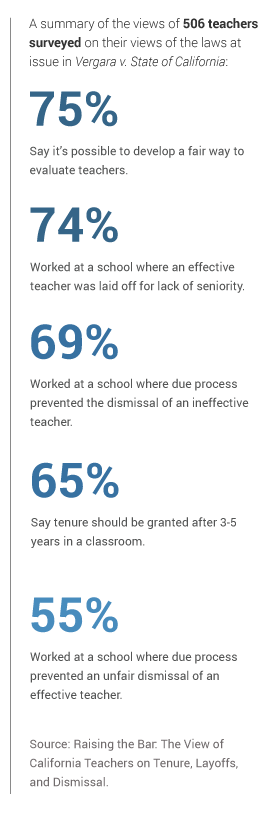
Most of the 506 public school district teachers who answered the online questionnaire, which was released Monday, said they favor lengthening how long it takes for teachers to receive tenure and making job effectiveness, not just seniority, a factor in layoff decisions. They also support a less drawn-out process for dismissing poor-performing teachers – as long as teachers have an opportunity to improve and their peers are involved in evaluating them.
Teach Plus, a national organization of teachers, funded the survey, which was conducted by Goodwin Simon Strategic Research, an independent opinion research firm with offices in Los Angeles and San Francisco.
raising-the-bar-graphic
The survey responses are more nuanced than the positions of the unions that represent them – the California Teachers Association and the California Federation of Teachers. Both unions are defendants in the Vergara lawsuit, which claims laws regarding teacher tenure, firing and layoffs disproportionately hurt poor and minority children, saddling them with the state’s worst-performing teachers. Last year, Los Angeles County Superior Court Judge Rolf Treu agreed with the plaintiffs and ruled the laws unconstitutional. The two unions have filed an appeal.
“The evidence at trial overwhelmingly showed that these statutes promote and support important public interests like attracting and retaining qualified teachers for California public schools while providing objective, fair, and transparent procedures in the event of economic layoffs,” the unions stated in announcing their appeal.
The views of teachers in the survey offer a path to compromise, “a ‘third way’ between reformer calls to throw out all teacher job protections and old-guard calls to preserve virtually all elements of the current system,” Teach Plus, which has called for changing the laws challenged in the Vergara lawsuit, said in its summary of the teacher survey.
The survey included a cross-section of new and veteran teachers from various grade levels. Its four main findings, according to a Teach Plus summary, are:
Teachers highly value tenure but support making it more performance-based, granted after a longer period than two years on the job under current law. Five years, on average, would be the appropriate length of time, the respondents said.
  • 81 percent said tenure is important to them personally;
  • 55 percent worked at a school where tenure protected an effective teacher from dismissal;
  • 69 percent said tenure protected an ineffective colleague who should have been dismissed but wasn’t;
  • 15 percent said tenure in two years or less was appropriate;
  • 75 percent said qualified teachers should play some role in tenure decisions.
Teachers believe that classroom performance should be an important element in any layoff decision.
  • 71 percent said layoff decisions should be based partly or entirely on classroom performance; 24 percent supported basing layoff decisions almost entirely on seniority;
  • 74 percent worked at a school where an effective teacher was laid off because of a lack of seniority.
The current system needs to better support struggling teachers while setting a time frame for firing persistently inTeacher survey: Change tenure, layoff laws | EdSource: