Latest News and Comment from Education

Tuesday, September 30, 2014

How LGBT Students Can Pay an ‘Unfair Price’ for Life | NEA Today

How LGBT Students Can Pay an ‘Unfair Price’ for Life | NEA Today:


How LGBT Students Can Pay an ‘Unfair Price’ for Life

September 30, 2014 by twalker  
Filed under Featured NewsTop Stories
Share
By Tim Walker
An economy still plagued by stagnant wages, sluggish growth and a tight job market has left millions of Americans financially vulnerable and struggling to make ends meet. A new landmark report, however, asserts that lesbian, gay, bisexual, and transgender (LGBT) Americans are feeling this pain more acutely than others. The reason? A combination of discriminatory state laws and unwelcoming environments that have thrown up obstacles to economic opportunities, penalizing the LGBT population – including students – because of who they are.
According to the report, these laws contribute to significantly higher rates of poverty among LGBT Americans and create unfair financial penalties in the form of higher taxes, reduced wages and Social Security income, increased health care costs, and reduced access to higher education.
“Imagine losing your job or your home simply because of who you are or whom you love. Imagine having to choose between paying the rent and finding legal help so you can establish parenting rights for the child you have been raising from birth,” said Laura E. Durso, Director LGBT Progress at the Center for American Progress (CAP). “These are just a couple of the added costs that are harming the economic security of LGBT people across the country.”
Paying an Unfair Price: The Financial Penalty for Being LGBT in America, was co-authored by the Movement Advancement Project (MAP) and CAP, in partnership with Center for Community ChangeCenter for Popular DemocracyNational Association of Social Workers, and the National Education Association.
Click to Enlarge
The study pinpoints three “state failures” that financially penalize LGBT people: failure to protect LGBT people from discrimination, failure to legally recognize LGBT families, and failure to protect LGBT students.
Students are vulnerable on two major fronts. One, the bullying and harassment LGBT students experience in school can lead to poor grades, dropping out of school and even homelessness. LGBT students at the college level also report feeling unsafe and unwelcome. Secondly, obtaining financial aid can be difficult for LGBT students and for students with LGBT parents for several reasons, including often-strained relationships with parents and difficulties related to identification documents for transgender students.
As the chart above shows, most states have not stepped up with laws prohibiting discrimination in schools based on sexual orientation and gender identity. Only 13 states and the District of Columbia currently have How LGBT Students Can Pay an ‘Unfair Price’ for Life | NEA Today:

Russ on Reading: VAMs: Stupid Economist’s Tricks

Russ on Reading: VAMs: Stupid Economist’s Tricks:


VAMs: Stupid Economist’s Tricks


The formula to the left will allow you to calculate your Value Added Score. Please don't forget to show your work.

I am not an economist. I had one intro to economics course in college. Everything I have learned about economics since then has come from reading Paul Krugman in the New York Times. I consider it a good month economically if my checkbook balances and my 401k doesn't tank.


But I am thinking of economists today because I just read a review byKrugman of a new book called Seven Bad Ideas: How Mainstream Economists Have Damaged America and the World, by Jeff Madrick. The book is a chronicle of all the wrong headed advice mainstream economists have been dishing out since before the debacle of 2008 and up until now. 

Here is a brief restatement of what the economists got wrong.
1.      Failed, despite all the warning signs, to predict the 2008 recession, and, in fact, argued that it could not happen.
2.      Failed to agree on a response to the recession once it did happen
3.      Opposed the stimulus package and raising the minimum wage as government interference in the free-market which would, according to these economists, right itself. How is that going?

How could economists get things so wrong? Well mainly, according to Madrick and Krugman, because of a slavish belief in the free market’s ability to manage itself, along with a faith based love of mathematical models that are elegant on paper, but have no connection to the realities of the real world.

Interestingly, while economists were not busy destroying the economy for all of us except the 1%,, they have busied themselves with attempts to apply their cockamamie “models” to teacher evaluation schemes. The movement toward value-added measurements has been led by, you guessed it, economists. People such as Stanford’s Erik Hanushek, Harvard’s and Bill and Melinda Gates Foundation’s Thomas Kane, Harvard’s Raj Chetty and Columbia’s Jonah Rockoff.

Madrick apparently does not mention Value-Added Measures (VAMs) of teacher accountability as one of the “seven bad ideas”, but it is at the top of Russ on Reading: VAMs: Stupid Economist’s Tricks:

School spending by affluent is widening wealth gap | 89.3 KPCC

School spending by affluent is widening wealth gap | 89.3 KPCC:


School spending by affluent is widening wealth gap

92854 full


Education is supposed to help bridge the gap between the wealthiest people and everyone else. Ask the experts, and they'll count the ways:
Preschool can lift children from poverty. Top high schools prepare students for college. A college degree boosts pay over a lifetime. And the U.S. economy would grow faster if more people stayed in school longer.
Plenty of data back them up. But the data also show something else:
Wealthier parents have been stepping up education spending so aggressively that they're widening the nation's wealth gap. When the Great Recession struck in late 2007 and squeezed most family budgets, the top 10 percent of earners —€” with incomes averaging $253,146 — went in a different direction: They doubled down on their kids' futures.
Their average education spending per child jumped 35 percent to $5,210 a year during the recession compared with the two preceding years — and they sustained that faster pace through the recovery. For the remaining 90 percent of households, such spending averaged around a flat $1,000, according to research by Emory University sociologist Sabino Kornrich.
"People at the top just have so much income now that they're easily able to spend more on their kids," Kornrich said.
The sums being spent by wealthier parents amount to a kind of calculated investment in their children. Research has linked the additional dollars to increased SAT scores, a greater likelihood of graduating from college and the prospect of future job security and high salaries.
The trend emerged gradually over the past three decades but accelerated during the worst economic slump since the 1930s. Now, enrollments at pricier private schools are climbing. Parents are bidding up home prices in top public school districts. Pay is surging for SAT tutors, who now average twice the median U.S. hourly wage of $24.45. The patterns suggest that the wealth gap could widen in coming years, analysts say.
"If you're at the bottom and the top keeps pulling away, you're just further behind," said Melissa Kearney, a senior economics fellow at the Brookings Institution.
Between 2007 and 2011, enrollment at private elementary and secondary schools whose annual tuition averaged $28,340 — more than half the median U.S. household income — jumped 36 percent, according to federal data. The intensified reach for the costliest schools occurred even as enrollment in private schools overall fell.
"What we know about parents who send their kids to private school is that by and large they place a very high priority oneducation," said John Chubb, president of the National Association of Independent Schools. "As prices go up, they may be frustrated and angry, but they find a way to make it work."
Most families can't compete. Incomes have barely budged for most Americans since 1980 after accounting for inflation. For the top 10 percent, IRS data show pay has School spending by affluent is widening wealth gap | 89.3 KPCC:

9-30-14 Cali Education Headlines | CSIS – California School Information Services

Fiscal Crisis & Management Assistance Team | CSIS – California School Information Services:


Education Headlines

  • Stockton USD truancy force puts love in tough love

    One little girl had a lice infestation so severe, she’d gouged her scalp trying to relieve the maddening itch. Badly infected, she was ashamed to go to school and her family too ashamed to reach out for help.
     
  • John Green’s ‘The Fault in Our Stars’ banned in Riverside

    One of the most popular young adult novels of recent times has been banned in Riverside. The Riverside Unified School District has forbidden John Green’s “The Fault in Our Stars” in its middle school libraries.
     
  • LAUSD board to privately evaluate Superintendent John Deasy

    Los Angeles Unified School Board members will meet behind closed doors on Tuesday to discuss Superintendent John Deasy’s performance amid divisive contract negotiations with the teachers union and mounting scrutiny for his oversight of technology programs.
     
  • Civic and business leaders urge L.A. school board to keep Supt. Deasy

    Local business and civic leaders are calling on the Los Angeles Board of Education to retain Supt. John Deasy, hoping to head off potential action by a board majority that is unhappy with the head of the nation’s second-largest school system.
     
  • Manteca Unified on curriculum’s cutting edge

    Fast becoming one of the most tech-savvy districts in the state, Manteca Unified moved ahead this month on a plan to equip every one of its students in January with a tablet-style laptop as it moves into the second phase of its $30 million digital push.
     
  • Bassett Unified unveils new computer lab for video game design

    Bassett High School junior Isaaac Olguin taught himself to build a computer but now he hopes a new video game design class will help him better understand the intricacies of programming.
     

Note: FCMAT provides links to California K-12 news stories as a service to the industry. However, some stories may not be accessible because of newspapers' subscription policies.

9-30-14 Curmudgucation - What Lily Misses about the Common Core

CURMUDGUCATION:


What Lily Misses about the Common Core

My esteemed colleague at Edushyster scored an interview with NEA president Lily Eskelsen Garcia, and as always, it's pretty encouraging to see an NEA boss express herself in plain English that clearly opposes reformster ideas-- except for the Common Core. I'm going to reprint a full paragraph because I think it articulates more clearly than anything I've seen where LEG's mistake lies. But listen,


9-29-14 Curmudgucation - Data Dopiness Survives in Indiana
CURMUDGUCATION: Data Dopiness Survives in IndianaYou may recall that back in the day, one of the items on our List of Terrible Things About Reformy Stuff was data mining. Featured in RttT and RttT Lite Waivers, the mandate to hoover up giant mounds of data was one of the great hated evils of reformsterdom, loathed by conservatives and liberals alike.The Leonie Haimson led a fight against InBloom i


9-30-14 Seattle Schools Community Forum

Seattle Schools Community Forum:


OSPI Says Seattle Schools is "High Risk" for Sped
SPED reported that this letter was sent to Seattle Schools today by OSPI.   As the Seattle Schools SPED Community blog says:Strong words from OSPI and withholding of $3,000,000.00 should get someone's attention at SPS, maybe the school board should step in and make sure people are doing their jobs.I note that on item called out by OSPI is the hiring of a consultant to come in and oversee the work.

California First in the Nation to Eliminate Student Suspension for Minor Behavior
From ACLU of Northern California:SACRAMENTO, CA  – Today California becomes the first state in the nation to eliminate suspensions for its youngest children, and all expulsions for all students for minor misbehavior such as talking back, failing to have school materials and dress code violations. Gov. Jerry Brown’s signing today of AB 420 caps a landmark year for the movement away from harsh disci

Tuesday Open Thread
Parents, the Enterovirus D68 has been documented in 40 states including ours.  There are about 300 cases nationwide, mostly in children.  From the CDC:CDC is prioritizing testing of specimens from children with severe respiratory illness. There are likely many children affected with milder forms of illness. Of the specimens tested by the CDC lab, about half have tested positive for EV-D68. About o

Seattle Schools and Garfield Field Trip Incident: PTSA meeting
I attended Garfield's PTSA meeting last night.  There were about 65 people in attendance.  It was a bit odd because they chose to have the lights down so as to put the agenda and supporting documents on a big overhead screen.  It was pretty dark and made the remarks even more gloomy.I was fairly astonished and dismayed at what both Principal Howard and Director Blanford said on the subject of the

9-29-14 Seattle Schools Community Forum
Seattle Schools Community Forum: Why the NatureBridge Case MattersThe reported rape on a Garfield High School field trip in November 2012 matters deeply to me. Not only because I care about student safety in general and sexual assault in particular, but because I see this case as a prime example of the central dysfunction in the District. This is a particularly tragic consequence of the District’s


9-30-14 LA School Report - What's Really Going on Inside LAUSD

LA School Report - What's Really Going on Inside LAUSD (Los Angeles Unified School District):


UTLA highlights contract demands on ‘Big Red Tuesday’
UTLA highlights contract demands on ‘Big Red Tuesday’ United Teachers Los Angeles President Alex Caputo-Pearl speaks on “Big Red Tuesday” at Thomas Starr King Middle School To commemorate “Big Red Tuesday,” United Teachers Los Angeles (UTLA) President Alex Caputo-Pearl used a sidewalk press conference at Thomas Starr King Middle School this morning to outline yet again the union’s contract demands


Future of Deasy moves behind closed doors in board meeting
Future of Deasy moves behind closed doors in board meeting Superintendent John Deasy Drama tonight. Or maybe not. The LA Unified school board is convening a two-part session at 4 p.m. today — one open, the other closed, with Superintendent John Deasy the prime subject of conversation in the closed session. Members have confirmed that they are using their privacy to determine what parameters to con


Homeless student population in US grew rapidly since recession
Homeless student population in US grew rapidly since recession Via Hechinger Report | by Jill Barshay Despite signs of a national economic recovery, homelessness in U.S. public schools steadily increased 8 percent, to 1.26 million students, in the 2012-13 school year from the previous year. That may not sound terrible, but consider that it is part of a 58 percent jump in the number of homeless stu
Morning Read: Gov Brown vetoes mandatory kindergarten
Morning Read: Gov Brown vetoes mandatory kindergarten Brown wraps up ed bills, leaves some heads shaking Gov. Jerry Brown has vetoed a bill that would have made kindergarten mandatory while at the same time signing one intended to show the overwhelming boost that optional year gives kids headed to first grade. S&I Cabinet Report Bond committee demonstrates how to ask questions about iPads Opi
9-29-14 This Week in LA - School Report - What's Really Going on Inside LAUSD
LA School Report - What's Really Going on Inside LAUSD (Los Angeles Unified School District): Brown signs bill limiting ‘willful defiance’ suspensions, expulsionsBrown signs bill limiting ‘willful defiance’ suspensions, expulsions Gov. Jerry Brown With the signing of AB 420, Gov. Jerry Brown on Saturday made California the first state in the nation to limit suspensions and expulsions for the reaso


“More Than a Score” named in The Nation’s “5 Books to Build a Movement for Education Justice!” | I AM AN EDUCATOR

“More Than a Score” named in The Nation’s “5 Books to Build a Movement for Education Justice!” | I AM AN EDUCATOR:


“More Than a Score” named in The Nation’s “5 Books to Build a Movement for Education Justice!”

I am thrilled to announce that Kenzo Shibata, writing for the current issue of The Nation magazine, named the forthcoming book I edited, More Than a Score: The New Uprising Against High-Stakes Testing, to the list of “5 Books to Build a Movement for Education Justice.” The book’s forward was written by Diane Ravitch, the introduction by Alfie Kohn, and the afterward by Wayne Au.
Shibata wrote in part, “More Than a Score collects narratives from teachers, parents, students, academics and elected union leaders describing the growing grassroots resistance to testing gone mad.”
Cover_MTaSI am greatly honored that our book made this list with such a wonderful collection of must read volumes in defense of public education, including, SCHOOL REFORM, CORPORATE STYLE: Chicago, 1880–2000, THIS IS NOT A TEST: A New Narrative on Race, Class, and Education, THE TEACHER WARS: A History of America’s Most Embattled Profession, and STRIKE FOR AMERICA: Chicago Teachers Against Austerity.
Please share this list of books with everyone you know who longs for the day when the “testocracy” no longer runs our schools and educators, parents, and students are respected. When the book is released, I hope to make it to a town near you on a book tour to help speed up that day.“More Than a Score” named in The Nation’s “5 Books to Build a Movement for Education Justice!” | I AM AN EDUCATOR:

Is the new AP U.S. History really anti-American? | The Hechinger Report

Is the new AP U.S. History really anti-American? | The Hechinger Report:


Is the new AP U.S. History really anti-American?

What changed and what didn’t in the latest “Common Core” version of the class

By
Martin Luther King Jr., Benjamin Franklin, George Washington Carver, James Madison and Rosa Parks. If you’ve heard that the new AP U.S. History course description doesn’t mention these legendary Americans, you have not been misled.
But whether the new version of the class skips over key moments in United States history – and even disparages the nation – are still being hotly debated across the country.
Here’s a look at how the controversy began, what’s really different in the new APUSH (a nickname for the class that critics and supporters still agree on), and how the national war over Common Core is influencing the battle.
The controversy
In October 2012, College Board, a nonprofit that develops and distributes not only the AP exams but also the SAT, revamped APUSH to encourage teachers to go more in depth into fewer topics. The class is College Board’s second most popular, after AP English Language and Composition, with 442,890 students taking the exam in 2013. After the changes, the course description for the first time also called for teachers to impart critical thinking skills to their students, ideas in line with the Common Core, a set of guidelines for math and English that most states have adopted. These changes first went into effect this school year.
The new course description raised little notice until July, when some members of the Texas State Board of Education expressed concern that the class would bring Common Core into Texas schools. State law bans Common Core.
In August, the Republican National Committee brought national attention to the controversy when it passed a resolution asserting that the new curriculum “reflects a radically revisionist view of American history that emphasizes negative aspects of our nation’s history while omitting or minimizing positive aspects.”
The fight reached a boiling point in September.
On September 19, the Texas State Board of Education passed a resolution asking that the AP U.S. History curriculum be rewritten “in a transparent manner to accurately reflect U. S. history without a political bias.”
Around the same time, Julie Williams, a school board member in Jefferson County, Colorado, a district of more than 84,000 students just west of Denver, proposed completely revamping the college-credit-earning course in the local schools because she said the new version had “an emphasis on race, gender, class, ethnicity, grievance and American-bashing while simultaneously omitting the most basic structural and philosophical elements considered essential to the understanding of American History for generations.”
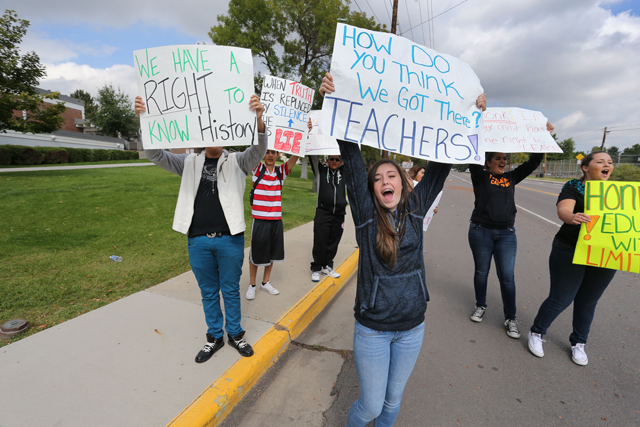
In response to the proposal, hundreds of Jefferson County students skipped school in protest, citing concerns that the plans would lead to censorship.
Students protest against a Jefferson County School Board proposal to emphasize patriotism and downplay civil unrest in the teaching of U.S. history, in front of their school, Jefferson High, in the Denver suburb of Edgewater, Monday, Sept. 29, 2014. (AP Photo/Brennan Linsley)
And in South Carolina, a group calling itself S.C. Parents Involved in Education also raised concerns about what isn’t explicitly mentioned in the new course – the founding fathers, civil rights leaders and wartime heroes – and what is – “wartime experiences, such as the internment of Japanese Is the new AP U.S. History really anti-American? | The Hechinger Report:

The growing disjunction in education policy | TheHill

The growing disjunction in education policy | TheHill:


The growing disjunction in education policy


A flurry of activity among education reformers across the country exposes a growing bifurcation within its ranks, uncovered by recent challenges to teacher tenure in New York. Former CNN anchor Campbell Brown's Partnership for Educational Justice, which recently recruited renowned attorneys David Boies and Laurence Tribe, seeks to reform teacher tenure laws, mirroring activities that led to California's controversial Vergara ruling. But earlier this month, the New York City Parents Union filed suit separately alleging that Brown's group failed to include scores of minority parents in their complaint. This troubling yet pervasive tableau has bedeviled modern reform movements since their inception: Leadership has remained predominantly white, even though the target populations are overwhelmingly black and Latino. And these battles are contributing to a growing disjunction in education policy and among stakeholders within communities and across cities.
The role of school choice advocates in governing regimes is extensive and will prove difficult to extricate from the policymaking process. Since much of the activity against reforms has been at the state and local level, the Obama administration has been, in many ways, held harmless. In fact, the Obama presidency became viable in part because many of his early donors were wealthy liberals and some conservatives connected to foundations and Wall Street, who themselves were advocates for school choice. Proximity to the new president laid a foundation for much of the Obama administration's education policies, including Race to the Top, high-stakes teacher evaluations and rapid expansion of charter schools. Their power and influence, highlighted in Steven Brill's 2011 book, Class Warfare: Inside the Fight to Fix America's Schools, also extended to a cohort of new development-minded mayors that eschewed traditional political pathways to power, were deracialized in their approach to policy and meritocratic in their staffing.

To be clear, education reform exists along a continuum throughout America's history. From the Progressive Era in the late 1800s to early 1900s, to black activists who sought "community schools" to magnet schools and now charters, many district-wide and community-led efforts have long involved a delicate balance of teachers, administrators, activists and parents. Furthermore, most reformers are mindful of this rich history. But the attacks leveled by a select few on teachers and community leaders who were deemed antithetical to education "progress" were likely unsustainable, and the Obama administration's tacit support would make allies vulnerable to institutions with historic sway over local community and political leaders.
As a result, tactics shifted as these policy entrepreneurs who excelled at building national networks of influence were ineffective at converting access to influential elites into broad grass-roots electoral strategies, though their ability to mobilize parents within specific schools proved formidable.
In an effort to engage the grass roots in multiple policy venues, top Democratic leader and Democratic National Committee Vice Chair Donna Brazile, speaking at the American Federation of Teachers' (AFT) national conference in July, announced that she and former Govs. Jennifer Granholm (D-Mich.) and Ted Strickland (D-Ohio) would spearhead an effort to counter the efforts of school choice advocates. Democrats for Public Education — as opposed to the charter-backed Democrats for Education Reform — seeks to fight "market-driven" reforms that left Brazile "ashamed of some of the Democrats of her own party." Such a rebuke of President Obama's education policy may add another layer of friction among activists and parents on the ground and between policy leaders and entrenched education stakeholders that include organized labor, foundations and major donors.
None of these organizations or their strategies should be observed in a vacuum, but rather as part of a string of events provoked perhaps by Washington Mayor Adrian Fenty's (D) failed reelection bid in 2010. Many reports suggest that Fenty's difficulty with constituents stemmed from their truculent relationship with his chancellor of schools, Michelle Rhee, and a desire to return to more fundamental notions of public education. The recent mayoral victories of Bill de Blasio (D) in New York and Ras Baraka (D) in Newark, N.J., arguably punctuate a rejection of centrist policies and will become an overture to the high-profile mayor's race in Chicago, which might match Rahm Emanuel (D) against Chicago Teachers Union President Karen Lewis, who is strongly considering challenging him in a primary.
The language and tactics of the civil rights movement will undoubtedly permeate debates over The growing disjunction in education policy | TheHill:

The Games Charter Schools Play | Frank Breslin

The Games Charter Schools Play | Frank Breslin:


The Games Charter Schools Play


Judging by the claims made by charters, one would think it but child's play to make good on their boast of having higher test scores than their public-school cousins.
Charters' ability to deliver on their promise of achieving higher scores is, after all, their sole reason for existing and the only justification for their annually diverting billions of dollars from public schools.
However, before reviewing the evidence that refutes their claims, let us first consider how charters go about "gaming the system" to their own advantage.
With few exceptions, charters cherry-pick their students, admitting only those students who do well on tests.
Rarely, do they accept students with learning disabilities, emotional disorders, autism, ADHD, speech or language impairment, behavioral problems, or immigrant children still learning English, since these students tend to test poorly and would lower a charter's overall average.
Public schools, conversely, are legally required to accept every student who walks through their doors.
Such a discriminatory admissions policy hardly makes for an honest playing field.
However, sometimes, a few students who do test poorly are accepted, and only later then asked to leave after a charter has received the public-school money that comes with these students.
The problem is that when these students return to their schools, the money that came with them stays with the charters, causing hardship to those public schools, which must unfairly absorb the loss.
Despite this practice of charters' "creaming off" the better test-takers and rejecting the rest, a Stanford University study last year showed that 19/31 percent of children in charters still get lower scores in reading and math than those in public schools; 56/40 percent receive roughly the same scores; and only 25/29 percent achieve higher scores.
Hardly a bravura performance for charters, especially when they've weakened public schools by billions annually!
Please note that this 25/29 percent with higher scores embodies the unfair tactic of charters' admitting only those who test well, whereas public schools must accept every student, without exception.
This 25/29 percent is hardly then the result of charters'providing a superior program, as it is of their unfairly gaming the system, and it is upon such dubious legal, not to mention moral, grounds that charters divert billions from public schools to themselves.
More to the point, it is hard to see how this discriminatory admissions policy is legally justified when charters accept taxpayer dollars, which require them to accept everyone.
Charters play a second game. They seem to have a curious split-personality whenever it suits them. In one breath, they claim to be public schools entitled to taxpayer The Games Charter Schools Play | Frank Breslin: