Latest News and Comment from Education

Wednesday, March 19, 2014

New Extremists In The Education Debate Education Opportunity Network

Education Opportunity Network:


Education Opportunity Network -


New Extremists In The Education Debate


For people who like to think of themselves as being “exceptional,” Americans can sometimes abandon the very principles their exceptionality is founded on. Nowhere is this more apparent than in the current debate of education policy. A feature that has long made America’s public school system exceptional for sure is its governance through democratically elected [...]


Hey Congress, Show Us The Money For Pre-K


If our nation’s leaders made policy decisions on actual evidence, this matter would have been addressed a long time ago. This “matter” is the increasingly desperate state of the nation’s youngest children and the callousness in the way they’re being treated in our austerity-loving, market competitive culture. There’s also evidence there is something we could [...]


The Beginning Of An End To Sanction-Driven Education?


Last week, the Obama administration took an important step for the well being of the nation’s youth – especially those who are of racial minorities – by issuing new guidelines that many hope will shut down what has come to be known as “the school-to-prison pipeline.” This action – welcome, for sure – constitutes a [...]

Tell Congress: Investigate the Tests! - Integrity in Education

Tell Congress: Investigate the Tests! - Integrity in Education:


Tell Congress: Investigate the Tests!

1947840_259155307588740_21226903_nIt’s far from a secret to most teachers, students and parents that policies pushing high-stakes testing in primary schools are deeply flawed. Testing and test preparation has pushed out too much learning time in too many struggling schools nationwide.
This week, our friends at the Network for Public Education(NPE) are pushing for Congressional hearings to investigate the harmful effects of political leaders’ obsession with high-stakes testing. This is an important push – and we’re proud to join NPE in calling for everyone concerned to tell their representatives to at the very least hold hearings to take a look at the issue.
For our part, we’re concerned that low-quality, mass-produced high-stakes tests are being used as a political tool to justify pre-determined policy decisions that have little to do with student learning. Across the country, low test scores are being cited to justify mass  firings, school closures, and charter takeovers. Tests are supposed to be a diagnostic tool that educators use to assess students’ progress and identify areas where they should invest more time and effort. The best assessments are those created by educators and tailored to the learning happening in the classroom—not tests created by faraway corporations, unconnected to things happening in the classroom, scored by…well, just about anyone, and returned long after those students have left the their previous year’s class. So why have commercial tests become such a dominant feature of the schooling experience?
One cynical-but-obvious answer? Revolving door politics. From the cozy relationships between the US Department of Education and testing companies like Pearson, to the US Department of Education’s complete lack of transparency about how important education policy decisions are made, there’s reason to wonder just who is calling the shots that impact our students and communities every day. We’ve already asked the Department of Education to unveil its ties to for-profit institutions, and we’re still fighting an uphill battle for answers.
In the meantime, it’s important that we continue to push legislators to look at rampant high-stakes testing and hold the Department of Education accountable. If you haven’t already, sign on to join NPE’s Thunderclapdemanding Congressional hearings into high-stakes testing. And please make time to be a part of tonight’s Twitter storm, happening from 8 to 10 PM Eastern Time, calling on federal legislators to hold hearings into this national problem.

3-19-14 CURMUDGUCATION: Inauthentic Assessment

CURMUDGUCATION: Inauthentic Assessment:


No Good Metrics??!!
The Ed Week account of a snippy meeting between Randi Weingarten, Dennis van Roekel, and the CCSSO included one quote that came roaring out at me.Melody Schopp, South Dakota Ed Secretary, was bemoaning the lack of press coverage for positive CCSS success stories. Mike Cohen, from Achieve (the accountable-to-nobody organization that helped birth, groom and market CCSS) chimed in that too much of th


Duncan Checks in with Race Results
The US DOE released reports Wednesday, March 19, to update us on how well the Race to the Top winners are doing (because in US education, we only want some states to be winners). The full collection of reports is here, but Arne wanted to let everyone know about his four superstars in Top Racing.This year is the final year for implementing RTTT, and at this point we might expect to see some payoff

Inauthentic Assessment

One more factor that highlights how artificial and inauthentic the current testing regimen has become is the proliferation of rules for proctors.Faced with the spreading realization of just how invalid the tests are, testmakers and state officials have issued a truckload of proctor leash laws.Some rules are no-brainers. "Don't erase wrong answers and replace them with the correct ones" (


CURMUDGUCATION: Who Is Diane Ravitch?
CURMUDGUCATION: Who Is Diane Ravitch?: Who Is Diane Ravitch?At Reclaiming Public Education 101 (my website for ed reform neophytes), I'm trying to create and collect materials to answer some of the questions newby ed reform students might have. I'm not a fan of cults of personality-- any time I'm in a group that drops its mission to sing a hymn of praise to its leaders, I get itchy. But I also kno


Shanker Blog » Estimated Versus Actual Days Of Learning In Charter School Studies

Shanker Blog » Estimated Versus Actual Days Of Learning In Charter School Studies:


Estimated Versus Actual Days Of Learning In Charter School Studies

Posted by  on March 19, 2014


One of the purely presentational aspects that separates the new “generation” of CREDO charter school analyses from the old is that the more recent reports convert estimated effect sizes from standard deviations into a “days of learning” metric. You can find similar approaches in other reports and papers as well.
I am very supportive of efforts to make interpretation easier for those who aren’t accustomed to thinking in terms of standard deviations, so I like the basic motivation behind this. I do have concerns about this particular conversion — specifically, that it overstates things a bit — but I don’t want to get into that issue. If we just take CREDO’s “days of learning” conversion at face value, my primary, far more simple reaction to hearing that a given charter school sector’s impact is equivalent to a given number of additional “days of learning” is to wonder: Does this charter sector actually offer additional “days of learning,” in the form of longer school days and/or years?
This matters to me because I (and many others) have long advocated moving past the charter versus regular public school “horserace” and trying to figure out why some charters seem to do very well and others do not. Additional time is one of the more compelling observable possibilities, and while they’re not perfectly comparable, it fits nicely with the “days of learning” expression of effect sizes. Take New York City charter schools, for example.
In 2009, as many of us remember, there was a highly-publicized analysis released, which focused on the performance of oversubscribed NYC charters (vis-à-vis the city’s regular public schools), and was therefore able to exploit the random admission lotteries in an experimental research design. The results were packaged using a 

Arranging Classroom Furniture: An Unobtrusive Glimpse into How Teachers Teach | Larry Cuban on School Reform and Classroom Practice

Arranging Classroom Furniture: An Unobtrusive Glimpse into How Teachers Teach | Larry Cuban on School Reform and Classroom Practice:


Arranging Classroom Furniture: An Unobtrusive Glimpse into How Teachers Teach

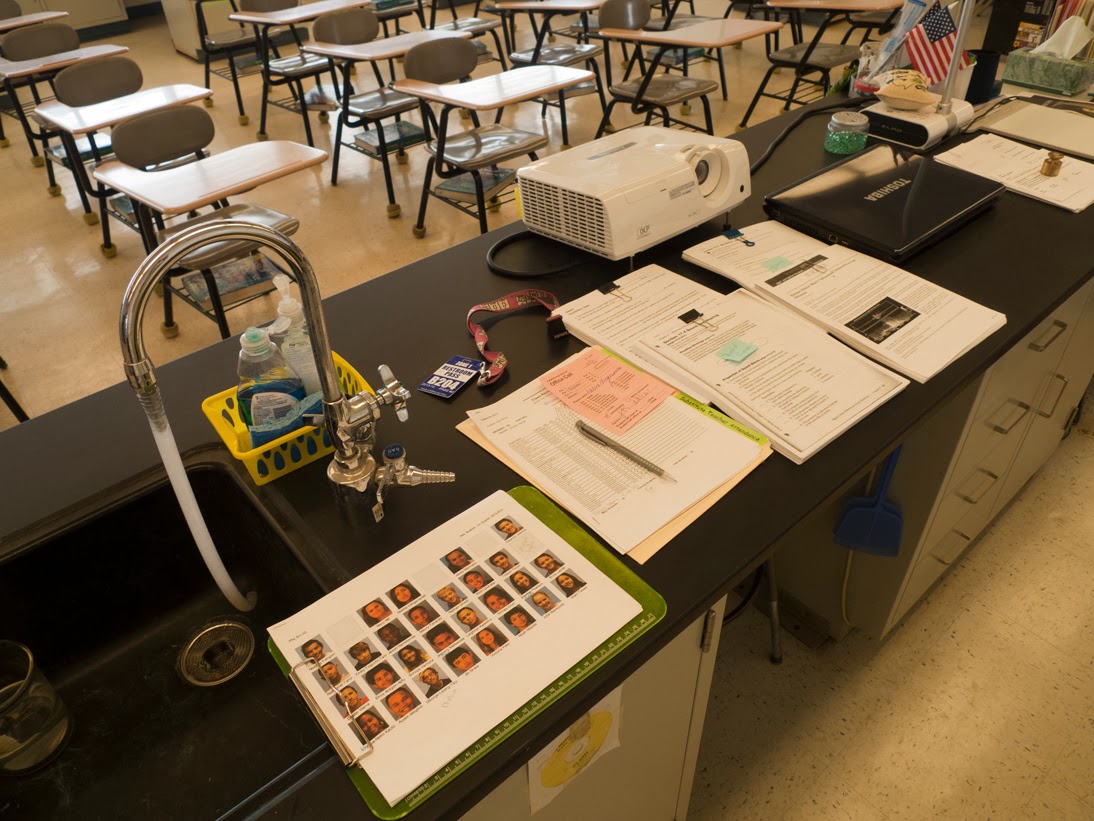
How teachers arrange the furniture in classrooms gives a peek into how teachers teach. Look at these photos taken last year of elementary and secondary classrooms that have different furniture arrangements.Science+room
photo 9
images-4
Note the different arrangements of  desks. In the first photo, rows of movable desks face the front of the classroom where the teacher’s desk is located. The second photo has a horseshoe pattern of tablet armchairs across from one another. The third photo is of an elementary classroom that is chock-full of materials and children working on different activities with adults sitting on the rug and chair working with  individual pupils. And the final photo is one of a secondary classroom arranged in rows where each student has