Latest News and Comment from Education

Tuesday, March 11, 2014

3-11-14 the becoming radical | A Place for a Pedagogy of Kindness by P. L. Thomas, EdD

the becoming radical | A Place for a Pedagogy of Kindness (the public and scholarly writing by P. L. Thomas, Furman University):


Writing Is a Journey: Thoughts on Writing, College, and the SAT
A writer’s writer often ignored is James Baldwin, who examines his drive to write in the context of race: INTERVIEWER If you felt that it was a white man’s world, what made you think that there was any point in writing? And why is writing a white man’s world? BALDWIN Because they own the business. Well, in retrospect, what it came down to was that I would not allow myself to be defined by other p


James Baldwin, The Art of Fiction No. 78
James Baldwin, The Art of Fiction No. 78 INTERVIEWER Do you think painters would help a fledgling writer more than another writer might? Did you read a great deal? BALDWIN I read everything. I read my way out of the two libraries in Harlem by the time I was thirteen. One does learn a great deal about writing this way. First of all, you learn how little you know. It is true that the more one learn


American Hustle: Ignoring Poverty in U.S. Needs More than 50-Year Anniversary

It is 2014, and publications such as Education Week are offering 50th-year anniversary looks at the War on Poverty. It is 2014, and race and racism remain words that shall not be spoken, lingering scars on the American character [1] that are routinely concealed beneath a heavy foundation (something in a Caucasian, please) and a bold but not too flashy shade of red lipstick. It is 2014, and almost


3-10-14 the becoming radical EMPATHYEDUCATES! | A Place for a Pedagogy of Kindness by P. L. Thomas, EdD
empathyeducates: Teaching Students, Missionary Zeal, and the Cult of PersonalityBy Paul L. Thomas, Ed.D. | Originally Published The Becoming Radical. March 9, 2014 As a teacher educator, I now spend much of my spring visiting schools and observing my seniors who are learning to teach in extended field experiences (my university’s version of student teaching). What […]8 by empathy / 9h  3-8-14 the

3-11-14 Perdido Street School Week

Perdido Street School:


Governor Jerry Brown: We Are To Help Teachers, Not Make The Job Into An Obstacle Course
Compare and contrast the governor in California with the governor in New York:Governor Brown took aim at excessive testing in the schools – an ongoing theme of his governorship – and warned lawmakers in Sacramento and Washington not to burden teachers with more demands than they are already experiencing in forceful remarks at the California Democratic Convention in Los Angeles over the weekend. St
Cuomo Sets Up Another Strong Man Over Teacher Evaluations
From Daily Politics: Cuomo also defended his Common Core implementation panel’s recommendation that math and English assessment tests not count toward grade promotion or be put on the permanent records of those in third through eight grades while at time not recommending a delay in applying the new standards to teacher evaluations. He said teacher evaluations are considered an integral part of ref

Christie Under Water In New Poll
So much for Chris Christie's assertion that the public doesn't care about Bridgegate:Gov. Chris Christie has called the George Washington Bridge scandal an obsession of the press that the public doesn’t care about, but two polls released today show the ordeal continues to erode his political support and public image. One survey, the Fairleigh Dickinson University PublicMind poll, showed Christie’s

Cuomo Says Public Education Needs "Disrupting," Common Core Is Just The Thing To Do It
Governor Cuomo today:Under fire from Republican Rob Astorino, the Westchester County executive running for governor and who has called it the “Cuomo Common Core,” the governor was quick to point out that he has nothing to do with the education department. “The education system across the board needs serious reform and has for a long time,” he said. He added: “To the extent this is a moment to brin

Ask Eva Moskowitz About The Attrition Rate At Success Academies
From State of Politics:At 6:30 a.m., Success Academy Harlem Central Middle School scholars will appear on MSNBC’s Morning Joe with their principal, Andrew Malone. Yesterday the hosts of the Morning Joe Clown Show beatup on Mayor de Blasio over the Success co-location issue.Today, they let Eva use the program for more pro-Success propaganda.But one stat never makes it into these mainstream media pr
Teacher On Cuomo Common Core Panel: No Discussion Or Dissent Was Allowed
A tweet last night from the teacher on the Cuomo Common Core panel:I will issue a further statement tomorrow on the sham of @NYGovCuomo CCLS implementation panel. No dissent allowed, no discussion allowed!— Todd Hathaway (@toddjhathaway) March 11, 2014That's Cuomo-style democracy in action.No dissent, no discussion.Findings decided beforehand.Sign it or else. As I noted when the Cuomo Common Core
3-10-14 Perdido Street School Week
Perdido Street School: There Will Be A Political Price For Lawmakers Who Vote To Reelect Incumbent Members Of The Board Of RegentsFrom Jessica Bakeman at Capital NY:Assembly higher education committee chair Deborah Glick said Monday's last-minute interviews of candidates for the Board of Regents are not atypical, despite the fact that the political circumstances surrounding this year's elections a


Shanker Blog » SIG And The High Price Of Cheap Evidence

Shanker Blog » SIG And The High Price Of Cheap Evidence:


SIG And The High Price Of Cheap Evidence

Posted by  on March 11, 2014


A few months ago, the U.S. Department of Education (USED) released the latest data from schools that received grants via the School Improvement (SIG) program. These data — consisting solely of changes in proficiency rates — were widely reported as an indication of “disappointing” or “mixed” results. Some even went as far as proclaiming the program a complete failure.
Once again, I have to point out that this breaks almost every rule of testing data interpretation and policy analysis. I’m not going to repeat the arguments about why changes in cross-sectional proficiency rates are not policy evidence (see our posts herehere and here, or examples from the research literature herehere and here). Suffice it to say that the changes themselves are not even particularly good indicators of whether students’ test-based performance in these schools actually improved, to say nothing of whether it was the SIG grants that were responsible for the changes. There’s more to policy analysis than subtraction.
So, in some respects, I would like to come to the defense of Secretary Arne Duncan and USED right now – not because I’m a big fan of the SIG program (I’m ambivalent at best), but rather because I believe in strong, patient policy evaluation, and these proficiency rate changes are virtually meaningless. Unfortunately, however, USED was the first to portray, albeit very cautiously, rate changes as evidence of SIG’s impact. In doing so, they provided a very effective example of why relying on bad evidence is a bad idea even if it supports your desired conclusions.
To make a long story short, last year, USED released the first year of proficiency rate changes for schools that received SIG grants. The results suggested that there were rate increases among most SIG schools (note that th

Title 1 Services for Students in Private Schools - Improving Academic Achievement (CA Dept of Education)

Title 1 Services for Students in Private Schools - Improving Academic Achievement (CA Dept of Education):


Title 1 Services for Students in Private Schools

Legislation and Resources for eligible private school children.
Pictures of School Children and Classes


Private School Services for Students: Title I requires that local educational agencies (LEAs) provide eligible private school children with Title I educational services or other benefits that are equitable to those provided to eligible public school children. Title I services for eligible private school children must be developed in consultation with private school officials. Eligible students enrolled in private schools receive Title I, Part A services; private schools do not receive Title I, Part A funds. The public school district, where the students reside, is responsible for making these services available for students in private schools.
Legislation External link opens in new window or tab.
NCLB, Title I, Part A, Section 1120, Participation of Children Enrolled in Private Schools.
Resources
Technical assistance through useful Web sites and documents.
Non-Regulatory Guidance External link opens in new window or tab. (DOC)
Guidance issued by the US Department of Education.
Appendix I: Affirmation of Consultation form (DOC; 17-Sep-2004)
An example document taken from the Non-Regulatory Guidance issued by the US Department of Education.
Guidance Document
Guidance document issued by the California Department of Education.
Title I Resource Tool Kit External link opens in new window or tab. (PDF)
Ensuring equitable services to private school children.
Title I Services for Children Enrolled in Private Schools 2013 (PDF; June 2013)
Title I Services for Children Enrolled in Private Schools 2012 (PDF; June 2013)
Provides information on federal equitable services and consultation requirements, as well as information on generating funds, reservation requirements, and student selection criteria. 
Questions: Jyoti Singh | JySingh@cde.ca.gov | 916-319-0372

Private Schools Frequently Asked Questions

Frequently asked questions and requirements regarding private schools in California.

Private Schools and Schooling at Home

Private Schools: Alternatives; Regulations; Selecting a School

  1. What is a private school?
  2. What is the compulsory education law?
  3. What are the exemptions?
  4. How do these exemptions to compulsory attendance work?
  5. What is truancy?
  6. What constitutes a full-time day school for exemption purposes?
  7. How can I learn more about education rules and regulations?
  8. Do the public schools offer alternatives within the public school system?
  9. What is a charter school?
  10. What is a nonpublic school or certified nonpublic school?
  11. Does the California Department of Education (CDE) regulate private schools?
  12. Do any California Education Code (EC) sections apply to private schools?
  13. Does CDE license private schools?
  14. How can I get a teaching position at a private school?
  15. Must private school teachers possess a valid California teaching credential?
  16. How can I locate private schools in my area?
  17. Are there online private schools?
  18. How do private internet-based programs work?
  19. Does the CDE validate private school diplomas?
  20. Does the CDE evaluate or rate private schools?
  21. Do private schools have Academic Performance Index (API) scores?
  22. How do I determine if a private school has high student achievement?
  23. How can I learn about the quality of a private school’s program?
  24. Does the CDE accredit schools?
  25. Are public funds available for private school tuition?
  26. What if my California private school did not file the Private School Affidavit?
  1. What is a private school?
    A private school is a private business or nonprofit entity that offers or conducts full-time instruction with a full complement of subjects at the elementary, middle, or high school level. Private schools function outside the jurisdiction of the California Department of Education (CDE) and most state education regulations. Private schools do not participate in California’s educational accountability system and are directly accountable to students and their parents or guardians, based on the terms of the private school enrollment contract.

    A more detailed discussion of private schools is located in the CDE Fact Book 2009 (pages 102-103) on the CDE Fact Book Web page.

    Information on the definitions of public and private schools is on the CDE Web page Definition of a School - Content.
  1. What is the compulsory education law?
    California's compulsory education law (See EC Section 48200 on the CDE Selected California Education Codes Web page) requires each person between 6 and 18 years of age to attend public, full-time day school and requires their parents or guardians to send them unless legally exempt.
  1. What are the exemptions?

    The two principal exemptions from attending public school are set forth in EC Section 48222, under which children being instructed in a private, full-time day school by persons capable of teaching shall be exempt; and in EC Section 48224, under which children being instructed in study and recitation for at least three hours a day for 175 days each calendar year in the several branches of study required to be taught in the public schools of this state and in the English language by a private tutor or other person holding a valid California teaching credential for the grade level being taught shall be exempt.
  1. How do these exemptions to compulsory attendance work?
    In California, exemption from public school attendance requires enrollment in and instruction of a student by a full-time private school. A full-time private school may include a parent instructing his or her own child at home if the home school meets the criteria applied to other private schools. All private schools must file the Private School Affidavit annually as required by EC Section 33190. Credentialed tutors seeking exemption for a student must offer instruction for at least 3 hours a day for 175 days in a year.

    Students not enrolled in a public school and not exempt by California Education Code may be declared truant by the local school district.
  1. What is truancy?

    Truancy is declared by a public school district when a child misses a defined number of days of school without a valid excuse. (EC Section 48260 et seq.)
  1. What constitutes a full-time day school for exemption purposes?

    California law does not specifically define “full-time” for this purpose. It appears to mean enough hours per day and days per year to offer instruction in the several branches of study required to be taught in the public schools of the state to the same general degree of depth. These branches of study are outlined in EC sections 51210 and 51220. “Full-time” does not include institutions or programs which offer instruction in single subject classes such as language or driver education, nor does it include tutoring of students enrolled in regular public schools.
  1. How can I learn more about education rules and regulations?

    There are local regulations and state regulations. California is divided into county offices of education and public school districts. Your local county and local district offices have policy and procedure manuals and other local resources. For state statute, the California Education Code and Code of Regulations can be accessed through the CDE Laws and Regulations Web page.
  1. Do the public schools offer alternatives within the public school system?

    Yes. Public school districts offer independent study, charter schools, and other alternatives. Look for the questions/answers that follow about public school options or refer to the education options link below. Because all such public school options require enrollment in a public school system, these options satisfy compulsory attendance. Your local public school district can explain public school alternatives.

    For more information about public school alternatives, visit the CDE Educational Options Web page.
  1. What is a charter school?

    A charter school is a public school that may provide instruction in any of grades kindergarten through twelve. A charter school is usually created or organized by a group of teachers, parents and community leaders or a community-based organization, and it is usually sponsored by an existing local public school board or county board of education. Specific goals and operating procedures for the charter school are detailed in an agreement (or charter) between the sponsoring board and charter organizers.

    For more information on charter schools, visit the CDE Charter School Resources Web page or the CDE Fact Book 2009 (pages 100-101) on the CDE Fact Book Web page.
  1. What is a nonpublic school or certified nonpublic school?

    California's nonpublic schools (NPS) are specialized private schools that provide services to public school students with disabilities. EC Section 56034 External link opens in new window or tab. defines a nonpublic, nonsectarian school (nonreligious) as a private, nonsectarian school that enrolls individuals with exceptional needs pursuant to an individualized education program. The tuition of a student in an NPS is paid by the public LEA that places the student in the NPS based on the student’s individual needs. Unlike other private schools, each NPS is certified by the CDE. The federal government also uses the term nonpublic school but as a descriptor for any private school.

    Questions concerning the operation of certified nonpublic schools should be directed to the CDE Special Education Division at 916-327-0141.
  1. Does the CDE regulate private schools?

    No. The CDE has no statutory authority to regulate or monitor private schools or private education, except to the extent they request NPS certification.
  1. Do any California EC sections apply to private schools?

    Yes. While the vast majority of EC sections apply only to public schools, certain sections do apply to private education and private schools. Selected EC sections that pertain to private schools are listed below and on the CDE Selected California Education Codes Web page.
The U.S. Department of Education maintains a current statement of private school regulations External link opens in new window or tab. in each state.
  1. Does CDE license private schools?

    No. In California, no state agency licenses, regulates, or oversees private schools, except for non-public schools as described in #10, above. A private school is a business or nonprofit entity that is required to comply with requirements imposed by the jurisdiction, county, city, or other locality in which it is located, such as zoning, health and safety codes, fire codes, or other local ordinances.
  2. How can I get a teaching position at a private school?

    Private schools are completely independent of CDE. Anyone interested in employment in a private school should contact each private school directly about available teaching positions. A list of California private schools that have filed the Private School Affidavit and have six or more students is on the CDE Private Schools Web page. The list is arranged alphabetically by county and then by school name and includes the contact information for each school listed along with other information that may be useful.

    The Teach California External link opens in new window or tab. Web site has valuable information for anyone interested in teaching at any level in California.
  3. Must private school teachers possess a valid California teaching credential?

    No. EC Section 48222 specifies only that private school teachers be “…persons capable of teaching”. However, many private school teachers do possess current California teaching credentials. An NPS (defined in #10, above) that accepts public school students with individualized education programs must have appropriately qualified and credentialed staff.
  4. How can I locate private schools in my area?

    CDE has two directories for private schools in California. The online Private School Directory can be used to search for private schools and contains more detailed information about each school. This listwhich includes private schools having six or more students that registered with CDE by filing a Private School Affidavit, is located on the CDE Private Schools Web page. The lists on this Web page have been posted annually in the spring since 1999. Each list is an Excel spreadsheet that can be sorted and downloaded.

    A second directory, the California School Directory on the CDE Web site, also includes private schools. This Directorycan be faster and easier to use for some types of searches which require general contact information for a private school.

    Note: A listing in either Directory is not evidence that the entity is a private school. A listing is evidence only that a Private School Affidavit has been filed. Filing the Affidavit does not imply any evaluation by the CDE nor does it indicate any approval by CDE or other government agency.
  5. Are there online private schools?
    Yes. Such virtual campuses can be found through an Internet search. The quality of such schools varies widely.
  6. How do private internet-based programs work?
    Private, fee-based programs offered on the Internet can be found through an Internet search. Programs are located in California and in many other parts of the country. These programs operate with little oversight. Students enroll online. Some programs offer face-to-face meetings with teachers; others are purely virtual and operate almost completely online. Transferability of course credits between private online schools and California public schools and colleges varies widely. Some programs qualify for accreditation by the regional accrediting agency. The regional accrediting agency for California is the Western Association of Schools and Colleges.
  7. Does the CDE validate private school diplomas?
    No. The CDE does not have any authority to monitor or regulate private schools and consequently has no role in determining the validity or acceptability of private school diplomas. Colleges, employers, and military branches have complete discretion as to whether private school credits or diplomas are acceptable. Private high schools that are accredited by the Western Association of Schools and Colleges grant diplomas that generally are universally accepted.
  8. Does the CDE evaluate or rate private schools?
    No. CDE does not have any authority to monitor or evaluate private schools and has no ranking or rating system for private schools.
  9. Do private schools have Academic Performance Index (API) scores?
    No. The API, by law, applies only to public schools.
  10. How do I determine if a private school has high student achievement?
    The CDE does not collect any information on private school student performance nor does it evaluate private school instructional programs. To determine the relative competitiveness of a private school, ask the school’s main office how the school measures student achievement and request copies of any reports of this information.
  11. How can I learn about the quality of a private school’s program?

    When considering a private school, ask the school’s administrator to explain how student achievement is measured and how teachers use assessment information. Private high schools will also have information about college acceptance. For more detailed program quality information, ask to see the school’s profile of standardized test results by grade
  12. Does the CDE accredit schools?

    No. The CDE does not accredit either public or private schools. Accrediting is done by a variety of accrediting organizations.

    The Western Association of Schools and Colleges (WASC) is an example of an established organization that accredits private schools. WASC accreditation generally ensures that the credits and diploma awarded by the schools it accredits will be accepted by colleges and prospective employers. You can review the WASC External link opens in new window or tab. list of accredited schools on their Web site or by calling 650-696-1060.
  13. Are public funds available for private school tuition?

    No. There are no state programs in California that offer public funding for private school tuition, except where a student with a disability is placed in a non-public school by a public school district.
  14. What if my California private school did not file the Private School Affidavit?
If a private school does not file an Affidavit, the CDE will have no record of this school, and the students attending the private school will not be exempt from compulsory public school attendance.

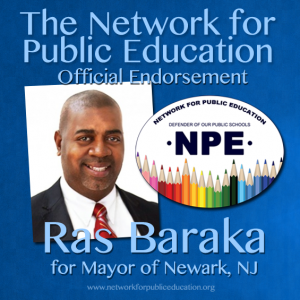
Ras Baraka - educator, progressive, candidate for mayor

Ras Baraka - educator, progressive, candidate for mayor:


npe endorsement ras baraka


Sometimes we encounter a unique voice, even in politics, one which we might not be expecting, but to which we should pay attention, and even more, give our support.
On Saturday I was one of a small group of DC-area education bloggers who had a unique experience.  We were invited guests for a political fundraiser in the Langston Hughes room of the original Busboys and Poets, at 14th and V Streets NW, followed by a sitdown with the candidate.
It might have seem an unusual setting.  After all, this was a candidate for mayor of a city several hours away.  Why should we be interested?
I did say we were educational bloggers.  This candidate has not only served as vice-mayor and a city councilman in the city in question.  He has also been a teacher, an administrator, and principal of a high school.  He is on leave from the last position while he runs for mayor.
The city is Newark NJ.
The candidate is Ras Baraka.
Let me start with this -  I have never met a candidate for relatively high public office with as thorough and detailed an understanding of the role of and issues related to public education.
I want this community to have an understanding of why I feel that way, in the hopes that I can persuade you that his election might be one of the most significant achievements not only for those of us commited to public education, but to all who view themselves as Progressives, who want to see a more Progressive approach to public policy and governance in our nation.
Please keep reading.
First some background.  Ras Baraka was born in 1970.  He is the son of the playwright Amiri Baraka (born LeRoi Jones) and the poet Amina Baraka, was raised in Newark, has a degree in political science from Howard University and a masters in Education Supervision from St. Peters University in Jersey City.  He began his educational career as a middle school English teacher, became an administrator at several different schools in the district, and has been the very 

Testing, Truth, and Consequences - Bridging Differences - Education Week

Testing, Truth, and Consequences - Bridging Differences - Education Week:


Testing, Truth, and Consequences

Robert Pondiscio of CitizenshipFirst writes again to Deborah Meier today.
Not so fast, Deb.  
As much as I'm eager to find common ground with you, I'm not quite ready to agree with your summary, "we both oppose making profits from educating our nation's children." That's an impractical stance and an impossible standard. Our classrooms are filled with the products of profit-making industries, from smart boards and laptops to loose leaf paper and No. 2 pencils.  I'm hard-pressed to think of a single object I can touch in any classroom that someone, somewhere isn't "making profits from."  It doesn't trouble me in the least.  
As we've discussed, the very different incentive structures and value systems of business and education make me skeptical that a for-profit system of schools can be successful (I'm struggling to think of one), but I won't be joining you on the barricades to protest their mere existence.
If a for-profit school can produce good outcomes for students and turn a profit at the rate a state or municipality sees fit to pay, I see no reason to criticize or ban it.  I've been utterly consistent about my view of this: The public's interest lies in ensuring a well-educated citizenry.  Under whose roof or control that happens is a secondary concern.
Having observed that education responds poorly to incentives and changing market conditions let me now give credit to a high-profile attempt to do precisely that.  The College Board last week 

NYC Educator: What About the War on PUBLIC Schools?

NYC Educator: What About the War on PUBLIC Schools?:


What About the War on PUBLIC Schools?

Everywhere you turn it's poor Eva Moskowitz. How can mean old Bill de Blasio treat her so shabbily? After all, the woman has to scrape by on 499K per annum, and that's only 99K more than President Obama earns. It was certainly poor judgment for Carmen Fariña to say the kids were on their own, but she's since bent over backwards to accommodate.

Yet for 12 years I've watched school after school close. I don't think there's a single comprehensive high school left in the Bronx. All over the city neighborhood schools have disappeared, replaced by little academies, or charter schools. When one school fell, they'd move the high-needs kids to another, and soon it was a game of dominoes.

When Sandy hit my town, we gathered in the local high school to hear our mayor, and a lawyer from New Orleans told us about handling reluctant insurance companies. Do you suppose some neighborhood will gather at the new Michael Bloomberg School of Basket Weaving to discuss some community issue?

I've faced Mayor Bloomberg's war on public schools. Like hundreds of other community members, I spoke at PEP meetings. I spoke at school closing hearings. I watched a two-minute stop watch tick the seconds away as I spoke truth to Mayor Bloomberg's minions, who ignored me, parents, clergy, students, politicians, and countless other teachers. I don't recall any news reporters 

Mike Klonsky's SmallTalk Blog: Let Teachers Teach!...Moses, Ayers, Ravitch, Cunningham...

Mike Klonsky's SmallTalk Blog: Let Teachers Teach!...Moses, Ayers, Ravitch, Cunningham...:


Let Teachers Teach!...Moses, Ayers, Ravitch, Cunningham...

At yesterday's Let Us Teach rally in Pilsen protesting CPS threats to punish teachers who support parents and boycott useless standardized testing (h/t Michael Harrington)

Moses... Good news from DePaul College of Ed Dean Paul Zionts. Civil Rights leader and Algebra Project founder Bob Moses will be this year's commencement speaker.

THANKS to Bill Ayers for being an inspiring guest speaker in last night's final class of the quarter. Congratulations are also in order for Bill who has been voted to receive the Lifetime Achievement Award at the upcoming AERA convention in Philly on April 4 at 6 pm. Bill says he's worried that such awards mean you're at the end of the line. But I think his best is yet to come.

Last week's NPE Conference in Austin ended withDiane Ravitch's call for congressional hearings on the misuse and abuse of standardized tests used for high-stakes purposes. The Washington Post's