Latest News and Comment from Education

Tuesday, January 14, 2014

1-14-14 Fred Klonsky | Daily posts from a retired public school teacher

Fred Klonsky | Daily posts from a retired public school teacher who is just looking at the data.:

#5


Thousands of teachers in Puerto Rico strike against pension cuts.
Thousands of teachers across Puerto Rico walked off their jobs Tuesday in a noisy two-day strike over cuts to their pensions that the island’s government says are necessary to avert financial disaster but that educators say will force many of them into poverty. The teachers gathered with tambourines, cowbells and bullhorns outside public schools across the island on the first day of classes afte


Real world math.
“I do not understand your last post.  How do you figure the $10.00,” writes a friend about my assertion that SB1 means $10 an hour for retirees. That’s Squeezy’s proposal for a minimum wage. Let me do the real world math. If the average retiree is getting $48,000 a year now, what will that be worth in 20 years. Why 20 years? Because pensions are all about future earnings. The end to our cost of li
IEA and IFT joint statement on Special Needs class size limits.
  Joint letter from Cinda Klickna, President, Illinois Education Association, and Dan Montgomery, President, Illinois Federation of Teachers. The IFT, IEA and our members oppose the State Board’s proposed 226.730 Staffing Plan. We believe in providing students with disabilities access to the most effective and appropriate education within the least restrictive environment. We further believe all
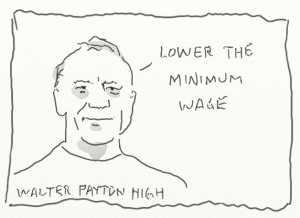
I’m thinking about the minimum wage and my pension.
Nothing good will emerge from the race for Illinois Governor. No matter who wins. I was driving home from the gym yesterday afternoon and there was another discussion of Bruce Rahmer’s disastrous comments on the topic. The fact is that in spite of all the shouting about Bruce Rahmer’s flip-flop, none of the Republican candidates support raising  the minimum wage. In fact they don’t support a mini
1-13-14 Fred Klonsky | Daily posts from a retired public school teacher
Fred Klonsky | Daily posts from a retired public school teacher who is just looking at the data.: Keeping retirement weird. 450 years of teaching experience.When I retired from teaching in June of 2012, I walked out of my building on the last day of school with nothing in my hands. Anne picked me up and we drove to the airport. All the retirement celebrating had been done. My union honored me and

1-14-14 Ed Notes Online

Ed Notes Online:


Videos: PS 106
The fancy prom.video I shot at the school on Jan. 13, 2014

  
1-13-14 Ed Notes Online
Ed Notes Online: The Corporate Ed Reform DogExclusive: PS 106 Library Funds Diverted by Sills as Llloyd-Bey Ignored ComplaintsI'm heading down to PS 106 right now for The Wave - I was just interviewed in my house by Telemundo who sent their truck over to the school. I just got a call from a teacher who told me how the school was allocated about 3 grand a year for books but the books never arrived.

1-14-14 Perdido Street School

Perdido Street School:


Shelly Silver Backs John King, Says He "Has Confidence" In Merryl Tisch
So much for relying on the Legislature to put a stop to the ravages being caused by the SED/Regents reform agenda:Assembly Speaker Sheldon Silver told reporters in Albany on Tuesday there should be a slower implementation of the Common Core standards, but declined to say if there should be a legislative fix to its issues. Rather, the speaker said he is waiting to see the implementation recommendat
Surprise, Surprise - Cuomo's Ed Reform Committee Calls For Cuomo's Preferred Reforms
From Jessica Bakeman at Capital NY:A panel of education experts recommended expanding pre-kindergarten, boosting technology in schools and rewarding high-performing teachers with financial incentives in a long-awaited report commissioned by Governor Andrew Cuomo.Cuomo designed his education priorities last year and this year based on the commission's recommendations. The final report is four month


Christie Calls For Longer School Days, Longer School Year
From Capital NY:Christie, addressing the 216th session of the legislature in the Assembly Chambers of the State House in Trenton, will argue that despite improvements in the troubled schools of Newark and Camden, the state needs to take bigger and broader steps to adjust its approach to K-12 education to address the new competitive world. He’ll say that the school calendar is antiquated, both educ

Did Merryl Tisch Just Refuse To Back John King?
Dunno, maybe I'm just cynical, but what I didn't hear in these Tisch statements sounds louder to me than what I did hear:ALBANY—State Board of Regents chancellor Merryl Tisch won't “dignify” a response to whether she supports state education commissioner John King, calling a statewide teachers' union's plan to take a no-confidence vote against him “politics” and a “sideshow.” At a Regents meeting

1-13-14 Perdido Street School
Perdido Street School: Again I Ask, Why No Blame For Bloomberg And Walcott?The Post does another story on horror school PS 106 this morning:Kids at Queens’ notorious “School of No” have been forced to pay for a bizarre fifth-grade party at which their principal makes them dress up as little brides and grooms, The Post has learned — as the DOE announce that it would probe conditions at the school.


The Hidden Curriculum - Bridging Differences - Education Week

The Hidden Curriculum - Bridging Differences - Education Week:

The Hidden Curriculum

Deborah Meier continues her conversation with Robert Pondiscio of CitizenshipFirst today.


Dear Robert,
1. Public Education.  While I like many standalone charters—mom-and-pop shops—run by the constituents of the school's "community," I see no reason why the schools have to go charter to have that independence.
The three case stories I described last week, as well as my experience in District 4 in the 1970s and 1980s, reminds me that the best charters are just like the best public schools.   
I am not for publicly funding charter chains that are essentially accountable to their "owners," not their public.  If your view is based on a general aversion to public institutions we obviously won't find a compatible compromise.  That would be too bad.  
2.  Who decides what? We might still agree on some guidelines for thinking through who should decide what: professionals, families, or the public?  Choice doesn't solve this.  Especially if it's the kind of choice in which parents, teachers, and kids who have complaints are told, "So, leave." 
If we could stop pretending there's one right answer to what a "good school" is, including our definition of success, we could learn from each other. An independent agency collecting data—tests, interviews, site visits might make sense, too.  Are we on the same page so far? 
However, I fear that you fail to see how an imposed Common Core with its testing component, as well as charter chains, undermine the freedom to make critical decisions that we both cherish.
3.  What can we do? What makes for a strong school lies somewhere else: in how the school 

On Failed DC Chancellor Michelle Rhee's Latest State-Policy Report Card, No 'A' Grades Once Again - State EdWatch - Education Week

On Michelle Rhee's Latest State-Policy Report Card, No 'A' Grades Once Again - State EdWatch - Education Week:

On Michelle Rhee's Latest State-Policy Report Card, No 'A' Grades Once Again

StudentsFirst, the K-12 advocacy organization run by Michelle Rhee, the former District of Columbia schools chancellor, on Tuesday released its "State Policy Report Card" for 2014, giving states letter grades for their education policy environment. StudentsFirst, based in Sacramento, Calif., favors school choice, report cards for schools, performance pay for teachers, and the elimination or significant alteration of many established teacher-tenure systems. 
As I say in the headline, no state received an A grade on this latest report, the group's second, just like in 2013. The only two states to receive B grades last year, Florida and Louisiana, once again are the only two states this year to get Bs (actually a B- for both states).  But what's also striking about the list is that no state's overall grade dropped. In fact the number of states receiving F grades declined from 11 in the last report to seven in this lastest one. The most prominent state to leave the report card's doghouse is California, which improved along with Mississippi, New Hampshire, and South Dakota. Nevada and Georgia also improved from Ds to Cs.
(You may remember that last year, in reaction to StudentsFirst flunking California, the state's chief 

Harold, William, Victor, and Me (Part 1) | Larry Cuban on School Reform and Classroom Practice

Harold, William, Victor, and Me (Part 1) | Larry Cuban on School Reform and Classroom Practice:

Harold, William, Victor, and Me (Part 1)

I want to tell you about three high school students I have taught.
First, Harold. Lanky, always stylishly dressed and so clever, he drove me up one of my four walls. Harold was 19 and in the 11th grade. He had failed all of his subjects the year before he entered my U.S. history class. Yet he scored above national norms on college board exams.
Harold was never, and I mean, never on time to class, that is, when he chose to come to class. About five minutes after the bell, he would bang through the rear door of the room, clip-clop over to his seat. Passing a friend, he would lean over, hand cupped to his mouth and whisper something. Anyone in earshot would laugh uproariously. Harold had arrived. Another lesson interrupted.
Whenever the class got into meaty discussions with students interacting over ideas raised in the lesson, Harold was superb in his insights and arguing skills. He used evidence to back up his words without any encouragement from me. He revealed a sharp, inquiring mind.
But this did not happen often. What happened most of the time was that Harold would wisecrack, twist what people say, or simply beat a point to death. When 

Planet Ponzi | EduShyster

Planet Ponzi | EduShyster:

Planet Ponzi


Rocketship Education’s plan for intergalactic domination hits a rough patch
Once upon a time there was a boldly disruptive innovator who had a boldly disruptive idea. Why not turn old school schools into rocketships by fitting them with thrusters and boosters, then send them soaring into outer space where, thanks to zero gravity that keeps expectations buoyant, there is no achievement gap? Strap yourself in reader. We’re headed up, up and away to see for ourselves how this space-age disruption is faring.
Stratosphere or bust
The audacious exercise in audaciousness was off to an audacious start. Fueled by an explosive combo of Silicon Valley funding and free advertising from *journalists* who found the use of rocket-related terminology irresistible, the super cool new rocketships blasted off towards the stratosphere. Before long, ground control envisioned a whole fleet—no wait—a whole galaxy of rocketships, each populated by rocketeers excelling like never before.Why not eight schools serving up to 4,000 children in Milwaukee. Why not schools in Tennessee, Louisiana, Indiana and Washington D.C.?  Why not 2,000 schools in 50 cities, serving 1 million rocketeers? 
Testing, testing
But space colonization turned out to be rather more challenging than expected. For one thing, sending all of those rocketships into orbit was an expensive business, meaning that new 

Cramming is indisputable proof of the superficiality of most classrooms in America | Dangerously Irrelevant

Cramming is indisputable proof of the superficiality of most classrooms in America | Dangerously Irrelevant:

Cramming is indisputable proof of the superficiality of most classrooms in America

Cramming
Marion Brady says:
The Procedure: 1. Take notes during lectures, and hi-lite key sentences in the textbook. 2. Before a big test, load the notes and hi-lited passages into short-term memory. 3. Take the test. 4. Flush short-term memory and prepare for its re-use.
The Procedure, of course, is called “cramming.” Do it well and it leads steadily up the academic ladder.
But here’s a question: Does The Procedure have anything do with educating?
Learning – real LEARNING – starts when, for whatever reason, the learner wants it to start. It proceeds if the aim is clear and what’s being learned connects logically and solidly to existing knowledge. It’s strengthened when mistakes are made, clarifying the potential and limitations of the new knowledge. It’s reinforced when it’s put to frequent, immediate, meaningful, real-world use. It becomes permanent when it’s made part of the learner’s organized, consciously known “master” structure of 

The Shriver Report – Woman Doing It All: Allie Winans

The Shriver Report – Woman Doing It All: Allie Winans:

The Shriver Report - Reporting from the frontlines of our changing lives


Breaking Through the Maternal Wall: The Time is Now
© Kirill Zdorov – Fotolia.com It’s time.  It’s time to talk about motherhood, and our changing nation, front and center.  It’s time to talk about the fact that 81% of women in America have children by the time they’re forty-four years old, yet too often the adverse economic impact of motherhood is hidden and ignored. It’s time to talk about the fact that our labor force is now 50% women for the fi
Women Pushing Past the Brink
  By Alejandra Have your ever felt that the whole world was suppressing you from trying to fulfill your aspirations? Are you convinced that you are alone in a world of solitude, where you depend only on your instincts and hope for a miracle? I have witnessed my close cousin, Elizabeth, standing on the verge of many emotional breakdowns, but she stops the tears from rolling down her cheek, for she
Have You Ever Been on the Brink? (VIDEO)
  GlobalGirl Reporters in Los Angeles perform an original poem about what it means to “be on the brink” as a teenage girl.  This was shot on the streets of Santa Monica. This video was originally produced for and by GlobalGirl Media.  GlobalGirl Media seeks to address this disparity by supplying the equipment, education and support necessary to help young women become digital and blog journalists
Living on the Brink: A Poem
By Maya Muldrew Have you ever been on the brink? Uncomfortable with the thoughts that you think The struggle to survive while trying to fit in Living under the radar dealing with deep aberration The life of a young girl who’s finding it hard to make it Being deserted by the people who she thought she had faith in Going through the same fear of falling off the edge Not knowing if her loved ones wi
The Irony of Today’s College Admissions
By Ariana Seymore “My dream school is Stanford,” is one of the most common sentences that has been coming out of my mouth for the past few months now that I am in the middle of my college application process. I haven’t been too worried about paying for college since most of the schools I’m applying to have great financial aid that meet one hundred percent of my expected family need. A couple of w
Woman Doing It All: Allie Winans
The Shriver Report commissioned a team of award-winning photographers to crisscross the country, capturing a day in the life of women living on the brink. The team was led by photojournalist Barbara Kinney and included Melissa Farlow, Melissa Lyttle, Barbara Ries, Callie Shell, Jan Sonnenmair, and Ami Vitale.

Mike Klonsky's SmallTalk Blog: It's silly to pretend Common Core is not a curriculum

Mike Klonsky's SmallTalk Blog: It's silly to pretend Common Core is not a curriculum:

It's silly to pretend Common Core is not a curriculum

"The Common Core has become a rallying cry for fringe groups that claim it is a scheme for the federal government to usurp state and local control of what students learn. An op-ed in the New York Times called the Common Core "a radical curriculum." It is neither radical nor a curriculum." -- Arne Duncan


Well, Arne Duncan got it half-right. It's certainly not radical.

I half expect Duncan himself to slam me (call me "silly," a "suburban mom" or a "fringe group"?)  for writing this but here goes.

Disinformation about the Common Core, coming straight from the D.O.E. and spread across a compliant media, includes the myths that standards are home-grown and that they are simply standards and NOT curriculum.

In an unusually long Huffington blog piece, ed  writer Joy Resmovitz reports:
Each state sets its own learning standards, and those get translated through thousands of districts and schools and teachers. The Core is supposed to unify this patchwork of efforts not only across states, but across the country. .And contrary to popular belief, it's not a curriculum: School systems and teachers can choose their own instructional materials, as long as students know what the Core says they should know by year's end.
But curriculum is all about determining and deciding what's most worthwhile to teach and