Latest News and Comment from Education

Friday, March 15, 2013

LISTEN TO DIANE RAVITCH 3-15-13 Diane Ravitch's blog | A site to discuss better education for all

Diane Ravitch's blog | A site to discuss better education for all:

Click on picture to Listen to Diane Ravitch


Yes, It Is OK to Teach Literature in English Class!

Kay McSpadden, a high school English teacher in York, S.C., was told by school officials that English classes would have to stop teaching literature due to the new Common Core standards. She knows that isn’t true, and David Coleman (“the architect of the Common Core standards”) has said it isn’t true. But the word reaching the field is that informational text is supposed to replace literature.
For no good reason, the Common Core standards decree that the balance between literature and informational text in elementary school should be 50-50, and in the upper grades it should be 70% informational text and 30% literature.
This is nutty on its face. First of all, the ratios have no rhyme or reason (oops, forget the reference to rhyme,


Florida Teacher: A Fruitless Pursuit of My VAM Rating

Please read the link in this comment. Kafkateach has been trying, again and again, to find out what her VAM score for 2011-2012 was. No one will tell her. No one knows. It is being calculated. It is being recalculated.
If it takes two years to find out what your evaluation score is, what value does VAM add?
Will someone be sure to let Arne Duncan and Bill Gates know?

She writes:

The new and improved teacher evaluations in my district have proven to be nonexistent. It’s March 12th 2013 and we still have yet to receive evaluations and our VAMs for the 2011-12 school year. The state, the district, and the union have been tossing around the stinking pile of value added bogosity like a hot potato. Nobody wants to 

What Is the Evidence for Common Core?

When No Child Left Behind was passed, the law contained dozens of references to evidence-based policy or practice.
But NCLB itself was not based on evidence. It was based on a political campaign claim about a “miracle” in Texas. The miracle was spin and hype. It didn’t happen. After ten years of NCLB, the nation has not experienced a miracle. It has experienced cheating, narrowing of the curriculum, gaming the system, and amnesia about the 

Teacher: Kopp Can’t Connect the Dots

A teacher in California heard Tavis Smiley and Cornel West interview Wendy Kopp, Jonathan Kozol, and me–in separate interviews–and this was her reaction. She wrote a post called “TFA can’t connect the dots.”
Here is a link to the interview with Kopp.
link to the interview with me.
link to the interview with Jonathan Kozol. I am not sure if this is the right link, as it is a panel discussion on poverty, not the 2:1 conversation found in the other links.

Providence Student Union to Adults: Take the Test

Members of the Providence Student Union persuaded at least 50 adults to take the high school graduation test this Saturday.
One who took it early was State Senator Gayle Goldin. She fears she didn’t do very
well.
This is a stellar example of creative student protest. No one was injured. They are making their point well and getting great media attention.

How Many Reformers Does It Take to Fix a School?

John J. Vial has written a hilarious spoof of school reform. You will enjoy reading it

Don’t miss Diane Ravitch next week! « The Progressive Pulse

coopmike48 at Big Education Ape - 11 hours ago
Don’t miss Diane Ravitch next week! « The Progressive Pulse: Don’t miss Diane Ravitch next week! Post on March 13, 2013 by Rob SchofieldNo Comments [image: Diane Ravitch]America’s leading spokesperson for public education, Diane Ravitch, will be in Raleigh*next Thursday March 21* to headline an NC Policy Watch Crucial Conversation luncheon. Diane is, among other things, the author of several books including “The Death and Life of the Great American School System: How Testing and Choice Are Undermining Education,” a professor at NYU, a former Bush I administration official and a pro... more »

MORNING UPDATE: LISTEN TO DIANE RAVITCH 3-14-13 Diane Ravitch's blog | A site to discuss better education for all

coopmike48 at Big Education Ape - 11 hours ago
Diane Ravitch's blog | A site to discuss better education for all: [image: Click on picture to Listen to Diane Ravitch] Big Data and Your Child by dianerav Here is a good account of the plans that Bill Gates and Rupert Murdoch have for your child’s personal information. Hey, the data will generate a $20 billion industry. Not for you, of course. Leave a comment, if you are do inclined. Father Sends Email to State: DO NOT RELEASE MY CHILD’S DATA by dianerav Louisiana has agreed to turn over the confidential personal data of all its students to a corporation created by the Gates Foun... more »

Persepolis off CPS classroom shelves. No explanation given. | Fred Klonsky

Persepolis off CPS classroom shelves. No explanation given. | Fred Klonsky:


Persepolis off CPS classroom shelves. No explanation given.

The story of the removal of Persepolis from CPS classrooms and libraries gets stranger and stranger.
One CPS teacher wrote me:  The book is included in the Common Core curriculum for both 7th grade and 11th grade, so there’s no way for the Board to plausibly claim the book was ordered “by mistake.”
-Fred
I’m a CPS librarian very worried about the possible banning of the book Persepolis. We received the email below today, after HS librarians raised the issue days ago on our listserv. We have a CPS listserv for librarians, but a friend of mine tried to comment on this issue and was censored from discussing the issue further on this listserv.  We were also told it was Fullerton Network where the book was being removed.
-N


CPS book banning.

504280418xsjvla_fs
Photo: CPS Chatter.
Is there a free speech storm brewing at Lane Tech?
Here is what I am hearing.
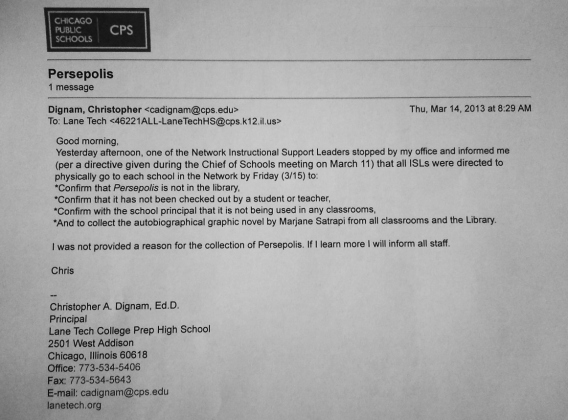
CPS suits apparently sent a directive to Lane (and how many other high schools?) on March 13th, 2013 to remove copies of the graphic novel, Persepolis by Marjane Satrapi.
Persepolis deals with the Iranian Revolution and issues of intolerance. The author wrote a sequel. An award winning animated movie was made in 2007.
But the staff at Lane Tech’s library were directed to remove the book from their shelves.
I have been told that some students reported the removal of Persepolis in a journalism course. As reporters, those students called CPS central offices to try to find out what had happened and why the books were being removed.
On March 14 Lane staff members received the following email:
Yesterday afternoon, one of the Network Instructional Support Leaders stopped by my office and informed me (per a directive given during the Chief of Schools meeting on March 11) that all ISLs were directed to physically go to each school in the Network by Friday (3/15) to:*Confirm that Persepolis is not in the library,*Confirm that it has not been checked out by a student or teacher,*Confirm with the school principal that it is not being used in any classrooms,*And to collect the autobiographical graphic novel by Marjane Satrapi from all classrooms and the Library.I was not provided a reason for the collection of Persepolis. If I learn more I will inform all staff.
Are there legal issues involved in book banning at CPS?
One teacher shared this:
Board of Education vs. Pico in 1982 states that is illegal to remove a book from a high school library. This, effectively, is a violation of the Freedom of Speech. Board of Education v. Pico, 457 U.S. 853 (1982), was a case in which four Justices of the United States Supreme Court concluded that the First Amendment limits the power of local school boards to remove library books from junior high schools and high schools, four Justices concluded the contrary (with perhaps a few minor exceptions), and one Justice concluded that the Court need not decide the question.
News on social media boards yield that CPS is claiming that there was a set of new books sent to schools and the distributor included copies of this one by mistake. Since CPS hadn’t paid for them, schools were asked to pull the books and send them back. “a mix-up’. The books, in fact, were purchased some years ago by an English teacher when she applied (and received) a grant to pay for them.
More to come. I’m sure

Dramatic dip in ‘pink slips’ given to teachers | EdSource Today

Dramatic dip in ‘pink slips’ given to teachers | EdSource Today:


Dramatic dip in ‘pink slips’ given to teachers - by Susan Frey and John Fensterwald

Louisiana Educator: Ravitch Exposes Reform Myths

Louisiana Educator: Ravitch Exposes Reform Myths:


Ravitch Exposes Reform Myths

Diane Ravitch visited Baton Rouge yesterday, and participated in a forum with BESE president Chas Roemer sponsored by Leaders With Vision.  In this forum and in a town hall meeting with teachers later in the afternoon Dr Ravitch discredited the myths upon which the Jindal education reforms are based.

To summarize, Ravitch used the latest educational research findings to point out that (1) vouchers have never improved education, and in the longest running voucher program in Milwaukee have actually resulted in substandard results (2) Charter schools generally perform worse than average pubic schools and are creating chaos in school systems all over the country (3) Closing schools in poor communities has become an epidemic that dislocates and damages the education of at risk students (4) Virtual charter schools are the worst performing schools in the country and are draining public school systems of vital funding while making their owners rich. (5) Evaluating teachers using student test scores is not educationally sound and is based on junk science. (6) Merit pay for teachers has never been proven to work in almost 100 years of testing. The most 

The Seductive Lure of Big Data: Practitioners Beware | Larry Cuban on School Reform and Classroom Practice

The Seductive Lure of Big Data: Practitioners Beware | Larry Cuban on School Reform and Classroom Practice:


The Seductive Lure of Big Data: Practitioners Beware

Big Data beckons policymakers, administrators and teachers with eye-popping analytics and snazzy graphics. Here is Darrell West of the Brookings Institition laying out the case for teachers and administrators to use Big Data:
Twelve-year-old Susan took a course designed to improve her reading skills. She read short stories and the teacher would give her and her fellow students a written test every other week measuring vocabulary and reading comprehension. A few days later, Susan’s instructor graded the paper and returned her exam. The test showed that she did well on vocabulary, but needed to work on retaining key concepts.
In the future, her younger brother Richard is likely to learn reading through a computerized software program. As he goes through each story, the computer will collect data on how long it takes him to master the material. After each assignment, a quiz will pop up on his screen and ask questions concerning vocabulary and reading comprehension. As he answers each item, Richard will get instant feedback showing whether his answer is 

Why English spelling is so messed up | toteachornototeach

Why English spelling is so messed up | toteachornototeach:


Why English spelling is so messed up

imqwesWhy English spelling is so messed up
The explanation may not comfort you, but it may at least 

make you see the language as less arbitrarily maddening
by Arika Okrent
If you’re a kid learning how to write, or an adult speaker of a language with sensible spelling, English spelling can seem like a cruel prank.
And even if you’re a completely literate adult native speaker of English, you will still run into situations that make you wonder how English spelling ever got so messed up. Here are some answers for the next time you clutch your hair yelling, “WHYYYYYYYY?!?!?” They may not comfort you, but they may make you see English as less of an arbitrary meanie and more of a victim of history.
1. Spelling was established while big pronunciation changes were underway Before the printing press came along, there was a lot of flexibility in English spelling. Look at some of the ways beauty used to be spelled:

Aspire surrenders benefit charter status under settlement terms SI&A Cabinet Report – News & Resources

SI&A Cabinet Report – News & Resources:


Aspire surrenders benefit charter status under settlement terms

Aspire Charter Schools will surrender its statewide benefit charter status under terms of a settlement agreement reached today between the charter operator, the state board of education and the group of education advocates that brought the lawsuit.
Aspire will also be ineligible to seek statewide benefit charter status for five years and, along with SBE, will pay $300,000 – $150,000 each – in attorney’s fees and court costs.
“Today’s settlement is an important victory for parents and children across the state. It is important that all charters – whether locally approved or state approved – meet the standards established in the Education Code and comply with the law,” said Keith Bray, director of the Education Legal Alliance and general counsel of the California School Boards Association, the two groups who led the legal fight against Aspire. “As a public school option, statewide benefit charter schools must demonstrate, at the time of application, the same thoroughness and rigor expected of charter schools overseen by local educational agencies.” 
The California Teachers Association, the Association of California School Administrators and Stockton Unified School 

State board adds support for CORE’s NCLB waiver application

Despite concerns about the role California could be asked to play, state board of education members on Thursday elected to send a letter urging federal support of an application by a coalition of school districts for relief from the sanctions of the No Child Left Behind Act.

Open Letter to Parents of Public Schooled Children | Truth in American Education

Open Letter to Parents of Public Schooled Children | Truth in American Education:


Open Letter to Parents of Public Schooled Children

This fall as your buy your school supplies, tennis shoes, and backpacks, make sure you do your homework on the shift that has taken place within the halls of public schools across this nation. Common Core State Standards (CCSS) are creating a dark future for education and parents must educate themselves on these new standards and their radical implications.
What you need to know about CCSS:
1) These standards claim to be “rigorous” and will prepare your child for “college and career”. But upon review you will find that these standards will prepare your child with empty skill sets and will teach them what to think, not how to think. They will also foster “teach to the test” practices!
2) These standards claim to be “state led”, but this is one of the largest myths of CCSS. Truth is CCSS were initiated by private interests in Washington, DC, without any representation from the states. Eventually the creators realized the need to present a façade of state involvement and therefore enlisted the National Governors 

When Common Core News Becomes Propaganda

The Pittsburgh Tribune-Review reports that the Pensylvania State Board of Education adopted the Common Core State Standards. Actually report isn't entirely accurate as you will see.
As expected, the state Board of Education on Thursday adopted a more rigorous curriculum known nationally as the Common Core Standards.
The board also voted to require students to pass the Keystone Exams before they graduate from high school.
The Common Core Standards in English, arts and mathematics will take effect next school year. More than 40 states have adopted or are considering some version of Common Core, which has generated controversy elsewhere but largely escaped opposition here.
The class of 2017 will be required to pass three Keystone Exams: algebra I, biology and literature; the class of 2019 will be required to pass four: algebra I, biology, literature and composition; and 

UPDATE: Daily Kos: Robinson + Krugman: After the Flimflam

Daily Kos: Krugman: After the Flimflam:


Eugene Robinson asks "Questions from a ‘Dirty War’"

in this column from this morning's Washington Post.
By now increasing numbers of people are aware and demonstrating some concern for the role the then Jesuit Provincial supervisor played during Argentina's "Dirty War."  Robinson puts in bluntly at the beginning of his column:
They are impolite questions, but they must be asked: What did Jorge Mario Bergoglio know, and when did he know it, about Argentina’s brutal “Dirty War” against suspected leftists, in which thousands were tortured and killed? More important, what did the newly chosen Pope Francis do?
 The link goes to a Post story in which the new Pope's authorized biography argues that he took actions that saved lives.  Before returning to Robinson's column, and also in providing some of the context in which he writes, allow me to quote two paragraphs from that story:  
But others say Bergoglio’s rise through the Argentine church since then has put him in many positions of power where he could have done more to atone for the sins of Catholic officials who did actively conspire with the dictators. Some priests even worked inside torture centers, and blessed those doing the killing.And now that Argentina is actively putting former dictatorship figures on trial for human rights violations, they say he’s been more concerned about preserving the church’s image than providing evidence that could lead to convictions.
Please keep reading.


Krugman: After the Flimflam

begins like this:
It has been a big week for budget documents. In fact, members of Congress have presented not one but two full-fledged, serious proposals for spending and taxes over the next decade.
As it happens, and as one discovers by reading Krugman's entire New York Times column, both "full-fledged, serious proposals" are by Democrats, those in the Senate, and those in the Congressional Progressive Caucus.Krugman acknowledges that 3 proposals were presented this week, but the third was not serious, that it was essentially a cruel joke.  Krugman reminds us that in 2010 when others were treated Ryan as a serious thinker, he himself described him as The Flimflam Man reminding us today that his proposals were obviously fraudulent:
huge cuts in aid to the poor, but even bigger tax cuts for the rich, with all the assertions of fiscal responsibility resting on claims that he would raise trillions of dollars by closing tax loopholes (which he refused to specify) and cutting discretionary spending (in ways he refused to specify).
 Krugman describes Ryan more recent proposals as "even flimflammier," supporting that by noting  Ryan claims that he can slash the top income tax rate
from 39.6 percent to 25 percent, yet somehow raise 19.1 percent of G.D.P. in revenues — a number we haven’t come close to seeing since the dot-com bubble burst a dozen years ago.
 I checked that last assertion, and according to The Tax Policy Center the last time revenues were that high was 2001, when they were 19.5% of GDP.  For the last 4 years or so revenues have been between 15 an 16% of GDP.  Perhaps that is one reason why, as Krugman notes, this time pundits and reporters are greeting Ryan's approach with skepticism and appropriate derision.But that is not what is really important about this column.

Can we simultaneously fix and flee public schools? | Get Schooled

Can we simultaneously fix and flee public schools? | Get Schooled:


Can we simultaneously fix and flee public schools?

Can we simultaneously fix and flee public schools?
artchangeI wondered about that question after meetings with Georgia’s last Democratic governor, Roy Barnes, and House Majority Whip Edward Lindsey, R-Atlanta. The men sat down with the AJC recently to discuss education issues in the state.
In many areas, the two leaders — both noted for their interest in education — see eye to eye.
“Just because a child is born in Schley County and not Forsyth County, you cannot constitutionally justify that child is going to receive an inferior education just because of an accident of birth,” said Barnes.
Speaking to AJC reporters a week later, Lindsey said much the same thing. “The fact of where a child is born should not determine whether they are going to have a future or not. Wherever a child is born, we have to concentrate on how to get them the education they need.”
Where the two leaders disagree is over the fundamental definition of public education: Is schooling a collective 

Chicago school activists get trained in civil disobedience tactics

Chicago school activists get trained in civil disobedience tactics:


Chicago school activists get trained in civil disobedience tactics


Chicago teachers on strike last fall.  (By John Gress/Reuters)
Chicago teachers on strike last fall. (By John Gress/Reuters)
Chicago Public Schools officials are considering closing as many as 129 public schools said to be under-enrolled — and activists are gearing up for a fight.
The Chicago Teachers Union is co-sponsoring “Citywide Non-Violent Civil Disobedience Trainings” to teach parents, teachers and others  protest techniques, including disruptions, occupations and arrests, according to a union press release. The trainings, the release said, are going to be led by political activist and scholar Lisa Fithian, who for decades has been a student, labor and community organizer on a range of issues. Chicago Teachers Union Vice President Jesse Sharkey will participate in one of the training sessions, which is also being sponsored by the Grassroots Education Movement, a group of community-based organizations from across the city.
Over the last decade some 70 cities have closed public schools, some because they are 

A new education story

Here’s a piece and a short film about new education narratives from Vicki Abeles, a parent of three and the director of the documentary, “Race to Nowhere,” a documentary that challenges current thinking about how to prepare students for success. By … Continue reading →

A telling tweet

Finland is always held up a model for education reform. Here’s a tweet from Pasi Sahlberg, an international education expert and author of “Finnish Lessons,” about what Finnish teachers think about some of the American reforms: In Finland half of … Continue reading →


Activists: D.C. school-closure lawsuit could come by end of March

Opponents of D.C. school closures said Thursday night that they plan to file a lawsuit against the city before the end of the month.
Speaking at an anti-school-closure rally at Temple of Praise in Southeast Washington, attorney Johnny Barnes declined to say whether he plans to file the lawsuit in local or federal court.
Read full article >>

Weakening Local Control of Schools to Empower Charter Schools Continues in Florida | Scathing Purple Musings

Weakening Local Control of Schools to Empower Charter Schools Continues in Florida | Scathing Purple Musings:


Weakening Local Control of Schools to Empower Charter Schools Continues in Florida

Floridians have not witnessed such an avalanche of legislation intended to shift tax payer dollars which once went to public schools to the education for profit industry. Scathing Purple Musings wrote yesterday that a senate bill would turn over children’s private information to testing corporations to stay in line with Florida’s move to Common Core Standards. The House was at it yesterday and passed a bill through the Appropriations Committee which would give more taxpayer dollars to for-profit charter school and allow them to seize unused public school property at no cost. Times-Herald Tallahassee Bureau reporter Mary McGrory writes:
The House Appropriations Committee on Thursday approved a sweeping charter school bill that would, among other things, require traditional public schools to share empty classroom space with charter schools.
The bill from Rep. George Moraitis, R-Fort Lauderdale, would also require the state Department of Education to adopt a model charter school contract that could not be amended by the school or 

Have charter schools grown too fast? Page 1 of 2 | UTSanDiego.com

Have charter schools grown too fast? Page 1 of 2 | UTSanDiego.com:


Have charter schools grown too fast?

The California Charter Schools Association's 20th annual conference took place this week at the San Diego Convention Center.  /  photo by John Gastaldo * U-T
The California Charter Schools Association's 20th annual conference took place this week at the San Diego Convention Center. / photo by John Gastaldo * U-T


Mar 14, 2013, 8:48 p.m.
After two decades of offering educational choice to families, leaders of the charter-school movement in California are touting accomplishments but also calling for higher standards in light of some underperforming and mismanaged schools. “If you were to look anywhere in the landscape to find the most exciting things happening right now, you’d look at charters,” Jed Wallace, president and CEO of the California Charter Schools Association, said during the group’s annual conference this week in downtown San Diego. The event drew educators from Chula Vista and Escondido to Los Angeles and San Francisco. San Diego was also the host city for the inaugural statewide charter-school conference in 1993 — the year legislation was signed to allow the first 31 charter campuses to open in California. There are now 1,065 charter schools serving more than 484,000 students in the Golden State. ...

Missouri Education Watchdog: How to Sustain a Nationalized Educational System. Turn it Over to 501(c)(3) Groups for Outsourcing.

Missouri Education Watchdog: How to Sustain a Nationalized Educational System. Turn it Over to 501(c)(3) Groups for Outsourcing.:


How to Sustain a Nationalized Educational System. Turn it Over to 501(c)(3) Groups for Outsourcing.

OutsourcingOutsourcing is any task, operation, job or process that could be performed by employees within an organization, but is instead contracted to a third party for a significant period of time. In addition, the functions that are performed by the third party can be performed on-site or off-site.


The two private trade organizations The National Governors Association (NGA) and Council of Chief State School Officers (CCSSO) sure had a nifty plan to nationalize education.  Get states to "voluntarily" sign  up to relinquish their constitutional authority to develop and deliver education for their citizens in 

NYC Educator: The Dreaded Parent-Teacher Conference Attendance Sheet

NYC Educator: The Dreaded Parent-Teacher Conference Attendance Sheet:


The Dreaded Parent-Teacher Conference Attendance Sheet

Mr. Hopkins had been teaching for over a decade. Twice a year, he held parent-teacher conferences. By 9 PM, he was anxious to go home. But there was always the matter of the attendance sheet. You had to send the office a report of how many parents you saw, and before doing this, you simply could not go home.

Mr. Hopkins would often see 30 parents. One year, he dropped a sheet saying he had seen those 30 parents, but did so 5 minutes before visitations began. That will save some valuable time, he thought. But lo and behold, the APO's efficient and overbearing secretary interrupted a conversation with a parent to say there must have been an error, and that he could not possibly know how many parents he'd seen before the actual conferences began.

She returned his sheet, and at 9 PM he marched forlornly to the APO's office, where he deposited the very same paper, saying he had seen 30 students. He wondered what on earth they did with this paper, and why it was so important. No teacher had ever hear