Latest News and Comment from Education

Sunday, September 23, 2012

Remarks by the First Lady at the Congressional Black Caucus Gala | The White House

Remarks by the First Lady at the Congressional Black Caucus Gala | The White House:


Remarks by the First Lady at the Congressional Black Caucus Gala


Washington Convention Center
Washington, D.C 
7:33 P.M. EDT
     MRS. OBAMA:  Thank you so much.  (Applause.)  Thank you.  It is truly a pleasure and an honor to be here with all of you tonight.  Thank you so much for having me.
I want to start by thanking Congressman Cleaver and Shuanise Washington for their outstanding work and for their introduction. I also want to recognize your terrific CBC Foundation President and CEO, Elsie Scott.  (Applause.)    
And of course, I want to congratulate this year’s Phoenix Award winners -- Attorney General Holder, Congresswoman Brown, Mayor Gantt, and George Lucas.  Thank you all for your outstanding contributions to our nation, and we look forward to hearing from you all later this evening.  (Applause.) 
I also want to take a moment to note the passing of a true leader in this caucus, Congressman Donald Payne.  (Applause.)    Congressman Payne was a distinguished member of Congress, a visionary Chairman of the CBC, and his presence is sorely missed.  
And finally, I want to recognize all of the CBC members, past and present, who are with us here tonight.  You all are part of a proud tradition, one that dates back not just to the founding of this caucus, but to the beginning of so many improbable journeys to the halls of Congress.
Take Congressman John Lewis, for example.  He was the son -- (applause.)  Yes, indeed.  He was the son of sharecroppers.  And as a boy, yearning to become a preacher, he gave impassioned sermons to the chickens on his family’s farm.  (Laughter.)    
And then there’s Congressman Louis Stokes who was raised by a widowed mother in Cleveland’s public housing.  (Applause.)  He served in the Army during World War II.  And although he fought under the same flag, he still had to eat, sleep, and travel separate and apart from his fellow soldiers. 
And then there's Congresswoman Barbara Lee, who almost didn’t make it into this world.  When her mother was in labor, the segregated hospital refused to admit her, and they didn’t agree to care for her until hours later, when it was almost too late.
But from so many unlikely places, members of this caucus rose up and lived out their own version of the great American Dream.  And that is why they came here to Washington.  They came because they were determined to give others that same chance; they were determined to open that doorway of opportunity even wider for those who came after them.  They came because they believe that there is no higher calling than serving our country, no more noble a cause than that of our fellow citizens. 
Now, this work wasn’t always easy, especially in the early years, when many members of this caucus faced challenges they never could have anticipated.  For example, back in the early '70s, Congressman Ron Dellums was appointed to the Armed Services Committee -- (applause) -- as was Congresswoman Pat Schroeder.  Displeased about having both a woman and an African American assigned to his committee, the chairman at the time added just one seat to the committee room -- and he forced the two of them to share it.  But Congressman Dellums was unphased.  He said to Congresswoman Schroeder, "Let’s not give these guys the luxury of knowing they can get under our skin.  Let’s sit here and share this chair as if it’s the most normal thing in the world."  (Laughter.)   
Since its earliest days, this caucus has been taking on challenges and leading the way in the urgent work of perfecting our union -- fighting for jobs and health care, working to give all our children opportunities worthy of their promise, standing up for the least among us every day, and earning the proud distinction as the "conscience of Congress."  (Applause.)     
That is the legacy of this caucus.  And that's also what I want to talk a little bit about tonight.  I want to talk about how we carry on that legacy for the next generation and generations to come.  
Now, back when our great-grandparents were riding that Underground Railroad, back when John Lewis was marching across that bridge in Selma, and Jim Clyburn was sitting in an Orangeburg jail, the injustices we faced were written in big, bold letters on the face of our laws.  And while we may have had our differences over strategy, the battles we needed to fight were very clear. 
We knew that to end slavery, we needed a proclamation from our President, an amendment to our Constitution.  To end segregation, we needed the Supreme Court to overturn the lie of "separate but equal."  To reach the ballot box, we needed Congress to pass the Voting Rights Act. 
So we moved forward, and we won those battles.  And we made progress that our parents and grandparents could never have dreamed of. 
But today, while there are no more "whites only” signs keeping us out, no one barring our children from the schoolhouse door, we know that our journey is far, far from finished.  But --(applause) -- yes.  But in many ways, the path forward for this next generation is far less clear.  I mean, what exactly do we do about children who are languishing in crumbling schools?  What about kids growing up in neighborhoods where they don’t have opportunities worthy of their dreams?  What about the 40 percent of black children who are overweight or obese, or the nearly one in two who are on track to develop diabetes in their lifetimes? 
What court case do we bring on their behalf?  What laws can be passed to end those wrongs? 
You see, today, the connection between our laws and our lives isn’t always as obvious as it was 50 or 150 years ago.  And as a result, it’s sometimes easy to assume that the battles in our courts and our legislatures have all been won.  It’s tempting to turn our focus solely to what’s going on in our own lives and our own families, and just leave it at that. 
And make no mistake about it, change absolutely starts at home.  We know that.  It starts with each of us taking responsibility for ourselves and our families.  Because we know that our kids won’t grow up healthy until our families start eating right and exercising more.  That’s on us.  (Applause.)  We know we won’t close that education gap until we turn off the TV, and supervise that homework, and serve as good role models for our own kids.  That’s on us.  We know that.  (Applause.)    
But while we certainly need to start at home, we absolutely cannot stop there.  Because as you all know better than just about anyone, our laws still matter.  Much like they did 50, 150 years ago, our laws still shape so many aspects of our lives:  Whether our kids have clean air and safe streets, or not.  Whether we invest in education and job training and truly focus on the urgent challenge of getting folks back to work, or not.  Whether our sons and daughters who wear our country’s uniform get the benefits they’ve earned, or not. 
See, these are the types of decisions that are made by the folks in our city halls and our state legislatures, by folks in our statehouses, in our Congress, and, yes, in our White House.  And who's responsible for selecting those public servants?  Who is ultimately responsible for the decisions they make -- or don't make?  We are.  That’s our job.  As citizens of this great country, that is our most fundamental right, our most solemn obligation -- to cast our ballots and have our say in the laws that shape our lives.  (Applause.) 
Congressman Lewis understood the importance of that right. That's why he faced down that row of billy clubs on the Edmund Pettus Bridge, risking his life so we could one day cast our ballots.  As he put it, "…your vote is precious, almost sacred.  It is the most powerful nonviolent tool we have to create a more perfect union."  (Applause.) 

But today, how many of us have asked someone whether they’re going to vote, and they say, no, I’m too busy -- and besides, I voted last time; or, nah, it’s not like my vote is going to make a difference?  See, after so many folks sacrificed so much so that we could make our voices heard, too many of us still choose not to participate.
But let’s be clear:  While we're tuning out and staying home on Election Day, other folks are tuning in.  Other folks are taking politics very seriously.  (Applause.)  And they’re engaged on every level.  They’re raising money.  They’re in constant dialogue with elected officials.  And understandably, in the face of all of that money and influence, it can start to feel like ordinary voices can’t be heard -- like regular folks just can’t get a seat at the table.
But we are here tonight because we know that simply is not true.  (Applause.)  Time and again, history has shown us that there is nothing -- nothing -- more powerful than ordinary citizens coming together for a just cause.  And I’m not just talking about the big speeches and protests that we all remember. I’m talking about everything that happened between the marches, when the speeches were over and the cameras were off. 
I’m talking about the thousands of hours that people like Dr. King and so many of you spent strategizing in cramped offices late at night.  I’m talking about the folks in Montgomery who organized carpools and gave thousands of rides to perfect strangers, folks who walked miles on aching feet.  I’m talking about the volunteers who set up drinking fountains and first aid stations on the Washington Mall, who made 80,000 bag lunches for folks who marched on that August day. 
I am talking about the tireless, thankless, relentless work of making change -- (applause) -- you know, that phone-calling, letter-writing, door-knocking, meeting-planning kind of work.  (Applause.)  That is the real work of democracy -- what happens during those quiet moments between the marches. 
And that is how we carry on that precious legacy we’ve inherited -- by recommitting ourselves to that day-to-day work that has always paved the way for change in this country. 
So that means being informed.  It means following the news, learning about who's representing us and how our government works.  Even more important, it means showing up to vote -- and not just every four years, but every year, in every election.  (Applause.)   
As the great Congresswoman Shirley Chisholm once said, "You don’t make progress by standing on the sidelines…"  Active and passionate citizen engagement is at the core of our democracy -- that’s the whole point.  It is the first three words of the Preamble to our Constitution:  "We the people."  And over the past two centuries, so many righteous men and women toiled and bled and sacrificed so that every last one of us could be included in that "we."  (Applause.)  And today, we owe it not just to ourselves, but to them, to exercise the rights they fought and died for. 
So when it comes to casting our ballots, it cannot just be "we the people" who had time to spare on Election Day.  Can't just be "we the people" who really care about politics, or "we the people" who happened to drive by a polling place on the way home from work.  It must be all of us.  That is our birthright -- as citizens of this great nation.  (Applause.)  That fundamental promise that we all get a say in our democracy, no matter who we are, or where we’re from, or what we look like -- yeah, or who we love. 
So we cannot let anyone discourage us from casting our ballots.  We cannot let anyone make us feel unwelcome in the voting booth.  It is up to us to make sure that in every election, every voice is heard and every vote is counted.
And that means making sure our laws preserve that right.  It means monitoring the polls to ensure that every eligible voter can exercise that right.  (Applause.)    
And make no mistake about it, this is the march of our time -- marching door to door, registering people to vote.  Marching everyone you know to the polls every single election.  See, this is the sit-in of our day -- sitting in a phone bank, sitting in your living room, calling everyone you know -- (applause) -- your friends, your neighbors, that nephew you haven’t seen in a while, that classmate you haven’t spoken to in years -- making sure they all know how to register, where to vote -- every year, in every election.
This is the movement of our era -- protecting that fundamental right not just for this election, but for the next generation and generations to come.  Because in the end, it’s not just about who wins, or who loses, or who we vote for on Election Day.  It’s about who we are as Americans.  It’s about the democracy we want to leave for our kids and grandkids.  It’s about doing everything we can to carry on the legacy that is our inheritance not just as African Americans, but as Americans -- as citizens of the greatest country on Earth.  (Applause.) 
Now, as you all know very well, continuing to uphold our legacy requires constant and sustained struggle and hard work.  It requires never-ending patience and determination.  But here's the thing -- when you get tired -- and you will -- when you start to get discouraged -- and you will -- I just want you to think about the members of this caucus.  I want you to think about Congressman Dellums sitting cheek to cheek with Congresswoman Schroeder -- (laughter) -- debating and legislating like he owned the place. 
I want you to think about Congressman Stokes and how he went from a soldier in a segregated army to a senior member of the Appropriations Committee, overseeing funding to support veterans across this country.  (Applause.)
And finally, I want you to think about a photo that hangs in the West Wing of the White House.  Some of you may have seen it. It’s a picture of a young black family visiting the President in the Oval Office.  The father was a member of the White House staff, and he’d brought his wife and two young sons to meet my husband.  In the photo, Barack is bent over at the waist.  And one of the sons -- a little boy, just about five years old -- is reaching out his tiny little hand to touch my husband’s head. 
And it turns out that upon meeting Barack, this little boy gazed up at him longingly and he said, "I want to know if my hair is just like yours."  And Barack replied, "Why don’t you touch it and see for yourself?"  (Applause.)  So he bent way down so the little boy could feel his hair.  And after touching my husband’s head, the little boy exclaimed, "Yes, it does feel the same!"  (Laughter and applause.)   
Now, every couple of weeks, the White House photographers change out all the photos in the West Wing -- except for that one.  That one -- and that one alone -- has hung on that wall for more than three years. 
So if you ever wonder whether change is possible, I want you to think about that little black boy in the office -- the Oval Office of the White House -- touching the head of the first black President.  (Applause.) 
And as we mark the 150th anniversary of the Emancipation Proclamation, I want you to remember that the house they were standing in -- the house my family has the privilege of living in -- that house was built in part by slaves.  (Applause.)  But today, see, the beauty is children walk through that house and pass by that photo and they think nothing of it, because that’s all they’ve every known.  Understand this -- they have grown up taking for granted that an African American can be President of the United States of America.  Now, isn’t that part of the great American story?  Isn't it?  (Applause.)   
It is the story of continuous, breathtaking progress from one generation to the next.  It's the story of unwavering hope grounded in unyielding struggle.  (Applause.)  It’s the story of men and women who said to themselves, I might not fulfill my dreams, but if I march, if I stand strong on this bridge, if I endure another night in this jail cell , then maybe my children will fulfill their dreams, maybe my grandchildren will.
It is the story found in Scripture, in the verse in Hebrews that says, "All these people were still living by faith when they died.  They did not receive the things promised; they only saw them and welcomed them in the distance…” 
So through all the many heartbreaks and trials, all of you, and so many who came before you, you have kept the faith.  You could only see that promised land from a distance, but you never let it out of your sight.  And today, if we are once again willing to work for it, if we’re once again willing to sacrifice for it, then I know -- I know -- that we can carry on that legacy.  I know that we can meet our obligation to continue that struggle.  And I know that we can finish the journey we started and finally fulfill the promise of our democracy for all our children. 
Thank you.  God bless.  (Applause.) 
                      END               7:54 P.M. EDT

DIARY OF A PUBLIC SCHOOL TEACHER!: #Why I Don't Use Technology: Anti-Tech Teachers Lament Has No Standing!

DIARY OF A PUBLIC SCHOOL TEACHER!: #Why I Don't Use Technology: Anti-Tech Teachers Lament Has No Standing!:


#Why I Don't Use Technology: Anti-Tech Teachers Lament Has No Standing!


The conversation went something like this:
Teacher: Do you know he suggested using Tagxedo at Reading Night?
Me: What a wonderful idea!
Teacher: I don't see why they want to use technology. (said with disdain)
Me: Why not? The kids and parents would have a good time.
Teacher: What if it doesn't work? What if it doesn't print? Then what are we supposed to do?
Me: What do you mean doesn't work? It's really easy to use.
And the conversation continued...

"Technology" is not something you can pick up or put down, it's not a solid object. That is what frustrates me so 

Seattle Schools Community Forum: Education News

Seattle Schools Community Forum: Education News:


Education News


On Saturday, September 22nd, at their Fall meeting in Yakima, the Washington State Democratic Party unanimously passed a resolution OPPOSING Initiative 1240. 

Out of nearly 500 delegates voting, not a single delegate from any county in our State voted to support 1240. The vote was 500 to ZERO to oppose Initiative 1240. 

From the NY Times, an important story about the use of epi pens at schools.

But school nurses in many districts face an agonizing choice if a child without a prescription develops a sudden reaction to an undiagnosed allergy. Should they inject epinephrine and risk losing their nursing license for 

Senators Introduce Bipartisan Resolution to Honor Hispanic-Serving Institutions - Hispanically Speaking News

Senators Introduce Bipartisan Resolution to Honor Hispanic-Serving Institutions - Hispanically Speaking News:


Senators Introduce Bipartisan Resolution to Honor Hispanic-Serving Institutions

Senators Introduce Bipartisan Resolution to Honor Hispanic-Serving Institutions
Photo: Honoring Hispanic-Serving Institutions
U.S. 


Senator Robert Menendez (D-NJ) and Senator John Cornyn (R-TX) introduced a bipartisan resolution designating the week of September 16-22 as “National Hispanic-Serving Institutions Week” to recognize the more than 300 non-profit Hispanic-Serving Institutions (HSIs) throughout our nation for their work, achievements, and critical role in educating and empowering Hispanic youth.
Hispanic-Serving Institutions (HSIs), defined as colleges or universities where total Hispanic enrollment constitutes a minimum of 25% of the total enrollment, serve more than half of all Hispanic students in the United States.  There are more than 300 Hispanic-Serving Institutions in operation throughout the country, including 7 in New Jersey. The resolution 

Unschooling in the Art of Writing | Lefty Parent

Unschooling in the Art of Writing | Lefty Parent:


Unschooling in the Art of Writing

This is another chapter in my series of looks back at my own development and how I learned most of the skills that are critical to my life today outside of any school or other formal education environment. Based on the sum total of this reassessment, I have become a strong advocate for informal learning, what 1970s radical educator John Holt coined as “unschooling”.
Wikipedia defines “unschooling” as representing…
A range of educational philosophies and practices centered on allowing children to learn through their natural life experiences, including play, game play, household responsibilities, work experience, and social interaction, rather than through a more traditional school curriculum. There are some who find it controversial. Unschooling encourages exploration of activities, often initiated 

Talk Budget Cuts With Tony Evers This Wednesday at MPS Central Office « Larry Miller's Blog: Educate All Students!

Talk Budget Cuts With Tony Evers This Wednesday at MPS Central Office « Larry Miller's Blog: Educate All Students!:


Talk Budget Cuts With Tony Evers This Wednesday at MPS Central Office

“What to Expect When You’re Expecting More Budget Cuts” previews education budget and policy reform
State Superintendent Tony Evers to preview his proposed
2013-15 state education budget to MPS parents

EVENT:         What to Expect When You’re Expecting More Budget Cuts
WHEN:          Wednesday, September 26, 5:00 to 7:00 p.m.
WHERE:        MPS Central Office, 5225 W. Vliet Street, Milwaukee
WHAT:          State Superintendent of Public Instruction Tony Evers previews his proposed 2013-15 state education budget and ideas for education funding reform. PPS-MKE offers MPS parents opportunities to discuss and take action re: education funding.
WHO:             Sponsored by PPS-MKE, with the generous support of co-sponsors Wisconsin Alliance for Excellent Schools and MPS Board    Director Larry Miller
MILWAUKEE: At the invitation of Parents for Public Schools-Milwaukee, State Superintendent of Public Instruction Tony Evers will headline “What to Expect When You’re Expecting More Budget Cuts” at an event this coming Wednesday. His remarks will include a preview of his 2013-15 state education budget, his proposal to restore education funding statewide and a brief Q&A.
Parents for Public Schools-Milwaukee (PPS-MKE): Launched in July 2012, PPS-MKE is the only Wisconsin chapter of the national nonprofit Parents for Public Schools. PPS-MKE promotes and strengthens Milwaukee Public Schools by engaging, educating and mobilizing parents, and is one of more than 15 PPS chapters in 13 states. PPS-MKE board member Robert Smith will moderate the event, which in addition to Supt. Evers’ presentation will include:
  • Parent discussion re: effects of funding cuts on kids and schools
  • Immediate opportunities for action to support children in MPS
  • More information about PPS-MKE
Contacts:         Jasmine Alinder (Parents for Public Schools-MKE), (414) 378-7262
Rob Smith (Parents for Public Schools-MKE) (704) 562-6970
Thomas Beebe (Wisconsin Alliance for Excellent Schools) 920-650-0525
Event is free and open to the public. For more information, visit
www.facebook.com/PPSMKE or http://ppsmke.org

Jersey Jazzman: Do Charters Serve ALL Children?

Jersey Jazzman: Do Charters Serve ALL Children?:


Do Charters Serve ALL Children?

I was just watching the Education Nation conflagration on MSNBC. A teacher from the Flint International Academy got up and claimed that his school is a "public charter school"  and that their door is open to everyone.

Well...

I went to the Michigan Department of Education and looked up some numbers. The website says:
The Michigan Merit Examination (MME) assesses students in grade 11 and eligible students in grade 12 based on Michigan high school standards. It is administered each March, and consists of three components:
  • ACT Plus Writing® college entrance examination
  • WorkKeys® job skills assessments in reading, mathematics, and "locating information"

10 great tweets from Education Nation - The Answer Sheet - The Washington Post #EdNatTTH #ParentsEdNat

10 great tweets from Education Nation - The Answer Sheet - The Washington Post:

Answer Sheet


10 great tweets from Education Nation

Thanks for joining today’s conversation. Taking a break, then we’re back on @msnbc at 6PM w/ @alexwagner talking w/ parents #ParentsEdNat
NCB launched its third Education Nation summit today in New York City. Here are 10 great tweets about a range of issues that appeared on Twitter during a town hall with teachers moderated by anchor Brian Williams.
Education Nation ‏@educationnation
MT @webster 1 in 5 students in the US live in poverty, gap often falls on teachers to step up to encourage and support families #EdNatTTH
Sabrina Stevens ‏@TeacherSabrina
Correction- *165%* increase in amount spent on testing. In a time when US asks parents to pay for bus service & lays off teachers. #EdNatTTH
Education Nation ‏@educationnation
RT @Scholastic 71 percent of Americans say they have confidence in teachers, @bwilliams says to start the #EdNatTTH.
Nikhil Goyal ‏@nikhilgoya_l

Common Core State Standards Initiative | The Standards @educationnation #ednatTTH

Common Core State Standards Initiative | The Standards:


The Standards


Building on the excellent foundation of standards states have laid, the Common Core State Standards are the first step in providing our young people with a high-quality education. It should be clear to every student, parent, and teacher what the standards of success are in every school.
Teachers, parents and community leaders have all weighed in to help create the Common Core State Standards. The standards clearly communicate what is expected of students at each grade level. This will allow our teachers to be better equipped to know exactly what they need to help students learn and establish individualized benchmarks for them. The Common Core State Standards focus on core conceptual understandings and procedures starting in the early grades, thus enabling teachers to take the time needed to teach core concepts and procedures well—and to give students the opportunity to master them.
With students, parents and teachers all on the same page and working together for shared goals, we can ensure that students make progress each year and graduate from school prepared to succeed in college and in a modern workforce.
To appropriately cite the Common Core State Standards, use the following:
Authors: National Governors Association Center for Best Practices, Council of Chief State School Officers
Title: Common Core State Standards (insert specific content area if you are using only one)
Publisher: National Governors Association Center for Best Practices, Council of Chief State School Officers, Washington D.C.
Copyright Date: 2010


Facts for Features — Back to School: 2011-2012 - Facts for Features & Special Editions - Newsroom - U.S. Census Bureau

Facts for Features — Back to School: 2011-2012 - Facts for Features & Special Editions - Newsroom - U.S. Census Bureau:

Facts for Features
CB11-FF.15
June 27, 2011

Back to School: 2011-2012

By August, summertime will be winding down and vacations will be coming to an end, signaling that back-to-school time is near. It's a time that many children eagerly anticipate — catching up with old friends and making new ones, and settling into a new daily routine. Parents and children alike scan the newspapers and websites looking for sales to shop for a multitude of school supplies and the latest clothing fads and essentials. This edition of Facts for Features highlights the many statistics associated with the return to classrooms by our nation's students and teachers.

Back-to-School Shopping

$7.4 billion

The amount of money spent at family clothing stores in August 2010. Only in November and December were sales significantly higher. Similarly, sales at bookstores in August 2010 totaled $2.2 billion, an amount approached in 2010 only by sales in January.
Source: U.S. Census Bureau, Monthly Retail Trade and Food Services <http://www.census.gov/mrts/www/mrts.html>
For back-to-school shopping, choices of retail establishments abound: In 2008, there were 28,429 family clothing stores, 7,349 children and infants clothing stores, 28,178 shoe stores, 9,373 office supply and stationery stores, 22,116 sporting goods stores, 9,708 bookstores and 8,813 department stores.
Source: U.S. Census Bureau, County Business Patterns: 2008 <http://www.census.gov/econ/cbp/>

Students

77 million

The number of children and adults enrolled in school throughout the country in October 2009 — from nursery school to college. They comprised 27 percent of the entire population age 3 and older.
Source: U.S. Census Bureau, School Enrollment - Social and Economic Characteristics of Students: October 2009, Table 1 <http://www.census.gov/population/www/socdemo/school/cps2009.html>

Pre-K through 12 Enrollment

52%

Percentage of 3- and 4-year-olds enrolled in school in October 2009.
Source: U.S. Census Bureau, School Enrollment - Social and Economic Characteristics of Students: October 2009, Table 1 <http://www.census.gov/population/www/socdemo/school/cps2009.html>

74%

Percentage of children 3 to 6 enrolled in kindergarten who attended all day, as of October 2009.
Source: U.S. Census Bureau, School Enrollment - Social and Economic Characteristics of Students: October 2009, Table 3 <http://www.census.gov/population/www/socdemo/school/cps2009.html>

55.5 million

The projected number of students to be enrolled in the nation's elementary through high schools (pre-kindergarten - 12th grade) this fall.
Source: U.S. National Center for Education Statistics as cited in the Statistical Abstract of the United States: 2011, Table 215 <http://www.census.gov/compendia/statab/>

11%

Projected percentage of elementary through high school students (pre-kindergarten - 12th grade) enrolled in private schools this fall.
Source: U.S. National Center for Education Statistics as cited in the Statistical Abstract of the United States: 2011, Table 215 <http://www.census.gov/compendia/statab/>

43%

Percentage of elementary through high school students who belonged to a minority population as of October 2009.
Source: U.S. Census Bureau, School Enrollment - Social and Economic Characteristics of Students: October 2009, Table 1 <http://www.census.gov/population/www/socdemo/school/cps2009.html>

23%

Percentage of elementary through high school students who had at least one foreign-born parent in October 2009.
Source: U.S. Census Bureau, School Enrollment - Social and Economic Characteristics of Students: October 2009, Table 1 <http://www.census.gov/population/www/socdemo/school/cps2009.html>

Nearly 80%

Percentage of students ages 12 to 17 who were academically on-track in 2006, up 8 percentage points from 1998. The odds of being on-track were 48 percent higher for these students if they were in a gifted class and 34 percent higher if they had never been suspended or expelled from school. (Students were considered to be academically on-track if they were enrolled in school at or above the grade level appropriate for their age.)
Source: U.S. Census Bureau, A Child's Day: 2006 (Selected Indicators of Child Well-Being), Table 5 <http://www.census.gov/newsroom/releases/archives/children/cb09-182.html>

52%

Percentage of 12- to 17-year-olds who were highly engaged in school (children reported as liking school, being interested in school and working hard in school) in 2006, up 5 percentage points from 1998. For 6- to 11-year-olds, the respective increase was from 56 percent to 59 percent.
Source: U.S. Census Bureau, A Child's Day: 2006 (Selected Indicators of Child Well-Being); Table 3 <http://www.census.gov/newsroom/releases/archives/children/cb09-182.html>

Languages

11.2 million

Number of school-age children (5 to 17) who spoke a language other than English at home in 2009; 8 million of these children spoke Spanish at home.
Source: U.S. Census Bureau, 2009 American Community Survey <http://factfinder.census.gov/>, Table B16004

Lunchtime

31.3 million

Average number of children participating each month in the National School Lunch Program in 2009.
Source: U.S. Department of Agriculture, Food and Nutrition Service, as cited in the Statistical Abstract of the United States: 2011, Table 568 <http://www.census.gov/compendia/statab/>

9.21 billion

The nation's total apple production, in pounds, in 2010. The chances are good that the apples your children present to their teachers or enjoy for lunch were grown in Washington state, which accounted for more than half of the nation's total production.
Source: USDA National Agricultural Statistics Service <http://usda.mannlib.cornell.edu/usda/current/NoncFruiNu/NoncFruiNu-01-21-2011.pdf>

College

19.7 million

The projected number of students enrolled in the nation's colleges and universities this fall. This is up from 14.4 million 20 years ago.
Source: U.S. National Center for Education Statistics as cited in the Statistical Abstract of the United States: 2011, Table 215 <http://www.census.gov/compendia/statab/>

16%

Percentage of all college students 35 and older in October 2009. They made up 37 percent of those attending school part time.
Source: U.S. Census Bureau, School Enrollment - Social and Economic Characteristics of Students: October 2009, Table 5 <http://www.census.gov/population/www/socdemo/school/cps2009.html>

50%

Percentage of 18- and 19-year-olds enrolled in college in 2009.
Source: U.S. Census Bureau, School Enrollment - Social and Economic Characteristics of Students: October 2009, Table 2 <http://www.census.gov/population/www/socdemo/school/cps2009.html>

56%

Percentage of college students who were women in October 2009.
Source: U.S. Census Bureau, School Enrollment - Social and Economic Characteristics of Students: October 2009, Table 5 <http://www.census.gov/population/www/socdemo/school/cps2009.html>

How Many Schools?

98,706

Number of public schools in 2008-09. In 2007-08, there were 33,740 private schools.
Source: U.S. National Center for Education Statistics, <http://nces.ed.gov/programs/digest/d10/tables/dt10_005.asp>

4,409

Number of degree-granting institutions of higher education in 2008-2009.
Source: U.S. National Center for Education Statistics, <http://nces.ed.gov/programs/digest/d10/tables/dt10_005.asp>

4,694

The number of public charter schools nationwide in 2008-09. These schools, exempt from selected state and local rules and regulations, enrolled 1,433,116 students.
Source: U.S. National Center for Education Statistics, <http://nces.ed.gov/programs/coe/pdf/coe_cse.pdf>

Teachers and Other School Personnel

7.2 million

Number of teachers in the United States in 2009. Almost 3 million taught at the elementary and middle school level. The remainder included those teaching at the postsecondary, secondary, preschool, kindergarten levels, special education and other teachers or instructors.
Source: U.S. Bureau of Labor Statistics as cited in the Statistical Abstract of the United States: 2011, Table 615 <http://www.census.gov/compendia/statab/>

$65,800

Average annual salary of public school teachers in California as of the 2007-2008 school year — the highest of any state. Teachers in South Dakota received the lowest pay — $36,700. The national average was $52,800. High school principals earned $99,365 annually in 2008-09.
Source: National Education Association and Educational Research Service as cited in the Statistical Abstract of the United States: 2011, Tables 252 and 255 <http://www.census.gov/compendia/statab/>

$16.44

Average hourly wage for the nation's school bus drivers in 2008-09. Custodians earned $14.59, while cafeteria workers made $11.94.
Source: Educational Research Service as cited in the Statistical Abstract of the United States: 2011, Table 255 <http://www.census.gov/compendia/statab/>

Technology

14.2 million

Number of computers available for classroom use in the nation's schools as of the 2005-2006 school year. That works out to one computer for every four students.
Source: Market Data Retrieval as cited in the Statistical Abstract of the United States: 2010, Table 259 <http://www.census.gov/compendia/statab/>

Rising Cost of College

$15,876

Average tuition, room and board (for in-state students) at the nation's four-year public colleges and universities for an academic year (2008-09). That was more than double the cost in 1990.
Source: U.S. National Center for Education Statistics as cited in the Statistical Abstract of the United States: 2011, Table 289 <http://www.census.gov/compendia/statab/>

$40,633

Average tuition, room and board at the nation's four-year private colleges and universities for one academic year (2008-09). That also was more than double the cost in 1990.
Source: U.S. National Center for Education Statistics as cited in the Statistical Abstract of the United States: 2011, Table 289 <http://www.census.gov/compendia/statab/>

Rewards of Staying in School

$83,144

Average annual 2008 earnings of workers 18 and older with an advanced degree. This compares with $21,023 for those without a high school diploma. In addition, those with a bachelor's degree earned an average of $58,613 in 2008, while those with a high school diploma earned $31,283.
Source: U.S. Census Bureau, Educational Attainment in the United States: 2009 <http://www.census.gov/newsroom/releases/archives/education/cb10-55.html>

$85,417

Average starting salary offered to bachelor's degree candidates in petroleum engineering in 2009, among the highest of any field of study. At the other end of the spectrum were those majoring in a social science, who were offered an average of $36,217.
Source: National Association of Colleges and Employers as cited in the Statistical Abstract of the United States: 2011, Table 294 <http://www.census.gov/compendia/statab/>

Graduation

3.2 million

Projected number of high school diplomas that will be awarded in the 2011-12 school year.
Source: U.S. National Center for Education Statistics as cited in the Statistical Abstract of the United States: 2010, Table 217 <http://www.census.gov/compendia/statab/>

3.4 million

Number of college degrees expected to be conferred in the 2011-12 school year.
Source: U.S. National Center for Education Statistics as cited in the Statistical Abstract of the United States: 2010, Table 217 <http://www.census.gov/compendia/statab/>

Government Spending on Public Education

$10,499

The per-pupil expenditure on public elementary and secondary education nationally in 2009. New York ($18,126) spent the most among states or state equivalents, followed by the District of Columbia ($16,408), New Jersey ($16,271) and Alaska ($15,552). Utah ($6,356) spent the least per student, followed by Idaho ($7,092) and Arizona ($7,813).
Source: U.S. Census Bureau, Public Education Finances: 2009
<http://www.census.gov/newsroom/releases/archives/governments/cb11-94.html>

Parental Involvement

89%

Among K-12 students, the percentage with a parent or other household member who attended a general school or PTO/PTA meeting during the 2006-07 school year. Additionally, 65 percent had such a relative who participated in school fundraising and 46 percent who volunteered to serve on a school committee.
Source: U.S. National Center for Education Statistics as cited in the Statistical Abstract of the United States: 2011, Table 248 <http://www.census.gov/compendia/statab/>
Following is a list of observances typically covered by the Census Bureau’s Facts for Features series:
  • African-American History Month (February)
  • Super Bowl
  • Valentine's Day (Feb. 14)
  • Women's History Month (March)
  • Irish-American Heritage Month (March)/
          St. Patrick's Day (March 17)
  • Asian/Pacific American Heritage Month (May)
  • Older Americans Month (May)
  • Cinco de Mayo (May 5)
  • Mother's Day
  • Hurricane Season Begins (June 1)
  • Father's Day
  • The Fourth of July (July 4)
  • Anniversary of Americans With Disabilities Act (July 26)
  • Back to School (August)
  • Labor Day
  • Grandparents Day
  • Hispanic Heritage Month (Sept. 15-Oct. 15)
  • Unmarried and Single Americans Week
  • Halloween (Oct. 31)
  • American Indian/Alaska Native Heritage Month (November)
  • Veterans Day (Nov. 11)
  • Thanksgiving Day
  • The Holiday Season (December)

Editor’s note: The preceding data were collected from a variety of sources and may be subject to sampling variability and other sources of error. Facts for Features are customarily released about two months before an observance in order to accommodate magazine production timelines. Questions or comments should be directed to the Census Bureau’s Public Information Office: telephone: 301-763-3030; fax: 301-763-3762; or e-mail: <PIO@census.gov>.

4LAKids - some of the news that doesn't fit: CHICAGO SCHOOLS: DEMOCRACY DENIED \ LAS ESCUELAS DE CHICAGO: UNA DEMOCRACIA DENEGADA

4LAKids - some of the news that doesn't fit: CHICAGO SCHOOLS: DEMOCRACY DENIED \ LAS ESCUELAS DE CHICAGO: UNA DEMOCRACIA DENEGADA:


CHICAGO SCHOOLS: DEMOCRACY DENIED \ LAS ESCUELAS DE CHICAGO: UNA DEMOCRACIA DENEGADA

BY WILLIAM H. WATKINS PH.D. | TRUBUNO DEL PUEBLO (CHICAGO) | HTTP://BIT.LY/URXLOV


September | October 2012 :: Chicago Public Schools (CPS) is a vast network of pre-school, elementary, secondary, military, charter and disability schools. 92% of its students are of color. Beyond education, it feeds, nurses and counsels children. It is the second largest employer in Chicago. It is the third largest school system in the United States. It has a budget exceeding $5.7 billion. It employs over 43,000 people. It is like a small city.
In this city, nobody gets to VOTE. It is a dictatorship.
For well over 100 years local school boards in America have been elected by the people. In the 1980s corporate sponsored reports, for example, Nation at Risk, began blaming public schools for America’s economic problems. Instead of looking at corporate greed, mortgage schemes and derivative gambling, big business deflected the spotlight to “declining” schools and waning test scores, 

EduShyster: Stuff White People Like: Education Reform | Seattle Education

EduShyster: Stuff White People Like: Education Reform | Seattle Education:


EduShyster: Stuff White People Like: Education Reform


Here’s an excerpt.
One lesson made abundantly clear by the recent Chicago teachers’ strike was that our nation suffers from a dearth of African-American hedge fund managers and venture capitalists. What can we do about this shameful scourge? I have no idea, but what I do know is that the strike revealed a fascinating split along race and class lines over what white hedge fund managers like to call priming the edu-pump for future profits education reform.
The key take away: rich white people who send their kids to private schools were the only group to oppose the teachers’ strike. In other words, the very group whose children will likely grow up to become the next generation of achievement gap warriors.
Warning: I am about to use some polling data to back up my claims so those of you whose own educational 

Teachers unions to fight 'top-down' school reform | www.palmbeachpost.com

Teachers unions to fight 'top-down' school reform | www.palmbeachpost.com:


Teachers unions to fight 'top-down' school reform

The Associated Press


CHICAGO — 
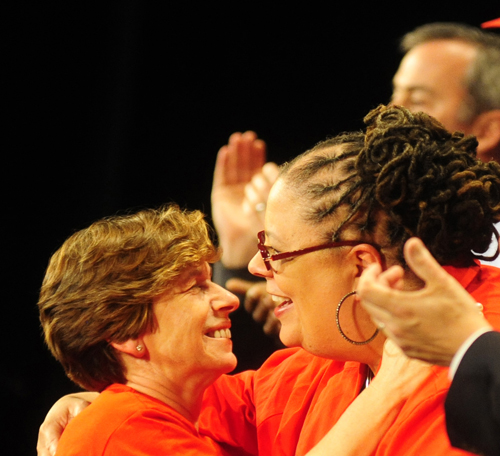
Seeking to capitalize on the momentum of the Chicago teachers strike, unions and allied parent and community groups promised Friday to launch a nationwide fight against government-led school reform efforts that they say are only making public education worse.
American Federation of Teachers President Randi Weingarten announced at a news conference in Washington that they plan workshops, town halls and other events in 11 cities to engage communities in finding their own solutions to improve public education.
For years, unions have pushed back against government interventions in education reform, including the closure of failing schools, the takeover of others by private consultants and the