Latest News and Comment from Education

Thursday, July 1, 2010

UC Davis professor given grant to heal soldiers with stem cells - Yolo County News - sacbee.com

UC Davis professor given grant to heal soldiers with stem cells - Yolo County News - sacbee.com

UC Davis professor given grant to heal soldiers with stem cells

Published: Thursday, Jul. 1, 2010 - 12:00 pm

The US Army has granted UC Davis professor Kent Leach $100,000 for further study of an innovative new medical treatment poised to help injured combatants.

The proposed technique will regrow damaged tissue and bones using stem cells extracted from the patient's own fat.

A stem cell is an undifferentiated cell whose role in the body is yet to be determined. When placed at the site of an injury these cells may grow to replace the damaged part.

Yet, "straight injection of stem cells has a limited effect," Leach said in a press release. His method embeds cells in a gel-like material which will hold the treatment in place.


Read more: http://www.sacbee.com/2010/07/01/2863336/uc-davis-professor-given-grant.html#mi_rss=Education#ixzz0sSZwZC78

Senate President Pro Tem Darrell Steinberg's bill to overhaul teacher layoffs and reassignments survived its first legislative test Wednesday despite the opposition of teacher unions.

Registration for the first charter school in California to focus on Hmong culture starts today with a ribbon-cutting ceremony.

Sacramento City Unified School District Health Services is providing free whooping cough, H1N1 and other vaccinations to students, their parents and community members.

More than 400 needy students at Sacramento middle schools have received free computers as part of a study that is testing the educational benefits of having a computer at home.


Read more: http://www.sacbee.com/education/#ixzz0sSaBjY1d

The Educated Guess � Charter advocates defeat restrictions

The Educated Guess � Charter advocates defeat restrictions

Charter advocates defeat restrictions

Posted in Charters
Charter schools’ lobby and friends have beaten back the latest effort to tighten financial and academic oversight of charter schools.
AB 1950 had easily passed the Assembly. But on Tuesday, the eve before her bill would have been heard – and likely voted down — in the charter-friendly Senate Education Committee, the bill’s sponsor, Democratic Assemblywoman Julia Brownley, withdrew it.
That will be it for imposing additional charter regulations for the session, unless Brownley and the California Charter School Assn. can cut a deal on new rules for closing poorly performing charter schools. Bill Lucia, CEO of EdVoice, an advocacy group that organized to kill AB 1950, said yesterday that he still hoped a compromise can be reached.

“Bad charters should be shut down,” he said, “ but not at a cost of stifling growth of the charter movement.”
California has dozens of excellent charters but also too many lousy ones whose test scores bring down the average for all. A half-dozen charter schools appeared

DFER Watch

DFER Watch

WELCOME TO DFER WATCH

Democrats for Education Reform (DFER) recently celebrated their third year of existence. Here’s how Executive Director Joe Williams summarizes their accomplishments to date:
  • Direct more than $17 million into political and grassroots advocacy for education reform, creating momentum which has the potential to dominate education policymaking for years to come.
  • Play a leading role in efforts to pass groundbreaking K-12 reform-centered legislation in multiple states, including New York, Colorado, Rhode Island, Wisconsin, and Florida.
  • Lead efforts to frame the fight that is playing out within the Democratic Party on education issues. This successful framing has cleared the way for significant reform efforts stemming from the Obama administration, and filtering down into states across the map.
  • Establish DFER outposts in Rhode Island, New York, New Jersey, Florida, Michigan, Wisconsin, Missouri, and Colorado. New outposts are in the process of forming in Ohio, Indiana, Tennessee, Oregon, Washington, California, and elsewhere. The effort to spread the reform blanket across as much of the map as possible is done in recognition of the reality that change must be pushed at all levels and all across the map in order to

School gets ‘potentially criminal’ threats after bogus Fox News report | Raw Story

School gets ‘potentially criminal’ threats after bogus Fox News report | Raw Story

School gets ‘potentially criminal’ threats after bogus Fox News report

By Muriel Kane
Thursday, July 1st, 2010 -- 1:30 pm
pledge School gets potentially criminal threats after bogus Fox News report
Police in a Boston suburb are investigating threatening messages sent to members of the Arlington School Committee, following what school officials said were incorrect reports by Fox News that they had banned the Pledge of Allegiance in Arlington schools.
According to the Boston Globe, a police spokespersondescribed the messages as "offensive and hateful and potentially criminal" and said that some of them were anti-Semitic.
The Pledge hasn't been recited at Arlington High School in decades, although it is said voluntarily in the elementary and middle schools. When the school committee recently deadlocked on a student-led proposal to introduce a voluntary recitation in high school classes, Fox leaped on the controversy with a story headlined "School Officials in Mass. Town Won't Let Students Recite Pledge of Allegiance."
"It is unfortunate that the national media has chosen to distort this very serious debate in a manner which so badly misinforms the public," School Committee Chairman Joseph Curro stated in a press release. He told the Globe that the messages were coming from "all over the country." A few "included indirect threats and one said the members should go to North Korea, where their throats would be slit."
The controversy began when Arlington High School junior Sean Harrington presented the committee with a petition calling for the Pledge of Allegiance to be recited in every school. Harrington is an associate member of Arlington's Republican Town Committee and the founder

ASCD Inservice: The Missing Ink on the Common Core

ASCD Inservice: The Missing Ink on the Common Core

The Missing Ink on the Common Core

MapWhy isn't state adoption of the Common Core getting more press? asks Linda Perlstein, public editor of the Education Writers Association.
"Standards are boring," is her conclusion, though she also surmises that the standards are "too removed" or won't really effect change.
Let me throw out another possibility: state departments of education aren't communicating adoption of the standards to reporters, much less the public.
ASCD has just posted a map to keep track of the states that have adopted the Common Core with a link to the official standards adoption announcement or decision. Compiling the links to official state education action on an issue of such national prominence as the Common Core has been an eye-opening experience. It has not been as easy as might have been expected.
Illinois, Maryland, Michigan, Missouri, North Carolina, Ohio, West Virginia, Wisconsin, and Utah all issued press releases or provided some easily found statement confirming the state had adopted the common core.
But for other states, such information is hard to come by.

On June 16, the New Jersey State Board of Education adopted the Common Core according to this news account, but the only press release issued from the department on that date touted the receipt of $45 million in federal school turnaround grants.
The Hawaii State Board of Education has posted no announcement or press

Celebrating W.S. Merwin, New U.S. Poet Laureate | The Atlantic Wire

Celebrating W.S. Merwin, New U.S. Poet Laureate | The Atlantic Wire

Celebrating W.S. Merwin, New U.S. Poet Laureate


Crowning a career filled with laurels, 82-year-old poet William Stanley Merwin has been named 17th Poet Laureaute of the United States. The weighty title, accompanied by a $35,000 stipend, is conferred by the Librarian of the U.S. Congress and carries few specified responsibilities. Literary commentators have responded to the pick with little surprise, given Merwin's eminence in the field, and are more focused on his relative isolation, his elliptical style, and his role within contemporary American poetry. Here's what they're saying:
  • Very Un-D.C. Drew Bratcher of Washingtonian delves into Merwin's personal and aesthetic distance from D.C. Bratcher notes he's a "Zen Buddhist [who] lives in a rainforest in Hawaii," and says his delicate lyrics owe "more to Asian and Latin American poets, many of whose work Merwin has translated, than to Beltway favorites such as Henry Wadsworth Longfellow and Robert Frost."
  • Passionate About Nature Mike Melia of PBS's News Hour explains that Merwin "designed and built their house at the edge of a dormant volcano. He is an avid gardener and passionate environmentalist. His garden has grown into a sanctuary for a number of rare plants." He brings back a News Hour segment on Merwin with Jeffrey Brown that you can view on their page.
  • A Quiet Poet of Mysterious, Musical Lines Patricia Cohen of the New York Times provides an excellent account of Merwin's life. She describes him as "reclusive," "extravagantly" handsome, and known for (in the words of fellow poet Dana

The trouble with charter schools - chicagotribune.com

The trouble with charter schools - chicagotribune.com

The trouble with charter schools

It's easier to open a new one than to close a bad one


Charter schools receive a lot of well-deserved attention this time of year when they appear to be performing miracles. But what about the ones that don't?

The Obama administration believes, as did the Bush administration, in taking harsh action against "failing" schools, such as firing staff, closing the school or turning over control to the state or private charters.

Much of the news has been encouraging, especially in schools where graduates outnumber dropouts for a change.

It was exciting to hear that Urban Prep Academies, a charter school on Chicago's South Side, is sending 100 percent of this year's 107 graduates to college. That's particularly impressive for a school where only 4 percent of its original 150 students were reading at or above grade level when it opened four years ago.

Get the Chicago Tribune delivered to your home for only $1 a week >>

It was also exciting to hear that Anacostia Senior High School, the District of Columbia charter school where first lady Michelle Obama delivered the commencement address this year, reported 79 percent of its seniors were graduating, up from 50 percent in 2009.

Plus, 95 percent of this year's graduates have been accepted to college, school representatives say. When

School Improvement Grants: How Many Charters are Eligible? - State EdWatch - Education Week

School Improvement Grants: How Many Charters are Eligible? - State EdWatch - Education Week

School Improvement Grants: How Many Charters are Eligible?

| No Comments | No TrackBacks
Charter schools are getting lots of media attention this week—from theappearance of Bill Gates at the National Charter Schools Conference in Chicago to the release of a new federal study that found charters have little edge over regular public schools. Then there was the bombshell that dropped late Tuesday night that some congressional Democrats want to shift $100 million in federal money meant for charters to the $10 billion bill aimed at staving off widespread layoffs in public schools.
So let me just add to this week's charter school overload.
Hearing Bill Gates call for the shuttering of bad charters—which is exactly what Education Secretary Arne Duncan told the national charter schools audiencelast year—made me think I should scour the states' applications for $3.5 billion in Title I School Improvement Grants to see how many "persistently lowest-achieving schools"—the campuses that are eligible for the money—are charters.
I naively thought I could look at the 32 state applications posted on the Education Department's website in half a day's time to compile my list. It was clear after combing through Arizona's list and confirming which schools were in fact charters that I would have to scale back my ambitions.
So I settled on a sample of five states to give a snapshot of how many charters are performing poorly enough to meet the federal government's rules that

Weingarten Accuses ED of Protecting "Pet Programs" - Teacher Beat - Education Week

Weingarten Accuses ED of Protecting "Pet Programs" - Teacher Beat - Education Week

Weingarten Accuses ED of Protecting "Pet Programs"

The feisty president of the American Federation of Teachers, Randi Weingarten, called this morning to give me an earful about the debate on Capitol Hill over the $10 billion edujobs fund.
As colleague Alyson Klein reported extensively yesterday, some of those dollars would be funded by offsetting appropriations for the Teacher Incentive Fund and the Race to the Top. Now, Weingarten is furious that the Department of Education wants to preserve those programs.
"The department was all for saving jobs until it was their pet programs or pet projects that have to share in some of the pain," she said. "I'm very upset. You have an immediate, well- documented harm to children, because of budget cuts. Everyone's been trying to talk about that. All of a sudden, Congress was forced to come up with offsets, and [Rep. David] Obey did and made sure nobody was insulated, and you have this hew and cry."
To be clear, the AFT preferred the former, $23 billion version of the jobs bill that did not raid other pots of

Appeals court rules against Plano ISD in Christian candy cane case 11:55 AM CT | News for Dallas, Texas | Dallas Morning News | Latest News

Appeals court rules against Plano ISD in Christian candy cane case 11:55 AM CT | News for Dallas, Texas | Dallas Morning News | Latest News

Appeals court rules against Plano ISD in Christian candy cane case11:55 AM CT


12:30 PM CDT on Thursday, July 1, 2010

By MATTHEW HAAG / The Dallas Morning News
mhaag@dallasnews.com

Two Plano school principals violated the Constitution when they confiscated Christian-themed materials, including candy cane pens, that students planned to hand out at school, an appeals court has ruled.
The 5th U.S. Circuit Court of Appeals in New Orleans on Wednesday ruled that the principals could be held liable for taking away the items. The principals had argued that the First Amendment doesn't extend to students distributing noncurricular items at school.
"They are wrong," the judges wrote.
The principals "had fair warning that the suppression of student-to-student distribution of literature on the basis of religious viewpoint is unlawful under the First Amendment," three judges concluded in a sometimes strongly worded decision.
Josh Skinner, the principals' attorney, said he was disappointed by the

My ISTE �Ideas and Thoughts from an EdTech

My ISTE �Ideas and Thoughts from an EdTech

My ISTE

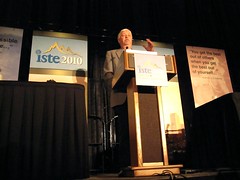
The whirlwind event that is ISTE represents for me, I tremendous learning environment. I realized after my first ISTE in 2008 that this is about people. While in the past serendipity seemed to rule my thinking, I was slightly more intentional this time around and yet left lots of room for impromptu learning. I may have crafted a near perfect learning experience for myself.

My intentional learning revolved around specific sessions I choose and specific conversations I wanted to initiate.

While I thought that ISTE did a fine job of offering variety in their sessions, I only had a handful that I felt I must attend.
Bernie Dodge (when an educator has a wikipedia article, you link to it. We don’t have many there) has always been someone I wanted to hear, and his talk about engagement was one I was hoping to listen to with Chris Lehmann who has already blogged a little about that. Chris wrote about this earlier and listening to the two of them, helped me get a better handle on this. Lynell Burmark is someone I’ve seen before but wanted to grab a few key ideas from her as I plan to present on similar ideas in the future. Nothing life changing here but certainly solid ideas I can use. There were a couple of other sessions that were okay but these two were certainly the most useful for me.

There were several conversations that I had hope to have with people

Mike Klonsky's SmallTalk Blog: NYT editorial got it wrong on small schools

Mike Klonsky's SmallTalk Blog: NYT editorial got it wrong on small schools

NYT editorial got it wrong on small schools

The Times lauds the reported success of NY small schools as shown in a recent MDRC study. Of course the benefits of small schools and smaller learning communities is nothing new and has been documented in study after study (including my own) for many years. But the editorial, as expected, puts its own spin on the research and credits that success to Bloomberg's school closing policies and top-down reform strategy.
The study validates the small school policies of the Bloomberg administration, which has shut down 20 large, failing high schools and replaced them with more than 200 small schools, about half of which were the focus of this study.
Nothing could be further from the truth. The Times confuses authentic small schools with Bloomberg/Klein's chains of privately-managed charter schools which were imposed on protesting communities and implanted in neighborhood school facilities. Study after study has found those charters to be no better and often worse than the closed neighborhood schools they replaced.

Of course there is some overlap between charter schools and small schools, a point not taken into account in the recent study, which was paid for by the Gates Foundation (isn't everything these days?).Charters on the whole, are small and benefit from the positives that small size brings, ie. stronger relationships between teachers and students and opt-in by parents and students. But those benefits, when gained Bloomberg-style, do so at the