Latest News and Comment from Education

Thursday, April 22, 2010

Do You Understand My School? (Part Two) � InterACT

Do You Understand My School? (Part Two) � InterACT

Do You Understand My School? (Part Two)

Yesterday, I posted “Do You Understand My School (Part One)” and argued that policy makers place unwarranted faith in state test scores as a tool for teacher evaluation. In large part, I believe that happens because they don’t really sufficiently understand how schools operate. The argument continues:

To further complicate matters for the test advocates, they have no formula to account for the students who change classes, teachers, or schools during the year. You can’t just weight the test score according to the percentage of instructional time spent in a class, since classes do not cover the same content and skills all year long. That’s not a trivial matter affecting a small number of students. In some school communities, student transiency is a huge factor; additionally, in some schools, students can drop a class, or be removed from it for disciplinary reasons, but the student still must take the state test in that subject. In some schools, semester long courses mean teacher changes for an entire student body at the middle of the year. How do you use state tests to evaluate a teacher’s performance across semesters when that test is given before the completion of the second semester, but months after the first?

If my school expects me to take on a different teaching assignment, new curriculum, or new methodology next year, am I allowed a one-year grace period on producing test results? After all, the first year of teaching a new curriculum presents some unique challenges during a period of adjustment. Or, should I fight any change to my duties, in order to protect my livelihood? If I’m deemed effective as a teacher of juniors but my principal asks me to teach freshmen, that change might involve some adjustment, or I just might not be as good with one age group as I am with another. Why take a chance? If I teach seniors, they don’t even take a state test, depriving me of a chance to (supposedly) prove my effectiveness.

If I teach courses for two grade levels, will I be evaluated with student test results separated by grade levels?If so, we should be concerned about sample size – how much weight is given to each single student’s results –

Education protestors head to Sacramento - 4/21/10 - Fresno News - abc30.com

Education protestors head to Sacramento - 4/21/10 - Fresno News - abc30.com

People in the Valley protesting cuts in education and other programs headed to Sacramento Wednesday morning.
Several hundred people boarded buses Wednesday morning in Northwest Fresno, marking the end of a 48-day march throughout California.
The 360-mile protest trek included six core marchers who say they braved the rain and heat to protest cuts to public education, public health and public safety.
The core group met with hundreds of Californians in the Central Valley as they walked from Bakersfield to Sacramento. The group from Central Fresno is meeting with thousands expected at the state capitol.
The rally is believed to be one of the largest demonstrations in Sacramento in years.

Students ask judge to roll back Cal State summer fee hikes - San Jose Mercury News

Students ask judge to roll back Cal State summer fee hikes - San Jose Mercury News

ReprintPrint Email Font Resize

Students ask judge to roll back Cal State summer fee hikes

Updated: 04/21/2010 05:34:33 PM PDT

A group of students is asking an Alameda County judge to bar California State University campuses from charging higher fees for summer and winter classes.

The four students, including one from Cal State East Bay, filed the petition Tuesday in Alameda County Superior Court. According to the filing, the university broke state law when it started charging students substantially more for classes historically subsidized by the state.

Summer courses are required by law to cost the same as those during the more traditional spring and fall terms, said Anne Arkush, the San Francisco attorney who is representing the students. The winter session generally falls between the two terms; this year, winter courses were offered Jan. 4 to March 14.

"State law is very clear," she said. "But the university seems to be ignoring that."

The university, however, can charge the higher prices because many of this summer's classes will be offered through extended-education programs, not through the central campus, said Rodney Rideau, the systemwide budget director. The difference, he said, means that the summer classes are not equivalent to those offered during the fall and spring terms.

The 430,000-student university has endured severe budget cuts the past two years, forcing it to cut enrollment and take other dramatic steps to balance its finances. Chancellor Charles Reed in January directed campuses to

Emergency funding urged to prevent worst school cuts in 50 years � peoplesworld

Emergency funding urged to prevent worst school cuts in 50 years � peoplesworld

Emergency funding urged to prevent worst school cuts in 50 years

TeacherLayoffsAriz

In Elgin, Ill., School Superintendent Jose Torres has had to eliminate early childhood classes for 100 children, cut middle school football, raise high school class sizes from 24 to 30 students, close swimming pools to save on the cost of chlorine, and lay off 1,000 school employees, including 700 teachers, The New York Timesreported this week.

And he thinks next year will be worse.

As state and local governments grapple with shrinking revenues and soaring budget shortfalls in the continuing fallout from the national economic crisis, public schools are among the top targets for cuts, even as they face new pressure to produce higher test scores.

Tens of thousands of teachers and other school staff are facing layoffs across the country for the coming school year, with school districts projecting slashed programs, larger class sizes and shortened school weeks.

The 2010-2011 school year "is shaping up as one of the most austere in the last half century," the Times report says.

In California, 22,000 teachers have gotten layoff notices. Illinois officials predict 17,000 public school job cuts.

City Brights: Dr. Jim Taylor : Stanford Charter School Fails to Make the Grade

City Brights: Dr. Jim Taylor : Stanford Charter School Fails to Make the Grade

Stanford Charter School Fails to Make the Grade

How much more evidence do we need before we conclude that charter schools aren't the panacea for America's public education woes that so many believe them to be? If you missed the story last week, a charter school created and administered by Stanford University's renowned Department of Education had its charter revoked by the local school board. Why? The same old drumbeat of low test scores and a designation as one of the poorest performing schools in California by our state's Department of Education.

You would, of course, expect nothing but the best of everything from Stanford University in its creation of a charter school: the highest-quality curriculum based on the latest educational research, the best-trained teachers, and outstanding resources. It was all there. And, in spending $3000 more per student than the average public school, money wasn't an issue either. Yet the charter school failed. My gosh, if some of the finest minds in education in America can't figure out a way to educate disadvantaged children, what are the chances that anyone else can?

Stanford has plenty of perfectly reasonable explanations for their failure. The charter school is located in East Palo Alto, a city with large minority and immigrant populations and a long history of poverty and crime. Many parents are uneducated and speak little English. Kids in East Palo Alto have a perfect storm of obstacles preventing them from achieving even minimal academic success. But that's the point. The Stanford charter school was designed to overcome these barriers and it couldn't.

Perhaps the Stanford charter school didn't fail. Reports indicated that its curriculum included traditional academic components, but also social and emotional education. So maybe the criterion that was used to evaluate performance, namely, testing, was too narrow to fairly assess the range of knowledge that the students were gaining from their education.

It is also not completely unreasonable to suggest that knowledge proficiency for many poor students might be less important than important life skills such as social and emotional competence, hard work, time management, and persistence, particularly since most of these students will likely join the work force rather than pursue higher education. Perhaps giving them


Read more: http://www.sfgate.com/cgi-bin/blogs/jtaylor/detail??blogid=180&entry_id=61767#ixzz0lpYBKq3L

EDITORIAL: Unchain schools to innovate

EDITORIAL: Unchain schools to innovate

EDITORIAL: Unchain schools to innovate

OUR VIEW: EDUCATION FUNDING, STANDARDS, CONTRACTS ALL NEED REVISION

The treacherous state school funding system has many local districts in tough, maybe impossible circumstances.

Unfortunately, besides hitting teachers, support staff and administrators, students will bear the brunt of the pain. Class sizes will grow, and in some cases, explode; and for the youngest pupils, the extra help they need with reading and math probably won't be available. And that's a shame, because cllass size makes a world of difference for students in the early grades.

One conclusion to draw is that we must loosen the chains around California public education ---- the funding restrictions, state standards and union contracts all need to be revised to allow schools to reinvent themselves.

The Oceanside Unified School District is a case in point.

The revenue the district expects to have next year (absent another miracle) is about $152 million ---- down from $161 million for the current school year and $172 million last year.

The board Tuesday tackled its ugly numbers, voting to approve "worst case" budget cuts next year that include ending school busing, eliminating about 50 positions (including the bus drivers, security guards and secretaries) and cutting support employees' work year by five days.

This worst case can be avoided only if the teachers are willing to share the pain with pay cuts and furloughs, too.

In February, OUSD Superintendent Larry Perondi said the district could save $11.8 million next year if every employee in the district would take a 5 percent pay cut, take five furlough days and pay more for health benefits. These are the cuts that the 67 administrators have already agreed to take.

Now it is up to the teachers.

And even under this plan, the district expects to see its average K-3 class size swell to an untenable 30 pupils per teacher and high school classes balloon to an average of 45 students per teacher.

Wonderland Avenue PTA: An Open Letter to Gov. Schwarzenegger From Those Parents Who Made a Funny Video About You

Wonderland Avenue PTA: An Open Letter to Gov. Schwarzenegger From Those Parents Who Made a Funny Video About You

Wonderland Avenue PTA

Wonderland Avenue PTA

Posted: April 21, 2010 02:40 PM


An Open Letter to Gov. Schwarzenegger From Those Parents Who Made a Funny Video About You

Two weeks ago, a group of us parents from the Wonderland Avenue PTA unveiled a satirical viral video about the crisis in California schools which will be exacerbated by further cuts proposed in your education budget. The stars of the video are Megan Fox, Brian Austin Green and 90 fifth grade students from our school. Since that time, the video has received approximately a million views on the websiteFunny or Die, has been featured on over 400 news and entertainment sites, and was the subject of hundreds of national, international and local print and broadcast news stories. It's rare that a local school story universally piques the interest of The Washington Post, Perez Hilton, The O'Reilly Factor, Education Week, as well as virtually every news outlet in the state.

Gov. backs law to halt layoffs of junior teachers - BusinessWeek

Gov. backs law to halt layoffs of junior teachers - BusinessWeek

Gov. backs law to halt layoffs of junior teachers

Schwarzenegger appeared at Edwin Markham Middle School in the Watts area of Los Angeles, which lost more than half its teachers in layoffs last year because they were largely new hires.

"Several teachers of the year have gotten pink slips. How can that happen if they are award-winning teachers?" the governor told an auditorium full of cheering children. "It is very important we change the system."

The California Teachers Association, which represents teachers statewide, and United Teachers Los Angeles, the union in the Los Angeles Unified School District, has denounced the bill proposed by state Sen. Robert Huff, R-Diamond Bar.

The unions said the proposal infringes on teachers' rights while glossing over the issue of underfunded public education.

The state has cut education funding by $17 billion over the past two years, resulting in the layoff of 16,000 teachers last year. Another 26,000 teachers have received layoff notices this year.

UTLA President A.J. Duffy said districts already have the ability to retain junior teachers if they have special training and experience.

LAUSD Superintendent Ramon Cortines said he would support legislation that gives districts flexibility to retain talented teachers, as long as the process is developed with teachers unions

Thousands Continue to Fight Budget Cuts | City on a Hill Press

Thousands Continue to Fight Budget Cuts | City on a Hill Press

Thousands Continue to Fight Budget Cuts

By Patrick Rooney & Julie Eng

City on a Hill Press Reporter & Editor

Photo by Julie Eng.

Photo by Julie Eng.

Photo by Julie Eng.

Photo by Julie Eng.

Photo by Julie Eng.

Photo by Julie Eng.

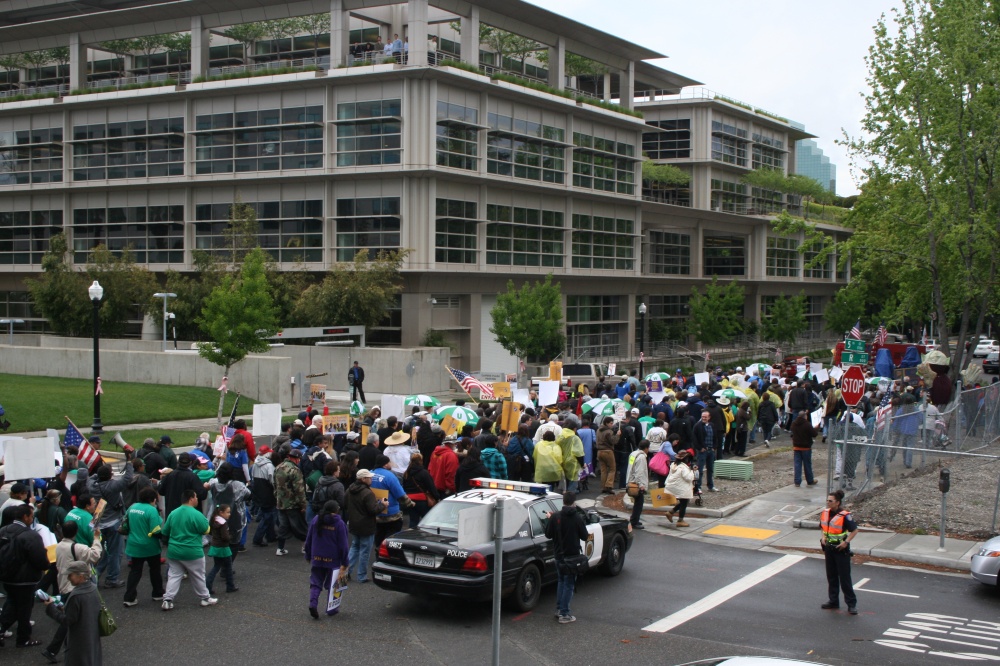
A diverse coalition of people walked the final mile of a 365-mile march in protest of state budget cuts to education on Wednesday, April 21.

Protesters filled three city blocks on their way to the Capitol.

Rain beat down on the group as they gathered in a Sacramento park before it became a drizzle.

The 48-day march, dubbed The March for California’s Future, began with five “core” walkers. A San Diego community college professor, a Los Angeles probation officer, a Watsonville teacher, a Marina del Ray substitute teacher, and a retired Los Angeles teacher began to walk in Bakersfield, with the ultimate goal of rallying on the steps of the Capitol.

“I am marching because I believe the only hope for education is for us to get out in the streets and educate people about how we fund public education in California,” said Jenn Laskin. She has taught for 11 years at Renaissance Continuation High School in Watsonville, and was among the group of core walkers.

The group was joined along the way by teachers, students, union members, public service employees, and parents and grandparents of students, among many others. They came out, most for hours and some for days, to show support for the walkers and solidarity with the movement.

The crowd held almost as many umbrellas as picket signs in the air, relics of their willingness to face the weather.

Felix Cabrera, a second-year at the City College of San Francisco, joined the march to express his own frustration over his inability to take the classes he needs to graduate.

“The current budget crisis and the cuts to education are forcing me to take more courses per semester, but take longer to graduate,” Cabrera said. “Not only that, but because of the cuts to the UC system I might not get into the schools I want. They’re just preventing my future from really happening.”

More than a thousand protestors filled the Capitol lawn as students from San Francisco State University opened the rally with a skit starring “The Draculator,” a vampiric

Teachers union in O.C. to begin striking - Los Angeles Times

Teachers union in O.C. to begin striking - Los Angeles Times

Teachers union in O.C. to begin striking

Negotiations with the Capistrano Unified district over reducing pay and benefits have hit an impasse. Both sides offered to talk again Thursday even as teachers head out to the picket lines.

April 21, 2010|By Carla Rivera, Los Angeles Times

Teachers in Orange County's second-largest school district are set to begin striking Thursday, after negotiations over pay and benefits with the Capistrano Unified School District collapsed.

Representatives from both sides offered to meet Thursday to try to break the deadlock, even as teachers begin walking picket lines.

The action by 2,200 teachers in Capistrano Unified threatens to disrupt classes, sports and other activities as administrators move to find substitute teachers and make contingency plans to keep schools open.

The district said on its website Wednesday that elementary and middle schools would maintain a regular schedule but high schools would dismiss at 1:35 p.m. After-school activities and athletic practices are canceled for the duration of the strike, and Thursday and Friday games will be rescheduled. Bus transportation to schools for most students is canceled.

The long-simmering dispute has become increasingly contentious as both sides have traded accusations of bad faith. Its origins, though, are in California's budget crisis, which has led nearly every school district in the state to make deep cuts and potentially lay off thousands of teachers.

Capistrano Unified, with 56 schools and 51,000 students, is facing a $34-million budget shortfall for the 2010-2011 school year. In March, while labor discussions were still ongoing, the district imposed a 10% pay cut and other benefit reductions on teachers.

The Capistrano Unified Education Assn., which represents teachers, wants the district to make the pay cuts temporary and to restore salaries, unpaid work days and other benefits if "unforeseen funds" are received.

School plans raise fears; drastic changes coming to 11 campuses - San Bernardino County Sun

School plans raise fears; drastic changes coming to 11 campuses - San Bernardino County Sun

School plans raise fears; drastic changes coming to 11 campuses


Tension was high among employees of the San Bernardino City Unified School District on Wednesday, a day after trustees voted to overhaul 11 struggling schools and increase scrutiny of teachers.

By dramatically overhauling the schools in time for the coming school year, the San Bernardino City Unified School District becomes eligible for up to $22million in state money to improve the campuses.

But while many local educators supported the plan to turn six of the campuses into district-sponsored charter schools and replace half the teaching staffs at the other five, many expressed fear and misgivings about the future.

"It's a different world right now, with a lot of uncertainties and questions, and that makes teachers nervous and apprehensive," said Rebecca Harper, president of the San Bernardino Teachers Association.

At its regular meeting, the school board decided to turn Pacific High School, Shandin Hills Middle School and Rio Vista, Wilson, Davidson and Hunt elementary schools into district charters.

Components of this include financial management by the district, starting new in the program improvement cycle and creating an executive board for the charter.

According to the California Department of Education, the schools will be expected to open under the new


Read more:http://www.sbsun.com/news/ci_14931360#ixzz0lpVMZ400

From California to Central Falls, RI

From California to Central Falls, RI
From California to Central Falls, RI — The fight to defend public education is heating up
Printer-Friendly
E-Mail This
Apr 22, 2010
By Tom Crean, United Federation of Teachers (NYC), chapter leader (personal capacity)
In February, the school board in Central Falls, Rhode Island, the poorest and most densely populated city in the state, voted to fire all 93 teachers and staff at the city’s only high school because it is allegedly “failing.”

On March 1, speaking before the US Chamber of Commerce, President Obama cited this mass firing as a model of how to hold schools and teachers “accountable.” The local school board was actually following one of four “turn around” models the Obama administration has put forward for districts to get a share of the $3.5 billion School Improvement Grant.

Who is to blame?

The idea of wholesale firings of teachers is the logical product of the “education reform” agenda which came to the fore with George W. Bush’s No Child Left Behind (NCLB) law and is now going into overdrive under the Obama Administration. The advocates of “reform” focus on “bad schools” and “bad teachers” as the root causes of why children from poor communities don’t achieve their potential, as well as the persistent racial gap in student performance.

Their solution is to close the bad schools and fire the bad teachers. And in their eyes a large proportion of teachers, especially the veterans, are indeed bad and need to go. As an angry blogging teacher named Mrs. Mimi wrote after the mass firing in Rhode Island was announced, “The line of argument here is that someone must be fired and since we can't fire poverty, parents, or children, teachers are the only suckers standing.”

This is a classic attempt to misdirect the understandable anger of millions of working class parents and students at the state of their local public schools. Of course all kids deserve a great education in a safe

Palo Alto Online : Gates: More talent needed on world's problems

Palo Alto Online : Gates: More talent needed on world's problems

Gates: More talent needed on world's problems
Brilliance, energy needed on global health, not anti-baldness drugs

Share
Are the world's brightest minds working on its most important problems?

Bill Gates thinks not, and has embarked on the Bill Gates 2010 College Tour in a challenge to students and professors to fix the problem.

Stanford University was one of the first stops this week on a tour that is taking Gates to the University of California at Berkeley, the University of Chicago, Harvard University and the Massachusetts Institute of Technology.

The software billionaire, who now co-chairs the Bill and Melinda Gates Foundation, said he was struck in recent conversations with friends by the energy, intelligence and passion with which they could dissect subjects like sports and financial markets.

"I was wondering as I heard all that energy and IQ -- could we have had the same discussion about how to have better teachers, or how to make better seeds to improve agriculture so the poorest could have plenty to eat?

"I sort of doubted that was the case."

Gates said he would prefer to see some talent shift away from sports, entertainment, investing and "innovations like drugs for baldness" and in the direction of global health, development and education.

Breakthroughs in solving the world's most vexing problems will require people deeply trained in science, and also those willing to take risks and work in "difficult environments" such as urban schools and destitute countries.

In a lengthy Q & A with students in a packed Memorial Auditorium, he extolled both the discipline of the private sector and

Budget woes imperil tens of thousands of teachers across U.S. - New York Times - Starbulletin.com

Budget woes imperil tens of thousands of teachers across U.S. - New York Times - Starbulletin.com

Budget woes imperil tens of thousands of teachers across U.S.

By Tamar Lewin and Sam Dillon / New York Times

POSTED: 01:30 a.m. HST, Apr 22, 2010

(Single Page View) | Return to Paginated View

School districts around the country, forced to resort to drastic money-saving measures, are warning hundreds of thousands of teachers that their jobs may be eliminated in June.


The districts have no choice, they say, because their usual sources of revenue -- state money and local property taxes -- have been hit hard by the recession. In addition, federal stimulus money earmarked for education has been mostly used up this year.

As a result, the 2010-11 school term is shaping up as one of the most austere in the last half century. In addition to teacher layoffs, districts are planning to close schools, cut programs, enlarge classes and shorten the school day, week or year to save money.

"We are doing things and considering options I never thought I'd have to consider," said Peter C. Gorman, superintendent of the Charlotte-Mecklenburg schools in North Carolina, who expects to cut 600 of the district's 9,400 teachers this year, after laying off 120 last year. "This may be our new economic reality."

Districts in California have given pink slips to 22,000 teachers. Illinois authorities are predicting 17,000 job cuts in the public schools. And New York has warned nearly 15,000 teachers that their jobs could disappear in June.

Secretary of Education Arne Duncan estimated that state budget cuts imperiled

Local school districts dismiss class-size reductions - Sacramento News - Local and Breaking Sacramento News | Sacramento Bee

Local school districts dismiss class-size reductions - Sacramento News - Local and Breaking Sacramento News | Sacramento Bee

Local school districts dismiss class-size reductions

Remember class-size reduction – the push for classes of no more than 20 students per teacher that swept California public schools in the 1990s?
The last two years of state budget cuts have sent the pendulum careening back in the other direction.
Classes of 30-plus students are once again commonplace in Sacramento-area schools, as districts lay off teachers to balance deflated budgets.
Maximum average class size in Sacramento-area districts

SACRAMENTO CITY UNIFIED
2009-10: 20 in grades K-3; 25 in grades 9-10
201O-11: Proposing 30 in grades K-3
Savings: $4.2 million

ELK GROVE UNIFIED
2009-10: 20 in grades K-3, 26 in grades 4-6
2010-11: 28 in grades K-3


Read more: http://www.sacbee.com/2010/04/22/2696768/local-school-districts-dismiss.html#ixzz0lpTvnFS1