Latest News and Comment from Education

Saturday, March 6, 2010

SAC City DAC Next meeting is Tuesday, March 9, 2010

Education News & Comment

Hello DAC members & Community Partners:
 
School Compact
In response to DAC membership’s Needs Survey last year, DAC will teach best practices on Parent/Student/Teacher Compact.  This topic will focus on how to academically link standards to the school compact. Anne T. Henderson, author of Beyond the Bake Sales: The Essential Guide to Family School Partnership offers an excellent way link the California Standards.  For example from her book:

Compact linked to Learning
Old-Styled Compact
Monitor my child’s progress and let the teacher know right away if I notice any problems
Send my child to school every day

Manuel Guillot, Parent Engagement Director will base his lecture on this book. We ask and encourage all DAC members to bring their school’s compact and compare with what is being taught.

2010 Census
The school district will be campaigning for the 2010 Census from March 22-26, 2010, the slogan is, Want School Funding? Be Counted. We need to be counted in this 2010 Census. Education funding is based on the census count, such as programs as like Title I and Head Start.  During Census Awareness week, there will be a press conference, posters provided to schools, Ed Connect announcement and encouragement for schools to have a family school night event to education parents about its importance. Our own Board of Education member, Diana Rodriguez will present.  We have the possibility to get $1,600 per person counted. For a decade, that means a family of 5 can bring $80,000. Be counted!

Bylaw Committee
The Bylaw Chair will propose Bylaws Revision Vote on Article II (Purpose) or table it for the Bylaws Convention (Special Meeting in April).

ConApp
Our Data Analysis Chair will ask the membership to vote whether the DAC chair should sign the ConApp.

Announcements:
Community Advisory Committee (CAC) is offering an orientation to high school for students in special education and their families on Tuesday, March 23 from 6-8 pm at Serna Center, Pennsylvania Room. Many parents express fear and concern when their students with special needs make the frequently daunting transition to high school.  Parents whose children have already been through high school often say they wish they had had the opportunity to learn more about the programs offered in high school so they could be better informed and more comfortable with the changes that were coming. Contact Susan McKellar at 201-0936 for more information.

California Department of Education (CDE) Title I Conference, May 24-25, 2010 at the Doubletree Hotel, Sacramento, CA. Website:http://www.cde.ca.gov/sp/sw/t1/title1conf.aspConference Questions: Sandi Ridge (916) 319-0243.

Come to be empowered, educated and current. Please forward to all school site council members.

Thanks,


Wanda Yañez
Chairperson
District Advisory Committee (DAC)
Sacramento City Unified School District
Work: (916) 654-7729

Remainders: NY’s Race to the Top bid a contender for most jargon | GothamSchools

Remainders: NY’s Race to the Top bid a contender for most jargon | GothamSchools

Remainders: NY’s Race to the Top bid a contender for most jargon

EducationNews.org - A Global Leading News Source

EducationNews.org - A Global Leading News Source


Jay Mathews: KIPP helps worst students, study says 
3.6.10 - Among the many controversies surrounding the Knowledge Is Power Program, the nation's most successful...

Charter school's seniors: They're all in
3.6.10 - The entire senior class of 107 students at Chicago's only public all-male, all-African-American high school has been accepted to four-year colleges....

Fire teachers in failing schools? It may work3.6.10 - PROVIDENCE - When all the teachers were fired from Central Falls High School last week in a sweeping effort at school reform
Analysis documents college 'grade inflation' over decades
3.6.10 - Grades awarded to U.S. undergraduates have risen substantially in the last few decades, and grade inflation has become particularly pronounced at

more articles....

Schools Matter: Children get their books from (school) libraries

Schools Matter: Children get their books from (school) libraries

Children get their books from (school) libraries

I just finished reading "Primary Sources: America's Teachers on America's Schools" which was published by Scholastic and the Gates Foundation. This report has been discussed in newspapers all over the country. Not mentioned in any of the media reports, and not mentioned in the summary section of the report is an interesting result about where students get their books for their own independent reading. This result was not discussed in the text but is buried deep in the appendix.

Q1505 Where do your students get books for their independent reading most often? Select all that apply.

1. school library: all levels: 83%. high school 80%
2. my classroom library: all levels: 68%, high school: 31%; elementary school 87%
3. public library: all levels: 38% high school: 46%
4. retailers: all levels: 20%, high school: 35%

This is similar to what has been reported before in the professional literature, as I reported in The Power of Reading, but shows the 

Sacramento Press / Day at the Museum empowers, inspires

Sacramento Press / Day at the Museum empowers, inspires

lose to 10,000 people gathered at the California Museum on Thursday for the first "Day at the Museum" to get a little bit of pampering and a lot of empowerment.
The star-studded event was part of first lady Maria Shriver's annual The Women's Conference in honor of Women's History Month. The day included exhibits, presentations, speeches and tours of the museum.
"Today is the most successful day [at the museum] in all of California's history," Shriver told the audience.
The day began early with a meet-and-greet session in the museum's lobby with Shriver, California Secretary of State Debra Bowen, Speaker Emeritus Karen Bass, and other female legislators, mayors and district attorneys.
This was followed by a panel of past Minerva Award winners. The Minerva is awarded annually to a California women who is making a difference and is what Shriver calls "an architect of change."
Women Escaping a Violent Environment (WEAVE) co-founder Jennie Hernandez, Parents of Watts founder "Sweet" Alice Harris, and homeless advocate Betty Chinn were just some of the recipients on hand to greet the audience and help Shriver showcase the museum's Minerva Award Exhibit.
Women were treated to free massages at the "Relaxation Station," makeup applications at the "Hello Gorgeous" booth, drum performances and edible 

Sacramento Press / 2010 Youth Media Forum For Social Change

Sacramento Press / 2010 Youth Media Forum For Social Change

In an Access Sacramento office full of high-tech video equipment, timelines circulated Friday morning among representatives of local community organizations working toward Sacramento's first Youth Media Forum For Social Change. The project is aimed at showcasing and supporting the use of digital tools for advocacy and social change as well as establishing a regional network of youth and adults to share and create them.
The upcoming forum is supported by The Healthy Youth/Healthy Regions initiative, a partnership between the University of California at Davis Center for Regional Change, Sierra Health Foundation and The California Endowment. Research obtained through the initiative will dictate the Center for Regional Change's recommendations regarding youth engagement in the region.
Access Sacramento, a nonprofit community media source, is collaborating on the Youth Media Forum with representatives from the Center for Regional Change, the Sacramento City Unified School District, the Committee Addressing Racial Equity, and diverse media and community groups.
"We're lucky Sacramento is very community minded," said Ron Cooper, executive director of Access Sacramento. "It's our greatest asset. It's elusive, hard to quantify, but it's a great thing."
Kindra Montgomery-Block and bel Reyes, representatives of the UC Davis Center for Community School Partnerships, said they hope to make the event the first in a continuing series. They are supported by a number of local media organizations and community members in promoting forums and discussions of media issues.
This alliance focuses on the region's youth, middle and high-school students in particular.
"This realization of 'I didn't realize kids were doing this!' speaks to a lot of 

Local News | 2 Seattle detectives honored for work with children | Seattle Times Newspaper

Local News | 2 Seattle detectives honored for work with children | Seattle Times Newspaper

2 Seattle detectives honored for work with children

Two Seattle police detectives have been honored by the Center for Children and Youth Justice for their "innovative" work with children and young people.
Seattle Times staff
Two Seattle police detectives have been honored by the Center for Children and Youth Justice for their "innovative" work with children and young people.
The center, founded in 2006 by former state Supreme Court Justice Bobbe Bridge, is a private nonprofit dedicated to breaking down the walls between the agencies that are supposed to help children, and to reforming the state's juvenile-justice and child-welfare systems.
The two juvenile detectives' efforts were recognized Wednesday at the third annual Norm Maleng Advocate for Youth Award Breakfast at the Washington Athletic Club.
According to the Seattle Police Department, detectives Kim Bogucki and Al Lebar received the President's Award by Bridge for their "innovations aimed at improving the lives of vulnerable children and youth."
Lebar guides at-risk young women and men through an outreach program that teaches love, relationships and the law. Bogucki is co-founder and producer of The If Project, an essay and video program involving incarcerated women who inspire others to avoid their mistakes.

Two tech workers sidelined in Web-cam case | Philadelphia Inquirer | 03/05/2010

Two tech workers sidelined in Web-cam case | Philadelphia Inquirer | 03/05/2010

Two tech workers sidelined in Web-cam case

Two information-technology employees of the Lower Merion School District have been placed on leave while an investigation continues into the use of remote surveillance software on student laptops.
The two people authorized to activate the software - Michael Perbix, a network technician, and Carol Cafiero, information systems coordinator - were put on paid leave last week while lawyers and technicians examine how the remote system was used, The Inquirer learned yesterday.
Lawyers for Cafiero and Perbix said their clients did nothing wrong. Perbix and Cafiero turned on the remote software only when a laptop was reported missing, they said - and administrators knew what they were doing.
"A phone call had to come from the high school to turn it on," said Charles Mandracchia, attorney for Cafiero. "And if it was turned on, it was turned on with the understanding that the computer was either lost or stolen."
Perbix's salary this year is $86,379. Cafiero, who supervises 16 technicians and administrative assistants, makes $105,569. Both have been with the Lower Merion district for 12 years, according to spokesman Douglas Young.
Their lawyers said the use of the software was no secret. On at least two occasions, the district turned over pictures and other information to Lower Merion police so they could help track stolen laptops.
The district even set up a secure Web site so the police could have access to pictures and other information, according to attorneys in the case.
"Quite honestly, the police knew about these devices," said Marc Neff, a lawyer representing Perbix. "They were not in the dark about the fact that these computers were being tracked."
Lower Merion Township Police Superintendent Michael J. McGrath did not return calls seeking comment.
The district's use of the software touched off a national furor when the parents of Harriton High School sophomore Blake Robbins, 15, filed a federal lawsuit on Feb. 16 saying that school officials used the remote-control software to invade his privacy.
An assistant principal later confronted Robbins because she thought a photo and screen image showed he might be dealing drugs, according to Mark Haltzman, the attorney who represents Blake and his parents, Michael and Holly Robbins.
The district says it turned on the camera in Robbins' computer because, since he had not paid a $55

The murder that galvanized Asian American activism | Philadelphia Inquirer | 03/05/2010

The murder that galvanized Asian American activism | Philadelphia Inquirer | 03/05/2010

The murder that galvanized Asian American activism

As part of making his documentary, producer Curtis Chin asked about 80 young Asian Americans a simple question: Have you heard of Vincent Chin?
The answers came back:
No.
No.
"Um, from the riot, a long time ago?"
"From Canada?"
No.
The correct answer: Vincent Chin was a 27-year-old Chinese American who in 1982 was beaten to death by two Detroit autoworkers. They thought he was Japanese and, thus, somehow responsible for the job losses that accompanied the decline of the U.S. auto industry.
The crime was notable for its gruesome details: One man held Chin as the other struck him with a baseball bat. And for its heart-wrenching timing: Chin died five days before he was to have been married.
But what compelled Curtis Chin to make the film Vincent Who? was the aftermath. The protests that followed Chin's death sparked the creation of the modern Asian American civil-rights movement.
Until then, different ethnicities had fought solo battles, the Chinese against the exclusion laws, the Japanese against World War II internment. But Chin's killing provoked a pan-Asian response toward larger white society.
"They can't tell the difference between us anyway, right?" said filmmaker Chin, 41 and no relation to Vincent Chin. "Before, it would have been annoying. Now, it could get you murdered. It literally could have been any one of us."
Today at the University of Pennsylvania, Vincent Chin's life, death, and meaning will be discussed at a screening of Vincent Who? It's part of the annual East Coast Asian American Student Union conference, 

Schools Matter: Wake County Board Chair Demands Respect for Racist Policy While Calling Critics Animals

Schools Matter: Wake County Board Chair Demands Respect for Racist Policy While Calling Critics Animals

Photo from TAKAAKI IWABU - tiwabu@newsobserver.com

The Wake County School Board's lead buffoon, Ron Margiotta, offered an non-apology for his "caged animal" remarks yesterday. Meanwhile the media has focused on complaints by parents of children having to be bused long distances to school as a result of the school diversity plan, which has been in place the the 1970s. The fact is that 95% of all school children in Wake County go to schools within five miles of their homes. This Republican-led plan is about resegregation, not busing.

The Margiotta story from the News Observer:

RALEIGH Wake County school board chairman Ron Margiotta is being criticized by supporters of the diversity policy for having complained at Tuesday’s school board meeting that some people were acting like “animals.”
Margiotta said “here come the animals out of the cages” in response to the booing that Bill Randall, a black conservative congressional candidate, received Tuesday from supporters of the diversity policy. Randall was among the speakers who had supported the resolution that received initial approval for abandoning busing for diversity in favor of neighborhood schools.
The Rev. William Barber, president of the state NAACP, has scheduled a

Six from Mt. Diablo on list of 190 failing schools - San Jose Mercury News

Six from Mt. Diablo on list of 190 failing schools - San Jose Mercury News

Six from Mt. Diablo on list of 190 failing schools

Updated: 03/05/2010 09:45:55 PM PST

The state on Monday will release its first list of "persistently lowest-achieving schools," including six in the Mt. Diablo district.
The announcement, expected at 10 a.m., will include nearly 190 schools that represent the lowest 5 percent throughout California, which are eligible for Title 1 funds and have failed to show adequate progress in student achievement, said Hilary McLean, a spokeswoman for the state Department of Education.
Schools on the list will be subject to severe sanctions under state and federal laws and will be required to implement one of four drastic interventions: close the school; transform the school through a series of strategies including replacing the principal and increasing instructional time; turn around the school by replacing the principal and at least half the staff; or restart the school by closing it and reopening it as a charter school, under a charter school management organization or under an education management organization.
The sanctions are required under state legislation that was approved as part of the Race to the Top bill package. They are also required under federal laws associated with the American Recovery and Reinvestment Act and School Improvement grant program for struggling schools, McLean said Friday.
Schools must begin implementing the changes in September to qualify for the grants, but there is no timeline if schools opt not to take the money, she said.
One high
school, one middle school and four elementary schools in the Mt. Diablo district are on the list, Superintendent Steven Lawrence said Friday. He declined to name them, saying he would release a statement to the community Monday.
"We're trying to be thoughtful," he said, "in the process of looking at the various options."
ONLINE
At 10 a.m. Monday, the California Department of Education expects to post its list of persistently lowest-achieving schools at www.cde.ca.gov. Information about School Improvement Grants is atwww.cde.ca.gov/ar/ts. Details about the American Recovery and Reinvestment Act are at www.cde.ca.gov/ar.

Firing all the teachers was justified - CNN.com

Firing all the teachers was justified - CNN.com
San Diego, California (CNN) -- In most high schools in America, they teach Shakespeare. But at Central Falls High School in Rhode Island, they're acting out a Shakespearean drama.

Only instead of the famous line from Henry VI -- let's kill all the lawyers -- what we have is: "Let's fire all the teachers."

That's exactly what Central Falls School District Superintendent Frances Gallo did in February. In a move that was bold but also justified, Gallo fired 77 teachers at Central Falls High School in Rhode Island, along with the school's principal, three assistant principals and other administrators. In all, the district said, 93 people were let go in the purge. The school board later stood by Gallo and approved the action
The mass firings, which take effect at the end of this school year, came after the district failed to reach an agreement with the local teachers' union on a plan that would have required teachers to spend more time with students to improve test scores -- with only a small increase in pay.

Consistent with federal guidelines designed to improve theeducational system, Gallo asked teachers to work a longer school day of seven hours and tutor students weekly for one hour outside school time. She proposed teachers have lunch with students often, meet for 90 minutes every week to discuss education and set aside two weeks during summer break for paid professional development.

Think of it as asking teachers to go back and fix what they didn't do right the first time.

Central Falls High School is one of the lowest-performingschools in Rhode Island. It operates in a community where the median income is $22,000, according to census statistics. Of the school's 800 students, 65 percent are Latino and most of them consider English a second language. Half the student body is failing every subject, with 55 percent meeting requirements in reading and only 7 percent in math.

"No thanks," said the teachers. "You're fired," said Gallo.

Upon hearing this story, my first thought was how do we get this woman out of Rhode Island -- and down to Washington to clean house by demanding results from the politicians?

Apologists for the public schools and other defenders of the status quo will hear those statistics, and say: "Well, how do you expect educators to reach and teach a population like that?"

Easy. I expect teachers to do it by putting aside the excuses, setting higher expectations, adhering to better standards, giving into common sense reforms and doing their jobs in a school that serves a vulnerable population that is especially in need of a quality education -- but also, and here's the good news, in many cases, extra motivated to get one.

Forget that poor-kids-can't-learn nonsense. It wasn't true 100 years ago and it's not true now. Besides, there is no ideal student population.

Readers' Forum: Must help California's community colleges - ContraCostaTimes.com

Readers' Forum: Must help California's community colleges - ContraCostaTimes.com

greg enholm | From the community
By Greg Enholm
Guest Commentary

YOUR FRONT page Feb. 25 article "College enrollment dips" highlights critically important issues challenging public education now. With substantial budget cuts at all levels, every level of education struggles to continue providing a solid education for students.
Contra Costa County's three community colleges (Contra Costa in San Pablo, Diablo Valley in Pleasant Hill and Los Medanos in Pittsburg) and campuses (Brentwood and San Ramon) have experienced 5 percent reductions in their funding.
Classes have been canceled and hundreds of students are told they cannot be admitted.
Budget cuts for the University of California have shifted students from UC to the California State University system. But CSU tuition increased dramatically so many students who wanted to attend CSU now want to attend community college for two years first. Community colleges are being deluged with students just when many newly unemployed workers want to learn new skills.
The time to stop denying any student access to California's community colleges is now while the solution is manageable. All Californians benefit when students learn new skills at, or prepare for university at, our community colleges.
A 2006 study concluded Contra Costa community colleges contribute substantially to both their students' knowledge and subsequent earnings ($200 higher lifetime earnings for every credit earned) and to the local economy ($2.50 for
every $1 of taxpayer financial support). About $3.5 billion in increased income was created by these colleges' students being better educated with new skills.
If America could afford to invest $180 billion (yes, billion not million) to save the insurance giant AIG International at $600 for each of 315 million Americans, how much would it cost to allow all students access to community colleges?
The U.S. House of Representatives has already passed "Student Aid and Fiscal Responsibility Act HR-3321," which would help and it is awaiting Senate action.
What happens to students denied entry to our affordable and efficient community colleges? Let's not find out!
Make your opinion known! E-mail your U.S. senators by going tohttp://boxer.senate.gov/en/contact/policycomments.cfm and http://feinstein.senate.gov/public/index.cfm.
Or call Sen. Barbara Boxer at (415) 403-0100 and Sen. Dianne Feinstein at (415) 393-0707. Call Rep. John Garamendi at (925) 932-8899 or Rep. Jerry McNerney at (925) 737-0727 or Rep. George Miller at (925) 602-1880.
Greg Enholm is a high school math teacher. He can be reached at gbenholm@gmail.com.

Opinion: Walters: Did governor snooker Legislature? - San Jose Mercury News

Opinion: Walters: Did governor snooker Legislature? - San Jose Mercury News

Opinion: Walters: Did governor snooker Legislature?

Updated: 03/05/2010 04:35:48 PM PST

It's not often that California's educational establishment — led by the very powerful California Teachers Association — loses a Capitol battle, especially when it's pitted against its archenemies in the school reform movement.
That's what made the approval in January of two major education reform measures, targeting low-performing schools and empowering parents to force school site change, so striking.
Reformers, led by Gov. Arnold Schwarzenegger and EdVoice, an advocacy group financed by a few wealthy civic leaders, and the CTA-led establishment have been jousting for years over whether schools must have more money to get better, or could and should be improved without extra funds.
The reform faction, however, gained a powerful ally in President Barack Obama, who offered $4.35 billion to states that met his Race to the Top criteria.
Obama's education secretary, Arne Duncan, singled out California as he pressed states to adopt reforms that unions dislike, such as increasing charter schools and using student test data for teacher evaluations.
It put Democratic legislators, who usually march to the CTA drumbeat, in a bind. If they refused to do what Schwarzenegger and Obama demanded, they'd look like obstructionists who were sacrificing children's education by ignoring as much as $700 million from the feds, even though it's scarcely 1 percent of school spending. But if they enacted the reforms, they'd be alienating
powerful allies.
As the deadline for applications loomed, the Legislature passed the two bills, somewhat watered down from the original versions but still opposed by big education groups. Republicans embraced them overwhelmingly, and Democrats were divided. Sen. Gloria Romero, D-Los Angeles, the EdVoice candidate for state schools superintendent, carried one.
"In the past, parents had no power to bring about change in their children's schools, but that will now change," Schwarzenegger crowed during his State of the State address. "Parents will now have the means to get rid of incompetent principals and take other necessary steps to improve their children's education."

As We See It: No fee lunch - Santa Cruz Sentinel

As We See It: No fee lunch - Santa Cruz Sentinel


After a raucous start Thursday morning outside UC Santa Cruz, demonstrations over California's funding for schools were mostly peaceful and reasonable.
Most of the heat Thursday was generated at university campuses, where a 32 percent hike in fees and budget cuts have infuriated many students. Protesters' argument against increases in tuition is that a public university education is becoming unaffordable to poorer families. This in turn would mean California's economic future is in doubt, since a highly educated work force would seem essential to future job creation.
Fees at UC campuses will be above $11,000 next year; at Cal State campuses fees will be $4,827.
California taxpayers who have experienced wage cuts and furloughs, not to mention job losses, may be wondering why they should be subsidizing higher education.
So, are the fee hikes unjust?
That would depend on who's paying the tab.
But in a San Jose Mercury News story published in Thursday's Sentinel, reporter Lisa M. Kreiger found that protesters may not realize state public university educations for the poor are being subsidized by middle-class families, who don't qualify for government aid readily available to lower-income families. Poorer students often pay no tuition at all in the new model of California public higher education, which Kreiger describes as "high tuition, high aid." Without substantial new taxes for Californians, this model will probably stick. Meanwhile,
the state's contributions to higher education as a percentage of the general fund are about half of what they were in 1984. That's why fees are rising.
The nonpartisan state Legislative Analyst's Office says fees are not the sole culprit, because they subsidize higher education for needy students. Reducing fees would reduce access.
That's probably little solace to hard-pressed families trying to keep up with drastic fee hikes, but it does put the current situation in context.
Legislative analyst Steve Bollard's solution is that UC and CSU systems create a formal fee policy, much like one in place from 1986-96 that specified increases should be gradual, moderate -- and predictable. By determining increases at least 10 months in advance and never jumping by more than 10 percent in a year, families who don't qualify for aid can budget for college costs.
The volatility of the state's budget has meant wealthier families are on the hook for ensuring that poorer students also have access to a UC or CSU education. That doesn't make it right, but protesters should do their homework to find out what's behind fee hikes.


Thousands rally in San Diego, California against education cuts

Thousands rally in San Diego, California against education cuts

Thousands rally in San Diego, California against education cuts

By a WSWS reporting team 
6 March 2010
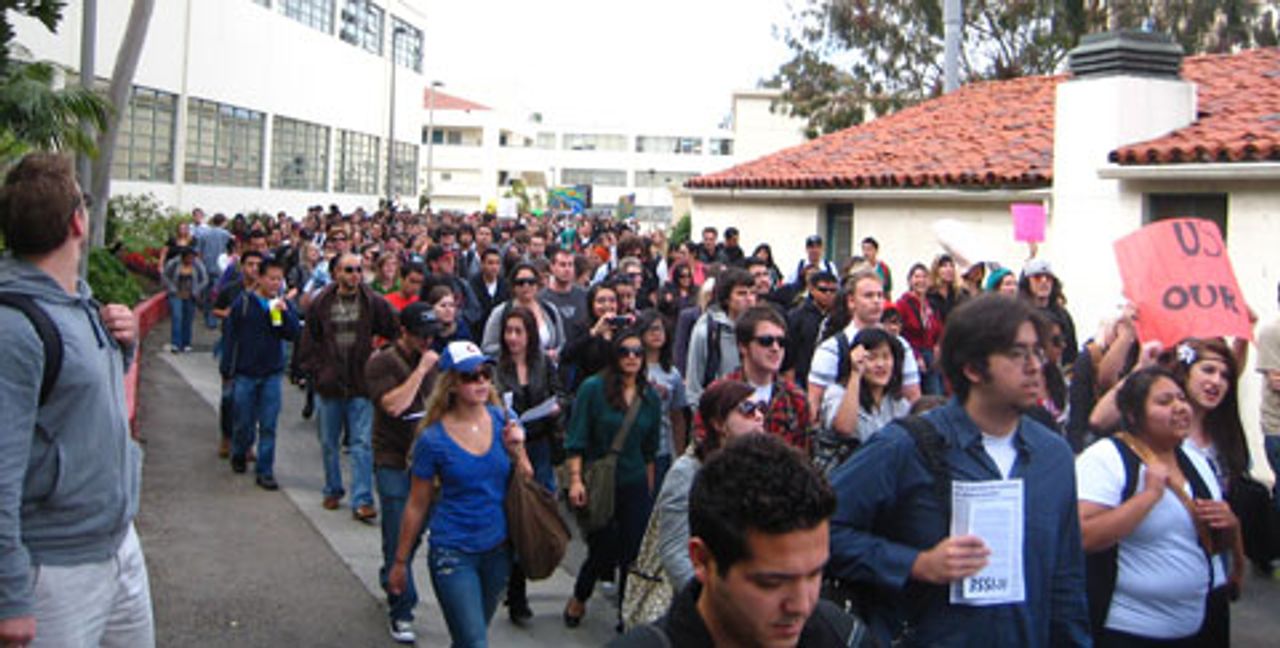
About 1,000 students and faculty gathered at a March 4 rally against education cuts at San Diego State University in California. A similar number of people demonstrated at the University of California, San Diego. A subsequent demonstration in downtown San Diego drew several thousand.
The events in San Diego were among the largest demonstrations in the state. Tens of thousands of students, parents and workers demonstrated throughout the country against school closings, tuition hikes, and teacher layoffs. (See, “Students and staff protest against education cuts in US”)
Among the main speakers at the San Diego rallies were members of the International Students for Social Equality, the student organization of the Socialist Equality Party. The ISSE, which helped organize the demonstration at SDSU, called for a break with the Democratic Party and for a socialist movement to defend education.
Despite their size, the San Diego rallies went largely unreported in the media. If their numbers were mentioned, they were generally reported as “hundreds.” This was part of what appeared to be a general attempt by the media to downplay the significance of the demonstrations.
The first speaker at the SDSU rally was Priscilla Diaz, a straight-A high school student who was denied admittance to SDSU because of budget cuts. The university cut its total enrollment by 4,500 this year, and expects to cut another 11,000 over the next two years.
The other speakers included representatives of the March 4 UCSD educational committee as well as various other student groups on campus. These groups, to the extent that they had any explicit political perspective,