Latest News and Comment from Education

Saturday, March 6, 2010

Scenes From the Demonstrations Over Education Cuts - Bay Area Blog - NYTimes.com

Scenes From the Demonstrations Over Education Cuts - Bay Area Blog - NYTimes.com

Scenes From the Demonstrations Over Education Cuts

In the Bay Area on Thursday, it was hard to go anywhere without running into people marching or a teacher handing out flyers, all part of the national protest over education cuts, as we wrote in a continually updated blog post.
Public schools like Oakland Technical High School held disaster drills, as described by Oakland North, and people marched from the Mission Districtin San Francisco to the Civic Center, where the day concluded with a rally, as described by Mission Local.
In Sacramento, about 1,000 people used “drums, bullhorns, and scores of young voices to try to get their message across,” as Jesse McKinley wrote in The New York Times.
About 150 people were arrested for being part of a blockage of an interstate in Oakland on Thursday afternoon, according to Oakland Local. The freeway 

Fear Of Failure Growing In California's Schools - News Story - KTVU San Francisco

Fear Of Failure Growing In California's Schools - News Story - KTVU San Francisco

Fear Of Failure Growing In California's Schools

The cuts made already are blamed for pushing California's once-esteemed education system to the bottom ranks of all states.
San Francisco's school district is sending 900 employees pink slips this month, and almost half of them are teachers.
At International Studies Academy, more than one-third of the staff are on the 'to go' list and ten of them are teachers.
"I don't know how we're going to be able to absorb that kind of hit," said Matt Livingston, the principal of International Studies Academy.
Livingston added he's had a lot of sleepless nights thinking about larger class sizes and fewer resources for his 500 sixth to twelfth graders.
"That's going to be a combination of teachers, counselors, possibly more. We're going to feel it," said Livingston.
Third year teacher Chris Cary said he took a $25,000 dollar a year pay cut to become a teacher and sees the old promise of a great California education being broken.
"If you don't invest in education what is the economy of this state gong to look like in ten, 15 years when those kids become the prime productive earners of the California economy," said Cary.
More than 40 percent of the state's general fund budget goes to kindergarten through 12 schools. Add colleges and universities and the figure reaches 52 per cent.
But Sacramento cut general fund spending on the total budget by $20 billion in the past year.
San Francisco School Superintendent Carlos Garcia said K-through-12 schools took the biggest hit.

California's education charade | Sasha Abramsky | Comment is free | guardian.co.uk

California's education charade | Sasha Abramsky |Comment is free |guardian.co.uk

California's education charade

Anti-tax revolts have led to a huge gap between well-resourced schools for the wealthy and starved-for-cash schools for the poorsasha
Education protests, California
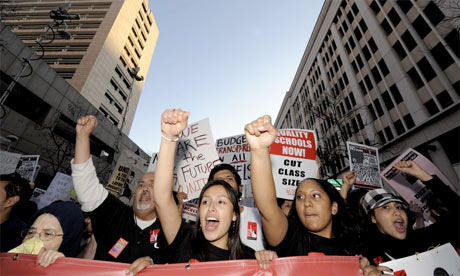
Protesters opposing cuts in education funding march in downtown Los Angeles, California. Photograph: Paul Buck/EPA
Over the next two weeks, more than 5,000 Los Angeles school employees – teachers and other personnel – will receive lay-off notices informing them that they might not have jobs come the start of the next academic year. Not all of them will ultimately lose their salaries, but many likely will. The reason? In addition to the hundreds of millions of dollars the city budget is short by, the school district, which has separate revenue streams, is also in the red by a staggering $640m.
The layoffs aren't just impacting Los Angeles. Around California, the education system is in crisis. Schools in the San Diego area face the loss of hundreds of teachers. In northern towns like Elk Grove, hit particularly hard by the housing bust, about one-sixth of school employees will receive lay-off notices. Even a university town like Davis, which prides itself on having one of the best public school systems in the state, is feeling the pain. Davis, a small town of fewer than 70,000 residents, recently announced that more than 100 teachers would lose their jobs.
With property tax revenues shrinking and state contributions to plug funding gaps on the decline, California's schools are haemorrhaging teachers and non-academic staff, cutting back on virtually every non-mandatory aspect of education – music, arts, science and so on – cleaning facilities less often, reducing special education programmes, and more. Many districts are all-but eliminating the presence of school nurses, counsellors, and psychologists. Teachers are being hit with pay cuts. The length of the school year is being trimmed. I'll stop there, but you can be sure that the list goes on.
What's insane about this is that everyone knows California's heading in the wrong direction here, yet the financial crisis is so vast, and the options for raising taxes so limited at this point because of the toxic politics around the issue, that nobody can see light at the end of this particular tunnel.
By most measures, California already performs poorly when it comes to educating its 6 million-plus public school students. It spends far less per kid than the national average – thus largely negating the arguments of conservatives who say that California's schooling crisis is all to do with overpaid, over-benefited teachers – it has higher student-teacher ratios, it has below-average test scores for maths and reading, and it has higher than average high school drop-out rates.

March 4 Day of Action Ripples Through California and Beyond | Labor Notes

March 4 Day of Action Ripples Through California and Beyond | Labor Notes

Walkouts, student strikes, and marches shook every level of California’s embattled public education system on March 4. University of California students blocked access to campus entrances at Berkeley and Santa Cruz in the morning. In the afternoon, college students joined forces with K-12 students and teachers in downtown Oakland, San Francisco, San Diego, and Los Angeles.
The rallies numbered in the thousands—some estimate the gathering in front of San Francisco's Civic Center at 20,000. In Oakland and Davis, hundreds of marchers confronted police after taking their protests onto the freeways.
The call for action against crippling state budget cuts—$17 billion in two years to the state’s education fund—and the UC administration’s crisis of priorities was taken up on every UC and state college campus—and echoed by students, teachers, and campus union activists in 32 states.
A major target is Governor Arnold Schwarzenegger and state legislators who ready their 

Why did California fail Race to the Top test?

Why did California fail Race to the Top test?:

"Why didn't California win a finalist position in the federal Race to the Top program?

The U.S. Department of Education announced Thursday that 15 states and the District of Columbia were finalists for the first round of funding from Race to the Top, a competition worth $4.3 billion in federal dollars. Despite a hard-fought victory to pass important educational reforms through the Legislature, California was glaringly absent from the list."

This is unsettling news. States that seemingly hadn't made reforms at all - like Kentucky, which doesn't permit charter schools, and New York, where the state Legislature failed to repeal a charter school cap - were among the finalists.
Not California. What happened?
We won't know for sure until April, when the feds will explain their reasons for rejecting California's application. But if we had to hazard a guess, it would be that the Race to the Top officials chose to pay more attention to the education squabbling in California than they did to our application.
Fortunately, there are some state legislators who remain passionately dedicated to reform, and Gov. Arnold Schwarzenegger is too. State Sen. Gloria Romero, D-Los Angeles, who authored some of the hardest-fought reforms, insists that the state will still compete for the second round of Race to the Top funding. That application is due in

Read more: http://www.sfgate.com/cgi-bin/article.cgi?f=/c/a/2010/03/05/ED1E1CBI13.DTL#ixzz0hP2RUG9I

03.05.2010 - Wendy Brown: Without quality public education, there is no future for democracy

03.05.2010 - Wendy Brown: Without quality public education, there is no future for democracy

Wendy Brown: Without quality public education, there is no future for democracy

05 March 2010
UC Berkeley professor of political science Wendy Brown was among the more than 200 Berkeley faculty members who traveled to Sacramento on March 4. A co-chair of the Berkeley Faculty Association, she gave the following address on the capitol steps during the "Educate the State" rally.
Not long ago, California public education was an international beacon of excellence. Through much of the 20th century, Californians were committed to quality public elementary and secondary schools and an accessible multi-tiered system of higher education — from guaranteed access to community college for every high school graduate, to great research universities and professional schools.
Wendy Brown, professor of political scienceWendy Brown, professor of political science
After decades of demonstrating that this was possible — that there could be affordable mass access to high-quality education — California begin to unravel its own accomplishment. The 1978 passage of Prop 13 marked the beginning of this unraveling, pitching our elementary and secondary schools into the downward decline that today finds teachers facing overcrowded classrooms, insufficient books and supplies, inadequate compensation and lay-offs, and throwing a spectacularly successful higher education system into the mud.
This devastation of our public education and the rest of our public sector is not the consequence of our state being poor. Certainly we have suffered from the recession, the financial meltdown, the collapse in housing wealth, unemployment and the foreclosure crisis. But California still generates nearly one sixth of U.S. Gross Domestic Product, and were it a nation unto itself, our GDP would place us among the top 10 nations in the world.
California, rich in resources, rich in human talent, rich in industries, and very rich in the rich, can afford a first rate education system. But our quagmired political system (minority rule), anti-tax political culture, upsidedown state budget priorities, and the configuring of higher education itself on the model of a business — these have demoted public education to the status of a failing discount store.
Indeed, there is more at stake here than the loss of a great system of education, than the madness of permitting oil wealth, real estate wealth, Silicon Valley wealth, banking wealth, Hollywood wealth, agribusiness wealth and prisons to grow ever larger while starving our schools. There is more at stake than the madness of cutting the fuel to the economic engine that generated so much innovation and capacity in California during the last century. It is also the case that there can be no democracy without an educated citizenry.
Without quality public education, we the people cannot know, handle, let alone check the powers

Peter Robinson: The Golden State's Me Generation - WSJ.com

Peter Robinson: The Golden State's Me Generation - WSJ.com

During the "Strike and Day of Action to Defend Education" on Thursday, tens of thousands of students, teachers, professors and administrators marched in California and some 30 other states to protest cuts in education spending. David Patterson, a librarian at Cañada College, a community college in Redwood City, proved typical.
Asked beforehand to explain his participation, he employed the vocabulary of idealism that appeared on every placard and sounded from every bullhorn. "I'm hoping that students . . . feel connected to Montgomery, to Selma . . . to the sit-ins, to Freedom Riders, to the farmworkers' struggle" of the 1960s and '70s, Mr. Patterson wrote on the Socialist Worker Web site. "Now that's an education: To see your fight against oppression connected to a long line of others' fights."
The demonstrations did offer a certain sort of instruction, though not of the kind Mr. Patterson and his fellow protesters had in mind. They demonstrated the entitlement mentality and self-absorption that has come to dominate much of higher education.
Associated Press
An unidentified demonstrator pleads with police blocking their access to the Interstate 80 as students demonstrate at the UC Davis campus in Davis, Calif. on Thursday, March 4, 2010.
If you went searching for the proximate cause of the "Strike and Day of Action to Defend Education," you wouldn't find it in any pattern of oppression. You'd find it in a couple of acts of desperation last year. First, Gov. Arnold Schwarzenegger, facing the worst budget crisis in state history, cut about $600 million in overall funding for 10-campus University of California and the 23-campus California State University. Then the U.C. regents and C.S.U. trustees, facing budget crises of their own, reduced programs, furloughed workers, and raised tuition.
Students and faculty erupted throughout California, but nowhere with quite the indignation displayed at the state's oldest and most prestigious public institution of higher learning, U.C. Berkeley. Addressing students last 

Thousands protest California education cuts - Los Angeles Times

Thousands protest California education cuts - Los Angeles Times

Thousands protest California education cuts

Rallies and walkouts are largely peaceful, but 150 are arrested in Oakland as a freeway is blocked. The demonstrations are part of a nationwide 'Day of Action for Public Education.'

March 05, 2010|By Carla Rivera and Nicole Santa Cruz and Larry Gordon
A day of passionate protest against education funding cuts attracted thousands of demonstrators Thursday to mostly peaceful rallies, walkouts and teach-ins at universities and high schools throughout California and the nation. In Oakland, however, about 150 protesters were arrested after they blocked a freeway, snarling rush-hour traffic.
From Los Angeles to New York and from San Diego to Humboldt in Northern California, students, faculty and parents at many schools decried higher student fees, reduced class offerings and teacher layoffs in what leaders described as a "Day of Action for Public Education." Labor unions and student government groups were the main organizers.

San Diego Professor Marches 400 Miles For Education | KPBS.org

San Diego Professor Marches 400 Miles For Education| KPBS.org:

"SAN DIEGO — Thousands of people embark on a 400-mile protest march today. The “March for California's Future” is intended to bring attention to a crisis in public education. One San Diego professor plans to spend seven weeks walking from Bakersfield to Sacramento."

San Diego City College professor Jim Miller, far left, takes a class photos with his son Walt and his classmates at McKinley Elementary School in San Diego.
Enlarge this image
Above: San Diego City College professor Jim Miller, far left, takes a class photos with his son Walt and his classmates at McKinley Elementary School in San Diego.
Kelly Mayhew is preparing the family dinner. Posters of Jerry Garcia and the Grateful Dead are taped and tacked on the walls. Kelly's husband, Jim Miller is in the living room with his 5-year-old son.
Miller is an English and Labor Studies professor at San Diego City College. He's known as much for his long, blonde ponytail as he is for his commitment to the greater good. Miller says he's ready to take his activism on the road.
A map of the route of the 400-mile long "March for California's Future," intended to bring attention to the crisis in public education.
Enlarge this image
Above: A map of the route of the 400-mile long "March for California's Future," intended to bring attention to the crisis in public education.
“We've been involved in lots of different activist groups, but this is the biggest single endeavor, a 48-day march,” Miller said.
Miller laughs because he's 45 years old, has asthma and a bad back. That means the 400-mile long march will be harder for him than most of the other marchers.
The route begins in Bakersfield. It cuts north through agricultural towns like Delano, Chowchilla and Modesto. Miller says the farmland in the Central Valley was fertile ground for the teachings of Cesar Chavez.
“In particular, when we're marching through the Central Valley, where you go through these towns, and the average income is so low, what will be the future for the kids of those farm workers?” said Miller.
“Jim and I are privileged,” Mayhew said. “He went to a public elementary school. I went to a public junior high and high school. We were fortunate California public schools at the apex, at the absolute best time. And what we’ve seen over the 20 years of our teaching is such a decline in support of education.”
Their son Walt goes to McKinley Elementary, a school in the San Diego Unified School District. It’s facing an $80 million state budget shortfall. They see their son's classes getting bigger, school services vanishing, and now a school year cut short due to teacher furloughs.

Angry students protest cuts to schools, colleges - BusinessWeek

Angry students protest cuts to schools, colleges - BusinessWeek

Anger over rising tuition and school budget cuts boiled over as students across the country staged rowdy demonstrations that led to clashes with police and the rush-hour shutdown of a major freeway in California.
Students, teachers, parents and school employees rallied and marched at college campuses, public parks and government buildings in several U.S. cities Thursday in what was called the March 4 Day of Action to Defend Public Education.
In Oakland, protesters evaded police and walked onto Interstate 880 near downtown Oakland just before 5 p.m., forcing the closure of the freeway in both directions for more than an hour and causing traffic to back up for miles.
Police arrested more than 150 people who blocked the freeway after breaking off from a peaceful rally at Oakland City Hall, said Officer Sam Morgan, a spokesman for the California Highway Patrol.
One protester suffered serious injuries after jumping from the elevated freeway while officers were making arrests, authorities said.
University of Wisconsin-Milwaukee police arrested at least 15 people protesting tuition hikes after demonstrators tried to enter an administrative building to deliver petitions to the chancellor. When police turned them away, some protesters threw punches and ice chunks, university spokesman Tom Luljak said.
Faced with plunging tax revenue and massive budget shortfalls