Latest News and Comment from Education

Tuesday, February 16, 2010

The Diamondback - MOTE TO RETIRE

The Diamondback - MOTE TO RETIRE:

"University President Dan Mote announced his resignation yesterday, ending a 12-year period in which he led the university to unprecedented successes while consistently battling eroding state support for higher education.

“Twelve years is a long time — longer than I expected when I arrived,” Mote said of his reason for resigning. “The place is in very good shape, running very well; the staff is very strong, and it’s a good time to have a transition.”

Mote, 73, will leave his position Aug. 31 and take a one-year leave of absence. Afterward, he will stay with the university as an engineering professor. Mote said announcing his resignation now will limit his time as a lame duck while providing enough time for the university system to search for his replacement.

As per university system requirements, Chancellor Brit Kirwan said he would select a committee to search for Mote’s replacement that will include students, faculty and staff. Final approval of the committee’s recommendation rests with the Board of Regents — a 17-member panel of gubernatorial appointees that oversees the university system."

California's sorry state a major threat to U.S. - The Globe and Mail

California's sorry state a major threat to U.S. - The Globe and Mail:

"California is to the United States what Greece is to Europe - and not just because of its abundance of sun and sea.

Busted budgets and dysfunctional politics have also made them kindred spirits.

And just as Europe is reluctantly looking at coming to Greece's financial rescue, the day may soon come when California's financial woes become a problem for all Americans.

In some ways, California may prove to be the bigger headache. Were it a country, the state's economy would rank eighth in the world - roughly the size of France and much larger than any of the so-called PIIGS of Europe: Portugal (No. 50), Ireland (No. 56), Italy (No. 11), Greece (No. 34) and Spain (No. 13).

California also makes up a larger relative share of the U.S. economy, at 13 per cent of U.S. gross domestic product. Greece accounts for just 2 per cent of Europe's GDP."

Four-year degrees at our community colleges? � Ventura County Star

Four-year degrees at our community colleges? � Ventura County Star:

"At long last, there are signs Californians might become a little inventive in the face of financial crisis. So far, the best example of an idea for making lemonade when life has dispensed lemons comes in the higher education field, where state colleges and universities that have absorbed large budget cuts are now charging higher tuition and fees than ever — and will still turn away about 100,000 qualified students in the fall.

That situation amounts to a wholesale abandonment of California’s 1960 Master Plan for Higher Education, which guarantees a place at either the University of California or a California State University campus for every student who has done enough to qualify.

With some campuses reserving significant numbers of spaces for local residents and others turning away even those students, public universities for the first time are plainly not keeping their 50-year-old promise."

Manteca Bulletin - Schools provide 1 in 10 SJ jobs

Manteca Bulletin - Schools provide 1 in 10 SJ jobs:

"Education is big business in San Joaquin County.

Over one out of every 10 jobs in the county during 2008 was in either private or public education. That translates into 23.632 out of the 220,983 private and public sector jobs within the county.

Those jobs also accounted for 11.5 percent of the overall county payroll of $8.6 billion.

The impact of education on the economy in terms of jobs as well as producing a workforce that will attract higher paying employers is detailed in a regional study conducted by the Eberhardt School of Business at the University of Pacific in conjunction with the San Joaquin County Council of Governments."

Editorial - Justice Kennedy on Prisons - NYTimes.com

Editorial - Justice Kennedy on Prisons - NYTimes.com:

"Justice Anthony Kennedy spoke out against excessive prison sentences this month in California, criticizing the state’s deeply misguided three-strikes law. It was a welcome message, delivered with unusual force. Much of the blame for the law, however, lies with the Supreme Court, which upheld it in a decision on which Justice Kennedy cast the deciding vote."


The overall tone of Justice Kennedy’s address to the Pepperdine University School of Law was “courtly and humorous,” according to The Los Angeles Times. He turned more serious, however, on the subject of incarceration. Sentences in the United States are eight times longer than those handed out in Europe, Justice Kennedy said. California has 185,000 people in prison at a cost of $32,500 each per year, he said. He urged voters and elected officials to compare taxpayer spending on prisons with spending on elementary education.
Justice Kennedy took special aim at the three-strikes law, which puts people behind bars for 25 years to life if they commit a third felony, even a nonviolent one. The law’s sponsor, he said, is the correctional officers’ union, “and that is sick.”
The criticism was on the mark. The state’s prison population has soared as a result of harsh sentencing laws and parole rules. California has been ordered by the courts to bring down the population of its prison system, which is badly overcrowded and unable to provide inmates with adequate medical care.
Under the three-strikes law, a man named Gary Ewing was sentenced to 25 years to life for shoplifting three golf clubs from a golf pro shop.
Mr. Ewing challenged his sentence before the Supreme Court as a violation of the Eighth Amendment prohibition on cruel and unusual punishment. By a 5-to-4 vote, with Justice Kennedy in the majority, the court rejected the challenge. The dissenters were right that

Our chance to send a message | SocialistWorker.org

Our chance to send a message | SocialistWorker.org:

"Matthew Palm, the Commissioner of Academic Affairs for the Student Union Assembly--the student government--at University of California Santa Cruz, explains in an open letter why he's supporting the March 4 Day of Action to defend public education in California."


Dear Friends:
I'm writing as a friend of yours, and as a fellow student. Over the last two years, I've spent countless hours sitting in meetings where administrators--the very same administrators other people want to tar and feather--sit in a conference room and pull their hair out over what the hell they're going to do about the implementation of budget cuts. In the same weeks (and in some cases on the very same days), I've also sat in on meetings of "radical" student organizers planning hunger strikes and walkouts.
Very few people on this campus have experienced the absolute "inside" and the absolute "outside" of "the system" and everything in between the way I have. Please know what I am about to say is reflective of this dissonant experience, which has challenged me to really re-think my values.
That experience taught me this: There is not a single person on this campus who wants to see these cuts take place, including administrators themselves. Period. The problem is structural: The people who have the real power over things in UC are the Regents and the President, and we have no mechanism of control over them. On top of that, those 21 people are participating in a national political and social context where universities are incentivized to make decisions that hurt students.
For this reason, I will be striking on March 4th, 2010, and I am asking you to join me.

Big Rally Planned Over UC Fee Hikes, Higher Education Funding - Los Angeles News - LA Daily

Big Rally Planned Over UC Fee Hikes, Higher Education Funding - Los Angeles News - LA Daily
Opponents of recent higher education budget cuts that have caused extreme student fee hikes at UCLA and other University of California campuses are planning a major demonstration in Sacramento next month.

The University of California Student Association will hold a rally at the state capital March 1, the same day that UC President Mark G. Yudof and several campus regents and chancellors will meet with legislators about the higher-education budget.
In November the UC Board of Regents approved a 32 percent increase in student fees that included a two-phase, $2,500 price hike -- which will soon put undergraduate costs at more than $10,000 a year and triple what UCLA students paid just ten years ago.
"Our students are a critical voice in delivering our message to Sacramento, and it's great to see them engaging in this way," Yudof stated. "We are honoring the wishes of the UCSA leaders and not taking a role in their public rally, but we will be visiting legislative leaders together that day to show our solidarity and to express how much we all care about UC's 

Remnants of Spitzer’s Plan for SUNY and CUNY Are in Peril - NYTimes.com

Remnants of Spitzer’s Plan for SUNY and CUNY Are in Peril - NYTimes.com


During Eliot Spitzer’s campaign for governor, he often wondered why New York lacked a public university on a par with Berkeley, theUniversity of California’s flagship. Once elected, he seemed poised to raise the profile of the state’s two huge systems — the State University of New York and the City University of New York — and maybe even create a couple of Berkeleys in the process.


A commission appointed by Governor Spitzer recommended a major infusion of state financial support, the hiring of 2,200 additional full-time faculty members and the creation of a $3 billion research fund. But the sex scandal that forced him from office in early 2008 was followed by economic freefall, and today, most of the big-ticket proposals for reinventing SUNY and CUNY have largely been ignored.
Mr. Spitzer’s successor, Gov. David A. Paterson, salvaged a few items from the commission, known as the New York 

Are Latinos Disappointed With Obama? - Los Angeles News - LA Daily

Are Latinos Disappointed With Obama? - Los Angeles News - LA Daily:

"Los Angeles-based state Sen. Gil Cedillo, one of President Obama's early campaign supporters, says he's disappointed with president so far, and that he's not alone among Latinos.

Cedillo says there are some hard feelings surrounding Obama's promise during his presidential run to reform U.S. immigration law. Many Latinos have stopped holding their breath. 'I think he's in danger of breaking the spirit of solidarity and hope,' Cedillo told McClatchy Newspapers. 'More than a broken promise, it's the danger of breaking people's sense of hope in the Latino community.'

Republicans, meanwhile, seem ready to pounce -- just in time for this year's mid-term elections. Hector Barajas, a communications consultant for the California State Senate Republican Caucus, said that 'what the Democrats offer is just a bunch of empty promises.'

Jaime Regalado, the executive director of the Pat Brown Institute at Cal State L.A., said"

Bill aims to end in-state tuition fees for illegal immigrants - San Bernardino County Sun

Bill aims to end in-state tuition fees for illegal immigrants - San Bernardino County Sun:

"The days of taxpayer-subsidized college tuition could be coming to an end for tens of thousands of illegal immigrants.
Republicans in the House of Representatives have introduced a bill to close a loophole that California and nine other states have used to provide lower-cost college tuition to illegal immigrants.

Supporters of the legislation say it's wrong for illegal immigrants to pay the same tuition as legal immigrants and U.S. citizens to attend public colleges and universities.

'In-state tuition is a benefit paid for by each state's taxpayers in order to improve educational opportunities for their citizens,' said Rep. Howard P. 'Buck' McKeon, R-Santa Clarita, whose district includes Victorville and Barstow.

'Extending this benefit to students in this country illegally undermines efforts to crack down on illegal immigration and keep college affordable for American citizens and the immigrants who come here legally to pursue the best higher education system in the world,' McKeon said.

The bill changes the 1996 Illegal Immigration Reform and Immigrant Responsibility Act to clarify that illegal immigrants who attend a postsecondary educational institution are ineligible for in-state tuition unless the institution offers those rates to all American citizens."

Rethinking elections - latimes.com

Rethinking elections - latimes.com: "Amid budget shortfalls, can we afford all these special elections?"

Elections in California are clearly in overdrive. Last year, more than a dozen were held in Los Angeles County, many triggered by vacancies in congressional or legislative offices.

The recent election of former Assemblyman Paul Krekorian to the Los Angeles City Council is keeping the election throttle to the floor in 2010, with a special primary in April, just two months before the statewide primary in June.

At a time when all levels of government are struggling to keep the engine running, cutting costs and looking for ways to work smarter, this pedal-to-the-metal pace of special elections is one area in which a major tuneup ought to be considered. Concerns over voter fatigue and mounting costs, once simply academic discussions, are now an intense reality.

In California, election law requires any vacancy in a state legislative or congressional office to be filled by a special primary and, if needed, a special general election within 126 days from when the governor proclaims the election. Since 2005, 14 vacancy elections to fill unexpired legislative terms have been called, resulting in 22 primaries and runoffs. 

Students sharpen attack on UC costs with satire

Students sharpen attack on UC costs with satire:

"It's been a seriously dramatic year at the University of California, where hundreds of students seized buildings, demonstrated and shut down regents meetings last fall to protest rising tuition and the perceived privatization of the public school."


It's also been a satirically dramatic year, thanks to the UC Movement for Efficient Privatization, a fledgling group of mostly grad students in business attire that uses humor tinged with sarcasm to lampoon UC officials.
Their own name is an example. Many UC students believe leaps in tuition and reduced state funding are turning the public university into a private institution.
The UC Movement for Efficient Privatization says, "Why not?"
"Unlike others whining about the direction of privatization, we're concerned about the snail's pace at which the inevitable transformation is proceeding," said Shane Boyle, 27, unofficial chairman of UCMeP.
That's You See Me ... you get the idea.
In the spirit of theatrical political activists, from Billionaires for Bush to the Yippies, the 5-month-old group says its goal is to help UC leaders advance their goals.
"We take them to the logical extreme to show how ridiculous they can be," said UCMeP's Chief Artistic Officer Brandon Woolf, 26, a doctoral student in theater with Boyle. "It's another tactic for protest."
To wit:
On Thursday, UCMeP organized a dozen or so people into a Student Counter-Activist

Read more: http://www.sfgate.com/cgi-bin/article.cgi?f=/c/a/2010/02/15/BA6A1BUGLU.DTL#ixzz0fheO1oYr

Study offers nuanced view of abstinence education | Philadelphia Inquirer | 02/16/2010

Study offers nuanced view of abstinence education | Philadelphia Inquirer | 02/16/2010:

"Proponents of abstinence-only sex education declared victory earlier this month after a study from the University of Pennsylvania found that a program for Philadelphia sixth and seventh graders deterred young teens from having sex.

Abstinence Clearinghouse, an advocacy group, proclaimed on its Web site that the study proved 'comprehensive sex ed a big flop.'

Not so fast, says the study's lead author, Penn sociologist John Jemmott.

Jemmott's study, published in this month's issue of Archives of Pediatric and Adolescent Medicine, examined an abstinence program that would not have qualified for federal funding during the Bush administration. Those programs required an emphasis on abstaining until marriage, whereas Jemmott's involved no preaching and no denigrating the effectiveness of contraception."

San Diego State University and BIOCOM Institute Receive $4.95 Million Grant: The BRIDGE Project, Linking... -- SAN DIEGO, Feb. 15 /PRNewswire/ --

San Diego State University and BIOCOM Institute Receive $4.95 Million Grant: The BRIDGE Project, Linking... -- SAN DIEGO, Feb. 15 /PRNewswire/ --


SAN DIEGOFeb. 15 /PRNewswire/ -- San Diego State University, BIOCOM, San Diego Workforce Partnership, and the Southern California Biotechnology Center at Miramar College today announced the award of a three-year, $4.95 milliongrant from the U.S. Department of Labor aimed at assisting the economic growth of the San Diego region's life sciences industry. The Biotechnology Readiness, Immersion, Certification and Degrees for Gainful Employment (BRIDGE) project will provide education, training, and placement services to more than 1,000 veterans, incumbent workers and dislocated and unemployed workers within the San Diego region.
The BRIDGE project is a partnership linking training and higher education with employment opportunities that address the regional and state-wide workforce needs of the life sciences industry. The project will focus on the critical need for clinical laboratory scientists, medical laboratory technicians, medical physicists, and professional scientists. SDSU and MiramarCollege will provide certificate, degree, and Professional Science Master's (PSM) programs. The BIOCOM Institute's Life Science Immersion Program will provide training needed for successful biotechnology careers, and the BioCollaborative,created in cooperation with the Alfred P. Sloan Foundation, will provide an online resource to facilitate seamless transition from higher education to careers in the life sciences industry.
All of these courses are part of a pipeline that can be used to educate, recruit, train and place workers of all levels, from high school students to people with graduate degrees and military

Schools boost green teaching - MontereyHerald.com :

Schools boost green teaching - MontereyHerald.com :


In what officials are calling a landmark move, California public schools now have state-approved environmental curriculum for students all the way from kindergarten through 12th grade.
The state Board of Education this year signed off on 76 sections of curriculum — part of California's Education and the Environment Initiative — and they are expected to be available for teachers online shortly at no charge.
"This is another example of California leading the nation in environmental policy," said Lindsay VanLaningham, deputy director of communications for the California Environmental Protection Agency. The K-12 curriculum is serving as a model, she said, and other states have requested information about California's efforts.
Legislation written by Fran Pavley, D-Agoura Hills, and signed into law in 2003 called for putting environmental education into public schools, and developing the curriculum was a lengthy process with multiple agencies involved, including the California EPA, state Integrated Waste Management Board and the California Department of Education, VanLaningham said.
It includes 85 sections of science and history-social science with academic standards, and the state board signed off on 76 of them at its January meeting. The remaining nine s

Monday, February 15, 2010

The Times Still Doesn’t Quite Understand the Internet � The Quick and the Ed

The Times Still Doesn’t Quite Understand the Internet The Quick and the Ed
The Times Still Doesn’t Quite Understand the Internet


I have no problem with the New York Times charging for Web content. They produce a great number of well-written, well-reported articles that are worth paying for (and since I already get the Sunday edition home-delivered it’s not going to cost me anything extra. ) But as the Times continues the inevitable long-term transition to the Web, it should work harder to embrace the way the Web works. For example, this story on the Texas schoolbook adoption process includes the following:
…the Texas board’s moves to bring Jesus into American history — has drawn anger in places far removed from the board members’ constituencies. (Samples of recent blog headlines on the topic: “Don McLeroy Wants Your Children to Be Stupid” and “Can We Please Mess With Texas?”)
Having written the second blog headline, I’m obviously pleased to see it referenced in the cover story of the New York Times Magazine. But why not include a hypertext link to the actual blog post? We’re talking about something that would consume less than 30 seconds of someone’s time. Instead, all the links in 

With Maldonado Vote, the Assembly Grows a Spine | California Progress Report

With Maldonado Vote, the Assembly Grows a Spine | California Progress Report


For all the hoopla about the rejection of Sen. Abel Maldonado today, Assembly Democrats showed they are a force to be reckoned with. Finally.
Frustrated by their role in budget negotiations over the past year, rank-and-file Assembly Democrats decided not to roll over and reward Maldo with a promotion. Only nine Democrats sided with the Republicans in the vote; just two of them were first-term members: Alyson Huber, who is in a hotly-contested race for re-election, and Bill Monning, who has close ties to former Assemblyman John Laird (who was gunning for the Maldo seat). Even Speaker Bass, who pushed back mightily last year in budget talks, didn't back Maldo.
The overwhelming number of freshman Assembly Democrats, who spent most of their first months in office facing an angry Democratic base back home because of budget cuts they didn't want to make, decided they had enough with Schwarzenegger's "post-partisanship." They remembered, all too well, the deal between Schwarzenegger and Maldo over the budget and open primary that was shoved down their throats. Majority Leader Alberto Torrico referenced the "back room deal" in a tough speech against Maldo on the floor.
Speaker-elect Perez, a freshman himself, let it rip in his statement after the vote.
"The people of California have made it abundantly clear that they loathe the kind of 

SCOTUSblog The Court's impact on the civil rights movement

SCOTUSblog


Podcast with Vernon Jordan
The Court's impact on the civil rights movement

Today our publisher Tom Goldstein spoke with Vernon Jordan – a senior counsel at Akin Gump who has also served as president of the United Negro College Fund, field director of the NAACP, and an adviser to former President Bill Clinton – about his experience with de juresegregation and the effect of the Supreme Court’s rulings on that subject on the civil rights movement.  This is the latest edition in our Race and the Court program.
Here is the link to the fourteen-minute podcast and a road map of highlights:
  • 0:50—The meaning of Brown v. Board of Education: “1954 was a clarion call”
  • 1:37—Indications that Brown was “coming down the pipe”
  • 2:37—Jordan’s impression of Brown while at DePauw University, and his experience with segregated universities and law schools
  • 4:48—The launch of the civil rights movement after Brown: “The Supreme Court decision was an answer to our prayers and a signal to the country that things were going to change”
  • 5:43—The long and gradual road to full desegregation
  • 7:30—Learning constitutional law from James Nabrit, who used to say “Raise it [the constitutional issue]!”
  • 8:17— Is the Court still the friend of the black community?
  • 12:08—The writing of the Voting Rights Act
Subscribe to the SCOTUSblog feed on iTunes to receive our latest podcasts automatically–this one should be available by this evening.

Philadelphia Public School Notebook Notes from the news, Feb. 15

Philadelphia Public School Notebook


Notes from the news, Feb. 15

Submitted by Erika Owens on Mon, 02/15/2010 - 09:59 Posted in Notes from the news | Permalink
Closing the learning gap The Inquirer (opinion)
A reflection on how to close the economic learning gap.
Changes in store for high school choice? The Notebook blog
The release of an RFA report shed light on the lack of real choice in the current system, but how to change that?
See also: Confessions of a Conflicted Public School Advocate Philly School Search blog
What Does Communication Mean in 2010? Philly Teacher blog
EduTweeters, EduCon, Classroom 2.0 communication is changing. Are we at the "tipping point"?
Please email us if we missed anything today or if you have any suggestions of publications, email lists, or other places for us to check for news.

With a Chancellor like this, DCPS doesn’t need enemies � GFBrandenburg's Blog

With a Chancellor like this, DCPS doesn’t need enemies GFBrandenburg's Blog


With a Chancellor like this, DCPS doesn’t need enemies

Isn’t it great to have a superintendent who denigrates DC public schools every chance she gets? Here is an example that she just published:
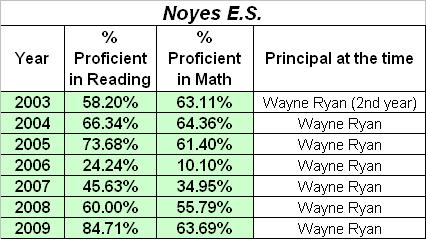
“….under a new principal at one school, student reading proficiency went from 24 percent to 85 percent in just four years, and from 10 percent to 64 percent in math. In another, only 9 percent of the students were on grade level, when just down the street in a successful charter school, over 90 percent of students were. Same kids, same neighborhoods and exposure to violence, same poverty, hunger, and parent education levels. At the successful schools, the primary difference was the team of adults who decided it was possible for lives and outcomes to move in other directions.”
As usual, Rhee operates on innuendo, never actually giving facts that people can check easily.
After doing a bit of research, I figured out that in the first sentence, she was probably referring to Noyes ES in Northeast Washington, where the percentage of students performing at the “Proficient” or “Advanced” level went as follows. Notice that in 2006, in reading, about 24% of the students scored “proficient”, and in 2009, about 85% scored “proficient”.
If you are wondering what happened to make the scores go down so much in 2006, the answer is simple: DCPS contracted with a different testing company that year to make the NCLB AYP tests for the city. Instead of the SAT-9, students took the DC-CAS. Since the change, our “curriculum” has been more and more just “test prep for the DC-CAS”, so it’s not entirely surprising that teachers have been getting better at coaching students to improve their scores.
Here’s the same data in the form of a graph:
Unlike what Rhee wrote, Noyes has had the same principal, Wayne Ryan, since 2002, well before Rhee came onto the scene, so she can’t take credit for hiring him. And with at least 8 years on the job, Ryan is now one of the most veteran principals in DCPS. I