Latest News and Comment from Education

Friday, July 10, 2020

Can Public Schools Open Safely for Children and their Teachers? Trump Worries Instead About His Own Political Future | janresseger

Can Public Schools Open Safely for Children and their Teachers? Trump Worries Instead About His Own Political Future | janresseger

Can Public Schools Open Safely for Children and their Teachers? Trump Worries Instead About His Own Political Future


Should public schools reopen this fall?  Is there a single plan that will work everyplace? Can school districts make social distancing workable with some kind of hybrid plan in which children are sometimes in class personally and sometimes online? Should schooling go online full-time for a whole semester or a whole school year?  Whose interests matter when it comes to reopening?  Should economic and political demands trump everything?  What about safety?  Do parents’ needs matter? And what about the well-being of children and adolescents themselves?
If you are not totally dispirited by President Trump’s bizarre and ugly July 4th allegation that, “against every law of society and nature, our children are taught in school to hate their own country,” I urge you to read Jeff Bryant’s excellent new summary of the dilemma about reopening public schools next month in the middle of the pandemic.  Bryant examines the arguments of people of both political parties. Then, with citations to important research, Bryant reminds readers about years of society’s failure to fund public schools and the consequences of our persistent failure to invest in an institutional infrastructure we need to fall back on today.  He explains how lingering funding cuts from the 2008 Great Recession have left teachers underpaid in many places, classes too large, key support staff laid off, and buildings poorly maintained.  Bryant reports on new recommendations from the American Academy of Pediatrics urging the reopening of schools based on new medical evidence that children are less likely to catch the virus or to be contagious.  Finally he examines the contradiction in President Trump’s and Betsy DeVos’s demands that schools be reopened at the same time the Trump administration and Senator Mitch McConnell are blocking a bill already passed by the U.S. House of Representatives to provide federal relief assistance vitally necessary if schools are going to reopen.  And Bryant adds that both Trump and DeVos are insisting on more federal funding for private schools at the expense of public schools.  Bryant wonders: “So now teachers are expected to save the nation’s bacon?”
On Tuesday, President Trump and Education Secretary Betsy DeVos launched a full bore CONTINUE READING:Can Public Schools Open Safely for Children and their Teachers? Trump Worries Instead About His Own Political Future | janresseger

UTLA: It Is Not Safe to Open Schools This Fall | Diane Ravitch's blog

UTLA: It Is Not Safe to Open Schools This Fall | Diane Ravitch's blog

UTLA: It Is Not Safe to Open Schools This Fall


Media Contact / Anna Bakalis 213-305-9654
For immediate release / June 9, 2020
UTLA recommends keeping LAUSD school campuses closed; refocus on robust distance learning practices for Fall
LOS ANGELES — Amid COVID-19 infections and deaths surging to record highs, Trump’s threats to open schools prematurely, and a groundbreaking research paper that outlines necessary conditions for safely reopening schools, the UTLA Board of Directors and Bargaining Team are recommending to keep school campuses closed when the semester begins on Aug. 18.
“It is time to take a stand against Trump’s dangerous, anti-science agenda that puts the lives of our members, our students, and our families at risk,” said UTLA President Cecily Myart-Cruz. “We all want to physically open schools and be back with our students, but lives hang in the balance. Safety has to be the priority. We need to get this right for our communities.”
UTLA is also engaging all members in a poll on Friday, July 10, to find out where they stand on re-opening campuses. UTLA will notify members of the results of the poll Friday night.
The research paper, Same Storm but Different Boats: The Safe and Equitable Conditions for Starting LAUSD in 2020-21, (attached) looks at the science behind the specific conditions that must be met in the second-largest school district in the nation before staff and students can safely return.
Even before the spike in infections and Trump’s reckless talk, there were serious issues with starting the year on school campuses. The state and federal governments have not provided the additional resources or funds needed for increased health and safety measures and there is not enough time for the district to put together the detailed, rigorous plans for a safe return to campus.
According to UTLA’s research paper, there is a jarringly disparate rate of COVID-19 infection, severe illness, and death among Black, Indigenous and People of Color (BIPOC) working communities, where structural racism and economic inequality mean people live with economic and social factors that increase risk of illness and death. In these communities, people are more likely to have “essential” jobs, insufficient health care, higher levels of pre-existing health conditions, and live in crowded housing. Because of the forces of structural racism, Blacks, Latinx, and Pacific Islanders in Los Angeles County are dying of COVID-19 at twice the rate of white residents. CONTINUE READING: UTLA: It Is Not Safe to Open Schools This Fall | Diane Ravitch's blog

COVID School: Breathing the Air, Staying Apart, and Shortening the Day | deutsch29

COVID School: Breathing the Air, Staying Apart, and Shortening the Day | deutsch29

COVID School: Breathing the Air, Staying Apart, and Shortening the Day


As one might expect, since I am a classroom teacher, I have been thinking a lot about the COVID-19 school day.
In this post, I offer a number of thoughts on physically returning to school during this coronavirus pandemic.
To begin, I have been thinking about how children may not be manifesting COVID symptoms and still have the virus. Too, it is possible that even though these children actually have coronavirus, their parents and guardians are not ill.
Some would like to take this as proof that such children will not infect their teachers.
But here is a thought:
What happens when several such children are together in the same classroom for at least one class period multiple days per week? The presence of COVID-19 is concentrated in the classroom, and the teacher is regularly exposed to this concentrated COVID-19 in a manner that parents and guardians with a single child carrying COVID-19 are not.
The potential for COVID-19 concentration matters, and I am concerned that even if I have only 10 students in my room at any given time, other students and I, who may fall ill from the virus, are being repeatedly exposed to a coronavirus concentration.
This brings me to my next thought:
Fresh air circulation matters.
Given that COVID-19 is airborne, recirculated air only aids that potential virus CONTINUE READING: COVID School: Breathing the Air, Staying Apart, and Shortening the Day | deutsch29

NYC Public School Parents: How the city's "plan" for re-opening schools highlights the cruel inequities of class size as never before

NYC Public School Parents: How the city's "plan" for re-opening schools highlights the cruel inequities of class size as never before

How the city's "plan" for re-opening schools highlights the cruel inequities of class size as never before


Yesterday, the DOE released the preliminary outlines of a “plan” for how schools will be restructured in the fall is they are reopened next fall. DOE officials have determined that to maintain proper social distancing, a range of 9-12 students per classroom will be allowed, varying according to the size of the classroom.

Because class sizes are much larger than this in nearly every school, schools will have to separate their students into two or three or sometimes four groups who will take turns attending school in person, to be provided with remote learning when not in school. Families can also choose full-time remote learning with their children never attending school in person.

As a result of vastly different levels of school and classroom overcrowding across the city, some schools will be able to offer about half of their students in-person instruction each day; while others may only be able to allow each student to attend school one or two days a week. Or alternatively, different schools will opt for different groups of students attending school every other week or every third week.


For the most overcrowded schools, there will likely be three cohorts of students with complex schedules (not counting the group who stays home for full time remote learning) as shown to the right.

As usual with most such DOE documents, it provokes as many questions as it answers:


  1. How will the existing number of teachers be able to teach three or four different student groups at the same time, including the ones who are present in school, the ones who are home receiving online instruction part-time, and those receiving full-time remote instruction --– particularly with planned budget cuts and a staffing freeze to schools?
  2. If schools are encouraged to repurpose gymnasiums and cafeterias to allow for more classes to be taught at once, as the Chancellor has suggested, what additional personnel will be used to teach those students?
  3. Will the same teachers be assigned to teach the same groups of students over time, whether in person or remotely?
  4. What will working parents do when their kids are learning from home and cannot be in school?
  5. How will busing and after school be handled?
At a Chancellor’s Parent Advisory Council meeting this morning, Chancellor Carranza said DOE will be identifying all individuals who have teaching certification -including himself – and may thus be redeployed and assigned to teach students. This would be an extremely smart move. While according to DOE,  CONTINUE READING: NYC Public School Parents: How the city's "plan" for re-opening schools highlights the cruel inequities of class size as never before


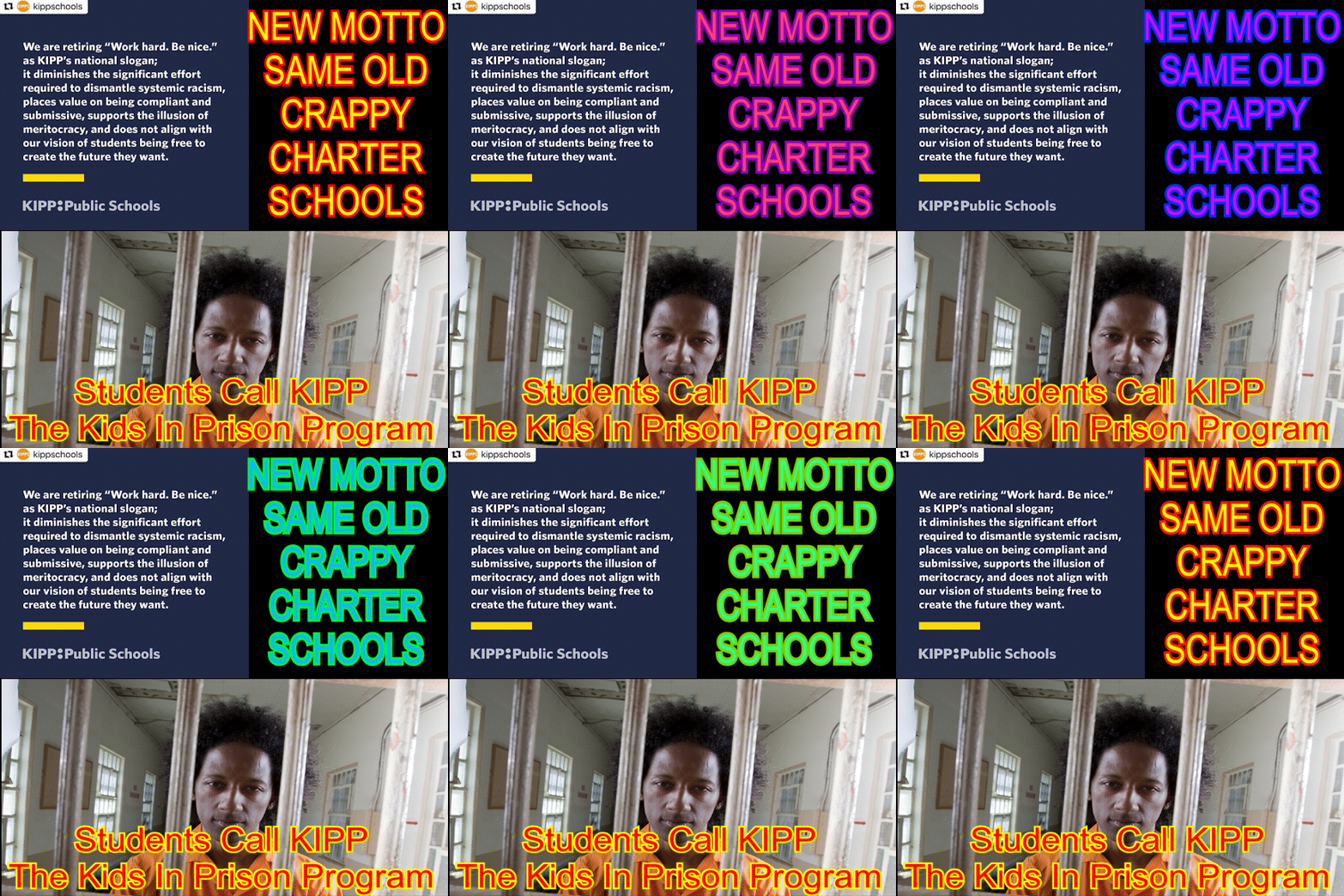
Schools Matter: KIPP Drops the Motto But Keeps the Brutality

Schools Matter: KIPP Drops the Motto But Keeps the Brutality

KIPP Drops the Motto But Keeps the Brutality


Four out of five students who started school at the Hampton Normal and Agricultural Institute during the decades just after the Civil War never earned their certificates of completion, even though academic expectations were far below schools for white students.  Getting booted from Hampton's residential program, you see, was more likely to come from a bad attitude, or bad character, than bad study habits.

Hampton's chief purpose, after all, was to inculcate in freed slaves and Western Indians a deep and abiding respect for hard work, above all else.  Secondarily, the purpose was to politically neuter Southern blacks and to assimilate Native Americans. As Captain Richard Pratt made infamous, "Kill the Indian, save the man."

The indoctrination at Hampton was non-stop, and most students who completed the program became teachers who were expected to fan out across the South to teach young black folks "the dignity of labor" and a ready acceptance of second-class citizenship, which had been earned, they were taught by white male instructors, by the inherent moral depravity of their race. 

To earn the favor of the white philanthropists who supported Hampton's methods, and to advance in white Southern society, Blacks would need to labor diligently and to remain compliant without complaint. You might say, those indoctrinated in the Hampton Model schools were taught to work hard and to be nice.

I was gratified to see, then, in Jay Mathews' announcement yesterday that KIPP would be dropping its motto, "Work Hard, Be Nice," that Jay acknowledges the obvious connection between the 21st Century KIPP CONTINUE READING: Schools Matter: KIPP Drops the Motto But Keeps the Brutality

Tell Congress: The Trump/DeVos Plan for School Reopening is Reckless and Dangerous - Network For Public Education

Tell Congress: The Trump/DeVos Plan for School Reopening is Reckless and Dangerous - Network For Public Education

Tell Congress: The Trump/DeVos Plan for School Reopening is Reckless and Dangerous


Send your email by clicking here and let Congress know that you oppose the Administration’s reckless plan to reopen schools.
Read our official statement below:
The Network for Public Education opposes the Trump Administration’s dangerous and reckless proposal to reopen schools without regard to safety or resources. If the pandemic has taught American parents and school children anything, it is the value of in-person education led by professional educators. We all want the schools to reopen for in-person instruction as soon as possible, but we must protect the health and well-being of children, educators, and other school staff.
We oppose the Trump Administration’s threat to cut federal funding to districts that refuse to bow to their demands. We insist that Congress and Governors provide the funding needed by schools to bring children and staff back safely. No school should open in an area where the virus is surging or there are high levels of transmission. Plans must be flexible, guided by science, not politics, and include alternatives for high-risk children and staff. The decision to open physically must be made locally depending on the extent of viral spread, and districts’ preparedness to provide safe conditions.
We condemn the reckless call by Trump and DeVos to reopen all schools without regard to safety, which undermines serious and responsible efforts to meet the needs of children and staff this fall.
We applaud the CDC for not bending to political pressure from the White House to weaken its guidelines for the safe reopening of schools.
The Administration’s position is a thinly veiled plan to demonize teachers and local school boards as disloyal Americans while demanding that districts ignore the safety of students and school staff.
We strongly oppose the outrageous Trump-DeVos proposal to transfer public school funds away from schools that do not physically open and move those federal funds to private, religious, online, and for-profit schools that are open. This is a transparent and cynical move to use the pandemic to voucherize school funding and destroy public education.
Tell Congress: The Trump/DeVos Plan for School Reopening is Reckless and Dangerous - Network For Public Education

NYC Educator: UFT Executive Board July 9, 2020--Riding a Hybrid Safely

NYC Educator: UFT Executive Board July 9, 2020--Riding a Hybrid Safely

UFT Executive Board July 9, 2020--Riding a Hybrid Safely


 Roll Call 2:50

UFT Secretary LeRoy Barr welcomes us.

Minutes--approved.

UFT President Michael Mulgrew--You all saw mayor's "blended plan." In April, after multiple models, there were two options to open safely. Either we triple classrooms and teachers, or have one third of students present. We are okay with the model as the way to go. The type of schedule is problematic. We would like to limit the number of models to those most schools could use, but offer flexibility.

Doing something else, though, does not mean you ignore safety rules. That comes first. Next phase is safety and developing protocols. We will enforce masks, not just talk to children about it. Everyone in school will have to wear a mask.

Medical accommodation process will be going out on July 15, along with ability for parents to opt their children out of live instruction. We believe 20-25% will opt out, if we stay on current trajectory of virus. We expect results by August 7th. We are not sitting around and waiting. Almost 1300 schools did walkthrough. We are engaged in this.

Blended plan yesterday is step one. We're looking at health and safety, and working conditions. We will need a temporary agreement for these conditions. We will have remote and live teachers, and some who do both. All of these things have to be negotiated. There are many outstanding safety issues, including physical proof that shields, masks, cleaners and protocols are in place, with personnel to make sure it's done.

This can't be like March. We will have to walk to each school and make sure this is all in place. Talking to infectious disease doctors, will talk to DOE and CSA about testing regimen. We will recommend that everyone, especially living in NYC, get an antibody test. Will be very important if you come into contact with virus. Thinking about a program to offer this to UFT members. Talking with hospitals and health care providers about this. CONTINUE READING: 
NYC Educator: UFT Executive Board July 9, 2020--Riding a Hybrid Safely


A VERY BUSY DAY Larry Ferlazzo's Websites of the Day... The latest news and resources in education since 2007

Larry Ferlazzo's Websites of the Day... | The latest news and resources in education since 2007


A VERY BUSY DAY
Larry Ferlazzo's Websites of the Day...
The latest news and resources in education since 2007


Four School Reopening-Related Articles From The Past Day That Are Worth Reading
Clker-Free-Vector-Images / Pixabay Wow, school reopening has been getting a lot of attention the past few days. I’ve already shared some of the most interesting and useful resources that have appeared. Here are a few more that I’ve picked from the blizzard of coverage. I’m adding these to THE BEST POSTS PREDICTING WHAT SCHOOLS WILL LOOK LIKE IN THE FALL : The American Academy of Pediatrics has ce
This Is Great – Canva Begins To Unveil Real-Time Collaboration Ability!
Canva has so many tools in one that it’s one of the most versatile apps on the Internet. However, it has has one major shortcoming – the inability to collaborate in “real-time.” You could have others work on a project with you, but only one person could work on it at the same time. Especially during this pandemic, this inability makes it less attractive to have teachers encourage students to use
“Strategies for Using Music in ALL Subjects”
Strategies for Using Music in ALL Subjects is the headline of my latest Education Week Teacher column. Five educators share multiple ways to use music in nonmusic classes, including having students create their own songs to help remember content and y interpreting the music of different eras in social studies classes. Here are some excerpts:

YESTERDAY

Video: I Think This Is A Pretty Good CNN Segment On Schools In The Fall
ernestoeslava / Pixabay I’m adding this good CNN segment to THE BEST POSTS PREDICTING WHAT SCHOOLS WILL LOOK LIKE IN THE FALL :
A Look Back: Big Study Finds Several Math & Reading Interventions Helpful To Secondary Students, But Offering Incentives Is Useless
I thought that new – and veteran – readers might find it interesting if I began sharing my best posts from the first half of this year. You can see the entire collection of best posts from the past thirteen years here . A meta-analysis of math and reading interventions targeting middle and high schools students experiencing academic difficulties found several interventions helpful, but found one
New PBS NewsHour Video Segment: “The ‘unwise, disruptive policy’ of shutting out international students”
nikolayhg / Pixabay Here’s an overview of yesterday’s awful decision by the Trump Administration – it appeared on tonight’s PBS NewsHour:
“Q&A Collections: Cooperative & Collaborative Learning”
Q&A Collections: Cooperative & Collaborative Learning is the headline of my latest Education Week Teacher column. All Classroom Q&A posts sharing advice on Cooperative & Collaborative Learning (from the past nine years!) 


Larry Ferlazzo's Websites of the Day... | The latest news and resources in education since 2007