Latest News and Comment from Education

Tuesday, February 18, 2020

A surprise big spender funds attack campaign mailers in key L.A. school board races - Los Angeles Times

A surprise big spender funds attack campaign mailers in key L.A. school board races - Los Angeles Times

A surprise big spender funds attack campaign mailers in key L.A. school board races

The barrage of campaign mail flooding voters in a Los Angeles school board race includes images of a child holding what appears to be a gun, with the message that school board member Jackie Goldberg is responsible for putting children at risk from gun-related violence.
The multiple mailings that Goldberg calls “pieces of lies” also suggest that she is responsible for the notorious sexual misconduct at Miramonte Elementary that came to light in 2012, and that she doesn’t care about Latino children.
“I’ve never before in my life been attacked with vicious lies like this,” said Goldberg, 75, who first served on the school board in the 1980s before being elected to the L.A. City Council and state Assembly.
Goldberg, who is running for reelection in the March 3 primary, finds herself in the crosshairs of Bill Bloomfield, a wealthy, retired businessman from Manhattan Beach, who has spent close to $2 million so far in two L.A. school board campaigns.
In Goldberg’s District 5, which stretches from neighborhoods north and east of downtown to the cities of southeast L.A. County, he has spent more than $1 million through Monday’s reported totals. In District 7 — the South L.A.-Harbor seat held by termed-out Board President Richard Vladovic — Bloomfield has so far spent nearly CONTINUE READING: A surprise big spender funds attack campaign mailers in key L.A. school board races - Los Angeles Times


Support Scott for LAUSD 


Aaron Wright: The Unintended Consequences of IDEA - NANCY BAILEY'S EDUCATION WEBSITE

The Unintended Consequences of IDEA

The Unintended Consequences of IDEA


By Aaron Wright
It is undeniable that the Individuals with Disabilities Education Act (IDEA) has aided educational access for autistic children. Prior to the first iteration of the law, children with disabilities did not necessarily have the right to a public education.
However, an unforeseen side effect of the IDEA’s deficit-oriented focus upon disability has created a dilemma for parents of autistic children and has fostered a problem-oriented societal approach to autistic people in general.
My daughter and Max Benson (#ShineOnMax) entered the public school system in Davis, California, at the same time as schoolmates. For our families, and families like ours, kindergarten was the next step on an already-established path of parental advocacy.
Enrolling a child in special education is not the same as signing someone up for T‑ball or a recreational soccer team. And it is certainly not the same as approaching your pediatrician for help with your infant or toddler who is displaying developmental delays.
It is often a tall order to obtain educational services for your child from an entity solely CONTINUE READING: The Unintended Consequences of IDEA

CURMUDGUCATION: How To Improve The Quality Of Teaching With Tools Districts Already Have At Hand (And How To Mess It Up)

CURMUDGUCATION: How To Improve The Quality Of Teaching With Tools Districts Already Have At Hand (And How To Mess It Up)

How To Improve The Quality Of Teaching With Tools Districts Already Have At Hand (And How To Mess It Up)

There is never a shortage of ideas about how to improve the quality of teaching in U.S. classrooms. From the intrusive and convoluted (“Let’s give every student a test and then run the test through a complex mathematical formula and use it to identify the strongest and weakest teachers and then fire the weak ones and replace them with strong ones, somehow”) to the traditional and banal (“Time for a day of professional development sessions that most of you will find boring and useless”), tied to either threats (“We’ll fire you!”) or rewards (“Merit pay!”), school systems and policy makers have come up with a wide variety of approaches that don’t do a bit of good. 
And yet, there is a very effective method that not only improves the quality of teaching in classrooms, but increases the chances of retaining good teachers in a district. Best of all, every district in the country already has every resource it needs to implement the technique. Some are even required to do it, though many mess it up badly. What’s the magic technique?
Mentors. 
The only resource needed is a good, experienced teacher to mentor a new teacher for a year, or even two or three.
In the old days, new teachers found their mentors through happenstance. Like many beginning teachers, I found my first mentors in the staff room during lunch. If I had eaten a different shift, I might not have met them at all. I also had the good fortune to be in an unconventional education program; the same professor who supervised me during my student teaching also visited my classroom during my first year, and I CONTINUE READING: CURMUDGUCATION: How To Improve The Quality Of Teaching With Tools Districts Already Have At Hand (And How To Mess It Up)

National Education Policy Center: Are Zillow and Real Estate Agents Promoting Segregation? | Diane Ravitch's blog

National Education Policy Center: Are Zillow and Real Estate Agents Promoting Segregation? | Diane Ravitch's blog

National Education Policy Center: Are Zillow and Real Estate Agents Promoting Segregation?


How do renters or buyers judge the quality of the schools zoned to their prospective homes?
Often it starts not with schools or teachers or students, but with the real estate industry.
Two recent pieces of investigative journalism call attention to a prominent flaw with this system: Realtors and real estate websites alike share assessments that downgrade schools that serve higher percentages of low-income and minority students, while also serving to maintain segregated housing patterns by steering Whites away from districts that serve students of color.
For a series of articles published earlier this month, the Newsday newspaper in Long Island paired testers of different ethnicities and races and had them seek similar homes from the same realtors.
The newspaper found that realtors repeatedly steered White buyers away from school districts enrolling higher percentages of minoritized residents, typically using veiled language. For example, they told White buyers that one community was an area to avoid “school district-wise” or “based on statistics.” Yet that district’s 90 percent Black and Hispanic high school boasted a 96 percent four-year graduation rate and above-average performance compared to the rest of the county.
In a study of the areas investigated by NewsdayNEPC Fellow Amy Stuart Wells, a professor of sociology and education at Teachers College, Columbia University found that a one percent increase in Black/Hispanic enrollment corresponded with a 0.3 percent decrease in home values. In other words, a home worth $415,000 at the time of the study in 2010 would cost $50,000 more in a 30 percent Hispanic/Black district as compared to a 70 percent Hispanic/Black district.
Wells and her team compared two districts with similar housing stocks and socioeconomic backgrounds but different percentages of Black, Hispanic, and White residents. Although Wells said realtors discounted the quality of the schools of the majority Black/Hispanic area, her team found few differences when they actually visited and studied the district.
“There didn’t seem to be a huge difference at all in the curriculum and the quality of the teachers,” she told the newspaper. “So, they [real estate agents] do play an important role in steering people away from certain districts that are becoming more racially, ethnically diverse and less White, in particular.”
An internet-era wrinkle to these longstanding practices was documented and described last week in an article published in the education-focused news site Chalkbeat. The site’s analysis found that school ratings featured on popular real estate sites like Zillow and Realtor.com—ratings assigned by the non-profit corporation called GreatSchools—nudged buyers toward schools with higher percentages of White students by assigning lower ratings to schools with higher percentages of Black and Hispanic students. This happened even when GreatSchools’ own evidence showed that these schools were doing a good job growing the scores of their students.
Specifically, although student’s test score growth is also considered, it’s worth a much smaller share of a school’s “grade” than proficiency, a factor that greatly penalizes schools serving students with fewer opportunities to learn due to societal inequalities outside the realm of the school.
More than that, the GreatSchools algorithm is overwhelmingly about these test scores, largely ignoring other factors of school quality. Rather than assessing the degree to which all students are provided opportunities to learn, test results tabulate outcomes that are profoundly influenced by the unequal opportunities and resources offered to White students versus students of color.
Alternative approaches are available, but they require us to truly and deeply learn about the school. Superficial measures like those used by GreatSchools and its real estate customers must be set aside. One example of such an alternative approach is NEPC’s Schools of Opportunityrecognition program for high schools, which uses a holistic assessment of school quality. The application and evaluation processes consider how these schools are broadening and enriching learning opportunities, creating and maintaining a healthy school culture, and implementing a variety of research-based approaches that close opportunity gaps.
Yet it is the GreatSchools ratings that are viewed by 150 million users of real estate software per year. And there’s evidence that it’s having an effect: A recent study found that property values in areas with a high GreatSchools rating increased by nearly $7,000 over three years, furthering the discriminatory real estate cycle that has always existed in the United States.
CONTINUE READING: National Education Policy Center: Are Zillow and Real Estate Agents Promoting Segregation? | Diane Ravitch's blog

The Adequacy and Fairness of State School Finance Systems (second edition) | School Finance Indicators Database

The Adequacy and Fairness of State School Finance Systems (second edition) | School Finance Indicators Database

The Adequacy and Fairness of State School Finance Systems

Image result for The Adequacy and Fairness of State School Finance Systems
When it comes to American education, few policy areas are as misunderstood — or as crucial — as school finance. Over the past several years, a political and empirical consensus has emerged about the importance of equitable and adequate school funding for high quality K-12 education. In other words, the evidence is clear that money does, indeed, matter.
Certainly, debates about how education funds should be spent are also important, and money should be spent wisely. But there are few options for improving America’s schools that don’t require adequate and sustained investment, particularly for disadvantaged students. And while maintaining efficiency is important, the fact is that districts cannot spend money wisely that they do not have.
In this report, we present key findings from the second release of our School Finance Indicators Database (SFID), a public database of sophisticated but user-friendly state school finance measures going back to 1993. This latest version of the SFID includes data up to 2017 (the 2016-17 school year).
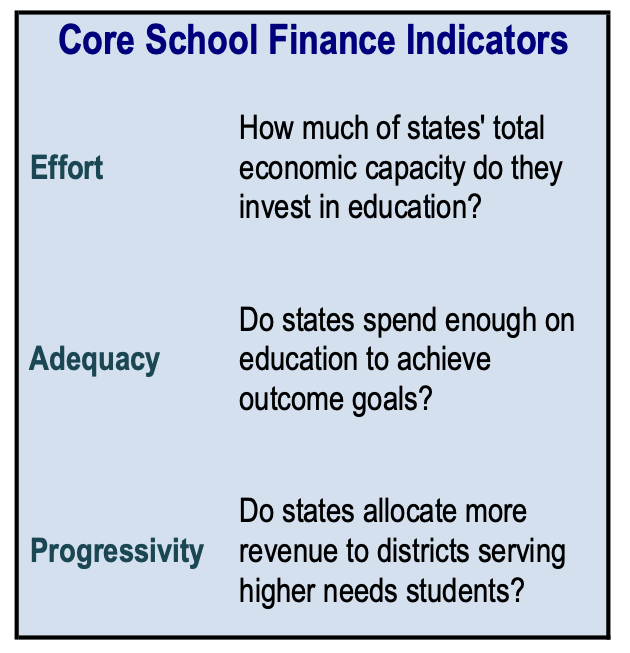
The database includes approximately 130 variables, but in this report we focus on three key school finance measures: effortadequacy, and progressivity. As a whole, we feel that these three measures provide a succinct and informative overview of the adequacy and fairness of states’ school finance systems.
Our indicators are most appropriately interpreted on a state-by-state basis, but in this report we do attempt to present some calculations of national averages and trends in those averages. A summary of our key findings on our “core indicators” is as follows:


This image has an empty alt attribute; its file name is coreindbox.png

Effort

Effort (or fiscal effort) measures how much of states’ total economic resources or capacity are spent directly on K-12 education. States with smaller economic capacity must exert greater effort than states with greater capacity to raise the same amount of revenue for their schools. Our measures allow us to determine whether states lag behind in spending because they don’t have the capacity to raise revenue (e.g., they have smaller economies from which to draw tax revenue), or because they refuse to devote sufficient resources to education. 
  • The typical state devotes about 3.5 percent of its capacity (i.e., Gross State Product) to K-12 education. Individual states’ effort levels range from about 2.4 percent in Nevada to over 5 percent in Vermont.
  • Other higher effort states include Wyoming (4.7), New Jersey (4.6), New York (4.5), and Alaska (4.5). Other lower effort states include Arizona (2.6), North Carolina (2.7), Delaware (2.8), and Tennessee (2.8). Most states, however, are within 0.5 percentage points of the national average (though even small differences can translate into large amounts of revenue, particularly in states with large economies).
  • The U.S. average effort increased from 3.7 percent in 2004 to a high of 4.1 percent in 2009. This was followed by a five year decline between 2009 and 2014, stabilizing at roughly 3.5 percent since then. In fact, between 2009 and 2017, fiscal effort decreased at least nominally in every single state except Wyoming. Overall, then, average effort has not rebounded since the Great Recession, and is slightly lower in 2017 than it was in 2004.

Adequacy

While effort measures how hard states and districts work to raise funds for their public schools, adequacy measures address whether the amount raised is enough. Our primary measure of adequacy compares current education spending, by district poverty quintile, to spending levels that would be required to achieve national average test scores. In other words, we define adequacy in terms of a common “benchmark” (national average scores) that is educationally meaningful, using estimates from complex models that take into account factors such as student characteristics, labor market costs, and district characteristics.
  • On average, spending on the highest poverty districts (80-100th percentile poverty) is approximately 70 percent of estimated adequate levels. That is, the typical state spends 30 percent less than it would need to for students in its highest poverty districts to achieve nationally average test scores.
  • There are only six states in which spending on the highest poverty districts exceeds estimated adequate levels: Wyoming; Delaware; New Hampshire; Nebraska; Connecticut; and New York. Conversely, current spending on these highest poverty districts is less than half of the adequate level in five states: Arizona; New Mexico; California; Texas; and Mississippi.
  • Nationally, the situation is not much better in the second highest poverty districts (60-80th percentile district poverty), where spending is, on average, about 78 percent of required amounts. In contrast, spending is above our estimated adequate levels for the lowest poverty (0-20th percentile) and slightly higher in the second lowest poverty (20-40th percentile) districts.
  • In general, states are spending enough on their lower poverty districts and not enough on their higher poverty districts (and their testing outcomes generally reflect this pattern).
  • There is a relationship between fiscal effort and adequacy — that is, states that spend more of their “economic pie” on education tend to exhibit more adequate spending levels. Of particular concern are states, such as Arizona, that spend inadequately and put forth low effort, as well as states, such as Mississippi, that fail to achieve adequate funding levels despite putting forth relatively high effort levels.

Progressivity

Put simply, progressive funding systems are those in which higher poverty districts, all else being equal, receive more revenue than lower poverty districts. Regressive funding systems, in contrast, allocate more revenue to wealthier districts than they do to poorer districts. Progressivity (sometimes called “fairness”) is important because it is generally acknowledged that students from disadvantaged backgrounds tend to require more resources than their more affluent peers to achieve the same level of educational outcomes. Our primary progressivity measure controls for factors — such as poverty, labor market costs, population density, and district size — that affect the value of the education dollar. These controls allow us to compare district and state school revenues in a way that accounts for differences that are largely outside the control of education policymakers. 
  • A handful of states, such as Wyoming, Alaska, and Utah, allocate revenue in a strongly progressive manner, whereas funding is highly regressive in Illinois and Nevada.
  • There are only ten states in which high poverty districts receive at least 10 percent more revenue than zero poverty districts. In 28 states, high poverty districts actually receive less revenue. In other words, the vast majority of states’ finance systems fund their high and low poverty districts either similarly or regressively.
  • Accordingly, on average, state and local education funding in the U.S. is neither progressive nor regressive. That is, the highest poverty districts in the typical state tend to receive similar amounts of revenue, all else being equal, as do the lowest poverty districts.
  • U.S. average progressivity has increased very modestly over the past two decades, going from minimally regressive in 1997 (revenue in the highest poverty districts was 3-4 percent lower than in the lowest poverty districts) to minimally progressive in 2017 (revenue was about two percent higher in the highest poverty districts compared with the lowest poverty districts). At the national level, education funding has been non-progressive for the past two decades.
Overall, then, our findings indicate that there are several states in which education funds are both adequate and distributed equitably. In general, however, resources in most states tend to be allocated regressively or non-progressively, and funding for higher poverty districts in the vast majority of states falls far short of estimated adequacy levels (in many cases reflecting a lack of effort). 
We do not provide state rankings or grades in this report, as the interplay between effort, adequacy and progressivity is far too complex to be boiled down to such simple measures. We do, however, include recommendations as to how researchers, policymakers, and the public can use our findings, as well as our database, to evaluate state systems and inform debates about improving school finance in the U.S.

Authors: Bruce D. Baker (Rutgers University); Matthew Di Carlo (Albert Shanker Institute); and Mark Weber (Rutgers University)

Download the full report
Download the press release
Download the full dataset or use data visualizations

Previous editions of the report: First edition (2019)
The Adequacy and Fairness of State School Finance Systems (second edition) | School Finance Indicators Database

Opinion | School Choice Logic Doesn’t Apply Here. Does the Supreme Court Get That? - The New York Times

Opinion | School Choice Logic Doesn’t Apply Here. Does the Supreme Court Get That? - The New York Times

School Choice Logic Doesn’t Apply Here. Does the Supreme Court Get That?
The Montana education system was designed for fairness and pulling together. The justices should appreciate that legacy.

Scrutinizing the avuncular sphinx Chief Justice John Roberts throughout the impeachment trial of President Trump, I kept wondering whether he will preserve or ransack the legacy of the framers we revere — framers like the Republican Betty Babcock and the Democrat Dorothy Eck. It’s the question on all Americans’ minds: Do Mr. Roberts and his eight co-workers fully appreciate the public-spirited grandeur of the winter of 1971-72, when 100 Montanans, including housewives, ministers, a veterinarian and a beekeeper, gathered at the state capital, Helena, for the constitutional convention, affectionately nicknamed the “Con Con”?
The question haunts the current Supreme Court case Espinoza v. Montana Department of Revenue. This newspaper has called the dispute over whether state tax credits can apply to donations for scholarships to private religious schools “a proxy battle over school choice.” However, the back story is so clumsily specific to Montana’s small population and immense geography that the case doesn’t entirely translate to states where people outnumber cows.
The novelist Ivan Doig wrote that in the scruffy Montana of yore, “when you met up with someone apt to give you trouble from his knuckles, the automatic evaluation was ‘too much Butte in him.’” When, as the grateful graduate of a Montana public school, I was determining whether I had a duty to stick up for the Con Con framers regarding the Espinoza case, I spotted a sequence in the web address of an article about it in The Atlantic that read “montana-bigoted-laws.” At that moment this Bozeman girl had too CONTINUE READING: Opinion | School Choice Logic Doesn’t Apply Here. Does the Supreme Court Get That? - The New York Times


Black Agenda Report: The Looting of Oakland’s Public Schools by Broadies | Diane Ravitch's blog

Black Agenda Report: The Looting of Oakland’s Public Schools by Broadies | Diane Ravitch's blog

Black Agenda Report: The Looting of Oakland’s Public Schools by Broadies


This is an astonishing report about the destruction and privatization of public schools in Oakland, California, and the billionaires who facilitated the looting of that city. The article by Eugene Stovall appeared in “Black Agenda Report.” The audacity of this attack on public education is astonishing. The mechanism for the destroyers were graduates of the Broad Academy, known as Broadies. Since billionaire Eli Broad gave Yale University $100 million to take charge of his program, someone should warn Yale about its record.
Read it all. It will take your breath away.

Stovall writes:
Eli Broad (rhymes with “toad”) conconcted a scheme to privatize Oakland’s public schools and produce a revenue stream for his billionaire cronies.
Operating unethically and illegally, Broad managers used their training to cripple and plunder Oakland’s schools.”
Eli Broad is a liberal Democrat. He opposes Trump’s Muslim ban, immigration policies and withdrawal from the climate change treaty. In fact, like Democratic billionaires Tom Steyer and Michael Blloomberg, Broad opposes CONTINUE READING: Black Agenda Report: The Looting of Oakland’s Public Schools by Broadies | Diane Ravitch's blog


Who Controls Our Schools? How Billionaire-Sponsored Privatization Is Destroying Democracy and Enriching the Charter School Industry – Alternet.org

Who Controls Our Schools? How Billionaire-Sponsored Privatization Is Destroying Democracy and Enriching the Charter School Industry – Alternet.org

Who Controls Our Schools? How Billionaire-Sponsored Privatization Is Destroying Democracy and Enriching the Charter School Industry


Editor's note: AlterNet has covered the school privatization story in great detail. Over time, we became alarmed at what we were seeing. The Independent Media Institute, AlterNet’s parent organization, has published an ebook, Who Controls Our Schools? The Privatization of American Public Educationthe full text of which you can access for free online with this link. What follows is a summary of its findings and recommendations.)
The Problem
America’s public schools, which over the 20th century came to embrace the promise of equal opportunity for all children, are at a historic crossroad. Once the heart of our democracy and a bastion of local accountability, our K-12 schools now bear the scars of a nearly 25-year assault from a cadre of very wealthy ideological reformers who seek to privately run them using taxpayers' funds. Their most popular tool to dismantle this public good? Charter public schools, especially those run by corporate franchises, which now educate millions of students.
The growth of charter schools nationwide (whose numbers have increased exponentially since 2000) would not have occurred without a handful of heirs to the world’s largest family fortunes and other billionaires directing their tax-exempt foundations using their wealth to remake public schools in a corporate image. Critics have called it a virtual conspiracy while charter school promoters see themselves as K-12 education’s saviors. Either way, the result has been the creation of a little-understood, parallel, privatized CONTINUE READING: Who Controls Our Schools? How Billionaire-Sponsored Privatization Is Destroying Democracy and Enriching the Charter School Industry – Alternet.org

“Purple Lit Book”: A Poem | deutsch29

“Purple Lit Book”: A Poem | deutsch29

“Purple Lit Book”: A Poem


In a recent creative writing assignment connected to our study of the Romantic period in British literature, I asked my senior English students to compose a poem about an item, object, experience, or person associated with the everyday.
Below is one student’s response, which I offer to my readers for their enjoyment.
Without further ado, and with student permission, I give you “Purple Lit Book,” by Nikolas.

Purple Lit Book


Oh when I turn the page
how the words change and
they inform me of different people daily.
From Sam Pepys and William Blake
to how King George is CONTINUE READING: “Purple Lit Book”: A Poem | deutsch29

DIARY OF A PUBLIC SCHOOL TEACHER!: "I Don't See Color":Why Educators Should Acknowledge the Race & Ethnicity of Students.

DIARY OF A PUBLIC SCHOOL TEACHER!: "I Don't See Color":Why Educators Should Acknowledge the Race & Ethnicity of Students.
"I Don't See Color":Why Educators Should Acknowledge the Race & Ethnicity of Students.


"I don't see color".


This was a phrase that was used by a teacher in a Facebook discussion regarding an article about
why more teachers of color are needed. The educator in the group took offense because
she felt that she didn't see color in her classroom, therefore the race of the teacher
should not matter. That's the part that resounded with me.


 We all see color, it's something that can't be avoided.


There is nothing wrong with "seeing color." It's a natural way we use to identify our fellow human beings.
I once had a teacher describe a student  with every identifying feature, but their race. I finally asked her
the student's race.Did she believe that I would misinterpret the identification of the student's race as racist? 


"Seeing color" becomes an issue, when along with a person's racial identity, we focus on the stereotypes
that go along with it. When we assume the Latino children can't speak English, or that they
are in the country illegally.When we assume the black children are dumb, and their parents are drug

Important update: invitation to speak at Council hearings on class size Feb. 24! | Class Size Matters

Important update: invitation to speak at Council hearings on class size Feb. 24! | A clearinghouse for information on class size & the proven benefits of smaller classes

Important update: invitation to speak at Council hearings on class size Feb. 24!


1. Just a quick note to let you know that the hearings on class size have now been rescheduled on Mon. Feb. 24 at 1 PM at 250 Broadway; 14th floor across from City Hall.
We really need parents and concerned citizens and, if possible, teachers to come speak about why this is an important issue to them. The hearings are likely to continue to at least 4 PM.
If you cannot attend, you can also send a statement or written testimony by Feb. 27 at 5 PM to jatwell@council.nyc.gov who will share it with Education Committee members.  
If you do plan to testify or send a statement, is always best to speak from your own experience as a parent or teacher. But additional points you could make are provided in our Class Size FAQ here.
We may hold a rally beforehand at City Hall, but not yet sure; will let you know as soon as this is settled.
2. If you haven’t already, please also call Speaker Corey Johnson at 212-564-7757 or 212-788-7210 and your own Council Member – you can find out their contact info at https://council.nyc.gov/districts/
Urge them to allocate at least $100 million in next year’s budget for class size reduction.
Then follow up by letting us know at our quick survey.  Thanks so much to those of you who’ve done this already.
Hope to see you next Monday, Leonie
PS I was flattered to discover I was just named the 16th most powerful education leader in NY State by City and State Magazine; you can check out the entire list here.
Important update: invitation to speak at Council hearings on class size Feb. 24! | A clearinghouse for information on class size & the proven benefits of smaller classes