Latest News and Comment from Education

Tuesday, January 7, 2020

It's Larry Ferlazzo's Websites of the Day... A VERY BUSY DAY | The latest news and resources in education since 2007

Larry Ferlazzo's Websites of the Day... | The latest news and resources in education since 2007

It's Larry Ferlazzo's Websites of the Day... A VERY BUSY DAY 
 The latest news and resources in education since 2007


Most Popular Posts Of The Week

I’m making a change in the content of the regular feature. In addition to sharing the top five posts that have received the most “hits” in the preceding seven days (though they may have originally been published on an earlier date), I will also include the top five posts that have actually appeared in the past week. Often, these are different posts. You might also be interested in IT’S THE TWELFT

YESTERDAY

“Author Interview: ‘Culturally Responsive Education in the Classroom'”

Author Interview: ‘Culturally Responsive Education in the Classroom’ is the headline of my latest Education Week Teacher column. In it, Adeyemi Stembridge talks about his new book, “Culturally Responsive Education In The Classroom: An Equity Framework for Pedagogy, including explaining the difference between “equity” and “equality.” Here are some excerpts:
A Look Back: “Shortcuts, School Reform and Private Foundations”

I thought that new – and veteran – readers might find it interesting if I began sharing my best posts from over the years. You can see the entire collection here . Today, I’m featuring a piece I wrote for The Huffington Post years years ago titled Shortcuts, School Reform and Private Foundations. Here’s an excerpt:
The Best Resources To Learn About The Importance Of Teacher Modeling

mohamed_hassan / Pixabay I’ve written a lot in posts and in my books about the importance of teacher modeling and how, usually, if one of my lessons goes south (which happens more frequently than I would like), I can usually find the reason in lack of teacher modeling. Literacy researcher Timothy Shanahan has just written the best piece I’ve seen on the importance of modeling – and how to do it.
My Latest BAM! Radio Show Is On Connecting Current Events To The Classroom

My latest ten-minute BAM! Radio Show is on connecting current events, including impeachment, to the classroom . I’m joined by Suzie Boss and Kristen Koppers, who have also contributed written commentaries to my Education Week Teacher column. I’m adding this show to All My BAM Radio Shows – Linked With Descriptions .
This Year’s “Doodle for Google” Student Contest Opens

Google’s annual contest for students to create “Doodles” opened up today . They will accept entries until March 13th. Even though there’s only “one” national winner, they seem to have enough finalists for it to be worthwhile for students to participate with a decent chance of gaining some recognition.


Chinese (Lunar) New Year Takes Place On January 25th – Here Are Teaching & Learning Resources

nguyentuanhung / Pixabay Chinese (Lunar) New Year takes place on January 25th this year. You might be interested in The Best Resources For Chinese (Lunar) New Year.
Larry Ferlazzo's Websites of the Day... | The latest news and resources in education since 2007

The Greatest Ed Tech Goof Of All Time (Adam Laats) | Larry Cuban on School Reform and Classroom Practice

The Greatest Ed Tech Goof Of All Time (Adam Laats) | Larry Cuban on School Reform and Classroom Practice

The Greatest Ed Tech Goof Of All Time (Adam Laats)


Adam Laats is an educational historian at Binghamton University, State University of New York. A former teacher, he is currently at work on the Lancasterian system of schooling in early 19th century America. Laats had read a post by Audrey Watters, “The 100 Worst Ed-Tech Debacles of the Decade.” He then wrote this post for his blog.
What have been the top ed-tech goofs of all time? The top choice from my current research is pretty clear, c. 1804. [My readers] are probably sick of hearing about Joseph Lancaster. And I’m sorry. But his plan was such a perfect mix of tech-naĆÆvetĆ© and Zuckerberg-level hubris that I can’t stop marveling over the 21st-century feel of Lancaster’s tech-obsessed school system.
If you’re just joining us, Lancaster was a young man who opened a school for poor kids in London in 1798. He tried some new tricks, including banishing corporal punishment and using students as teachers. He really believed technology could solve all the problems of education and therefore of society.
For example, he dreamed of new systems of “reading telegraphs,” “alphabet wheels,” and benches with holes for hats. His assumption—like that of so many of his peers—was that the right machine could eliminate traditional problems with school organization.
None of those failed ed machines, however, gets my pick as the top ed-tech goof CONTINUE READING: The Greatest Ed Tech Goof Of All Time (Adam Laats) | Larry Cuban on School Reform and Classroom Practice

Opting Out: The Story of the Parents’ Grassroots Movement to Achieve Whole-Child Public Schools | Diane Ravitch's blog

Opting Out: The Story of the Parents’ Grassroots Movement to Achieve Whole-Child Public Schools | Diane Ravitch's blog

Opting Out: The Story of the Parents’ Grassroots Movement to Achieve Whole-Child Public Schools


This is a book you will want to read if you are a parent, a teacher, a teacher educator.
Opting Out: The Story of the Parents’ Grassroots Movement to Achieve Whole-Child Schools is an essential addition to your bookshelf.
It was written by Professor David Hursh of the University of Rochester and parents leaders of the New York Opt Out movement Jeanette Deutermann, Lisa Rudley, and Hursh’s graduate students, Zhe Chen and Sarah McGinnis.
Together they explain the origins and development of the one of the most significant parent-led reactions against high-stakes testing and in favor of education that is devoted to the full development of children as healthy CONTINUE READING: Opting Out: The Story of the Parents’ Grassroots Movement to Achieve Whole-Child Public Schools | Diane Ravitch's blog

Jeff Bryant: Have Democrats Changed Course On Charters? | OurFuture.org by People's Action

Have Democrats Changed Course On Charters? | OurFuture.org by People's Action

Have Democrats Changed Course On Charters?


Democratic presidential candidate Michael Bennet wants you to know how much he cares—really cares—about education. Speaking at the Public Education Forum 2020, Bennet began his remarks by declaring he is “the first school superintendent in the history of America to run for president of the United States.” Bennet led the Denver school district from 2005 to 2009 before he was appointed to fill the state’s empty U.S. Senate seat. “Every single thing I do in the Senate runs through the lens of the kids that I used to work for in Denver,” he said.
Not that other Democratic presidential candidates at this strictly education-focused event weren’t equally intent on convincing the crowd they’re also deeply committed to educating the nation’s children. After all, the forum was sponsored and organized by the National Education Association and the American Federation of Teachers along with some other labor unions and civil rights and education advocacy groups. An audience of 1,500 in attendance seemed to be comprised mostly of educators and former educators from across the country.
Seven candidates each took to the stage one after the other, including Bennet; South Bend, Indiana, Mayor Pete Buttigieg; billionaire activist Tom Steyer; former Vice President Joe Biden; and Senators Amy Klobuchar, Bernie Sanders, and Elizabeth Warren. (New Jersey Senator Cory Booker, who has since left the race, had committed to attend but dropped out due to a bout of the flu.)
But Bennet at times seemed the most passionate among the candidates, raising his voice and jabbing the air on a number of CONTINUE READING: Have Democrats Changed Course On Charters? | OurFuture.org by People's Action

CURMUDGUCATION: How Tech Killed Tractors, And Why Teachers Should Care

CURMUDGUCATION: How Tech Killed Tractors, And Why Teachers Should Care

How Tech Killed Tractors, And Why Teachers Should Care


If you don't spend a lot of time around farms and farmers, you might have missed this story, which just made its way into legit journalistic coverage via the Star Tribune of Minnesota-- there is an exploding market for forty-year-old tractors.

Adam Belz reports on auction bidding wars over old tractors. Is it because of tractor nostalgia? Nope-- and if you think about your car or music system or the device with which you're reading this post, you already know the answer. Those earlier tractors were well-built and have lots of hours in them, but there's one other factor:

The other big draw of the older tractors is their lack of complex technology. Farmers prefer to fix what they can on the spot, or take it to their mechanic and not have to spend tens of thousands of dollars.

“The newer machines, any time something breaks, you’ve got to have a computer to fix it,” Stock said.


The tractors are loaded with shiny new tech. As Jason Bloomberg put it at Forbes, "John Deere is but one of thousands of enterprises undergoing digital transformation as it becomes a software company that runs its technology on tractors, rather than the other way around."

Farmers have steadily lost the right to repair, meaning that a tractor breakdown can result in a lomng wait for your turn to get a costly repair. It's not just the cost and the downtime that suck; as pointed out by Greg Peterson, the CONTINUE READING: 
CURMUDGUCATION: How Tech Killed Tractors, And Why Teachers Should Care


School Siting Task Force report and spreadsheets | Class Size Matters

School Siting Task Force report and spreadsheets | Class Size Matters School Siting Task Force report and spreadsheets | A clearinghouse for information on class size & the proven benefits of smaller classes

School Siting Task Force report and spreadsheets


The School Siting Task Force, created by Local Law 168, met only twice with no input from parent members appointed by the DOE or City Council members.
It produced only a 1 1/2 page report, along with two spreadsheets, one a list of empty city-owned sites from the Department of Citywide Administrative Services (“DCAS List”) and another, more inclusive list of empty sites from the Department of Finance (“DOF List”).
We obtained the report and the spreadsheets via a Freedom of Information request from the Council.
Of the 29,509 sites on these spreadsheets, the School Construction Authority said they would investigate two locations as possible sites for new schools, one in D21 and the other in D23.
The SCA has not yet analyzed over 75% (22,000+) of the locations because they are not owned by the City. The SCA claims that these sites will be looked at “in the near future.”
We are in the process of summarizing some of the many ambiguities and discrepancies in the Task Force report and the spreadsheets.
Sources
School Siting Task Force report and spreadsheets | Class Size Matters School Siting Task Force report and spreadsheets | A clearinghouse for information on class size & the proven benefits of smaller classes

YONG ZHAO: PISA Peculiarities (2): Should Schools Promote a Competitive or Cooperative Culture? - Education in the Age of Globalization

Education in the Age of Globalization » Blog Archive » PISA Peculiarities (2): Should Schools Promote a Competitive or Cooperative Culture?

PISA Peculiarities (2): Should Schools Promote a Competitive or Cooperative Culture?

PISA has many peculiar and surprising discoveries…
Should we encourage students to co-operate?
Yes, because according to PISA, the omnipotent judge of education policy and practice:
In about 78% of school systems, and on average across OECD countries, students scored higher in reading when they reported greater co-operation amongst their peers, after accounting for the socio-economic profile of students and schools (as measured by the PISA index of economic, social and cultural status) (Table III.B1.8.10). (OECD, 2019, p. 122).
But wait. PISA also found:
In about 88% of the countries and economies that participated in PISA 2018, students who see themselves as competitive scored higher in reading than students who perceive themselves as less competitive (Figure III.8.4). (OECD, 2019, p. 123).
Furthermore, PISA reports:
The results clearly show that students who agreed or strongly agreed that they try harder when they are in competition with other people scored considerably higher than students who disagreed with the statement (a difference of about 12 score points, on average across OECD countries, after accounting CONTINUE READING: 
Education in the Age of Globalization » Blog Archive » PISA Peculiarities (2): Should Schools Promote a Competitive or Cooperative Culture?

In Sacramento, Youth Activists Push to Get Police Out of Schools

In Sacramento, Youth Activists Push to Get Police Out of Schools

In Sacramento, Youth Activists Push to Get Police Out of Schools


As a 10th grader at Sacramento’s Luther Burbank High School, Stephanie Lopez remembers when she saw a school resource officer treat her brother like a criminal.
Her brother had bumped into the officer and apologized, Lopez said. But the officer proceeded to question him and asked him for his ID.
“It was all new to me,” said Lopez, now 17 and a senior, of the aggressive approach the officer used with her brother. “When I was younger, I wanted to be a police officer. When I got to high school, I finally saw what it’s like for us, for people of color. It really angered me, because I didn’t notice it in my childhood.”
As a result, more students such as Stephanie are organizing to confront school boards in California about feeling threatened, uneasy and unsafe with the police presence on their campuses. The goal is to pressure school boards to drop contracts to staff school resource officers, or SROs, and use the funds to pay for more mental health experts, counselors, nurses, librarians and other staff they say are lacking on their campuses.
The campaigns have not completely pushed out SROs, but some districts have drafted memorandums of understanding to address how school resource officers are used and the kind of services they can and cannot provide.
“A lot of our work is getting folks organized … we’re the train moving in the opposite direction,” said Carrie Lorraine Ayala, the regional connector for Central Valley Movement Building. Her organization is CONTINUE READING: In Sacramento, Youth Activists Push to Get Police Out of Schools


More Latinos Earned Degrees This Past Decade Than Any Time In History

More Latinos Earned Degrees This Past Decade Than Any Time In History

More Latinos Earned Degrees This Past Decade Than Any Time In History
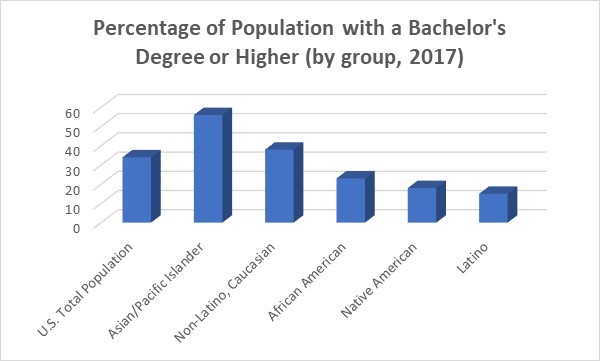
70% more Latinos earned degrees in the past decade than any previous decade.

Last month, the National Center for Education Statistics (NCES) released a comprehensive data analysis on the state of education across all educational levels, and it appears enrollment of Latino students at college campuses has increased.
But while Latino enrollment has increased overall, the Latino student population as a whole still lags behind the enrollment rate of other groups. The same pattern exists with the number of college degrees awarded to Latino students.
During the 2017-2018 cycle, there was around 26 million students enrolled in postsecondary institutions in the U.S., including degree and technical/non-degree programs.
While 18-24 year olds enrolled in degree-granting postsecondary institutions only made up 40 percent of the student population in 2017, the majority of the students were non-traditional (above 25 years of age).


Also, according to the NCES data, the year 2010 experienced the largest number of enrolled students, a number which is estimated to be surpassed later in 2028. 
Another fact to consider is that from 2007 to 2017, there was only a slight increase of enrolled CONTINUE READING: More Latinos Earned Degrees This Past Decade Than Any Time In History

Why Are Grades Important? Some Teachers Say They Do More Harm Than Good | Teen Vogue

Why Are Grades Important? Some Teachers Say They Do More Harm Than Good | Teen Vogue

Why Are Grades Important? Some Teachers Say They Do More Harm Than Good
Schooled is a series by Zach Schermele, a freshman at Columbia University, that explores the nuances of the American education system.


English teacher Gina Benz began to worry when several Advanced Placement (AP) students she knew were hospitalized for behavioral health problems in 2010. The need to “keep a high GPA, get that high ACT score, and get into that certain college” was taking a toll, she said. And she felt it, too. Benz used to spend hours grading papers at home — time that she said could have been better spent with family and friends and caring for herself instead of “drowning in the waters of competitive academic culture.” Something needed to change.
“Initially, I waded into the gradeless classroom waters for my own wellbeing,” she told Teen Vogue. “I wanted to reduce the hours of schoolwork I was doing at home each night. After only a few weeks, I realized that I wasn't getting the benefits I'd hoped for, but my students were experiencing benefits I never anticipated.”
Benz decided to make her classroom “gradeless” two years ago. Instead of “slapping a letter or number at the top of an assessment,” she now focuses on providing her students with high-quality feedback instead. Her students test ideas, make discoveries and embrace failure in an environment where learning is “transformational, not transactional.” Although she is technically required to give a final grade at the end of the semester, that number is based on cumulative evidence of her students’ progress, not a grade average. Benz says her students’ AP test scores haven’t dropped because of the change, and that parents have embraced it. Students tell her they have more “joy for learning” and better emotional health.
“Every week, I hear students talk about being awake until 1, 2, or even 3 in the morning doing homework,” she said. “The gradeless classroom releases students of the pressure CONTINUE READING: Why Are Grades Important? Some Teachers Say They Do More Harm Than Good | Teen Vogue