Latest News and Comment from Education

Friday, September 6, 2019

The Educator-Activist’s To-Do List - Education Votes

The Educator-Activist’s To-Do List - Education Votes

The Educator-Activist’s To-Do List

By Amanda Litvinov
Whether you are a new or veteran educator, the start of a new school year can be overwhelming. The entire community counts on educators to set up the school, help students get situated, and solve whatever problems crop up along the way.
But your community is also counting on you to keep advocating for the resources your students deserve, by telling local, state, and federal policymakers what your kids need to succeed. The educator voice is trusted and needs to be heard.
For Alaska special education teacher Winter Marshall-Allen, being an educator-activist means calling for better school funding and restorative justice practices to ensure that her special needs students are treated fairly and receive the services they need.


Alaska educator-activist Winter Marshall-Allen on a recent visit to Washington, D.C.

Marshall-Allen uses more than just facts and figures to make her case with policymakers. It’s the personal stories that resonate, and her own story is a starting point.
“I would not have my current job and opportunities as an educator were it not for the efforts of social justice and civil rights activists who preceded me,” says Marshall-Allen. “I had an Individualized Education Plan for visual impairment thanks to the American with Disabilities Act. Now, I am able to advocate for those who might be seen as less able or undeserving because they differ from societal expectations.”
True, it can be hard to find time for advocacy work, which can be emotionally taxing. But it’s worth it, says Marshall-Allen.
“Fighting with one’s heart is the most rewarding and significant display of love we can show our students,” she says. “Advocating for education and seeing how that affects my community and my students reaffirms that the struggle is worth it.”
Here are some ideas to help you get started.

Add Everyone Who Represents You to Your Mobile Contacts

Include all elected leaders—from your district school board members to your members of Congress—with their D.C. and back-home office numbers! Be ready to hold them accountable, and thank them when they do right by public schools.

Get the News that Public School Advocates Need

EducationVotes.org is an essential resource that helps busy educators stay in-the-know on state and national politics, legislation, and events that affect public education. It offers quick and easy ways to support good initiatives, speak out against bad ones, and share your story with decision makers. CONTINUE READING: The Educator-Activist’s To-Do List - Education Votes

CURMUDGUCATION: What Should Be Our Hot Topics For The New Year?

CURMUDGUCATION: What Should Be Our Hot Topics For The New Year?

What Should Be Our Hot Topics For The New Year?


It's the beginning of a new school year, and a good moment to take stock of the major policy issues, controversies and problems that we can expect to be (or ought to be) wrestling with in the coming year. Which issues are on the rise, which have lost a little steam and which should we be addressing?

Common Core

For years, the Common Core Standards were the hot button issue. Widespread pushback, from both left and right, changed that. The original Common Core dream was that every student in every school in every city in every state would be studying essentially the same things at roughly the same time. That dream is dead.


But the standards themselves live on. Some states have modified them lightly and given them an assumed name to hide under, but they're still there. Other states have promised to stamp them out, but it remains to be seen if they can really accomplish the task. Much of the discussion of standards is still held in plain sight, under the phrase "college and career ready." But on the school and classroom level, many teachers have long since adapted the standards to fit their own professional judgment.

The standards are still a presence in education, but not the hot-button issue they once were.

High Stakes Testing

High stakes standardized tests have been with us for a while, but the federal push for Common Core CONTINUE READING: 
CURMUDGUCATION: What Should Be Our Hot Topics For The New Year?


ALEC Legislator Retires a “Charter School Millionaire” from ALEC’s Top-Rated School Choice State | deutsch29

ALEC Legislator Retires a “Charter School Millionaire” from ALEC’s Top-Rated School Choice State | deutsch29

ALEC Legislator Retires a “Charter School Millionaire” from ALEC’s Top-Rated School Choice State

This is a post about how school choice works (and pays off) ALEC-style.
ALEC stands for the American Legislative Exchange Council.
ALEC describes itself as follows:
The American Legislative Exchange Council is America’s largest nonpartisan, voluntary membership organization of state legislators dedicated to the principles of limited government, free markets and federalism. Comprised of nearly one-quarter of the country’s state legislators and stakeholders from across the policy spectrum, ALEC members represent more than 60 million Americans and provide jobs to more than 30 million people in the United States.

However, the Center for Media and Democracy’s “ALEC Exposed” website reveals more about ALEC’s workings than ALEC prefers for people to know:
ALEC is not a lobby; it is not a front group. It is much more powerful than that. Through the secretive meetings of the American Legislative Exchange Council, corporate lobbyists and state legislators vote as equals on ‘model bills’ to change our rights that often benefit the corporations’ bottom line at public expense. ALEC is a pay-to-play operation where corporations buy a seat and a vote on ‘task forces’ to advance their legislative wish lists and can get a tax break for donations, effectively passing these lobbying costs on to taxpayers.
Along with legislators, corporations have membership in ALEC. Corporations sit on ALEC task forces and vote with legislators to approve “model” bills. They have their own corporate governing board which CONTINUE READING: ALEC Legislator Retires a “Charter School Millionaire” from ALEC’s Top-Rated School Choice State | deutsch29


Schools Matter: Walmart Shoppers Help Fund Public School Privatization

Schools Matter: Walmart Shoppers Help Fund Public School Privatization

Walmart Shoppers Help Fund Public School Privatization

From the Arkansas Education Association:

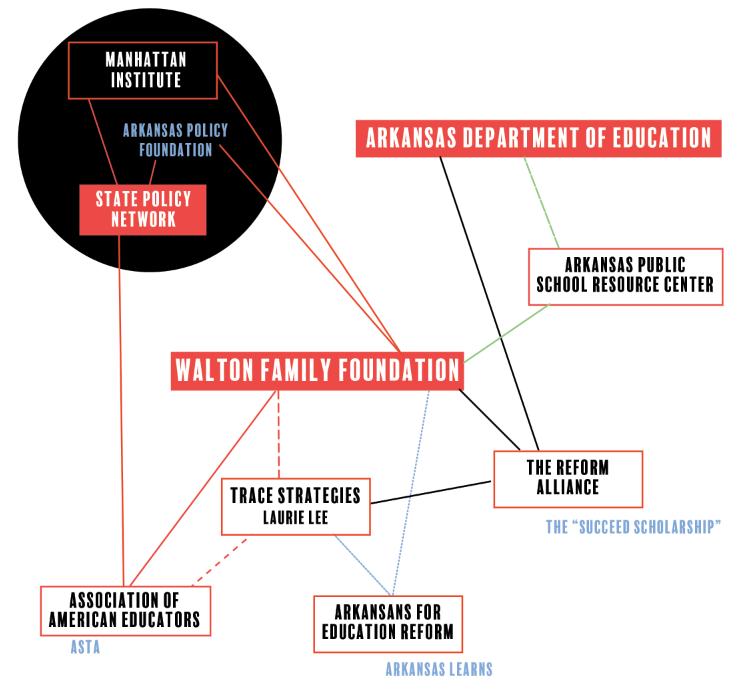
Inside the web of Arkansas’s School Privatization Empire 

A free quality public education for every child is a foundational principle of American society and a right guaranteed by Arkansas’s Constitution. Everyone in this state, regardless of religion, race, income, disability or any other characteristic deserves an equal opportunity to learn and succeed.  
Unfortunately, a vast network of corporate interests and wealthy individuals are chipping away at this bedrock of our democracy in an effort to turn public education into a marketplace where private interests can profit off of our students.  
Across the nation, states have implemented and expanded charter schools that are unaccountable to the public and voucher programs that have siphoned off public taxpayer money to pay for private school tuition. 
This powerful and well-funded effort is nationwide, but one of the biggest contributors is based right here in our state, and each year the network of privatizers working in Arkansas is growing. 

This network uses pass through organizations to fund a swarm of lobbyists and spend dark money on political candidates in our state and across the country. They initiated the recent attack on the Arkansas Teacher Retirement System, and have even co-opted our state’s flagship University to provide cover for the work of partisan think tank alumni who misuse statistics in support of a privatization agenda. They have close ties to members of the Arkansas State Board of Education, and their influence is part of the reason Arkansas’s latest legislative sessions have focused more on privatization schemes like vouchers and charter school expansion rather than the investments we know will actually improve outcomes for Arkansas’s 486,000 public school students.  
This article is a look at just some of the connections in our state. It is important to note that this report is not exhaustive. The web of dark money and organizations working in Arkansas and across the country to plunder public school resources is vast and difficult to track.   
HOME REGION 
The Walton Family Foundation (WFF) and many of its grantees are the major school privatization players in Arkansas and even CONTINUE READING: Schools Matter: Walmart Shoppers Help Fund Public School Privatization

2019 Medley #17: Back to school 2019, Part 2 The Test Fails | Live Long and Prosper

2019 Medley #17: Back to school 2019, Part 2 The Test Fails | Live Long and Prosper

2019 Medley #17: Back to school 2019, Part 2 The Test Fails


Testing and Accountability
THE TEST FAILS
Accountability is the big news in Indiana as school starts this year. It seems that our students didn’t do well on the new iLearn test which replaced ISTEP and was administred last Spring.
Steve Hinnefeld, who blogs at Schools Matter, reported (see The stakes are the problem, below),
Just under half of all students in grades 3-8 were proficient in English/language arts, and just under half were proficient in mathematics, according to the assessment. Some 37% were proficient in both.
Why? Our students did fine on the National Assessment of Educational Progress (NAEP) often called The Nation’s Report Card. At least three/fourths of our students in grades four and eight were At or above Basic in reading and the same in math (for a discussion of the difference between Basic and Proficient on the NAEP see If NAEP “Proficient” Means “Grade Level Proficiency,” Then America’s Private Schools Are in Trouble by blogger Mercedes Schneider. Also see Scale Scores and Achievement Levels).
The problem is, apparently, the test itself. Superintendents from across the state (including the State Superintendent of Public Instruction) have recognized this CONTINUE READING: 2019 Medley #17: Back to school 2019, Part 2 The Test Fails | Live Long and Prosper

The college admissions process is ‘unconscionably unjust.’ Here’s one way to help change that. - The Washington Post

The college admissions process is ‘unconscionably unjust.’ Here’s one way to help change that. - The Washington Post

The college admissions process is ‘unconscionably unjust.’ Here’s one way to help change that.

Late last month, the College Board announced that it was dropping a plan it had introduced a few months earlier to provide colleges with a single numeric rating of the adversity that students who took the SAT faced in their communities.
The original idea, called the Environmental Context Dashboard, was aimed at providing context to college admissions officers about the hardships that some students face as they go through school and try to get into college. Critics pounced, saying, in part, that the data would be questionable, and the College Board decided to change its plan.
The authors of the following post argue that despite its problems, the idea that the College Board introduced was a good one, and that some version of it could help improve “an unconscionably unjust process” — that being the college admissions process.
The writers are Brennan Barnard and Richard Weissbourd. Barnard is the college admission program manager at the Making Caring Common project at the Harvard Graduate School of Education and director of college counseling at the private Derryfield School in New Hampshire. Weissbourd is a senior lecturer at the Harvard Graduate School of Education as well as the faculty director of the Making Caring Common project and the co-director of the school’s Human Development and Psychology Program.
By Brennan Barnard and Richard Weissbourd
How do we measure human potential? And how do we do it in a way that’s both accurate and just, taking into account an individual’s advantages and disadvantages? Schools, college admissions offices, businesses and many other professions have always struggled with these questions, and now the College Board, the organization that owns the SAT, Advanced Placement program, and other educational assessments, finds itself in the thick of them. CONTINUE READING: The college admissions process is ‘unconscionably unjust.’ Here’s one way to help change that. - The Washington Post

Thursday, September 5, 2019

NYC Public School Parents: What both supporters and critics of the proposal to eliminated gifted programs are missing

NYC Public School Parents: What both supporters and critics of the proposal to eliminated gifted programs are missing

What both supporters and critics of the proposal to eliminated gifted programs are missing


There's been a tremendous amount of rhetoric from both sides and from the media about the recommendations in the second report from the School Diversity Advisory Group (SDAG), focusing primarily on its proposal to eliminate gifted programs in elementary schools.

See for example the hyperbolic headline of NY Times article saying these changes would create "seismic changes" and a tweet from the reporter, Eliza Shapiro, that it would "blow up the system." A headline in the NY Post claims, even more hysterically, that "De Blasio is out to destroy public schools."

The reality is that only about four percent of NYC public elementary grade children are attending gifted classes right now, and in many districts there are practically none.

See the chart below - showing there are only two districts, District 2 and 26, in which the share of elementary grade students in gifted classes are above ten percent.  (We took out the citywide gifted programs for this district analysis -of which there are five: NEST, Anderson, TAG, BK School of Inquiry and Q300, the 30th Ave. School.)


It is true that the parents of these kids are an extremely vocal constituency - with political influence far beyond their numbers.  Yet to eliminate these classes would hardly CONTINUE READING: 
NYC Public School Parents: What both supporters and critics of the proposal to eliminated gifted programs are missing


Deaning and the Education Profession | Cloaking Inequity

Deaning and the Education Profession | Cloaking Inequity

Deaning and the Education Profession 
Was honored to join News Talk 590 WVLK today. I talked with Scott about everything from diversity and inclusiveness to research and the politicization of teachers and the future of the profession.
Please Facebook Like, Tweet, etc below and/or reblog to share this discussion with others.
Check out and follow my YouTube channel here.
Twitter: @ProfessorJVH
Click here for Vitae.


Succeed or Surrender - Sacramento News & Review

Sacramento News & Review - Succeed or surrender - News - Local Stories - September 5, 2019

Succeed or Surrender
As Democratic presidential candidates debate school busing, Sac High’s graduation ceremony reveals the tricky role that charters play


From the rows on the floor to the near-nose bleed seats in the balcony, Memorial Auditorium was packed for Sacramento Charter High School’s 2019 graduation.

As with most graduations, the call to hold applause until the end was largely ignored. With my cousin next to be called, I figured self-restraint was unlikely.

“Summa cum laude,” a voice said. The man paused to let the screams and whistles simmer before continuing, “Amaya Rose-Hook.”

Like her fellow students, she belongs to one of many communities that has suffered from decades of racism, economic disinvestment and political disinterest—and then attended one of America’s charter schools dedicated to closing the education gap.

In that respect, Sacramento Charter High School is no different than other charter schools in the country, graduating upwards of 90% of its students and sending at least 85% to college.

But the school known to most as “Sac High” is unlike others in Sacramento. Of the 138 students who received their diplomas, none were white.

“One of the things that I could say that Sac High was good for is that I got to be around a whole bunch of black people,” my cousin told me the day before she left for San Diego State University.

The idea of a quasi-segregated public school normally sounds alarms at the state level, where lawmakers backed by a powerful teachers union are deciding bills to further regulate charter schools and halt their growth. And even at the national level where a Democratic presidential debate turned into an anecdotal history lesson about school busing and desegregation, the question of whether America has lived up to the landmark Brown v. Board of Education ruling remains bitterly contested.

Publicly funded but privately operated charter schools have largely benefited from bipartisan support over the years as an alternative to a traditional school system that has largely failed students from disadvantaged communities.

Sac High graduates are 90% black and Latinx, and most from Oak Park, a historically black and brown neighborhood undergoing rapid gentrification.

But as the state attempts to crack down on profiteering charter schools and questions linger about their effectiveness, do charters actually provide the best opportunity for underserved students—or just prove that America has surrendered its 65-year effort to provide equal education regardless of race?

Charter schools continue to grow at a rapid rate across the country, including in California, where nearly 10% of K-12 students are enrolled in charters.

According to financial records filed in July, the powerful California Teachers Association spent more than CONTINUE READING: Sacramento News & Review - Succeed or surrender - News - Local Stories - September 5, 2019


A Snapshot of the Status of African Americans Among School Principals in the United States : The Journal of Blacks in Higher Education

A Snapshot of the Status of African Americans Among School Principals in the United States : The Journal of Blacks in Higher Education

A Snapshot of the Status of African Americans Among School Principals in the United States

A new report from the U.S. Department of Education looks at the demographic characteristics of elementary and secondary school principals in the United States.
Overall, during the 2017-18 school year, 78 percent of school principals were non-Hispanic White, 11 percent were non-Hispanic Black or African American, 9 percent were Hispanic, and 3 percent were another race/ethnicity. Blacks were 16.3 percent of all principals at public charter schools.
Blacks made up slightly more than 20 percent of all principals in urban schools but only 9.4 percent of all principals in suburban schools and 4.5 percent of all principals at schools in rural areas.
African Americans were more than 20 percent of all principals at schools where 75 percent of all students qualified for federally financed school lunches. But Blacks were only 3.8 percent of the principals where less than 35 percent of all students qualified for free lunches.
Among private school principals, 86 percent were non-Hispanic White, 5 percent were non-Hispanic Black or African American, 5 percent were Hispanic, and 4 percent were another race/ethnicity.
The full 63-page report, Characteristics of Public and Private Elementary and Secondary School Principals in the United States: Results From the 2017–18 National Teacher and Principal Survey, can be downloaded by clicking here.
A Snapshot of the Status of African Americans Among School Principals in the United States : The Journal of Blacks in Higher Education

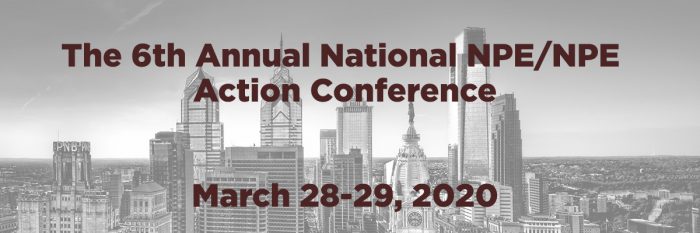
EDUCATION STARS WILL SHINE AT THE 2020 NETWORK FOR PUBLIC EDUCATION CONFERENCE: Conference Keynote Speakers #NPE2020

2020 Conference Keynote Speakers - Network For Public Education

EDUCATION STARS WILL SHINE AT THE 2020 NETWORK FOR PUBLIC EDUCATION CONFERENCE

Conference Keynote Speakers 


Diane Ravitch
Diane Ravitch is a co-founder of the Network for Public Education. She is a historian of education and Research Professor of Education at New York University. She has written ten books and edited another 14. She is a graduate of the Houston public schools, Wellesley College (BA), Columbia University (Ph.D. in history of American education), and holds ten honorary doctorates.

She blogs at dianeravitch.net. She lives in Brooklyn, New York.


Noliwe Rooks
An interdisciplinary scholar, Noliwe Rooks’ work explores how race and gender both impact and are impacted by popular culture, social history and political life in the United States. Specifically, Rooks works on the cultural and racial implications of beauty, fashion and adornment; educational inequality; race, food and the politics of the city, and Black women’s studies.

Rooks’ most current book is Cutting School: Privatization, Segregation, and the End of Public Education, published by The New Press in 2017.


Nikhil Goyal
Nikhil Goyal is a sociologist who has taught as an adjunct professor in New York University’s Prison Education program. He is also the author of Schools on Trial (Doubleday, 2016). He has appeared on CNN, FOX, and MSNBC and written for the New York Times, Washington Post, Wall Street Journal, TIME, The Nation, and other publications.

Goyal is a PhD candidate at the University of Cambridge, where he holds a Master of Philosophy (M.Phil) in Education. He lives in New York.


Jitu Brown
Jitu Brown is the national director for the Journey for Justice Alliance, a network of 30 grassroots community based organizations in 23 cities across the country organizing for community driven school improvement.

Born and raised in the Rosemoor neighborhood on the far south side of Chicago, Jitu Brown also teaches African-American history at St. Leonard’s Adult High School, the only accredited high school in the nation that exclusively serves people who have been formerly incarcerated.


Little Steven
In January of 2019, musician, actor and activist Little Steven was on the picket line in Los Angeles with striking teachers and Diane Ravitch. The two became fast friends – and Little Steven included Diane in his music video “Solidarity,” a video he created to bring attention to the teacher strikes across the world.

Little Steven is also shining a light on the dangers of privatization. In a Rolling Stone interview about his participation in the L.A. teachers’ strike, he said “The big-picture philosophical thing is privatization. It’s happening in every single town.”


DoubleTree by Hilton Philadelphia – Center City
237 S Broad Street Philadelphia, PA 19107-5686
A BLOCK OF ROOMS HAVE BEEN RESERVED AT A DISCOUNTED PRICE FOR THE CONFERENCE HOTEL

2020 Conference - Network For Public Education

Push for single rating of LA schools challenges state’s multi-dimensional accountability system | EdSource

Push for single rating of LA schools challenges state’s multi-dimensional accountability system | EdSource

Push for single rating of LA schools challenges state's multi-dimensional accountability system

There is a deeply rooted impulse in American society — perhaps any society — to rank everything from restaurants and refrigerators to athletes and colleges.
That may help explain why pressures continue in California to rank its schools based on a single score of some kind, despite a major thrust in the state to move in the opposite direction.
Great Schools, the hugely popular parent-oriented website, has combined several indicators to come up with score between 1 and 10 for every school in the state.

Another notable push is coming from Los Angeles, where the state’s largest school district has been working over the past year on a plan to rank schools on a numerical 1-to-5 scale, a number that would be reached by combining students’ improvement on test scores and other factors.
Underscoring the complexity and volatility of the issue, this week newly elected school board member Jackie Goldberg introduced a harshly critical resolution effectively calling on the district to abandon the idea in its current form. Among other CONTINUE READING: Push for single rating of LA schools challenges state’s multi-dimensional accountability system | EdSource

Seattle Schools Community Forum: Stories of HCC: You Failed Us: Students of Color Talk Seattle Schools

Seattle Schools Community Forum: Stories of HCC

Stories of HCC

Image result for You Failed Us: Students of Color Talk Seattle Schools


Crosscut has an article about a book that a 17-year-old trans person has written about their experience in HCC.  The book is called, "You Failed Us."

It was two years ago that Azure Savage began writing their first book, the origins of which can be traced back to their kindergarten year at Seattle’s Thurgood Marshall Elementary. It was there, they said, that they first noticed inequities in how different students are treated.

In August of this year, Savage published You Failed Us: Students of Color Talk Seattle Schools. Part memoir and part collected oral history, You Failed Us interlaces Savage’s personal journey with the experiences of approximately 40 other school-aged youth in the Seattle area.
Through 11 chapters, Savage's literary debut candidly explores issues surrounding race, as well as gender identity, mental health and structural barriers facing students navigating the city’s K-12 education system.
I am trying to recall when Thurgood Marshall took on HCC students but was it more than 10 years ago? Maybe the book explains.

Brazile chooses to focus on Savage so we don't get a read on what the CONTINUE READING: 
Seattle Schools Community Forum: Stories of HCC