Latest News and Comment from Education

Tuesday, April 9, 2019

Stealing Scarce Education Funds From LAUSD Students

Stealing Scarce Education Funds From LAUSD Students

Stealing Scarce Education Funds From LAUSD Students


– LAUSD Charter School Division
The LAUSD School Board took the rare step of considering the denial of a charter school’s renewal during their April 2, 2019, “special” meeting. In reviewing the hundreds of pages of documentssupporting this recommendation, it was clear that the Community Preparatory Academy (CPA) has been in trouble since it was opened five years ago. During public comment I summarized the worst of their offenses for the Board:


In recognition of Autism Awareness Day, I would like to point out that 6.87%of the students at this charter have disabilities. The resident schools median is 12.43%. This discrepancy is a systematic problem throughout the LAUSD. 
The Charter School Division is recommending denial now, but the problems are not new. This charter was originally approved in 2014 and has had a net deficit since the 2014-15 fiscal year. It’s ending Fund Balance last year was ($820,303).
That deficit not only affects the students who go to this charter, but it also takes money from the 80% of students who attend LAUSD public schools. According to the Charter School Division (CSD), CPA entered into Single-Year Food Services Agreements with the District. As of February 22, 2019, the District had not received payments from CPA for the months of January 2017 through June 2017, which total $82,240currently owed to the District.

Sometimes Fences Set Us Free + What Not To Wear: Joan of Arc Edition | Blue Cereal Education

Sometimes Fences Set Us Free | Blue Cereal Education

Sometimes Fences Set Us Free


My first year teaching, I had only one prep. I had four sections of U.S. History, fifth hour plan, and finished my day monitoring whatever in-house detention was called – essentially a second planning period. Compared to what we normally do to baby teachers, it was an amazing schedule.
Nevertheless, within about six weeks I was fresh out of lesson ideas. I’d done a few lectures with moderate success. I’d written my own 25 – 30 questions over several textbook chapters in hopes of guiding students through some form of close reading. We even spent an entire period looking through pictures, maps, and graphs in whatever chapter we were on, asking questions and making inferences – pretty cutting-edge pedagogy for me in those days.
I hadn’t yet grown comfortable with artsy-fartsy options, so I’m sure we didn’t color or fold or turn content into children’s bedtime stories, but I did my best to keep things engaging. I was scrambling to stay ahead of my students in the textbook – if not by a chapter, at least by a few sections – and I loved it, even though I was pretty sure it would kill me my very first year. 
But as week seven loomed, it was time to break things up a bit. We needed a… a… project of some sort. Something hands-on – maybe collaborative! Something where they did most of the work while I caught up with grading, and lesson-planning, Something sort of fun, but still, you know… educational – or at least educational enough.
But what to assign? What sort of project should it be?
I vaguely recalled something from teacher school about the importance of “student CONTINUE READING:   Sometimes Fences Set Us Free | Blue Cereal Education

What Not To Wear: Joan of Arc Edition

Joan on Stage and Black

Most of us have at least a working familiarity with the story of Joan of Arc. A simple (but not impoverished) French peasant girl, she began hearing voices from God telling her she was going to save France from the English and their Burgundian allies. Through some combination of cleverness, sincerity, and miraculous signs, she convinced Charles VII to let her lead French soldiers in battle and eventually secured his coronation.
Having outlived her political usefulness, Joan was then pushed aside. She was captured by the English, put on trial for heresy, and burned at the stake when she was only nineteen years old. In her final moments, she begged for a cross to be held before her, high enough to see through the flames. She called out to Jesus while she burned. 
It’s a gripping tale, and surprisingly well-documented for its times. Accounts of Joan pop up everywhere in the historical record, as do endless legends, rumors, and interpretations of her life and death. By far the most detailed accounts were the trial records so carefully preserved, first by those who wished to condemn her, then several decades later by those who wished her redeemed. For five months, Joan was questioned, criticized, badgered, and abused by learned men with little interest in legal or spiritual truth. Their goal was to destroy her reputation, to invalidate her apparent CONTINUE READING: What Not To Wear: Joan of Arc Edition

The Real Crime in Higher Education: Not Gaming Admissions but Underinvestment in Public Universities | Diane Ravitch's blog

The Real Crime in Higher Education: Not Gaming Admissions but Underinvestment in Public Universities | Diane Ravitch's blog

The Real Crime in Higher Education: Not Gaming Admissions but Underinvestment in Public Universities


Alan Aja, Joseph Entin, and Jeanne Theoharis identify the true crime in higher education: the abandonment of public higher education by the states and the federal government. The three authors are professors at Brooklyn College, which is part of the City University of New York (CUNY).
Image result for disinvestment in public universities
They write:
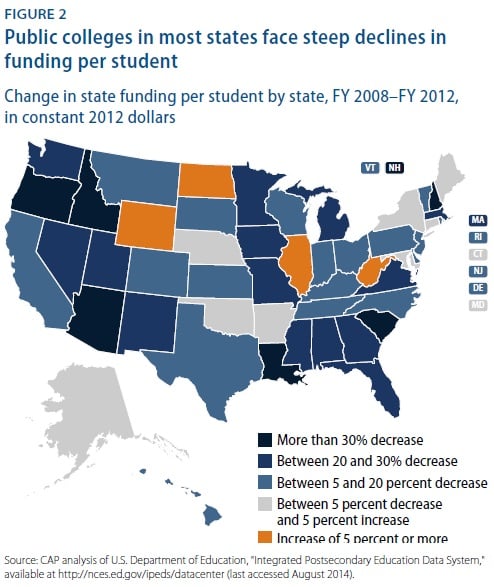
The biggest scandal in American higher education today is the staggering disinvestment in public universities like CUNY, even as politicians and the public pay lip service to abhorring the inequalities in higher education. What would it mean to view as scandalous the well-documented decline in federal and state funding of public universities across the country over the last 25 years, at the same time students have been expected to shoulder the cost of those “missing expenditures” through tuition hikes (amid other persistent cuts to federal and state financial aid and vital support services)? What would it mean to view self-declared “education governor” Andrew Cuomo of New York as a part of the problem for the ways he has underfunded public universities in the state and to see members of the public who allow this as his accomplices? What would it mean to see the scandal that the broken ceiling exposes as part of a larger systemic problem directly tied to the current state budget’s continued underfunding of CUNY (which once again this time around, fell dramatically short)?
Nearly a quarter of a million undergraduates attend the City University of New York, and they are caught in a vicious bind. Tuition for CUNY — which was free until 1975 — has risen by 31% since 2011. It now stands at $6,730 for full-time students at CUNY’s senior colleges CONTINUE READING: The Real Crime in Higher Education: Not Gaming Admissions but Underinvestment in Public Universities | Diane Ravitch's blog

Image result for disinvestment in public universities

ANDRE PERRY: DeVos’ support of charter schools spells disaster for Democrat backers

DeVos’ support of charter schools spells disaster for Democrat backers

DeVos’ support of charters spells disaster for their Democrat backers
The party of diversity should promote policies that embrace inclusion

When U.S. Secretary of Education Betsy DeVos put out the department’s 2019 budget, Democrats who support charter schools found themselves in an awkward political situation. DeVos proposed cutting $17.6 million the Department of Education had allocated for the Special Olympics, but she somehow found room in the budget to increase charter school funding by $60 million. DeVos’ proposed cuts signaled that the government doesn’t care about students with disabilities.
Charters earned a reputation for enrolling fewer students with disabilities than traditional schools and are already blamed by many for “siphoning” funds from their district counterparts. DeVos has all but confirmed those suspicions. Charters can’t be a centerpiece issue for Democrats running for public office if the schools’ biggest champion sees fit to make athletes with disabilities the sacrificial lambs of a leaner budget.
Democrats must instead focus on issues that affect all schools, teachers and students, regardless of school type — issues such as teacher diversity.

After the 2018 midterm elections, the 116th Congress looks radically different, with the most women in a single class; the first Muslim women; and the first Native American women. On the other side of the aisle, Republicans, whiter and more male, are looking less and less like America. The party of diversity must promote it in a new era of education reform. Political hopefuls should offer policy solutions to two divergent statistics: The percentage of students of color in public elementary and high schools is increasing, but the proportion CONTINUE READING: DeVos’ support of charter schools spells disaster for Democrat backers

Privately funded CT RISE program raises a number of key issues in public education - Jonathan Kantrowitz

Privately funded CT RISE program raises a number of key issues in public education - Jonathan Kantrowitz

Privately funded CT RISE program raises a number of key issues in public education


Source: NHPS (New Haven Public Schools) Advocates
Complete report The CT RISE program interacts with a number of key issues in public education, including: how we define, quantify, and measure student learning; teacher autonomy; teacher morale; student data privacy; and the role of philanthropists and other external and private interests in our public schools.
This report takes CT RISE as a concrete and revealing case study. NHPS (New Haven Public Schools) Advocates are volunteers, who do not have access to all the potentially relevant information and have not undertaken exhaustive research. Accordingly, this report is “preliminary” in that it summarizes emerging findings, based on the available information. It does not supply a comprehensive overview, but is aimed at contributing to ongoing discussion.
The CT RISE program—currently being piloted at high schools in New Haven (Career), Meriden, Hartford, and East Hartford—is under consideration for expansion in NHPS. The core of the CT RISE program is a “data dashboard” that collates data such as grades, test scores, attendance  data,course credits, and behaviors. The program provides a number of potential benefits, including streamlined access to student data and added supports for students and teachers. NHPS Advocates also note concerns in the following areas:
1. Instruction : There is no compelling evidence that the CT RISE program improves student learning. At the same time, its dashboard may bring unintended consequences, such as distracting from teaching and learning, prioritizing engagement with data profiles rather than human connections, steering teachers’ attention toward discrete data points and away from holistic development, and focusing excessive energieson narrow and/or standardized metrics.
2. Governance : Though it provides data in a useful collated format, the CT RISE dashboard essentially duplicates existing NHPS services. The RISE program also operates without oversight structures thatincorporate key participants, such as CONTINUE READING: Privately funded CT RISE program raises a number of key issues in public education - Jonathan Kantrowitz

When I was a little girl, I remember singing the song “This Little Light of Mine, I’m Gonna Let It Shine.” – Fred Klonsky

When I was a little girl, I remember singing the song “This Little Light of Mine, I’m Gonna Let It Shine.” – Fred Klonsky

When I was a little girl, I remember singing the song “This Little Light of Mine, I’m Gonna Let It Shine.”

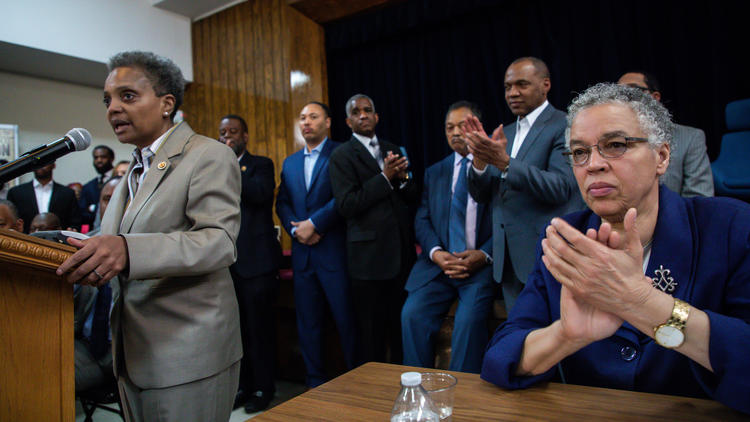
chi-toni-preckwinkle-politician-public-servant-photos-20140715

At the end of Mayor-elect Lightfoot’s speech last Tuesday evening, she ended with a rememberance of a song.
I thought of the lyrics again yesterday afternoon following the decision by current alderman and chair of the Chicago City Council’s Finance Committee, Patrick O’Connor, to delay the Lincoln Yard’s TIF vote at least until tomorrow.
2nd Ward Alderman Brian Hopkins had insisted that the request by Mayor-elect Lightfoot and Mayor Rahm be ignored.
“I have the votes,” Hopkins said. His ward is where the awful Lincoln Yards is planned to be plopped, a walled city for the rich on the north side.
Hopkins is a bought and paid for tool of the Sterling Bay developers.
Maybe he did have the votes. Maybe he didn’t.
Maybe the vote will go ahead tomorrow, Wednesday.
Maybe it won’t.
City Hall was jammed with protesters. The Chicago Teachers Union is calling for CONTINUE READING: When I was a little girl, I remember singing the song “This Little Light of Mine, I’m Gonna Let It Shine.” – Fred Klonsky


More Than Drawing and Coloring: Art (and Art Teachers) Have Power

More Than Drawing and Coloring: Art (and Art Teachers) Have Power

More Than Drawing and Coloring: Art (and Art Teachers) Have Power


“What are you going to do with that?” It’s a question college students and newly minted college graduates often hear from family and friends. For Allison Richo, who finished college in the 1980s, the that” was an art degree.
Allison Richo
Allison Richo
Today, she holds a bachelor’s degree in fine arts from Spelman College in Atlanta, Ga., and for the last 25 years has helped high school students in Prince Georges County, Md., see the world through artistic eyes.
“It’s been the best thing ever,” says Richo, who once owned an architectural design business with two friends.
When the business folded, Richo started to substitute teach.
“I did so well as an art teacher, I got a call [to return] and that started my career.”

Multiple Hats

It’s been nonstop for Richo, who teaches at Oxon Hill High School. Despite her love of art, and her long list of personal awards and recognitions, her attention is squarely centered on her students. So much so that she takes on a mammoth amount of responsibility: visual arts chairperson, interactive media and production coordinator, and academy and national art society sponsor. She also teaches five prep classes that include AP Drawing Studio, AP 2-D Design Studio, Basic Design, Drawing and Painting, and Art 1. Richo also earned National Board Certified status while battling a health crisis.
From your shoes to your cell phone, everything is connected to the arts.” – Allison Richo, art teacher
“I know it’s a lot, but I’m determined to give my students the best art education I can. If that means taking on more than what I need to, then I’ll do it.”
Richo is unafraid when it comes to looking directly at societal challenges, and bringing them into her classroom. Her students have examined issues like the murder of Michael Brown, an unarmed black man who was killed by police in Ferguson Mo., during August of 2014, and the Louisiana communities that were neglected following Hurricane CONTINUE READING: More Than Drawing and Coloring: Art (and Art Teachers) Have Power

Charter School Sector Swindles the Public, Burns Tax Dollars, and Cheats Children—Part 1 | janresseger

Charter School Sector Swindles the Public, Burns Tax Dollars, and Cheats Children—Part 1 | janresseger

Charter School Sector Swindles the Public, Burns Tax Dollars, and Cheats Children—Part 1


Many of us have been aware of problems with charter schools for a long, long time.  For over two years now, the Network for Public Education has been logging reports in local newspapers when an entrepreneur is caught stealing tax dollars; or when a state, a school district or charter authorizer finally shuts down a charter school for academic malpractice; or when a charter school goes broke mid-school year leaving children without a school mid-semester.
But the past month has produced an uptick in reports of large scale charter school ripoffs and charter school failure.
At the federal level: In late March, the Network for Public Education published Asleep at the Wheel, an explosive report documenting the waste of billions of federal charter school startup dollars on schools that that never opened or opened and then shut down.  The researchers conclude that if you want to start a charter school with seed money from the federal Charter Schools Program, you ought to hire a grant writer skilled at creating a compelling fictional narrative, because the Department of Education makes its grants almost exclusively based on the story spun in the grant application.  And the Department of Education rarely follows up to monitor the schools it has funded—neither to prevent conflicts of interest and profiteering, nor to ensure equitable open enrollment practices nor to oversee academic services for students.  (This blog covered NPE’s report here.)

But the federal Charter Schools Program is only a part of the problem.  Charters schools are enabled in state law—in 44 states, and each state’s authorization and oversight laws are different. Most of the recent exposure of widespread problems with charter schools involves CONTINUE READING: Charter School Sector Swindles the Public, Burns Tax Dollars, and Cheats Children—Part 1 | janresseger

13 Affluent Parents Plead Guilty in College Admissions Scam, Face Jail Time | deutsch29

13 Affluent Parents Plead Guilty in College Admissions Scam, Face Jail Time | deutsch29

13 Affluent Parents Plead Guilty in College Admissions Scam, Face Jail Time


Thirteen parents and one coach involved in a massive college admissions scam pled guilty federal court in Massachusetts on April 08, 2019.
Felicity Huffman and a dozen other wealthy parents swept up in the far-reaching college admissions scandal have agreed to plead guilty after being charged in the scheme, according to court records.
The actress and 12 other parents, including Los Angeles marketing guru Jane Buckingham, will plead guilty to one count of conspiracy to commit mail fraud and honest services mail fraud. Bay Area real estate developer Bruce Isackson will plead guilty to one count of money laundering conspiracy and one count of conspiracy to defraud the IRS. His wife, Davina Isackson, will plead guilty to one charge of conspiracy to commit fraud. …
Michael Center, the former men’s tennis coach at the University of Texas at Austin, will also plead guilty to one count of conspiracy to commit mail fraud and honest services mail fraud. Center is accused of accepting $60,000 in cash and a $40,000 donation to his tennis program to ensure a student was admitted as a recruited athlete. …
Manny Medrano, a defense attorney and former federal prosecutor, said that based on 2019 federal sentencing guidelines, Huffman would face from four to 10 months in prison as part of her plea. …
In a statement Monday, Huffman acknowledged her guilty plea.
I am in full acceptance of my guilt, and with deep regret and shame over what I have done, I accept full responsibility for my actions and will accept the consequences that stem from those actions. I am ashamed of the pain I have caused my daughter, my family, my friends, my colleagues and the educational community,” she said. …
Those who have signed plea agreements face recommended sentences of a few months to a year and a half in prison, prosecutors said.
When it came to charges, Huffman’s husband, actor William H. Macy, apparently lucked out. As People magazine notes, Macy was recorded discussing a cheating scheme for his younger daughter, not his older daughter. Huffman and Macy  CONTINUE READING: 13 Affluent Parents Plead Guilty in College Admissions Scam, Face Jail Time | deutsch29

Monday, April 8, 2019

The Sacramento teacher strike is a warning to the #RedForEd movement everywhere – Alternet.org

The Sacramento teacher strike is a warning to the #RedForEd movement everywhere – Alternet.org

The Sacramento teacher strike is a warning to the #RedForEd movement everywhere

The enduring RedForEd movement that has spurred teachers to walk out of schools, organize massive labor actions, and stage protests in streets and state capitols has resulted in big victories for teachers in terms of new labor-friendly contracts, increased teacher pay, and improved conditions in schools. But there’s a danger these victories could be undone. That’s the warning coming from teachers in Sacramento who are threatening to walk off the job over alleged violations of their collective bargaining agreement with the district.
Much like other teacher actions that have occurred across the nation, Sacramento teachers are demanding changes to their salaries, reduced class sizes, and increases in school support staff including more nurses, psychologists, librarians, and program specialists. But unlike other teacher walkouts, what’s happening in Sacramento is a replay of what they thought they had already won.
“We thought we had an agreement when we threatened to strike last year,” David Fisher tells me in a phone conversation. Fisher is the president of the Sacramento City Teachers Association (SCTA), which threatened a walkout in November 2017 of the previous school year.
“We were motivated by what was happening in RedForEd movements elsewhere,” he recalls. “We had everything lined up [in preparation for the strike] including having parents organized and having meals ready for the kids” who were going to miss school lunches.
The strike was averted when the union and district administration came to an agreement and signed a new contract in December 2017. Specifically, the three-year contractincluded an across-the-board pay increase for teachers. Salaries for the district’s teachers are below state averages and rank fourth from the bottom when compared to 14 other comparable districts in the state, according the Sacramento Bee.
Also, teachers won an adjustment to salary schedules that would result in an additional CONTINUE READING:  The Sacramento teacher strike is a warning to the #RedForEd movement everywhere – Alternet.org


Florida Congresswomen Denied Entry to Homestead Facility for Migrant Minors - YouTube

DWS to deliver letters - YouTube

Florida Congresswomen Denied Entry to Homestead Facility for Migrant Minors


DWS to deliver letters - YouTube

Florida Congresswomen Denied Entry to Homestead Facility for Migrant Minors - NBC 6 South Florida - https://www.nbcmiami.com/news/local/Florida-Congresswomen-Will-Attempt-to-Visit-Unaccompanied-Minors-Migrant-Facility-in-Homestead-508246771.html via @nbc6

Putting “Privilege” in Perspective - Non Profit News | Nonprofit Quarterly

Putting “Privilege” in Perspective - Non Profit News | Nonprofit Quarterly

Putting “Privilege” in Perspective


The word “privilege” has been thrown around a lot lately. But does this kind of widespread use of privilege (and the call-out culture that rains shame on those accused) diminish the power of the word and negatively affect the causes of social justice?
Privilege is defined as “the principle or condition of enjoying special rights or immunities.” The word begins to show up in the English language in the mid-12th century, borrowed from the Latin privilegium, referring to “a ‘private law’ that situates one outside of the laws that bind others.” It was considered a legitimate benefit of elites.
Tracing the history of the word, University of Memphis philosopher Michael J. Monahanobserves in “The concept of privilege: a critical appraisal” that the European enlightenment brought with it challenges to the hereditary aspects of privilege. It did not critique the idea of privilege as such, but the fact that it was unearned. Earned privilege then became “an exceptional opportunity earned (one hopes) through one’s individual merit.”
W.E.B. Du Bois appears to be the first to conceive of white people having privilege by virtue of the color of their skin, even when they are poor. In his 1903 book, The Souls of Black Folk, he writes about white Americans as privileged vis-à-vis Blacks because they do not have to think about Black people or the effects of racial discrimination the way that Black people have to about whites. This privilege also grants them advantage when it comes to valued resources.

The concept of privilege doesn’t take off, however, until the 1980s, when sociologists begin to study it as a social issue in the context of social inequality. This privilege focuses on the way certain groups were discriminated against and others afforded unearned advantages. In 1988, Peggy McIntosh publishes “White Privilege and Male Privilege: A Personal Account of Coming to See Correspondences through Work in Women’s Studies,” in which she describes privilege as an “invisible package of unearned assets.” Privilege begins to expand from a social level of analysis to a personal one.
Today, the word is used in relative ways between people to describe any perceived asymmetry in advantage. In fact, urbandictionary.com, keeping up with the times, CONTINUE READING: Putting “Privilege” in Perspective - Non Profit News | Nonprofit Quarterly

ReformCharterSchools.org – Strong charter school accountability now

ReformCharterSchools.org – Strong charter school accountability now

ReformCharterSchools.org

Strong charter school accountability now

FacebookDear Governor Gavin Newsom, Lt. Governor Eleni Kounalikis; Speaker of the Assembly Anthony Rendon, Assemblymember Patrick O’Donnell; State Senator Pro Tem Toni Atkins; State Superintendent of Public Instruction Tony Thurmond; State Controller Betty Yee; State Treasurer Fiona Ma; and State Attorney General Xavier Bacerra,
We are taxpayers, parents, students, and concerned Americans, and we support the call for a statewide moratorium on approval of charter schools (SB 756) until transparency, accountability, and local control provisions not already in the current approval process are established.
While there are some charter schools that are locally approved, are transparent with their budgets including posting executive salaries, and are accountable to the public, the vast majority of charter schools have taken advantage of taxpayers through weak charter laws and lax oversight by state and county officials.
Studies show that in school districts where teacher unions recently went on strike, Oakland and Los Angeles, charters defund Oakland public schools by $57.3 million a year, and defund Los Angeles public schools by $600 million a year. It is estimated well over 100,000 community, parent, student, and teacher supporters of public education marched in support of public schools in both cities in the first quarter of 2019.
Since 2006, the California state agency Financial Crisis and Management Assistance Team (FCMAT)
 has audited charter schools and identified $81 million in fraud, waste, abuse. Other school budget experts estimate $100 million lost to corruption by California charter operators in 2015 alone. (Source: http://populardemocracy.org/sites/default/files/Charter-Schools-California-Report-b.pdf)
Thank you for passing SB126 which makes the Brown Act apply to charter schools, who must now keep public records, hold open meetings, and bar operators and key staff from conflicts of interest.
However, under current law, charter schools are not required to:
  • Have transparent budgets and salaries
  • Ensure facilities are asbestos and lead free
  • Ensure local support and adequate resources for students with disabilities
  • Have locally elected board members
  • File a fiscal, academic, or facilities impact report on surrounding public and charter schools in a petition for authorization
  • Ensure parental oversight through School Site Councils and English Learner Advisory Committees
  • Ensure teachers hold a Commission on Teacher Credentialing certificate, permit, or other document equivalent to that which a teacher in other public schools would be required to hold
  • Maintain adequate cash reserves as required of public schools
Because of these loopholes, many charter operators are gaming the system and are in it to make money with little regard to children’s education.  Corruption is such that the largest charter school operator in America, with schools in California, is operated by foreign nationals without taxpayer knowledge and virtually no oversight.
This has got to stop.
As taxpayers and Americans, we deserve better. Our children deserve better.
Therefore, we respectfully request that you remedy these problems through your legislative authority, and pass the strongest versions of AB 1505, AB 1506, AB 1507, and SB 756 that you can, with input from grassroots school communities all over California.
READ MORE SIGN THE PETITION: ReformCharterSchools.org

Strong charter school accountability now

Strong Transparency, Accountability, Local Control for Charter Schools


READ MORE SIGN THE PETITION: ReformCharterSchools.org

Strong charter school accountability now
READ MORE SIGN THE PETITION: ReformCharterSchools.org


Strong charter school accountability now