Latest News and Comment from Education

Friday, April 5, 2019

New Oversight Law Won’t Prevent Charter School Financial Difficulties | Capital & Main

New Oversight Law Won’t Prevent Charter School Financial Difficulties | Capital & Main

New Oversight Law Won’t Prevent Charter School Financial Difficulties
Gavin Newsom hailed a new charter school transparency law he signed. Why won’t the law prevent charters from failing?


California Gov. Gavin Newsom recently signed into law Senate Bill 126, written to hold the state’s charter schools to the same transparency as other public schools. (Charter schools are funded by tax dollars but privately administered.) The bill, among other provisions, clarifies that charter schools are subject to existing state financial disclosure and conflict-of-interest laws. It’s a significant break from Newsom’s charter school-friendly predecessor, Gov. Jerry Brown, who twice vetoed similar legislation.
Still, the California Charter Schools Association, the well-funded charter lobbying group, praised the bill as a “balanced, fair application” of the state’s transparency laws, while preserving charter schools’ autonomy.

Some 31% of charter schools authorized by the state between Jan. 2002 and May 2018 are no longer open.


The fact that the bill sailed through the legislature without opposition strikes Julian Vasquez Heilig, a professor of Educational Leadership and Policy Studies at California State University, Sacramento, as “one small, small step for mankind.”
“[Senate Bill 126] is two pages long,” he says. “The governor and Democrats are using it to say they’re doing something. But we are still spending hundreds of millions to build charters next to failing public schools. And many of those charters are not doing anything innovative that public schools are not already doing.”
And, despite protestations of “failing public schools” voiced by charter school supporters, many more charter schools are failing due to lack of oversight that the new law is not set up to fix. Not only would additional laws to provide rules for and financial scrutiny of charter schools protect district schools, they might shore up charter schools as well. CONTINUE READING: New Oversight Law Won’t Prevent Charter School Financial Difficulties | Capital & Main


CURMUDGUCATION: MO: Bipartisan Fight Against Charter Expansion

CURMUDGUCATION: MO: Bipartisan Fight Against Charter Expansion

MO: Bipartisan Fight Against Charter Expansion


Rep. Rebecca Roeber (R) of Lee's Summit, Missouri has proposed a bill to expand charter reach; the state has basically confined charter schools to the Kansas City and St. Louis districts. But response to the bill has not been exactly a slam dunk.

The bill would allow charters to open in communities of greater than 30,000 people or an accredited-without-provisions school district. The feelings about the bill are tight enough that both sides were feeling cautiously optimistic.


Roeber is a former public teacher (and seventeen years in the classroom, not some TFA two-year temp). Her voting record is-- well, she tried to expand charters in 2017, voted against the authority of local government to set minimum wage, voted to keep language that says marriage is only between a man and a woman (but voted against closing the loophole that allows a sexual predator to avoid criminal charges by marrying their teenaged victims), and voted for Right-to-Work in the state. She appears to be married to Barefoot Rick, a well-known barefoot runner and Christian speaker. Nine days ago she was left in serious condition after the car she was driving crossed the center line and hit another head on.

Roeber's position on charters has been pretty simple:

This idea about how education works is not reflected by reality, and lots of Missourians know it.  CONTINUE READING: 
CURMUDGUCATION: MO: Bipartisan Fight Against Charter Expansion


Q&A: Sacramento City Unified School District budget crisis | The Sacramento Bee

Q&A: Sacramento City Unified School District budget crisis | The Sacramento Bee

You asked us about the Sac City Unified crisis. Here are answers to your top questions


With a teachers strike and a possible state takeover looming for the Sacramento City Unified School District, The Sacramento Bee put out a call this week for our readers’ most pressing questions about the crisis. Dozens have responded so far through our website, Facebook and Twitter.
Here are answers to some of your top questions:
Where are we with the strike? What do the district and the union say?
The strike by the Sacramento City Teachers Association is set for Thursday, April 11. The district says it will be a normally scheduled school day. Parents can expect some teachers in the classrooms, certificated substitutes and replacements.

The teachers union, however, says it is confident that teachers won’t cross the picket line. The overwhelming majority of its 2,500 members who voted approved the strike.
Why strike for just one day, and will it be effective? Will the teachers strike again?
The district and the United Professional Educators union, which represents administrators, are asking the same question: What does a one-day strike accomplish?
The union says it kept the strike to a day to minimize the impact on students. Union officials said they hope that will be enough to get the district to meet with them and “agree to honoring the contract and obeying the law.”
There have been changes to the state receivership process. Maybe it won’t be like the Oakland situation?
Oakland Unified School District went into state receivership in 2003 – a process in which the district takes an emergency loan from the state and is taken over by the California Department of Education. Since that time, state receivership has changed. Most significantly, the administrator who takes charge of the district’s finances is appointed by the county, not the state. If a takeover happens, this will be the first time a county superintendent – in this case, Sacramento County Superintendent of Schools David Gordon – will appoint the administrator.
Oakland Unified still owes the state about $30 million, which is roughly the amount Sacramento City Unified is in the red. By the time its receivership ends in 2026, Oakland will have paid tens of millions of dollars in interest on its state loan. Sacramento City Unified will faces interest payments as well.

If the school district goes into receivership, what does that do to those in positions like superintendent, and those on the board?
The new administrator appointed by Gordon would assume power and responsibilities of the governing board. The new administrator does not have to consult with the school board or the superintendent.
Over time, Gordon can replace the appointed administrator with a trustee, and the school board will slowly regain some of its powers. After at least three years, the trustee could be removed if the district has a recovery plan in place.
What will insolvency mean in real terms for students and families? What will we lose, specifically? And how will it hurt 40,000 students? Is it possible that it won’t be like the Oakland situation?
Sacramento is one of the most diverse cities in the country, with families from a wide range of socioeconomic backgrounds. Activists and community leaders are speaking out, saying the crisis will harm Sacramento City Unified’s most disadvantaged students first.
Officials from the Fiscal Crisis and Management Assistance Team, a state-created financial adviser for school districts, said that districts strive to keep cuts away from the classroom. But cuts that affect students are inevitable, especially during a state takeover, because the administrator will prioritize balancing the budget.
Cuts to after-school programs, athletics and health centers would be likely. The district just sent layoff notices to its preschool teachers in the Head Start program, which helps single mothers go back to work by offering free or affordable care for their children.
Is it true that a change to the teachers’ health care plan could close the budget gap? What is the rationale behind refusing a new plan?
A change in the teachers’ health care plan won’t close a $35 million gap, but it would significantly help. The union says it did not refuse a new plan – a key dispute behind the upcoming strike.
The union said it went into an agreement last year with the district to identify savings from the CONTINUE READING: Q&A: Sacramento City Unified School District budget crisis | The Sacramento Bee


30 Days To Make a Way! THE JOURNEY FOR JUSTICE ALLIANCE (J4J)

30 Days To Make a Way!
People Powered Donor Campaign


The Schott Foundation will match every $10 donated with $20 up to $60,000! Help us maximize these matching dollars!


Journey for Justice has:


1.  Led the fight for education equity and put privatizers on the defensive!
2.  Inspired the NAACP's call for a moratorium on charter schools
3.  Helped create Sustainable Community Schools model
4.  Won millions from the federal government to support community schools!
5.  United and developed independent, Black and Brown grassroots leadership!
6.  Built multi-racial coalitions across the U.S. fighting for education justice!
Ready to wage a 21st century campaign for education equity, J4J deserves our support!  It's time to answer the call!  We cannot lose J4J!  

Your Support will help Provide:


·  A J4J field organizer to help train parents, students and communities on sustainable community schools!

· A Policy Director for J4J!

· Posters, bumper stickers, t-shirts, buttons and other materials for the #WEChoose campaign!

· Resources for local organizations to host #WeChoose Equity Town Hall Meetings in 40 cities across the country!

·  Local equity bus tours in campaign cities!

· Regional mobilizations to Washington DC in order to advocate for full funding for IDEA, Title 1 and community schools!


There is room for you on the lines of education and social justice! Learn or support grassroots 
organizing here.


30 Days To Make a Way!

Weingarten calls DeVos a liar over teachers’ union comments | New York Amsterdam News: The new Black view

Weingarten calls DeVos a liar over teachers’ union comments | New York Amsterdam News: The new Black view

Weingarten calls DeVos a liar over teachers’ union comments


American Federation of Teachers President Randi Weingarten called out Education Secretary Betsy DeVos, saying she lied about the teachers’ unions losing members in the wake of the Janus v. AFSCME decision.
Weingarten said that while DeVos is secretly cheerleading the Janus decision and is anti-union, they actually added new members.
“The reality is the AFT has added 100,000 members from February 2018 to February 2019, and we’ve tallied 14 organizing wins since June,” stated Weingarten. “We are close to 1.7 million members again and have added a quarter of a million members in the last decade.”
Weingarten said that the Supreme Court decision ignited a “which side are you on?” moment for teachers instead of the reverse.
“The real reason DeVos is attacking us is because her antipathy toward public schools, public school children and the Special Olympics has been on front street this week,” said Weingarten. “Her disastrous testimony before Congress showed just how far she would go to privatize the schools that 91 percent of kids attend. Betsy isn’t concerned about fixing mold and crumbling classrooms because it gets in the way of her political project to syphon public money into private hands. And she wants to silence people like us who champion the aspirations of working families for a better life.”
Last month, DeVos unveiled a $64 billion proposed budget for the Department of Education that would take away $17.6 million in federal funds earmarked for the Special Olympics.
After the outcry, DeVos said she supports the Special Olympics, but it isn’t a federal program. She said it’s a private organization and she wants to CONTINUE READING: Weingarten calls DeVos a liar over teachers’ union comments | New York Amsterdam News: The new Black view

Alan Singer: Is Promesa the “Worst Charter Chain” in the Nation? | Diane Ravitch's blog

Alan Singer: Is Promesa the “Worst Charter Chain” in the Nation? | Diane Ravitch's blog

Alan Singer: Is Promesa the “Worst Charter Chain” in the Nation?


Alan Singer writes here about Promesa, a charter chain in Texas owned by Southwest Key, the same company that runs detention center for immigrant children.
As is often the case, the big profits are in real estate.
Here is an excerpt from a powerful article:
At one Texas Promesa charter school site, vermin roam the halls, offices, and classrooms and the roof leaks when it rains. The non-profit Southwest Key school pays its non-profit Southwest Key Foundation landlord almost a million dollars a year in state tax money for use of the building. Not only does Southwest Key collect rent from its four Southwest Key charters, but it forces them to purchase services including maintenance and school lunches from Southwest Key affiliate companies at above market rates. Southwest Key Maintenance charges almost $200,000 for janitorial work that an outside company offered to do for $93,000. The food served at Promesa’s schools is purchased from Southwest Key’s for-profit food company, Café del Sol. It is so bad that students have gone on a hunger strike. In addition, Southwest Key charged Promesa over $300,000 this year as a “management” fee and bills the schools for “accounting.”
Southwest Key uses its “non-profit” profits to pay hefty salaries to corporate and charity leaders and to stockpile tens of millions of dollars in reserves. Its former president and his wife were paid a combined $2 million a year. The foundation is now under federal investigation.
Texas Promesea schools are so badly run that when teachers quit they are not replaced. At one school CONTINUE READING: Alan Singer: Is Promesa the “Worst Charter Chain” in the Nation? | Diane Ravitch's blog

Defining “Educator” During a Teacher Shortage and the Privatization of Public Education

Defining “Educator” During a Teacher Shortage and the Privatization of Public Education

Defining “Educator” During a Teacher Shortage and the Privatization of Public Education

Define educator for America’s schools. It’s critical to nail this down during a teacher shortage and when there are attempts to privatize public schools. We don’t want people with inappropriate or no credentials teaching America’s children and directing their public schools.
Ensuring that teachers and administrators are qualified used to be required. Since NCLB, alternative routes to teaching and educational leadership have blurred the lines and deregulated the profession. Tampering with education credentials lessens their importance. This is a trick of those who want school privatization.
It’s no accident that there’s a teacher shortage at the same time teaching requirements have weakened. With a worsening problem to keep teachers in the classroom, some states relax teaching requirements!
If teacher preparation continues to be diminished by ill-defined teacher preparation and credentialing programs, children will get teachers who don’t understand what they teach, or how children learn.
For example, recent reports referred to Beta O’Rourke’s wife, Amy, as an educator. Mrs. O’Rourke taught kindergarten in Guatemala, but she has a degree in psychology. She is CONTINUE READING: Defining “Educator” During a Teacher Shortage and the Privatization of Public Education

Let’s fact-check this Betsy DeVos tweet about Trump’s $5 billion school tax credit proposal - The Washington Post

Let’s fact-check this Betsy DeVos tweet about Trump’s $5 billion school tax credit proposal - The Washington Post

Let’s fact-check this Betsy DeVos tweet about Trump’s $5 billion school tax credit proposal


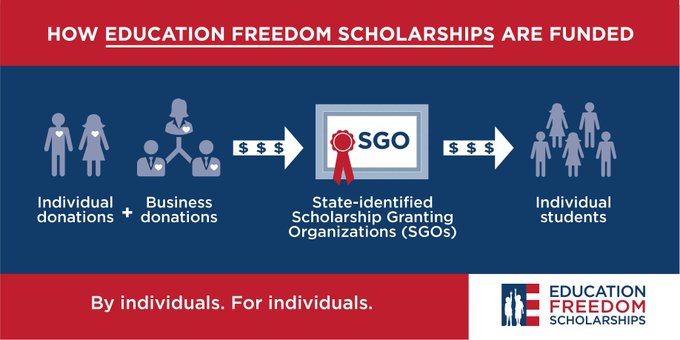
Despite what some may try to tell you . . . Education Freedom Scholarships are privately funded and do not take any money from public schools. #EducationFreedom
That comes from a tweet that Education Secretary Betsy DeVos posted in an attempt to sell the public on the Trump administration’s newest plan to expand alternatives to traditional public schools. And, for the record, it’s not true.
The Trump administration has included in its proposed 2020 budget spending up to $5 billion on tax credits for individuals and groups who donate to help children attend private and religious schools.
The donations, which would receive a 100 percent tax credit, could go for other education-related purposes — all aimed at expanding what DeVos now calls “education freedom” but used to more frequently refer to as “school choice."
The plan, called the Education Freedom Scholarships, has no chance of passing Congress with Democrats in control of the House, and with some Republican opposition.
That hasn’t stopped DeVos from talking and tweeting about it. In the following tweet, she presents a mini flow chart she says shows how the Education Freedom Scholarships would be funded, showing how individuals and organizations could donate to a state-approved organization that can grant scholarships to students.


Despite what some may try to tell you…Education Freedom Scholarships are privately funded and do not take any money from public schools.

And she says because these scholarships are privately funded, they “do not take any money from public schools.”
But donors can get a dollar-for-dollar tax credit to donate. That means up to $5 billion of federal taxpayer money will go back to private individuals and groups that donate for scholarships.
That isn’t what many people would call private funding.
Her claim that the scholarships “do not take any money from public schools” is misleading, too.
For one thing, any diminution of federal revenue could affect public school funding. For another, using CONTINUE READING: Let’s fact-check this Betsy DeVos tweet about Trump’s $5 billion school tax credit proposal - The Washington Post


Choosing Democracy: SCUSD Budget Crisis

Choosing Democracy: SCUSD Budget Crisis

Community Priority Coalition 
Both the Education and Democracy Insitute, and LULAC, League of United Latin American Citizens, are part of the Community Priority Coalition.  Our goal is to improve the quality of education for those under served in SCUSD.
Below is the Coalition's response to the current Budget Crisis.


Community Priority Coalition 

 4625 44th Street, Rm 5 Sacramento, CA 95820 

 March 6, 2019 
Jessie Ryan, President 
Darrel Woo, First Vice President 
Michael Minnick, Second Vice President 
Christina Pritchett 
Lisa Murawski 
Mai Vang 
Leticia Garcia 
Rachel Halbo 
Superintendent Jorge Aguilar 

Re: SCUSD financial crisis 
Dear SCUSD Board Members: 

The Community Priority Coalition (CPC) is very concerned about the Sacramento City Unified School District's financial health and deficit spending that will negatively impact students in the District. The Community Priority Coalition members consist of Black Parallel School Board, Building Healthy Communities. Hmong Innovating Politics, La Familia Counseling Center. Making Cents Work, League of United Latin American Citizens (Lorenzo Patiño Council #2862), Sacramento Area Congregations Together, Democracy and Education Institute, and Public Advocates Inc. Since 2016, the Community Priority Coalition has submitted to the Sacramento City Unified District Board an alternative budget that reflect the following Coalition priorities: 

1) Class Size Reduction (24 to 1); 

2) Professional development in cultural proficiency and restorative justice; 

3) Additional instructional assistance for English Language Learner and increased efforts to involve their parents in their education programs. including bilingual counselors, teachers, social workers and other staff; and 

4) After-school/early intervention programs. Although, CPC clearly understands that the District will make very difficult decisions; we are most alarmed that you are unable to address the key concerns of the Coalition given the District history and current financial crisis.
On December 12, 2018, the Fiscal Crisis Management Assistance Team (FCMAT), released the Sacramento City Unified School District's Fiscal Health Risk Analysis report. The purpose of the report is to evaluate SCUSD fiscal health and risk of insolvency in the current and next two fiscal years. The report indicted the District’s financial health by stating “that the district will be cash insolvent in November 2019 (estimated to be October 2019 at the time of FCMAT’s fieldwork) unless significant action is taken.” 

Historically, the District’s mis-management in the accounting department, poor budget development process, poor board decisions, and failure to address the structural deficit have placed the quality of education for the SCUSDs' students in jeopardy. Moreover, the current financial crisis will undermine the Local Control Accountability Plan process and shut out key stakeholders in the process. 
We understand that the District doesn’t want receivership nor do the Coalition, but the historical practices of the District gives us much pause. Therefore, we are urging the district not to use the  District's budget shortfalls in a way that will balance the budget on the backs of students, teachers and staff. 

The Community Priority Coalition sincerely wants to work collaboratively with the Superintendent and SCUSD Board for the betterment of our children. 
Sincerely, 


Community Priority Coalition 

Choosing Democracy: SCUSD Budget Crisis