Latest News and Comment from Education

Thursday, April 4, 2019

Diane Ravitch's blog | A site to discuss better education for all

Diane Ravitch's blog | A site to discuss better education for all


Diane Ravitch's blog 
 A site to discuss better education for all


Indiana: Virtual School Scams Taxpayers and Students

In every state that has authorized virtual charter schools, these schools are marked by two characteristics: 1. They are very profitable. 2. The “education” they provide is abysmal. Typically, they have high attrition, low graduation rates, and low scores on state tests. The state fails to monitor them for quality. Students and taxpayers are fleeced. The latest example is the Indiana Virtual Scho
Wisconsin: Charters and Vouchers Strip $193 Million from Public Schools

Yes, charters and vouchers take money from public schools, which enroll nearly 90% of students. In Tuesday’s election, a pro-public school slate swept the Milwaukee school board. It will be interesting to see what happens with that city’s heavy dose of privatized charters and vouchers. In Wisconsin, a legislator revealed that school choice removes $193 million in state aid from public schools. “M
“Have You Heard” Interviews Award-Winning Reporter about Arizona Charter School Scandals

Jennifer Berkshire and Jack Schneider interview Arizona Republic reporter Craig Harris about the charter school scandals in Arizona, the “wild west” of charters. Harris was a member of the investigative team that won the prestigious George Polk Award for its coverage of charter schools in their state. You can listen here. Or, you can read the interview here. Here is a small excerpt, where they be
Texas: A Great Day for Public Education!

The Texas House of Representatives endorsed sweeping legislation to fund public schools. Representative Dan Huberty (R-Houston), chairman of the House Public Education Committee, steered the legislation to a nearly unanimous vote. “House Bill 3 would increase base funding for each student by $890, fund full-day pre-K for low-income 4-year-olds in most school districts, compress tax rates for all

YESTERDAY

Jennifer Rubin: Trump Is Mentally Unraveling Before Our Eyes

Jennifer Rubin was hired by the Washington Post to be its “conservative” columnist, to counterbalance its liberal tilt on national issues (on education, the Washington Post is far-right and pro-privatization, with the exception of Valerie Strauss). But then Rubin encountered Trump, and she was horrified by the hash this man made of her fiscally responsible, conservative principles. In this articl
Massachusetts: Civil Rights Groups, Teachers’ Unions Demand Withdrawal of Racist Test Question

Massachusetts’ Civil Rights groups and teachers’ unions are outraged by a racist question in the state ELA Test. “In response to accounts about racially troubling questions embedded in this year’s 10th-grade English Language Arts MCAS exam, the Massachusetts Teachers Association, the Boston Teachers Union, the American Federation of Teachers Massachusetts, the Massachusetts Education Justice Alli
Fun Fact from Today’s Boston Globe

i get a daily news summary from the Boston Globe and several other newspapers. This arrived this morning: “ In the late 1700s, there were more than 60 million bison roaming North America, but because of commercial hunting and slaughter, there were just 541 animals left 100 years later. Thanks to preservation and rescue efforts, there are about 31,000 in existence today, in national parks and on r
Milwaukee: Progressive Slate Sweeps School Board Election!

A progressive slate backed by the Working Families Party and the Milwaukee teachers’ union swept the school board election in Milwaukee. I received this statement from Rob Duffey of the Working Families Party: “Last night in Milwaukee the Wisconsin Working Families Party won big, electing a slate of five pro-public school champions who flipped the Milwaukee city school board from a pro-privatizat
Houston: Charter Founder Pays Her Companies $17 Million a Year

The board of Houston Independent School District is reviewing three charter networks founded by one woman, who is both the highest ranking employee and pays her “related companies” $17 million dollars. Lois Bullock runs the networks and pays rent to companies she owns. “Over the past half-decade, Bullock’s company has served as the landlord for Energized For Excellence Academy, taking in $10.8 mi
North Carolina: Judge Rules Charter School Requirement of Skirts for Girls Is Discriminatory

A federal judge ruled that Charter Day School’s dress code –which requires girls to wear skirts and does not permit them to wear trousers or shorts–is unconstitutional. “Yes, the boys at the school must conform to a uniform policy as well,” Senior U.S. District Judge Malcolm J. Howard wrote. “But plaintiffs in this case have shown that the girls are subject to a specific clothing requirement that
Arkansas: Why Do Republicans Hate Local Control?

Republicans were once the party that advocated for local control of schools. No longer. Now they support state takeovers. This is the Big Bad Wolf technique. State Control makes it easier to privatize public schools. No need to listen to parents or communities. No raucous school board meetings. No democracy. State control of schools is autocracy in action. In Arkansas, a state that is almost whol
Bob Braun Blasts the Weak-Kneed Charter Expose in New Jersey Press

Bob Braun was a reporter for New Jersey’s biggest newspaper—the Star-Ledger—for fifty years. Now he writes what he wants, without any constraints. In this post , he lacerates the series of articles about charter school corruption and theft of public dollars in New Jersey because it failed to reach the logical conclusion of the evidence it produced. The logical conclusion would be to call off the
New Jersey Expose, Part 5: How to Fix the State’s Broken Charter Financing Problem (NOT!)

This article is the last of a five-part series called “Cashing in on Charter Schools,” published by northjersey.com and USA Today New Jersey and written by Jean Rimbach and Abbott Koloff. The post examines possible fixes for the problems and profiteering described in previous entries in the series. This concluding article in a series that revealed widespread theft of public funds is deeply disapp
Inside Philanthropy: Charters Lose Their Luster in the Philanthropic World

Caitlin Reilly of “Inside Philanthropy” writes that philanthropies no longer see charter schools as the means to transform American education. Although a few have doggedly doubled down on their commitment to charters, there seems to be a broad shift underway. Reilly calls it an “inflection point,” a point where change is undeniable. She writes: “Though charter schools have acquired a powerful all
Randy Rainbow on Betsy DeVos

Randy Rainbow reprises the budget hearings where Betsy DeVos attempts to defend her deep cuts to education. He calls her Cruella DeVos.

APR 02

Chicago Teachers Union on Mayoral Election

The militant Chicago Teachers Union issued a statement following the election of Lori Lightfoot, who was not its first choice. The CTU celebrates the end of the nightmare rule of Mayor Rahm Emanuel and Governor Bruce Rauner. And it commemorates the historic leadership of its President Emerita Karen Lewis, who inaugurated a historic awakening of teacher militancy with the Chicago teachers’ strike
California: Who Gave the Charter Reform Task Force to the Charter Industry? Mystery Solved!

Sometimes it helps to solve a mystery when you put it out there for public review. Like posting photos of the “Ten Most Wanted Criminals” in every postoffice. Tips come in. An hour ago, I learned the identity of the person who named the members of the Task Force that is supposed to propose reforms to the state’s notoriously weak charter law. Seven of the 11 members of the Task Force are connected
Los Angeles: Enrollment in Charter Schools Declines While Executive Salaries Soar

Blogger Red Queen in LA (Sara Roos) has combed through tax filings to reveal the exorbitant salaries paid to charter school execitives, demonstrating that the ban of for-profit charter corporations has not limited the raid on taxpayers’ dollarsby charter profiteers. At the same time that charters executives are pulling down hefty salaries, charter enrollments are declining. She writes: “Overall,
New York: NYSAPE Protests Commissioner Elia’s Efforts to Harass and Intimidate Parents to Prevent Opt Outs

The New York State Allies for Public Education issued this statement in opposition to State Commissioner MaryEllen Elia’s efforts to “bribe, coerce, manipulate, and threaten students and parents into complying with a broken assessment system.” NYSAPE has led the opt out movement for several years. About 20 percent of eligible students in grades 3-8 do not take the state tests. About half the stud
California: How Did Charters Gain Control Of Gavin Newsom’s Task Force to Reform Charter Law?

Bill Raden of Capital & Main presents us with this puzzle: how did it happen that seven of the 11 members of Gavin Newsom’s Task Force in charter school reform are part of the charter industry? The Fox is in charge of the henhouse. Since the Task Force is supposed to examine the fiscal impact of charters on public schools, why is the industry judging itself? Shouldn’t the Task Force have been com
New Jersey Expose, Part 4: Cashing in on Real Estate Deals in the Charter Market

This post is part 4 of a series published by northjersey.com and USA Today New Jersey. Written by Jean Rimbach and Abbott Koloff, it is called “Cashing in on Charter Schools.” It explores the many ways that charter operators exploit taxpayers. This post describes how charter operators and real estate developers are cashing in. “ I nterest-only mortgages with rates that grow each year. Multimillio
Garn Press Publishes a Collection of My Most Important Essays

Garn Press, one of the nation’s valuable independent publishers, has compiled a collection of my most important essays. I am grateful for their hard work and dedication in bringing the book to fruition. The book is titled “The Wisdom and Wit of Diane Ravitch.” It contains selected essays published on this blog, the New York Review of Books, Huffington Post, and the Education Week blog that I shar

APR 01

John Merrow: Retirement Sucks!

John Merrow retired as a national education journalist a while back, and he has been trying to figure out how to find a new purpose in life. In this post, he describes his different efforts and how he found an activity that has kept him very busy and satisfied. I should add that Merrow puts a great deal of time into his annual post on April 1. When he wrote about his decision to join the board of
If You Have a Dog, This Is for YOU and Your Dog! If You Don’t, Prepare to Laugh!

What if you could send your dog on a trip? This is it! Even if you don’t have a dog, you will love this video!
Why the British Don’t Like Trump

Bon Shepherd posted this explanation of why the British don’t like Trump: character counts. Someone on Quora asked “Why do some British people not like Donald Trump?” Nate White, an articulate and witty writer from England wrote this magnificent response: “A few things spring to mind. Trump lacks certain qualities which the British traditionally esteem. For instance, he has no class, no charm, no
I ❤️ Randy 🌈 Rainbow

If you are a regular reader of this blog, you know I often post the videos of Randy Rainbow. He is one of the cleverest political satirists in the nation, if not the world. This is an interview with him that appeared on ABC, where he explained how he makes his brilliant videos on his computer in his apartment in Astoria, Queens. His cat is his “executive producer. “ He does it all himself, and he
Anderson Cooper on Betsy DeVos’ Inexplicable Effort to Defund the Special Olympics

This isn’t funny but it is classic Betsy DeVos. Either smirking or giving a cold shoulder to the media, surrounded by serveral of her bodyguards. Look how many people protect her! And we pay for them.
Anthony Cody Fact-Checks Betsy DeVos on Class Size, and Jeanne Allen Scoffs At Cody

In this post, veteran teacher Anthony Cody explains how he happened to have a seat directly behind Betsy DeVos at the Congressional budget hearings, and he fact-checks DeVos’ preposterous claim that large classes may be preferable to small ones. No one asked her why wealthy parents who send their children to elite private schools expect and demand small classes. If they listen to our Secretary of
Hilarious! Betsy DeVos Explains the “Benefits” of Large Class Sizes

It’s April Fool’s Day but this is no joke. At the Congressional hearings on the Education Department’s budget, Secretary Betsy DeVos explained the benefits of large classes. When pressed to supply the research that undergirded her claim, she promised to supply it later. Watch this short video so you can understand the next post.

MAR 31

Sally Yates: Barr Should Release Mueller Report in Full, Without Redactions

Sally Yates was Deputy Attorney General from 2015-2017. In this article in the Washington Post, she argues that Attorney General William Barr should release the full Mueller Report as soon as possible, without redactions. She writes: “America’s justice system is built upon one thing — truth. When witnesses give testimony, they are sworn to tell “the truth, the whole truth, and nothing but the tru
Fred Smith: New York’s Testing Regime is Mindless Disruption

If you want to know why parents in New York have opted out in record numbers for the past few years, read testing expert Fred Smith’s account of the chaos and tumult inflicted on the children of the state by the State Education Department. Disruption! Change! Instability! Smith, who worked for many years as a testing expert at the New York City Board of Education, writes: Latch onto this, folks:
New Jersey Expose, Part 3: How Charter Operators Collected Hundreds of Millions from a Federal Fund for Building Public Schools

Northjersey.com and USA Today New Jersey are publishing a five-part series of the abuse of taxpayer funds by charter operators. This is part 3 of an investigation called “Cashing In on Charter Schools,” written by Abbott Koloff and Jean Rimbach. “H undreds of millions of dollars in federal aid was steered to New Jersey’s largest charter school management companies over the last decade, helping th
Nicholas Kristof: An 8-Year-Old Chess Champion, Homeless in NYC

Thanks to Nicholas Kristof for writing these stories and for recognizing that the economic and social supports needed for the hero of the story should not depend on philanthropy and charity. Nicholas Kristof wrote about an 8-year-old boy who won the New York State chess championship for his age group. He learned chess only a year earlier at his public school, PS 116, in Manhattan. He and his fami

MAR 30

Bill Phillis: Ohio’s State Takeover Law Should Be Repealed

Bill Phillis, retired deputy state superintendent and passionate advocate of equity and financial advocacy, has written many times about the absurd state takeover law. It gets more insane by the day. He wrires: Chairman of Lorain Academic Distress Commission (ADC) says he ALONE will complete the CEO’s job performance evaluation The Chairman of the Lorain ADC lives 130 miles from Lorain. He was ap
California: The Charter Law is Broken and Adversaries Don’t Agree on How to Fix It

This is part 3 of the Los Angeles Times’ series about charter school dysfunction in California, written by Anna Phillips. Phillips traces many of the problems, especially lack of oversight, to state law. She explains that the billionaires who fund the rapid expansion of charter schools have squared off against the powerful California Teachers Association, andthe two never agree. The resultis That
Beto O’Rourke’s Wife Works for an Organization that Brings Charter Schools to El Paso

I was an enthusiastic supporter of Beto O’Rourke when he ran against Ted Cruz. I regularly sent him checks of $50, $100. I would have loved to see Beto beat Cruz. I heard that Beto’s wife Amy was connected to the charter school movement but decided that was less important than beating Cruz. Now that Beto is running for President, it matters more. I don’t want another Democratic President pushing
New Jersey Expose, Part 2: Millions of Taxpayer Dollars Spent on a Floundering Charter School

Northjersey.com and USA Today New Jersey are posting a five-part series about how taxpayers are being taken for a ride by the charter industry. Part 2 is about the millions of state dollars spent to bailout a low-performing charter school. Reporters Jean Rimbach and Abbott Koloff write: “B y 2010, four years after it opened, the Central Jersey Arts Charter School in Plainfield was in trouble. “Th
Charter Schools: A Very Horrible, Terrible, Awful Week

This has been possibly the very worst week in the history of charter schools, which have existed for almost 30 years. It is fitting that this week coincided with Public Schools Week, reminding us of the importance of public schools, which are democratically governed, open to all who apply, and accountable, financially and academically, to the public. Consider the trajectory of the charter idea. W

MAR 29

Rhode Island: Under Pressure, Gov. Raimondo Will Donate Sackler Money

The Providence Journal published 20 articles about Governor Gina Raimondo and Sackler contributions to her campaign. It was only $12,500, nothing in the world of hedge fund managers, Raimondo’s former occupation. The publicity finally got to her, and she announced she was donating the money somewhere. Sackler owns Purdue Pharma, major manufacturer of OxyContin, the highly addictive opioid respons
New York: State Teachers’ Union Fact Checks State Commissionerof Education

NYSUT, The New York State United Teachers, issued a blistering fact check of State Commissioner MaryEllen Elia’s claims about the state tests. You have to open it to get the full flavor because NYSUT, not normally outspoken, shreds Elia’s claims. Elia writes in Orwellian Newspeak about value of the tests. NYSUT response: Because of the lack of movement by SED on NYSUT’s suggested changes to the t
D.C. Has Highest Rate of Gentrification in Nation

You may not be surprised to learn that gentrification means rising housing costs, as affluent people move into cities and developers demolish or upgrade low-income housing. Nor will you be surprised to learn that gentrification involves the displacement of low-income people. As they moveor leave the city, city leaders want charter schools so that the new middle-class families can separate from “t
California: Small Districts Make Money by Authorizing Charters in Big Districts with No Oversight

This article is the second of three written by Los Angeles Times education reporter Anna Phillips. The first told the story of charter operators who were making millions of dollars opening subpar charters. This story is about California’s broken system for authorizing charter schools. Small rural districts with small budgets can collect millions by authorizing charters that open outside their dis
New Jersey Exposé, Part 1: How Charters Use Millions of Dollars from Taxpayers for Their Private Property

NorthJersey.com and USA Today New Jersey are running a five-part series called “Cashing in on Charter Schools, written by reporters Jean Rimbach and Abbott Koloff. Follow this series if you care about integrity in spending public dollars. What follows is an excerpt. Open the link to read the story. . Part one. NJ taxpayers are spending hundreds of millions of dollars to construct and renovate cha

MAR 28

The Onion: Innovative Progressive Charter School with No Students

The Onion reports on an exciting and innovative concept in the world of charter schools: a school without students! “One year into its founding as the purported “bold next step in education reform,” administrators on Monday sang the praises of Forest Gates Academy, a progressive new charter school that practices an innovative philosophy of not admitting any students. “We’ve done something here at
California: Now Is the Time to Reform Charter Schools

California has more charter schools and students than any other state, due to its size and its notoriously weak charter law. Add to that a progressive Governor with a blind spot for charters (Jerry Brown opened two when he was mayor of Oakland) and to a gaggle of billionaires in both parties who favor privatization. in the new report by the Network for Public Education, Asleep At the Wheel, Calif
A Teacher in Arizona Reports on the Slow Strangulation of Public Schools

An Arizona Teacher left this comment: “I teach in an AZ public school–title 1 school. The poverty in this school is astonishing. This is my first year teaching in AZ after moving here from another state. I taught almost 20 years in a public school that was also a Title 1 school before moving to AZ. I have a lot of experience teaching in poverty schools. I have never seen anything as dysfunctional
John Merrow: Eight Fixes for the College Admissions Mess

John Merrow noted the intense media attention on the recent college admission scandal, where rich parents found ways to buy higher test scores or pay for guarantees of admissions by pretending they were star athletes or paying off coaches to ask for them to be admitted or hiring a ringer to take the SAT for them. He offers eight ways to repair the college admissions process. Here are a few of his
Tennessee Decides About Vouchers Today

Today is V-day in Tennessee. The Shelby County Board of Education (Memphis) opposes the plan, accurately protesting that the plan would divert dollars from their already underfunded schools. Meanwhile, six charter schools in Memphis have made a deal with the Catholic church to lease space, while pledging not to teach anything contrary to Catholic teaching. ”The Compass Community Schools network s


Texas: New Study Finds That Readability Levels on State Tests are Misaligned

A new study of the STAAR tests in Texas finds that the readability levels are far above the grade levels tested. Professor Susan Szabo and Professor Becky Barton Sinclair of the Texas A&M at Commerce reviewed STAAR tests and 
Diane Ravitch's blog | A site to discuss better education for all


ANDRE PERRY: To survivors of school shootings: your survival is ultimate form of protest

To survivors of school shootings: your survival is ultimate form of protest

To the survivors of school shootings
Your survival is the ultimate form of protest


Dear survivors of the Parkland school shooting,
I’m thinking of you, unsure of what to say, fearful that I will say the wrong thing. The last three weeks have been hard: Two of your Parkland classmates, maybe your friends, ended their lives. I don’t want to lose you, too. So, I’m reaching out to offer my support, love and attention, and my hope that if you are now considering or have considered suicide, you understand there is help and hope.
I lost a high school friend and running competitor to suicide. Maybe ‘competitor’ is too strong a word: I shouldn’t consider myself a challenger to the man I’ll call Jimmy Sherman, who was a state champion in the mile. I got to know him mostly from afar, back in the pack. He led almost every race I saw him in, setting the pace for everyone else. I don’t know if he knew, but Jimmy was a hero in my mind.
When he took his life in our college years, I really felt the loss of leadership — to me, he had always been a champion in so much more than a race.
This country’s plague of school shootings has made it clear that all parents are connected, as our children’s fates are inextricably linked. As a parent, I can’t help but feel a connection to you, and I humbly reach out as a father who fears that the killer who took the lives of CONTINUE READING: To survivors of school shootings: your survival is ultimate form of protest

Attorneys General Sue Trump Administration Over School Nutrition Rollbacks : The Salt : NPR

Attorneys General Sue Trump Administration Over School Nutrition Rollbacks : The Salt : NPR

Attorneys General Sue Trump Administration Over School Nutrition Rollbacks


A coalition of state attorneys general is suing the Trump administration for weakening the federal nutrition standards for school meals that are fed to about 30 million children across the country.
"Over a million children in New York – especially those in low-income communities and communities of color – depend on the meals served daily by their schools to be healthy, nutritious, and prepare them for learning," New York Attorney General Letitia James said in a statement announcing the lawsuit. Joining James in the lawsuit are the attorneys general of California, the District of Columbia, Illinois, Minnesota, New Mexico and Vermont.
As we've reported, last year the Trump administration gave school lunch administrators more flexibility in serving up refined grains, including white breads, biscuits and white pastas. The move weakened standards set during the Obama administration aimed at serving more nutritious and fiber-dense whole grains, which are a key part of a healthy diet.
In addition, the Trump administration put the brakes on targets to reduce the amount of salt allowed in school meals. At the time, U.S. Department of Agriculture Secretary Sonny Perdue wrote: "If kids are not eating what is being served, they are not benefiting, and food is being wasted."


But public health advocates have cried foul. "The 'flexibilities' the administration is offering [schools] are both unnecessary and undermining," Laura MacCleery, policy director at the Center for Science in the Public Interest, told me.
Her group has also filed a lawsuit in federal court in Maryland. The suit argues that the CONTINUE READING: Attorneys General Sue Trump Administration Over School Nutrition Rollbacks : The Salt : NPR

Congress Approves National Award Program for ESPs - NEA Today

Congress Approves National Award Program for ESPs - NEA Today

Recognition Long Overdue: Congress Approves National Award Program for ESPs


After the U.S. House of Representatives overwhelmingly passed the Recognizing Achievement in Classified School Employees Act (H.R. 276) by a vote of 387-19 in February, the Senate quickly followed suit with its own unanimous approval in March.
“This recognition is way overdue,” said Debby Chandler, president of the National Council for Education Support Professionals (NCESP), which works within the National Education Association (NEA) to represent the interests and issues of education support professionals (ESP).
It has taken more than a decade of seemingly endless meetings between elected officials in Washington, political appointees from two different presidential administrations, and numerous NEA staff, board members, lobbyists, ESPs and other activists for the bill to get this close to becoming law.
“The voices of our board members and activists who contacted Congressional members in the first few months of this year made the difference,” said Marc Egan, NEA director of government relations. “We had worked behind the scenes and knew we had a moment to try to capitalize on.”
Popularly known as the RISE Act, the bill has been sent to the president for review.
“Lobbying for a bill like this is one of those moments where you realize how fortunate you are to work on behalf of educators nationwide,” Egan said. “Over the many years we fought for this bill, I would say to members of Congress, ‘This is as much of a mom-and-apple-pie bill that you can find.’”
“After many years by educators of advocating for such a national award, Congress is right to recognize the unsung and often unseen heroes of the education professions – education support professionals and classified school employees.” – NEA President Lily Eskelsen García.
The legislation provides recognition by the federal government for the outstanding contributions of ESPs to the nation’s public schools and the students they serve. If signed by the president, the legislation will direct the Secretary of Education to establish a national award program recognizing the excellence exhibited by these public school educators in pre-kindergarten through grade 12.
Similar to the National Teacher of the Year award program, governors from each state will work with educators, associations, and other stakeholders on identifying nominees for final selection by the education secretary.
“Schools simply cannot run without us,” said Chandler, who is an NEA board member and a secretary at John R. Rogers High School in Spokane, Wash. “We ignite the love of learning while providing essential services to the whole student.”
There are almost 3 million school support professionals in our nation’s public CONTINUE READING: Congress Approves National Award Program for ESPs - NEA Today

A (Mostly) Brief History Of The SAT And ACT Tests

A (Mostly) Brief History Of The SAT And ACT Tests

A (Mostly) Brief History Of The SAT And ACT Tests

H/T Sonja Luchini

late 1800s
Average Scores

SAT (1952–present)
Data | Graph

ACT (1970–present)
Data | Graph
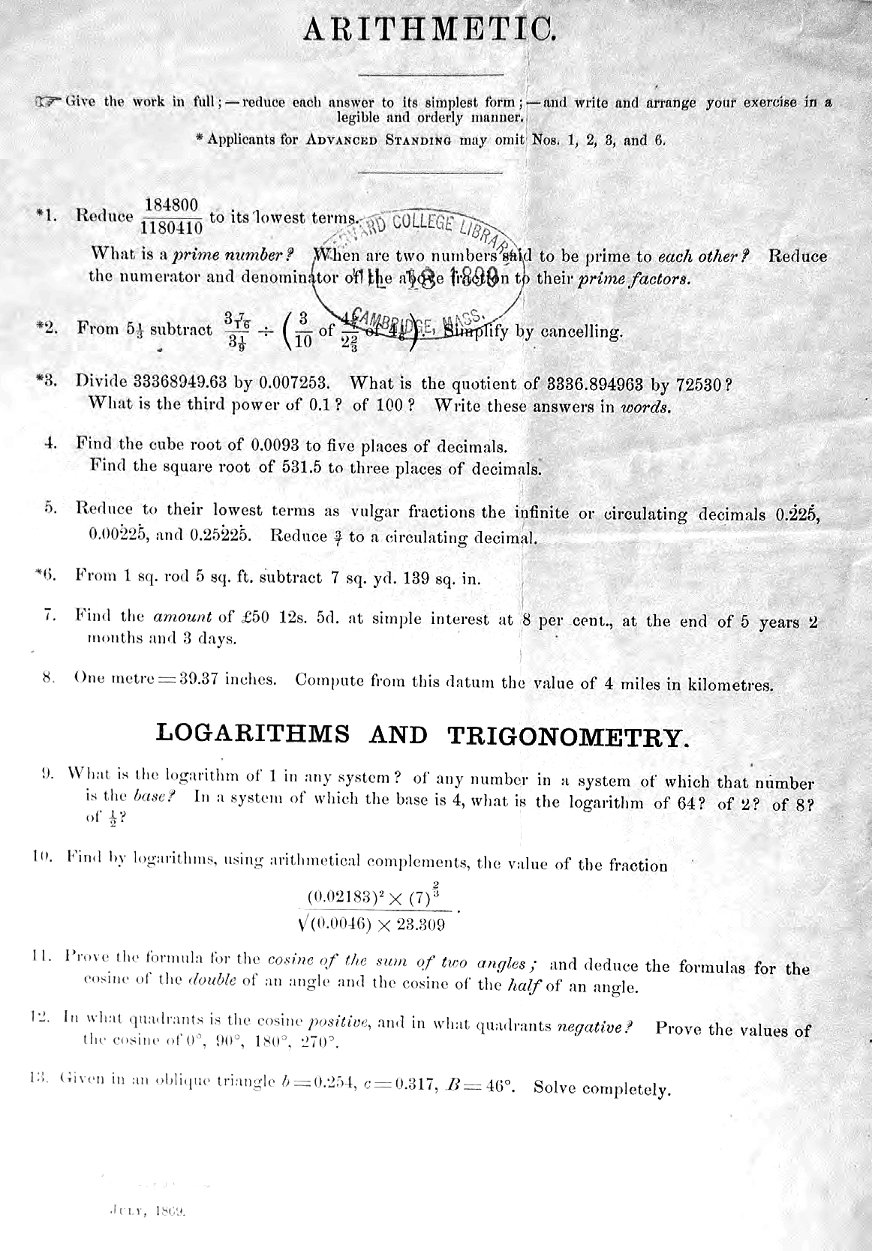
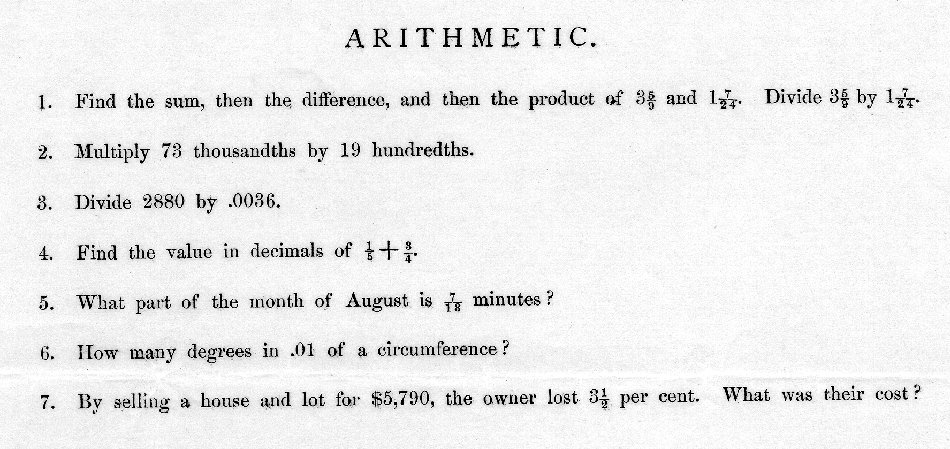
By the end of the 19th century, tests for admission to U.S. colleges are specific to each school. (The arithmetic portion of Harvard's 1869 entrance exam can be seen here. The corresponding portion of MIT's 1869 exam can be seen here. These portions of the two tests are quite different in difficulty.) The content of the tests varies widely and can be highly dependent on the interests of the faculty conducting the exams. It is not unusual for a college to administer exams on campus a week or two before classes begin. As an alternative to testing, many colleges, especially in the midwestern U.S., use "admission by certificate": a high school would be certified by inspectors from the colleges to have an appropriately preparatory curriculum for college work, and students graduated from such a high school would be considered to be adequate without testing. By 1900, however, inspections are infrequent and college faculty are often not present.
1899The College Entrance Examination Board (or "College Board") is founded in December, consisting of a non-profit membership of twelve colleges and universities. The membership is comprised mostly of elite institutions in the northeastern U.S., including Columbia, Cornell, Vassar, Barnard, and New York University. The founders are worried that the lack of uniform admissions testing and the certificate system places too much control of college admissions with the high schools. Also, the certificate system is thought to be conducing students away from the northeastern colleges.

The purpose of the Board is primarily to administer annual examinations in a variety of subjects thought to be important for college-level work. The members of the Board could then use the test scores however they chose. The fee for the test is expected to be $5 (about $136 in 2012 dollars).

At this time, roughly 4% of high school graduates go on to college.
1901The "College Boards" are administered in June for the first time to fewer than 1000 students. Roughly 75% of these students are applicants to Columbia University or Barnard College, hence the practical effect of these tests is to distinguish excellent students from elite students. The essay tests, which require five days to complete, are curriculum-based achievement exams, designed to assess a student's mastery of nine subjects, including Greek, Latin, and physics. For the price of ten cents, an examinee could find out from the College Board, before taking the test, the area of knowledge that each subject test would focus on. (For example, the student could learn that this year's Greek test would cover the first three books of Homer's Iliad.) Scoring is done by hand and consists of five ratings for each subject, from "Excellent" to "Very Poor", with "Doubtful" in the middle.
1917An intelligence test developed by Robert Yerkes and other psychologists is administered to more than 1.5 million U.S. Army recruits. The test, called the Army "Alpha" exam, uses multiple-choice questions (invented two years prior) and is designed to help the Army make rapid placement decisions for prospective soldiers entering World War I.
1919Columbia University begins allowing prospective students to substitute the results of an intelligence test (the Thorndike test for "Mental Alertness") for its regular entrance exams.
1925By this time, about 20,000 prospective freshmen take the College Board's exams each year. However, this figure represents only about 10 percent of the number of students entering college in the U.S. Most colleges continue either to admit by certificate or use their own entrance exams.

In April, the College Board appoints a commission, headed by Carl Brigham, to develop a new test designed to measure general intelligence.
1926The first Scholastic Aptitude Test (or "SAT") is administered on June 23 to 8,040 students, 40% of whom are women. (About 85% of these students are taking the traditional boards as well.) Carl Brigham, a psychologist who helped to develop aptitude tests for the U.S. Army during World War I, is influential in the development of the CONTINUE READING: A (Mostly) Brief History Of The SAT And ACT Tests

“Have You Heard” Interviews Award-Winning Reporter about Arizona Charter School Scandals | Diane Ravitch's blog

“Have You Heard” Interviews Award-Winning Reporter about Arizona Charter School Scandals | Diane Ravitch's blog

“Have You Heard” Interviews Award-Winning Reporter about Arizona Charter School Scandals 


Jennifer Berkshire and Jack Schneider interview Arizona Republic reporter Craig Harris about the charter school scandals in Arizona, the “wild west” of charters.
Harris was a member of the investigative team that won the prestigious George Polk Award for its coverage of charter schools in their state.
You can listen here.
Or, you can read the interview here. 
Here is a small excerpt, where they begin to interview Craig Harris:
Craig Harris​: It started about a year ago on two fronts. One, there was a relatively prominent charter school, a notorious charter school that abruptly closed on the west side of Phoenix in a town called Goodyear. And the reason that school had gained some notoriety is because a few years earlier, one of the students had gone missing and died. And what happened, now we’re finding out later, is that the school was being fraudulent on its attendance in order to keep it running because people had left the school because of the tragedy. And so the school got shut down. And that piqued our interest.
And then I live on the east side of Phoenix in town called Gilbert, which is kind of like ground zero of where charter schools are. They’re very, very popular out in my neck of the woods. And part of the reason is that a lot of the operators that run the charter schools belong to the Church of Jesus Christ of Latter Day Saints. They’re Mormons. And so a lot of them have developed charter schools and they’ve been able to grow because they have pretty good academics, but they also focus on morality and wholesomeness and things like, so that, that gets a lot of parents to enroll their kids at those schools.
Berkshire​: Well, we are obviously here to talk about some of the less wholesome aspects of Arizona’s charter school industry over the last year. You’ve written one unbelievable exposé after another about the CONTINUE READING: “Have You Heard” Interviews Award-Winning Reporter about Arizona Charter School Scandals | Diane Ravitch's blog


High School Doesn’t Have to Be Boring (Jal Mehta and Sarah Fine) | Larry Cuban on School Reform and Classroom Practice

High School Doesn’t Have to Be Boring (Jal Mehta and Sarah Fine) | Larry Cuban on School Reform and Classroom Practice

High School Doesn’t Have to Be Boring (Jal Mehta and Sarah Fine)


This op-ed appeared in the New York Times, March 30, 2019
“The writers spent six years traveling the country studying high schools. Jal Mehta  is an associate professor at the Harvard Graduate School of Education. Sarah Fine runs a teacher preparation program at the High Tech High Graduate School of Education in San Diego. They are the authors of ‘In Search of Deeper Learning: The Quest to Remake the American High School.’ “

When you ask American teenagers to pick a single word to describe how they feel in school, the most common choice is “bored.” The institutions where they spend many of their waking hours, they’ll tell you, are lacking in rigor, relevance, or both.
They aren’t wrong. Studies of American public schools from 1890 to the present suggest that most classrooms lack intellectual challenge. A 2015 Gallup Poll of nearly a million United States students revealed that while 75 percent of fifth-grade students feel engaged by school, only 32 percent of 11th graders feel similarly.
What would it take to transform high schools into more humanizing and intellectually vital places? The answer is right in front of us, if only we knew where to look.
When the two of us — a sociologist and a former English teacher — began our own investigation of this question several years ago, we made two assumptions. Both turned out to be wrong.
The first was that innovative schools would have the answers. We traveled from coast to coast to visit 30 public high schools that had been recommended by leaders in the field. What we saw, however, was disheartening. Boredom was pervasive. Students filled out worksheets, answered factual questions, constructed formulaic paragraphs, followed algorithms and conducted “experiments” for which the results were already known. Covering content CONTINUE READING: High School Doesn’t Have to Be Boring (Jal Mehta and Sarah Fine) | Larry Cuban on School Reform and Classroom Practice


CURMUDGUCATION: College Board's AP Rate Hike Backlash

CURMUDGUCATION: College Board's AP Rate Hike Backlash

College Board's AP Rate Hike Backlash

The College Board, the company behind the dreaded SAT and popular AP courses has made changes to the registration for the AP exams. AP courses and the exams that go with them are supposed to provide students with a leg up on college applications. Though the changes, which amount to an increase in cost, were announced over a month ago, they now add to the conversation the nation is suddenly having about the college admissions process.
The new policy (to be implemented next school year) calls for students to register in November for the AP test. But in November, students are barely one quarter of the way through the AP course; they might not yet be certain they'll take the test in May. Additionally, AP tests are only accepted by certain schools; a sufficiently high score (as determined by the college) may be good for a credit, or simply serve as a placement test. However, AP credits are often not counted in the student's major.All this means that for a high school senior to accurately gauge the utility of an AP test, she needs to know what college she will attend and what her major will be. Many high school seniors will have none of that information in November. Yet under the new policy, the College Board will charge them a $40 late fee if they register after November, and a $40 cancellation fee if they register and then decide not to take the test.
This certainly looks like a financial windfall for the College Board, particularly when one considers that data collected from high school seniors in the fall would be a valuable commodity. And the CONTINUE READING: CURMUDGUCATION: College Board's AP Rate Hike Backlash