Latest News and Comment from Education

Saturday, February 16, 2019

Bill and Melinda Gates annual letter 2019: is their fortune justifiable? - Vox

Bill and Melinda Gates annual letter 2019: is their fortune justifiable? - Vox

Bill and Melinda Gates and the problem of the “good billionaire”
A new wave of critics say even the most generous billionaires are bad. Are they right?


Bill and Melinda Gates are odd billionaires.
The Gateses, who released their foundation’s annual letter this week, are not cartoonishly out-of-touch like Stephen Schwarzman, the private equity billionaire who gave Yale $150 million for a performing arts center; they’re not magnates attempting to use their money to swing elections like Charles and David Koch or Tom Steyer.
They’re also not self-hating plutocrats like Nick Hanauer who openly decry their station in society and constantly demand just economic policies. And they’re certainly not among the dozens of barely known billionaires who fill out the Forbes 400 list of America’s richest people (quick, tell me all your thoughts about, uh, Thomas Peterffy?).
But I think in some ways, the Gateses (and to a certain extent, Cari Tuna and Dustin Moskovitz as well) raise the hardest questions about the role billionaires and philanthropy play in our society. Which is to say: The Gates Foundation has the kind of money and power that there are very, very good reasons to not want a foundation controlled by a private individual (or, in this case, three individuals — Bill, Melinda, and Warren Buffett) to have.
It is able to spend vast sums of money to influence the lives of people around the globe with minimal accountability, without the discipline that consumers and competitors force on businesses and voters force on governments.
When I look at figures like Steyer or Schwarzman or the Kochs or Howard Schultz exercising the power derived from their wealth, my reaction is easy: You’re doing this wrong. You’re not living up to the responsibility inherent in having that kind of money and power. The money you’re spending would probably be better used in public coffers.
I think the Gates Foundation, by contrast, has mostly used that money and power well. And I’m CONTINUE READING: Bill and Melinda Gates annual letter 2019: is their fortune justifiable? - Vox


Why Donald Trump Jr.'s ‘loser teachers’ comment was 'a chilling moment’ for educators around the world - The Washington Post

Why Donald Trump Jr.'s ‘loser teachers’ comment was 'a chilling moment’ for educators around the world - The Washington Post

Why Donald Trump Jr.'s ‘loser teachers’ comment was 'a chilling moment’ for educators around the world


You may recall that President Trump held a pro-border wall rally on Feb. 11 in El Paso and his eldest child, Donald Trump Jr., made a speech that roused the crowd.
The president’s son drew cheers when he urged young conservatives to “bring it to your schools” (though he didn’t say exactly what “it” was) because “you don’t have to be indoctrinated by these loser teachers that are trying to sell you on socialism from birth.”
The comment drew response on social media from teachers and others who don’t see educators in the same way as he does, with the hashtag #loserteachers. For example:


In this post, three internationally respected teachers respond, explaining why his comment was more than simply mean.
They are Jelmer Evers of the Netherlands, Michael Soskil of the United States, and Armand Doucet of Canada. The three were featured authors in the 2018 book “Teaching in the Fourth Industrial Revolution: standing at the precipice.”
Evers (@helmerevers) is also the author of “Flip the System: changing education from the ground up.” Soskil (@msoskil) was the 2017-18 Pennsylvania Teacher of the Year. Doucet (@DoucetArmand) was the recipient of the Canada Teachers Award and is the author of “Teaching Life: Our Calling, Our Choices, Our Challenges.”
By Jelmer Evers, Michael Soskil and Armand Doucet
“You know what I love? I love seeing some young conservatives because I know it’s not easy. (Crowd applauds and shouts.) Keep up that fight. Bring it to your schools. You don’t have to be indoctrinated by these loser teachers that are trying to sell you on socialism from birth. You don’t have to do it. Because you can think for yourselves. They can’t.” (Crowd applauds and shouts again.) – Donald Trump Jr. in Texas on Feb. 11, 2019
For teachers around the globe this was a chilling moment.
In a stadium filled with people chanting “USA, USA!” the son of the president of the United States called for CONTINUE READING: Why Donald Trump Jr.'s ‘loser teachers’ comment was 'a chilling moment’ for educators around the world - The Washington Post


Ohio: Rightwing Think Tank Aide Attacks Hero of Public Education | Diane Ravitch's blog

Ohio: Rightwing Think Tank Aide Attacks Hero of Public Education | Diane Ravitch's blog

Ohio: Rightwing Think Tank Aide Attacks Hero of Public Education


Ohio has one of the worst charter sectors in the country.
In 2015, The Cleveland Plain Dealer and Valerie Strauss of the Washington Post agreed that Ohio’s Charters had become a national joke.  Margaret Raymond, leader of CREDO, which conducts studies of state charter sectors, said to Ohioans, “Be glad that you have Nevada, so you are not the worst,” referring to Ohio’s charters.
Two-thirds of Ohio’s charters are rated failing by the state. Enrollment in charters is falling. The number of charters is declining. Ohio’s failing  charter schools drain $1 billion a year from Ohio’s public schools.
Why is Ohio taking $1 Billion a year from public schools to sustain failing charter schools?
In short, Ohio’s charter sector is a disaster.

So now is exactly the time when Aaron Churchill of the Thomas B. Fordham Institute attacks Bill Phillis, the retired assistant superintendent of education, a courtly gentleman who has warned about the fiscal dangers of charters for Ohio public schools for years and whose warnings have been prophetic.
Bill Phillis is a hero of education in Ohio and in the nation. He is paid by no one to tell the truth.
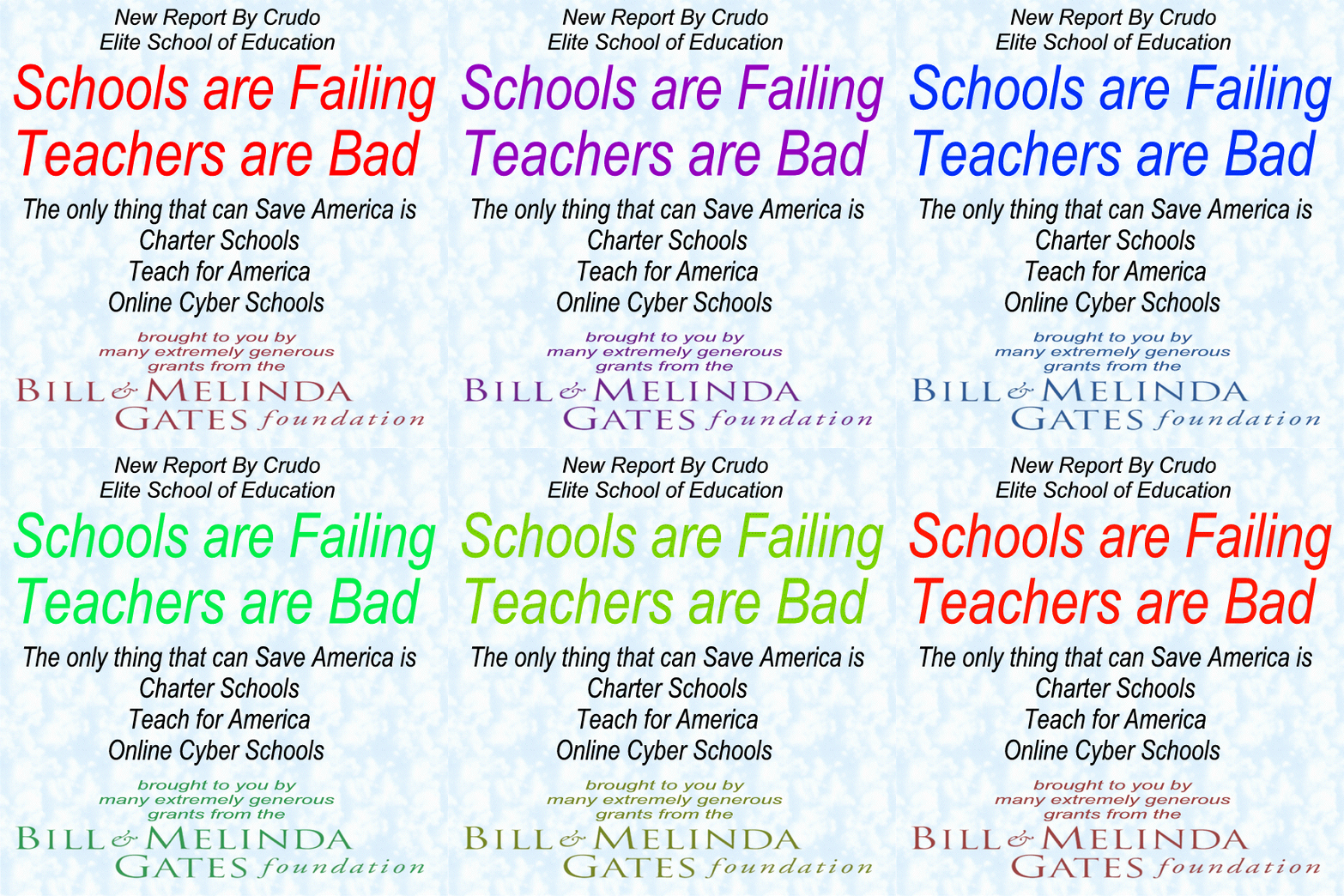
Aaron Churchill works for a rightwing think tank that is funded by Gates, and a long list of foundations, whose purpose is to advance the cause of privatization. (I was a founding member of that organization at a time when its endowment of $40 million was considered adequate, and I opposed the pursuit of outside funding, then turned against TBF’s goal of privatization.) TBF sponsors charter schools in Ohio (another decision I opposed because I CONTINUE READING: Ohio: Rightwing Think Tank Aide Attacks Hero of Public Education | Diane Ravitch's blog


Chaz's School Daze: Comparing Our Contract Raises With Los Angeles And Denver

Chaz's School Daze: Comparing Our Contract Raises With Los Angeles And Denver

Comparing Our Contract Raises With Los Angeles And Denver


UFT members just received a 2% raise on Valentine's Day and the total 42 month contract (Feb 2018 -September 2022)  is 7.5% or 2% annually.  This contract was negotiated by New York City which has a multi billion dollar surplus.  How does our contract compare to the recently settled Los Angeles and Denver teacher contracts?

The Los Angeles teachers contract gave them a 6% raise for the two years, or 3% annually, despite a one billion dollar shortfall for the Los Angeles Board of Education.  Moreover, the City committed to have a full time guidance consular, librarian, and nurse for every public school. Additionally, the City will reduce class size by two students next school year.  Finally, the City agreed to a charter school moratorium for the next year.

The Denver teachers contract was all about raises.  The three year contract had an average raise of 9% or 3% annually.  Moreover, the contract increased and added steps, 20 in all, that guaranteed raises for every teacher.   Finally automatic cost of living raises, based on the local CPI will be included.

Comparing the three contracts, one can see that our annual raises are 1% lower than both Los Angeles and Denver for the length of the three contracts.  Furthermore, Denver has an improved salary step scale and a cost of living raises based on the local CPI.

The bottom line is our UFT leadership negotiated an inferior contract when it comes to annual raises.


Chaz's School Daze: Comparing Our Contract Raises With Los Angeles And Denver

Denver Teachers Strike Pays Off for Teachers | deutsch29 #DCTAstrong #RedforEd #edcolo #coleg #copolitics #FairPayForTeachers

Denver Teachers Strike Pays Off for Teachers | deutsch29

Denver Teachers Strike Pays Off for Teachers


On Monday, February 11, 2019, Denver teachers went on strike. Later that week, on Thursday, that decision apparently paid off.
More than 2,000 educators, who have been on strike since Monday, said they reached a tentative deal Thursday with the local school district.
Details are not yet available, but the deal includes an average 11.7 percent pay raise and annual cost of living increases, according to the school district and the Denver Classroom Teachers Association….
It also addresses the teachers’ biggest concern: the need to overhaul the merit-pay system, which relies heavily on annual bonuses that fluctuate from year to year. The new system will place more emphasis on education and training when considering promotions, while keeping some bonuses in place.
Where will they find the $23 million to pay for this? The district agreed to cut back on administrative costs, and will eliminate about 150 positions in the school’s central office. Five-figure bonuses for senior school administrators will also come to an end.
Some observations about career classroom teachers:
We want a livable salary, one that is stable, and not some unpredictable set of bonus dollars.
We want to be paid for our education and experience.
We do not want to be economically strained at the expense of overcompensated, top-heavy, central office administration.
We want to be able to afford to live in the districts where we teach– without CONTINUE READING:  Denver Teachers Strike Pays Off for Teachers | deutsch29


Sacramento City teachers union to hold vote by members to authorize potential strike #Unite4SACKids #WeAreSCTA #WeAreCTA #strikeready #REDFORED #SCTA #CTA

Sacramento City teachers union to hold vote by members to authorize potential strike


The teachers union took its long-running dispute with the Sacramento City Unified School District up a notch Thursday as union leaders voted to seek members’ authorization for a potential strike.

The move adds to the challenges faced by the district, which is under the threat of state takeover as it wrestles with a $35 million budget gap.
About 100 teacher representatives agreed unanimously Thursday night to give their union’s bargaining team the OK to collect strike authorization votes from teachers at each school. The SCTA has about 2,500 members.
“It doesn’t mean that a strike is certain, but rather it’s an option,” said SCTA President David Fisher in an interview with The Sacramento Bee.
In a statement to The Bee, Sacramento City Unified Superintendent Jorge Aguilar said, “We will continue inviting SCTA leaders to encourage their members to be part of a solution, not a strike.”
“A strike will not save our schools from a state takeover. It would only disrupt student learning and create more division in our District,” Aguilar said.
But Fisher claimed an ongoing, long-standing pattern of “bargaining in bad faith” by the district. He said if it continues, the union wants the option to strike.
“It grows out of frustration of the failure of the superintendent to honor a contract that he signed more than a year ago, and the continued treatment of our contract gets optional as opposed to something that’s binding on both parties,” Fisher said.
He said the union also was concerned about the status of arbitration efforts with the district, and follow-through if agreement is reached.
The district had filed a motion in Sacramento Superior Court in November that halted planned arbitration, asking the judge to determine whether there was an agreement over how to distribute a salary adjustment for early and mid-career teachers.
The judge last week ordered the district back to the arbitration table with the union to settle the contract dispute. The SCTA recommended scheduling arbitration meetings for early March.
But the union said the arbitration is just to negotiate the salary schedule, and that their list of grievances is much longer than that.
“It’s a pattern of things that are happening and continue to happen and then a lack of certainty into what the district might do next,” Fisher said.
Union site representatives will begin collecting member votes in person at each school site on Tuesday. It will take approximately three weeks to collect the votes, according to the union. The votes will then go through the union’s executive board, and if enough members vote yes, under its contract the union can then call for a strike date.
According to an online FAQ by the union, a simple majority vote is needed to authorize a strike.
“We hope that the district will engage lawfully with us,” Fisher said, adding that would prevent seeking a strike date. “That’s the idea behind the vote.”
District spokesman Alex Barrios said the district’s attorneys question whether there are legal grounds for teachers to go on strike.
“It will end up putting further strain on the relationship when we need to be working together,” he said.
In September 2017, about 80 percent of SCTA members turned out to vote in its last strike over contract negotiations. Nearly 97 percent voted for a strike, and while it was imminent, both reached an agreement on a new contract brokered by Sacramento Mayor Darrell Steinberg.
The SCTA also held a vote for a strike in 2015, with the majority of teachers favoring one.
The last teachers strike in the district was in 1989.

CA K-12 schools press Gavin Newsom for more funds | The Sacramento Bee - https://www.sacbee.com/news/politics-government/capitol-alert/article223799285.html on sacbee_news


Sac City Teachers Association: $60 million in SCUSD cuts | The Sacramento Bee - https://www.sacbee.com/news/local/education/article223065935.html on sacbee_news

Friday, February 15, 2019

What Will It Take to Get Equitable School Funding in Pennsylvania – a Statewide Teachers Strike!? | gadflyonthewallblog

What Will It Take to Get Equitable School Funding in Pennsylvania – a Statewide Teachers Strike!? | gadflyonthewallblog

What Will It Take to Get Equitable School Funding in Pennsylvania – a Statewide Teachers Strike!?


What if instead they took to the streets with signs and placards, bullhorns and chanted slogans.
Maybe:
“Hey! HEY! Ho! HO! This Unfair Funding Has to Go!”
Or:
“What do we want!? FAIR FUNDING! When do we want it? YESTERDAY!”
The problem is that from Pittsburgh to Philadelphia and all places in between, the Keystone state has the most unequal school funding system in the country. And no one in Harrisburg seems able and/or willing to do a damn thing about it.
Nor is anyone going to do much again this year.
Gov. Tom Wolf didn’t mention it once last week during the Democrat’s first budget speech to the legislature after being re-elected.
Don’t get me wrong. He’s not exactly ignoring the issue. His newly proposed budget asks for a $200 million increase in education funding.

Boston: Charter Schools Are Pushing Public Education to the Breaking Point | Schott Foundation for Public Education

Boston: Charter Schools Are Pushing Public Education to the Breaking Point | Schott Foundation for Public Education
Boston: Charter Schools Are Pushing Public Education to the Breaking Point

When striking Los Angeles teachers won their demand to call for a halt to charter school expansions in California, they set off a domino effect, and now teachers in other large urban districts are making the same demand.
Unchecked charter school growth is also bleeding into 2020 election campaigns. Recently, New York magazine columnist Jonathan Chait berated Democratic Massachusetts Senator and presidential candidate Elizabeth Warren for having opposed a ballot initiative in her home state in 2016 that would have raised a cap on the number of charter schools. “There may be no state in America that can more clearly showcase the clear success of charter schools than [Massachusetts],” declared Chait.
But while Chait and other charter school fans claim Massachusetts as a charter school model, the deeper reality is that charters are driving Boston’s public education system to the financial brink.
As the Boston Globe recently reported, the city is experiencing an economic boom, but its schools resemble “an economically depressed industrial center.” The state’s unfair funding formula is part of the problem, but an ever-expanding charter school industry also imposes a huge financial drain.
Charter school money suck
“Two decades ago, state educational aid covered almost a third of Boston’s school expenses,” writes Globe reporter James Vaznis. Today, “city officials anticipate that in just a few years every penny from the state will instead go toward charter-school costs of Boston students. Boston is slated to receive $220 million in state education aid; about $167 million will cover charter-school tuition for 10,000 students, leaving a little more than $50 million for the 55,000 students in the city school system.”
As charter schools suck students and their per-pupil funding from the public system, the impact on Boston’s schools are glaring: “Decades-old buildings plagued by leaks. Drinking fountains shut because of lead pipe contamination. Persistent shortages of guidance counselors, nurses, psychologists, textbooks — even soap in the bathrooms. All the while, many Boston schools are under state pressure to increase their standardized test scores and graduation rates.”
As funds for Boston schools dwindle due to the drain from charter schools, the district’s alternatives are painful any way you CONTINUE READING: Boston: Charter Schools Are Pushing Public Education to the Breaking Point | Schott Foundation for Public Education

New York City Public Schools Should Be Evaluated Based on Diversity, Not Just Tests, Panel Says - The New York Times

New York City Public Schools Should Be Evaluated Based on Diversity, Not Just Tests, Panel Says - The New York Times

New York City Public Schools Should Be Evaluated Based on Diversity, Not Just Tests, Panel Says


A high-level panel commissioned by Mayor Bill de Blasio called on the city to adopt a sweeping measure to address entrenched segregation in education: create diversity targets for all 1,800 schools so that their population reflects the racial and economic makeup of the surrounding areas.
Over the next five years, the panel recommended, elementary and middle schools should reflect the racial makeup of their local school district, and high schools should look as much like their local borough as possible, in terms of race, income level, disability and proficiency in English.
New York’s schools have become increasingly divided along racial lines over the last two decades, and the city is currently home to one of the most segregated urban public school systems in America.
Mr. de. Blasio, now in his second term, ran on a promise to reduce inequality in all aspects of city life. But, when it comes to school segregation, he has been stymied by the same quandary that previous mayors faced: How to redistribute resources so that black and Hispanic students have more access to high-quality schools without alienating middle class, white families. CONTINUE READING: New York City Public Schools Should Be Evaluated Based on Diversity, Not Just Tests, Panel Says - The New York Times

CURMUDGUCATION: PA: The Death of Cyber Charters (Maybe, Finally)

CURMUDGUCATION: PA: The Death of Cyber Charters (Maybe, Finally)

PA: The Death of Cyber Charters (Maybe, Finally)


In the entire education ocean, cyber charters continue to be a festering garbage patch, and a recently proposed bill could clean them out of Pennsylvania.

It is not that cyber charters could not be useful for a select group of students with special needs. But in the whole panoply of failed reform ideas, none have failed harder and more thoroughly than cyber charters. In fact, they have failed so hard that among their opponents you will find many supporters of bricks and mortar charters. CREDO, the clearing house for choice friendly research, found them hugely ineffective. Their problems are legion. Even The 74, a generally pro-choice site, recently took a hard swing at cybers. In at least five states, cybers are being shut down.


But in Pennsylvania, it's still cyber-Christmas. Pennsylvania has one of the largest cyber-sectors in the country, and provides no oversight or accountability? How little? No PA cybers have yet "passed" a single year of school accountability scores. One of the biggest fraudsters had to be caught by the feds. And perhaps most astonishing, we learned last month that ten of the fifteen Pennsylvania cyber charters are operating without a current charter agreement! In one case the charter expired in 2012.

PA cybers are huge money makers; they are reimbursed at the full per-pupil formula, but spend far less. So a cyber collects generally from $10,000 to $25,000 for each student, and spends a fraction of that on each student, pocketing the rest.

Several lawmakers in Harrisburg would like to put a stop to that.

Senate Bill 34's prime sponsor is Judith Schwank of Berks County, a former dean at Delaware Valley CONTINUE READING: 
CURMUDGUCATION: PA: The Death of Cyber Charters (Maybe, Finally)


Inequity Enablers: Politicians Who Support Charter Schools

Inequity Enablers: Politicians Who Support Charter Schools

Inequity Enablers: Politicians Who Support Charter Schools


Politicians who support charter schools are inequity enablers. 
The proliferation of charter schools is indicative of a toxic environment due to our nation’s planned neglect of public schools and the intentional failure to mediate inequity.  Politicians who have advocated for and abetted the rise of charter schools are complicit in a ploy in which an experiment with competition among a few students for entry into privately governed schools is substituted for a systemic effort to improve the education of all students.
I am a science educator, so of course, I have an affinity for science experiments that try to make sense of how the natural world works.  What we learn may help us solve human problems. My disposition toward social science experiments is far more wary.  These often begin with contentious, values-driven, “I wonder if…?” questions. But too often, the policies that align with hypotheses get implemented with a much wider audience before the results of the smaller experiment are analyzed and sometimes even when the findings are negative.  That is the case with the current national experiment with charter schools.
To paraphrase, in 1988 Albert Shankar, former American Federation of Teachers president, famously asked, “I wonder if we remove bureaucratic and administrative restrictions, whether it could unleash often squelched teacher-led innovation and creativity?” Shankar wanted to empower teachers’ voices. Needless to say, anti-union folks and those who did not want to give up administrative prerogatives were not thrilled. The result of that short-lived experiment was creativity in some places. In others, different people made familiar decisions: Old wine in new bottles, just with CONTINUE READING: Inequity Enablers: Politicians Who Support Charter Schools

Bill Aims to Fix Hollow 'College Promise' Aid Program | Capital & Main @BillRaden #Unite4OaklandKids #WeAreOEA #WeAreCTA #strikeready #REDFORED #SCTA #CTA

Bill Aims to Fix Hollow 'College Promise' Aid Program | Capital & Main

Bill Aims to Fix Hollow ‘College Promise’ Aid Program
Also this week: Governor Gavin Newsom chooses a new state education board president, Oakland teachers move closer to a strike and the money continues to flow in an L.A. school board race.


Learning Curves” is a weekly roundup of news items, profiles and dish about the intersection of education and inequality. Send tips, feedback and announcements of upcoming events to  braden@capitalandmain.com, @BillRaden.

Governor Gavin Newsom on Tuesday filled the state’s most powerful unelected education post, appointing Stanford University professor emeritus Linda Darling-Hammond as president of California’s State Board of Education. In his State of the State address, Newsom said that the nationally renowned K-12 education researcher would work alongside new schools superintendent Tony Thurmond to confront problems plaguing California’s public schools.
Darling-Hammond, who currently chairs the California Commission on Teacher Credentialing and is president of the Learning Policy Institute, a Palo Alto education think tank, is the first African-American woman to head the 11-member board. The acclaimed expert in teacher preparation and educational equity has more recently come under fire for a report on school choice she co-authored that embraced portfolio districts but ignored the negative impact that charter schools have on the viability of neighborhood public schools.
Oakland high school students staged a one-day sickout Friday in support of Oakland Unified teachers, who have been working without a contract for two years. Four days earlier, the Oakland Education Association overwhelmingly voted to authorize a strike. Defying a prerecorded call and email sent on Thursday by the district that urged parents to keep their kids in class, hundreds of students from across Oakland took to the streets, marching down Broadway from Oakland Tech High School to a rally in front of Oakland Unified’s downtown CONTINUE READING: Bill Aims to Fix Hollow 'College Promise' Aid Program | Capital & Main


Why Two Moms Support Jackie Goldberg for School Board  - LA Progressive #ILoveJackieBecause #TeamJackie #WeLovePublicEducation @Jackie4LAUSD #UTLAStrong #WeAreLA #REDFORED

Why Two Moms Support Jackie Goldberg for School Board  - LA Progressive

Why Two Moms Support Jackie Goldberg for School Board 


As parents, we are committed to keeping our neighborhood schools thriving. For us, that means doing everything we can to make Dorris Place and Elysian Heights Elementary, local public schools here in the diverse communities along the L.A. River, into the very best environments we can for sustained learning for all of our kids.

We were very impressed that Jackie Goldberg literally walked the walk with us, braving the downpour and holding a sign stating “Our Students Deserve Fully Funded Schools.”

Now, in the March 5 special election for our District 5 seat on the L.A. School Board, we have a chance to elect someone who will support our neighborhood schools as much as we do: Jackie Goldberg.
We give many volunteer hours, help raise needed funds for student projects and classroom materials, and recently stood in the rain with our teachers and fed them at our homes while they were on strike to support the fight for public education. We were very impressed that Jackie Goldberg literally walked the walk with us, braving the downpour and holding a sign stating “Our Students Deserve Fully Funded Schools.”
Public schools in our communities in Board District 5 suffered greatly under former board member Ref Rodriguez, who operated under a cloud of suspicion amid evidence of fraud and money laundering from his 2015 campaign for the board. For more than three years in office, this undercut not only his credibility, but also his function on the board, as he often ducked out of meetings and skipped community gatherings CONTINUE READING: Why Two Moms Support Jackie Goldberg for School Board  - LA Progressive

Teachers’ Strikes Are Rattling Washington. This Hearing in the U.S. House Is Proof.

Teachers’ Strikes Are Rattling Washington. This Hearing in the U.S. House Is Proof.

Teachers’ Strikes Are Rattling Washington. This Hearing in the U.S. House Is Proof.


As Denver public school teachers head back to school, ending their first labor stoppage in 25 years, it’s hard to dismiss the impact the nation-wide teacher strikes have had on American politics. As Democratic presidential candidates rush to voice support for the Colorado educators, Denver’s strike marks the ninth major teacher uprising in the last twelve months, with the anniversary of the very first—West Virginia’s—coming up next week.
Survey after survey has shown the striking teachers have gotten their message across: The majority of Americans agree teacher pay is a real problem. The annual PDK poll reported in September that two-thirds of people say teacher salaries are too low — a new high in its data since the poll started in 1969. Another national poll released in April found 78 percent of adults think schools don’t pay teachers enough, and 52 percent supported those going on strike over wages.
As further evidence of how the teacher protests have shaped the national conversation, the House education committee convened this week for its first hearing on K-12 schools in the new Congress, and the topic of teacher pay was front and center. Republicans and Democrats both agreed that teacher salaries were simply too low.

The House Education and Labor Committee hearing, chaired by Democratic Representative Bobby Scott of Virginia, lasted three and a half hours, and was entitled, “Underpaid Teachers and Crumbling Schools: How Underfunding Public Education Shortchanges America’s Students.” Topics explored throughout the convening included more than just teacher compensation and school infrastructure. Legislators and witnesses also discussed adequate funding for students with CONTINUE READING: Teachers’ Strikes Are Rattling Washington. This Hearing in the U.S. House Is Proof.