Latest News and Comment from Education

Friday, October 19, 2018

School choice opponents urged to vote, lobby - WDRB 41 Louisville News

School choice opponents urged to vote, lobby - WDRB 41 Louisville News

School choice opponents urged to vote, lobby

Speakers at Thursday's rally included a former assistant secretary in the U.S. Department of Education and a prominent community organizer.
LOUISVILLE, Ky. (WDRB) -- The message at Thursday’s rally hosted by Save Our Schools Kentucky was simple: Opponents of school choice in Kentucky must vote for like-minded candidates in the Nov. 6 elections and show up to the Capitol when lawmakers return to Frankfort in January.
Speakers such as Diane Ravitch, a former U.S. assistant education secretary in the early 1990s, and Jitu Brown, national director of the Journey for Justice Alliance, urged the audience of 80 at Central High School to actively oppose charter schools, tuition vouchers and other forms of school choice.
They, like others who reject school choice initiatives, argued that such efforts undermine traditional public schools and don’t produce the results that proponents claim.
They also say that efforts to stymie such initiatives are working.
“I think we’re in an epic battle between David and Goliath,” Ravitch said, “and I believe … David is winning.”
Education has been a political flash point in states like Kentucky, where teachers marched on the Capitol against changes to their pensions and budget cuts in various educational programs. That prompted dozens of current and former teachers to run for seats in the General Assembly this year.
The legislature approved charter schools during the 2017 session, but lawmakers adjourned this year without passing a public funding mechanism for them, leaving charters in limbo for now.
Gay Adelmann, co-founder of Save Our Schools in Kentucky, hopes that some legislators who voted to pass the charter school law will reverse course and support bills to strike it down.
That, coupled with voting charter opponents into office, would make the law’s prospects bleak, she said.
“If we keep putting pressure on our legislators who may have been pro-charter in the past, I think they’re starting to see the light,” Adelmann said after the rally.
But Joel Adams, executive director of the Kentucky Public Charter Schools Association, says he doesn’t see legislators repealing the law after passing it less than two years ago.
“There’s a whole long-standing history of building to the point of getting people to understand why this is important, why it’s critical for a lot of students across the state of Kentucky, and that need hasn’t gone away regardless of whether Save Our Schools folks think that it has,” Adams told WDRB News.
Speakers at Thursday’s rally said school choice efforts don’t produce the results that advocates claim and that charter school operators in particular are more concerned with profits and cherry-pick students.
Ravitch said Michigan’s educational rankings have “steadily declined” since school choice initiatives became law there.
Adams, however, rejected the argument that charters don’t work as “simply not true.” Charter schools must show results or risk being shut down, he said, adding that Kentucky's law doesn't allow charters to be selective in the students they enroll.
“I think there’s a little less emphasis on the newest innovations and more focus, in many areas at least, on what really has been shown to work, and there’s a ton that has been shown to work, especially in urban environments,” Adams said.
Brown, with the Journey for Justice Alliance, said residents in other states have been successful in local efforts to boost traditional public schools.
“My point is if we work together, if we organize together, if we learn the artistic science of community organizing, we can win,” he said. “The privatizers have the money, but they don’t have the people.”
Reach reporter Kevin Wheatley at 502-585-0838 and kwheatley@wdrb.com. Follow him on Twitter @KevinWheatleyKY.
Copyright 2018 WDRB News. All rights reserved.
School choice opponents urged to vote, lobby - WDRB 41 Louisville News


NPE Action - Political Endorsements - https://npeaction.org/ on @NPEaction

Teachers are Running for Office – And to Save Public Education – Have You Heard

Teachers are Running for Office – And to Save Public Education – Have You Heard

Teachers are Running for Office – And to Save Public Education


Teachers are running for office in unprecedented numbers. And that’s not the only thing that makes this wave of teachers-turned-candidates unique. In the latest episode of the Have You Heard podcast, we meet some candidates who aren’t just running for office but to save public education. Full transcript of the episode here.


NPE Action - Political Endorsements - https://npeaction.org/ on @NPEaction
Teachers are Running for Office – And to Save Public Education – Have You Heard


Dysfunctional School Boards: Part I and Part 2– Educate Louisiana

Dysfunctional School Boards: Part I – Educate Louisiana

Dysfunctional School Boards: Part I

Dysfunctional School Boards: Part Two – Educate Louisiana - https://wp.me/p790OS-vz on @edlouisiana

If you ask any teacher in Louisiana who has taught more than ten years what’s the worst thing to happen to the teaching profession, most of them will say Act I; the legislation that defines how teacher are evaluated using invalid student test scores and a Utopian scoring rubric that was designed to be a tool for teacher reflection and not a standard to be judged against.
What the general public doesn’t realize is that in addition to demeaning the teaching profession, Act I also stripped locally elected school boards of most of their power. When you understand the motivation behind these significant changes, you get a better understanding of what is happening in education.
State statute defines local school boards as a political subdivision of the State of Louisiana. The members of local school boards are democratically elected by the citizens of the school districts they represent. The changes made by Act I have limited the ability of individual board members, and the board as a whole, to effectively represent their constituents. Act I essentially reduces the local board to three responsibilities. 1.) Appoint a superintendent. 2.) Approve a budget. 3.) Make policy.
I’ll get more into those responsibilities later, but first I want to talk about why certain entities would want the power of boards limited. Education reform groups, which are largely comprised of subsets of business and industry, believe that local school boards are too political and get in the way of policies that support the wants and needs of business and industry. Their belief is that school districts should be run like corporations, or nonprofits that have a hands-off board of directors that hires an executive to run the organization, and that executive should be a business leader who can run the district like a business. In Continue reading: Dysfunctional School Boards: Part I – Educate Louisiana 


NPE Action - Political Endorsements - https://npeaction.org/ on @NPEaction

Forgive me #edutwitter, for I have sinned - Edu-Confessional | Blue Cereal Education

Edu-Confessional | Blue Cereal Education

Edu-Confessional

Confessional Moment

Forgive me #edutwitter, for I have sinned. It’s been two weeks since my last post, but months since anything, you know… good
Where should I start? I teach history so I’m partial to chronologically, but—
Maybe it’s best if I just dive in with the worst of it, then move through the list from there. 
First, I assign a lot of videos in my AP World History class. My AP U.S. History class, too – but not as many as for World. “Required Viewing,” I call it, to go with each week’s “Required Reading.” Crash CourseHip HughesTed-EdOverly Sarcastic (not to be confused with OverSimplified, which in turn is quite different than Simple History). 
I think I even used It’s History! once or twice, when it really fit. 
It’s just… well, our textbook isn’t very good. It’s poorly organized and at times downright bewildering. My kids get frustrated with it – and not in the usual “but this is hard!” way. It has some good sections, but… well, it’s mediocre at best for most things. 
There are articles and supplemental readings I use, but when you can have animation and key points on the screen and entertaining personalities… Plus, we went one-to- Continue reading: Edu-Confessional | Blue Cereal Education


NPE Action - Political Endorsements - https://npeaction.org/ on @NPEaction

Exploding Inequality and Poverty: We Got the “Failing” Schools Narrative Wrong and Failed to See the Real Problem | janresseger

Exploding Inequality and Poverty: We Got the “Failing” Schools Narrative Wrong and Failed to See the Real Problem | janresseger

Exploding Inequality and Poverty: We Got the “Failing” Schools Narrative Wrong and Failed to See the Real Problem


Two articles published this week make interesting companions.
The first is Jack Schneider’s post—published in the Washington Post as part of Valerie Strauss’s column: How Are America’s Public Schools Really Doing?  Schneider, of the University of Massachusetts at Lowell, explores the fact that widespread public perception of America’s public education system tanked after No Child Left Behind labeled an ever-increasing number of schools as failing every year.  So-called failing schools were the ones that couldn’t make Adequate Yearly Progress on what we now know was a crazy and unrealistic timeline.  It became apparent, as the 2014 deadline approached when all public schools were supposed to make every child proficient or be labeled “failing,” that almost every school in America would have been received the label except that Arne Duncan’s Department of Education began granting the states waivers from what had become a ridiculous expectation.


Schneider describes what became a widely believed narrative: “(T)he emergence of this popular belief (in the failure of our schools) may illustrate the triumph of rhetoric rather than an actual shift in school quality… New lows were established in 2007 and 2008, as the failures of No Child Left Behind began to clearly reveal themselves, before confidence fell to 29 percent in 2012, the year the federal government began issuing waivers form NCLB’s accountability mechanisms… then to an all-time low in 2014, at 26 percent.”
Schneider shows, however, that scores on the National Assessment of Education Progress in both language arts and math remained relatively flat, in fact growing very slightly between the 1970s and 2012.  Schneider concludes: “(I)t seems that national reform rhetoric has driven the decline in perceptions of school quality.  For the past several decades, Americans have been inundated with messages about a crisis in public education.”
Having rejected the narrative of widespread public school failure, Schneider reminds us that we do have an education problem, but we’ve chosen to ignore it as we listened to the wrong Continue reading: Exploding Inequality and Poverty: We Got the “Failing” Schools Narrative Wrong and Failed to See the Real Problem | janresseger


NPE Action - Political Endorsements - https://npeaction.org/ on @NPEaction

A 50-State-Plus-DC Exploration of Alice Walton’s Political Contributions | deutsch29

A 50-State-Plus-DC Exploration of Alice Walton’s Political Contributions | deutsch29

A 50-State-Plus-DC Exploration of Alice Walton’s Political Contributions


Several days ago, I began an exploration of the political contributions of billionaire Wal-Mart heir, Alice Walton. I was both curious about her political spending and desiring to offer readers quick links to the campaign finance web sites in all 50 states and DC.
Below are my findings. I have bolded all entries indication Alice Walton’s spending.
As anyone familiar with Walton’s school choice preferences might expect, she donates her money toward the advancement of charter schools and vouchers. She also likes the Teach for America (TFA) spinoff, Leadership for Ed Equity.

When it comes to school choice and anti-union politicians, Walton is fine with contributing to the coffers of NY Democratic governor, Andrew Cuomo, and to the pseudo-Democratic org, Democrats for Ed Reform (DFER). Of course, there is still money for Betsy DeVos’ American Federation for Children, which is connected to DFER via Kevin Chavous.
  • AL: $50,000; AL Fed for Children PAC; 03/21/2016.
  • AK: No contributor search.
  • AZ: $5,000; Friends of Reginald Bolding; 11/08/2017.
  • AR: No contributions from Alice Walton. (Other Walton relatives listed.)
  • CA: $6.2M, including multiple donations to (former Green Dot charter president) Marshall Tuck campaign and Charter Schools PAC; 2012-2018.
  • CO: $5,150, including Leadership for Ed Equity PAC; 2014 – 2017.
  • CT: No contributor search.
  • Continue reading: 
  • A 50-State-Plus-DC Exploration of Alice Walton’s Political Contributions | deutsch29


NPE Action - Political Endorsements - https://npeaction.org/ on @NPEaction


Thursday, October 18, 2018

Charter schools are a hot real estate market — and that’s bad for students

Charter schools are a hot real estate market — and that’s bad for students

Charter schools are a hot real estate market — and that’s bad for students
Where there’s smoke there’s fire — and there’s tons of smoke when it comes to the charter school industry pocketing public money meant for school buildings.
It seems like almost every week another charter school operator is exposed for taking taxpayer money that was supposed to be spent on renting, building, or buying classroom space.
One recent example: a charter school in California, Imagine Schools at Imperial Valley (ISIV), closed its doors in September after years of poor academic performance — but not before its owners made out with a fortune.
ISIV was spending a substantial portion of its annual revenue — all public money — on rent paid to a company connected to its owners. In a labyrinthine scheme, the school subleased a converted department store from a related for-profit corporation that leased from another corporation. As of February this year, ISIV had paid $7.9 million in rent even though the store was originally purchased for $3.1 million.
Such “related-party transactions” are so common that a professor at the University of Connecticut wrote a report last year comparing the charter industry to the energy-trading firm Enron, which collapsed in 2001 under the weight of massive fraud. “Without strict regulation, some bad actors have been able to take advantage of charter schools as an opportunity for private investment,” he wrote.
You might be thinking, aren’t charter schools nonprofit? Yes, most are. But in Continue reading: Charter schools are a hot real estate market — and that’s bad for students


NPE Action - Political Endorsements - https://npeaction.org/ on @NPEaction

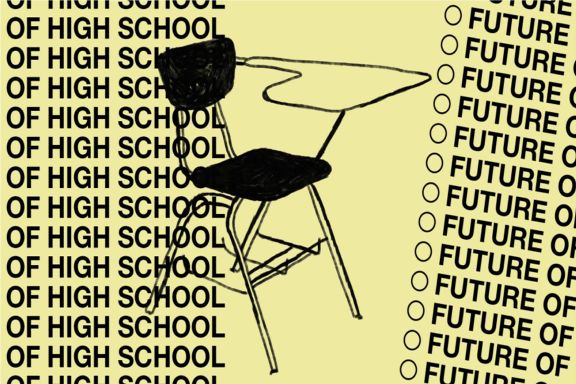
The History of the Future of High School - VICE

The History of the Future of High School - VICE

The History of the Future of High School
The problem with American secondary education is not that students haven’t learned the “right skills,” as the Betsy DeVoses of the world would have you believe.


This story appears in VICE Magazine's Power and Privilege Issue. Click HEREto subscribe.
High school is broken in America. Its buildings and classes are old and stodgy. As an institution, it’s unchanging, built to crank out factory workers and thus unsuited for our modern, high-tech era.
That’s the convenient fiction repeated by business-minded politicians and philanthropists for some time now. Consider what the US secretary of education, Betsy DeVos, told students in Wyoming last year: “For far too many kids,” DeVos said, “this year’s first day back to school looks and feels a lot like last year’s first day back to school. And the year before that. And the generation before that. And the generation before that.” Later, while visiting a charter school in Florida, DeVos again said as much: “Far too many schools have been stuck in a mode that is basically approaching things that have been done very similarly to 100 years ago, and the world today is much different.”
When folks like DeVos make the inaccurate claim that schools haven’t changed in a century, they often invoke the phrase “factory-model schooling,” implying that schools—the buildings, the curriculum, the practices—were established to prepare students for manufacturing work. America’s first high school opened in 1635, and taught religion and the classics to the sons of wealthy elites. High schools in the late 1800s and early 1900s in the US were likewise not designed to prepare students for work in factories, despite the pervasiveness of that “factory model” myth. Rather, most of these early learning institutions served academically talented students whose parents could afford to have their child pursue secondary education. That is, they could get by without their teenager working. Only a fraction of kids attended high school in those days, and an even smaller fraction of those students went on to university, in part because most professions did not require college degrees.
As the historians David Tyack and Larry Cuban wrote in their 1995 history of school reform, Tinkering Toward Utopia, just one in every ten teens age 14 to 17 was enrolled in high school in 1900. By 1940, that number was up to seven in ten; by 1980, nine in ten. The percentage of kids enrolled in high school has continued to grow in the decades since Tinkering was published, as have graduation rates (8 percent in 1900, 51 percent in 1940, and about 83 percent today). These shifting demographics have transformed what schools do and are expected to do. A century ago, students of color were largely denied equal access to educational opportunities, for example, and special education as we know it didn’t exist. And though it’s not always the way it works out in practice, public high schools are now required to serve all students, and curriculum modifications along the way reflect that.
To meet the needs of these incoming students, schools started offering an Continue reading: The History of the Future of High School - VICE


NPE Action - Political Endorsements - https://npeaction.org/ on @NPEaction

Decolonizing Wealth Officially Released! | Schott Foundation for Public Education

Decolonizing Wealth Officially Released! | Schott Foundation for Public Education

Decolonizing Wealth Officially Released!

This is an exciting week at Schott—it marks the official release of Decolonizing Wealth, the provocative new book by Edgar Villanueva, Schott’s Vice President of Programs and Advocacy.  It’s in bookstores nationwide—and is deservedly garnering wide attention, spurring candid assessments and dialogue within philanthropy.


Edgar oversees Schott’s grant investments and capacity-building supports for grassroots-led education-focused justice campaigns across the United States.  "It is important to listen to people who are living with the long-term impacts of colonization, says Villaneuva. “And the best way to learn is to actually begin investing in those communities, and then the community can teach you."John Jackson, Schott President & CEO urges colleagues to heed the book’s insights. “Through Decolonizing Wealth, Edgar Villanueva reinserts purpose and humanity into a philanthropic industry that has too often been driven by wealth accumulation, grant cycles, portfolios and metrics. Inspired by Indigenous worldview, the book pushes philanthropy back towards its original meaning, “love for humanity”. It is a must read for those new and old in philanthropy as well as those seeking to use their resources to create loving systems.”
Released by Berrett-Koehler Publishing, Decolonizing Wealth exposes the racial, class and cultural dynamics that plague institutions like banks, investment funds, and aid organizations, including foundations.
Decolonizing Wealth interweaves personal storytelling with field research and dozens of funder interviews to provide a prescriptive analysis of the challenges facing philanthropy and social finance. In the book, Villanueva outlines “7 Steps to Healing” that funders can use to better serve the needs of Native/Indigenous people, people of color, and other marginalized communities to close the racial wealth gap.
Rinku Sen, author and strategist and former Board Chair of the Schott Foundation:  “Having been both grant-seeker and grant-maker, I welcome any wisdom that can release us from a relationship of paternalism and enable true partnership. Nothing is more important to decolonize than money -- without it, change is slower and harder, and comes too late for too many people. Edgar Villanueva is a fresh voice in the money scene, one we should all heed.”
Villanueva serves as Chair of the Board of Directors of Native Americans in Philanthropy. Proceeds from Decolonizing Wealthwill support the Generation Indigenous Fund—a Native-led fund created by Native Americans in Philanthropy that empowers Indigenous youth.

For more information about Decolonizing Wealth, visit DecolonizingWealth.com.


Decolonizing Wealth Officially Released! | Schott Foundation for Public Education


NPE Action - Political Endorsements - https://npeaction.org/ on @NPEaction

Spring’s Teacher Walkouts Put Education On The Ballot In Fall Elections

Spring’s Teacher Walkouts Put Education On The Ballot In Fall Elections

Spring’s Teacher Walkouts Put Education On The Ballot In Fall Elections


This year’s Educator Spring that brought teachers into the streets in massive protests has resulted in hundreds of educators running for officein November midterm elections, thrust education issues into electoral contests between Democratic and Republican candidates up and down the ballot, and pushed education-related initiatives on ballots in 16 states, according to an analysis by the Center for American Progress. “From taxes to bonds, governance to vouchers, education is on the ballot this November,” says the analysis. “Voters should not miss the chance to make their voices heard.”
In states such as Arizona and Georgia where gubernatorial candidates are locked in tight races and Democrats are anticipating gains in state legislatures, state ballot measures could help provide the difference between victory and defeat.
At least one study on the impact of ballot initiatives on voter turnout has found in midterm elections they can increase turnout at 7 to 9 percent in initiative states compared to non-initiative states, while turnout in presidential elections tends to be 3 to 4.5 percent higher in initiative states than in non-initiative states. Ballot measures have the power to “transform low information midterm elections to high information elections,” according to the study, and the presence of “even one initiative ballot is sufficient” to boost turnout.

School Privatization at Stake in Arizona
In what is perhaps the most-heated ballot initiative contest, in Arizona, voters will decide whether a state school voucher program providing taxpayer money for families to pay for private school tuitions will be expanded.
The massive #RedForEd teacher walkout that occurred in the state this spring resulted in a grassroots campaign to place an Continue reading: Spring’s Teacher Walkouts Put Education On The Ballot In Fall Elections


NPE Action - Political Endorsements - https://npeaction.org/ on @NPEaction


Lies We Tell Our Students | Blue Cereal Education

Lies We Tell Our Students | Blue Cereal Education

Lies We Tell Our Students

Lies Lies Sign
I don’t like to lie to my students. I try not to, but it’s not always easy. Sometimes it’s literally required by the folks signing my paycheck, creating what we in the teaching business call “a dilemma.”
My ex-wife and I never told our kids there was a Santa, a Tooth Fairy, or an Easter Bunny, even when they were very little. We tried to make holidays fun, of course, and we played all sorts of pretend games and did traditional things – we weren’t uptight. It just seemed wrong to demonstrate to them early on that we were willing to fabricate stories about invisible beings which they were expected to later outgrow, for no better reason than our own amusement.
Euthanized animals weren’t playing on someone’s farm, pre-teens didn’t always win at games they sucked at, and not everyone is special in their own way. We tried to balance this with some grace and humility – it wasn’t their job to puncture the illusions of their young peers – but we didn’t figure familial festivities required lies and delusion.
(I’m not criticizing those of you who choose to betray your child’s trust repeatedly, by the way – that was just our personal choice. We wanted the truth – whether it be uncomfortable, encouraging, unwelcome, or warm – to mean something. We were odd that way.)
I feel the same way with my kids today – the ones I’m paid to deal with. It doesn’t Continue reading: Lies We Tell Our Students | Blue Cereal Education


NPE Action - Political Endorsements - https://npeaction.org/ on @NPEaction

Jeff Bryant: This is Your Future Without Public Schools | National Education Policy Center

OurFuture.org: This is Your Future Without Public Schools | National Education Policy Center

This is Your Future Without Public Schools

‘The Education Debt’

The first report, “Confronting the Education Debt” from the Alliance to Reclaim Our Schools, examines the nation’s “education debt” – the historic funding shortfall for school systems that educate black and brown children. The authors find that through a combination of multiple factors – including funding rollbacks, tax cuts, and diversions of public money to private entities – the schools educating the nation’s poorest children have been shorted billions in funding.
One funding source alone, the federal dollars owed to states for educating low-income children and children with disabilities, shorted schools $580 billion, between 2005 and 2017, in what the government is lawfully required to fund schools through the provisions of Title I of the Elementary and Secondary Education Act (ESSA) and the Individuals with Disabilities Education Act (IDEA).
The impact of not fully funding Title I is startling. At full funding, the nation’s highest-poverty schools could provide health and mental health services for every student – including dental and vision services – and these schools would have the money to hire a full-time nurse, a full-time librarian, and either an additional full-time counselor or a full-time teaching assistant for every classroom.
State and local governments contribute to underfunding too by keeping in place tax systems that chronically short schools, particularly those that educate low-income students, mostly of color. Two school districts in Illinois are highlighted – one where 80 percent of students are low-income and gets about $7,808 per pupil in total expenditures, while another, where 3 percent of students are low-income, spends $26,074 per student.
The disparities were made worse after the Great Recession in 2008, when most states slashed taxes for funding schools and often gave bigger tax cuts to corporations and the wealthy, while many local governments rolled out tax abatement programs that exclude corporations and developers from paying taxes that fund public schools.
In the meantime, while the nation’s education debt expands, the accumulated wealth of the richest Continue reading: OurFuture.org: This is Your Future Without Public Schools | National Education Policy Center

News about wealthy folks giving millions to education draws both praise and criticism. But two new reports by public education advocacy groups reveal the real impact rich people have on schools and how they’ve chosen to leverage their money to influence the system.


NPE Action - Political Endorsements - https://npeaction.org/ on @NPEaction

OPINION: The Opt Out movement is gaining ground, quietly

OPINION: The Opt Out movement is gaining ground, quietly

OPINION: The Opt Out movement is gaining ground, quietly
Concerns go beyond standardized testing


Imagine hundreds of thousands of parents protesting the ways in which schools educate their children.

Now imagine that this protest continues for several years in a row and that it takes place in multiple locations simultaneously.
Wouldn’t you want to know what parents are protesting and why?
New York state is the epicenter of what is known as the “Opt Out” movement. Standardized testing is a common feature in K-12 schooling in the United States, with federal legislation requiring since 2002 that states test virtually all children in grades 3-8 in mathematics and English language arts. But during the past four years, New York parents have actively excluded about one in five students from taking the annual state tests (including 18 percent in the spring 2018 test administration).

Other states have also experienced high rates of opting out. Indeed, in 2016, the U.S. Department of Education warned 11 states that their opt-out rates exceeded five percent. Nevertheless, data from the spring 2018 test administration show that Colorado saw 8 percent opt out in 7th grade and 11 percent opt out in 8th grade; and in Alaska, the state-wide opt out rate is 8.5 percent. Rather than try to understand why parents might opt out of state testing, the federal government simply threatened states that high opt-out rates could affect their federal funding.
Why haven’t we heard more about this? Partly because it’s a grassroots movement without clear leadership or an elaborate organization. Unlike movements such as Occupy Wall Street or Black Lives Matter, “opt out” activism does not take place in the streets. Rather, it is more subdued, and is focused on public schools, which despite their status as public institutions, rarely open themselves up to public scrutiny. Moreover, the movement has yet to form an Continue reading: OPINION: The Opt Out movement is gaining ground, quietly