Latest News and Comment from Education

Thursday, October 18, 2018

New Educator Toolkit to protect data privacy | Parent Coalition for Student Privacy

New Educator Toolkit to protect data privacy | Parent Coalition for Student Privacy


New Educator Toolkit to protect data privacy
 Guide designed to prevent breaches or abuse of personal information
Today, the Parent Coalition for Student Privacy and The Badass Teachers Association released an Educator Toolkit for Teacher and Student Privacy:  A Practical Guide for Protecting Personal Data.  The Toolkit is a comprehensive guide to help educators deal with the complex world of data privacy and the widespread proliferation of education technology.  It is designed to support their efforts to become responsible digital citizens by providing strategies and best practices to minimize the disclosure of personal data and protect the privacy of their students as well as their own.
Through an online survey and focus groups, the authors discovered that most teachers feel they are forced to implement ed tech products which gather and use data in ways they do not understand.  Sixty eight percent of respondents said they didn’t know if the products they used sold student data or used it for marketing purposes, and sixty nine percent said that they felt that their training in data privacy had been insufficient.
Teachers are also being asked to share more and more of their own data in ways that violate their privacy.  The recent strike in West Virginia was in part sparked by a demand from the state that they wear devices to collect data on their movements and physical activities.  In user-friendly terms, the Toolkit explains what federal laws protect student data, what common classroom practices to avoid, and how to advocate for stronger privacy policies at the school and district level.
American Federation of Teachers President Randi Weingarten issued the following statement in support of the toolkit: “As states continue to disinvest in public education, large technology companies have turned their sights on school districts as a lucrative business opportunity. Too often, school districts purchase and implement these aggressively marketed digital programs and resources without having the privacy safeguards and quality-assurance mechanisms in place to protect students and their teachers.
“When used appropriately, technology can be a powerful classroom tool to enhance the learning of students and support the work of educators. But unregulated, technology should never supplant the work that educators do, particularly when exposure to hackers, fraud and infiltration can provide a real security threat. This toolkit helps ensure that digital and new media tools don’t infringe on the safety of our schools.”
Leonie Haimson, the co-chair of the Parent Coalition for Student Privacy explained, “Privacy is a precious if vanishing resource with expanding data collection and use of ed tech tools in the classroom. In a recent public service announcement, the FBI warned that cyber criminals have been hacking into school databases, threatening students with violence and the release of their personal information.  It is critically important that educators learn how to safeguard their students’ sensitive information from breach and misuse, yet up to now, most teachers have felt unprepared to do so.”
“We surveyed and interviewed 365 educators from across the country to find that teachers care deeply about their privacy and want to learn more about protecting their own sensitive information as well as that of their students,” remarked Rachael Stickland, co-chair of the Parent Coalition for Student Privacy. She concluded, “Our hope is that this toolkit gives teachers easy access to the resources they need every day to make the best possible decisions to keep personal data at school safe.”
Marla Kilfoyle, former executive director of The Badass Teachers Association explained, “As an educator who has been the victim of an ed tech product that has threatened my privacy, the work that has been done on this toolkit is important to safeguard data for everyone using these  products. It has been an honor to work on this toolkit for over a year. I have been an educator for 30 years and this toolkit has taught me so much about my own personal data, how to protect the data of my students, and how to advocate for data privacy in my district.”
President of the National Education Association Lily Eskelsen Garcia said, The Educators Toolkit for Teacher and Student Privacy” will be a helpful document to educators across the nation as they navigate the complexities of protecting privacy data today. NEA applauds the BATs for their leadership in raising the issue of privacy and creating this resource. This guide can serve as an important tool when used in conjunction with the expertise of local Uniserve [union advocacy staff]  or legal counsel when seeking specific guidance relative to an educator’s unique worksite and legislative geography. Today, we need all the good information we can get!”
Melissa Tomlinson, assistant executive director of The Badass Teachers Association stated, “Working on The Educators Toolkit has been an eye-opening experience for me. Armed with this information, I have changed practices within my own classroom around how I use technology in ways to make sure all of my students’ information remains safe.”
As the FBI pointed out, “widespread collection of sensitive information by education technology vendors, such as web browsing history, biometric data and students’ geolocation, could present unique exploitation opportunities for criminals.”  It is our hope that teachers, administrators, and union leaders will share this Toolkit, and use it in trainings so that educators better understand how to ensure their students’ privacy and their own.
The Toolkit was made possible by grants from the Rose Foundation for Communities and the Environment, the American Federation of Teachers, and the NEA Foundation.
New Educator Toolkit to protect data privacy | Parent Coalition for Student Privacy

Dolores Huerta Endorses Tony Thurmond for State Schools’ Superintendent  - Oakland Post

Dolores Huerta Endorses Tony Thurmond for State Schools’ Superintendent  - Oakland Post

Dolores Huerta Endorses Tony Thurmond for State Schools’ Superintendent 


Civil rights icon Dolores Huerta and the California Association of Bilingual Educators Political Action Committee have endorsed Tony Thurmond for State Superintendent of Public Instruction.
“Californians can count on Tony Thurmond to put children first and work each day to ensure every child has access to a quality education,” Huerta said.
“Education is the soul of America and the foundation of our democracy. Tony understands that a quality education has that power to up lift minority and underprivileged communities, and that is why I am so proud to support him,” she said.
“Tony Thurmond embraces opportunities for California students to develop multilingual skills in their Pre K-12 education,” said Rosalia Salinas, president of the Bilingual Educators PAC.
“Assemblymember Thurmond’s extensive experience in public service and track record as an elected official, his passionate dedication to our public school students who are most in need of extra support, and his focus on parent engagement have convinced the California Association of Bilingual Educators (CABE-PAC) that he is the most qualified candidate to Continue reading: Dolores Huerta Endorses Tony Thurmond for State Schools’ Superintendent  - Oakland Post

A Plan to Improve California's Public Schools

Tony Thurmond for State Superintendent of Public Instruction -https://www.tonythurmond.com/

Big Education Ape: Why Electing Tony Thurmond as Superintendent of Public Instruction Is the Most Important Race in California - https://bigeducationape.blogspot.com/2018/10/why-electing-tony-thurmond-as.html

Big Education Ape: The truth about money in public education politics - https://bigeducationape.blogspot.com/2018/10/the-truth-about-money-in-public.html

Big Education Ape: Tony Thurmond for California State Superintendent of Public Instruction - NPE Action - https://bigeducationape.blogspot.com/2018/10/tony-thurmond-for-california-state.html


Student data mining: Parents deserve right to refuse | The Edvocate Blog

Student data mining: Parents deserve right to refuse | The Edvocate Blog

Student data mining: Parents deserve right to refuse


Unfortunately, states and school districts are embracing student digital badges, programs like i-Ready, adaptive computer-based education and other Ed-Tech products in exchange for money and/or one-on-one devices. The growing focus on data mining our children’s personal information, sentiments, social/emotional information, even  creating “predictive” profiles,  is something parents deserve the right to refuse for their student.
In Consider Yourself Warned, Deb Herbage explores K-12 data mining and the grave threat it poses to student privacy. Re-blogged with permission:

If you were walking down the street and a stranger stopped you and asked you to hand over your driver’s license and social security card….would you?  Of course, you wouldn’t!  Those two items contain extremely personal information – YOUR personal information.  Your driver’s license has your full name, your picture, your birth date, a unique number (in some state’s it could be your social security number), your address, your height and weight, any restrictions for driving a vehicle and even your eye color.  How about if you put your wallet down for a few seconds and a stranger snatched it, essentially stealing your information.  Wouldn’t that make you feel violated?  You would have to start the whole process of canceling your credit cards, getting a new driver’s license and possibly putting a hold on your credit.  How about if that same stranger who Continue reading: Student data mining: Parents deserve right to refuse | The Edvocate Blog


CURMUDGUCATION: DeVos Organization Issues School Choice Guidebook

CURMUDGUCATION: DeVos Organization Issues School Choice Guidebook

DeVos Organization Issues School Choice Guidebook


The American Federation for Children is a dark money group that advocates for school choice in general, and vouchers in particular. It was founded and funded by the DeVos family (Betsy was chair right up through the summer of 2016), and is well-connected via ALEC, that special organization in which corporate sponsors get to write bills for legislative members. The AFC Growth Fund is another wing of the group, and they produce an annual School Choice Guidebook. This year's book is out, and I've looked at it, but you probably should anyway.

The report is 88 pages of reform chatter, so this trip will be neither quick nor easy, but if you stick with me, you'll get to see some stunning reform logic at work, gather some fun factoids along the way, and see exactly what their idea of a perfect voucher program would be.

It's Not All Awful

Okay, it is kind of awful, but it's worth noting that the guidebook contains a ton of information, much of it arranged in handy charts. If you have questions about, say, which states have which kinds of voucher programs, and how the details of those programs vary from state to state, this guidebook has answers, often arranged so that they can be viewed easily at a glance. I doubt that it's all perfectly accurate, but honestly, this is a resource I'll probably return to for answers to certain questions about the state of voucherdom.

So let's dig in and see what the report has to offer.

Types of Private School Choice Programs and $$$

A whole page of the different flavors of choice, though oddly they lump magnet schools and Continue reading: CURMUDGUCATION: DeVos Organization Issues School Choice Guidebook


Wednesday, October 17, 2018

Teachers: VOTE! (For Education) | The Range: The Tucson Weekly's Daily Dispatch

Teachers: VOTE! (For Education) | The Range: The Tucson Weekly's Daily Dispatch

Teachers: VOTE! (For Education)


Apologies to fellow teachers. (I know, I've been out of the profession for 15 years, but once a teacher, always a teacher, even after you lose your class [badum-ching!]). I know how much teachers hate being told what to do. I always did. I keep promising I won't give teachers advice, but I keep doing it anyway. My excuse is, I spent 30-plus years in the classroom, so I'm cutting myself a little slack.

My advice to teachers is, VOTE! If you have a mail-in ballot sitting around beginning to gather dust, pick it up, fill it out and mail it in. No stamp required. If not, there's early voting at the polls. And there's November 6.

Teachers, vote for education, whatever that means to you. More on that later.

Arizona has about 50,000 K-12 teachers. Roughly 40,000 of them work in school districts, and most of the remainder work in charter schools. That's a whole lot of people whose lives revolve around governmental decisions. Include an equal number of non-teaching staff, and it adds up to nearly 100,000 potential education-based voters in statewide races, 3,000 per legislative district. That's more than enough to make the difference in close races.

For some reason I've never understood, teachers aren't reliable voters. I've heard figures as low a 35 percent show up for elections, which astounds me. Anything lower than 80 percent from a group of people who dedicate themselves to serving the public interest, who perform their civic duty every working day, seems wrong. Maybe some teachers feel like they use up their quotient of public service in the classroom, then when it comes time to vote, they think, "Screw it, it's time for Teachers: VOTE! (For Education) | The Range: The Tucson Weekly's Daily Dispatch


As Ye Sow, So Shall Ye Reap….. | The Merrow Report

As Ye Sow, So Shall Ye Reap….. | The Merrow Report

As Ye Sow, So Shall Ye Reap…..

We cannot let continuing evidence of the folly of test-centric education be obscured by the craziness of our polarized politics or the increasingly frequent (and devastating) proof of climate change, because, make no mistake, public education is in danger, and not just from Betsy DeVos and her privatizing schemes.
Here’s my headline: Since the non-partisan “No Child Left Behind” Act of 2001 ushered in ‘accountability’ and ‘school reform,’ things have generally gone south, and students and teachers are paying the price. Students are being mis-educated and undereducated by a system that basically reduces them to a number, their score on standardized, machine-scored tests.
The latest evidence comes from ACT’s report on the “Performance of 2018 Graduates,” and it’s not pretty.  The ACT score range is 1-36, with 20 being “OK.”  The average score in English, 20.2, is a point lower than its high point in 2007.   And the average math score, 20.6, represents a 20-year low.
But it is actually worse than that, because ACT also measures whether our high school graduates are ready for college…and most are not.
As Education Week’s Catherine Gewertz reported, “Math and English scores drew the attention of the ACT by another measure, too: readiness for college-level work. The ACT’s score benchmarks are correlated with the likelihood of earning Bs or Cs in credit-bearing coursework. And increasing numbers of students are falling short.
Only 4 in 10 met the math benchmark, the lowest level since 2004, and down from 46 percent in Continue reading: As Ye Sow, So Shall Ye Reap….. | The Merrow Report


Teachers in America: No matter where they work, they feel disrespect

Teachers in America: No matter where they work, they feel disrespect

We followed 15 of America's teachers on a day of frustrations, pressures and hard-earned victories 


It’s shortly after dawn when Edward Lawson, one of America’s 3.2 million public school teachers, pulls his car into the parking lot of Thomas Elementary in Racine, Wisconsin. He cuts the engine, pulls out his cellphone and calls his principal. They begin to pray.


Lawson is a full-time substitute based at a school with full-time problems: only 1 in 10 students is proficient in reading and math.

That may be explained by the fact that 87 percent of the students are poor and 1 in 5 has a diagnosed disability. Blame for such test scores, however, often settles on the people who are any school’s single-most-important influence on academic achievement – teachers.
Lawson says a prayer for the coming school day. He says a prayer for the district, the students, the upcoming state tests. He says a prayer for the second-grade teacher who had emergency back surgery and for the sub taking her class.
He says a prayer for all teachers – a fitting petition for a profession in crisis.

The crisis became manifest this spring when teachers in six states, sometimes even without the direction or encouragement of any union, walked off the job to protest their own compensation and school spending in general.


We think we know teachers; we’ve all had them. But the suddenness and vehemence of the Teacher Spring suggest we don’t understand their pressures and frustrations.
To try to understand, 15 teams of USA TODAY NETWORK journalists spent Monday, Sept. 17, with teachers around the nation.  
We found that teachers are worried about more than money. They feel misunderstood, unheard and, above all, disrespected. 
That disrespect comes from many sources: parents who are uninvolved or too involved; government mandates that dictate how, and to what measures, teachers must teach; state school budgets that have never recovered from Great Recession cuts, leading to inadequately prepared teachers and inadequately supplied classrooms.
It all may be exacting a toll. This year, for the first time since pollsters started asking a half-century ago, a majority of Americans said they would not want their child to become a teacher.

And yet teachers everywhere believe that if only the American people – the parent, the voter, the politician, the philanthropist – really understood schools and teachers, they’d join their cause.
Some people mistakenly think teachers “sit around all summer, collecting a paycheck,’’ complains Lawson, the full-time substitute. Not him. In addition to working in both the before- and after-school programs, he teaches summer school and last summer took on extra hours at an Amazon warehouse.
Lawson is a jack of all trades. A walkie-talkie on his hip, he moves from room to room — teaching a class or Continue reading: Teachers in America: No matter where they work, they feel disrespect


Broad's Boy Austin Beutner and UTLA Pres Alex Caputo-Pearl: Two leaders on a collision course toward a teachers strike - Los Angeles Times

Austin Beutner and Alex Caputo-Pearl: Two leaders on a collision course toward a teachers strike - Los Angeles Times

Austin Beutner and Alex Caputo-Pearl: Two leaders on a collision course toward a teachers strike


The two men who could determine whether Los Angeles teachers go on strike sound almost as if they inhabit different worlds. They don’t even agree on a set of basic facts, which makes negotiation difficult.
L.A. schools Supt. Austin Beutner speaks of a school system teetering on insolvency and failing so many students that aggressive changes are needed, including new ways to assess teachers and quickly push out ineffective ones.
Alex Caputo-Pearl, who leads the teachers union, says teachers at traditional public schools try valiantly but are besieged — even sabotaged — by outsiders who want to dismantle the district and by officials like Beutner who would rather stockpile money than use it to help teachers and make schools successful.
In the gulf between these competing realities, a teachers strike seems increasingly likely.
The tension between the two sides has been building at a fraught moment for the nation’s second-largest school system. Enrollment, which is the basis for funding, continues to decline because of population trends and the growing number of privately operated charter schools. And, as officials struggle to offset the problems that come with more than 80% of students living in poverty, student achievement remains well below state averages.
Both leaders believe they are at a crucial turning point that could lead either to disaster or Continue reading: Austin Beutner and Alex Caputo-Pearl: Two leaders on a collision course toward a teachers strike - Los Angeles Times


John Thompson: Data reveal opportunity gaps along demographic lines

Data reveal opportunity gaps along demographic lines

Data reveal opportunity gaps along demographic lines

Opportunity Gap - Overview | Schott Foundation for Public Education - http://schottfoundation.org/node/2744

In recent years, we have heard plenty of sad news about our home state. We learned in 2016 that life expectancies of poor Oklahomans were basically tied for the lowest in the nation. Life expectancy of poor women in Oklahoma City and Tulsa had dropped to the nation’s second and third worst, respectively. Life expectancy for poor men in Tulsa and Oklahoma City were fifth and seventh worst, respectively.
The latest database publicized in September found that life expectancy in Stilwell (56.3 years) is the nation’s lowest. Two other towns, Eufaula (59.5 years) and Checotah (58.1 years), are among the 10 towns with the lowest lifespans. I looked up my address in the database and found that the life expectancy for Oklahomans is 75.7, or about three years less than the rest of the country, and life expectancy in Oklahoma County is 75.8. In my ZIP code, the average person lives almost 80 years.
Then, I changed a couple of digits and checked out North Highland, a neighborhood about three miles north of my house and characterized as having “extreme poverty.” I learned that my former students disproportionately came from a ZIP code where life expectancy was 10 years less than in my neighborhood.
Similarly, a 2015 New York Times database showed that, in comparison to the rest of the U.S., an Oklahoma County boy from the top 1 percentile will make an additional $4,590 in annual income. Meanwhile, a poor boy growing up in Oklahoma County will make $1,850 less, meaning that his home county is in the bottom 13 percentile in offering economic opportunity.
Our education system is not reducing these opportunity gaps. In 2017, we learned that 4.2 percent of students at the University of Oklahoma come from the top “1 percent,” earning Continue reading: Data reveal opportunity gaps along demographic lines


On Demand Food Delivery Services In Gig Economy Disrupt Elk Grove Schools - Elk Grove Tribune

On Demand Food Delivery Services In Gig Economy Disrupt Elk Grove Schools - Elk Grove Tribune

On Demand Food Delivery Services In Gig Economy Disrupt Elk Grove Schools


High School lunches in Elk Grove just might be the latest, albeit unlikely, target of the ‘Gig Economy’.
It turns out Millennials aren’t the only ones taking advantage of today’s mobile on-demand food delivery services in a big way – Gen Z is here, and they want in on the action!
The convenience of being able to order almost anything to eat and have it delivered to you within minutes right from the palm of your hand — services made popular by well-known tech industry disruptors like Uber Eats and DoorDash – is, however, causing quite the conniption among at least some school officials in Elk Grove.
In a recent letter, Franklin High School Principal Chantelle Albiani asked for assistance from parents in curbing on campus food deliveries.
According to Albiani, the risks posed to school safety and security by food delivery services is a main concern, one she addressed directly in her letter.
“If the food is coming via a delivery service, we have no way to verify the person delivering the food is working for a legitimate company and is in fact delivering food”, Albiani wrote.
In today’s heightened school security environment, protecting students and faculty is a top concern and challenge Continue reading: On Demand Food Delivery Services In Gig Economy Disrupt Elk Grove Schools - Elk Grove Tribune
Image result for On Demand Food Delivery Services


This Company Could Be Your Next Teacher: Coursera Plots A Massive Future For Online Education

This Company Could Be Your Next Teacher: Coursera Plots A Massive Future For Online Education

This Company Could Be Your Next Teacher: Coursera Plots A Massive Future For Online Education


Sitting in a fluorescently lit conference room dressed in a pressed gray work shirt, jeans and gray suede sneakers, Jeff Maggioncalda, the tightly wound 49-year-old CEO of Coursera, doesn’t touch his plate of plain spaghetti, edamame and artichoke hearts from the company cafeteria. By the end of our hour-and-a-half lunch meeting, he is still talking nonstop.
First, he goes on at length about the two years he spent traveling the world before joining the Mountain View, California-based online education company in June 2017. “I climbed Kilimanjaro with my middle daughter, I went to Cuba for a week, I went to Uganda to see the mountain gorillas,” he says. “In Indonesia we went scuba diving and saw the Komodo dragons. In Borneo we saw the orangutans.”
But in Kyoto his adventures had been cut short. Lounging at a traditional ryokan in a robe and one-toe socks, he read an email from a headhunter who described his dream job: take over a fast-growing tech startup with a social mission—to vastly expand access to higher education through massive open online courses, known as MOOCs, taught by the best professors from the world’s top universities. He was chanting the company mantra before he’d even spoken to Coursera’s board: “I said to my wife, Anne, ‘The solution to our most pressing human problems is education.’”
Maggioncalda didn’t need a job. In 2014 he had stepped down as CEO of Financial Engines, a retirement planning website he launched 18 years earlier with two high-profile Stanford professors, Nobel prize winner William F. Sharpe and former SEC commissioner Joseph Grundfest. In 2010 he took the company public, and by the time he left its market cap was close to $2 billion and his net worth was north of $50 million.
After Kyoto, he and Anne had planned to visit Israel, Machu Picchu, the Galapagos and Antarctica. Instead, he flew back from Japan and became Coursera’s third CEO. He has since boosted the company’s status as the world’s biggest, most successful MOOC provider, with 150 international university partners, 36 million registered learners, $210 million in investment capital, an $800 million valuation and expected 2018 revenue Forbes estimates at $140 Continue reading: This Company Could Be Your Next Teacher: Coursera Plots A Massive Future For Online Education


A Primer for the Public Education Voter in this Fall’s Midterm Election | janresseger

A Primer for the Public Education Voter in this Fall’s Midterm Election | janresseger

A Primer for the Public Education Voter in this Fall’s Midterm Election


The midterm election is only weeks away. The airwaves are filled with attack ads that sensationalize and distort the issues.  Even in states where public education has not emerged as a central issue, it ought to be, because K-12 education and higher education are among the biggest lines in every state’s budget.  Without naming states and without naming candidates or particular ballot issues, today’s blog will serve as a voters’ primer about what to consider on November 6, if you think of yourself a public education voter. These reports present simple information about each state.  If a candidate for your legislature or governor, for example, claims to be an “education” candidate, having invested significantly in education, you can check his or her promises against the facts.  I hope you’ll take a look at how your state has been supporting or failing to support the mass of children who attend public schools and the teachers who serve them.
The Network for Public Education and the Schott Foundation for Public Education put the importance of public schools into perspective: “In fact, the overwhelming majority of students in this country continue to attend public schools with total public school enrollment in prekindergarten through grade 12 projected to increase by 3 percent from 50.3 million to 51.7 million students. This compares with a 6% enrollment in charter schools and a 10.2% enrollment in private schools, with the majority (75% of private school students) attending religious private schools.”
In 1899, the philosopher of education, John Dewey explained the public purpose of education: “What the best and wisest parent wants for his own child, that must the community want for all of its children… Only by being true to the full growth of all the individuals who make it up, can society by any chance be true to itself.” (The School and Society, p. 1)
Public schools are the institutions most likely to balance the needs of each particular child and family with a system that secures the rights and addresses the needs of all children.  Public Continue reading:  A Primer for the Public Education Voter in this Fall’s Midterm Election | janresseger


The Standardized Classroom (Part 1) | Larry Cuban on School Reform and Classroom Practice

The Standardized Classroom (Part 1) | Larry Cuban on School Reform and Classroom Practice

The Standardized Classroom (Part 1)


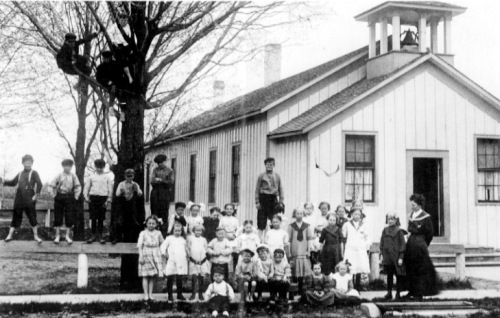
Once upon a time in a nearby land there were one-room schoolhouses.
 clark6.jpg
These one-room schools worked well enough for farm families but in towns and cities, they did not. Too many children to school and too few schoolhouses. Also it was too hard for the teacher to get four year olds and 13 year-olds in one room to learn the entire curriculum.
What made the situation worse was that many people from other lands came to this country who wanted to send their children to school–after all it was free for the youngest ones. Also many rural families migrated to towns because there were jobs that paid far more than they earned on the farm. So more and bigger schools were needed because the leaders of the land believed that public schools were essential to build a patriotic populace, a strong nation and a job-rich economy.
Then a band of reformers found a new kind of school that had worked well in another country and brought it to this nearby land. This kind of school had eight rooms in one building,  When children came to the school they were sent to Continue reading; The Standardized Classroom (Part 1) | Larry Cuban on School Reform and Classroom Practice


Tuesday, October 16, 2018

Seattle Schools Community Forum: Gates Foundation Flounders

Seattle Schools Community Forum: Gates Foundation Flounders

Gates Foundation Flounders


An interesting article from Geek Wire which itself comes from one in Non-Profit Quarterly in August of this year.  I loved the NPQ title:


Why Smart People (at the Gates Foundation) Can’t Learn


An article in the latest World Development Journal finds that staff at the Gates Foundation have trouble making effective grants because they are all trying so hard to be the smartest guy in the room.
The article examines the organizational culture of the foundation’s Agriculture Developmental program and finds that its heavy emphasis on strategic planning distracts from the practices on the ground from which they might learn and build. Specifically, it “abstracts away from smallholder farmers’ sociocultural worlds and relies on a generalizable set of development solutions.” The “bright, high achievers” on staff end up learning to manage up to Bill, presumably the alpha smartest-guy-in-the-room, instead of Continue reading: 
Seattle Schools Community Forum: Gates Foundation Flounders

DeVos accuses senator of sending 'completely false' tweet - POLITICO

DeVos accuses senator of sending 'completely false' tweet - POLITICO

DeVos accuses senator of sending 'completely false' tweet


Education Secretary Betsy DeVos on Tuesday lashed out at Sen. Patty Murray on Twitter, accusing her of sending a "completely false" tweet and acting "unbecoming and irresponsible."


DeVos' tweet came in the form of a reply to a tweet Monday night by Murray (D-Wash.), the ranking Democrat on the Senate HELP Committee.


Murray said in her tweet that DeVos wants to "weaken student protections so— an unmarried mother may be denied admission, a woman could be thrown out for using birth control & an LGBTQ student could be subjected to cruel punishment at school. This is unacceptable." Murray linked to a press release from her office criticizing draft Department of Education proposals for overhauling Title IX rules for schools handling sexual harassment allegations.


DeVos, in turn, tweeted today: "This is completely false and you know it, @PattyMurray. It’s also unbecoming and irresponsible of a U.S. Senator to sow fear and falsehood. Our efforts will restore #DueProcess and support all students, including survivors."


DeVos has said the Obama-era rules the department is replacing “failed too many students” and lacked due process for the accused.


DeVos and Murray have frequently sparred since DeVos was nominated to the position last year. DeVos' handling of civil rights issue has been a particularly contentious issue. DeVos has said the department has taken steps to streamline and more fairly handle claims, while Democrats have accused her of stripping away students' civil rights.

DeVos accuses senator of sending 'completely false' tweet - POLITICO

"Policing Our Students" Report Points to New Directions for School Discipline - LA Progressive

"Policing Our Students" Report Points to New Directions for School Discipline - LA Progressive

“Policing Our Students” Report Points to New Directions for School Discipline

Policing Our Students Report

s a follow-on research project to its celebrated Million Dollar Hoods project, a research team led by UCLA Professor Kelly-Lytle Hernandez has released its “Policing-Our-Students” report, which documents the disparate impact Los Angeles School Police Department (LASPD) policing has on students of color.
Also led by Terry Allen, Isaac Bryan, and Andrew Teng, the Million Dollar Hoods team demonstrates that between 2014 and 2017, LASPD issued 24% of its arrests, citations, and diversions to black students in the Los Angeles Unified School District, even though those students represented less than 9% of the district’s total student population.
By contrast, Latinx students represented 74% of the student body and had 71% LASPD involvement, white students represented 10% of the student body and had 3% LASPD involvement, and “other” students represented 8% of the student body and had 2% of LASPD involvement.

Positive conditions for learning and safety do not exist when Black students are disproportionately subject to contact with law enforcement

“This racial disproportionately in contact with L.A. School Police disrupts opportunities to learn for black students,” says Terry Allen, a division lead and also a Ph.D. candidate at UCLA. “Contact with law enforcement can also impair mental health and well-being, induce trauma, erode trust in the criminal justice system, and negatively impact educational achievement, advancement, and subsequent attainment.”
“Positive conditions for learning and safety do not exist when Black students are disproportionately subject to contact with law enforcement,” Allen continues. “Schools must be wary that learning and safety are not comprised as they pursue approaches to reducing contact with law Continue reading: "Policing Our Students" Report Points to New Directions for School Discipline - LA Progressive