Latest News and Comment from Education

Wednesday, September 12, 2018

Education Law Prof Blog: Network for Public Education Conference to Feature Groundbreaking Report on the Privatization of Education | National Education Policy Center


Education Law Prof Blog: Network for Public Education Conference to Feature Groundbreaking Report on the Privatization of Education


This summer, the Network for Public Education and the Schott Foundation released on new report on the privatization of public education titled, Grading the States: A Report Card on Our Nation’s Commitment to Public Schools. The report was the one I had been waiting for. It filled in key facts that have been missing from the public debate and will help move it in a more positive direction. The Network's national conference on October 20 to 21 will feature a panel on the report.  John Jackson, President of Schott, and Tanya Clay House, a long time civil rights advocate and former Obama appointee, will be on the panel along with myself.  Registrationn for the event is still open here.
The panel promises to be an important one.  As I argue in Preferencing Educational Choice: The Constitutional Limits, the analysis of charter schools and vouchers needs to be reframed.  Toward that end, I identify a handful of categorical ways in which states have actually created statutory preferences for charters and vouchers in relation to traditional public schools.  I explain why a statutory preference for these choice programs contradicts states’ constitutional obligations in regard to education.  I also explain how, even if there is no statewide statutory preference, choice programs can have the effect of undermining the delivery of adequate and equitable education opportunities in particular locations.  When they do, the programs violate state education clauses. We just have to examine the facts on a case by case basis.
My research, however, analyzes the issues from a relatively high level of abstraction, highlighting problematic examples in particular states and districts and synthesizing constitutional principles from various states.  The NPE/Schott report drills down into the facts deeper than anyone before.  It offers a systematic examination of charter and voucher laws in each state.  As a result, it clearly shows the extent to which each state’s laws represent a decommitment to public education.
The report is the “yin” to the National Alliance for Public Charter Schools’ “yang.” Each year, the National Alliance for Public Charter Schools (NAPCS) releases a report detailing charter school laws, with the frame of reference being the extent to which states have law that promote the expansion of charters.  The report normatively assumes that charter schools are good and state laws that overly restrict them are bad.  So the states that it labels as having excellent charter school laws will probably fair poorly on the Network for Public Education (NEP)/Schott Foundation report.  For instance, NAPCS ranks Indiana as the top state for charters, but NEP and Schott rank Indiana in the 40s.
But that is what makes this report so important.  Because there hasn’t been any systemic to response to NAPCS’s reports, it has been able to skew the conversation. This new report brings balance.
Here are some key paragraphs from the executive summary:
Public schools remain a source of pride and hope, helping to level the playing field for children from incredibly diverse racial, ethnic, religious and socioeconomic groups. Even amid concerns and often unsubstantiated criticism, Americans continue to view public schools as a defining hub for their communities. In the spring of 2001, a national poll found that Americans ranked public schools as “the most important public institution in the community” by at least a five-to-one margin over hospitals, churches and other institutions. Nonetheless, within the past two Continue reading: 
Education Law Prof Blog: Network for Public Education Conference to Feature Groundbreaking Report on the Privatization of Education | National Education Policy Center

Privatization Report Card - Network For Public Education -https://wp.me/P3bR9v-2IA via @Network4pubEd

Arizona charter schools are behaving badly, and only you can stop it

Arizona charter schools are behaving badly, and only you can stop it

Angry over sleazy charter school financial dealings? Don't get mad. Vote


Arizonans are upset over state Rep. Eddie Farnsworth’s scheme to walk away from his charter schools with up to nearly $30 million of taxpayer dollars.
The outburst of indignation and disgust is fitting, given that this is just the latest of Republic reporter Craig Harris's stories exposing all sorts of schemes by charter school operators to enrich themselves.

Only you can end this

But now what? What are you doing to do about it? Are you going to keep expressing indignation and merely wait for the next installment of charter schools' sleazy financial dealings?
This has to end, one way or the other.
And it has to come from you, the parent whose kids are struggling in crumbling traditional public schools while the likes of Farnsworth pocket millions.
It has to come from you, the overworked teacher earning meager salaries. It has to come from you, the average Arizona taxpayer who sweats every dollar.
It has to come from you, the senior citizen on fixed income who can’t afford to keep pouring your dollars into private bank accounts.
But exactly can you about it?

What you can do to stop it


Charter schools have become more popular in recent years. Reporter Craig Harris talks about investigating Arizona's charter schools. Arizona Republic
You can begin by asking Gov. Doug Ducey and the Republican-controlled Legislature why aren't they doing anything. We know their deafening silence means they're sanctioning this type of behavior. We know they're the school choice champions  diverting taxpayers’ money to pay for private education.
But ask, anyway. Hold them accountable and demand an overhaul of charter schools or vote them out this November.
Talking about killing charter schools altogether might be premature because the Continue reading: Arizona charter schools are behaving badly, and only you can stop it

Privatization Report Card - Network For Public Education -https://wp.me/P3bR9v-2IA via @Network4pubEd


American public schools need help. To achieve change, we need to vote | Randi Weingarten | The Guardian

American public schools need help. To achieve change, we need to vote | Randi Weingarten | Opinion | The Guardian

American public schools need help. To achieve change, we need to vote
By casting their ballots and running for office, determined educators are fighting for change


As students and teachers return to school each year, so do I. As the American Federation of Teachers president, I visit classrooms throughout the country in order to see for myself how our students and teachers are doing. On the one hand, I find myself inspired by those helping our students to thrive. On the other hand, I’m angered by the many forces hindering public education.

Last week, teachers in Burnsville, Minnesota proudly showed me classrooms with reading nooks, educational games and extra supplies – all purchased with teachers’ own money – so no child would have to go without. Educators in Massena, New York organized a Ready-4-School event so their students could get free school supplies, clothing, books and even haircuts. And in Baltimore, where many schools were too cold last winter and too hot last week to conduct classes, school staff recently helped distribute more than $30,000 worth of books and school supplies to students in need.
I hear the same things over and over during these visits: disinvestment in public education is hurting our students. Teachers are struggling to get by on salaries that don’t reflect the importance of their work. Educators are frustrated by their lack of latitude to meet children’s needs because decisions about instruction and classroom assessment are driven more by standardized testing than by teaching and learning.
And yet, these educators persist.

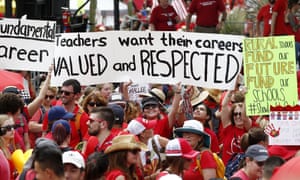
Thousands protest for higher teacher pay and school funding on 26 April in Phoenix.
After a decade of disinvestment and austerity, teachers are demanding adequate funding for public schools and professional salaries for educators. Thankfully, they have the public’s support. The 2018 Phi Delta Kappa poll of Americans’ attitudes about public schools is clear: People support public schools and want their state governments to invest in them and those educators who sacrifice much in order to make a positive difference.
Unfortunately, Donald Trump and the education secretary, Betsy DeVos, disparage these concerns. It’s not simply the cuts they proposed last year to eliminate summer school and after-school programs and to reduce class size, or their attempts to privatize education. Betsy DeVos’ big back-to-school idea this year was to divert funding for guidance counselors, mental health services and enrichment programs for poor kids and to arm educators.
No wonder teachers are angry. Many, owing to a lack of resources, even have Continue reading: American public schools need help. To achieve change, we need to vote | Randi Weingarten | Opinion | The Guardian


You Have Read Diane Ravitch's Blog but Did You Know Diane Has A Website Too

Diane Ravitch
You Have Read Diane Ravitch's Blog but Did You Know Diane Has A Website Too
Diane Ravitch Website 


Diane Ravitch Website 

We ALL Deserve a Vote | Schott Foundation for Public Education

We ALL Deserve a Vote | Schott Foundation for Public Education
We ALL Deserve a Vote


It’s election season again. And with that comes a barrage of PSA’s and famous people reiterating that the most important thing you can do is vote. Yet, in the 2016 presidential election only 58% of eligible voters went to the polls. ONLY 58 PERCENT! Almost half of people that could vote, either were not able to or chose not to.
Voter turnout is a critical indicator of how well our local systems are working to provide all children with love and support. Research by Jan Leighley and Jonathan Nagler highlights that the people who are not turning out to vote tend to be more supportive of unions and government spending on health insurance and public schools compared to the population that is voting. In fact, research has shown that disparities in voter turnout directly predicts minimum wages, children’s health insurance spending and anti-predatory lending policies.
To increase access to livable wages, affordable healthcare and quality public schools, we must address the barriers to voting so we elect representatives committed to ensuring that all children have the opportunities to learn and thrive. The Schott Foundation’s Loving Cities Index outlines the deep and growing body of research on the direct connection between cross-sector supports and a child’s success in high school and post-secondary degree attainment. Addressing massive gaps in voter registration and voter turnout is critical to ensuring all economically marginalized voters are represented, not just the white, blue-collar class, and when everyone’s voice is represented at the polls, policies are put in place that actually lead to lower levels of income inequality.
How can we remove barriers to voting?
People do not vote for one of two reasons: 1) they can’t or 2) they choose not to.
There are numerous reasons why people can’t vote. Many of those barriers to voting are created by state laws and practices that determine how difficult or easy it will be to register to vote, who is eligible, what you need to bring with you when you vote, how long the voting period will be, wait times at voting stations, and what options residents have to mail in or vote-at-home. The Center for American Progress compiled a great resourcesummarizing how localities and states can set up policies and practices to encourage voting and ensure our democracy works effectively, and sharing examples of ways different states are working to increase turnout. If legislators cared about every person’s right to vote, they would ensure that those policies and practices were in place and hold themselves accountable to high turnout rates, including:
  1. Remove or reduce the burden of registration with automatic voter registration, same-day registration, and online voter registration
  2. Create larger windows for voting with options for in-person early voting, no-excuse absentee voting andvote-at-home systems
  3. Restore voting rights for formerly incarcerated
  4. Introduce voting rights and civic responsibility in school curriculum
  5. Broaden the options for voter identification, for those facing barriers to gaining identification cards or drivers licenses but have other forms of government-issued identification
  6. Ensure every school provides voting-age students with an option to register on-campus to vote, including pre-registration for 16- and 17-year-olds
While localities and states are responsible for setting their own policies and approaches to voting, there are important steps that the Federal government must take to provide a check and balance on states to protect our sacred right to vote. Unfortunately, in 2014 the supreme court struck down Section 4 of the Voting Rights Act, which had previously kept specific jurisdictions with a history of race-based voter discrimination from changing election rules without preclearance from the federal government. This ruling opened the floodgates to laws that suppress voter turnout in states across the country, which likely had a detrimental effect on voter turnout and a real impact on election outcomes. The people affected by voter suppression tactics are most often those that have been most impacted by policies rooted in racism and hate, and it’s critical that their voices are heard in order to replace those systems with policies and practices that create healthy living and learning environments where everyone can thrive. Therefore, federal laws that create pre-emptive protections against laws that suppress voting participation are essential to protect every person’s right to vote and to uphold a functioning democracy.
Even with great systems for registration and voting that are designed to promote turnout, there are still many people that are able to vote but choose not to. The reasons people choose not to vote can differ by person, but typically stem back to either a belief that the system doesn’t work, that their vote doesn’t matter, or that they do not have a candidate that they support. The Love Vote is one project aiming to motivate non-voters by creating a platform to connect them with those that can’t vote (including teens, immigrants and disenfranchised citizens) who share their stories and ask their family, friends and neighbors to make a promise to vote on their behalf. Other efforts to increase representation of women and people of color running for office and innovate on the voting system promise to chip away at the issue of having candidates in the running that people will be excited to turnout to vote for. Some of those innovations include efforts to limit campaign spending and Maine’s ranked-choice system, both of which highlight ways to encourage more people of diverse backgrounds and political thought to run for office, and as a result gain more interest in participation in the voting process.
The right to vote has become politicized in the past decade, with the debate being framed as a choice betweensafe-guarding our elections or letting anyone who shows up vote. This narrative has lost sight of the ultimate outcome we should all care about: voter participation. Our democracy rests upon every one of us having the opportunity to vote and feeling compelled to do so. Current rates reflect an epidemic of under-representation of the interests of people of color, low income individuals, and young people, and as a result our systems and policies are being shaped in ways that the majority do not agree with. Without a vote, that dissent has no power. Without a vote, we lose access to the supports that give every child the opportunity to learn and thrive.


Like what you've read?

Then don't miss a thing. Join the thousands of students, parents, educators, and activists who already receive our latest updates and resources!


We ALL Deserve a Vote | Schott Foundation for Public Education

Teacher strikes: Teachers of the world, unite. You have nothing to lose but your pain!

Teacher strikes: Teachers of the world, unite. You have nothing to lose but your pain!

Teachers of the world, unite. You have nothing to lose but your pain!
Strikes can help ensure class cabinets are fully stocked

n the run-up to a new school year, I was proud to contribute $100 to the parent teacher association at my son’s school for classroom supplies. It seemed an uncontroversial ask — of course I wanted his class to have the supplies they needed for the year. And for those who can easily afford it, this sort of donation, or, at some schools, the purchase of the supplies themselves, can seem entirely innocuous.
But why exactly are parents paying for paper and pencils? You know, those things schools should have in their supply cabinets. Unfortunately, school cupboards across the country are bare — or at least underfunded.
“Between 2005 and 2017, public schools in the U.S. were underfunded by $580 billion in federal dollars alone — money that was specifically targeted to support 30 million of our most vulnerable students,” says a new report published by the education advocacy nonprofit, the Alliance to Reclaim Our Schools. The research report, “Confronting the Education Debt,” provides an overview of how state and federal governments subvert programs designed to address poverty; reduce revenues through tax breaks; and divert fiscal resources from public schools, burdening black and brown children who make up the majority of public school students.

The adage that you can do less with more doesn’t hold up when it comes to education. There are bigger budgetary issues behind school supply drives. If districts don’t have enough money for pencils, teachers’ salaries will eventually join glue sticks and permanent markers on the need-to-buy list.
“It’s increasingly clear that the school district has a very different set of priorities than you do,” said Tacoma Education Association president Angel Morton, speaking to a crowd of mostly teachers at a rally on September 5 in the high school’s gymnasium, according tolocal newspaper The News Tribune. Teachers in Tacoma and Puyallup, Washington, went on strike on the scheduled first day of school to increase the pressure on the district to agree to their terms Continue reading: Teacher strikes: Teachers of the world, unite. You have nothing to lose but your pain!


Tuesday, September 11, 2018

New York’s Democratic Primary is a Showdown for Charter School Politics - Progressive.org

New York’s Democratic Primary is a Showdown for Charter School Politics - Progressive.org

New York’s Democratic Primary is a Showdown for Charter School Politics
The upcoming New York primary could redefine the Democratic party in the state—and could mean drastic change for the charter school industry.


The upcoming September 13 primary in New York could re-energize and redefine the Democratic party in the state. It also might mean drastic change for the charter school industry.
Across the U.S., billionaire hedge fund managers have routinely secured support for charter schools through direct campaign donations to candidates, or the simple act of “loading” charter school PACs with millions of dollars, which frightens potential critics into silence.
But public support for charters is waning. The industry took an unexpected beating in a 2016 Massachusetts ballot referendum when voters rejected a proposal to lift a cap on the number of charters allowed each year. Recent pollshave shown declining public support for charter schools, and a litany of scandals surrounding charters have prompted a number of progressive candidates to offer fresh criticism of the industry.
The political friction surrounding charters has dramatically increased in New York, where for years the most visible avatar for the industry has been Success Academy, the largest charter school network in the state. Widely credited by corporate media outlets for raising test scores for traditionally low-performing students, the New York City-based charter chain and its CEO Eva Moskowitz have also been deluged by negative press about heavy-handed discipline and abusive instructional practices.
This summer, things truly went off the rails for Success.

In June, a bill that would have added 100 new charter schools to the statewide cap was declared dead-on-arrival, even though it included an extremely popular repeal for a teacher evaluation law that uses standardized test scores to evaluate teachers.
Just days later, a judge struck down an audacious proposal to allow Success Academy and other charter schools authorized under SUNY’s Charter Committee to train and certify their own teachers. As The Progressive reportedin March, this violated clear legal requirements for minimal training standards and bypassed critical input by the public.

Soon after, there was a “mass exodus” of teachers leaving a Success Academy high school in Manhattan where forty-seven of sixty-seven educators will not return. At least twenty-five quit, nine were dismissed, and the rest were reassigned within the charter network. Some teachers mentioned inappropriate disciplinary policies and lack of respect for teachers, while others cited draconian policies that force students to repeat grades for failing classes.
And news of the charter network’s first graduating senior class brought new criticisms to light. Of the seventy-two first graders who comprised Success Continue reading: New York’s Democratic Primary is a Showdown for Charter School Politics - Progressive.org

Defiant DeVos Ignores Judge's Order, Ends Union Release Time | News of the Week | thechiefleader.com

Defiant DeVos Ignores Judge's Order, Ends Union Release Time | News of the Week | thechiefleader.com
Defiant DeVos Ignores Judge's Order, Ends Union Release Time
Plans to Unilaterally Ban Telecommuting Option For Employees


Despite the ruling last month by U.S. District Judge Ketanji Brown Jackson that struck down President Trump’s May Executive Orders seeking to force Federal unions out of the workplace, Secretary of Education Betsy DeVos is doubling down in her effort to make the Department of Education a “no-union” zone, according to officials with the American Federation of Government Employees.
As a result, the union said, by Oct. 1 its 4,000 members employed by the U.S. Department of Education in Washington, D.C. and 10 satellite offices will lose the option of telecommuting that’s been available for years.
A Do-It-Herself Pact
Ms. DeVos in March unilaterally declared an impasse and imposed what her agency called “a collective-bargaining agreement” that covered the unionized workers in her agency without negotiating with the union.
The AFGE filed a complaint with the Federal Labor Relations Authority and prevailed in July. The FLRA Regional Director agreed with the union that Ms. DeVos had engaged in an unfair labor practice when her management team walked away from the bargaining table and imposed its “contract.”
But the FLRA currently lack enforcement powers because President Trump has not appointed its General Counsel, who is required to present the FLRA findings to the agency’s full board for final approval.
‘DOE More Recalcitrant’
“Despite the FLRA finding, and now Judge Jackson’s ruling, there’s been no change Continue reading: Defiant DeVos Ignores Judge's Order, Ends Union Release Time | News of the Week | thechiefleader.com