Latest News and Comment from Education

Wednesday, August 1, 2018

Privatization and Segregation of U.S. Public Education Endangers Democracy - BTL

Privatization and Segregation of U.S. Public Education Endangers Democracy - BTL

Privatization and Segregation of U.S. Public Education Endangers Democracy
Interview with Noliwe Rooks, author and director of American studies at Cornell University, conducted by Scott Harris
Image result for Privatization and Segregation of U.S. Public Education


Randi Weingarten, who leads the 1.6 million-member American Federation of Teachers union declared in August that President Trump’s Education Secretary, Betsy DeVos, “is the most ideological anti-public education person to ever be nominated or confirmed to that position.” DeVos, who never attended public school or worked in one, has devoted her life to allowing parents to choose the schools their children attend, either charter or private schools using public funds – and decreasing the federal government’s role in education.
DeVos bankrolled a ballot measure in Michigan to create a private school voucher system that was defeated by a two-to-one margin. She then spent millions of dollars of her own money to elect legislators who then made deep cuts to public school budgets and promoted unaccountable for-profit charter schools in the state. Now almost half of Michigan’s charter schools rank near the bottom of U.S. schools, and Michigan dropped from 28th to 41st in reading, and from 27th to 42nd in math compared with other states.

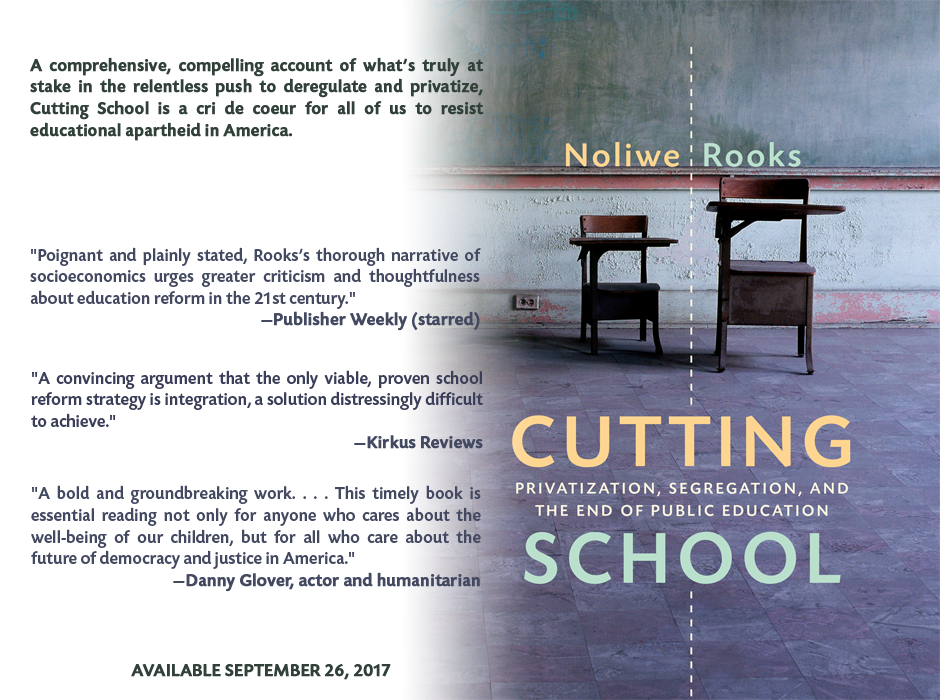
Between The Lines’ Scott Harris spoke with Noliwe Rooks, director of American studies at Cornell University, who talks about her new book “Cutting School: Privatization, Segregation and the End of Public Education.” She is an associate professor in Africana Studies and Feminist, Gender, Sexuality Studies.
Here, Rooks condemns school privatization efforts and contends that publicly-funded schools are essential to quality, equal education for all – and an indispensable element to build a democratic society.
NOLIWE ROOKS: Taxpayer-supported public education starts for the entire country. It had been in certain parts of the East Coast, in Massachusetts in particular, from the 1600s. But it’s really post-Reconstruction that the rest of the country gets with the idea of you know, we should use taxpayer dollars to educate all of our citizens regardless of wealth. Before 1890 to 1920, that period, education was really something only for the very wealthy. It was mostly private, you know, people were sent to Europe. They were sent to private boarding school. In the U.S., the idea of educating the masses of Americans really is a kind of quintessentially American intervention – that no matter who you are, no matter your social status, there’s something about education that would be valuable for you. And this is a way that we can start to educate all Americans around what citizenship means. That we can define a particular kind of civic imagination and a goal of democracy of what kinds of citizens we want to participate in this experiment in democracy where you know, voters, where everyone, where citizens of the country are engaging in setting the policy and setting the direction. That was the ideal.

BETWEEN THE LINES: When we see the drive toward privatizing our education system in this country through charter schools, the movement toward school vouchers, the whole notion of school choice which underlines those in a system called “virtual education” – tell us about how that affects the quality of education. These companies obviously are in it to make a buck. They’re making profit here, by getting into privatizing the education system. But what’s the effect on the students?
NOLIWE ROOKS: So, one of the terms that I came up with to talk about this moment, where we really do have an unprecedented move towards dismantling what we consider traditional public education. What that’s being replaced by – with high concentrations of poor people and high concentrations of people of color – are charter schools, which are Continue reading: Privatization and Segregation of U.S. Public Education Endangers Democracy - BTL
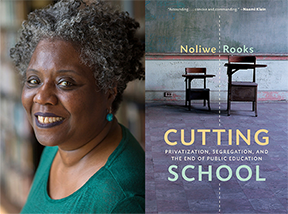
Noliwe Rooks at the Schomburg Center | The New Press - https://thenewpress.com/node/12217

Noliwe Rooks

Noliwe Rooks is the director of American studies at Cornell University and was for ten years the associate director of African American studies at Princeton University. She is the author of White Money/Black PowerHair Raising, and Cutting School (The New Press). She lives in Ithaca, New York.
Tuesday, July 31, 2018

Special Nite Cap: Catch Up on Today's Post 7/31/18


Special Nite Cap: Catch Up on Today's Post 7/31/18

TODAY

CHARTER SCHOOL CROOKS IN THE NEWS: Company used convicted Chicago schools chief in 'highly unethical' work to win millions in CPS business, watchdog finds - Chicago Tribune | WBEZ

Company used convicted Chicago schools chief in 'highly unethical' work to win millions in CPS business, watchdog finds - Chicago Tribune Company used convicted Chicago schools chief in 'highly unethical' work to win millions in CPS business, watchdog finds A for-profit company that educates at-risk students won tens of millions of dollars from Chicago Public Schools with help from then-CEO Barba
Inside A FCMAT Fiscal Crisis & Management Assistance Team Audit of One More Unaccountable California Charter School

Livermore charter schools accused of misuse of public funds Inside A FCMAT Fiscal Crisis & Management Assistance Team Audit of One More Unaccountable California Charter School LIVERMORE — An audit released Thursday suggests Livermore’s two charter schools misappropriated public funds, including a tax-exempt bond totaling $67 million, and mainly pointed the finger at former CEO Bill Batchelor. The
What New Orleans Tells Us About the Perils of Putting Schools on the Free Market | The New Yorker

What New Orleans Tells Us About the Perils of Putting Schools on the Free Market | The New Yorker What New Orleans Tells Us About the Perils of Putting Schools on the Free Market A year ago, I volunteered to serve on the board of a charter elementary school in New Orleans, where I live. Two months ago, in a cafeteria crowded with whiplashed parents, I tried to give some comfort by explaining why,
LeBron James, education reformer. Attn. Waltons. | Arkansas Blog

LeBron James, education reformer. Attn. Waltons. | Arkansas Blog LeBron James, education reformer. Attn. Waltons. Give a read to the new public school basketball star LeBron James is backing to serve at-risk kids in Akron. Imagine. It's a part of the Akron School District. It is NOT a charter school. It is NOT a private school. They aren't skimming students from motivated families who might alrea
L.A. School Board in Limbo After Member's Felony Plea | Capital & Main

L.A. School Board in Limbo After Member's Felony Plea | Capital & Main L.A. School Board in Limbo After Member’s Felony Plea A troubled charter-school advocate calls it quits — but not before participating in a string of key policy votes. “Learning Curves” is a weekly roundup of news items, profiles and dish about the intersection of education and inequality. Send tips, feedback and announcements

YESTERDAY

Randi Weingarten joins Margaret Hoover to Discuss the Supreme Court Janus Ruling | Firing Line | PBS

Randi Weingarten | Firing Line | PBS Randi Weingarten joins Margaret Hoover to Discuss the Supreme Court Janus Ruling Randi Weingarten | Firing Line | PBS
Edged out of the middle class, teachers are walking out - The Hechinger Report

Edged out of the middle class, teachers are walking out - The Hechinger Report Edged out of the middle class, teachers are walking out Dissatisfied with low pay and school funding, teachers in more red states are poised to protest. I n 2015, Jennifer Vetter decided to change careers and become a teacher. The 46-year old quit her well-paying management job at an orthodontic clinic in Gilbert, Ariz
The DeVos Democrats and Betsy DeVos’ Message to Students: You Have the Right to Be Ripped Off

Betsy DeVos’ Message to Students: You Have the Right to Be Ripped Off Betsy DeVos’ Message to Students: You Have the Right to Be Ripped Off The education secretary’s new rules on student loans favor the predatory institutions that don’t provide good educations and blame the students who trusted them. When I read about what Education Secretary Betsy DeVos did last week on student loans, I thought

JUL 29

An Explanation to My Readers | Diane Ravitch's blog

An Explanation to My Readers | Diane Ravitch's blog An Explanation to My Readers Dear Readers, Most of you have been faithful readers of this blog since I started it in 2012. I consider you my friends, even when we disagree. You have 


LeBron James, education reformer. Attn. Waltons. | Arkansas Blog

LeBron James, education reformer. Attn. Waltons. | Arkansas Blog

LeBron James, education reformer. Attn. Waltons.

Image result for LeBron James, education reformer.


Give a read to the new public school basketball star LeBron James is backing to serve at-risk kids in Akron.

Imagine.

It's a part of the Akron School District. It is NOT a charter school. It is NOT a private school. 

They aren't skimming students from motivated families who might already be achieving in school. They are SEEKING out students who need help in reading and math.

There will be long school days and intensive tutoring.

But that's not all.

But it will also focus on factors outside the classroom.

Services will help parents with stress related to their struggles. There will be extra activities to keep kids out of trouble in idle time. 


ips-slider1.jpg

There will be family services, including job placement assistance and a food bank. James remembers the freedom a bicycle gave him as a child to escape dangerous neighborhoods. Every student will receive a bicycle.

The I Promise school embodies James' pledge not to ever forget where he came from.

Imagine if the Walton Foundation didn't spend $8 million to open yet another an unproven charter school amid a neighborhood overbuilt with school seats with an enrollment system likely to attract children more likely to succeed. Imagine if it poured this kind of effort into one of the Little Rock School District's real public Continue reading: LeBron James, education reformer. Attn. Waltons. | Arkansas Blog


What New Orleans Tells Us About the Perils of Putting Schools on the Free Market | The New Yorker

What New Orleans Tells Us About the Perils of Putting Schools on the Free Market | The New Yorker
What New Orleans Tells Us About the Perils of Putting Schools on the Free Market


A year ago, I volunteered to serve on the board of a charter elementary school in New Orleans, where I live. Two months ago, in a cafeteria crowded with whiplashed parents, I tried to give some comfort by explaining why, three days before the school year ended, the school had announced that it wouldn’t be open this fall. I apologized. I described the scrambling to try to solve a six-hundred-thousand-dollar budget shortfall. I apologized again. But what I didn’t explain was that the fate of Cypress Academy, a unique closure in a unique, charter-dominated school district, was not just about one school. It was about how startups fail, and about what happens when a school system is redesigned around the engines of the free market—autonomy, competition, and customer choice. Frankly, I didn’t understand this until later. Which is good, because the parents didn’t want to hear market theory. They just wanted their children to get a good public education.

In New Orleans, alone among large urban districts, almost all schools are now charter schools. This is the result of perhaps the most ambitious school-reform effort in the country’s history. In 2004, the year before Katrina, only fifty-four per cent of New Orleans high-school students graduated. After Katrina, the state of Louisiana took over almost all of the city’s schools and began turning them over to independent groups—either single-school charters, like Cypress, or largely local charter-management organizations, or C.M.O.s. This month, after thirteen years, the Orleans Parish School Board assumed control as the regulatory body over all the public schools in the city, reunifying the district and stirring intense reflection—locally and nationally—on the effects, so far, of ceding the city to a charter system.

That system, in which eighty-three per cent of students are economically disadvantaged, still has a long way to go. Forty per cent of the city’s schools are ranked “D” or “F” by state standards, and New Orleanians are no rookies at the national pastime of school segregation: the C.M.O.s serve mainly poor black students, while independent, “community” charters serve racially mixed populations. But, in the years since Katrina, the rates of high-school graduation, college attendance, and college persistence have increased by a range of ten to sixty-seven per cent. That’s confirmed in a recent study by Matthew Larsen, a professor at Lafayette College, and Doug Harris, an education researcher and economist at Tulane who, in the past, has been wary of “teach-to-the-test” results and the notion that “scores equal learning.” New Orleans achieved all this without two of the features most detested by charter critics: there are no for-profit charter schools in the city, and the charter system doesn’t drain money from the “regular” school system. In New Orleans, there is no other system.

Sitting on a charter-school board, I could observe that system firsthand. I joined the board of Cypress because Bob Berk, the founder of the school and a childhood acquaintance, convinced me that volunteering in elementary education was the most direct way to help children in a state that’s hard on them. (Save the Children recently ranked Louisiana the worst state for children, for the second year in a row.) And I admired the school’s philosophy, which stressed diversity, a “whole child” education, and a commitment to teaching all types of learners, from gifted to special-needs, in one classroom.

In New Orleans, parents rank schools through a common application, so Cypress treated every challenge—teacher turnover, disappointing enrollment—as an existential threat that demanded a creative response. By the end of the Continue reading: What New Orleans Tells Us About the Perils of Putting Schools on the Free Market | The New Yorker