Latest News and Comment from Education

Monday, July 30, 2018

The DeVos Democrats and Betsy DeVos’ Message to Students: You Have the Right to Be Ripped Off

Betsy DeVos’ Message to Students: You Have the Right to Be Ripped Off

Betsy DeVos’ Message to Students: You Have the Right to Be Ripped Off
The education secretary’s new rules on student loans favor the predatory institutions that don’t provide good educations and blame the students who trusted them.


When I read about what Education Secretary Betsy DeVos did last week on student loans, I thought back to all my visits to college campuses in the late nineties, dazzled by all the different lives I might lead after graduating high school.
But for all the specifics about, say, how many books were in the library, the guides usually handled one subject with shoulder-shrugging vagueness: money. When asked about high tuition at the University of Notre Dame, an administrator said simply: “What’s more important than your education?”
What indeed? Any counterargument comes across as philistine. But the administrator’s glibness belied how brutal student debt is. At the excessive levels that are now typical, it constricts your life—limiting your choices in where you work and live, and whether and when you marry and parent—because you sought an education in hopes of expanding your life.
I opted for an in-state school, the University of Michigan, and worked constantly (unpaid internships, I hardly knew ye), but the tremendous education debt that I began building at age 18 would shadow me for the next 20 years.
Still, it’s nothing compared to the perniciousness of for-profit colleges that exploit the dreams of students—often non-traditional ones, like veterans and older adults—by using them as vehicles to access federal loan money and delivering desperately little skill-building and job readiness in return. Then they leave the students holding the tab.

In essence, what DeVos did last week affirmed that that’s a perfectly fine way to do business—and, indeed, the federal government will both subsidize and cover for these faux schools. Both draft and proposed changes show that Continue reading: Betsy DeVos’ Message to Students: You Have the Right to Be Ripped Off

The DeVos Democrats

 https://www.jacobinmag.com/2017/01/betsy-devos-public-schools-teachers-unions-charters-privatizations-democrats
Corporate Democrats have enabled Betsy DeVos's privatization agenda for years. It's time for them to choose which side they're on.


My children attend an amazing public elementary school in Bloomington, Illinois. The student body is diverse, and the teachers are committed professionals who genuinely care about the wellbeing and education of all their students.
The school building is full of joy. Many of the children could not receive such an education — would not spend their days in a place of joyful learning — if not for this public school. Whenever I spend time there, I always leave feeling optimistic about the future of public education in the United States.
Then I read the news and my optimism turns to dread.
Donald Trump’s nominee to be the nation’s next secretary of education is Betsy DeVos, a longtime Republican operative from two of the wealthiest and most powerful conservative families in the nation. She is the daughter of Edgar Prince, founder of the Prince Corporation; sister of Erik Prince, founder of the private military contractor formerly known as Blackwater; and daughter-in-law of Richard DeVos, the billionaire who co-founded the Amway Corporation. DeVos, who received her entire education from private Christian schools, also has close ties to the conservative Christian Reformed Church.

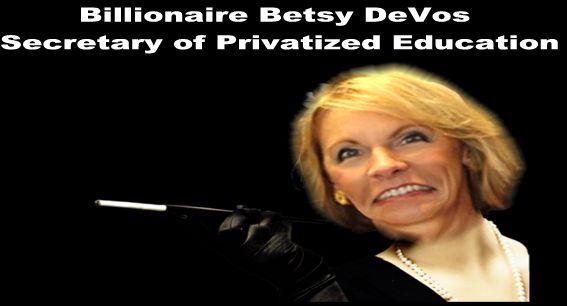
For years, DeVos has used her enormous wealth and power to promote what is euphemistically called “school choice.” Perhaps the most pervasive education reform idea of the last few decades, school choice is sold as a way to give parents more educational options for their children. Under a voucher program, for instance, parents would be able to take public money that normally goes to fund traditional public schools and use it to send their children to private schools. If DeVos has her way, the state would even fund religious schools of the type she attended, which teach deeply conservative curricula that include creationism.
At her Senate confirmation hearing on Tuesday, DeVos told Bernie Sanders: “I have worked very hard on behalf of parents and children for the last almost thirty years, to be a voice for parents and a voice for students and to empower parents to make decisions on behalf of their children, primarily low-income children.”
While that’s a dubious spin on an insidious career, it’s undoubtedly true that DeVos has funded and led some of the most influential school choice organizations in the country: All Children Matter, Alliance for School Choice, American Education Reform Council, American Federation of Children, Children First America, Education Freedom Fund, Foundation for Excellence in Education, the Great Lakes Education Project.

As many of her critics have pointed out, DeVos is a case study in the nefarious ways that big money shapes education policy in the United States. But she takes such criticism in stride. In 1997 she wrote: “I have decided . . . to stop taking offense at the suggestion that we are buying influence. Now I simply concede the point. They are right. We do expect some things in return.”
In short, DeVos is arguably the nation’s most powerful proponent of school privatization — and now, even after bumbling her way through her confirmation hearing, she’s set to take the reins of the Department of Education.
American public schools have some very serious problems. Spend time in the crumbling public schools Continue reading: The DeVos Democrats   https://www.jacobinmag.com/2017/01/betsy-devos-public-schools-teachers-unions-charters-privatizations-democrats

Sunday, July 29, 2018

An Explanation to My Readers | Diane Ravitch's blog

An Explanation to My Readers | Diane Ravitch's blog

An Explanation to My Readers 


Dear Readers,
Most of you have been faithful readers of this blog since I started it in 2012.
I consider you my friends, even when we disagree. You have tolerated (and even corrected) my typos and errors because you know that everything I write here is written by me, not by a staff. I am the only staff.
You know that I worked for President George H.W. Bush from 1991-1993. I served on the NAEP board for seven years (appointed by Bill Clinton and Secretary Riley). I was a conservative on education issues until about 2007 or so, when the realization hit me that NCLB was a failure. Obama’s Race to the Top was more of the same test-and-punish regime. I experienced a political conversion. I publicly renounced my support for testing and choice in a book called “The Death and Life of the Great American School System: How Testing and Choice Are Undermining Education,” and followed up with “Reign of Error: The Hoax of the Privatization Movement and the Danger to America’s Public Schools.” I support public schools, students, unions, teachers, and parents. I fight for a real education, one that encourages young people to think and question, one that endows them with a love of learning. I recognize the role of poverty and racism in harming children, families, and communities. I oppose high-stakes testing and privatization in all its forms.

These past few years have been challenging, because the blog is supposed to be about education, not about national politics.
In 2016, I made clear that I would endorse whoever was nominated by the Democrats, because the Republican party had taken a strong stand in favor of privatizing our nation’s public schools, attacking teachers’ unions, and undermining the teaching profession. I would have supported Clinton or Sanders, even though neither was perfect on education issues. Clinton won the nomination and I supported her.

Since the election, I have come to see Trump as the charlatan that he has always been, but more ignorant and more dangerous to our democracy than I assumed. His policies–like withdrawing from the Paris Climate Accord, attacking Roe v. Wade, demonizing immigrants, and relinquishing public lands for drilling and privatization of everything–are appalling. He knows nothing of foreign or domestic policy. He has no values or beliefs other than personal ego and self-enrichment. He undermines our standing in the world by attacking other democratic nations and acting obsequious towards tyrants. He is a racist, a misogynist, a xenophobe. He sees no difference between white nationalists (KKK) and those who stand up to them. His boasting, his narcissism, and self-love know no limits.
I have tried to keep national politics out of my blog, but it has proved to be impossible because I think our nation is in crisis due to its dangerous and ignorant leader. The Republicans are rushing Trump’s judicial nominations through the Senate, stacking the federal bench with people who share Trump’s biases and who are receiving lifetime appointments. Trump’s legacy will remain in the courts for decades to come, thanks to his Republican enablers.
I cannot remain silent. I cannot pretend that education and national politics are separate domains. They are not.
The blog will continue to be an education blog. If we allow grifters and for-profit corporations to open their own schools, we forfeit the future. If we divert funding from public schools to subsidize privately-run unaccountable charters and unregulated religious schools, we harm our children while subtracting money from regulated, transparent, and accountable public schools.

As many of you know, I am writing a book about the Corporate Reform movement and the Resistance. I am excited about the book.
I am writing it as I continue to post comments and blogs. I am about half-way through the book.
Bear with me.
If you like Trump, you won’t like what I post. I consider him to be a menace, a clear and present danger to our nation and the world. Read or don’t read. It’s your choice.
If you share my fears for our future as a nation, stay with me.
If you care about the future of public education, stay with me.
Thank you.
Diane
An Explanation to My Readers | Diane Ravitch's blog


Saturday, July 28, 2018

Randi Weingarten: Teaching demands respect from Keleher | Meter

Teaching demands respect from Keleher | Meter

Teaching demands respect from Keleher
The Association of Teachers held a demonstration to clarify, among other things, the uncertainty lived by about 2,000 teachers who have not been relocated

Teaching demands respect from Keleher


Teachers and teachers of the Puerto Rico Teachers Association (AMPR) gathered today in front of the facilities of the Department of Education to demand, among other things, to clarify the process of teacher relocation after the closure of school campuses
.
According to the teacher leader, the relocation process that the Department of Education intends to carry out is not being done in accordance with the law.
"[Teachers] have the right to be on a shifts list according to their qualifications, so respect that process so that teacher who is 28 years old, have the assurance that they are not naming one who was after him", the union president, Aida Díaz, told Metro .
According to Díaz, about 2,000 teachers do not know which schools will be relocated to next semester. The school semester begins on August 13.
The teacher leader called on the Secretary of Education, Julia Keleher, to meet with the leadership of the organization. However, he warned that the official must demonstrate "good faith with the teaching [and] must be willing to listen to our recommendations."
The demonstration - in which a picket was held in front of the offices of the instrumentality - counted on expressions of the president of the American Federation of Teachers (AFT), Randi Weingarten, who also denounced the lack of negotiation between the teaching profession and the Education deparment.
"Earlier, I said that Puerto Rico experienced two hurricanes: Hurricane Maria and Hurricane Julia, one was a natural disaster and the other could be changed ... When you close 500 schools and hurt communities, we teachers and parents have the right to ask questions." , he sentenced.

The American leader also repudiated the uncertainty of thousands of teachers and students who do not know which schools will be relocated.
Just this morning, the AMPR held an extraordinary assembly at the Sheraton Hotel to ratify its affiliation with the AFT. In addition, Congresswoman Nancy Pelosi offered a welcome message in which she endorsed the guild's efforts.
During the assembly, Díaz denied that the AMPR resorted to a strike. He assured that he will continue to exert pressure against the measures promoted by the Department of Education, but that if all the remedies have been exhausted, the teachers should decide whether to resort to the strike and to jeopardize the union's certification.
Also, the teacher leader said that the teacher relocation procedure is not being done according to the law because it is naming employees with less experience to the places available. According to Díaz, the process is supposed to first serve the relocated teachers with greater seniority.

Damn Good Education Daily:A Twitter List by @coopmike48/birds on a wire on Twitter


Damn Good Education Daily

Damn Good Education Daily - Paper.li


Image result for Damn Good Education Daily coopmike48

Tweets by Over 50 of the Most Significant Voices in Support of Our Public Schools

Hess/Addison: Teachers’ Unions Get More Political in Wake of Supreme Court Decision | National Review #AFT2018 #RedForEd #IamAFT @aft @AFSCME @NEAToday @SEIU

Teachers’ Unions Get More Political in Wake of Supreme Court Decision | National Review

Teachers’ Unions Plan to Become ‘More Political, Not Less Political’


The recent Supreme Court decision has not led to moderation.
In a landmark First Amendment decision, the Supreme Court ruled earlier this summer in Janus v. AFSCME that states cannot require public employees to pay “agency fees” to unions. Prior to the decision, in 22 states, public employees who chose not to join a union could still be required to pay these fees — somewhat less than full dues — for union services. Some have suggested that unions might temper their left-wing politics in response to the decision, in the hopes of wooing potential members put off by union politics.

For unions, the stakes could hardly be higher. Kate Walsh, president of the National Council on Teacher Quality, warns that surveys show “many [teachers] see dues as too high” and “political activity as too leftist”; she also notes that “only half of all teachers voted for Hillary Clinton.” Internal documents from the National Education Association (NEA), the nation’s largest teachers’ union, anticipate that the union will lose a whopping 300,000 members. Things look even bleaker for the American Federation of Teachers (AFT), the nation’s other major teachers’ union, which has 15 of its 22 largest state affiliates in former agency-fee states — and already had fewer than half its members paying full dues.
By happenstance, both unions held their big national conventions in July, providing a chance to scour the tea leaves for subtle hints as to how the unions might woo reluctant members, especially the hefty share who take issue with the leftist bent that has characterized the unions in recent decades. Even before the shock of Janus, unions worked in concert with Senate and House Republicans in 2015 to pass the Every Student Succeeds Act in a push to roll back many of the federal educational excesses of the Bush and Obama years, so a shift in approach seemed entirely possible.
It turns out that the tea leaves weren’t that hard to read, after all. At the NEA’s annual convention and representative assembly in Minneapolis, things kicked off on day one with Parkland survivor and woke gun-control activist David Hogg joining NEA president Lily Eskelsen García on stage to exhort the cheering throng, “There’s nothing more powerful in America than a pissed-off teacher.” The NEA also made time to award its Human and Civil Rights Award — given to those who have “demonstrated remarkable courage and conviction to stand up for racial and social justice” — to recipients including First Lady Michelle Obama and former NFL quarterback Colin Kaepernick.

The NEA adopted 122 total New Business Items, including commitments to promote the Black Lives Matter Week of Action (including supporting BLM’s demand that “ethnic studies be taught in pre-K-12 schools”), to support “a strategy postponing confirmation of a Supreme Court justice until after the mid-term election,” and to Continue reading: Teachers’ Unions Get More Political in Wake of Supreme Court Decision | National Review


Friday, July 27, 2018

Why charter school advocates have mixed feelings about the state Supreme Court's integration decision | MinnPost

Why charter school advocates have mixed feelings about the state Supreme Court's integration decision | MinnPost

Why charter school advocates have mixed feelings about the state Supreme Court's integration decision


On Wednesday, the Minnesota Supreme Court put a high-profile school integration lawsuit back in play by deciding that state courts can weigh in on whether or not the state has failed in its responsibility to adequately educate students.  
The plaintiffs in the lawsuit, Cruz-Guzman v. State of Minnesota, accuse the state of enabling racial segregation in the Twin Cities' seven-county metro area by supporting open enrollment and the creation of racially segregated charter schools. That segregation is an issue, they claim, because the public schools are failing to adequately teach poor students and students of color.

The class-action lawsuit has been winding through the court system since November 2015, when seven Minneapolis and St. Paul families and a Minneapolis-based nonprofit organization filed the suit. 
In July 2016, a Hennepin County district judge ruled in favor of letting the case proceed. But in March 2017, the Minnesota Court of Appeals dismissed the case after ruling that defining a standard of quality of education was outside the court’s realm of authority. The plaintiffs then brought their case to the Supreme Court, which overturned that ruling with its 4-2 decision on Wednesday.
The case will now go back to the Hennepin County district court, where Dan Shulman, the lead attorney for the plaintiffs, says he’s hoping to get a trial date set within a year. 
If the plaintiffs prevail, state education leaders could be forced to grapple with a metrowide desegregation plan that could drastically alter the demographic makeup of many schools. 
Shulman says he has been working on putting together a desegregation plan proposal, but is withholding the details until the trial. At this point, he’s confident that some sort of desegregation plan will eventually move forward.
And that precedent, he says, will have implications far beyond Minnesota.“This opinion says, straight out, that a segregated education cannot be adequate,” Shulman said. “The implications of today’s decision are that if we prove the allegations that are in our complaint — and I expect to be able to prove them during the trial — we will establish the state has violated its constitutional duty and it will be required to remedy that. And it has implications not just here, but throughout the country. It’s a decision, I believe, people will be talking about decades from now.”

School-choice advocates raise concerns

The Supreme Court’s decision on the Cruz-Guzman case drew a mixed reaction from school-choice advocates, who were happy with Wednesday’s outcome but are critical of the Continue reading: Why charter school advocates have mixed feelings about the state Supreme Court's integration decision | MinnPost


The Details of the Koch Foundation's College Grants - The Atlantic

The Details of the Koch Foundation's College Grants - The Atlantic

Here’s How Colleges Are Spending Money From the Koch Foundation
As part of a transparency effort following ethical controversies, the philanthropy shared its newest grant agreement with The Atlantic.


On Tuesday, the Charles Koch Foundation announced that it would be making a significant change: The philanthropic behemoth would begin publishing details about the multi-year contracts that it makes with universities. The contracts, known as “grant agreements,” lay out the “term, scope, and purpose” of the funds the foundation gives to organizations. The effort at transparency was big news, not least because it came on the heels of a controversy over what exactly was in the libertarian organization’s agreement with George Mason University.

“There has been a lot of mischaracterization of our grants in the past,” Brian Hooks, the foundation’s president, told The Wall Street Journal. “The opportunity to be crystal-clear about how our foundation interacts with universities is a good opportunity.” The foundation awarded more than $49 million to more than 250 colleges in 2016, according to the Associated Press. And a new grant agreement that Koch shared with The Atlantic—the first since the announcement of the foundation’s transparency push— shows exactly what goes into those contracts.
Image result for Charles Koch Foundation
The new grant is with Arizona State University, and is being given to the Academy for Justice, a coalition of criminal justice scholars housed at the Sandra Day O’Connor School of Law; it is a five year grant for $6.5 million. The academy, which is led by Erik Luna, a professor at the law school, recently produced a four-volume publication which addresses criminal justice topics such as racial profiling, mass incarceration, and use of force by police, as well as potential reforms. The grant, Luna told me in an interview, will help build on the model they used to create the report—injecting rigorous academic research The Details of the Koch Foundation's College Grants - The Atlantic


We want to hear what you think. Submit a letter to the editor or write to letters@theatlantic.com.


Thursday, July 26, 2018

Why the IRS’ Recent Dark Money Decision May Be Less… — ProPublica

Why the IRS’ Recent Dark Money Decision May Be Less… — ProPublica

Why the IRS’ Recent Dark Money Decision May Be Less Dire Than It Seems
With the tax agency already “toothless” on political cases, how much difference does it make if it’s now “deaf and blind,” too?


Starting next year, the Internal Revenue Service will no longer collect the names of major donors to thousands of nonprofit organizations, from the National Rifle Association to the American Civil Liberties Union to the AARP. Democratic members of Congress and critics of money in politics blasted the move, announced last week by the Treasury Department, the IRS’ parent agency. The Democrats claim the new policy will expand the flow of so-called dark money — contributions from undisclosed donors used to fund election activities — in American politics. For their part, Republicans and conservative groups praised the decision as a much-needed step to avoid chilling the First Amendment rights of private citizens.
The Supreme Court’s decision in Citizens United unleashed these groups, typically organized as 501(c)(4) nonprofits, to spend unlimited amounts of money on campaign ads. Their role in American politics has grown increasingly central. In theory, the new IRS policy could have a significant impact on the tax agency’s ability to detect improper contributions — and thereby curb illegal campaign spending.
But in practice, even critics acknowledge that the IRS very rarely audits nonprofits. In other words, the IRS will no longer receive information that it was seemingly making little use of. And the information in question was already shielded from the public’s view.

Up to now, IRS regulations have required all types of nonprofits to report the names and addresses of each major donor, as well as the dollar amount the donor contributed that year, on their tax returns. But the IRS can override this reporting requirement in certain cases when it finds that the information is “not necessary for the efficient administration of the internal revenue laws.”
That’s what the IRS did last week — relieving most nonprofits, excluding 501(c)(3) charities and foundations, of the need to report the names and addresses of major donors. “The IRS simply does not need tax returns with donor names and addresses to do its job in this area,” Treasury Secretary Steven Mnuchin said in a press release.
The Treasury Department pointed to 2015 changes to the tax code that exempted from taxation many gifts or contributions to nonprofits. Without the need to Continue reading: Why the IRS’ Recent Dark Money Decision May Be Less… — ProPublica

Wednesday, July 25, 2018

Education Dept. Illegally Curbed Workers’ Union Protections, Mediators Suggest - The New York Times

Education Dept. Illegally Curbed Workers’ Union Protections, Mediators Suggest - The New York Times
Education Dept. Illegally Curbed Workers’ Union Protections, Mediators Suggest


WASHINGTON — Federal labor mediators have advised the Education Department that it most likely imposed new work rules on its employees illegally, curtailing workers’ protections and access to union representation in violation of federal law.

The American Federation of Government Employees said Tuesday that the Federal Labor Relations Authority advised the Education Department that it had engaged in “bad-faith bargaining” when it implemented a contract this year that gutted compensation and benefits provisions for the department’s 3,900 employees, and limited employees’ ability to carry out union duties during the work day.

The decision could have broad implications because the Education Department’s actions mirror Trump administration efforts throughout the federal government. The Social Security Administration and the Department of Veterans Affairs have begun implementing work rules similar to the ones at the Education Department, union officials said. And many of the anti-union elements reflect a series of executive orders on the federal work force that President Trump signed in May.

The union plans to use the finding as it pursues labor disputes across the federal government.

“For the first salvo to be knocked down by the F.L.R.A., it sends the message that the government isn’t going to be allowed to operate outside the bounds of the law,” said David A. Borer, general counsel for the union.

The Education Department imposed the contract after a year of  Continue reading: Education Dept. Illegally Curbed Workers’ Union Protections, Mediators Suggest - The New York Times


As fiscal problems mount, Celerity charter network closes a school

As fiscal problems mount, Celerity charter network closes a school

As fiscal problems mount, Celerity charter network closes a school

For months after federal agents raided the offices of a Los Angeles charter school network, seizing documents and electronic records, the Celerity Educational Group tried to overhaul its image.
The nonprofit cut financial ties with its parent organization and replaced its chief executive. It launched a rebranding effort to distance itself from allegations of financial wrongdoingthat have hovered for more than a year.
But in a sign that all is not well, the charter management organization made the decision last week to close one of its seven schools in Los Angeles County: Celerity Rolas, in Northeast L.A.
In a letter to parents, Nadia Shaiq, the group’s CEO, said that Rolas had been unable to attract enough students to justify the costs of keeping it open.
“Closing a school is always a disappointment for our entire community,” Shaiq wrote. “But keeping the school without the enrollment necessary for a balanced budget would threaten the overall health of our other schools, impacting students, parents and employees.”
A spokesman for Celerity did not respond to requests for comment.
Rolas’ closure means that several hundred students will be forced to find new placements — and without much time. The first day of school in the Los Angeles Unified School District is Aug. 14, and many of the deadlines for enrollment lotteries at the most sought-after charter schools have passed. Celerity’s leaders have encouraged families to switch to its school in Glassell Park, Celerity Octavia.
The closure is the first public sign that Celerity is under considerable financial strain.
In the aftermath of the January 2017 raid and news that the FBI was investigating the nonprofit and questioning its employees, Celerity was thrown into turmoil. The State Board of Education refused to renew two of its charter schools, and although both schools were able to reopen under different names, the network said some its families never came back.
At Celerity Rolas, an elementary and middle school split between two sites — one in Eagle Rock and one in Highland Park — the school needed 435 students to break even, according to the organization’s correspondence with the state. But only 309 students enrolled last year.
The loss of students meant less funding from the state. Meanwhile, the organization’s legal fees were rising.
Facing investigations by federal agencies and L.A. Unified’s Office of Inspector General, the group hired the law firm Gibson Dunn to aid it during the inquiries and help it separate from  Continue reading: As fiscal problems mount, Celerity charter network closes a school


Big Education Ape: Few school supplies but a lavish party: At charter school, teachers saw a clash between scarcity and extravagance - LA Times - https://bigeducationape.blogspot.com/2017/01/few-school-supplies-but-lavish-party-at.html

Big Education Ape: Los Angeles Rocked by Another Charter School Scandal: State Awards Two New Schools to Ethically Challenged Charter Chain | Diane Ravitch's blog - https://bigeducationape.blogspot.com/2017/03/los-angeles-rocked-by-another-charter.html


Big Education Ape: Under federal investigation, Celerity charter schools are in danger of losing their accreditation - LA Times - https://bigeducationape.blogspot.com/2017/04/under-federal-investigation-celerity.html

Image result for the party never ends
Big Education Ape: 2 Celerity charter schools shut down by California board of education | 89.3 KPCC - https://bigeducationape.blogspot.com/2017/05/2-celerity-charter-schools-shut-down-by.html

Big Education Ape: Meeting Notice/Agenda for April 5, 2017 - Advisory Commission on Charter Schools (CA Dept of Education) - https://bigeducationape.blogspot.com/2017/03/meeting-noticeagenda-for-april-5-2017.html