Latest News and Comment from Education

Thursday, June 14, 2018

BROOKINGS: More findings about school vouchers and test scores, and they are still negative

More findings about school vouchers and test scores, and they are still negative

More findings about school vouchers and test scores, and they are still negative


Vouchers to pay for students to attend private schools continue to command public attention. The current administration has proposed vouchers in its budget, and more than half of states are operating or have proposed voucher programs.


Four recent rigorous studies—in the District of Columbia, Louisiana, Indiana, and Ohio—used different research designs and reached the same result: on average, students that use vouchers to attend private schools do less well on tests than similar students that do not attend private schools. The Louisiana and Indiana studies offer some hints that negative effects may diminish over time. Whether effects ever will become positive is unclear.
Test scores are not the only education outcome and some observers have downplayed them, citing older evidence that voucher programs increase high school graduation and college-going.  We lack evidence that the current generation of voucher programs will yield these longer-term outcomes. We also lack evidence of how public schools and private schools differ in their instructional and teaching strategies that would explain negative effects on test scores. Both questions should be high on the research agenda.
Vouchers to pay for students to attend private schools continue to command public attention. The current administration has proposed vouchers in its budget, and more than half of states are operating or have proposed voucher programs.

Dynarski wrote in this forum last year about recent studies that had shown negative effects of vouchers on test scores in Louisiana and Indiana. Since that time, new studies of vouchers in DC and Ohio have been released, and the Louisiana and Indiana studies released findings from an additional year.
The four different studies use four different designs but arrive at the same result: on average, students that use vouchers to attend private schools do less well on tests than similar students that do not attend private schools. With voucher programs expanding rapidly and with each of the four studies measuring effects of vouchers differently, it’s worth unpacking each study a bit to see what they say and do not say about effects of vouchers.
Table 1, in the appendix (please see attached PDF), compares features of the four studies, including the populations served by the programs, sample sizes of the studies, the test that studies used as their outcome, and how the studies measured impacts on those tests.
Figure 1, below, shows measures of test-score impacts, starting with the four studies at the top, and then effects on test scores from previous studies, roughly in reverse historical order. The point in the middle of the bars for each study is the estimate of the score effect, which is negative in both subjects in all four studies. The bars are confidence intervals for the estimated effects—when confidence intervals include zero, the effect is not statistically significant. Below the blue divider, we show effects for eight prior studies of vouchers. These show some positive effects for both subjects, though most are not statistically significant.
Figure 1. Findings from four current studies of vouchers and eight previous studies
CCF_20170713_MDynarski_Evidence_Speaks_1
The question is why the pattern of recent studies differs from previous studies. As Dynarski had written previously, public schools and private schools have been under different accountability pressures for the last 15 years or so, which might explain some of the findings. Recognizing that researchers often call for more research, we think that call is merited here. It is rare for policy initiatives to be expanding in the face of evidence that those initiatives may have negative effects on key outcomes.

THE DISTRICT OF COLUMBIA OPPORTUNITY SCHOLARSHIP PROGRAM

This study is a classic ‘field experiment’ consistent with the authorizing legislation that called for the program to be studied using the ‘strongest appropriate design.’[1] Students selected to receive a voucher could attend private schools that agreed to accept the voucher as payment, which was more than half of all private schools in the District. Students and families had no obligation to use the voucher and, after a year, the study reported that about 30 percent of students in fact had not used their vouchers. This is a useful reminder that being offered a voucher expands options for parents but does not by itself require parents to do anything.
The study administered the Terra Nova test at the time students applied for vouchers (generally spring or early summer), and again about a year later. It also collected other data about students and families such as demographic characteristics, parent education, length of time at current residence, and parent ratings of the child’s current school. These characteristics were used in statistical models to adjust for whatever differences remained between students who were offered and not offered vouchers.
The findings showed that after one year, students who had been offered a voucher scored lower on the math part of the test, and the amount by which they were lower was statistically significant (the difference could not be explained by random variation). Students also scored lower on the reading test but the amount by which they were lower was not statistically significant.[2]
The study considered three possible explanations for the negative results. One was that students not offered vouchers went on to attend high-performing public schools (either traditional or charter schools). This did not explain much, however—students not offered vouchers attended public schools that had achievement levels that were average for the District. A second possible explanation was that students did less well on tests because they were adjusting to new schools. This explanation also did not hold up, in part because more than half of students not offered a voucher also switched schools, either because they had to (such as students who were moving from an elementary school to a middle school) or because they wanted to.
The third explanation was that private schools provided less instruction in reading and math. Data from a survey of principals that the study administered found that instructional time was lower by about an hour a week in both subjects, about twelve minutes a day. The District was not unusual in this regard—the difference in instructional time between private and public schools was about the same as the National Center for Education Statistics reported from a national survey of principals.[3] But it’s at least plausible that students in private schools may have scored lower because they received less instruction in reading and math.

THE LOUISIANA SCHOLARSHIP PROGRAM


The Louisiana Scholarship Program (LSP) began in 2012.[4] It is a statewide program and almost 10,000 students applied in its first year, making it considerably larger than the DC program, which averaged about 600 eligible applicants a year during the three years when students were enrolled in the study sample. Private schools that elected to participate by accepting vouchers as payment also had to administer the Louisiana state assessment to voucher-receiving students and were graded by the state using the same A-F scheme the state used for its public schools. Private schools whose voucher-receiving students scored poorly and received low grades from the state could be removed from the program.
The study of the LSP is an experiment but it is more complex than the one in DC. The lottery at the heart of the LSP experiment was conducted only when schools did not have enough available spaces at a grade level for the number of students that wanted to attend that school and grade level. A school may have had enough spaces for the number of applying fourth-graders, for example, but not enough spaces for the number of applying third-graders. That would have triggered a third-grade lottery at the school. The combination of applicant priorities, preferences parents expressed for schools, and available spaces resulted in a complex structure with 150 different lotteries, which required a complex analytic approach to measure voucher effects that is described in study reports.
The study estimated that students using vouchers had lower math scores on the Louisiana state assessment—in fact, scores were quite a lot lower. The study presented results for two samples, one that was restricted to students who had baseline scores because they had previously participated in the state tests in public school before they applied for a voucher, and another that included the full sample of students that had a test score three years later regardless of whether they had a baseline score. Scores were negative and statistically significant for the full sample, but less negative and not statistically significant for the sample that was restricted to students with baseline scores. Experiments do not have to use baseline data to estimate effects because simple differences of outcomes at follow-up are effects of the program. And using larger samples can yield more precise estimates. It depends on whether the sample is sufficiently larger to offset not having baseline test scores. In this case, our preference is for the results from the full sample, but the results from both samples point in the same direction.
Media reporting of the findings pointed to the larger negative effects in the first year and smaller negative effects in the third year as good news.[5] This is an odd conclusion. There are different arguments for vouchers, such as that they would give parents more choice, reduce the role of government in education, enable parents to transmit values and religion to their children, and deliver cost-effective education. But certainly one of the arguments for vouchers is to enable students to thrive academically in private schools. If this is the case, there should have been no catching up to do in the first place, beyond whatever adjustments students need to make when they change schools. And it’s noteworthy that Louisiana students have not yet caught up after three years.
Some commenters have concluded that the negative effects in Continue Reading: More findings about school vouchers and test scores, and they are still negative


Wednesday, June 13, 2018

Death by a Thousand Cuts: Privatization in American Education

Death by a Thousand Cuts

Death by a Thousand Cuts
Privatization in education has been slow but steady. It’s already crippling many public schools.

Image result for Privatization in American Education


When champions of market-based reform in the United States look at public education, they see two separate activities — the government funds education and the government runs schools. The first is okay with them; the second is not. Reformers want to replace their bĆŖte noir — the “monopoly of government-run schools” — with freedom of choice in a competitive market dominated by privately run schools that get government subsidies. Public funding, private management — the four words sum up American-style privatization whether applied to airports, prisons, or elementary and secondary schools.
In the last twenty years, the “ed-reform” movement has assembled a mixed bag of players and policies, complicated by alliances of convenience and half-hidden agendas. Donald Trump’s election and his choice of zealot privatizer Betsy DeVos as US secretary of education bolstered reformers but has also made more Americans wary. What follows is a survey of the controversial movement — where it came from, how it grew, and what it has delivered so far to a nation deeply divided by race and class.

The Backstory in Brief
In the latter decades of the nineteenth century, consensus grew around an expansive vision of education in which government plays a far-reaching role: schooling should be government funded and administered, universal, and compulsory until a certain age. In a nation that was increasingly industrialized and home to new immigrants, citizens expected public schools to accomplish a great deal, including impart general knowledge and practical skills, prepare young people psychologically and socially for self-sufficient adult lives, educate for democratic citizenship, unify a diverse population, and create opportunity for upward mobility. Over time, many Americans came to regard public education as a mainstay of democracy.

The US constitution makes no mention of education, so the federal government had no specified role to play. Since the earliest days of the republic, local and state authorities shaped elementary and secondary (K-12) public education. Racial segregation in schools, which became the law in seventeen states and the norm almost everywhere else, was also a local and state matter. This did not change until 1954 when the US supreme court ruled that racially segregated public schools were “inherently unequal” and therefore unconstitutional (Brown v. Board of Education of Topeka).
When the federal government stepped in to enforce school desegregation, it met with fierce resistance. After several years of minimal progress, federal authorities resorted to court-ordered desegregation plans, which they imposed on school districts across the country, not only in the South. For the first time, government at the highest level assumed a significant role in K-12 schooling. In the mid-1960s and 1970s, the federal role expanded to include protecting the civil rights of all students and offering financial assistance to public schools with high percentages of low-income students.
In the 1980s, the political climate shifted. An international renaissance of laissez-faire economics, updated as “neoliberalism,” challenged the dominant Keynesian model of regulated markets. Governments around the world began to act on a suite of neoliberal principles: competition and choice in the free market are the best organizing principles for most human activity because they produce greater efficiency and higher quality; the role of government is to provide a framework that allows the market to function freely; most other government activity merely clogs the system with bureaucracy and special interests. Ruling elites believed that implementing these principles would solve high Continue reading: Death by a Thousand Cuts


Sen. Patty Murray Drills DeVos questioned about NRA influence over school safety panel - POLITICO

DeVos questioned about NRA influence over school safety panel - POLITICO

DeVos questioned about NRA influence over school safety panel


The Education Department on Tuesday denied that the National Rifle Association is playing any role in a White House school safety commission, after a leading Democratic senator raised questions about the organization’s influence.
Sen. Patty Murray of Washington, the top Democrat on the Senate education committee, in a letter pressed Education Secretary Betsy DeVos about whether the NRA was “involved in setting the scope of the commission’s work“ or if any member of the commission has met with the NRA.
Murray said that in an earlier letter, in March, she expressed concern the commission would try to shift public attention away from gun safety reforms. “I also expressed concern that in our private meeting, you could not assure me that the National Rifle Association (NRA) would not influence the Commission's process,” she wrote DeVos.
A DeVos spokeswoman, Liz Hill, responded the NRA “will have absolutely no say and no sway“ over the commission and charged Murray with “grandstanding.”
She said, “The commission set an aggressive schedule of meetings, field visits and public listening session to gather valuable input from stakeholders across the country. The commission will produce a report by year’s end that will serve as a resource guide for schools on proven practices that are working across the country to improve school safety.“ continue reading: DeVos questioned about NRA influence over school safety panel - POLITICO

Tuesday, June 12, 2018

Betsy DeVos’ smoking gun of ignorance - The Hechinger Report

Betsy DeVos’ smoking gun of ignorance - The Hechinger Report

Betsy DeVos’ smoking gun of ignorance
The education secretary tells Congress that school safety doesn’t involve gun control

Image result for Betsy DeVosĆ¢€™ ignorance


Maybe the adults have gotten used to saying, ‘It is what it is,’ but if us students have learned anything, it’s that if you don’t study, you will fail,” said Parkland school shooting survivor Emma Gonzalez at a gun control rally in Fort Lauderdale, FL, in February. “And in this case if you actively do nothing, people continually end up dead, so it’s time to start doing something.”

The most obvious thing to do is to study the causes of mass shootings, in school and elsewhere, and then pass legislation to fix it. Yet Secretary of Education Betsy DeVos doesn’t agree. Her national commission on school safety dismisses the impact of guns on school safety. This shouldn’t be terribly surprising to anyone who’s paying attention. After all, this is the same woman who, during her Senate confirmation hearing in 2017, absurdly justified guns in school to “protect from potential grizzlies.” No wonder then that she told the Senate Appropriations subcommittee hearing last week that a school safety commission formed after the Parkland, FL, mass shooting was “not part of the commission’s charge, per se.”
The omission of guns from a comprehensive examination of school safety flies in the face of the original directive of the commission: the connection between guns and other violent behaviors. This exclusion also belittles the hundreds of lives that have been negatively affected by gun violence, from Columbine in 1999 to Sandy Hook in 2012 to Parkland earlier this year. In one exchange during the subcommittee hearing with Sen. Patrick Leahy, DeVos made an absurd argument that gun violence wasn’t a focus because the commission was charged with examining Continue reading: Betsy DeVos’ smoking gun of ignorance - The Hechinger Report
Image result for Betsy DeVosĆ¢€™ ignorance

Monday, June 11, 2018

Florida must stop paying $1 billion a year to 'educate' children in fringe religious nonsense - Orlando Sentinel

Florida must stop paying $1 billion a year to 'educate' children in fringe religious nonsense - Orlando Sentinel

Florida must stop paying $1 billion a year to 'educate' children in fringe religious nonsense

Image result for schools' curriculum downplays slavery, says humans and dinosaurs lived together


Florida is using nearly $1 billion of your tax dollars to teach kids in voucher schools fake science and distorted history — all because uneducated charlatans have figured out how to intimidate state legislators.
Some of these schools — 80 percent describe themselves as “Christian” — use textbooks that claim people lived with dinosaurs. Heck, Noah had a couple in the ark. Some say God saved North America from Catholics and gave them South America instead. Others teach that slaves who “knew Christ” had “more freedom” than nonbelievers who weren’t captive. Babble. Just sheer babble.
The only reason these fringe “Christian schools” are getting away with sucking up millions in education funding is that Florida legislators are afraid of offending them. Elected types are so terrified of the instant howling about “Christians” being “persecuted” that they never seriously considered demanding the course of study in voucher schools meet the same standards taught in public schools. They’re just happy to buy votes with millions in cash. Your tax dollars.
Folks, these are neither real schools nor, scholars will argue, are they Christian. They’re just little money-making engines for benighted fraudsters whose only other chance at a paying job is the Sears hardware department.
Image result for god gave us the constitution


Not all voucher schools act like science is just a different religion — some are excellent schools with deep community roots. But the Orlando Sentinel’s series “Schools Without Rules” revealed that other voucher schools hire high school dropouts and felons as teachers, and even one fellow criminally charged with inappropriately touching a student popped up in three different voucher schools.
Stop it right now. The U.S. Supreme Court has ruled that vouchers aren’t a violation of the First Amendment because they’re given to parents who then make the decision on where to educate their children. That doesn’t mean these schools should get away with teaching gibberish. They should meet the same curriculum requirements as every public school.
Tim Dees, director of Downey Christian School in east Orange County, where 90 percent of his 275 students rely on state scholarships to pay tuition, defended his school: “We believe our way is correct. We focus on creationism because that’s what we believe.”
No problem. Do fundamentalists want their kids to learn a bunch of hillbilly science? Handle venomous snakes? Learn that God looks down on Catholics, that America would still have slavery except “some power-hungry individuals stirred up the people”? Continue reading: Florida must stop paying $1 billion a year to 'educate' children in fringe religious nonsense - Orlando Sentinel


Charter Schools Regroup After Big California Election Loss | California News | US News

Charter Schools Regroup After Big California Election Loss | California News | US News

Charter Schools Regroup After Big California Election Loss
Charter school supporters say they're deciding where to direct their considerable resources after spending nearly $23 million in the California governor primary on a candidate who didn't win.


By SALLY HO, The Associated Press
Charter school supporters are deciding where to direct their considerable resources after pouring money into the California governor primary to support a longtime ally who failed to move on to November's election.
The fallout may signal future uncertainty for the school choice movement in a state with some of the most robust charter school laws in the United States.
The front-runner for governor, Democrat Gavin Newsom, could hamper or threaten the progress of charters — privately run schools that use public money and have divided parents and politicians. He has mostly emphasized his support of traditional public schools and called for more charter school accountability.
Newsom's campaign said it would seek to temporarily halt charter school openings to consider transparency issues but that "successful" charters would thrive under his leadership. In the June 5 race, he beat out former Los Angeles Mayor Antonio Villaraigosa, a key ally of the California Charter Schools Association Advocates.
The powerful organization and its big-name donors, including Netflix CEO Reed Hastings, former New York City Mayor Michael Bloomberg and Walmart heir Alice Walton, gave nearly $23 million to support Villaraigosa, who finished behind Newsom and Republican businessman John Cox.
Now, the group said it's working on a new strategy that could include supporting Newsom or Cox, despite the Republican's endorsement from President Donald Trump. The heavily Continue reading: Charter Schools Regroup After Big California Election Loss | California News | US News

Saturday, June 9, 2018

Why Parents Are Choosing Charter Schools, According to Dick DeVos: VICE ...

Why Parents Are Choosing Charter Schools, According to Dick DeVos


Check out VICE News for more: http://vicenews.com

Image result for dick and betsy devos

Charter vs. Public Schools And The Kids In The Middle | VICE on HBO (Bonus)

Charter vs. Public Schools And The Kids In The Middle 


School choice is an education reform movement that promotes alternatives to traditional public schools in the form of charter schools and voucher programs. One of the biggest advocates for "choice" over the past two decades, Betsy DeVos, is now serving as President Trump's secretary of education.
VICE correspondent Gianna Toboni traveled to DeVos' home state of Michigan to see school choice in action and to understand what the future of public education might look like.


We Talked To 18 Teachers In Oklahoma Calling It Quits


Eric Weingartner worked two side jobs in addition to his role as a full-time 4th grade teacher to make ends meet. Chemistry teacher Becky Smith’s monthly paycheck rose just $300 in sixteen years. Aimee Elmquist spent her own money to stock her biology classroom. Mary West was did the same for high school art.

Teachers in Oklahoma have been doing more with less for over a decade now: state funding for schools has decreased over 25 percent in the last 10 years, the state ranks ranks dead last in teacher pay, and almost a quarter of its school districts transitioned to a four-day school week to save money on things like electricity and janitor hours. Earlier this year, 30,000 teachers walked out of their classrooms in an effort to change on that.

“It was this super hopeful environment. We were all down there, we were all together, working for the same thing,” Elmquist says. “The atmosphere was good; we felt like we had a lot of support.”

After nine days, the Oklahoma Education Association, the largest teacher’s organization in the state, called off the walkout and teachers returned to their classrooms without additional funding or raises. And now we’ve learned something else: Maybe it’s time to leave the classroom, for good.

“It wasn't until the day they announced that the walkout ended without teacher input that I knew. We have to leave,” says Sierra Thompson, a 9th grade teacher in Tulsa. “It was actually the next day that I started applying for jobs.”

VICE News spoke to 18 teachers who are closing their classroom doors one last time.
Subscribe to VICE News here: http://bit.ly/Subscribe-to-VICE-News
Check out VICE News for more: http://vicenews.com

NO CHOICE BUT TO CHOOSE

School choice is an education reform movement that promotes charter schools and voucher programs as alternatives to traditional public schools. One of the biggest advocates for "choice" over the past two decades, Betsy DeVos, is now serving as President Trump's secretary of education. VICE correspondent Gianna Toboni traveled to DeVos' home state of Michigan to see school choice in action and understand what the future of public education might look like.

Check out VICE News for more: http://vicenews.com

Sunday, June 3, 2018

Union: School districts with high opt-out rates face penalty | Newsday

Union: School districts with high opt-out rates face penalty | Newsday:

Union: School districts with high opt-out rates face penalty
New York State United Teachers is targeting proposed new financial penalties and other sanctions for school districts that do not maintain student test participation rates of at least 95 percent.


A statewide debate over how best to deal with schools where large numbers of students boycott state tests took a new turn this past week, as teachers union leaders charged that proposed new regulations represent a “direct frontal assault” on parents’ efforts to pull children out of the annual assessments.
The testing dispute resonates on Long Island, where more than 50 percent of eligible students in grades 3 through 8 opted out of state English Language Arts tests administered in mid-April. The region has emerged as an epicenter of the boycott movement over a six-year stretch.
Last week, the fight intensified, as New York State United Teachers or NYSUT, an Albany-based union umbrella group, issued a letter blasting the new regulations. Specifically, the union targeted proposed new financial penalties and other sanctions for school districts that do not maintain student test participation rates of at least 95 percent.
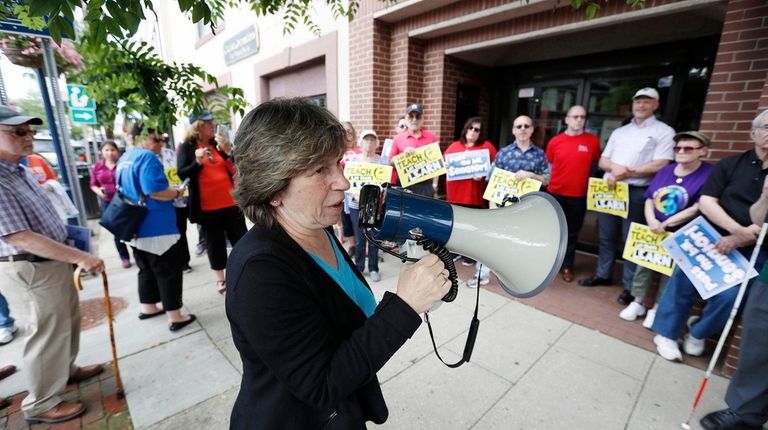
Randi Weingarten, president of the American Federation of
Randi Weingarten, president of the American Federation of Teachers, makes a speech during a demonstration on Friday in Oyster Bay. Photo Credit: Michael Owens

The great majority of districts in Nassau and Suffolk counties do not meet that standard, set by federal law.
The letter was addressed to state Education Commissioner MaryEllen Elia, who later said during a Newsday interview that NYSUT and other educational groups had been consulted before regulations were drafted.

The regulations would restrict the way that penalized districts spend federal Title I dollars, by requiring them to set aside money to be used in encouraging greater student test participation, according to union analysts who have reviewed the 95-page regulatory document.
In addition, analysts said, the proposed rules would change the way test-participation rates are factored into schools’ overall academic ratings, making it more likely that schools would be Continue reading: Union: School districts with high opt-out rates face penalty | Newsday:

Saturday, June 2, 2018

How Mexican teachers unions are pushing the presidential frontrunner left | Salon.com

How Mexican teachers unions are pushing the presidential frontrunner left | Salon.com:

How Mexican teachers unions are pushing the presidential frontrunner left

López Obrador is signaling his support for the thousands of communities fighting privatization across Mexico


This article originally appeared in In These Times
InTheseTimes
As Mexico moves closer to the July 1 Presidential election, candidate AndrĆ©s Manuel López Obrador (commonly referred to AMLO) is signaling his support for the thousands of communities fighting privatization across Mexico. López Obrador hails from the Juntos Haremos Historia coalition — a center-left coalition of National Regeneration Movement Party, The Labor Party and the Social Encounter Party. He is the former mayor of Mexico City and widely considered to be the frontrunner. López Obrador has found a significant ally in the Oaxacan teachers of Sección XXII, who are pushing the candidate to take a more left-leaning position on privatization and reject controversial education reforms.
On May 12, López Obrador announced in a speech in Puebla that he rejects privatization programs of previous administrations. "Privatization policies are over,” he declared. “Water will not be privatized; health services will not be privatized.”
 Among the privatization efforts he focused on were the education reforms passed by Enrique Pena Nieto, calling the measures “a humiliation of the teachers.” López Obrador announced in mid-May that he would end the education reform.

The announcement represents the culmination of resistance to the controversial reforms, according to the teachers of Oaxaca’s Sección 22 of the National Union of Education Workers (Sindicato Nacional de Trabajadores de la Educación, or SNTE) and The National Coordinator of Education Workers (Coordinadora Nacional de Trabajadores de la Educación, or CNTE).
The teachers' decision to pursue an agreement with the López Obrador was made in Februaryduring the V Political Congress of Sección XXII. Eloy López HernĆ”ndez, Sección XXII’s General Secretary, announced the decision “to influence this electoral situation by orienting the conscious and reasoned vote towards the bases, to the parents of family and society in general, to being guarantors of the popular will in favor of the alternative project of nation" that López Obrador's campaign represents. Carlos Barriosa, a member the political section of Sección XXII, is using a Continue reading: How Mexican teachers unions are pushing the presidential frontrunner left | Salon.com:

Gates Foundation launches a new global education strategy | Devex

Gates Foundation launches a new global education strategy | Devex:

Gates Foundation launches a new global education strategy


SAN FRANCISCO — On Friday, the Bill & Melinda Gates Foundation launched its global education strategy, to provide education systems in India and sub-Saharan Africa with better resources to improve teaching and learning.
Building on its investments in global health and international development, and expanding its work on education beyond the United States, the new global effort has a $68 million budget for the next four years.
In a blog post announcing the strategy, Girindre Beeharry, director of global education at the Gates Foundation, notes the progress the world has made on education over the past 15 years, but explains that expanded access has not translated to better outcomes.
“What we’re trying to do here is stay with the problem a bit longer, as opposed to going to a solution mode,” he told Devex ahead of the announcement. “Instead of saying, ‘This is the answer,’ we are trying to say: ‘It is likely that every country will need to find its own path in solving the education problem.’”
 The strategy has four pillars: At the classroom level, the foundation will identify cost-effective approaches to supporting teaching and learning; it will work with partners to assess the causes of poor performance and identify solutions best suited to those needs; it will support efforts to make data on learning outcomes comparable across countries so progress can be tracked over time; and it will seek to understand barriers holding girls back.

Millions of children in school are learning very little, which emphasizes the point that attendance and learning are separate challenges, Beeharry wrote in the blog post.
“Leaving these students behind amplifies inequality, as the learning deficiency is largest among the poor,” he continued in the post. “The learning deficit is also at the root of what worries many governments: A poorly skilled youth population.”
Traditionally, the Gates Foundation’s work on education has been limited to the United States, though Bill Gates, billionaire co-chair of the Gates Foundation, has personally supported education beyond U.S. borders through some of his investments.
Gates, who along with his wife and fellow foundation co-chair Melinda Gates, Continue reading: Gates Foundation launches a new global education strategy | Devex:

Friday, June 1, 2018

'Janus' and Its Supreme Court Enablers | Capital & Main

'Janus' and Its Supreme Court Enablers | Capital & Main

‘Janus’ and Its Supreme Court Enablers

The stacking of the U.S. Supreme Court with anti-union justices has allowed the right-to-work movement to circumvent, and undercut, pro-union state policies.

 NIELFEDERALIST


n the fall of 2015, the Federalist Society, a conservative legal organization with a libertarian bent, held its annual lawyers convention at the Mayflower Hotel in Washington, DC. The three-day event included a panel that reviewed the past decade of the John Roberts court, and featured Michael Carvin, a high-powered attorney with Jones Day, who in recent years has taken the fight against labor unions to the Supreme Court.
Carvin began his remarks, curiously, by downplaying the chief justice. “The real consequential thing that happened 10 years ago, frankly, was not John Roberts replacing Chief Justice Rehnquist,” he told the crowd. Instead, he argued, the dramatic shift had been the replacement of Sandra Day O’Connor by Samuel Alito.
There was a lot that Carvin and Alito had in common. Both were members of the Federalist Society—Alito had joined in 1983, a year after it was founded; Carvin has served as the chairman of the Society’s Civil Rights Practice Group. The men also had worked together at the Justice Department during the Reagan administration. In 2006, when George W. Bush nominated Alito to the Supreme Court, it was Carvin who repeatedly stood up for his former colleague’s far-right views. Carvin even went so far as to defend him when the Wall Street Journal revealed that Alito, when applying for the Reagan position, had written that he disagreed with the Supreme Court decision that had established the “one person, one vote” doctrine as the framework for American elections.
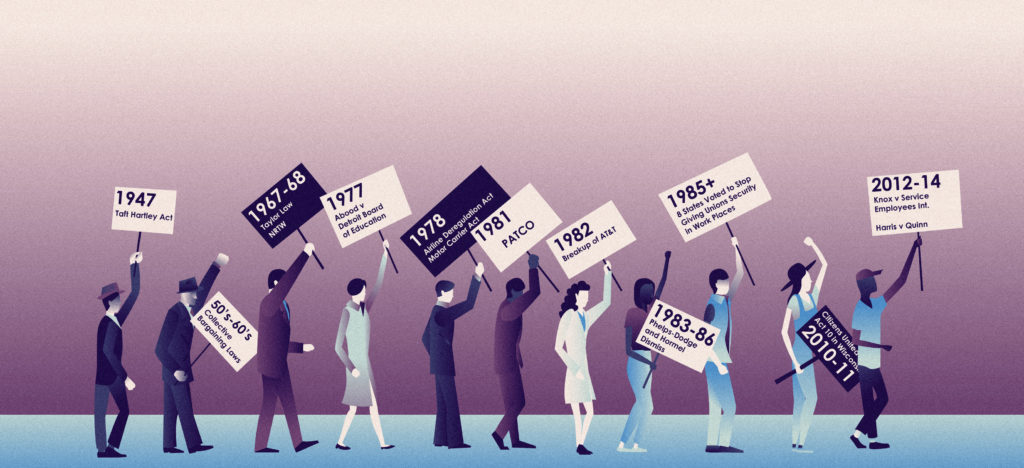
At the Mayflower Hotel, Carvin argued that Alito represented “some baby steps toward the return of law.” Just two months later, Carvin was in front of Alito and the eight other justices, arguing a case, Friedrichs v. California Teachers Association, that sought to strip public sector unions from “fair share” fees they collected to represent workers who declined to join the union. (By law, a union must represent all workers in a bargaining unit, whether or not they choose to join. It was a far-reaching case that could cripple the power of unions, and would represent the crowning achievement of a conservative movement that had been decades in the making. Disclosure: The California Teachers Association is a financial supporter of this website.)
In a unanimous 2009 decision, the court reaffirmed a 1977 case, Abood v. the Detroit Board of Education, which had ruled that unions could charge such fees. But the ascent of Alito had helped shift the court in a vehemently anti-union direction, and it was widely expected to rule against the unions in Friedrichs. Then Antonin Scalia suddenly died, and the court deadlocked, four-to-four. The reprieve was only Continue reading: 'Janus' and Its Supreme Court Enablers | Capital & Main
Image result for Ć¢€˜JanusĆ¢€™ and Its Supreme Court

Private schools' curriculum downplays slavery, says humans and dinosaurs lived together - Orlando Sentinel

Private schools' curriculum downplays slavery, says humans and dinosaurs lived together - Orlando Sentinel:

Schools Without Rules: Private schools' curriculum downplays slavery, says humans and dinosaurs lived together

private school curriculum


 ome private schools in Florida that rely on public funding teach students that dinosaurs and humans lived together, that God’s intervention prevented Catholics from dominating North America and that slaves who “knew Christ” were better off than free men who did not.

The lessons taught at these schools come from three Christian publishing companies whose textbooks are popular on many of the about 2,000 campuses that accept, and often depend on, nearly $1 billion in state scholarships, or vouchers.
At the Orlando Sentinel’s request, educators from Florida colleges and school districts reviewed textbooks and workbooks from these publishers, looking at elementary reading and math, middle school social studies and high school biology materials.
They found numerous instances of distorted history and science lessons that are outside mainstream academics. The books denounce evolution as untrue, for example, and one shows a cartoon of men and dinosaurs together, telling students the Biblical Noah likely brought baby dinosaurs onto his ark. The science books, they added, seem to discourage students from doing experiments or even asking questions.
“Students who have learned science in this kind of environment are not prepared for college experiences,” said Cynthia Bayer, a biology lecturer at the University of Central Florida who reviewed the science books. “They would be intellectually disadvantaged.”
The social studies books downplay the horrors of slavery and the mistreatment of Native Americans, they said. One book, in its brief section on the civil rights movement, said that “most black and white southerners had long lived together in harmony” and that “power-hungry individuals stirred up the people.”
The books are rife with religious and political opinions on topics such as abortion, gay  Continue reading: Private schools' curriculum downplays slavery, says humans and dinosaurs lived together - Orlando Sentinel:
Image result for private schools vouchers