Latest News and Comment from Education

Monday, June 12, 2017

Success Academy, Known for Harsh Discipline and Skimming Students, Wins Broad Prize | Diane Ravitch's blog

Success Academy, Known for Harsh Discipline and Skimming Students, Wins Broad Prize | Diane Ravitch's blog:

Success Academy, Known for Harsh Discipline and Skimming Students, Wins Broad Prize

Eva Moskowitz’s Success Academy charter chain, known for its harsh discipline and cherrypicking students, won the Broad Prize for Charter Schools.
In the past year, the New York Times ran stories about a “got to go” list, identifying students who were supposed to be pushed out because of their behavior or test scores.
Image result for big education ape eva moskowitz  “got to go” list,
There was also a prominent page-one story about a leaked video showing a teacher at SA humiliating a first-grade child and ripping her paper up in front of the class.
According to the press release, former Secretary of Education John King, a member of the selection committee for Broad, landed the choice and said that Success Academy proved it was possible to give high-quality to “every child.” He meant “every child” except those with disabilities, English language learners, nonconformists, and others who can’t or won’t produce high test scores.
“Success Academy is intentional about delivering quality instruction and offering well-rounded, hands-on learning experiences to every child,” said former Education Secretary John B. King Jr., who’s now president of the nonprofit, The Education Trust, and a member of the Broad Prize’s review board.
“These charter schools understand the benefit of a diverse educational community, with children of different socioeconomic status, race, and background all learning together,” he said.”Success Academy, Known for Harsh Discipline and Skimming Students, Wins Broad Prize | Diane Ravitch's blog:
Image result for big education ape eva moskowitz  “got to go” list,

Why giving grades destroys education--Aleteia

Standardized testing and education--Aleteia:

Why giving grades destroys education

Kids deserve better than to have their education turned into a contest.

Image result for Kids deserve better than to have their education turned into a contest.


 chool’s out for summer, which means I can finally be honest about something that’s been bugging me all year long: grades.

Grades are terrible for children. They’re terrible for all children, whether they struggle in math like my oldest or they excel in spelling like my youngest. They’re terrible for a million reasons, but the primary one is because they turn education into a contest.
Scary Mommy had a post up recently that expressed the unease around grading that’s beginning to circulate among parents. Author Meredith Ethington, herself a former honor roll student, said:
“It’s not that I don’t care about the grade. I do. But I think sometimes the emphasis we are putting on our kids getting straight A’s is setting them up for lofty expectations that just aren’t realistic for some kids. Not everyone excels in all areas. We all have our strengths and weaknesses. Not everyone is meant to be an honor roll student. I firmly believe that.”
This is true, but it’s just the tip of the iceberg. Grades are an utterly terrible way to monitor what a child has or hasn’t learned. I get that they’re convenient and simple, but like all convenient and simple things, they cause more harm than good.
Grades measure performance. Like standardized tests, grades reflect how well a student was able to perform — on tests, mostly, but also projects, homework, even class conversation.
What they don’t measure is how much a student understands. In high school, I spent countless afternoons in private tutoring for trig and pre-calculus. I did not care about those subjects — I used (and still use) my Standardized testing and education--Aleteia:

Key facts about race and marriage in the U.S. | Pew Research Center

Key facts about race and marriage in the U.S. | Pew Research Center:

Key facts about race and marriage, 50 years after Loving v. Virginia


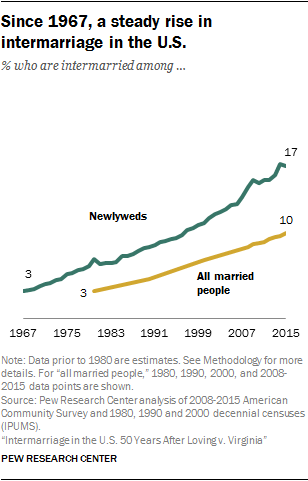
In 1967, the U.S. Supreme Court ruled in the Loving v. Virginia case that marriage across racial lines was legal throughout the country. Intermarriage has increased steadily since then: One-in-six U.S. newlyweds (17%) were married to a person of a different race or ethnicity in 2015, a more than fivefold increase from 3% in 1967. Among all married people in 2015 (not just those who recently wed), 10% are now intermarried – 11 million in total.
Here are more key findings from Pew Research Center about interracial and interethnic marriage and families on the 50th anniversary of the landmark Supreme Court decision.
1A growing share of adults say interracial marriage is generally a good thing for American society. Nearly four-in-ten adults (39%) say the growing number of people marrying someone of a different race is good for society, up from 24% in 2010. Adults younger than 30, those with at least a bachelor’s degree and those who identify as a Democrat or lean Democratic are especially likely to say this.
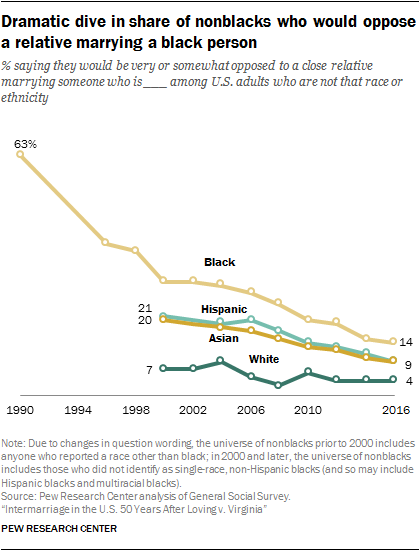
Americans today also are less likely to oppose a close relative marrying someone of a different race or ethnicity. Now, 10% say they would oppose such a marriage in their family, down from 31% in 2000. The biggest decline has occurred among nonblacks: Today, 14% of nonblacks say they would oppose a close relative marrying a black person, down from 63% in 1990.
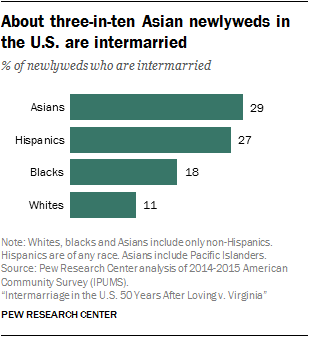
2Asian and Hispanic newlyweds are the most likely to be intermarried. Nearly three-in-ten Asian newlyweds (29%) were married to someone of a different race or ethnicity in 2015, as were 27% of Hispanic newlyweds. Intermarriage for these groups was especially prevalent among the U.S. born: 39% of U.S.-born Hispanics and almost half (46%) of U.S.-born Asian newlyweds were intermarried in 2015.
Although Asian and Hispanic newlyweds are most likely to be intermarried, overall increases in intermarriage have been driven in part by rising intermarriage rates among black and white newlyweds. The most dramatic increase has occurred among black newlyweds, whose intermarriage rate more Key facts about race and marriage in the U.S. | Pew Research Center:

Black Girls Matter: Pushed-Out, Overpoliced and Underprotected | Schott Foundation for Public Education

Black Girls Matter: Pushed-Out, Overpoliced and Underprotected | Schott Foundation for Public Education:

Black Girls Matter: Pushed-Out, Overpoliced and Underprotected

Image result for Black Girls Matter: Pushed-Out, Overpoliced and Underprotected
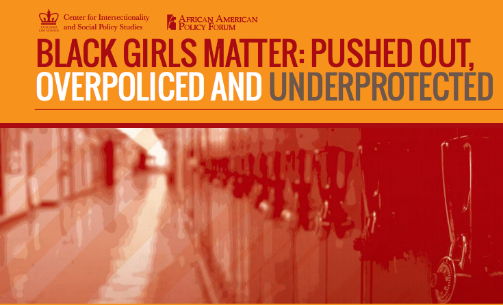
An important new report from the African American Policy Forum is a must-read for anyone committed to understanding how both race and gender impact educational opportunity in our country. Black Girls Matter: Pushed-Out, Overpoliced and Underprotected combines national data on school discipline with interviews with young women of color to paint a picture of their experiences in school and in their communities and to offer suggestions for how we can better support them.
 Download here (2.14 MB)


 Black Girls Matter: Pushed-Out, Overpoliced and Underprotected | Schott Foundation for Public Education:

Related image

Black Girls Matter:
Pushed Out, Overpoliced, and Underprotected

February 4, 2015—Girls of color face much harsher school discipline than their white peers but are excluded from current efforts to address the school-to-prison pipeline, according to a new report issued today by the African American Policy Forum and Columbia Law School’s Center for Intersectionality and Social Policy Studies. 
The report, Black Girls Matter: Pushed Out, Overpoliced and Underprotected, is based on a new review of national data and personal interviews with young women in Boston and New York. Read a copy of that report here.
“As public concern mounts for the needs of men and boys of color through initiatives like the White House’s My Brother’s Keeper, we must challenge the assumption that the lives of girls and women—who are often left out of the national conversation—are not also at risk,” said Kimberlé Crenshaw, the report’s lead author.
 Crenshaw, a leading authority in how law and society are shaped by race and gender, argues that an intersectional approach encompassing how related identity categories such as race, gender, and class overlap to create inequality on multiple levels is necessary to address the issue of school discipline and the school-to-prison pipeline.
The study cites several examples of excessive disciplinary actions against young black girls, including the controversial 2014 case of a 12-year-old in Georgia who faced expulsion and criminal charges for writing the word “hi” on a locker room wall.  A white female classmate who was also involved faced a much less severe punishment.  
According to the most recent data from the U.S. Department of Education cited in the report, nationally black girls were suspended six times more than white girls, while black boys were suspended three times as often as white boys.
Data specific to New York and Boston demonstrates that the relative risk for disciplinary action is higher for Black girls when compared to white girls than it is for Black boys when compared to white boys.
      In New York, the number of disciplinary cases involving black girls was more than 10 times more than those involving their white counterparts and the number of cases involving black boys was six times the number of those involving white boys, despite there being only twice as many black students as white students.
      In Boston, the number of disciplinary cases involving black girls was more than 11 times more than those involving their white counterparts while the number of cases involving black boys was approximately eight times those involving white boys, despite there being less than three times as many black students as white students.
      Rates of expulsion were even more strikingly disproportionate between black and white students, especially among girls.
The report recommends policies and interventions to address challenges facing girls of color, including revising policies that funnel girls into juvenile supervision facilities; developing programs that identify signs of sexual victimization and assist girls in addressing traumatic experiences; advancing programs that support girls who are pregnant, parenting, or otherwise assuming significant familial responsibilities; and improving data collection to better track discipline and achievement by race/ethnicity and gender for all groups.
Click on the images below to access to the report, the executive summary, and a Black Girls Matter: Social Media Guide, which provides images, tweets, and key messages for you to use in promoting the basic point that Black Girls Matter. 
Black Girls Matter: Pushed Out, Overpoliced and Underprotected — AAPF - http://www.aapf.org/recent/2014/12/coming-soon-blackgirlsmatter-pushed-out-overpoliced-and-underprotected

Lily Eskelsen García: He wanted to interview me, but then I learned about him.

He wanted to interview me, but then I learned about him.:

He wanted to interview me, but then I learned about him…

I get many inquiries from reporters who want my take on an issue. Recently, I received an unusual query. It was from a student at Orange County Community College (OCCC) in Newburgh, NY who writes for the campus paper.
The student, Samir Thomas, sent me some of his articles from the Community College Campus News and asked for my answers to two questions for a series he’s writing to help special education students adjust to college. What Samir asked me and what he wrote were so moving that I wanted to share it.
First, let me tell you a little about this remarkable student.
Samir lives with his mom and brother in Newburgh.  When he and his younger brother were very young, they ingested lead-based paint chips from the walls of their old apartment in the Bronx. Lead poisoning, which can result short- and long-term learning difficulties and damage a developing brain, was the result. 
From kindergarten through 12th grade, Samir and his brother were in special education in the Newburgh Enlarged City School District. Last August, Samir graduated from high school. He enrolled in community college through TRIO, the federal outreach programs that assist students who are low-income or have special needs.
Those programs are a lifeline—but at this moment they’re in danger.  They would suffer under the budget-cutting agenda of Donald Trump and Betsy DeVos, a dangerous duo that wants to take an ax to funding for public schools and higher education.
The Individuals with Disabilities Education Act (IDEA), which helps level the educational playing field but has never been fully funded by Congress, is at risk, as are many other programs designed to help vulnerable K-12 and college students. But it doesn’t have to be this way. Take a minute to send an email to DeVos and tell her how harmful her plans are.
Samir gives me even more motivation to fight for all our students—so that each and every one of them has the resources and support to discover their passions, follow their hearts, and live out their dreams.
Samir’s goal is to graduate with an associate’s degree and then attend a four-year college to study engineering science. And he’s well on his way. In his articles, he shares tips and lessons learned from his first year at OCCC. Here are a few:
  • “Thinking about going to college made me extremely nervous. I didn’t believe I would understand what my teachers, a.k.a. professors, said, or the classwork. I had a fear of the big words they would use or not knowing He wanted to interview me, but then I learned about him.:

Confederate Statues Down In New Orleans, But Structural Racism Still Stands Tall In Our Schools | PopularResistance.Org

Confederate Statues Down In New Orleans, But Structural Racism Still Stands Tall In Our Schools | PopularResistance.Org:

Confederate Statues Down In New Orleans, But Structural Racism Still Stands Tall In Our Schools

Image result for New Orleans, But Structural Racism Still Stands Tall In Our Schools

Above Photo: Ashana Bigard. Two students embrace outside a New Orleans Center for the Creative Arts graduation ceremony that many protested because of the high numbers of fellow students being expelled for minor, arbitrary infractions, and not allowed to graduate.
Many New Orleanians celebrated at the removal of confederate monuments around the city in recent weeks. But on the same day that Robert E. Lee’s bronzed image came down from Lee Circle, two black boys (like hundreds of boys throughout the city and state of Louisiana) were not allowed to graduate for arbitrary, punitive, and potentially illegal reasons.
The monuments may be gone, but structural racism continues to create barriers for students of color in New Orleans schools.
Take the cases of Rahsaan Ison and Rashaad Brown, both enrolled at the New Orleans Center for the Creative Arts. They had requested a tutor in Spanish, and one was provided to them under state and federal law protecting students with disabilities. But the tutor turned out to be so unprofessional that their school claimed he had cheated on a test by answering questions for them, and refused to accept any of their work, making it impossible for them to achieve their graduation requirements.
I acted as a student advocate for the boys, and I asked for an accommodation on the 504 plan so they could graduate with the rest of the class. Both Ison and Brown worked hard and had completed more than 621 assignments, and, according to computer records, they had passing grades. On the day of the graduation ceremony at 9:00am, they were told by their principal that they had another 1700 assignments to do that he had yet to “unlock.”
I son, who suffers with panic attacks, couldn’t breathe when he heard the news.
“Why?” he asked. “What kind of ugly set up is this? How can we do assignments if you didn’t even unlock them? Every hoop you gave us to jump through, we jumped and jumped and now you’re telling me I still can’t graduate with my class. Why?”
And if that is not enough to get your blood boiling, Ison was even featured in Teen Vogue, after NOCCA expelled him in his ninth grade year because he had crossed train tracks (which he didn’t know was forbidden) in order to save time and not be late forConfederate Statues Down In New Orleans, But Structural Racism Still Stands Tall In Our Schools | PopularResistance.Org:

K–12 Cyber Incidents Have Been Increasing in 2017 -- THE Journal

K–12 Cyber Incidents Have Been Increasing in 2017 -- THE Journal:

K–12 Cyber Incidents Have Been Increasing in 2017

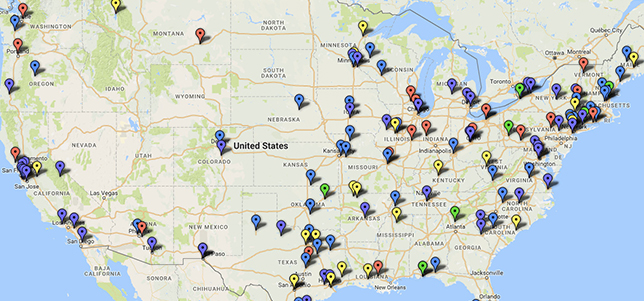
The creator of a national K–12 Cyber Incident Map warns that schools should act now, not later, to bolster their security.

map
Ed Tech Strategies' K–12 Cyber Incident Map. Courtesy of Doug Levin.


The founder and operator of a K–12 Cyber Incident Map is sharing some lessons he has learned after collecting data over the past 17 months on cyber incidents at United States schools.
Doug Levin, president of Ed Tech Strategies, a Virginia-based research and counsel consultancy, says that as K–12 schools increase their use and reliance on digital tools and services, the number of cyber incidents has also been on the rise — exponentially so.
Since Jan. 1, 2016, 141 U.S. K–12 schools and districts experienced one or more publicly disclosed cyber incidents. Sixty-seven incidents were reported during 2016, and 74 have been reported during the first five months of 2017. If the pace continues at the current rate, that will represent a more than 100 percent increase in 2017, compared to last year.
“Incidents and disruptions have been on the rise,” Levin said in an interview. “We have had more incidents in 2017 than all of 2016. We’ve seen more than double the number of incidents in schools.”
Levin attributed this rise to a few different factors: more awareness of nefarious cyber activities; more schools using more hackable technologies; more schools going 1-to-1 and relying on digital tools; and bad actors who continue to look for soft targets, such as students and school staff.
“They’re looking for vulnerable targets,” Levin said. “My sense is that as schools increase reliance on technology, [cybercriminals] are finding that schools are softer targets.”
Levin has been tracking the publicly disclosed K–12 incidents on a color-coded K–12 Cyber Incidents Have Been Increasing in 2017 -- THE Journal:

Chicago’s public teacher union and charter teacher union merge. Hear about it on this coming Hitting Left with the Klonsky brothers minus one brother. | Fred Klonsky

Chicago’s public teacher union and charter teacher union merge. Hear about it on this coming Hitting Left with the Klonsky brothers minus one brother. | Fred Klonsky:

Chicago’s public teacher union and charter teacher union merge. Hear about it on this coming Hitting Left with the Klonsky brothers minus one brother.


The Chicago Teachers Union legislative director Stacy Davis Gates and Chris Baehrend, head of ChiACTS, the Chicago charter teacher union (with Chuy Garcia).
I will be in Brooklyn this coming weekend to celebrate my granddaughter’s graduation from middle school to high school.
Which means I will miss my co-hosting job on Friday’s Hitting Left with the Klonsky Brothers at 11AM on 105.5 FM, streaming live on http://www.lumpenradio.com and podcasted at Hittingleft.libsyn.com
I will be sorry to miss the conversation my brother will be having with the Chicago Teachers Union’s Political and Legislative Director Stacy Davis Gates and Chris Baehrend of ChiACTS, the charter teachers union.
Both groups, currently separate affiliates of the American Federation of Teachers, have agreed to merge.
Even the charter organizers have described Chicago as the epicenter of charter union organizing.
Chicago’s public teacher union and charter teacher union merge. Hear about it on this coming Hitting Left with the Klonsky brothers minus one brother. | Fred Klonsky:


Image result for hitting left with the klonsky brothers

The big problem with what Trump just said about religion in schools - The Washington Post

The big problem with what Trump just said about religion in schools - The Washington Post:

The big problem with what Trump just said about religion in schools


On the day that Washington was riveted by the testimony on Capitol Hill of former FBI director James Comey, President Trump made a speech to a group of religious conservatives during which raised the issue of religion and schools. Here is what he said on June 8, according to a White House transcript:
So we want our pastors speaking out. We want their voices in our public discourse. And we want our children to know the blessings of God. (Applause.) Schools should not be a place that drive out faith and religion, but that should welcome faith and religion with wide, open, beautiful arms. (Applause.) Faith inspires us to be better, to be stronger, to be more caring and giving, and more determined to act in selfless and courageous defense of what is good and what is right. It is time to put a stop to the attacks on religion. (Applause.) Thank you.
It’s no surprise that Trump would say this to the Faith and Freedom Coalition; 80 percent of white evangelicals who voted in the November 2016 selected supported him, and polls show that most of them approve the job he is doing as president.
But a First Amendment scholar has some issues with what Trump said. The following is the reaction from Charles Haynes, the vice president of the Newseum Institute in Washington D.C. and founding director of the Religious Freedom Center of the Newseum Institute:
I have no problems with the part where the president calls on schools to “welcome faith and religion” — only, of course, if he means that they welcome religion throughout the First Amendment door. If Trump is saying that public schools should treat students of all faiths with fairness and respect, then he is only re-stating what the law requires under the First Amendment.
Unfortunately, however, the president frames his remarks in culture-war language about schools being places that “drive out faith” and ends his remarks with a call to “put a stop to attacks on religion.” This is a false narrative about most public schools today, a narrative that stirs anger by reinforcing culture-war myths about public schools as places hostile to religion.
I very much doubt that President Trump has visited very many public schools 
The big problem with what Trump just said about religion in schools - The Washington Post:


 FFRF_NYTAd_Pence_11x21_sm

DeVos is Questioned About Campaign to Influence Climate Change Education | FRONTLINE | PBS

DeVos is Questioned About Campaign to Influence Climate Change Education | FRONTLINE | PBS:

DeVos is Questioned About Campaign to Influence Climate Change Education

Image result for DeVos  Climate Change Education
Four Democratic senators are sharply criticizing a conservative think tank’s efforts to bring climate change skepticism into the nation’s public schools as “industry funded” and “possibly fraudulent” and demanding to know whether federal education officials have been in contact with the group.
The Heartland Institute has been sending books, DVDs and pamphlets to science teachers across the country promoting its stance that climate change is caused by natural phenomena rather than human activities — a view rejected by nearly all climate scientists. Heartland’s campaign to influence how climate science is taught in public schools was first reported by FRONTLINE and The GroundTruth Project in March.
The Illinois-based non-profit vows to continue its efforts, saying it has already sent more than 300,000 packages to K-12 and college-level science teachers since the launch of the campaign earlier this year. Mailings have wrapped up for the summer break, according to Heartland spokesman Jim Lakely. He added, however, “This is not the end of Heartland’s efforts to bring balance to the climate debate in our schools, but just the beginning.”
In a letter sent to Education Secretary Betsy DeVos on Wednesday, Sens. Sheldon Whitehouse (D-R.I.), Brian Schatz (D-Hawaii), Edward Markey (D-Mass.) and Elizabeth Warren (D-Mass.) — all of whom have been outspoken on climate change issues — described the campaign as an effort “to disseminate fossil-fuel industry talking points as curriculum for science teachers.”
The senators asked DeVos whether any Education Department officials have had contact with individuals associated with the Heartland Institute “on climate, science, or science education issues,” and whether any informational resources put out by the department have been created in collaboration with Heartland.
The senators also asked DeVos whether she was aware of any discussions between the White House staff and Heartland. In March, the group’s president and CEO, Joseph Bast, told FRONTLINE and GroundTruth, “We’re getting a lot of requests for expert opinion from the White House … That’s very new.”
Heartland was founded in 1984 and has a history of promoting causes that align with the interests of industry. In the 1990s, for instance, the organization lobbied against smoking bans, for which it was rewardedwith donations from tobacco company Philip Morris. Today, the group DeVos is Questioned About Campaign to Influence Climate Change Education | FRONTLINE | PBS:
Related image
Image result for DeVos  Climate Change Education

Jessica Tang quietly makes history with Boston Teachers Union election - The Boston Globe

Jessica Tang quietly makes history with Boston Teachers Union election - The Boston Globe:

Jessica Tang quietly makes history with Boston Teachers Union election

Jessica Tang has been elected the Boston Teachers Union’s new president.

The most remarkable thing about Jessica Tang’s ascension as head of the Boston Teachers Union might be just how unremarkable it feels.
Tang’s election last week as president of one of the city’s most important unions was anticlimactic: She was unopposed. She’s the first person of color to head the union, the first member of the LGBT community, and the first woman in more than three decades. Since 1983, in fact, only two people, Edward Doherty and the retiring Richard Stutman, have led the city’s teachers. 
But Tang, 35, is a brilliant and passionate advocate for public schools and their teachers.She has learned the art of fiercely defending positions without sparking personal animusand her rise through the union ranks has been so seamless that she was elected to the presidency unopposed. 


She takes office at a challenging time for the union, which is locked in a contentious contract negotiation with the city. This is also a watershed moment for teachers unions in general, facing fire Jessica Tang quietly makes history with Boston Teachers Union election - The Boston Globe:

Seattle Schools Community Forum: Tomorrow's City Council Vote on Two-Tier Transportation

Seattle Schools Community Forum: Tomorrow's City Council Vote on Two-Tier Transportation:

Tomorrow's City Council Vote on Two-Tier Transportation

Image result for drive safely school

The full City Council will hear the legislation tomorrow about the City paying for a two-tier bus system for school year 2017-2018 from Families and Education levy funds.  Here is the agenda and here is the Summary and Fiscal Note.

According to the agenda, this item will come up in the first third of the meeting which starts at 2 pm at City Hall in City Council chambers.

Of interest from the Summary and Fiscal Note:

Summary:  


This legislation, if approved, would authorize the Department of Education and Early Learning to provide a one-time, $2.3 million payment to Seattle Public Schools (SPS) for a transportation realignment to a two-tier system and would appropriate funds to the Seattle Department of Transportation (SDOT) to fund school crossing guards.
From Background:
The Seattle School Traffic Safety Committee (a team including representatives from SDOT, Cascade Bicycle Club, Seattle Police Department, Seattle Neighborhood Greenways, Seattle Public Schools Transportation Department) recommends one or more crossing guards at 107 school locations in order to provide safe routes for students walking to and from school. Due to the current funding levels from the State and the resulting strain on the SPS budget, SPS is unable to fund the crossing guard program as it is focusing all available resources into classrooms. This legislation would use funds from the School Safety Traffic and Pedestrian Improvement Fund to support the crossing guard program.

Please describe any perceived implication for the principles of the Race and Seattle Schools Community Forum: Tomorrow's City Council Vote on Two-Tier Transportation:

Selling Back to the Public What It Already Owned: “Public-Private Partnership” Shark Bait | deutsch29

Selling Back to the Public What It Already Owned: “Public-Private Partnership” Shark 

 | deutsch29:

Selling Back to the Public What It Already Owned: “Public-Private Partnership” Shark Bait

Image result for bad public-private partnership

I find myself increasingly encountering the term, “public-private partnership.”
Today, I read two articles centered on this idea, both of which concerned Vice President Mike Pence– and one that concerned Pence’s role in the aftermath of Hurricane Katrina.
One article also included a sprinkling of US secretary of [privatized] education, Betsy DeVos.
A major goal of corporate education reform is to hand over public education to private entities (corporations, or even nonprofits, but don’t think that an entity termed “nonprofit” cannot be a handsome money dispenser for those running the nonprofit and doling out contracts). However, the extreme-right-Republican aim does not end with public education but with handing over the operation of the entire American infrastructure to private entities.
In the end, what this entails is having private corporations front money to state and local governments in order to lease back to the public what the public already owns.
It’s similar what already happens in the case of some charter schools. The school owns property, which it “sells” to a private corporation or third-party nonprofit and then leases back from that entity– often at extreme rates– thereby milking public funds to pay the lease, which was the point. (I wrote about this practice in my book, School Choice: The End of Public Education?.)
The third-party landlord is the one who can really make some money by throwing an initial, tempting sum of cash at the would-be former owner (in the case of public works, the tempting cash is given to a public board, for example) in exchange for major– often ridiculous, balloon-payment-styled– future profits.
Think predatory loans. I saw a commercial years ago for one of those quick-cash businesses that preys on lower-income individuals, and I was able to read the minuscule fine print at the bottom of the screen as I was hearing how I deserved to give myself a break by getting cash when I needed it.
The interest exceeded 300 percent. So, on the back end of the deal, the one who sells his birthright for a bowl of stew feels the sting.
Think of Chicago’s parking meter fiasco. From the May 23, 2016, Chicago Sun-Times:
Chicago’s parking-meter system took in $121.7 million last year, while four underground city-owned garages reaped another $34.7 million — with not a penny of that money going to the cash-strapped city government.
Instead, the $156.3 million pot of parking cash went to private investors who
Selling Back to the Public What It Already Owned: “Public-Private Partnership” Shark Bait | deutsch29:
 Image result for big education ape kevin johnson
Image result for big education ape kj arena
Image result for big education ape kevin johnson
Image result for big education ape kj privatization

Case Challenging Segregation as Violation of State Constitutional Right to Education Gains Support of National Scholars and Advocates - Education Law Prof Blog

Education Law Prof Blog:

Case Challenging Segregation as Violation of State Constitutional Right to Education Gains Support of National Scholars and Advocates

Image result for Constitutional Right to Education fape


For two decades, advocates and scholars have been calling for an expansion of school quality and  finance precedent to incorporate claims challenging school segregation.  The Connecticut Supreme Court issued the most significant victory in Sheff v. O'Neill in 1996, holding that de facto segregation violated the state's education clause.  Plaintiffs in Minnesota are hoping their new case, Guzman v. State, will follow suit. 
The plaintiffs survived a motion to dismiss in the trial court.  After a quick stop at the court of appeals, the case is now before the Minnesota Supreme Court.  The primary issue before the court is whether de facto racial and/or socioeconomic school segregation violates the Education Clause of the Minnesota Constitution.  The state argues the issue is non-justiciable.
Last week, the Education Law Center and over twenty of the nation’s leading education and constitutional law scholars filed an amicus brief in support of the plaintiffs.  The brief argues that the state constitution’s mandate for the legislature to maintain a “general and uniform system of education” makes plaintiffs’ segregation claims justiciable.  They cite to Minnesota precedent, as well as a host of other cases from peer states, regarding the general responsibility of courts to adjudicate school equity and quality challenges.  The brief emphasizes that:
a claim that an education system is segregated by race is justiciable because, as state supreme courts have long and properly recognized, education clauses in a state constitution not only prohibit intentional segregation that is unlawful under Brown v. Board of Education, 347 U.S. 483 (1954), but also protect students against the negative effects of segregation when they are unintentional. Segregated schools are unequal schools and therefore do not provide a “general and uniform,” “thorough and efficient” system of education, as required by the Minnesota State Constitution.
[I]n Skeen, th[e Minnesota Supreme] Court acknowledged that the guarantee in the Education Clause of a Education Law Prof Blog:

Higher order thinking about HOTS – Missouri Education Watchdog

Higher order thinking about HOTS – Missouri Education Watchdog:

Higher order thinking about HOTS 

Image result for hot temperature

All hail Higher Order Thinking Skills!
HOTS (gotta love the acronym) conjures up images of Einstein, Hawking and Holmes. Who wouldn’t want to be them? Who wouldn’t want to have a company full of them? If our schools could teach more kids to have good HOTS, think of how far our country could go. Or so goes the lower level thinking of HOTS.
Higher order thinking skills involved analyzing and evaluating. In contrast lower order thinking skills involve things like observing and describing. We are being pushed towards prizing the former, when often we really value the latter because it can be so much harder to do.
Take our friend Sherlock Holmes. Yes he was able to use the art of deduction to solve crimes, clearly using higher order thinking. But his greatest skills was observing which we are told is a lower order thinking skill. His classic rebuke to Dr. Watson in A Scandal in Bohemia was, “You have not observed. And yet you have seen.”
Nathan Woods in the Journal of Education wrote, “In some situations the ability to observe and describe something accurately and in detail is demanding. Because human minds tend to impose patterns or ‘meanings’ onto their perceptions, the ability to see accurately and in detail is often difficult.”
In contrast, higher order thinking like analyzing a text, breaking it into parts and see how the parts make up to the whole, can be much easier than writing an accurately descriptive paragraph of an observation.
Yet our schools want to focus heavily on HOTS. They want to teach it. Test it. Foster it. Why? Because business claims to want it.
As a business owner I might like the concept of a bunch of really smart people analyzing my business and coming up with creative solutions to bring in more revenue. I may even buy into the concept of business disrupters which worked well for Aldi, but not so much for Garmin after Google Maps completely blew apart their business model. Higher order thinking skills work really well for the entrepreneur who can analyze an existing market, like for-hire transportation, and come up with a completely different delivery model (Uber) to shift market share away fromHigher order thinking about HOTS – Missouri Education Watchdog: 

Diversity Is A Good Thing – redqueeninla

Diversity Is A Good Thing – redqueeninla:

Diversity Is A Good Thing

Related image


But what is it? Like pornography, it seems to be something folks “know” when they see, but aren’t very comfortable defining.
For one thing, there’s the question of what kind of diversity we’re talking about. It’s used commonly as a proper noun, without explanation as to what particular sort of diversity is alluded to. Not nailing down a definition means there’s always room to squirt the other direction when challenged: “No, I meant ethnic diversity not racial”….
Socioeconomic diversity is often conflated with racial diversity, entwining racism and prejudice and all manner of unexamined presumptions. But the federal government provides a tolerably good way to quantify a school’s socioeconomic diversity. By using their surrogate measure of poverty, qualification for the free-or-reduced-price-meal-program (FRPM), schools in LAUSD are ranked by the proportion of their students who are Title I-eligible, or “poor”. This proportion though subject to considerable measurement error and bias, becomes a rough measure of the school’s poverty concentration. Title I is the federal program that supplements the budget of schools serving highly concentrated populations of impoverished children.
A school where more than 3 in 4 children are Title 1-Eligible (T1 > 75%) is in such high need that the federal government mandates these “T1” schools receive T1 monies first. Schools with a high T1 ranking can be understood to be “segregated” by socioeconomic status because so comparatively few children attend who are not low-income.
Conversely, as the proportion of T1-eligible kids drops in a student body, the “diversity” of the school goes up, by definition. Schools of middling T1 Diversity Is A Good Thing – redqueeninla: