Latest News and Comment from Education

Tuesday, April 11, 2017

Time for a Break Tuesday on Diane Ravitch's blog | A site to discuss better education for all

Diane Ravitch's blog | A site to discuss better education for all:

Time for a Break Tuesday on Diane Ravitch's blog
 A site to discuss better education for all


Trump on Track to Spend More on Vacations in One Year than Obama in 8 Years
CNN reports that the government has spent more than $20 million for Trump’s weekend trips over 80 days–and will spend more in one year than was spent on Obama in 8 years. This would not be an issue if Trump had not ridiculed Obama for excessive spending on his vacations. Excessive?? Trump on pace to surpass 8 

Media Mattters Calls for Journalists to Investigate Devos’s Department of Education
The nonpartisan group Media Matters has issued a call for an investigation of the staffing of the U.S. Department of Education. The call is directed at reporters, since there is little likelihood that either house of Congress would investigate 

Gayle Green: Corporate School Reform and the Cynical Manipulation of the English Language
Gayle Green is a professor of English at Scripps College. She is writing a book about the corporate reform in higher education. In this article , she describes how corporate reformers have taken guidance from Orwell’s “1984” in their deliberate distortion of language to mask reality. She writes: “In this post-truth age that’s done away with facts, George Orwell’s 1984 has soared to the top of the
One of the Best Articles You Will Ever Read About Standardized Testing
When I read this post by Steven Singer, I was so excited that I thought about devoting an entire day to it. Like posting it and posting nothing else for the entire day. Or posting this piece over and over all day to make sure you read it. It is that important. Steven’s post explains two different phenomena. First, why is standardized testing so ubiquitous? What does it have a death grip on public
Indiana Officials Planning State Takeover of Gary and Muncie Schools
The far-rightwing organization ALEC (American Legislative Exchange Coucil) owns the state of Indiana. ALEC is determined to crush public education. Check out ALEC exposed, a website that show the ALEC agenda for charters, vouchers, and state takeovers. ALEC hates democracy and local control. It hates local school boards, because they interfere with privatization. In Indiana, with Mitch Daniels as
Phyllis Bush: “Nobody’s Gonna Break My Stride”
Phyllis Bush is a retired English teacher in Indiana. She became active in the fight to save public schools in her state as the privatization movement gained steam under Mike Pence’s predecessor as governor, Mitch Daniels. Phyllis was one of the founders of Northeast Indiana Friends of Public Education. She is a powerhouse, a passionate advocate with a wonderful sense of humor, and a wise woman.
Should Your High School Be Recognized for Its Success in Providing Equal Opportunity to All Students? Apply Now.
The National Education Policy Center is inviting high schools to apply for recognition as a “school of opportunity.” A School of Opportunity is one that works hard to make sure that all children have equal opportunity to succeed. The deadline for applying is May 1. Learn more by going to this site: schoolsofopportunity.org High schools still have three weeks left to apply for recognition for work

YESTERDAY

Here is the “Reform” that DeVos Loves: Religious Schools
What we have learned about Betsy DeVos is this. She doesn’t like public schools, unless they are “great schools,” which they seldom are, because they are government schools, dead ends, and godless. In this article , Emma Brown of the Washington Post describes the schools that DeVos loves: they are religious; they are Christian; they don’t have to be accountable to the state; their teachers don’t
Laura Chapman: California Loves Waste, Fraud, and Financial Abuse So Long as the Money Goes to Charters
In response to the report from “In the Public Interest” about waste, fraud, and abuse of taxpayer dollars in California facilities funding, Laura Chapman responded that the state doesn’t care if it wastes money: This shows why the state will do nothing about fraud, waste, abuse. This is current information about charter school financing in California. Begin Quote: Through the passage of Propositi
A Visit to the Offices of SBAC
From California parent, Joan Davidson, about her visit with teacher Larry Lawrence to the offices of the Smarter Balanced Assessment Consortium, which received $180 million in federal funding when Arne Duncan was Secretary of Education, to write tests for the Common Core standards. SBAC was supposed to have 25 states, but it now has only 15. The other consortium is PARCC, which has shrunk from 25
Alan Singer: How to Fight the DeVos-Trump Miseducation Agenda
Alan Singer writes here about the resistance to the DeVos-Trump miseducation agenda, which has no core idea other than to replace public schools with charters and vouchers. If you see the photograph that accompanies his article, you will recognize the DeVos smirk. It is the smirk of an entitled billionaire who knows what is best for you and everyone else, and who takes instruction from no one. Th
Bombshell! California Charter Report: Hundreds of Millions of Taxpayer Dollars Wasted
The nonpartisan group In the Public Interest has released a major new report on wasteful spending on charter schools in California. It is called Spending Blind: The Failure of Policy Planning in California’s Charter School Facility Funding. The bottom line is that California spends on charter schools without planning, without supervision, and without accountability. Vast sums of public money have
The Public Should Pay Only for Public Schools, not Religious Schools
Robert Natelson, a retired constitutional law professor who is allied with the ultra-conservative Heartland Institute, writes in this opinion article that the Supreme Court may well strike down the state prohibitions on funding religious schools (known as “baby Blaine Amendments) because of their origins in anti-Catholic bias. If this happened, it would pave the way for government to divert publi
Joseph Batory: The Betrayal of Pennsylvania’s Public Schools by the Legislature
Joseph Batory, a retired superintendent in Pennsylvania, has been speaking out loud and clear about the deliberate defunding of public schools in Pennsylvania and other issues. In this post , he describes the betrayal of the public schools by the Legislature: The betrayal of Pennsylvania public schools by the State legislature began in the early 1990’s when Pennsylvania government consciously des
Chicago: Rahm Should Drop His Punitive High School Graduation Demands and Fund the Public Schools
Miles Kampf-Lassin writes in The Chicago Reader that Rahm Emanuel’s plan to deny high school diplomas to students who don’t have a definite commitment from a college, the military, or a trade school is a farce. He writes: On its face, 
 Diane Ravitch's blog | A site to discuss better education for all:

A Quarter Century of Changes in the Elementary and Secondary Teaching Force: From 1987 to 2012

A Quarter Century of Changes in the Elementary and Secondary Teaching Force: From 1987 to 2012:

A Quarter Century of Changes in the Elementary and Secondary Teaching Force: From 1987 to 2012

This report looks at changes in several key characteristics of the teaching force between the 1987-88 and 2011-12 school years, including the number of teachers, the level of teaching experience, and the racial/ethnic diversity of the teaching force. The report focuses on how these demographic changes varied across different types of teachers and schools.
Among the findings about changes in the teacher workforce over this 25 year period:
  • The teacher work force grew by 46 percent between 1987-88 and 2011-12. Above average growth was seen among teachers in the fields of English as a Second Language, English language arts, mathematics, foreign language, natural science, and special education. Below-average growth was seen in the fields of general elementary education, vocational-technical education, and art/music;

  • The growth in the teaching force varied across different types of schools. The teaching force in high-poverty public schools grew by nearly 325 percent while the number of teachers in low-poverty schools declined by almost 20 percent. The number of teachers in private schools grew at a higher rate than in public schools. However, private school teachers still account for only about 12 percent of the teacher work force; and

  • The teacher force became more diverse. While minority teachers remain underrepresented in the teaching force, both the number and proportion of minority teachers increased. Between 1987–88 and 2011–12, the number of minority teachers grew by 104 percent, compared to 38 percent growth in the number of White teachers. The percentage of teachers who belonged to all minority groups increased from 12.4 percent in 1987-88 to 17.3 percent in 2011-12.
This report utilizes data from the Schools and Staffing Survey (SASS), a large-scale sample survey of elementary and secondary teachers and schools in the United States. SASS has been conducted seven times—in school years 1987-88, 1990-91, 1993-94, 1999-2000, 2003-04, 2007-08, and 2011-12.


Online Availability:
Cover Date:April 2017
Web Release:April 11, 2017
Publication #:NCES 2017092
Center/Program:NCES
Authors:Richard Ingersoll and Lisa Merrill
Type of Product:Research Report
Survey/Program Areas:Schools and Staffing Survey (SASS)
Keywords:
Teachers
Questions:For questions about the content of this Research Report, please contact:
Andrew Zukerberg.
A Quarter Century of Changes in the Elementary and Secondary Teaching Force: From 1987 to 2012:

Noble tried to poach from other charter schools, not just CPS | Chicago Sun-Times

Noble tried to poach from other charter schools, not just CPS | Chicago Sun-Times:

Noble tried to poach from other charter schools, not just CPS

A Noble Network of Charter Schools recruitment effort that used improperly obtained information on Chicago Public Schools students also targeted kids at other charter schools, records obtained by the Chicago Sun-Times show.
More than 28,000 students at 473 schools were sent a glossy mailer last fall inviting them to consider attending a Noble school, and about 2,800 of them — one in 10 of the recipients — already were enrolled at another charter school, according to records Noble released in response to a public records request.
CPS previously has said it sent letters in November to nearly 30,000 households apologizing for the privacy breach that gave Noble personal information about students. A CPS staffer was fired for leaking the student data to Noble.
Neither CPS nor Noble gave any indication that children outside of CPS-operated schools were affected.
But the newly released records show Noble also tried to poach students from 53 charter schools.
Though privately owned and operated, the charter schools are all publicly funded, their government funding based on the number of students they have.
Noble also sent recruitment postcards to students attending a private therapeutic day school for children with such severe behavioral or emotional problems that CPS can’t accommodate them, the records show. Students enrolled at a CPS school on the Southwest Side that serves only children with physical and learning disabilities also were targeted.
The privacy breach came to light when CPS parents complained last fall about receiving the recruitment pitch, which went to children in sixth and eighth grades, and named the students’ schools.
A Noble internal investigation found that a low-level employee of the charter operator was given the list by a CPS staffer who had improperly accessed and shared the students’ private records.
Some of the cards promoted Noble’s high schools. But others offered spaces for students to immediately transfer to Gary Comer College Prep’s middle school.
Noble has said it put letters of reprimand in the personnel files of seven employees for using the CPS student data. They included two principals. One of those who got the letter Noble tried to poach from other charter schools, not just CPS | Chicago Sun-Times:

Beware the new Connecticut legislative plan to channel even more public funds to charters - Wait What?

Beware the new Connecticut legislative plan to channel even more public funds to charters - Wait What?:

Beware the new Connecticut legislative plan to channel even more public funds to charters

In a new piece published in the Stamford Advocate, education columnist and advocate Wendy Lecker reveals a stunning new proposal that would force taxpayers to give Connecticut’s charter schools even more scarce public funds.  Governor Dannel Malloy already gives Connecticut’s charter school more than $110 million a year and this year, while proposing the deepest cuts in state history to public schools, Malloy unveiled a plan to increase that amount by about 10 percent.  However, a group of Democrats in the Connecticut General Assembly want to divert even more public funds to these privately owned, but publicly funded entities.
As Wendy Lecker explains;
Using the Betsy DeVos playbook, Norwalk Sen. Bob Duff and East Hartford Representatives Jason Rojas and Jeffrey Currey are pushing major changes to Connecticut’s school funding system, concocted by the charter front group, the Connecticut School Finance Project; in order to funnel money directly from school districts to privately run charter schools.
Currently, public school districts pay for the cost of education from: a state allocation, ostensibly calculated under Connecticut’s school funding formula, the Education Cost Sharing (ECS) formula; local funding, i.e. the local share; and some federal funds.
Charter schools are considered independent school districts, authorized and overseen by the state. Local communities have no say over the operation of charters within their borders. Charters are exempt from many requirements, such as having all certified teachers and serving all grade levels. Thus, it is logical that districts should not pay local dollars to charters. Charters are funded through a separate state funding stream, and receive federal and private funds.
However, the Connecticut School Finance Project proposal will now have local districts paying for these privately run charters. For every child attending a charter school, a local district will lose a portion of its ECS allocation equal to about 25 percent of its local per-pupil share. Charter schools will Beware the new Connecticut legislative plan to channel even more public funds to charters - Wait What?:

DANA GOLDSTEIN: Special Ed School Vouchers May Come With Hidden Costs - The New York Times

Special Ed School Vouchers May Come With Hidden Costs - The New York Times:

Special Ed School Vouchers May Come With Hidden Costs

For many parents with disabled children in public school systems, the lure of the private school voucher is strong.
Vouchers for special needs students have been endorsed by the Trump administration, and they are often heavily promoted by state education departments and by private schools, which rely on them for tuition dollars. So for families that feel as if they are sinking amid academic struggles and behavioral meltdowns, they may seem like a life raft. And often they are.
But there’s a catch. By accepting the vouchers, families may be unknowingly giving up their rights to the very help they were hoping to gain. The government is still footing the bill, but when students use vouchers to get into private school, they lose most of the protections of the federal Individuals with Disabilities Education Act.
Many parents, among them Tamiko Walker, learn this the hard way. Only after her son, who has a speech and language disability, got a scholarship from the John M. McKay voucher program in Florida did she learn that he had forfeited most of his rights.
In the meantime, public schools and states are able to transfer out children who put a big drain on their budgets, while some private schools end up with students they are not equipped to handle, sometimes asking them to leave. And none of this is against the rules.
“The private schools are not breaking the law,” said Julie Weatherly, a special-education attorney who consults for school districts in Florida and other states. “The law provides no accountability measures.”
McKay is the largest of 10 such disability scholarship programs across the country. It serves over 30,000 children who have special needs. At the Senate confirmation hearing for Betsy DeVos, President Trump’s education secretary, she cited research from the conservative Manhattan Institute, saying “93 percent of the parents utilizing that voucher are very, very pleased with it.”
Legal experts say parents who use the vouchers are largely unaware that bySpecial Ed School Vouchers May Come With Hidden Costs - The New York Times: 


Children of undocumented immigrants to protest at White House

Children of undocumented immigrants to protest at White House:

Children of undocumented immigrants to protest at White House

Dozens of child and teen protesters — mostly youths whose parents are in the United States illegally — departed Florida for Washington Monday to urge President Donald Trump to end his policy of ramped-up deportations.
“We are going to Washington on a bus. This caravan is about how us, youth, are going to stand up to President Trump’s bullying,” said Jasmine, a 10-year old, said at a news conference.
She did not want to give her last name so as to protect her parents.
“I’m going to Washington DC for my mom and dad. I’m going to stand up to defend my family,” Jasmine said.
She was part of a group of about 40 minors, accompanied by relatives and adult activists, who boarded a bus in Florida bound for the US capital, wearing T-shirts and carrying signs reading “We Belong Together.”
They were to meet up in Washington with youngsters from other US cities, stopping along the way north in Atlanta, Georgia, and Raleigh, North Carolina.
The protest at the White House is planned for Thursday.
Helena, a 17-year-old from Homestead, Florida, said she wanted to take part to protest against a policy that has exacted a heavy toll in her family.
“Five years ago my father was deported. His deportation was unjust,” the teen said.
“He was a good father and a hard worker.”Children of undocumented immigrants to protest at White House:


DeVos, Rahm and Moskowitz. | Fred Klonsky

DeVos, Rahm and Moskowitz. | Fred Klonsky:

DeVos, Rahm and Moskowitz.


DeVos

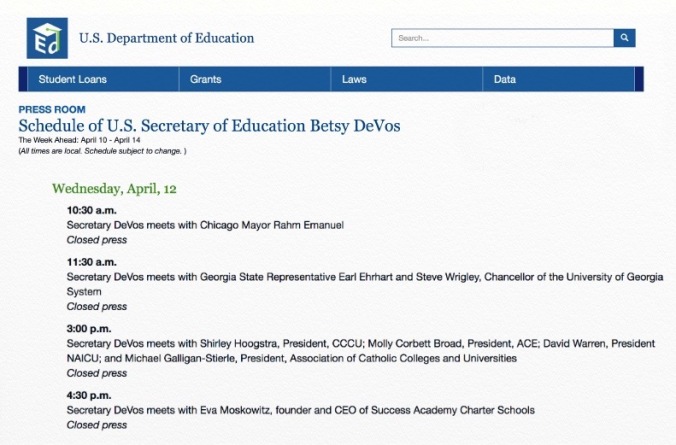
Tomorrow is a busy day for the Secretary of Education, Betsy DeVos.
She starts the day with the school-closer-in-chief, Mayor Rahm.
She ends the day with the Queen of Charters, Eva Moskowitz.
Details are not available to the public. The meetings are closed to the press. The exact locations of the meetings are unknown.
Perhaps Rahm will explain his continuing efforts to shut down neighborhood public schools. His latest plan is to close seven African American high schools in and around Englewood in spite of a declared and contractual moratorium on school closings.
Details are not available to the public.
Or maybe he will be sharing his latest high school graduation requirements. The Mayor-Autorcrat – who disdains the idea of citizens electing their school board – woke up the other morning and decided that CPS students should have a letter of acceptance from a college in order to graduate.
Voila! And so it shall be, says  the Mayor-Autocrat.
I bet Betsy wishes she had such power to make things happen. If only she did our kids would be genuflecting and saying the Lord’s Prayer in school this morning.
Which I had to do in first grade, by the way, having been in first grade before the Supreme Court ruled that religious activity had no place in a public school.
But with Gorsuch plus another Trump appointee to the Court, Betsy might get her way.
Her last meet up of the day is with Eva Moskowitz.
Eva was on the short list to be Secretary of Education.
For those of you who live out of New York, Moskowitz is a pre-eminent charter DeVos, Rahm and Moskowitz. | Fred Klonsky:


NaughtyBots Part 1: Articles | Truth in American Education

NaughtyBots Part 1: Articles | Truth in American Education:

NaughtyBots Part 1: Articles


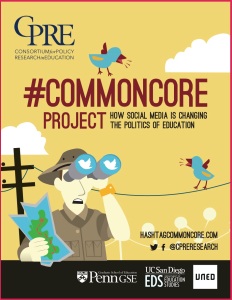
coverThis is the first part in a four part NaughtyBots series about the #commoncore Project: How Social Media is Changing the Politics of Education. I refer to it as a project since it says Project in the title rather than research. The research issue will be addressed in the fourth part of the series.
I should say at the start that it may appear at times that I stray from addressing this Project, but in my eyes, I do so no more than those who conducted this project, hereinafter referred to as the project undertakers.
This first installment presents hotlinks to the press release for this project followed by a number of related articles. You are encouraged to read the press release and see if articles are basically “retweeting” without questioning the information. Do you think the article authors read the actual project report? Articles pushing back against the project information and other articles are listed after the supporting articles. It may be fair to say that both sides are biased, but does fairness even matter anymore?
If a person only had time to read one of these articles, I would recommend reading Three sournote1Problems With CPRE’s Twitter Bot Claims. After that, if you are up for some entertaining reading, try The Anti-#CommonCore Movement on Twitter: Thousands of angry people? Or one well-paid Floridian robot? To get this kind of response, the Twitter activity must be hitting a sour note with some Common Core proponents.

Biased Articles Supporting the Project
Do the people writing articles about this so-called “research” even bother reading the report? If they do, are they so enamored with the confusing interactive presentation or dazzled by the presented information that they don’t bother to question the report’s veracity?
Common Core, Automated Advocacy, & Media Coverage
“It’s unclear whether those mass tweets influenced the course of events as various states changed their minds about the curriculum standards. And there’s no concrete evidence #PJNET’s efforts NaughtyBots Part 1: Articles | Truth in American Education:

Arizona Expands Privatization of Education Yet Again | janresseger

Arizona Expands Privatization of Education Yet Again | janresseger:

Arizona Expands Privatization of Education Yet Again

Arizona is no stranger to the privatization of education.  It has had charter schools, online charter schools, tuition tax credits and the newest iteration of privatization—Education Savings Accounts (ESAs).  Tuition tax credits and education savings accounts are particular types of school tuition vouchers, by which children are granted tax funded coupons to pay all or more commonly part of private school tuition.  An education savings account program expansion was signed into law late last week by Arizona’s governor.  Now every single child in the state will be eligible, though at this time there are enrollment caps—to be expanded gradually over time— on how many students the state will underwrite each year.  ESAs are basically an experiment in totally portable school funding.
Here is Dana Goldstein describing Arizona’s ESA expansion in the NY Times: “The bill, which the State Legislature passed on Thursday, makes all 1.1 million public school students in Arizona eligible for money from a program that until now was available only to some students, including those with disabilities and those in underperforming schools. Under the law, parents who withdraw their children from public school can use their child’s share of state education funding to pay for private school tuition, home-schooling costs, tutoring and online education, as well as for therapies for the disabled…  Florida, Mississippi and Tennessee have similar programs, but they all restrict eligibility to disabled children. That makes the Arizona expansion the broadest to date. Unlike traditional vouchers, in which states pay private schools directly, E.S.A.s allow parents to distribute public dollars for educational expenses.”
For parents an education savings account is like a credit card which parents can use to buy particular services for a child. This puts parents fully in charge of where and how children are educated. Here is how the Network for Public Education explains education savings accounts in a fact sheet that is part of an excellent new new toolkit, School Privatization Explained: “ESAs provide a huge loophole for unaccountable use of public money. Parents who withdraw their children from public schools get a proportion of the money the state would otherwise have spent to educate their children deposited into an account. The account comes with a debit card families can use to pay for unaccountable education products and services such as private schools, home schooling, online courses, lessons and private therapists and tutors… Most of these (ESA) programs release their funds to parents in exchange for the parents agreeing to forego their right to a public education.”
Goldstein explains the size of Arizona’s monetary awards to parents: “This year, about 3,500 Arizona students, the majority of whom have special needs, are participating in the program.  The average size of an account is $5,700 per year for children without disabilities and $19,000 for children with them.”


Post and Courier (Charleston, SC): CCSD plan for teachers won’t work | radical eyes for equity

Post and Courier (Charleston, SC): CCSD plan for teachers won’t work | radical eyes for equity:

Post and Courier (Charleston, SC): CCSD plan for teachers won’t work


Post and Courier (Charleston, SC): CCSD plan for teachers won’t work
[see full submission with hyperlinks below]
Charleston School District Arriving Late to a Very Bad Party
P.L. Thomas, Professor, Furman University
The most telling aspect of Charleston County School District’s announcement about holding teachers accountable for student test scores may be in the second paragraph of Paul Bowers’s coverage: “District leaders say they don’t want to fire anyone — particularly not in the midst of a statewide teacher shortage that’s only getting worse.”
While it appears some are aware of the unintended consequences of new education policy, we must be concerned that such awareness has not helped better inform this recent decision to move forward with using value-added methods (VAM) in teacher evaluations.
Early research warned and current studies confirm that VAM fails to fulfill political promises, but also feeds existing problems. This pattern has been seen with school choice increasing segregation, exit exams causing higher drop-out rates, and high-stakes tests driving teaching to the test, asking far less of students.
First, we should acknowledge the flawed logic driving the use of VAM to increase teacher accountability. The recent concern about teacher quality is grounded in several false assumptions.
One is the “bad” teacher myth strongly associated with the stereotypical unionized teacher as portrayed in Waiting for Superman.
However, across the U.S. teachers in unionized states produce students with higher test scores that teachers in non-union (called right-to-work) states such as South Carolina. The problem with associating teacher quality and low student outcomes with union protection is that student test scores are more powerfully associated with poverty than any other factor.
This leads to the other false assumption that teacher quality is the most or one of the most important causes of student learning. In fact, teacher quality accounts for only about 10-15% of standardized test scores, the Post and Courier (Charleston, SC): CCSD plan for teachers won’t work | radical eyes for equity:

Have Silicon Valley Teachers Using Technology Daily Altered Their Classroom Practice? (Part 2) | Larry Cuban on School Reform and Classroom Practice

Have Silicon Valley Teachers Using Technology Daily Altered Their Classroom Practice? (Part 2) | Larry Cuban on School Reform and Classroom Practice:

Have Silicon Valley Teachers Using Technology Daily Altered Their Classroom Practice? (Part 2)

Related image

Of the 37 teachers who replied to my questions, 24 (65 percent) said yes.
Nine (24 percent) said “no.” I sorted  the “no” answers into two bins. Six teachers who said “no” explained that using digital tools had not changed their ways of teaching because they had been using high-tech devices since they entered the profession or labeled themselves as “digital natives” even before they began teaching. The other three teachers who said “no” gave different answers.
Lyuda Shemyakina, a biology teacher at Mountain View High School in the Mountain View-Los Altos Union High School District, has been a teacher for six years, two of which were in Chicago. Her response was:
Technology facilitates the gathering and disseminating of information in my classroom, but I wouldn’t say it has fundamentally changed how I teach. 
For example, designing, scaffolding, and handing out homework and classwork are integral parts of my teaching practice. Whereas in another country or another decade I might have made paper copies or made students write these down, many/most things now are electronic. Students can see all my presentations (directions for class); students can e-mail me with questions, and students have fewer excuses for not knowing the homework. I literally post it in five different places from with the white board in my room to a public on-line space. I also post links to helpful videos, worksheets, etc. to help both struggling and advanced students….[i]
Ultimately, though, a teacher is still an intellectual who must design or select instruction and instructional materials, including assessments. If I don’t have the skills to appropriately design and assess activities, no amount of technology can help me. For instance, during the class you saw, I chose to have students design and share analogies. These were very telling as a measure of their understanding of basic genetics. If I had asked the wrong question, like “do you get genetics?” it wouldn’t have mattered what technology I used.  
David Campbell, a teacher of Spanish and a National Board Certified Teacher. He has taught 16 years, the last eight at Mountain View High School.
Technology has changed how I teach a little, but not that much. Ultimately it is the personality of the class and their engagement that allows a teacher to do Have Silicon Valley Teachers Using Technology Daily Altered Their Classroom Practice? (Part 2) | Larry Cuban on School Reform and Classroom Practice:

Join us for the Brooklyn filming of Defending Public Education in the Era of Privatization - Network For Public Education

Join us for the Brooklyn filming of Defending Public Education in the Era of Privatization - Network For Public Education:

Join us for the Brooklyn filming of Defending Public Education in the Era of Privatization


We need you. Your physical presence. You.
After nearly a year of brainstorming and planning, we’re ready.
The Network for Public Education is collaborating with Shoot4Education to make a series of short films to articulate the issues our schools face and to imagine what we want for public education. We’ve never before had the opportunity to bust “out of the bubble” to speak to the whole country, and we’re going for it. To do that, we’ve convened an AMAZING group of speakers, from points north, south, east, and west. They are converging on Brooklyn on Sunday April 30th and they need someone to speak to.
You.
The success of this endeavor depends on an attentive, committed, engaged, and activated audience. The audience is essentially another “character” in the films and we need it to reflect who we are in all our diversity because these issues affect all of us: urban, rural, and suburban; people of color and whites; teachers, parents, and students; those who are comfortable and those who are struggling.
Please come and be yourself. Lend your image and enthusiasm to the cause.
Sign up details, including speaker names and topics are below.
___________________________________________________________________
You can sign up for one, two, or three sessions—but if you sign up, please think of it as a commitment and show up. Too small an audience will lessen the impact of what we are trying to do. We also ask that you be present for the duration of the session(s) you sign up for, as we will need to keep the doors closed while filming is in progress.

MORNING SESSION (9:15-12:45)

Linda Lyon
Privatization: Be Careful What You Wish For
Linda Lyon, a retired Air Force colonel, is president-elect of the Arizona School Boards Association and serves on the board of Support Our Schools AZ. She blogs about education at RestoreReason.com.
Jesse Hagopian            
The Destruction of the Teaching Profession
Jesse Hagopian is a Seattle-based high school teacher, speaker, and activist. He edits the journal Rethinking Schools and also edited the book More Than a Score: The New Uprising Against High-Stakes Testing.
John Kuhn                        
A New Paradigm for “Accountability”
John Kuhn is the superintendent of the Perrin-Whitt School District in Texas and author of the book Test and Punish: How the Texas Education Model Gave America Accountability without Equity.

AFTERNOON SESSION (1:00-4:30)

Johanna Garcia
False Promises: Equity and High-Stakes Testing
Johanna Garcia served as chief of staff to New York City Council Education Committee Chair Robert Jackson, the co-founder of New York’s Campaign for Fiscal Equity. A committed parent activist, Garcia advocates for families in her Upper Manhattan district, many of whom are immigrants living in poverty.
Jitu Brown                        
How School Closures Destroy Community
Jitu Brown is the national director for the civil rights organization Journey for Justice (J4J) Alliance. In 2015, he garnered international attention for successfully leading a 34-day hunger strike that reversed the closure of Chicago’s Dyett High School.
Diane Ravitch            
Betsy Devos, Charters, and The Trump Agenda
Historian of education Diane Ravitch is President of the Board of Directors of the Network for Public Education, an organization that she co-founded. Ravitch’s influential blog and best-selling books have made her a much sought after speaker and commentator on public education policy.

Evening Session (4:30-6:50)

Jeanette Deutermann
A Parent’s Perspective: Testing as a Tool of Ed “Reform” and a Call to Action
Jeanette Deutermann is a founding member of both Long Island Opt Out and New York State Allies for Public Education, grassroots organizations credited with spearheading the nation’s largest and most vigorous testing resistance movement.
Kymberley Walcott            
Student’s Perspective: How Ed “Reform” Affects Students on the Ground
Kymberley Walcott, currently an undergraduate student at City University of New York’s Hunter College, attended Jamaica High School in Queens when that 122-year-old institution underwent a controversial closure by the NYC Department of Education.

LOCATION

The shoot will take place in the Gowanus section of Brooklyn in a warehouse where we are having a set constructed. Gowanus is adjacent to the better known and amenity-filled Park Slope and Carroll Gardens. Gowanus itself is industrial, a mixture of factories, artist spaces, and, yes, on the block where we’ll be shooting, there’s a less-than-pretty recycling facility. The neighborhood also has some of the best pie in the city, a few blocks from the shoot on the corner of 8th St. & 3rd Avenue.
We hope to see in Brooklyn on the 30th!
Thanks for all you do,
Carol Burris Network for Public Education, Executive Director
Join us for the Brooklyn filming of Defending Public Education in the Era of Privatization - Network For Public Education:

MY KIND OF EDUCATION REFORM « Dad Gone Wild

MY KIND OF EDUCATION REFORM « Dad Gone Wild:

MY KIND OF EDUCATION REFORM


A couple weeks a go, it was Spring Break in Middle Tennessee. Scrolling through my social media feed, I was suddenly inundated with pictures of friends taking their children to Chicago to see Hamilton, to New York to visit the Museum of Natural History, a week at the beach. I must admit most of my friends are of the middle class persuasion though we as a family cling to that classification precariously. Still my own kids went to see their aunt in Chattanooga where they visited the Adventure Science Museum and toured Lookout Mountain. Meanwhile, kids from poorer families spent large chunks of time in their homes whiling away time, waiting for parents who couldn’t afford to take time off from work to get home.
I’m not trying to cast stones at anyone. Parents who continue to invest in the educational experiences, often at great sacrifice, of their children should be commended. And yes, I count going to Walt Disney World as an educational experience. One of the traps that we fall into is thinking that education only falls into a formal category, whereas learning is as natural as breathing to children, and therefore every experience forces their brains to grow and expand. Think of it in computer terms. The larger a database a machine has, the greater likelihood you’ll get a relevant answer when you query a search. Same holds true for kids. The more experiences they have as a kid, the more likely they’ll be able to take advantage of an opportunity in the future. Why is this a hard concept for policymakers to grasp?
Parents intrinsically know this. Why do you think wealthier parents invest so heavily in extracurricular activities despite the high cost? Do you think they harbor illusions of Johnny being a star pitcher in the majors? Or little Jennie becoming a concert pianist at the Met? Well, some do; those are the ones we all snicker at. The rest of us realize the important life lessons that are taught through these extracurricular activities. Lessons like grit, teamwork, leadership, self-confidence all are grown through participation in extracurricular activities. No less an authority than Tony Wagner, co-director of the Change Leadership Group at Harvard’s Graduate School of Education has gone on MY KIND OF EDUCATION REFORM « Dad Gone Wild:

Question: Who Are the ESSA “Peer Reviewers” Selected to Review State Plans? | deutsch29

Question: Who Are the ESSA “Peer Reviewers” Selected to Review State Plans? | deutsch29:

Question: Who Are the ESSA “Peer Reviewers” Selected to Review State Plans?

Image result for Peer Reviewers


According to the Every Student Succeeds Act (ESSA), state plans are to be reviewed by a group of individuals holding specific roles– and the reviewers are to be identified by name.
From the ESSA document (pages 20-21):
(4) PEER REVIEW AND SECRETARIAL APPROVAL.—
(A) IN GENERAL.—The Secretary shall—
(i) establish a peer-review process to assist in the review of State plans;
(ii) establish multidisciplinary peer-review teams and appoint members of such teams—
(I) who are representative of—
(aa) parents, teachers, principals, other school leaders, specialized instructional support personnel, State educational agencies, local educational agencies, and the community (including the business community); and
(bb) researchers who are familiar with—
(AA) the implementation of academic standards, assessments, or accountability systems; and
(BB) how to meet the needs of disadvantaged students, children with disabilities, and English learners, the needs of low-performing schools, and other educational needs of students;
(II) that include, to the extent practicable, majority representation of individuals who, in the most recent 2 years, have had practical experience in the classroom, school administration, or State or local government (such as direct employees of a school, local educational agency, or State educational agency); and
(III) who represent a regionally diverse cross-section of States;
(iii) make available to the public, including by such means as posting to the Department’s website, the list of peer reviewers who have reviewed State plans under this section;
(iv) ensure that the peer-review teams consist of varied individuals 
Question: Who Are the ESSA “Peer Reviewers” Selected to Review State Plans? | deutsch29: