Latest News and Comment from Education

Wednesday, April 5, 2017

Fighting Hate In Schools : NPR Ed : NPR

Fighting Hate In Schools : NPR Ed : NPR:

Fighting Hate In Schools

Image result for Fighting Hate In Schools

Editor's note: This story contains language that may be offensive to some readers.
Hate incidents can happen anywhere: the mall, the church, the office. But, in the wake of the 2016 election, hate's been showing up a lot in school.
According to the Southern Poverty Law Center, in the months following the election more hate incidents took place in America's schools than anywhere else. Hundreds of elementary, middle and high schools have played host to an array of troubling events, from sophomoric stunts to much worse: a hijab pulled off a Muslim student, physical fights with racial epithets flung, even violent threats.
Educators in Massachusetts, as elsewhere, are struggling with what to do.
In Medway, a video began circulating showing a student with a rifle, saying the N-word and "kill 'em all." This was just one of dozens of school incidents called in to a hate hotline set up by the Massachusetts attorney general.
One concerned parent called to ask about getting a restraining order. The staffer answering the phone explained the law and promised to follow up to make sure school and local law enforcement officials were taking it seriously.
"It's especially concerning that a child was responsible," the staffer offered sympathetically. "And this is exactly the reason we started this hotline, so we really appreciate you taking the time to call."
But along with the anxious parents, schools themselves are also calling with their own concerns about how to handle it all.
As Attorney General Maura Healey puts it, when it comes to student behavior, "there's Fighting Hate In Schools : NPR Ed : NPR:


What protections do student journalists really have? Check your state on this map. - The Washington Post

What protections do student journalists really have? Check your state on this map. - The Washington Post:

What protections do student journalists really have? Check your state on this map

Related image

Student journalists at a high school in southeast Kansas investigating the credentials of their new principal found that they had been falsified — and the principal resigned. Those teenagers were able to do that work because of a state law enacted in 1992 that offers K-12 students protection, in addition to the First Amendment, from administrative censorship. But not all student journalists in the country have such protection.
Each state looks at protection for student journalists differently, according to the Student Press Law Center, a nonprofit organization that has been the nation’s only legal assistance agency exclusively devoted to educating high school and college journalists about the First Amendment and supporting the student news media to do their work without censorship. SPLC provides free legal advice, information and materials to students and operates a formal Attorney Referral Network of lawyers who will represent student journalists in the country at no cost.
Here’s a map from New Voices USA, a network of state campaigns to pass anti-censorship legislation to grant extra protections to student journalists.
CLICK ON EACH STATE FOR MORE INFORMATION 
Five states have added protection for college and high students against administrative censorship. They are California, Oregon, North Dakota, Illinois and Maryland.
Seven states provide protection against administrative censorship only for high school students. They are Arkansas, Colorado, Iowa, Kansas, Massachusetts, Pennsylvania and Washington state (which appears on the map as blue because there is also a campaign to extend protections to college students). The District of Columbia has a Board of Education regulation that givesWhat protections do student journalists really have? Check your state on this map. - The Washington Post

Schott Grantees Convene to Change the Conversation | Schott Foundation for Public Education

Schott Grantees Convene to Change the Conversation | Schott Foundation for Public Education:

Schott Grantees Convene to Change the Conversation

Image result for Change the Conversation
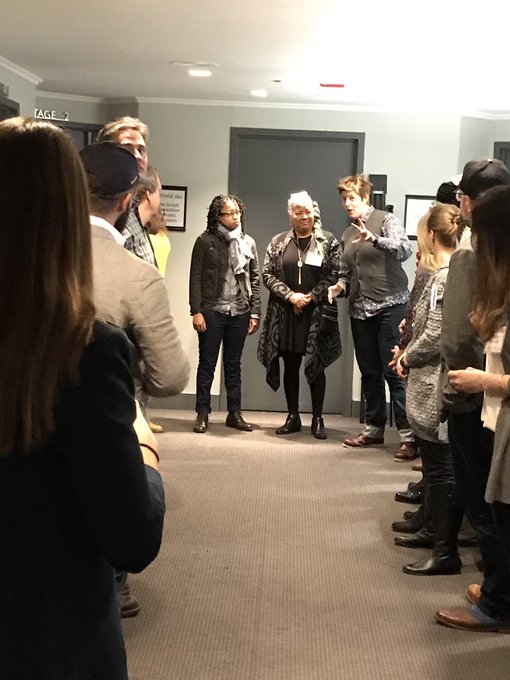
One of the pleasures of working at the Schott Foundation for Public Education is that we have the opportunity to work with and learn from our grantee partners who do incredible grassroots organizing work all across the country. These public education advocates lead campaigns in their respective regions, but on March 15 and 16 leaders from 22 of our grantee partners convened together for our first Opportunity to Learn Network Communications Summit. Experts on media training, message development, education, and social justice organizing led workshops to enhance these leaders’ skills.
Our guest presenters were Sally Kohn, Jeff Bryant, and Aliya Rahman. Sally Kohn is a CNN political commentator, a columnist and one of the leading progressive voices in America today. Jeff Bryant is the director of the Education Opportunity Network, an education media and communications project of People's Action Institute in partnership with the Schott Foundation. Aliya Rahman is Director of Movement Technology for Wellstone, an organization dedicated to building movements, progressive political leadership and technology and digital strategy.
We began Wednesday afternoon by introducing ourselves to each other and explaining the reasons we fight for public education. Many of the leaders in attendance had already worked together on campaigns and initiatives, some had admired each other’s work from afar, and others were learning about each other’s work for the first time. Aliya led a “Digital Toolbox” workshop, in which she discussed digital organizing frameworks, strategy, and tactics for today’s political and organizing climates. She reminded us that we are all organizers, and can use technology and data to better organize and that we shouldn’t let be intimidated by the myriad of tech tools available. As Aliya put it, we’re all “tech people” — “being a ‘tech person’ is about using tech for work we already know how to do.” Schott’s Creative & Online Communications Director Patrick St. John and Communications Director DeQuendre Neeley-Betrand then provided a crash course on beginner and advanced topics in social media promotion and advertising. Tips included how to target and maximize one’s audience, automate social media updates, and analyze an organization’s impact to help refine communications strategy.


The next morning began with a training led by Sally in which attendees learned how to better craft their message and make Schott Grantees Convene to Change the Conversation | Schott Foundation for Public Education:

SMMUSD'S NEW SUPERINTENDENT- FINALLY RACIAL JUSTICE? - Perdaily.com

SMMUSD'S NEW SUPERINTENDENT- FINALLY RACIAL JUSTICE? - Perdaily.com:

SMMUSD'S NEW SUPERINTENDENT- FINALLY RACIAL JUSTICE?

Dr. Ben Drati.jpg

On Sunday April 2nd the Committee for Racial Justice in Santa Monica had as their guest speaker Dr. Ben Drati, the relatively new African American superintendent of the Santa Monica-Malibu Unified School District (SMMUSD). What Dr. Drati discussed in his presentation was SMMUSD's decision to once and for all effectively deal with the unacceptable realities behind why African American and Latino students have continued to do poorly at SMMUSD and what can be done to finally close this achievement gap in a manner where the positive results are independently and empirically verifiable.

While I found that I had some problems with Dr. Drati's approach to achieving minority student parity with their usually more affluent and academically more successful non-minority peers, what I nonetheless found refreshing in his approach was a clear willingness to incorporate any ideas that might help him and SMMUSD to finally allow minority students to achieve their potential.

In the "coherent and cohesive focus" that Dr. Drati seeks to finally implement at SMMUSD in improving minority achievement, for me it is a sine qua non that Dr. Drati not underestimate the entrenched "culture of opposition" that he will surely come up against, when his reforms challenge the vested and very profitable interests of those who are doing just fine financially under the present system.

Dr. Drati believes the "people leading schools have best intentions in mind," when the reality is that we have 2.3 million people presently being incarcerated in our prisons- 1 million of whom are African American. Fixing our schools, so that minority students would now come out of school socialized and highly educated and employable, could not help but cut into these rates of incarceration and the obscene corporate profits that have been generated by them for so long.

There is also a tendency to minimize or not really understand just how profound of a positive effect a good and pragmatically driven public education system has, when it does something more than just mouth platitudes, which most of those presently running the system don't even really believe in. For example, Dr. Drati presented a list of several factors that schools could not control in dealing with SMMUSD'S NEW SUPERINTENDENT- FINALLY RACIAL JUSTICE? - Perdaily.com:


Torlakson Honors Sac City USD as Safe Haven - Year 2017 (CA Dept of Education)

Torlakson Honors Sac City USD as Safe Haven - Year 2017 (CA Dept of Education):

State Superintendent of Public Instruction Tom Torlakson Honors Sacramento City Unified for Safe Haven Efforts
Image result for Sacramento City Unified for Safe Haven sign

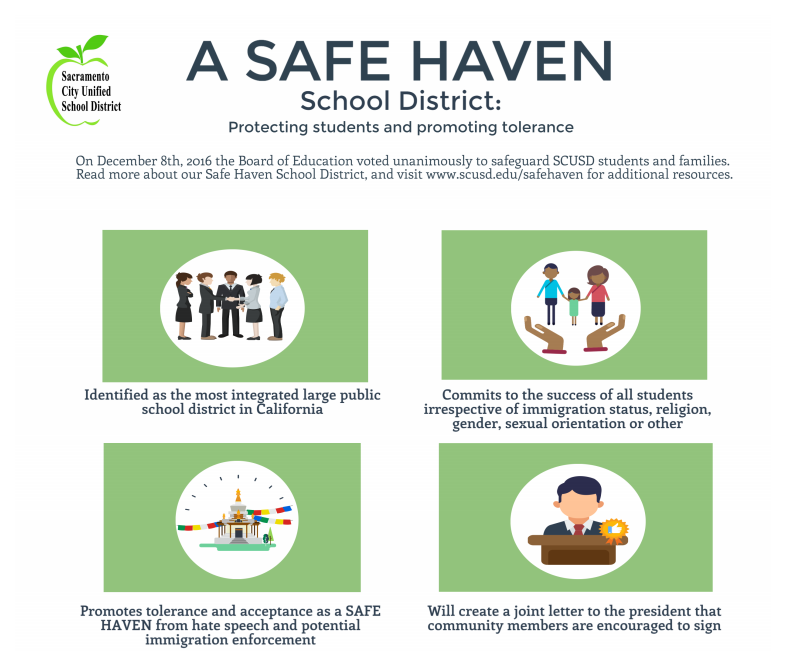
SACRAMENTO —State Superintendent of Public Instruction Tom Torlakson today commended the Sacramento City Unified School District for its leadership in the movement for school districts to declare themselves as “Safe Havens” and urged other districts across the state to follow Sacramento City Unified’s example.
“It’s critical in this climate that California schools reassure their students, parents, educators, and local communities that schools welcome everyone regardless of immigration status,” Torlakson said.
“Federal law requires schools to educate all children, even those who are undocumented. Students cannot learn and succeed if they are afraid to come to school, or if their parents are afraid to allow them to come to school or otherwise fully participate in the school community.”
Torlakson’s remarks came during a school visit and town hall forum today at Oak Ridge Elementary School in the Sacramento City Unified School District. Oak Ridge Elementary serves a student body that is largely Latino and Hmong from immigrant families.
Located in Sacramento’s Oak Park neighborhood, the school is represented by Sacramento City Unified School District Board of Education First Vice President Jessie Ryan, who spearheaded the District’s Safe Haven efforts that resulted in a Safe Haven resolution last December External link opens in new window or tab. (PDF). The District has continued to promote tolerance and a welcoming environment while informing students and their families of their rights and legal protections against stepped-up federal immigration enforcement.
“Sacramento City Unified is honored by State Superintendent Torlakson’s recognition of our Safe Haven work,” Ryan said. “We are proud to have him stand with us to ensure that all children feel welcome at every school—regardless of their immigration status. We stand together for the safety and protection of our families.”
Torlakson last year urged California school districts to declare themselves Safe Havens and reminded schools of state and federal safeguards in place that protect immigrant families. To date, nearly 60 separate school district boards, representing a total of nearly two million students, have adopted Safe Haven or similar resolutions.
Last month, Torlakson reached out to the federal government to clarify whether it is changing a longstanding policy that had avoided immigration actions near schools. Torlakson has also filed a friend of the court brief in federal court supporting Santa Clara County’s request to stop an executive order by President Donald Trump that threatens to stop federal funding for California cities, counties, and possibly public schools.
More information is available at the California Department of Education’s Safe Havens Web page.
# # # #
Tom Torlakson — State Superintendent of Public Instruction
Communications Division, Room 5602, 916-319-0818, Fax 916-319-0100
Image result for Sacramento City Unified for Safe Haven

Safe Havens - Initiatives & Programs (CA Dept of Education)

Safe Havens - Initiatives & Programs (CA Dept of Education):

Safe Havens


Safe Havens are local educational agencies (LEAs), which include school districts, county offices of education, and direct-funded charter schools that have committed themselves to reassuring students, parents and educators that everyone is welcome on school sites, regardless of immigration status. Safe Havens also provide helpful resources, such as information about immigration laws, and ways to be prepared in case a student or family member is deported.

Frequently Asked Questions

What is the purpose behind being a Safe Haven district?
Fears, anxiety, uncertainty have been widely reported in California schools because of the current federal administration vowing to increase deportations of undocumented immigrants.
California has an estimated 300,000 students who are undocumented as well as about one million students who live with a parent or guardian who are undocumented. Superintendent Torlakson is encouraging districts to pass these resolutions to lessen fears and uncertainty surrounding immigration activities and directives issued by a new federal administration in Washington, D.C. 
Districts and county offices are encouraged to make powerful and reassuring statements to their students and families and to provide accurate information about relevant laws. 
It is important that parents and guardians feel safe on their school campuses so they will fully participate their school communities. Engaged parents play a key role in helping students succeed on their way to 21st century careers and college.
How many Safe Haven school districts are there in California?
As of April 2017, almost 60 school districts and county offices of education have declared themselves Safe Havens. These schools and districts serve more than 1.5 million students and include large and small districts, urban and rural districts and represent a wide variety of geographic regions—stretching from north to south, coastal to inland, and mountain to desert communities. There are likely to be more districts that have passed similar resolutions, but have not used the term Safe Haven.
What are the laws protecting schools and students with regard to student records and immigration status?
There are several legal protections in place, including:
  • The 1984 Supreme Court decision Plyler v. Doe which requires schools to enroll all eligible children regardless of their citizenship or immigration status.
  • State and federal laws prohibit educational agencies from disclosing personally identifiable student information to law enforcement, without the consent of a parent or guardian, a court order or lawful subpoena, or in the case of a health emergency. 
  • Districts must verify a student’s age and residency, but have flexibility in what documents or supporting papers they use. They do not have to use documents pertaining to immigration status.
  • To determine age, for example, LEAs can rely on a statement from a local registrar, baptismal records, or an affidavit from a parent guardian or custodian.
  • To determine residency, an LEA can rely on property tax receipts, pay stubs, or correspondence from a government agency.
What other advice or support can the California Department of Education (CDE) provide schools and districts?
Since LEAs have wide discretion in what records they use, Superintendent Torlakson strongly recommends that they do not collect or maintain documents related to immigration status.
Superintendent Torlakson and the California Department of Education will continue to provide LEAs with information, updates, and support as indicated in the Public Schools Remain Safe Havens for California’s Students letter he sent to all school, district, and county office administrators on December 21, 2016. It is also available in Spanish below.

Resources

News Releases

Superintendent Letters

Questions:   Communications | communications@cde.ca.gov | 916-319-0818
Last Reviewed: Wednesday, April 5, 2017Safe Havens - Initiatives & Programs (CA Dept of Education):
Image result for big education ape  Torlakson safe haven

Private Practice – Have You Heard + Like a Laundromat for Tax Dollars

Private Practice – Have You Heard:

Private Practice
Image result for big education ape Relay Graduate School of Education

 I talk to Professor Ken Zeichner about how the push to deregulate teacher preparation fits into our privatized, for-profit times…
Image result for big education ape Relay Graduate School of Education


 JenniferBerkshire: You’ve been leading a one-man crusade to expose what you say are false claims being made by the Relay Graduate School of Education and other startup teacher training programs. How’s it going?

Ken Zeichner: Not well. Although the state of Pennsylvania recently denied Relay’s application to offer a graduate degree upon completion of its program in the state on the grounds that it isn’t actually a graduate school, Relay has just signed a contract with the Philadelphia schools to run a teacher residency in Philly with the goal of increasing teacher diversity in the city. The issue of diversifying the teaching force is extremely important, but if you’re going to place your resources somewhere in order to reach this goal, the research suggests that you would invest in grow-your-own programs, high-quality teacher residency programs (which Relay is not), induction and mentoring, and improving working conditions and access to high quality professional learning opportunities in the high-poverty schools in which many teachers of color work. You wouldn’t bring in a program like Relay that can provide no evidence at all that their teachers stay, even though they’ve been in existence since 2007. What good is it if you bring in teachers but aren’t able to retain them?
Berkshire: You wrote a paper called Apocryphal Claims, Illusory Evidence, charging that the case for the rapid expansion of independent teacher education programs like Relay and Match in Boston has ideology behind it but not actual evidence. Elaborate, sir.
Zeichner: I looked at five of the most visible independent programs not associated with colleges and universities and I tried to find the evidence for the claims that they and their supporters make about how great they are. There is absolutely no credible evidence that programs like Relay have accomplished even the goals they say they’ve accomplished. In the paper and in the testimony I’ve been providing to states where Relay is seeking to expand, I’ve tried to force them to defend their claims, which they haven’t been able to do. When Relay was asked in California to provide evidence about the claims they keep making, that their graduates have to demonstrate Private Practice – Have You Heard:
Like a Laundromat for Tax Dollars
In episode #15, Have You Heard talks to tax policy expert Carl Davis about the scam known as tax credit scholarships or *neo vouchers*… 
In this episode of Have You Heard, we explore the the complex, controversial craze that’s sweeping the land: tax credit scholarships. These *neo-vouchers* send taxpayer dollars to private religious schools, while allowing wealthy donors and corporations to make money in the process. If it sounds rotten, that’s because it is, says tax policy expert Carl Davis. As Davis explains, tax credit scholarships have more in common with money laundering than with traditional charitable giving. And he instructs listeners on what to keep an eye on when one of these schemes pop up in your state. The full transcript of our interview is available here


Like a Laundromat for Tax Dollars

Bribing children to take our tests | @mcleod | Dangerously Irrelevant

Bribing children to take our tests | @mcleod | Dangerously Irrelevant:

Bribing children to take our tests

Bribe

It’s standardized testing season again in American schools. And that means it’s also time for many schools to bribe and punish their children into submission because those tests are ones they don’t want to take.
Over the past couple of decades, the political stakes attached to standardized testing have accelerated greatly. So too have teachers’ and administrators’ concerns about their schools’ scores. As a result, there now exists a staggering range of ‘motivational’ efforts that attempt to get students in a positive mindset about testing. For instance, a search for ‘test prep rally’ on YouTube returns over 250 videos of school plays, lip synced songs, and ‘Slam the Exam’ concerts. On Pinterest and at Teachers Pay Teachers, educators can download and attach to candy over 40 different cute, motivational phrases such as ‘You were MINT to succeed’ or ‘You’re a STARBURST of knowledge’ or ‘It’s CRUNCH time. Show what you know!’ At Minds in Bloom, schools can get tips about costuming, audience participation, songs, dances, cheers, jokes, skits, videos, and slide presentation decks for their own test prep rallies. They also can hire the Morris Brothers to perform original songs and share their testing strategies and stress reduction tips. Or they can tap into the numerous other web sites that will help them implement raffles, revise song lyrics, make posters with test taking tips, and stage Are You Smarter Than Your Teachers? game shows.
More troublesome are the post-test ‘celebrations of learning’ that are available only to certain children. A Colorado school made the news recently for its plans to reward those students who show up for every testing day and ‘try their hardest’ (one can only imagine how that will be measured), despite state laws that allow students to opt out of state testing without penalty. As Alfie Kohn reminded us long ago, the withholding of a reward is most certainly a punishment, particularly in the eyes of young children. Is it kind and sensible for educators to preclude from the fun those children who exercised their legally-protected rights? Similarly, I know of a school in Iowa that kept half a dozen of its eight hundred students back from its Bribing children to take our tests | @mcleod | Dangerously Irrelevant:


Trump’s War on Journalism - Los Angeles Times

Trump’s War on Journalism - Los Angeles Times:

Trump’s War on Journalism
In Donald Trump’s America, the mere act of reporting news unflattering to the president is held up as evidence of bias. Journalists are slandered as “enemies of the people.”
Facts that contradict Trump’s version of reality are dismissed as “fake news.” Reporters and their news organizations are “pathetic,” “very dishonest,” “failing,” and even, in one memorable turn of phrase, "a pile of garbage.”
Trump is, of course, not the first American president to whine about the news media or try to influence coverage. President George W. Bush saw the press as elitist and “slick.” President Obama’s press operation tried to exclude Fox News reporters from interviews, blocked many officials from talking to journalists and, most troubling, prosecuted more national security whistle-blowers and leakers than all previous presidents combined.
But Trump being Trump, he has escalated the traditionally adversarial relationship in demagogic and potentially dangerous ways.
Most presidents, irritated as they may have been, have continued to acknowledge — at least publicly — that an independent press plays an essential role in American democracy. They’ve recognized that while no news organization is perfect, honest reporting holds leaders and institutions accountable; that’s why a free press was singled out for protection in the 1st Amendment and why outspoken, unfettered journalism is considered a hallmark of a free country.
Trump doesn’t seem to buy it. On his very first day in office, he called journalists “among the most dishonest human beings on earth.”
Since then he has regularly condemned legitimate reporting as “fake news.” His administration has blocked mainstream news organizations, including The Times, from briefings and his secretary of State chose to travel to Asia without taking the press corps, breaking a Trump’s War on Journalism - Los Angeles Times:


Long Beach Unified accused of underfunding ‘high-needs’ students | EdSource

Long Beach Unified accused of underfunding ‘high-needs’ students | EdSource:

Long Beach Unified accused of underfunding 'high-needs' students

Long Beach Unified failed to account for or misspent $41 million that should have been used to expand and improve services for students receiving extra money under the state’s funding formula, according to a complaint filed Tuesday by the nonprofit law firm Public Advocates. The group filed a separate complaint against the Los Angeles County Office of Education for approving the district’s spending plan last fall.
The district is demanding that Long Beach, the state’s third-largest district, amend its Local Control and Accountability Plan, or LCAP, as the document is called, to justify how it used the money or to reallocate it to comply with the spending law.
In return for receiving additional “supplemental” and “concentration” dollars for “high-needs” students – low-income children, foster and homeless youth, and English learners – the Local Control Funding Formula requires districts to spend the money on these students.
Public Advocates said it filed the complaint on behalf of two Long Beach parents, a community group and the state chapter of the Children’s Defense Fund after the district failed to respond to inquiries about the spending. “Over the past two years, the district has received multiple letters warning that it is not meeting its obligations to equitably serve high-needs students. Unfortunately, the district has not meaningfully responded,” Angelica Jongco, Public Advocates senior staff attorney, said in a statement.
Long Beach Superintendent Christopher Steinhauser said Tuesday that the district’s LCAP fully complied with and met the spirit of the Local Control Funding Formula. If the district has to refine the LCAP’s language, it will do so, he said in an interview.
Public Advocates has filed similar complaints over the past several years against other districts alleging that they are violating the requirement for spending for Long Beach Unified accused of underfunding ‘high-needs’ students | EdSource: