Latest News and Comment from Education

Thursday, March 16, 2017

Special Nite Cap: Catch Up on Today's Post 3/16/17


Special Nite Cap: Catch Up on Today's Post 3/16/17
Featured Post

Skipping Down the Bipartisan Path Toward Big Data | Truth in American Education


Trump budget casualty: After-school programs for 1.6 million kids. Most are poor. - The Washington Post
Trump budget casualty: After-school programs for 1.6 million kids. Most are poor. - The Washington Post : Trump budget casualty: After-school programs for 1.6 million kids. Most are poor. Every weekday, 700 children from some of the poorest parts of the Atlanta area stay after school for three hours with Wings for Kids, a program that aims to bolster not only academic performance but also social
Hundreds of Sacramento city teachers rally to protest lack of progress over contract talks with Sacramento City Unified | The Sacramento Bee
Hundreds of Sacramento city teachers rally to protest lack of progress over contract talks with Sacramento City Unified | The Sacramento Bee : Sacramento City teachers union vows protest rally Thursday at trustee meeting The Sacramento City Teachers Association vowed on Thursday that hundreds of teachers will rally in protest outside Sacramento Unified School District trustee meeting at 5 p.m. ov
Opt Out 2.0: Adding Tech Concerns to the Conversation – Wrench in the Gears
Opt Out 2.0: Adding Tech Concerns to the Conversation – Wrench in the Gears : Opt Out 2.0: Adding Tech Concerns to the Conversation Earlier today I posted the following comment on Diane Ravitch’s March 12 post “Send a Message to Betsy DeVos: Opt Out of Federally Mandated Testing.” I second Former Teacher’s comments regarding the damage interim assessments are doing to the educational process. Opt
Trump's budget takes a meat cleaver to public education | American Federation of Teachers
Trump's budget takes a meat cleaver to public education | American Federation of Teachers : Trump's budget takes a meat cleaver to public education The 2018 budget proposal released by the White House on March 16 "takes a meat cleaver to public education" and ignores promised investments in the types of skills, training and other vital family supports that Trump rode to the White House in 2016, A
Seattle Schools Community Forum: Thoughts on the Future of Public Education, Part 1
Seattle Schools Community Forum: Thoughts on the Future of Public Education, Part 1 : Thoughts on the Future of Public Education, Part 1 Pearson , the education publisher, suffered a huge loss in February of this year. From The Guardian : Pearson has reported a pre-tax loss of £2.6bn for 2016, the biggest in its history, after a slump at its US education operation. The profit warning was prompted
Skipping Down the Bipartisan Path Toward Big Data | Truth in American Education
Skipping Down the Bipartisan Path Toward Big Data | Truth in American Education : Skipping Down the Bipartisan Path Toward Big Data Comedian George Carlin once observed that “the word ‘bipartisan’ means some larger-than-usual deception is being carried out.” This has certainly been the case in Congress recently, especially on education issues (case in point: the Every Student Succeeds Act, in whi
Trump budget would result in loss of hundreds of millions in education dollars to California | EdSource
Trump budget would result in loss of hundreds of millions in education dollars to California | EdSource : Trump budget would result in loss of hundreds of millions in education dollars to California Even as his proposed 2017-18 budget calls for increasing funding for “school choice” programs, President Trump is proposing to cut programs that will result in the loss of hundreds of millions of doll
St. Patrick's Day and today's immigrants - Lily's Blackboard
St. Patrick's Day and today's immigrants - Lily's Blackboard : St. Patrick’s Day and today’s immigrants St. Patrick’s Day began as a religious feast day for Ireland’s patron saint. Today, it’s all about celebrating the Emerald Isle and its people: the culture, the history, the cuisine…Kelly green. Given the current discussion about undocumented immigrants and the hostility and fear that some powe
The “Trump Effect” at School? – Education Town Hall Forum
The “Trump Effect” at School? – Education Town Hall Forum : The “Trump Effect” at School? Jewish schools and Jewish community center pre-schools have received 126 bomb threats in 2017. (Update: 144 as of March 16; latest from Jewish Daily Forward ) Two DC area schools were among those threatened in late February: the Charles E. Smith Jewish Day School in Rockville and Gesher Jewish Day School in
Forgotten Purpose: Civics Education in Public Schools
Forgotten Purpose: Civics Education in Public Schools : Forgotten Purpose: Civics Education in Public Schools ne of the primary reasons our nation’s founders envisioned a vast public education system was to prepare youth to be active participants in our system of self-government. The responsibilities of each citizen were assumed to go far beyond casting a vote; protecting the common good would re
60 Years Ago, Resistance to Integration in Texas Led to School Voucher Plan | KUT
60 Years Ago, Resistance to Integration in Texas Led to School Voucher Plan | KUT : 60 Years Ago, Resistance to Integration in Texas Led to School Voucher Plan The Texas Senate Education Committee plans to discuss a bill next week that would allow parents to use taxpayer dollars to send their kids to private schools. The school voucher program is cited as a way to give students — especially low-i
Trump seeks to slash Education Department but make big push for school choice - The Washington Post
Trump seeks to slash Education Department but make big push for school choice - The Washington Post : Trump seeks to slash Education Department but make big push for school choice The Trump administration is seeking to cut $9.2 billion — or 13.5 percent — from the Education Department’s budget, a dramatic downsizing that would reduce or eliminate grants for teacher training, after-school programs
John Thompson: Family, student deaths reinforce value of teaching - NonDoc
Family, student deaths reinforce value of teaching - NonDoc : Family, student deaths reinforce value of teaching M y mother, Betty Thompson , died last week at the age of 89. As such, I haven’t been in the mood for analyzing education policy, but rather predisposed to contemplating deeper issues. At some point, I’m confident the words will come for celebrating my mom’s contributions. Now, the bes
Ed Notes Online: On ESSA Rules Change: Will Opt Out Be Affected?
Ed Notes Online: On ESSA Rules Change: Will Opt Out Be Affected? : On ESSA Rules Change: Will Opt Out Be Affected? My initial reaction to ESSA rules changes was the less feds the better, given the past 20 years. Like, liberals supported a fed heavy hand to force states like Mississippi to do better educationally -- good luck with that. The cost to us was testing, wasteful accountability, closing
Try this one trick to improve student outcomes | 89.3 KPCC
Try this one trick to improve student outcomes | 89.3 KPCC : Try this one trick to improve student outcomes "Millions of poor, disadvantaged students are trapped in failing schools." So said President Trump at the White House recently. It's a familiar lament across the political spectrum, so much so that you could almost give it its own acronym : PKTIFS (Poor Kids Trapped In Failing Schools). Whe
Confronting the Scheme to Gamble With Connecticut Special Education Funds by Robert Cotto Jr. - Wait What?
Confronting the Scheme to Gamble With Connecticut Special Education Funds by Robert Cotto Jr. - Wait What? : Confronting the Scheme to Gamble With Connecticut Special Education Funds by Robert Cotto Jr. In a MUST READ commentary piece published in the CTNewsjunkie , Robert Cotto Jr. reviews the flawed special education proposal submitted by The Connecticut School Finance Project, a corporate educ
Capitalism is Bad for Your Health | Bill Ayers
Capitalism is Bad for Your Health | Bill Ayers : Capitalism is Bad for Your Health DEMAND the IMPOSSIBLE!! Medicare—government-run health insurance for the elderly—was fiercely opposed by conservatives and political reactionaries when it was proposed half a century ago: “We are against forcing all citizens . . . into a compulsory government program,” said one; it’s nothing less than “socialized m
CURMUDGUCATION: The Basic Unit of Writing
CURMUDGUCATION: The Basic Unit of Writing : The Basic Unit of Writing If you are of a Certain Age, this how you were taught writing-- 1) Learn the parts of speech, sentence parts, and the rest of grammar. 2) Learn how to construct a sentence. 3) Learn how to write several sentences to make a paragraph. 4) Learn how to write several paragraphs to make an essay. That's how we were taught to write.
Case Challenging Segregation As a Violation of State Right to Education Heading to Minnesota Supreme Court - Education Law Prof Blog
Education Law Prof Blog : Case Challenging Segregation As a Violation of State Right to Education Heading to Minnesota Supreme Court On Monday, the Minnesota Court of Appeals in Cruz-Guzman v. Minnesota ruled that plaintiffs' challenge to segregation in public schools was non-justiciable under the state constitution. Plaintiffs, among other claims, argued that segregated schools deprive students
Check Out PBS NewsHour’s Fine Report on School Vouchers | janresseger
Check Out PBS NewsHour’s Fine Report on School Vouchers | janresseger : Check Out PBS NewsHour’s Fine Report on School Vouchers On Tuesday night, the PBS NewsHour in collaboration with Education Week reporter Lisa Stark aired a short and almost perfectly framed piece on Indiana’s school voucher program. Vice President Mike Pence, who is responsible for the rapid growth of Indiana school vouchers,
Paying the Price for Monica Garcia’s Win
Paying the Price for Monica Garcia’s Win : Paying the Price for Monica Garcia’s Win If parents are not happy with the school program, it is a school of choice. They are free (and indeed encouraged) to remove their kids from the school. There are plenty of other public school options for their children. ” – Mr. Tschang, former KIPP Principal As I walked off stage at the only debate in the race for
Charter School With 38% High School Completion Rate Brags About 88% College Completion Rate In USA Today | Gary Rubinstein's Blog
Charter School With 38% High School Completion Rate Brags About 88% College Completion Rate In USA Today | Gary Rubinstein's Blog : Charter School With 38% High School Completion Rate Brags About 88% College Completion Rate In USA Today In yesterday’s USA Today there was an article with the enticing title “Charter schools’ ‘thorny’ problem: Few students go on to earn college degrees” This article
Jeff Bryant EON THIS WEEK: Schools Are Falling Apart - Teachers Oppose Trump - Charter School Corruption - School Rankings Suck - College Student Poverty
3/16/2017 – What Betsy DeVos Means When She Says ‘Public Schools’ : 3/16/2017 – What Betsy DeVos Means When She Says ‘Public Schools’ March 16, 2017 Subscribe THIS WEEK: Schools Are Falling Apart … Teachers Oppose Trump … Charter School Corruption … School Rankings Suck … College Student Poverty TOP STORY What Betsy DeVos Means When She Says ‘Public Schools’ By Jeff Bryant “Betsy DeVos once calle

YESTERDAY

Loyal Trump Supporters Serenade President Trump
Jonny Lang - Lie To Me - YouTube : Loyal Trump Supporters Serenade President Trump
Special Nite Cap: Catch Up on Today's Post 3/15/17
Special Nite Cap: Catch Up on Today's Post 3/15/17 Featured Post Charter schools’ ‘thorny’ problem: Few students go on to earn college degrees State releases second report potentially more useful than its new dashboard | 

Top Posts This Week


Trump budget casualty: After-school programs for 1.6 million kids. Most are poor. - The Washington Post

Trump budget casualty: After-school programs for 1.6 million kids. Most are poor. - The Washington Post:

Trump budget casualty: After-school programs for 1.6 million kids. Most are poor.


Every weekday, 700 children from some of the poorest parts of the Atlanta area stay after school for three hours with Wings for Kids, a program that aims to bolster not only academic performance but also social skills, relationships with caring adults and a sense of belonging at school.
The kids get a safe and enriching place to spend the afternoon and early evening, and their working parents get child-care. But now Wings for Kids and thousands of programs like it are on the chopping block, threatened by President Trump’s proposal to eliminate $1.2 billion in grants for after-school and summer programs.
“It’s heart-wrenching,” said Bridget Laird, chief executive of Wings for Kids, which serves 1,600 children in Atlanta; Charlotte; Charleston, S.C.; and rural Lake City, S.C. She said Thursday that without federal aid, those programs would be eliminated or gutted. “I can’t imagine if that were turned off — all of those kids running around the streets.”
The program Trump is seeking to ax — known as the 21st Century Community Learning Centers — helps school districts, churches and nonprofits serve more than 1.6 million children nationwide. The administration argues that there’s no evidence the program has been effective. But Heather Weiss — who has studied after-school programs for nearly 20 years — said that’s not true.
“There is a lot of evidence,” she said. “Engaging kids in high-quality after-school and programs, many of which are supported by 21st Century Community Learning Centers grants, results in kids doing better in school. They’re more likely to graduate and to excel in the labor market.”
The proposal is one cut among many in a budget that would slash federal education spending by $9 billion in 2018, or 13.5 percent. Trump aims to eliminate billions for teacher training and scale back or end several programs that help low-income students prepare and pay for college.
At the same time, Trump is seeking to shift a historic amount of money — $1.4 billion — into charter schools, private-school vouchers and Title I “portability,” a controversial form of choice that would allow $1 billion in federal funds to follow poor children to the public school of their choice. Advocates hope it would give poor children access to better schools; critics fear it would dilute funds available to the nation’s neediest schools.
“The budget places power in the hands of parents and families to choose schools that are best for their children,” Education Secretary Betsy DeVos said in a statement. It is “the first step in investing in education programs that work.”
Some conservatives hailed the budget as a sign that Trump intends to make good on his Trump budget casualty: After-school programs for 1.6 million kids. Most are poor. - The Washington Post:

Hundreds of Sacramento city teachers rally to protest lack of progress over contract talks with Sacramento City Unified | The Sacramento Bee

Hundreds of Sacramento city teachers rally to protest lack of progress over contract talks with Sacramento City Unified | The Sacramento Bee:

Sacramento City teachers union vows protest rally Thursday at trustee meeting

Image result for angry mob animated gif

The Sacramento City Teachers Association vowed on Thursday that hundreds of teachers will rally in protest outside Sacramento Unified School District trustee meeting at 5 p.m. over contract negotiations and a declared impasse.
The SCTA announced it plans to call attention to the district’s “rejection of a series of proposals from teachers” that are intended to “make Sacramento City a destination district.”
Among them: The teachers association said it seeks to ensure that all classrooms have a credentialed teacher, that class sizes are further lowered, that the number of school nurses and psychologists is increased and that all students are able to take classes in arts, music and physical education.
It also wants to expand a parent-teacher home visit project. The association said the district “is in the best financial position in its history.”
District spokesman Alex Barrios referred inquiries to the district’s bargaining update page.
The page, in part, notes that the district is facing a budget deficit.
“Costs are expected to exceed budget in future years,” the update said. “As has been reported widely in the news, rising health care premiums and pension costs to California schools are a significant factor in the district’s increased costs.
“The district also is facing a large debt obligation for other post-employment benefits. While the district has, and will continue to, invest the bulk of its budget on competitive salaries and benefits for teachers, we face significant fiscal challenges. The SCUSD spends more on teacher salary and benefits and less on administrative costs than any other school district in the region.”
SCTA declared an impasse March 9 and has asked for a state mediator.
Nikki Milevsky, SCTA president, said in a statement that the district is refusing to invest in students and educators.
“The District is more focused on hiring administrators and building up an enormous reserve, rather than making sure our students can thrive,” she said.
The SCTA said in the last four years district revenues have grown by 41 percent while its reserve fund has quadrupled to $98 million.Hundreds of Sacramento city teachers rally to protest lack of progress over contract talks with Sacramento City Unified | The Sacramento Bee:

Opt Out 2.0: Adding Tech Concerns to the Conversation – Wrench in the Gears

Opt Out 2.0: Adding Tech Concerns to the Conversation – Wrench in the Gears:

Opt Out 2.0: Adding Tech Concerns to the Conversation


Earlier today I posted the following comment on Diane Ravitch’s March 12 post “Send a Message to Betsy DeVos: Opt Out of Federally Mandated Testing.”
I second Former Teacher’s comments regarding the damage interim assessments are doing to the educational process. Opt Out can no longer simply be focused on end of year testing. It MUST expand to address student data-mining that takes place throughout the school year via interim assessments as well as use of adaptive learning management systems that “learn” our children. These programs disempower both students AND teachers, putting the educational process in the hands of AI algorithms.
Resist data collection at all levels, including (especially) surveys and games that gather non-academic, social-emotional competencies. End of year opt out is a valuable access point for parents, but it is up to teachers and long-term activists to begin to expand the conversation. The time to do this is now! The Learning Accelerator and Education elements just released an updated communications plan with step-by-step instructions on how to sell “personalized” (digital) learning to community members.
We must not waste this opportunity to begin introducing the dangers of blended learning into the opt out conversation.
I shared it a few places online and received feedback that it is becoming increasingly difficult to opt out of the many online curriculum and 1:1 programs being imposed. My response was that while it may not be realistic to opt out without leaving public education entirely (which is not something I advocate), we must resist. We need to begin to have conversations about the role of technology in our schools, and we need to do it sooner rather than later. Each person who shares this concern should be actively seeking out opportunities to spark conversations about technology, educational surveillance, and what it means to prioritize devices and data over human interaction. To that end, I am heading out in a few hours to share the testimony below with the Philadelphia School Reform Commission. We don’t have an elected school board, being under Opt Out 2.0: Adding Tech Concerns to the Conversation – Wrench in the Gears:

Trump's budget takes a meat cleaver to public education | American Federation of Teachers

Trump's budget takes a meat cleaver to public education | American Federation of Teachers:

Trump's budget takes a meat cleaver to public education


The 2018 budget proposal released by the White House on March 16 "takes a meat cleaver to public education" and ignores promised investments in the types of skills, training and other vital family supports that Trump rode to the White House in 2016, AFT President Randi Weingarten says.
President Donald Trump's budget plan axes $54 billion from nondefense discretionary funding; the Department of Education would take a hit of $9 billion, or 13.5 percent. Title II funding, which currently provides $2.4 billion under the Every Student Succeeds Act for professional development and class-size reduction, would be eliminated, as would the 21st Century Community Learning Centers program, which is a $1.2 billion investment in community schools, before- and after-school programs, and summer programs.
Higher education supports also take a hit: Trump's budget eliminates $732 billion in federal funding offered through the Federal Supplemental Educational Opportunity Grant program. It calls for level funding of the Pell Grant program, but raids the so-called Pell surplus, stripping $3.9 billion from those reserves, which could be used to help more low-income students.
"These are the biggest cuts to the education budget we can recall—even during times of great fiscal stress," Weingarten says. "Only someone who doesn't know what public schools do and what kids need would contemplate or countenance these kinds of cuts."
Spared from this scorched-earth proposal would be dollars for public and private school choice. Trump's plan lavishes $1.4 billion on programs in this area, ramping up to an annual total of $20 billion, with an estimated $100 billion extra when matching state and local funds are factored in. The Trump budget includes a $168 million hike for charter schools, and $250 million for a new private school choice program. The plan also boasts a $1 billion increase for Title I that is dedicated to public school portability—a "dollars follow the student" scheme that works like vouchers, one that bipartisan majorities in both chambers of Congress expressly rejected when the Every Student Succeeds Act was approved in 2015.
Title I portability, combined with funding for new private school vouchers, is a blueprint for disaster in American public education. The White House and Education Secretary Betsy DeVos are angling for "both backdoor and 'front-door' voucher programs that further the Trump administration's ideological crusade against public education," Weingarten warns.
Education is by no means the only vital interest that gets hammered in Trump's plan. The environment, labor, agriculture and diplomacy also are huge targets for reductions. The Department of Health and Human Services would lose $15.1 billion, or 17.9 percent. The National Institutes of Health would suffer a $5.8 billion cut.
Funding would fall $2.5 billion, or 21 percent, at the Labor Department under Trump's budget. It eliminates training grants through the Occupational Safety and Health Administration. And it weakens federal support for job training and employment service formula grants—shifting more of the burden to states, localities and employers when it comes to expanding apprenticeships and other proven job generators.
"These cuts, if enacted, will turn into real-life effects on kids. They do what we feared would happen when Education Secretary Betsy DeVos was nominated: defund public schools with the aim of destabilizing and destroying them," Weingarten says. And much of what Trump put on the table, she adds, is right out of the pro-school-choice playbook that DeVos used to cripple education across Michigan.
"When DeVos was nominated, we warned that she would use her office to wage an ideological attack against public education, and this budget is the latest confirmation of her efforts to rob the future to push failed voucher strategies."  
- See more at: http://www.aft.org/news/trumps-budget-takes-meat-cleaver-public-education#sthash.O21wyks9.dpuf

Seattle Schools Community Forum: Thoughts on the Future of Public Education, Part 1

Seattle Schools Community Forum: Thoughts on the Future of Public Education, Part 1:

Thoughts on the Future of Public Education, Part 1

Pearson, the education publisher, suffered a huge loss in February of this year.  From The Guardian:
Pearson has reported a pre-tax loss of £2.6bn for 2016, the biggest in its history, after a slump at its US education operation.
The profit warning was prompted by the collapse of its US higher education business, which is struggling with a decline in textbook sales and the transition to digital learning. The US business accounts for two-thirds of Pearson’s revenues and profits.
I point this out because even as Seattle Schools struggles with textbook adoptions, are textbooks on the way out?  I think that may be true in years to come but until every single child has a tablet or access at home to a computer, I'm not sure how that could be mandated.  It would seem to be a real cost-saver to districts as well as add to the variety of curriculum available. 

From The AtlanticWhat is the Future of Public Education?  Four agendas beyond school choice the new administration might look to advance:

It appears unlikely that President-elect Donald Trump can convince Congress—even a Republican-controlled Congress—to shell out $20 billion for school choice, as he promised during his campaign. But by tapping billionaire voucher-advocate Betsy Seattle Schools Community Forum: Thoughts on the Future of Public Education, Part 1:
 Image result for Melissa Westbrook

Skipping Down the Bipartisan Path Toward Big Data | Truth in American Education

Skipping Down the Bipartisan Path Toward Big Data | Truth in American Education:

Skipping Down the Bipartisan Path Toward Big Data

Comedian George Carlin once observed that “the word ‘bipartisan’ means some larger-than-usual deception is being carried out.” This has certainly been the case in Congress recently, especially on education issues (case in point: the Every Student Succeeds Act, in which the Republicans proved they can “govern” by giving the Obama administration basically everything it wanted). Now congressional Republicans led by Speaker Paul Ryan are skipping down the bipartisan path yet again on the issue of Big Data and lifetime citizen surveillance.
Why do Republicans sometimes embrace the very worst schemes of the totalitarian Left? Can they not think through the implications of what they’re endorsing? In this case, the implications are extraordinarily dangerous to the foundational American principles of individual liberty and self-determination.
The vehicle for imposing expanded citizen surveillance is a new federal panel called the Commission on Evidence-Based Policymaking. The Speaker worked with Senator Patty Murray (D-WA) on the legislation to create the Commission, which “is charged with reviewing the inventory, infrastructure, and protocols related to data from federal programs and tax expenditures while developing recommendations for increasing the availability and use of this data in support of rigorous program evaluation.”
The appeal of this Commission to “conservatives” is that it will recommend ways to evaluate federal programs and see which ones work and which are a waste of money We need a commission for this? If we just assume all federal programs are a waste, we’ll be right at least 95 percent of the time. And the federal government routinely ignores research, such as the massive evidence that Head Start is useless, that doesn’t support its preferred policies.
But “program evaluation” is the excuse. And the basis of the Commission’s work will be expanded sharing of personal data on American citizens. In a free society, that’s a price too high to pay.
The authorizing statute makes it clear that the Commission must explore new and exciting ways of sharing personal citizen data. The Commission is directed to:
  • “determine the optimal arrangement for which administrative data on Federal programs . . . may be integrated and made available to facilitate program evaluation, continuous improvement, policy-relevant research, and cost-benefit analyses by qualified researchers and institutions . . .”;
  • “make recommendations on how data infrastructure, database security, and statistical protocols should be modified to best fulfill” these objectives;
  • “consider whether a clearinghouse for program and survey data should be established and how to create such a clearinghouse”;
  • determine “which survey data [this] administrative data may be linked to, in addition to linkages across administrative data series . . .”;
  • determine what incentives may facilitate interagency sharing of information to improve programmatic effectiveness . . .”
Although the statute mentions protecting privacy and data-security, its general thrust is toSkipping Down the Bipartisan Path Toward Big Data | Truth in American Education: 


Trump budget would result in loss of hundreds of millions in education dollars to California | EdSource

Trump budget would result in loss of hundreds of millions in education dollars to California | EdSource:
Trump budget would result in loss of hundreds of millions in education dollars to California

Even as his proposed 2017-18 budget calls for increasing funding for “school choice” programs, President Trump is proposing to cut programs that will result in the loss of hundreds of millions of dollars in federal support to California for early learning programs, K-12 schools, teacher preparation and retention, and college student aid.
If Congress were to agree to this proposals, the cuts would come as part of deep budget reductions Trump is seeking in numerous federal departments and agencies, while greatly increasing spending on defense and homeland security.  All states would feel the cuts.  Because of its size, California receives the largest amount in federal support and therefore would feel the cuts to the greatest extent.
Consistent with longstanding Republican policy positions to shrink the U.S. Department of Education, he is proposing to reduce its budget by 13 percent, or $9 billion, while investing an additional $1.4 billion in “school choice” programs. That would include increased support for charter schools and a new  $250 million “school choice” proposal for private schools.
One major program Trump is proposing to eliminate is the $2.4 billion Supporting Effective Instruction Grants program, also known as Title II Part A of the Every Student Succeeds Act. It is intended to improve teacher preparation and recruit and retain high quality teachers.
California currently receives $252 million from this grant fund. Trump’s budget described the programs as “poorly targeted and spread thinly across thousands Trump budget would result in loss of hundreds of millions in education dollars to California | EdSource:

St. Patrick's Day and today's immigrants - Lily's Blackboard

St. Patrick's Day and today's immigrants - Lily's Blackboard:
St. Patrick’s Day and today’s immigrants

St. Patrick’s Day began as a religious feast day for Ireland’s patron saint. Today, it’s all about celebrating the Emerald Isle and its people: the culture, the history, the cuisine…Kelly green.
Given the current discussion about undocumented immigrants and the hostility and fear that some powerful people are stirring, I’ve been reflecting, also, on the Irish as migrants to America who made us richer because of all the things that make their culture unique.
But did we always appreciate how much depth and texture they added to the American story? No. When the Great Potato Famine drove hundreds of thousands of poor, uneducated Irish Catholics to these shores beginning in 1845, they were not celebrated. They were despised.
Although there’s been some debate about the prevalence of “No Irish Need Apply” signs in storefronts and other businesses, it is a fact that the Irish faced discrimination in hiring and housing. (Just listen to this song by the folk music quartet, The Weavers.) “Americans,” many of whom were only recent immigrants themselves, used their newly gained status and power to ostracize the newcomers who didn’t talk the way they did and observed unfamiliar customs, whose style of worship was not in keeping with what true “Americans” did. They needed to feel superior to someone and the Irish were an easy scapegoat.
Here we go again. This disturbingly familiar cycle goes like this: We initially fear those we don’t know. Egged on by cynical politicians, we blame them for what’s not right in our lives. But when we dare to stand up to the fear-mongering, we reach out and discover hopes and dreams very much like our own. We find common themes, and we come to respect and accept our differences rather than attempting to keep these “others” out or to make them copies of ourselves.
I’ve been thinking a lot about “othering” and about the Irish American experience as it relates to the journey of the 11 million undocumented immigrants and the DREAMers in our nation today. I’ve been thinking of the parents who have risked everything to get here, escaping hardships we can’t imagine. The children raised by relatives because their parents cannot make the journey, or have been deported. The students who now sit in privatized detention centers, where private prison chains make millions on keeping undocumented non-criminals behind bars for as long as possible, instead of classrooms.
 And I wonder: Is this the America that the Irish immigrants envisioned 172 years ago?
It’s become a bit trite to say that President Trump, Steve Bannon and those who share their ideology want to build walls instead of bridges. (Exhibits A-Z: The travel (Muslim) banimmigration raidsexpanded deportation policiesthe rhetoric, etc.) But just because we hear it over and over again, doesn’t make it is any less harmful. And whether or not the walls are ever built, what they are actually doing may be even worse than constructing a literal barrier.
They’ve begun to succeed at Balkanizing us emotionally through pitting groups against each other and finding bogeymen to exploit. They hope to keep us distracted from the power we could have by standing together. They hope we won’t notice TrumpCare in which the richest get a tax break and the middle class and elderly get the St. Patrick's Day and today's immigrants - Lily's Blackboard:
College faculty: Standardize, privatize and then deprofessionalize, unless you unionize!

 Later this week, I’ll be hanging out with some of the most inspiring, dedicated educators I know. People like Judy Olson, who teaches English composition at California State University Los Angeles and chairs NEA’s Contingent Faculty Caucus. And Loretta Ragsdell, an adjunct professor at the City Colleges of Chicago and president of the union.

The 2017 NEA Higher Education Conference, March 17-19 in Dallas, will bring Judy, Loretta, and many other higher ed members of NEA together to delve into crucial issues, including the rise in part-time, adjunct and contingent faculty, and what it means for academia.
These people live for higher ed. Too bad higher ed doesn’t give them much to live on.
Part-time, adjunct and contingent faculty members—more likely to be women, by the way—account for more than 70 percent of faculty in higher ed. Many are so underpaid they have to rely on food stamps and other public assistance.
The trend in part-time and contingent faculty is one sign of the corporatization of higher education. This model provides a simple recipe for higher ed: First you standardize it, then you privatize it and then you deprofessionalize it. Under this model, colleges view faculty members as warm bodies who can teach a class rather than experts who are devoted to their subjects and to their pedagogy, as well as advising and mentoring students.
Commodifying professionals in this way means hiring part-timers make perfect sense; colleges can pay them less and provide few-to-zero benefits and get more “bang for the buck”—or at least that’s what they believe. Tenure? No way. Academic freedom? Forget about it. And without job security, it’s harder for instructors to participate in debate about controversial issues such as climate change, health care reform and immigration.
And yet, without part-time faculty members, campuses would shut down in a heartbeat. After all, they keep the doors open. That’s partly because they spend so much time running from campus to campus and building to building, patching together one full-time job with two or three part-time teaching posts. When they leave their classrooms at the end of the academic year, they’re not even sure if they’ll return.
This way of operating higher ed reveals “the general lack of understanding of faculty’s central role in providing a high-quality education,” wrote Adrianna Kezar and Dan Maxey in “Faculty Matter: So why doesn’t everyone think so?” in the Fall 2014 Thought & Action. Kezar and Maxey noted that interactions between faculty members and College faculty: Standardize, privatize and then deprofessionalize, unless you unionize!

The “Trump Effect” at School? – Education Town Hall Forum

The “Trump Effect” at School? – Education Town Hall Forum:

The “Trump Effect” at School?
Jewish schools and Jewish community center pre-schools have received 126 bomb threats in 2017. (Update: 144 as of March 16; latest from Jewish Daily Forward) Two DC area schools were among those threatened in late February: the Charles E. Smith Jewish Day School in Rockville and Gesher Jewish Day School in Fairfax. Schools around the country report seeing swastikas and other anti-Semitic graffiti. Children are also affected by shootings, vandalism, and a variety of other hate incidents in synagogues, cemeteries, and other Jewish spaces.
This morning, we’ll be joined a DC public school alumnus concerned about the atmosphere at his old school, after a swastika was recently found, following earlier racist and anti-Semitic incidents. Full radio program here.
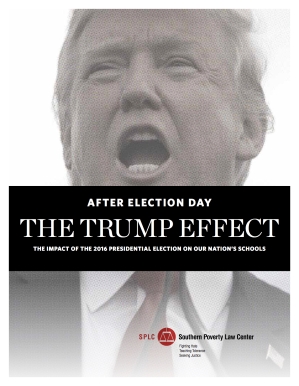
Trump Effect reportIn DC and around the country, children of immigrant and Muslim communities face a variety of threats as well as actual deportations, separation of families due to harassment at U.S. borders, and attacks on mosques and other sacred and community spaces.
LGBTQ community centers are seeing a rise in vandalism and violence. DC’s Casa Ruby, which serves transgender youth and adults, has suffered three incidents of violent harassment in the last two weeks. (NBC report)
Confederate flags, KKK- and lynching-related images are also appearing in disparate places, including a Maine high school.
The overall situation is sometimes called the “Trump Effect,” although there are not enough data from prior to the election to accurately chart a rise in school hate incidents.
However, just after the election, however, the Southern Poverty Law Centercollected 2500 school-based reports of hate incidents that educators attributed to election rhetoric. In addition, schools where teachers said they did not hear derogatory language or anti-immigrant sentiment were often those with students belonging exclusively to targeted populations, and they did report students feeling vulnerable and scared. Nine out of ten of the 10,000 educators responding to the survey said they were seeing “a negative impact on students’ mood and behavior following the election,” and reported worries about continuing impact.
Some schools and school systems are teaming up with neighbors – synagogues or mosques, for example – to conduct educational programs when hate incidents occur. Some have established programs to address trauma and bullying. Many are The “Trump Effect” at School? – Education Town Hall Forum:
DC Schools as Sanctuaries and Other Issues for Public Ed in Administration #45


Feature Report: The “Trump Effect” in Schools (4:20-7:50)
Max Ewart, a graduate of DCPS’ School Without Walls Senior High School, shares the latest on hate incidents and diversity issues at his old school. (7:50->)
Elizabeth Davis, president of the Washington Teacher’s Union, discusses school responses and responsibilities in the current national climate, the impact of ICE threats on DC public schools, and the latest on contract negotiations. (35:00->)
wtulogo
The Education Town Hall broadcasts from Historic Anacostia
in Washington, DC, on We Act Radio,
Thursdays at 11:00 a.m. Eastern
Listen live via TuneIn.
Shows are archived for convenient listening shortly after broadcast.
After years of weekly broadcasts, the program now focuses one show each month on local issues and one on “the BUS,” organized by BadAss TeachersUnited Opt Out, and SOS March.
DC Schools as Sanctuaries and Other Issues for Public Ed in Administration #45