Latest News and Comment from Education

Tuesday, November 1, 2016

Black Students Are Less Likely To Get Suspended When They Have Black Teachers | Huffington Post

Black Students Are Less Likely To Get Suspended When They Have Black Teachers | Huffington Post:

Black Students Are Less Likely To Get Suspended When They Have Black Teachers

So, hire more black teachers.


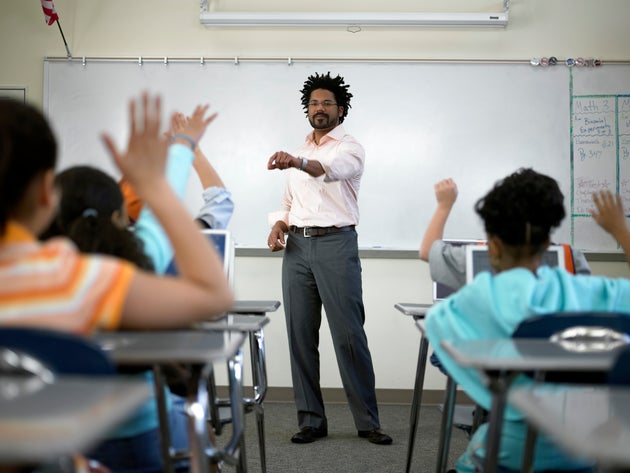
Black students are routinely punished more harshly in school than white counterparts. However, new research shows there may be a relatively simple fix for this disparity: more black teachers. 
For years, data from the U.S. Department of Education has shown that black students disproportionately face exclusionary punishments, like suspensions and expulsions. But new research published Tuesday in the quarterly journal Education Next finds that black students are less likely to receive detentions, suspensions or expulsions when they are taught by educators who are also black. 
Researchers from American University and University of California, Davis, looked at teacher demographic and student discipline data for North Carolina elementary school students from 2008 to 2013. The data included certain identifiers that allowed researchers to match a student’s discipline records with the race of their classroom teachers. The data allowed researchers to compare the discipline records of individual students as they progressed throughout elementary school. 
Previous studies used aggregate data. But the new study used precise information that allowed researchers to “really match students one-to-one with a teacher,” said co-author Constance Lindsay.
Overall, researchers found that students were less likely to face exclusionary discipline when taught by teachers who look like them. 
“This effect is driven almost entirely by black students, especially black boys, who are markedly less likely to be subjected to exclusionary discipline when taught by black teachers,” says the study. “There is little evidence of any benefit for white students of being matched with white teachers.”
Researchers found that 16 percent of black boys in the study were subjected to exclusionary discipline when they had white women as teachers. However, when black boys were taught by black women, this number dropped to 14 percent. This number fell further when black boys were taught by black men.
Black girls were also less likely to get sent to detention, suspended or expelled Black Students Are Less Likely To Get Suspended When They Have Black Teachers | Huffington Post:


Testing company faces fines in California for second year | EdSource

Testing company faces fines in California for second year | EdSource:

Testing company faces fines in California for second year


After it was fined $3.1 million last year for not fulfilling its contract, the company that administers the state’s standardized tests is again facing penalties for failing to meet all requirements of its contract with the state.
However, the fine is expected to be much smaller than last year.  The State Board of Education expects to vote Wednesday on whether to withhold nearly $272,000, or 3 percent, from more than $8.6 million still owed to the Educational Testing Service, or ETS. That proposed penalty is based on a recommendation from the California Department of Education and represents about 0.3 percent of the total contract.
A staff report prepared for this week’s state board meeting says ETS should be fined for “not satisfactorily providing accurate and complete reports of test results” to educational agencies and “not satisfactorily meeting all reporting requirements.”’
The state has a contract with ETS that included $86.4 million for the 2015-16 school year. Last spring, schools administered the Smarter Balanced tests in English and math to about 3.2 million students in grades 3-8 and 11.
Last year, the board withheld $3.1 million, or about 4 percent, of its $83 million contract with ETS for failure to meet contract requirements related to processing, scoring, analysis and reporting of test results for the 2014-15 school year.
Michael Kirst, president of the State Board of Education, said last week that he had not yet been briefed on the reasons for the recommended penalties. However, he praised ETS for its overall work on all state tests.
“Our assessments have proceeded with almost 4 million children with only minor glitches, so their overall performance has been, I think strong – especially compared to other states – where they’ve had major problems and the whole systems have blown up,” Kirst said. “So, I think we need to look at the overall picture.”
Jim Popham, a UCLA emeritus professor and a member of the National Assessment Governing Board, said the fine was minimal and not unusual.
“I think if anything it shows diligence on the part of the state Department of Testing company faces fines in California for second year | EdSource:

Cleveland schools "eliminate" 10 failing schools, but fewer than its plan called for | cleveland.com

Cleveland schools "eliminate" 10 failing schools, but fewer than its plan called for | cleveland.com:

Cleveland schools "eliminate" 10 failing schools, but fewer than its plan called for

Image result for big education ape closing schools


CLEVELAND, Ohio – Aggressively closing or replacing failing schools was a major goal of the Cleveland Plan, but one that has been scaled far back from what the Plan first called for.
The original version of the district-wide improvement plan in 2012 said that the district would  "target the lowest 10–15 percent of these (failing) schools for immediate and dramatic action" each year including closure, starting new schools in their place or turning operations over to a charter school.
That aggression was scaled back as the plan developed, and the eventual legislation for the Plan left out any closure requirements.
The major effort with "failing" schools named 23 of them - nearly ¼ of the district  – as "Investment Schools" and put them on an improvement plan, instead of targeting them for closure. We'll have a roundup of how that has gone later today.
But the district has taken stronger action with some schools.
To date, four years into the six-year Plan, the district says it has "eliminated 10 failing schools by closing or replacing them with new models" since 2012.
Of these schools, three were closed, three other high schools are well on the way to becoming campuses of small schools and four more career technical high schools are in early stages of an overhaul.
Wit the school district seeking a renewal on Nov. 8 of the 2012 tax increase that helps pay for its improvement plan, The Plain Dealer has been looking at how different parts have been carried out. Here's a look at what's happened with these "eliminated" schools:
Closed schools: The district has shut down the old Success Tech high school downtown after it struggled for several years. It is perhaps best known for when a student shot four people there in 2007 before killing himself. Its location on Lakeside Avenue is now home to the new High School for the Digital Arts.
The district also says it has closed the Paul Revere and Buckeye-Woodland elementary schools, though it never announced those as academic closings until the levy supporting the Cleveland Plan was up for renewal.
Those schools were announced as closing because of a facilities reorganization and the district's own website reported them as closing to meet a "promise to eliminate surplus space," with no mention of failure.
Michelle Pierre-Farid, the district's chief academic officer, said poor academic performance and poor conditions in the school buildings contributed to closing Cleveland schools "eliminate" 10 failing schools, but fewer than its plan called for | cleveland.com:

State Board of Education – Reject the application by Relay Graduate School of Education (By John Bestor) - Wait What?

State Board of Education – Reject the application by Relay Graduate School of Education (By John Bestor) - Wait What?:

State Board of Education – Reject the application by Relay Graduate School of Education (By John Bestor)

Image result for Reject  Relay Graduate School of Education
Image result for Reject the application by Relay Graduate School of Education


 To the Members of the Connecticut State Board of Education:

I am writing to share my concerns associated with impending CSBE approval of the Relay Graduate School of Education Alternate Route to Certification.
I would like to make you aware of some insightful commentary from Peter Greene, a New York teacher and education activist who writes the CURMUDGUCATION (“Trying to make sense of what’s happening in education”) blog. Last January, he wrote extensively about the founding and intentions of the Relay Graduate School of Education, concluding “In short, Relay is a teacher training school founded and operated by three people who have almost no teacher training, next to no classroom teaching experience, and who have spent their careers in the charter world…. It’s a remarkable achievement. If some buddies and I got together and declared that we would open our own hospitals and train our own doctors, even though none of us have any medical training or experience, we could expect to be laughed out of the medical field. If I showed up at a law school and said: ‘I am ready to be a legal professor, training the lawyers of tomorrow, though I have done nothing my whole life but teach high school English, I don’t think I’d be hired on the spot.'”
There is a body of evidence beyond Relay’s own aspirational website and marketing that tells a different story than the one you may have already or are likely to hear from SDE Chief Talent Officer Sarah Barzee, her SDE boss Education Commissioner Dianna Wentzell, and Achievement First’s  Co-CEO Dacia Toll. To be fair, I would ask you to conduct due diligence and read what Mercedes Schneider, a New Orleans teacher, education activist, and the author of three books on “education reform”, including her most recent: School Choice: The End of Public Education?, had to say about this “phony” graduate program which makes a “mockery” of graduate programs in education. Follow her deutsch29 blog (10/03/16) and read the many reasons why the Pennsylvania Department of Education refused to approve Relay’s request for state-sponsored recognition, especially as to the minimal qualifications necessary to become a Relay instructor. Dr. Schneider’s commitment to shedding light on these issues is highly informative, yet not likely to be found in mainstream media coverage or forwarded by SDE officials.
If you are so inclined, you may also want to read the recent Washington Post (10.24.16) article, entitled “The big problem with the Obama administration’s new teacher-education regulations”, in which the chair of Connecticut College’s Education Department co-wrote that the “academy provisions” which were incorporated into ESSA (after initially being State Board of Education – Reject the application by Relay Graduate School of Education (By John Bestor) - Wait What?:

What Would It Take to Turn Back the Wave of Behaviorism in American Education? | janresseger

What Would It Take to Turn Back the Wave of Behaviorism in American Education? | janresseger:

What Would It Take to Turn Back the Wave of Behaviorism in American Education?

Image result for end citizens united

Public education policy these days is trapped in behaviorist thinking about rewards and punishments.  We have zero-tolerance charter schools that award demerits to children for failing to exhibit good posture, track the speaker, and even wear the socks that are part of the school uniform. We close or privatize schools for failing quickly to raise overall test scores, and we downgrade teachers in their formal evaluations for failing to raise their students’ test scores fast enough. Now the U.S. Department of Education says states must rate colleges of education by tracking whether their graduates, once they get hired as teachers, can produce students whose test scores rise quickly.
David Kirp, a professor of public policy at the University of California at Berkeley and a fellow at the Learning Policy Institute, thinks our education policy’s reliance on behaviorist psychology is technocratic nonsense.  His article in Sunday’s NY Times explains why.
Kirp describes three research studies about interventions by teachers “to combat students’ negative feelings.  I’m dumb, some believe; I don’t belong here; the school views me only as a member of an unintelligent group.”
In one study, “sixth-grade students… (were) taught, in eight lessons that intelligence is malleable, not fixed, and that the brain is a muscle that grows stronger with effort.”  This kind of teaching “aims to change students’ mind-sets by showing them that their intelligence can grow through deliberate work.”
In a second study, when teachers wrote comments on the school work of African American male adolescents, no matter the other critiques on the students’ papers, the teacher explained: “she had high expectations and believed that, if the student worked hard, he could meet her exacting standards.”
In the third study, “sixth graders wrote about values that were meaningful to them, like What Would It Take to Turn Back the Wave of Behaviorism in American Education? | janresseger:
Image result for big education ape oligarchy

BRIDGEGATE: At trial’s closing, someone finally takes on the bully named Chris Christie |

BRIDGEGATE: At trial’s closing, someone finally takes on the bully named Chris Christie |:

BRIDGEGATE: At trial’s closing, someone finally takes on the bully named Chris Christie

Image result for big education ape Chris Christie


For two hours on Halloween, Michael Critchley, the relentless criminal defense lawyer, said about Chris Christie what should have been said long ago. What should have been said about the US Attorney’s office while Christie ran it. What should have been said about the conduct of state government under Christie.
Critchley, the lawyer for Bridget Anne Kelly,  called Christie a “bully” and a “liar” and a “coward.” Critchley became, for just that brief time, the kid on the playground who finally had enough of the bully and challenged him to a fight–he literally told Christie to “come at me.”
Critchley became, for those two hours, the stand-in for a flaccid press that should have exposed Christie years ago when he was using the media and his office as US Attorney  to eliminate potential political rivals–a press that settled for his approval and for the access to leaks that approval meant.
“He lied, he flat out lied,” Critchley said in court Monday, citing the words of a witness–and then, in the courtroom, the lawyer turned to the professional descendants of Christie who were prosecuting his client and said, words bristling with sarcasm, “The chief federal prosecutor wouldn’t lie, would he?”
Critchley became, but only for a time, the substitute for legislators who bent to Christie’s will by approving without reservation public officials–including top law enforcement figures and even judges–whose behavior raised serious questions. The spokesman for the silent lawyers who have been too afraid to say publicly what they have said privately about Christie both as governor and prosecutor, afraid because it hurt their clients.
“Cowards! Cowards! Cowards!” Critchley literally shouted during his closing argument for Kelly–and while he was then talking about Christie and former Attorney General and assistant US Attorney Kevin O’Dowd and others–he might as well have been screaming at all of those who contributed to making Christie what he was. He could have been talking about Essex County Executive Joe DiVincenzo and Sheriff Armando Fontoura and Union City Mayor Brian Stack–and BRIDGEGATE: At trial’s closing, someone finally takes on the bully named Chris Christie |:
Image result for big education ape Chris Christie
 Image result for big education ape Chris Christie

The content, predictive power, and potential bias in five widely used teacher observation instruments Education Research Report:

Education Research Report: The content, predictive power, and potential bias in five widely used teacher observation instruments:

The content, predictive power, and potential bias in five widely used teacher observation instruments

Image result for evaluation systems in teaching

Many states and districts are adopting commercially available teacher observation instruments for the professional practice component of their evaluation systems. This study was designed to inform decisions about the selection and use of five widely-used teacher observation instruments. The purpose was to explore (1) patterns across instruments in the dimensions of instruction that they measure, (2) relationships between teachers' scores in specific dimensions of instruction and their contributions to student achievement growth (value-added), and (3) whether teachers' observation ratings depend on the types of students they are assigned to teach.

Researchers analyzed the content of the
  • Classroom Assessment Scoring System (CLASS), 
  • Framework for Teaching (FFT),
  • Protocol for Language Arts Teaching Observations (PLATO), 
  • Mathematical Quality of Instruction (MQI), 
  • and UTeach Observational Protocol (UTOP). 
The content analysis then informed correlation analyses using data from the Gates Foundation's Measures of Effective Teaching (MET) project. Participants were 5,409 4th-9th grade math and English language arts (ELA) teachers from six school districts. Observation ratings were correlated with teachers' value-added scores and with three composition measures: proportions of nonwhite students, low-income students, and low achieving students in the classroom.

Results show that eight of ten dimensions of instruction are captured in all five instruments, but instruments differ in the number and types of elements they assess within each dimension. Observation ratings in all dimensions with quantitative data were significantly but modestly correlated with teachers' value-added scores—with classroom management showing the strongest and most consistent correlations. Finally, among teachers who were randomly assigned to groups of students, observation ratings for some instruments were associated with the proportion of nonwhite and lower achieving students in the classroom, more often in ELA classes than in math classes.

Findings reflect conceptual consistency across the five instruments, but also differences in the coverage and the specific practices they assess within a given dimension. They also suggest that observation scores for classroom management more strongly and consistently predict teacher contributions to student achievement growth than scores in other dimensions. Finally, the results indicate that the types of students assigned to a teacher can affect observation ratings, particularly in ELA classrooms.

When selecting among instruments, states and districts should consider which provide the best coverage of priority dimensions, how much weight to attach to various observation scores in their evaluation of teacher effectiveness, and how they might target resources toward particular classrooms to reduce the likelihood of bias in ratings.
 Image result for evaluation systems in teaching

Parents say kids are being mistreated at one of Dallas' biggest charter schools | Education | Dallas News

Parents say kids are being mistreated at one of Dallas' biggest charter schools | Education | Dallas News:

Parents say kids are being mistreated at one of Dallas' biggest charter schools

Image result for big education ape charter schools not healthy
Families at one of Dallas’ oldest and biggest charter schools say children have been mistreated, school leaders don’t listen, and the board is tainted by nepotism.
Parents at A.W. Brown-Fellowship Leadership Academy have launched largely symbolic online petitions calling for the board’s removal. They’ve posted videos and pictures on Facebook from heated board meetings where parents question the school’s direction.
“It’s horrible this year. Something’s changed,” parent LaTrondra King said. School leaders don’t seem to take parents’ concerns seriously, she said.
School leaders say they do listen to families and respond swiftly to allegations of abuse. The school is so popular that enrollment hit a record high this fall. As for family members serving together on the board? It’s perfectly legal, leaders say.
Much of the discontent among families was sparked by the recent departure of the school's founders, the Rev. Armond W. Brown and his ex-wife, Paula Brown.
The A.W. Brown charter school opened in Dallas' Red Bird area in 1999 with fewer than 200 students. Enrollment has grown to 2,400 students in pre-kindergarten through eighth grade across two campuses, as more families choose it over Dallas ISD and other school districts.
"A.W. Brown has a beautiful and rich legacy in our community," Superintendent Laura Mimms said. It's the largest charter school in Texas founded by African-Americans, she said, where students build character and leadership skills.
But some parents and guardians worry the school’s proud heritage is being tarnished. This spring the board fired Paula Brown as deputy superintendent. The board voted to hire a new superintendent to replace Armond Brown. The school let a dozen teachers and other employees go.
LaChanda Dupard, a former Brown parent whose niece and nephew go there now, helped start an online petition to remove the school board. Several families said they filed complaints with the Texas Education Agency, which oversees charter schools.
“The integrity of our school is lost because the children don’t have that nurturing spirit there. It’s gone,” Dupard said.
The seven-member board includes lawyers and judges.
School board president Lorenzo Brown — no relation to Armond or Paula Brown — said the staffing changes were necessary because the school had declined academically. It met state standards the past two years, but without any distinctions.
Paula Brown said the school had top-notch teachers whom she wanted to pay more. Asked why the board fired her, she said, “We had different opinions about how to move forward and best serve the children.”
Meanwhile, two parents have alleged that teachers physically harmed their children this fall.
LaTrondra King said in September, a teacher purposely hit her 7-year-old son in the face with a ball. Two other teachers made him hold a stack of dictionaries for 15 to 20 minutes because he’d been playing with the Velcro on his shoe, King said.
Mimms said for the first allegation, the school alerted Child Protective Services, which investigated and found there was insufficient evidence to classify the case as abuse. As for the book incident, Mimms said it’s not an approved practice, and the school took “appropriate employee disciplinary action.”
Parent April Wren said a teacher slammed her 12-year-old son’s head against a classroom door in early October, leaving him with a bruised and swollen jaw. She said the school didn’t alert her or the police immediately. Now, Wren said, the school is trying to expel her son for aggravated assault.
“I was so shocked,” she said. “You’re going to flip it on my child? C’mon.”
The teacher in that case is on paid administrative leave, Mimms said. Police declined to file charges, and Child Protective Services is still investigating.
Mimms said she could not discuss specific personnel matters. Any allegations of injury to a child get referred to the proper authorities for investigation, she said. The school also disciplines employees when appropriate.
Parents also complain of nepotism — namely, that board president Lorenzo Brown and his son serve together. But that’s legal for charter schools in Texas. After all, A.W. Brown school was started by a husband and wife. At one point, both Armond and Paula Brown served on the board and worked as employees, records show. Other family members also worked for the school.
Lorenzo Brown said neither he nor his son gets a penny from the school.
If the school were part of a traditional district, parents could elect their board members. But as a public charter school, A.W. Brown’s board appoints its members.
So some parents say they’re voting with their feet. LaTrondra King said her son is on the waiting list at another charter school. “I just want the best for him,” she said.
Mimms said she hopes people can stay focused on the school’s mission of providing a great education.
“It is my hope and desire that we can heal from the hurt of this transition,” she said.Parents say kids are being mistreated at one of Dallas' biggest charter schools | Education | Dallas News:

Dark Apps: Sites parents need to know about - Cleveland 19 News Cleveland, OH

Dark Apps: Sites parents need to know about - Cleveland 19 News Cleveland, OH:

Dark Apps: Sites parents need to know about


CLEVELAND, OH (WOIO) -

Parents need to be aware that truly dangerous apps exist and, believe it or not, are readily available to children.
Dr. Kathleen Stansberry is an Assistant Professor with Cleveland State University who is an expert in the field of social media, apps and the internet.
"Parental involvement with media activity is something that should be well ingrained their entire life. Limits should be set early," Dr. Stansberry advised.
But before you listen to her as an expert she's also a parent.
"My son, my 7-year-old in particular, we spend a fair amount of time online but we do it together," she said.
We went to Dr. Stansberry to ask what new technologies are out there that parents need to look for on their kid's phone, tablets and computers. Our first topic, apps that are actually hidden vaults. We found one called Calculator Plus, but it is absolutely not a calculator. It's a false front that once you open the app, you need a password, from there you have access to files in which to hide pics and videos.
"That would be a huge red flag that there's something going on that my child doesn't want me to be aware of, or doesn't want anyone to be aware of. And it's natural to want privacy but to actively go through the process of hiding something, that's not going to work," explained Dr. Stansberry.

Image result for Dark Apps
The next type of app and website of concern is the continued popularity of anonymous chat sites, which also have app versions. What started with Chat Roulette has exploded into sites like Omegle. When you search Omegle on Google you might be surprised what its tagline is, "Talk to Strangers!".
"I feel like, didn't we tell our kids our entire lives not to talk to strangers?" questioned Dr. Stansberry as she shows us around the site.
The concerning part about an app like Omegle is there is no sign up, no email address to register to, no phone number meaning no real way to track back who's posting what. You click and instantly start texting a complete stranger.
For a demonstration with the professor we used the internet version of Omegle and in a split second we were connected to a stranger who said she was a 21-year-old woman. In seconds she was telling us to look her up on another anonymous app kik. There, we find a pic of her, or who she says she is and she tells us she's glad we texted and she's bored.
"So this seems innocent enough," we said to the professor.
"Probably not," Dr. Stansberry replied.
The next question, “I'm assuming this is going to go a different direction?"
"I imagine," stated the professor.
And then again in a matter of second she directs us to a third app, to see another pic. When we click on that, we get a pic of a half-naked woman in a t-shirt. And this is clearly heading down a different path.
So we asked Dr. Stansberry, "That conversation that happened so quickly what does that say that you?"
"It shows out how easy it is to first, go from site to site. So it's not enough to talk about one dangerous site, or dangers apps. It's not one location. It's that your phone and your computer and the web in general facilitates a lot of interactions. A lot of them are good. A lot of them are not," warned Dr. Stansberry.
In defense of Omegle on its homepage at the very bottom in small print is this warning: Parental control protections (such as computer hardware, software, or filtering services) are commercially available that may assist you in limiting access to material that is harmful to minors. And then they provide a link to some of the products available.
Bottom line according to Dr. Stansberry parents need to have a working relationship with their kids and the types of media their using before you just hand them a phone for the first time.

"It's a conduit into a massive amount of people. So just as you wouldn't, I don't know, send your kid into a crowded auditorium full of people and say 'ohh go make some friends' and not monitor them, you can't do that with a phone either," she explained.
According to Dr. Stansberry there are two devices and apps parents can use for protection. First parental controls:

"Parental control tend to be more related to maybe making things not available or you can, there are apps, so you can have the phone shut off or you can only use apps for a certain amount of time," the professor said.
And there are things called nanny controls:
"If a child downloads a new app, maybe you can get a ping on your phone or an alert. So you are actually connecting your phone or your technology with your child's."
The apps and the kids are getting smarter, and parents have to try and keep up.
Download the Cleveland 19 News app
Copyright 2016 WOIO. All rights reserved.


 Dark Apps: Sites parents need to know about - Cleveland 19 News Cleveland, OH:

Few answers from Failing charter school - The San Diego Union-Tribune

Few answers from troubled charter school - The San Diego Union-Tribune:

Few answers from troubled charter school

Missing test scores, financial strain and a lack of resources are contributing to difficulties at Beacon Classical Academy, where state assessment results show very few of the students to be proficient in English and math.
Alma Van Nice, the charter school’s executive director, presented an academic achievement report at the Oct. 26 National School District board meeting that has district officials deeply concerned.
She was asked to return to the school board next week with additional information requested by district administrators and trustees.
State standardized test scores released in August show Beacon’s students are way behind their counterparts at the district, county and state level. Only 17 percent meet or exceed standard in English language arts, and 6 percent meet or exceed standard in math.
“This is very dire. This is very disheartening,” Van Nice said. “When I presented this data to staff, their eyes welled up with tears.”
The National School District’s overall scores from the new state exam, commonly called the Smarter Balanced test, show 41 percent of its students meet or exceed standard in English and 30 percent meet or exceed standard in math.
The testing is intended to show how well students understand Common Core state standards. Those who meet or exceed the state standard are considered to be proficient.
Beacon’s state test results conflict with scores from quarterly benchmark assessments the school conducted this year that Van Nice said shows students making gains.
How student improvement is being measured, however, is in question. Van Nice told trustees she didn’t have access to last year’s Smarter Balanced scores, so they were not used as a guide to academic needs.
That was a surprise to district officials. They told Van Nice how to find the publicly available results on the California Department of Education’s website and pointed out that Beacon’s scores in English and math fell from last year.
Overall, school districts across the state saw about a 5 percent gain over last year’s test scores.
The K-8 charter school serves 188 students, most of whom are economically disadvantaged. Ninety percent of the children qualify for free or reduced-cost breakfast and lunch. Forty-four percent are English language learners.
Superintendent Leighangela Brady said the information Van Nice presented last week left the district with more questions than answers. 
“It was very unclear that there is a plan, that there is a good understanding of the deficit in the test scores,” Brady said.
To get the charter school on track, Brady said the district is currently auditing its academic program.
“We feel the test scores are alarming,” Brady said. “We’re going to get some answers at the November board meeting and make some decisions. We don’t want to wait for another round of testing to get this rectified.”
The district will also be investigating the charter school’s finances and governance structure. 
Beacon’s charter petition calls for a five- to seven-member governing board. It has been operating this year with three board members, and often doing business with two members present.
Van Nice said a variety of factors have put a strain on the charter school this year, including a decrease in enrollment that caused a loss of state revenue and the financial cost of fighting a lawsuit.
Beacon opened its campus on Euclid Avenue two years ago under the authorization of the Julian Union School District. National, however, said the arrangement violated California Education Code and filed a lawsuit against Julian.
The case was settled last year with oversight of Beacon being transferred to National’s jurisdiction. The school district is now responsible for supervising the charter school’s operations and providing support.
“It was a very unstable year, and we lost a lot of students,” Van Nice said.
Finances were so bad, Van Nice took out a $200,000 personal loan to keep the charter school afloat. She said most of that money was spent fixing up the building the school leases from South Bay Community Church.
Charter schools are publicly funded and independently operated. Beacon’s most recent financial report shows it operating in the black. 
Van Nice said she is working to improve testing conditions at Beacon, which used its Chromebook laptop computers to take the state assessment. It only has 25 of them up and running, however. Another 25 have yet to be configured, Van Nice said, because it’s a “time consuming process.”
Brady said the district is committed to working collaboratively with Van Nice to get all the right curriculum, resources and processes in place for the charter school to succeed. But things need to get turned around fairly quickly.
“She’s passionate and her heart’s in the right place,” Brady said of Van Nice. “But in the end, we need to do right by kids.”Few answers from troubled charter school - The San Diego Union-Tribune:


Another Broadie Bites It: Turnover rises for urban superintendents

Turnover rises for urban superintendents:

Turnover rises for urban superintendents


NEW HAVEN >> As the architect of school reform in New Haven, Superintendent Garth Harries appeared to be making progress. Test scores were up, dropout rates were down, and a new teacher evaluation system became a national model.
But after only slightly more than three years, and clashes with members of the city’s Board of Education, Harries is stepping down Monday.
He lasted about as long as the average for superintendents in urban American school districts, a turnover rate that has been on the rise. While the churn reflects growing strains on leaders in the largest and neediest school systems, it also adds to the challenges by disrupting improvement plans that are measured over years, not months.
Harries, 44, had the support of the mayor and the teachers union, but the Yale University alumnus with experience at the consulting firm McKinsey & Co. and New York City schools said differences with the board drove him to leave New Haven.
“This is difficult, hard work, just in the educational sense,” Harries said. “Obviously the public and political nature of it creates a whole other set of pressures and challenges. I’m looking forward to decompressing.”
The job has grown more challenging as urban superintendents, once tasked primarily with keeping schools free of violence, focus more on preparing all students for the modern economy. That has meant addressing the effects of concentrated poverty on students’ ability to learn while overseeing budgets of hundreds of millions of dollars and, in the form of busing, some cities’ largest transportation system.
“It’s a major, crushing responsibility for many people, and they increasingly run afoul of politics,” said James Harvey, director of the National Superintendents Roundtable, a professional development organization.
A 2014 survey by the Council of the Great City Schools found the average superintendent in cities with populations over 250,000 lasts 3.2 years, down from 3.6 years in 2010. The turnover rate was 2.8 years in 2003. Superintendents last about roughly twice as long in rural and suburban districts.
In Connecticut alone, Harries outlasted superintendents in the two other biggest cities — Hartford and Bridgeport, where his counterparts also announced unexpected departures this fall.
The resignation letter from Bridgeport’s Fran Rabinowitz cited one school board member’s “negative crusade” to undermine her work. In Hartford, which has had a dozen superintendents in the past 25 years, Beth Schiavino-Narvaez is leaving for a job with the Defense Department.
Baltimore’s superintendent, Gregory Thornton, was ousted this spring after two years. He was wrestling with a $100 million shortfall in the $1.2 billion budget and a need to close buildings because of declining enrollment.
He said that it’s important to have a good match with overseers, and that he knew a year in he was not a good fit, but that another key to successful change is patience.
“You can’t just drop the seeds in the ground and hope the crops come up tomorrow,” he said.
Now in his 15th year overseeing Long Beach, California, schools, Christopher Steinhauser is a rare urban superintendent with staying power, a feat he credits to harmony with his board. He said the time has allowed him to experiment with programs on a pilot basis.
“I have been blessed over my 14 years. I have a board that, even though they’re elected geographically, they always focus on the good on the system,” he said.
In New Haven, Harries was promoted from assistant superintendent around the time the school board, whose members had all been appointed by the mayor, changed to include some elected members. Mayor Toni Harp said that introduced people who did not agree with some of the system’s goals and made it difficult for Harries to do his job.
Harries said he helped more students succeed by emphasizing engagement of staff, focusing on developmental needs, and attending to students and communities that most need support. While most of his ideas had broad support, some questioned his approach.
One school board member, Alicia Caraballo, who worked in the district for 26 years, said there were problems with communication and criticized a proposal, abandoned after two years of controversy, to divide up the student body of Hillhouse High School, the city’s oldest.
David Cicarella, president of the New Haven Federation of Teachers, said Harries was a strong partner but was seen by some as an outsider despite attending college in New Haven.
“One issue was he was an Ivy Leaguer. He was a Yalie, and there always has been town-gown tension,” Cicarella said. “Those are all things that were at his doorstep. That was incredibly unfair.”
Harries earned an annual salary of $200,797, close to the average of $242,000 for urban superintendents in the 2014 survey.
Urban superintendents do not do the job for the money, said Henry Duvall, a spokesman for the Council of the Great City Schools. And the ones that have time to get traction, he said, are the ones who can see their ideas to completion.
“The longer a superintendent stays,” he said, “the greater the chances for reforms to work.”Turnover rises for urban superintendents:


Monday, October 31, 2016

Dear Next President, I am reporting a crime against children - Children are more than test scores:

Children are more than test scores: Dear Next President, I am reporting a crime against children:

Dear Next President, I am reporting a crime against children


Dear Next President:
It appears the main stream media failed to raise one single significant question about our nation's public school system during the debates. It is my intention to update you on the status of our public school system from an educator's perspective.
 
Our Nation's greatest achievement ~ Over one hundred and fifty years of Public Education! Our Nation's greatest shame, 150 years of quality Public Education determined by zip code policies... Historically, our Public School System has, since the first day doors opened, given more money to our wealthy schools than to our poor schools. America's Black children have not only face inequity, but segregation and racism as well.
·      In 1896 Plessy vs Ferguson documents that Black children have been asked to do more with even less.
·      In 1954 Brown vs The Board of Education offered America an opportunity to redeem itself on race; six decades later that redemption is still as far away as it was before our Nation's Highest Court ordered an end to segregation.  
·      The 2015 Education Week Quality Counts Report, indicates that 49 of our 50 states spend more money on their wealthy schools than their poor schools.  The schools where children living below the poverty line attend, have always been asked to do more with less.  


Dear Next President, racism has deep roots in our American Public School System, since that very first day when doors opened.  Immigrant children have done no better than Black children in our Children are more than test scores: Dear Next President, I am reporting a crime against children: